Available online: http://edupediapublications.org/journals/index.php/IJR/ P a g e | 1066
A Study on Consumer Satisfaction towards Lux
Boya Chandrasekhar1, Gangavaram amaresh2, Ramesh Naik3
1,2P.G. Scholar, 3Lecturer
Email : 1[email protected], 2[email protected]
Abstract
In FMCG industry sector there has been severe competition among the Multi-National Companies, national and local players. Brand loyalty is determined by several distinct psychological processes of the consumers and entails multivariate measurements. Product features is one of the most important factors that affect brand loyalty. The relationship between the availability of the toilet soap and the extent of brand loyalty was also found to be significant. The toilet soaps can be divided into four price segments: Premium, popular, economy and carbolic soaps. At the same time, penetration level of toilet soaps in urban areas is very high, but per-capita consumption levels remain low. In this scenario, it is very important for marketers to know the consumer behaviour with respect to toilet soaps, which will be very useful in adopting suitable strategies. This research paper attempts to analyze the brand loyalty, satisfaction, awareness regarding lux soap in Hyderabad.
Key words: LUX, Consumer satisfaction, Products.
Introduction
"Consumer satisfaction provides a leading indicator of consumer purchase intentions and loyalty." "Consumer satisfaction data are among the most frequently collected indicators of market perceptions. Organizations need to retain
existing Consumers while targeting non-Consumers.
Consumer satisfaction is a term
frequently used in marketing. It is a measure of how products and services supplied by a company meet or surpass Consumer expectation.
Consumer satisfaction is defined as "the number of Consumers, or percentage of
total Consumers, whose reported
experience with a firm, its products, or its services exceeds specified satisfaction goals." Expectations are a key factor behind satisfaction. When Consumers have high expectations and the reality falls short, they will be disappointed and will likely rate their experience as less than satisfying. The importance of Consumer satisfaction diminishes when a firm has increased bargaining power.
Measuring Consumer satisfaction provides an indication of how successful the organization is at providing products
and/or services to the
Available online: http://edupediapublications.org/journals/index.php/IJR/ P a g e | 1067
Hedonic benefits are associated with the sensory and experiential attributes of the product. Utilitarian benefits of a product are associated with the more instrumental and functional attributes of the product. Consumer satisfaction is an ambiguous and abstract concept and the actual manifestation of the state of satisfaction will vary from person to
person and product/service to
product/service. The state of satisfaction
depends on a number of both
psychological and physical variables which correlate with satisfaction behaviors such as return and recommend rate.
The level of satisfaction can also vary depending on other options the Consumer may have and other products against which the Consumer can compare the organization's products. The usual measures of Consumer satisfaction involve a survey. The Consumer is asked to evaluate each statement in terms of their
perceptions and expectations of
performance of the organization being measured.
Objectives
To identify the consumers
satisfaction level of the consumers. To know about the problems they
have to face when they are making marketing strategies.
To analyze the knowledge of the Consumers about the product To identify the buyers opinion.
Scope of the study
There is a wider scope for consumer research. Because, the consumers, taste, likes, preferences etc., change often
because of financial, psychological,
sociological and some other factors. Academic community as well as business firms has undertaken a lot of researches in the field of consumer behavior, in different ways. The consumer differs in many
respects. They form different segments in market. All the firms are interested in studying each segment separately. As for as the bath soaps are concerned, the consumers may change their brand loyalty frequently because various new brands are coming every day. So, there are a lot of opportunities to probe into various aspects of consumer preference. The present study would help the dealer to know the satisfaction of the respondents towards Dove soap and various soap brands. This would help the company to determine the promotional measures based on the findings. The company can adopt the promotional measures in and around Mayiladuthurai town as this study was conducted there
Review of literature
According to Herrmann et al. (1992), price perceptions directly influence satisfaction judgments: “The research demonstrated the influence of perceived price fairness on satisfaction judgments empirically.” According to Xia et al. (2004), price fairness refers to consumers’ assessments of whether a seller’s price is reasonable, acceptable or justifiable. In a
separate study on factors affecting
Consumer satisfaction, the authors found that “charging a fair price helps to develop
Consumer satisfaction and loyalty.” Herrmann et al. (2007) told that Consumer
satisfaction is directly influenced by price perceptions, albeit indirectly, through the perception of price fairness. The price fairness itself and the way it is fixed and offered have a great impact on satisfaction. Eugene Anderson reported in the study: “The findings imply that increasing Consumer satisfaction is likely to decrease price elasticity of demand. In particular, the findings imply a 1 percent increase in
Consumer satisfaction should be
Available online: http://edupediapublications.org/journals/index.php/IJR/ P a g e | 1068
In 1995, a Harvard Business
Review article by Thomas Jones and Earl Sasser Jr. came up with the “satisfied Consumers defect.” This theory debunked the clout of Consumer satisfaction. R.L.
Oliver’s Expectations Confirmation
Theory held that Consumer satisfaction could be defined by measuring the gap between the Consumer’s expectations and his or her perception of whether those expectations had been met. Thomas Jones and Earl Sasser Jr. showed that Consumer satisfaction couldn’t be used solely to track Consumer loyalty, and in fact – you should be looking at a range of Consumer satisfaction metrics to gauge a better understanding of your Consumers and their loyalty. Hoyer and MacInnis (2001) said that satisfaction can be associated with feelings of acceptance, happiness, relief, excitement, and delight. There are many factors that affect Consumer satisfaction.
RESEARCH METHODOLOGY
Both primary data and secondary data were collected for doing research. The methods of data collection used were.
PRIMARY DATA
The information collected under “primary data” is mainly based on personal discussions with the Consumers of coup area. A structured questionnaire is used to collect the primary data.
SECONDARY DATA
The secondary data was
obtained through the dealers, sales record, and internet also from various books and journals.
TOOL FOR ANALYZING DATA
The statistical tool used is
percentage analysis. The percentage method is used for comparing certain features. The collected data respondents on the fore of tables and charts in order to give effective visualization of comparison made
DATA ANALYSIS AND
INTERPRETATIONS TABLE 1
GENDER OF RESPONDENTS
INTERPRETATION:
From the about table it is inferred that 82.0% of the respondents are male, 18.0% of the respondents are female
Majority (82.0%) of the respondents are female.
TABLE 2
Available online: http://edupediapublications.org/journals/index.php/IJR/ P a g e | 1069
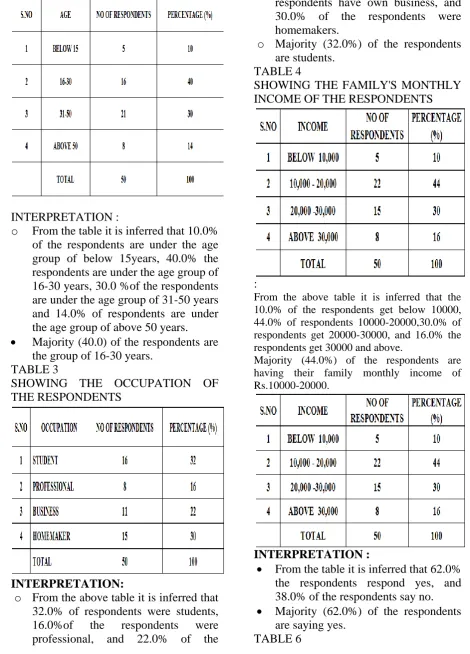
INTERPRETATION :
o From the table it is inferred that 10.0% of the respondents are under the age group of below 15years, 40.0% the respondents are under the age group of 16-30 years, 30.0 %of the respondents are under the age group of 31-50 years and 14.0% of respondents are under the age group of above 50 years.
Majority (40.0) of the respondents are the group of 16-30 years.
TABLE 3
SHOWING THE OCCUPATION OF THE RESPONDENTS
INTERPRETATION:
o From the above table it is inferred that 32.0% of respondents were students,
16.0%of the respondents were
professional, and 22.0% of the
respondents have own business, and 30.0% of the respondents were homemakers.
o Majority (32.0%) of the respondents are students.
TABLE 4
SHOWING THE FAMILY'S MONTHLY INCOME OF THE RESPONDENTS
:
From the above table it is inferred that the 10.0% of the respondents get below 10000, 44.0% of respondents 10000-20000,30.0% of respondents get 20000-30000, and 16.0% the respondents get 30000 and above.
Majority (44.0%) of the respondents are having their family monthly income of Rs.10000-20000.
INTERPRETATION :
From the table it is inferred that 62.0% the respondents respond yes, and 38.0% of the respondents say no.
Majority (62.0%) of the respondents are saying yes.
Available online: http://edupediapublications.org/journals/index.php/IJR/ P a g e | 1070
SHOWING THE FREQUENCY OF PURCHASE
INTERPRETATION:
o From the above table it is inferred that 22.0% of the respondents buy weekly, 48.0% of the respondents buy
monthly, 20.0% of the respondents buy bimonthly and 10.0% of the respondents buy quarterly.
Majority (48.0%) of the respondents are buying monthly.
Findings:
Majority (82.0%) of the respondents are female.
Majority (40.0) of the respondents are the group of 16-30 years.
Majority (32.0%) of the respondents are students.
Majority (44.0%) of the respondents are
having their family monthly income of
o Rs.10000-20000.
Majority (62.0%) of the respondents are saying yes.
Majority (48.0%) of the respondents are buying monthly.
Suggestions:
Lux is a generic brand widely used by all segment of society, so company should consider all segment of society while launching its different types of product. Consumer's behaviour always looks for some extra benefit with purchasing.
They demand for affordable price for product and good schemes with purchasing.
Company targets only youth between 15 to 35 years who are conscious of beauty and skin but in current scenario
all people are more conscious
regarding their skin and beauty, so company should also consider them while manufacturing the product. The company has to give some discounts or offers at the time of special occasions i.e.. Festivals.
Conclusion:
From this study its finding revealed that majority of the respondents belongs to teenage group. They expect the company to provide the product at a lower price. The company can increase its sales by reducing its price and increasing its advertisements. The company has to give some discounts or offers at the time of special occasions i.e... Festivals. Majority of the respondents suggest to provide free gifts like earrings, toys, necklaces, ect,…
QUESTIONNAIRES
A STUDY ON CONSUMER’S
SATISFACTION TOWARDS LUX
SOAP.
1) Occupation?
a) Student
b) Professional
c) Business
d) Homemaker
2) Family’s monthly income?
a) Below 10,000
b) 10,000-20,000
c) 20,000-30,000
d) Above 30,000
3) Do you use Lux soap?
a) Yes
b) No
4) What is the frequency of purchase of the Lux soap?
a) Weekly
Available online: http://edupediapublications.org/journals/index.php/IJR/ P a g e | 1071
c) Bimonthly(monthly twice)
5) How much Lux soap do you personally require every month? (If more than 3 mention in numbers)
a) 1
b) 2
c) 3
d) Others………..
6) What influences when you purchase the Lux soap?
a) Price
b) Celebrity advertisements c) Quality & Quantity
d) Package
7) You like the Lux soap because of
a) Perfume
b) Color
c) Hygienic
d) Protect skin
References
1. Edward F. Flipper, Marketing
Managements, S. Chand & Co., New Delhi, 1990.
2. Ghosh PK. Marketing
Management, Vikas Publications, kolkata, 1998.
3. Gupta SP. Business Statistics, Sulthan Chand & Sons, New Delhi, 2006.
4. Kothari CR. Research ethodology,
Allied Publishers Kolkatha, 1999.
5. Memoriya CB. Marketing
Management, & Practice of Marketing in India, Kital Mahal, Alahabad, 1998.
6. Rajan Nair N. Marketing
Management, S. Chand & Co., New Delhi, 2001.
7. RSN Pillai, Bagavathi. Modern
Marketing Principles and
Practices, S. Chand & Co., New Delhi, 2011.
BIBLIOGRAPHY
PHILIP KILTER KELLER
“Marketing Management”,
14th edition, sultan & sons 2001, New Delhi.
KOTHARI C. R Research Methodology