Related-Key Rectangle Attack of the Full 80-Round
HAS-160 Encryption Mode
Ewan Fleischmann, Michael Gorski, and Stefan Lucks
Bauhaus-University Weimar, Germany
{Ewan.Fleischmann, Michael.Gorski, Stefan.Lucks}@uni-weimar.de
Abstract. In this paper we investigate the security of the encryption mode of the HAS-160 hash function. HAS-160 is a Korean hash standard which is widely used in Korea’s industry. The structure of HAS-160 is similar to SHA-1 but includes some improvements. The encryption mode of HAS-160 is defined similarly as the encryption mode of SHA-1 that is called SHACAL-1. In 2006, Dunkelman et. al. [10] successfully broke the full 80-round SHACAL-1. In this paper, we present the first cryptographic attack that breaks the encryption mode of the full 80-round HAS-160. SHACAL-1 and the encryption mode of HAS-160 are both blockciphers with key size 512 bits and plain-/ciphertext size of 160 bits. We will apply a key recovery attack that needs about 2155
chosen plaintexts and 2375.98
80-round HAS-160 encryptions. The attack does not aim for a collision, preimage or 2nd-preimage attack, but it shows that HAS-160 used as a block cipher can be differentiated from an ideal cipher faster than exhaustive search.
Keywords:differential cryptanalysis, related-key rectangle attack, HAS-160.
1
Introduction
HAS-160 is a hash function that is widely used by the Korean industry. It is a hash function standardized by the Korean government (TTAS.KO-12.0011/R1) [1]. Based on the Merkle-Damg˚ard structure [17, 9], it uses a compression function with input size 512 bits and a
chaining and output value of 160 bits. HAS-160 consists of a round function which will be applied 80 times for each input message block. The overall design of the compression function is similar to the design of SHA-1 [18] and the MD family [19, 20], except some modifications in the rotation constants and in the key schedule.
Up to now there are only a few cryptographic results on HAS-160. Yun et al. [25] found a collision on 45-round HAS-160 with complexity 212 by using the techniques introduced by
Wang et al. [24]. Cho et al. [7] extended the previous result to break 53-round HAS-160 in time 255. At ICISC 2007 Mendel and Rijmen [15] improved the attack complexity of the
attack in [7] to 235 hash computations and they were able to present a colliding message
pair for the 53-round version of HAS-160. They also show how the attack can be extended to 59-round HAS-160 with a complexity of 255.
HAS-160 in encryption mode is resistant to many attacks that can be applied on SHACAL-1, since it offers different rotation constants in each round and its key schedule does not offer any sliding properties. Nevertheless it has a high degree of linearity which makes it vulnerable to related-key attacks.
some key bits faster than exhaustive search. Our attack uses about 2155 chosen plaintexts
and runs in time of about 2375.98 80-round HAS-160 encryptions, while an exhaustive key
search would require about 2512 80-round HAS-160 encryptions.
The paper is organized as follows: In Section 2 we give a brief description of the HAS-160 encryption mode. Section 3 discusses some crucial properties of HAS-160. In Section 4 we describe the related-key rectangle attack. Section 5 presents our related-key rectangle attack on the full HAS-160 encryption mode. Section 6 concludes the paper.
2
Description of the HAS-160 Encryption Mode
The following notations are used in this paper:
⊕ : bitwise XOR operation
∧ : bitwise AND operation
∨ : bitwise OR operation
X≪k : bit-rotation ofX by k positions to the left.
⊞ : addition modulo 232 operation
¬ : bitwise complement operation
ei : a 32-bit word with zeros in all positions except for bit i, (0≤i≤31)
ei1,...,il : ei1 ⊕ · · · ⊕eil
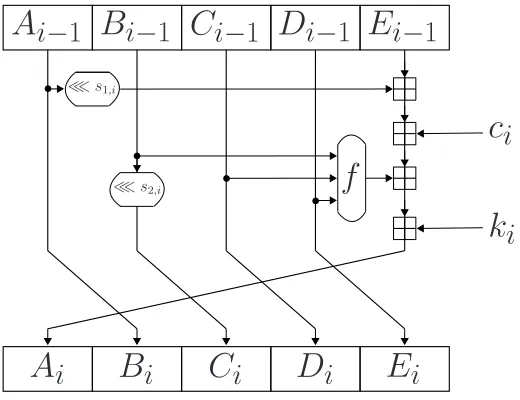
The inner block cipher operates on a 160-bit message block and a 512-bit master key. A 160-bit plaintextP0 =A0||B0||C0||D0||E0 is divided into five 32-bit wordsA0, B0, C0, D0, E0.
HAS-160 consists of 4 passes of 20 rounds each, where the round function is applied 80 times in total. The corresponding ciphertext P80 is denoted by A80||B80||C80||D80||E80. The bit
positions of a 32-bit word are labeled as 31,30, . . . ,1,0, where bit 31 is the most significant bit and bit 0 is the least significant bit. The round function at round i (i = 1, . . . ,80) can be described as follows:
Ai ←A
≪s1,i
i−1 ⊞fi(Bi−1, Ci−1, Di−1)⊞Ei−1⊞ki+ci,
Bi ←Ai−1,
Ci←B
≪s2,i
i−1 ,
Di ←Ci−1,
Ei ←Di−1,
whereci andki represents thei-th round constant and thei-th round key respectively, while
fi(·) represents a boolean function. The function fi(·) and the constant ci of round i are as
in Table 1.
The rotation constant s1,i used in round i are given as in Table 2.
The rotation constants2,idepends on the pass, i.e., it changes the value if the pass is changed
but it is constant in each pass. The pass dependent values of s2,i are: • Pass 1: s2,i = 10
Table 1.Boolean functions and constants
Pass Round (i) Boolean function (fi) Constant (ci)
1 1 – 20 (x∧y)∨(¬x∧z) 0 2 21 – 40 x⊕y⊕z 0x5a827999 3 41 – 60 (x∨ ¬z)⊕y 0x6ed9eba1 4 61 – 80 x⊕y⊕z 0x8f1bbcdc
Table 2.The bit rotations1
Round (imod 20) + 1 1 2 3 4 5 6 7 8 9 10 11 12 13 14 15 16 17 18 19 20
s1,i 13 5 11 7 15 6 13 8 14 7 12 9 11 8 15 6 12 9 14 5
• Pass 3: s2,i = 25 • Pass 4: s2,i = 30
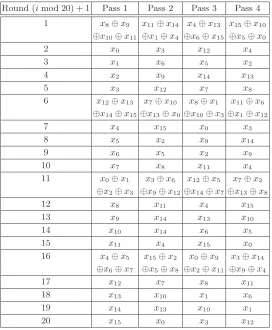
The 80 round keys ki, i∈ {1,2, . . . ,80} are derived from the master key K, which consists
of sixteen 32-bit words K = x0, x1, . . . , x15. The round keys ki are obtained from the key
schedule in Table 3.
Figure 1 shows the round function of HAS-160.
A
i
−
1
B
i
−
1
C
i
−
1
D
i
−
1
E
i
−
1
A
i
B
i
C
i
D
i
E
i
≪s1,i
≪s2,i
f
c
i
k
i
Fig. 1.The round function of HAS-160
3
Properties in HAS-160
Table 3.The key schedule
Round (imod 20) + 1 Pass 1 Pass 2 Pass 3 Pass 4 1 x8⊕x9 x11⊕x14 x4⊕x13 x15⊕x10
⊕x10⊕x11 ⊕x1⊕x4 ⊕x6⊕x15 ⊕x5⊕x0
2 x0 x3 x12 x4
3 x1 x6 x5 x2
4 x2 x9 x14 x13
5 x3 x12 x7 x8
6 x12⊕x13 x7⊕x10 x8⊕x1 x11⊕x6
⊕x14⊕x15⊕x13⊕x0⊕x10⊕x3⊕x1⊕x12
7 x4 x15 x0 x3
8 x5 x2 x9 x14
9 x6 x5 x2 x9
10 x7 x8 x11 x4
11 x0⊕x1 x3⊕x6 x12⊕x5 x7⊕x2
⊕x2⊕x3 ⊕x9⊕x12⊕x14⊕x7⊕x13⊕x8
12 x8 x11 x4 x15
13 x9 x14 x13 x10
14 x10 x14 x6 x5
15 x11 x4 x15 x0
16 x4⊕x5 x15⊕x2 x0⊕x9 x3⊕x14
⊕x6⊕x7 ⊕x5⊕x8 ⊕x2⊕x11 ⊕x9⊕x4
17 x12 x7 x8 x11
18 x13 x10 x1 x6
19 x14 x13 x10 x1
1. If X ⊕X∗ = e
j and Y = Y∗, then Z ⊕Z∗ = ej,j+1,···,j+k−1 holds with probability 2−k
(j <31, k≥1 and j+k−1≤30). In addition, in case j = 31, Z⊕Z∗ =e
31 holds with
probability 1. 2. If X⊕X∗ = e
j and Y ⊕Y∗ = ej, then Z ⊕Z∗ = ej,j+1,···,j+k−1 holds with probability
2−k (j < 31, k ≥1 and j +k−1 ≤ 30). In addition, in case j = 31 Z = Z∗ holds with
probability 1.
A more general description of these properties can be derived from the following theorem.
Theorem 1. (from [14]) Given three 32-bit XOR differences ∆X, ∆Y and ∆Z. If the
prob-ability Pr[(∆X, ∆Y)→⊞ ∆Z]>0, then
Pr[(∆X, ∆Y)→⊞ ∆Z] = 2−k,
where the integer k is given by k = #{i|0≤i≤30, not ((∆X)i = (∆Y)i = (∆Z)i)}. Property 2. Consider the difference ∆Pi = (∆Ai, ∆Bi, ∆Ci, ∆Di, ∆Ei) of a message pair in
round i. Then we know some 32-bit word differences of round i+ 1, i+ 2, i+ 3 and i+ 4. The known word differences are as follows:
(∆Bi+1, ∆Ci+1, ∆Di+1, ∆Ei+1) = (∆Ai, ∆Bi ≪s2,i+1, ∆Ci, ∆Di),
(∆Ci+2, ∆Di+2, ∆Ei+2) = (∆Ai ≪s2,i+2, ∆Bi ≪s2,i+1, ∆Ci),
(∆Di+3, ∆Ei+3) = (∆Ai ≪s2,i+2, ∆Bi ≪s2,i+1),
(∆Ei+4) = (∆Ai ≪s2,i+2)
4
The Related-Key Rectangle Attack
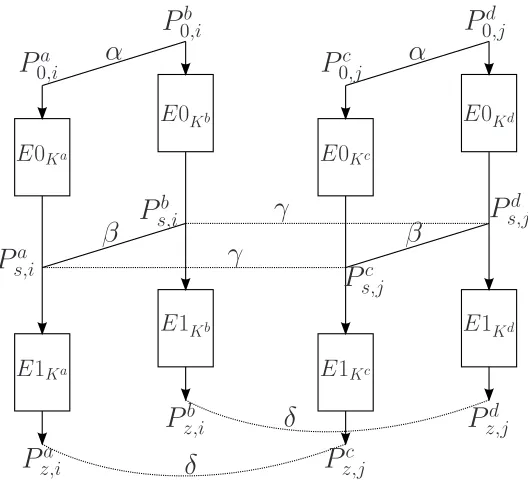
The boomerang attack [22] is an extension to differential cryptanalysis [5] using adaptive chosen plaintexts and ciphertexts to attack block ciphers. The amplified boomerang attack [12] transforms the ordinary boomerang attack into a chosen plaintext attack. This attack can be improved by using all possible differentials instead of two. The resulting attack is called the rectangle attack [3]. The related-key rectangle attack was e.g. published in [13, 4, 11]. It is a combination of the related-key attack [2] and the rectangle attack. The attack can be described as follows.
A block cipher E : {0,1}n× {0,1}k → {0,1}n with E
K(·) := E(K,·) is treated as a
cascade of two sub-ciphersEKi(Pi) =E1Ki(E0Ki(Pi)), wherePiis then plaintext encrypted
under the key Ki. It is assumed that there exists a related-key differential α → β which
holds with probability p for E0, i.e., Pr[E0Ka(Pa
0)⊕ E0Kb(P0b) = β|P0a ⊕P0b = α] = p,
where Ka and Kb = Ka ⊕∆K∗ are two related keys and ∆K∗ is a known key difference (the same holds for Pr[E0Kc(Pc
0)⊕E0Kd(P0d) = β|P0c⊕P0d =α] = p, where Kc and Kd = Kc ⊕∆K∗ are two related keys). Let Pi
s = E0Ki(P0i), i ∈ {a, b, c, d} be an intermediate
encryption value. We assume a related-key differential γ → δ which holds with probability
q for E1, i.e., Pr[E1Ka(Pa
s) ⊕E1Kc(Pc
Kc are related as Ka⊕Kc =∆K′ and ∆K′ is a known key difference (the same holds for Pr[E1Kb(Psb)⊕E1Kd(Psd) = δ|Psb ⊕Psd = γ] = q where the keys Kb and Kd are related as Kb⊕Kd=∆K′). In our attack we use four different keys but one can also apply the attack with more or less keys.
Let a plaintext quartet (Pa
0,i, P0b,i, P0c,j, P0d,j) with P0a,i ⊕P0b,i = α = P0c,j ⊕ P0d,j, where
Pt
0 is encrypted under the key Kt, t ∈ {a, b, c, d}. Out of N pairs of plaintexts with the
related-key difference α about N ·p pairs have an output difference β after E0. These pairs can be combined into about (N·p)2
2 quartets, such that each quartet satisfies E0Ka(P
a
0,i)⊕
E0Kb(P0b,i) = β and E0Kc(Pc
0,j)⊕E0Kd(P0d,j) =β. We assume that the intermediate values
after E0 distribute uniformly over all possible values. Thus, E0Ka(P0a,i)⊕E0Kc(P0c,j) = γ
holds with probability 2−n. If this occurs, E0
Kb(P0b,i)⊕E0Kd(P0d,j) = γ holds as well, since
the following condition holds: (E0Ka(Pa
0,i)⊕E0Kb(P0b,i))⊕(E0Kc(Pc
0,j)⊕E0Kd(P0d,j))⊕(E0Ka(Pa
0,i)⊕E0Kc(Pc
0,j)) =
(Ps,ia ⊕Ps,ib )⊕(Ps,jc ⊕Ps,jd )⊕(Ps,ia ⊕Ps,jc ) =
β⊕β⊕γ=γ
The expected number of quartets satisfying bothE1Ka(Ps,ia)⊕E1Kc(Ps,jc ) =δandE1Kb(Ps,ib )⊕ E1Kd(Ps,jd ) =δ is
X
β,γ
(N ·p)2
2 ·2
−n·q2 =N2·2−n−1·(ˆp·qˆ)2,
where ˆp = qP
β′(Pr[α→β′])2 and ˆq =
q P
γ′(Pr[γ′ →δ])2. For a random cipher, the
expected number of correct quartets is about N2
2 · 2−
2n = N2 · 2−2n−1. Therefore, if ˆp · ˆ
q >2−n/2 and N is sufficiently large, the related-key rectangle distinguisher can distinguish
betweenE and a random cipher. Figure 2 displays the structure of the related-key rectangle distinguisher.
5
Related-Key Rectangle Attack on the full HAS-160 Encryption
Mode
In this section, we give a 71-round related-key rectangle distinguisher, which can be used to mount a related-key rectangle attack on the full 80-round HAS-160 encryption mode. We can use Property 2 to partially determine whether a candidate quartet is a correct one or if it is not. A false quartet can be discarded during the stepwise computation, which reduces the complexity of the subsequent steps and also the overall complexity of the attack. Thus, our technique is in some way similar to the early abort technique presented by Lu et al. [14].
5.1 A 71-Round Related-Key Rectangle Distinguisher
LetK be a master key which can be written asK =x0, x1, . . . , x15, wherexiis a 32-bit word.
We use four different – but related – master keys Ka, Kb, Kc and Kd to mount our
α
α
β
β
γ
γ
δ
δ
E0Ka
E1Ka
E0
Kb
E1
Kb
E0Kc
E1Kc
E0
Kd
E1
Kd
P
0a,iP
z,iaP
0b,iP
z,ibP
0c,jP
z,jcP
0d,jP
z,jdP
s,iaP
s,ibP
s,jcP
s,jdFig. 2.The related-key rectangle distinguisher
as follows:
∆K∗ =Ka⊕Kb =Kc ⊕Kd= (e
31,0,0,0,0,0,0,0,0,0, e31,0,0,0,0,0), (1)
∆K′ =Ka⊕Kc =Kb ⊕Kd= (0,0,0,0,0,0,0,0,0,0,0,0, e
31,0, e31,0).
Since the key schedule of HAS-160 offers a high degree of linearity we can easily determine all the 80 round key differences derived from the master key differences ∆K∗ and ∆K′ respec-tively. We observe that if we choose∆x0 =∆x10 and the remaining word differences as zero,
i.e., ∆xi = 0, i= 1,2, . . . ,8,9,11,12, . . . ,15, then a zero difference can be obtained starting
from round 14 up to round 37. We use this observation for the related-key differential for
E0. Moreover, we can observe that if∆x12=∆x14holds and the remaining word differences
in∆K′ are all zero, then a zero difference can be obtained from round 44 to round 65. This observation is used in our related-key differential for E1.
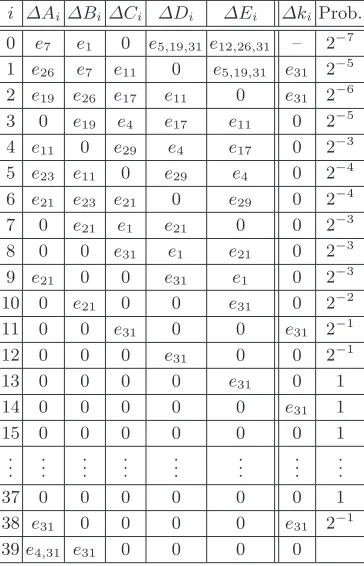
Considering Property 1 and Theorem 1 we have found a 39-round related-key differential from round 0 to 39 for E0 (α → β) using the master key difference ∆K∗. The related-key differential is:
(e7, e1,0, e5,19,31, e12,26,31)→(e4,31, e31,0,0,0).
The related-key differential E0 is shown in Table 4.1
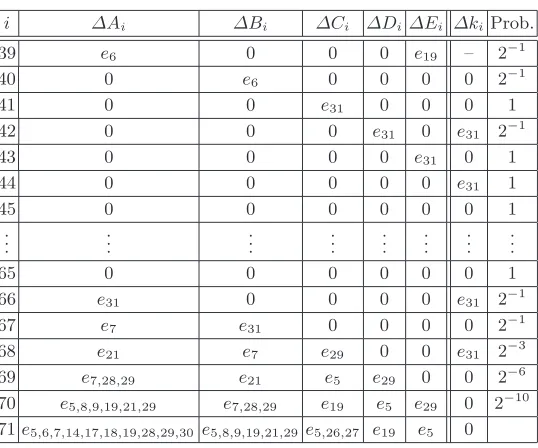
We exploit a 32-round related-key differential for E1 (γ → δ) that covers rounds 39 to 71 using the master key difference ∆K′. The related-key differential is:
(e6,0,0,0, e19)→(e5,6,7,14,17,18,19,28,29,30, e5,8,9,19,21,29, e5,26,27, e19, e5)
1
Note that Pr[(∆ci, ∆ki)
⊞
→∆ki] = 1 always holds due to Property 1. This is true since∆ci is equal to zero for all
Table 4.The Related-Key DifferentialE0
i ∆Ai∆Bi∆Ci ∆Di ∆Ei ∆kiProb.
0 e7 e1 0 e5,19,31 e12,26,31 – 2− 7
1 e26 e7 e11 0 e5,19,31 e31 2− 5
2 e19 e26 e17 e11 0 e31 2− 6
3 0 e19 e4 e17 e11 0 2− 5
4 e11 0 e29 e4 e17 0 2− 3
5 e23 e11 0 e29 e4 0 2− 4
6 e21 e23 e21 0 e29 0 2− 4
7 0 e21 e1 e21 0 0 2− 3
8 0 0 e31 e1 e21 0 2− 3
9 e21 0 0 e31 e1 0 2− 3
10 0 e21 0 0 e31 0 2− 2
11 0 0 e31 0 0 e31 2− 1
12 0 0 0 e31 0 0 2−
1
13 0 0 0 0 e31 0 1
14 0 0 0 0 0 e31 1
15 0 0 0 0 0 0 1
..
. ... ... ... ... ... ... ...
37 0 0 0 0 0 0 1
38 e31 0 0 0 0 e31 2− 1
39e4,31 e31 0 0 0 0
The 160-bit difference δ can be written as a concatenation of five 32-bit word differences
δ= (δA, δB, δC, δD, δE) = (∆A71, ∆B71, ∆C71, ∆D71, ∆E71). (2)
The related-key differential E1 is shown in Table 5. The probability for the differential
E0 is 2−48 due to Table 4, while the probability for E1 is 2−24 from Table 5. We compute a huge amount of possible differentials to increase both differential probabilities. We can compute a lower bound for the probability of the differential E0. Similarly, we can compute a lower bound for the probability of the related-key differential for E1.
The probability of our related-key rectangle distinguisher for round 1–71 is:
2−48·2−242
·2−160 = 2−304
However, the correct difference δoccurs in two ciphertext pairs of a ciphertext quartet for a random cipher with probability (2−160)2 = 2−320.
5.2 The Attack on the full HAS-160 Encryption Mode
Our attack uses four related keys Ka, Kb, Kc and Kd where each two of the four master
Table 5.The Related-Key DifferentialE1
i ∆Ai ∆Bi ∆Ci ∆Di∆Ei ∆kiProb.
39 e6 0 0 0 e19 – 2−
1
40 0 e6 0 0 0 0 2−
1
41 0 0 e31 0 0 0 1
42 0 0 0 e31 0 e31 2−
1
43 0 0 0 0 e31 0 1
44 0 0 0 0 0 e31 1
45 0 0 0 0 0 0 1
..
. ... ... ... ... ... ... ...
65 0 0 0 0 0 0 1
66 e31 0 0 0 0 e31 2−
1
67 e7 e31 0 0 0 0 2−
1
68 e21 e7 e29 0 0 e31 2−
3
69 e7,28,29 e21 e5 e29 0 0 2− 6
70 e5,8,9,19,21,29 e7,28,29 e19 e5 e29 0 2− 10
71e5,6,7,14,17,18,19,28,29,30 e5,8,9,19,21,29 e5,26,27 e19 e5 0
in rounds 72,73,74,76,77,78,80. In the second step we find the remaining subkey candidates by an exhaustive search for the obtained subkey candidates and the remaining subkeys to recover the four 512-bit master keys Ka, Kb, Kc and Kd.
The attack works as follows:
1. Chose 2153.3 plaintexts Pa
0,i = (A0,i, B0,i, C0,i, D0,i, E0,i), i = 1,2, . . . ,2153.5. Compute 2153.5
plaintexts Pb
i, i.e., P0b,i = P0a,i⊕ α, where α is a fixed 160-bit word as stated above. Set
Pc
0,i = P0a,i and P0d,i = P0b,i. With a chosen plaintext attack scenario, encrypt the
plain-texts Pa
0,i, P0b,i, P0c,i, P0d,i under Ka, Kb, Kc and Kd respectively and obtain the ciphertexts
Pa
80,i, P80b,i, P80c,i and P80d,i.
2. Guess seven32-bit round keys ka
80, k79a, k78a , ka77, k76a , ka75, k74a and compute
kl
80, k79l , kl78, k77l , k76l , kl75, k74l ,l ∈ {b, c, d} using the known round key differences.
2.1. Decrypt the ciphertexts Pa
80,i, P80b ,i, P80c,j, P80d,j under k80l , k79l , kl78, kl77, k76l , kl75, k74l , l ∈
{a, b, c, d} respectively and obtain the intermediate values Pa
73,i, P73b,i, P73c,j, P73d,j. From
Property 2 we know the value of the96-bit difference δA≪30,δ
B≪30 and δ
C, see (2).
2.2. Check whether the following conditions are fulfilled:
C73a,i⊕C73c ,j=δA≪30 =Cb
73,i⊕C73d,j,
Da73,i⊕D73c ,j=δB≪30 =Db
73,i⊕D73d,j,
E73a,i⊕E73c ,j=δC =E73b ,i⊕E73d,j
Record kl
80, k79l , kl78, k77l , k76l , k75l , kl74, l ∈ {a, b, c, d} and all the quartets that satisfy the
above conditions.
3. Guess one 32-bit round keys ka
73 and compute k73l , l ∈ {b, c, d} using the known round key
3.1. Decrypt the ciphertexts Pa
73,i, P73b,i, P73c,j, P73d,j under kl73, l ∈ {a, b, c, d} respectively and
obtain the intermediate values Pa
72,i, P72b,i, P72c ,j, P72d,j. From Property 2 we know the value
of the 32-bit difference δD.
3.2. Check whether Ea
72,i⊕E72c ,j =δD =E72b ,i⊕E72d,j holds. Record
kl
80, kl79, k78l , k77l , kl76, k75l , kl74, k73l ,l ∈ {a, b, c, d}and all the quartets that satisfy the above
condition.
4. Guess one 32-bit round keys ka
72 and compute k72l , l ∈ {b, c, d} using the known round key
differences.
4.1. Decrypt the ciphertexts Pa
72,i, P72b,i, P72c,j, P72d,j under kl72, l ∈ {a, b, c, d} respectively and
obtain the intermediate values Pa
71,i, P71b,i, P71c ,j, P71d,j. From Property 2 we know the value
of the 32-bit difference δE.
4.2. Check whether Ea
71,i⊕E71c ,j =δE =E71b ,i⊕E71d,j holds. If there exist at least2 quartets
passing the above condition, record kl
80, kl79, k78l , kl77, k76l , k75l , k74l , kl73, k72l , l ∈ {a, b, c, d}
and go to Step5. Otherwise go to Step4with another guessed round key. If all the possible
round keys for ka
72 are tested, then repeat Step 3 with another guessed round key k73a . If
all the possible round keys forka
73 are tested, then go to Step2with another guess for the
round keys ka
80, ka79, k78a, k77a , ka76, k75a , ka74.
5. For a suggested (kl
80, k79l , kl78, k77l , kl76, k75l , k74l , kl73, k72l ), do an exhaustive search for the
re-maining 512−9·32 = 224key bits by trial encryption. If a 512-bit key is suggested, output
it as the master key of the full HAS-160 encryption mode. Otherwise restart the algorithm.
5.3 Analysis of the Attack
We have 2153.5 pairs (Pa
i , Pib) and 2153.5 pairs (Pic, Pid) of plaintexts, thus we have
(2153.5
)2
2 =
2306 quartets. The data complexity of Step 1 is 22·2153.5 = 2155.5 chosen plaintexts. The time
complexity of Step 1 is about 22·2153.5 = 2155.5 encryptions. Step 2.1 requires time about
2224·22·2153.5·(7/80)≈2375.98eighty round encryptions. The number of remaining quartets
after Step 2.2 is 2306 · (2−96)2 = 2114, since we have a 96-bit filtering condition on both
pairs of a quartet. The time complexity of Step 3.1 is about 2256·22·2114·(1/80) ≈2365.68
encryptions. After Step 3.2 about 2114 · (2−32)2 = 250 quartets remain, since we have a
32-bit filtering condition on both pairs of a quartet. The time complexity of Step 4.1 is 2288·22 ·250·(1/80) ≈2333.68 encryptions. After Step 4.2 the number of remaining quartets
is about 250 ·(2−32)2 = 2−14, since we have a 32-bit filtering condition on both pairs of a
quartet. Thus, we do not expect false quartets after the distinguisher step remaining either for the correct or the false round keys. The expected number of correct quartets that remain for the correct round keys are about 2306·2−304= 4.
Using the Poisson distribution we can compute the success rate of our attack. The proba-bility that the number of remaining quartets for each false key bit combination is larger then 1 is Y ∼ Poisson(µ= 2−14), Pr(Y ≥ 2) ≈ 0. The probability that the number of quartets
counted for the correct key bits is at least 2 is Z ∼ Poisson(µ = 4), Pr(Z ≥ 2) ≈ 0.9. The data complexity of our attack is 2153.5 ·22 = 2155.5 chosen plaintexts, while the time
complexity is about 2375.98 full eighty round HAS-160 encryptions. Our attack has a success
6
Conclusion
In this paper we present the first cryptanalytic result on the inner block cipher of the Korean hash algorithm standard HAS-160. Our related-key rectangle attack can break the full 80-round HAS-160 encryption mode. A more complex and non-linear key schedule would have defended our attack. Moreover, to strengthen the cipher against differential attacks, we propose to use thef-function more often in each round and so thef-function may influence more than one word in each round. Note that this analysis does not seem to say anything about the collision, preimage or 2nd-preimage resistance of HAS-160, but it shows some interesting properties that occur if HAS-160 is used as a block cipher. It shows that HAS-160 as a block cipher can be differentiated efficiently from a random cipher and the key bits can be found much faster than exhaustive search.
References
[1] Telecommunications Technology Association. Hash Function Standard Part 2: Hash Function Algorithm Stan-dard (HAS-160). TTAS.KO-12.0011/R1, December 2000.
[2] Eli Biham. New Types of Cryptanalytic Attacks Using Related Keys. J. Cryptology, 7(4):229–246, 1994. [3] Eli Biham, Orr Dunkelman, and Nathan Keller. The Rectangle Attack - Rectangling the Serpent. In Birgit
Pfitzmann, editor,EUROCRYPT, volume 2045 ofLecture Notes in Computer Science, pages 340–357. Springer, 2001.
[4] Eli Biham, Orr Dunkelman, and Nathan Keller. Related-Key Boomerang and Rectangle Attacks. In Cramer [8], pages 507–525.
[5] Eli Biham and Adi Shamir. Differential Cryptanalysis of DES-like Cryptosystems. In Menezes and Vanstone [16], pages 2–21.
[6] Gilles Brassard, editor. Advances in Cryptology - CRYPTO ’89, 9th Annual International Cryptology Con-ference, Santa Barbara, California, USA, August 20-24, 1989, Proceedings, volume 435 of Lecture Notes in Computer Science. Springer, 1990.
[7] Hong-Su Cho, Sangwoo Park, Soo Hak Sung, and Aaram Yun. Collision Search Attack for 53-Step HAS-160. In Min Surp Rhee and Byoungcheon Lee, editors, ICISC, volume 4296 ofLecture Notes in Computer Science, pages 286–295. Springer, 2006.
[8] Ronald Cramer, editor. Advances in Cryptology - EUROCRYPT 2005, 24th Annual International Conference on the Theory and Applications of Cryptographic Techniques, Aarhus, Denmark, May 22-26, 2005, Proceedings, volume 3494 ofLecture Notes in Computer Science. Springer, 2005.
[9] Ivan Damg˚ard. A Design Principle for Hash Functions. In Brassard [6], pages 416–427.
[10] Orr Dunkelman, Nathan Keller, and Jongsung Kim. Related-Key Rectangle Attack on the Full SHACAL-1. In Eli Biham and Amr M. Youssef, editors, Selected Areas in Cryptography, volume 4356 ofLecture Notes in Computer Science, pages 28–44. Springer, 2006.
[11] Seokhie Hong, Jongsung Kim, Sangjin Lee, and Bart Preneel. Related-Key Rectangle Attacks on Reduced Versions of SHACAL-1 and AES-192. In Henri Gilbert and Helena Handschuh, editors,FSE, volume 3557 of
Lecture Notes in Computer Science, pages 368–383. Springer, 2005.
[12] John Kelsey, Tadayoshi Kohno, and Bruce Schneier. Amplified Boomerang Attacks Against Reduced-Round MARS and Serpent. In Bruce Schneier, editor,FSE, volume 1978 ofLecture Notes in Computer Science, pages 75–93. Springer, 2000.
[13] Jongsung Kim, Guil Kim, Seokhie Hong, Sangjin Lee, and Dowon Hong. The RelatedKey Rectangle Attack -Application to SHACAL-1. In Wang et al. [23], pages 123–136.
[14] Jiqiang Lu, Jongsung Kim, Nathan Keller, and Orr Dunkelman. Related-Key Rectangle Attack on 42-Round SHACAL-2. In Sokratis K. Katsikas, Javier Lopez, Michael Backes, Stefanos Gritzalis, and Bart Preneel, editors,ISC, volume 4176 ofLecture Notes in Computer Science, pages 85–100. Springer, 2006.
[16] Alfred Menezes and Scott A. Vanstone, editors. Advances in Cryptology - CRYPTO ’90, 10th Annual Interna-tional Cryptology Conference, Santa Barbara, California, USA, August 11-15, 1990, Proceedings, volume 537 ofLecture Notes in Computer Science. Springer, 1991.
[17] Ralph C. Merkle. One Way Hash Functions and DES. In Brassard [6], pages 428–446.
[18] National Institute of Standards and Technology. FIPS 180-1: Secure Hash Standard. April 1995. See http://csrc.nist.gov.
[19] Ron Rivest. The MD5 Message-Digest Algorithm. Request for Comments: 1321, http://tools.ietf.org/html/rfc1321, April 1992.
[20] Ronald L. Rivest. The MD4 Message Digest Algorithm. In Menezes and Vanstone [16], pages 303–311. [21] YongSup Shin, Jongsung Kim, Guil Kim, Seokhie Hong, and Sangjin Lee. Differential-Linear Type Attacks on
Reduced Rounds of SHACAL-2. In Wang et al. [23], pages 110–122.
[22] David Wagner. The Boomerang Attack. In Lars R. Knudsen, editor,Fast Software Encryption, volume 1636 ofLecture Notes in Computer Science, pages 156–170. Springer, 1999.
[23] Huaxiong Wang, Josef Pieprzyk, and Vijay Varadharajan, editors. Information Security and Privacy: 9th Australasian Conference, ACISP 2004, Sydney, Australia, July 13-15, 2004. Proceedings, volume 3108 ofLecture Notes in Computer Science. Springer, 2004.
[24] Xiaoyun Wang, Xuejia Lai, Dengguo Feng, Hui Chen, and Xiuyuan Yu. Cryptanalysis of the Hash Functions MD4 and RIPEMD. In Cramer [8], pages 1–18.