ENHANCED FACE DETECTION FRAMEWORK BASED ON SKIN COLOR AND FALSE ALARM REJECTION
ALI SHARIFARA
A thesis submitted in fulfilment of the requirements for the award of the degree of
Doctor of Philosophy (Computer Science)
Faculty of Computing Universiti Teknologi Malaysia
ACKNOWLEDGEMENT
First and foremost, I would like to take this opportunity to express sincerest gratitude to my supervisor, Assoc. Professor Dr. Mohd Shafry Mohd Rahim, who has supported me throughout my thesis with his patience, skillful guidance and knowledge during this work, which made it possible for me to complete a dissertation with appreciable quality and standard.
I also wish to thank all the staff of Universiti Teknologi Malaysia, especially Faculty of Computing, for providing me with all the necessary facilities for the research.
I want to thank all of my friends for their support and the enjoyable discussions about Ph.D., computer science, and personal challenges, in particular Mr. Mazlan Ali, Mr. Hamed Sayyadi, Dr. Farhad Navabifar, Dr. Mazdak Zamani, and Dr. Mojtaba Alizadeh.
ABSTRACT
ABSTRAK
Pengesanan objek dengan cepat dan tepat merupakan tugas yang mencabar dalam visi komputer. Pengecaman muka manusia memainkan peranan penting pada peringkat pertama aplikasi pemprosesan wajah seperti pengesanan pengecaman, dan pengurusan pangkalan data imej muka. Dalam aplikasi tersebut, objek muka sering datang daripada bahagian imej yang tidak penting yang mengandungi variasi seperti pencahayaan, posisi serta halangan pada muka. Variasi ini dapat mengurangkan kadar pengecaman muka dengan ketara. Selain itu, masa pengesanan merupakan faktor penting, terutamanya dalam sistem masa nyata. Kebanyakan pendekatan pengecaman muka yang sedia ada tidak tepat kerana tidak dapat menyelesaikan imej tidak berstruktur ekoran daripada luasnya variasi penampilan dan hanya dapat mengecam muka manusia di bawah variasi tertentu. Kerangka kerja pengecaman muka yang sedia ada
TABLE OF CONTENTS
CHAPTER TITLE PAGE
DECLARATION ii
DEDICATION iii
ACKNOWLEDGEMENT iv
ABSTRACT v
ABSTRAK vi
TABLE OF CONTENTS vii
LIST OF TABLES xiii
LIST OF FIGURES xv
LIST OF ABBREVIATIONS xx
LIST OF APPENDICES xxi
1 INTRODUCTION 1
1.1 Introduction 1
1.2 Problem Background 2
1.3 Problem Statement 11
1.4 Research Aim 12
1.5 Research Objectives 12
1.6 Research Scope 12
1.7 Significance of Study 13
1.8 Thesis Organization 15
2 LITERATURE REVIEW 17
2.1 Introduction 17
2.2 Face Detection 17
2.2.1 Importance of the Face Detection 19
2.2.2.1 Preprocessing 23
2.2.2.2 Facial Feature Extraction 24
2.2.2.3 Skin Color Segmentation 25
2.2.2.4 Classification 25
2.2.3 Face Detection Issues 25
2.2.3.1 Pose Variation 26
2.2.3.2 Complex Background 27
2.2.3.3 Illumination 28
2.2.3.4 Facial Expression 29
2.2.3.5 Occlusion 30
2.3 Feature Extraction Methods 32
2.3.1 Multiple Features 35
2.4 Search Space Reduction 36
2.4.1 Skin Color Segmentation 38
2.4.2 Edge Detection 40
2.4.2.1 Kirsch Algorithm 40
2.4.2.2 Sobel Algorithm 41
2.5 Knowledge-Based Method 43
2.6 Template-Based Method 44
2.7 Appearance-Based Approach 45
2.8 Pattern Classification 46
2.8.1 Neural Network-Based Methods 57
2.8.2 SVM-Based Methods 58
2.8.3 HMM-Based Face methods 59
2.8.4 LBP-Based Methods 60
2.9 Discussion 61
2.10 Conclusion 62
3 RESEARCH METHODOLOGY 64
3.1 Introduction 64
3.2 Proposed Framework 65
3.3 Preprocessing Enhancement 67
3.3.1 Median Filtering 69
3.3.2 Resolution Reduction 69
3.3.3 Histogram Equalization 69
3.4 Search Space Reduction 70
3.4.2 Edge Detection 72
3.4.3 Morphological Operations 73
3.4.4 Adaboost Algorithm 73
3.5 Face Detection Process 73
3.5.1 Conversion of Image to Integral Image 75
3.5.2 Haar-like Feature Extraction 76
3.5.3 Classification 77
3.5.4 Training Dataset 78
3.5.5 Testing Dataset 79
3.6 Face Validity Process 80
3.6.1 Feature Extraction 81
3.6.1.1 LBP 81
3.6.1.2 Extended Local Binary Pattern 83
3.6.2 Support Vector Machine (SVM) Classification 84
3.6.3 Rejection of False Positive Windows 85
3.6.4 Crop and Locate the Validated Face 85
3.7 Data Collection 86
3.7.1 CMU Frontal Face Database 87
3.7.2 CMU Profile Face Database 88
3.7.3 Caltech 10000 Web Face Database 88
3.7.4 GTAV Database 89
3.8 Definition of Evaluation of the Face Detection Process 89
3.8.1 Search Space Reduction Rate (SSRR) 90
3.8.2 False Negative (FN) 90
3.8.3 True Positive (TP) 90
3.8.4 True Negative (TN) 91
3.8.5 False Positive (FP) 91
3.8.6 Total Faces (TF) 91
3.8.7 Correct Detection Rate (CDR) 92
3.8.8 False Detection Rate (FDR): 93
3.8.9 Missing Rate (MR) 93
3.8.10 Recall 93
3.8.11 Precision 93
3.8.12 Specificity 94
3.8.13 Accuracy 94
4 SEARCH SPACE REDUCTION METHOD 96
4.1 Introduction 96
4.2 Preprocessing Enhancement 97
4.2.1 Median Filtering 97
4.2.2 Resolution Reduction 99
4.2.3 Histogram Equalization 100
4.3 Search Space Reduction 102
4.3.1 Skin Color Scheme 104
4.3.2 Edge Detection 107
4.3.3 Morphological Operations 108
4.3.4 Adaboost Algorithm 110
4.4 Conclusion 111
5 FACE VALIDITY PROCESS 113
5.1 Introduction 113
5.2 The Face Validity Process Framework 113
5.3 Coarse and Fine Stage Feature Extraction 114
5.4 ExLBP Feature Extraction 116
5.5 SVM Classification of Face/non-face Windows 123
5.6 False Alarm Rejection Process 125
5.6.1 Cropping 125
5.6.2 Feature Extraction Using Enhanced LBP 125
5.6.3 Image Block Scanning Method 126
5.6.4 SVM Classification 126
5.6.5 SVM applied to Face Detection Classification 127
5.6.6 Verification 128
5.7 Conclusion 128
6 THE FACE DETECTION FRAMEWORK 130
6.1 Introduction 130
6.2 Face Detection Using Proposed Framework 132
6.2.1 Preprocessing Enhancement 132
6.2.2 Search Space Reduction 133
6.2.2.1 RGB Color Space 134
6.2.2.2 YCbCr Color Space 135
6.2.2.3 Skin Color Scheme 136
6.2.2.5 Edge Detection 140
6.3 Detection Process 141
6.3.1 Feature Extraction Process 141 6.3.1.1 Alternative feature sets 143
6.3.1.2 Number of features 144
6.3.1.3 Fast Feature Computation 146
6.3.2 Classification 148
6.3.2.1 Training Theory 148
6.3.2.2 Boosting 149
6.3.2.3 Number of Weak Classifier 150 6.3.2.4 Learning and Classification of Adaboost 150 6.3.2.5 The Attentional Cascade 151 6.3.3 Cascade and Features Selection Results 151 6.3.4 Face Wrapping and Cropping 156
6.4 Validity Process 157
6.5 Conclusion 158
7 RESULTS AND EVALUATIONS 159
7.1 Introduction 159
7.2 Dataset 160
7.3 Preprocessing Result 160
7.4 Search Space Reduction Result 162
7.5 Feature Extraction Result 168
7.6 Classification Result 169
7.7 Computation Time Result 173
7.8 Framework Results 175
7.8.1 Framework Result without Validity Process 177 7.8.2 Framework Result with Validity Process 178
7.9 Comparison and Evaluation 180
7.10 Framework Implementation Results 181
7.11 Conclusion 187
8 CONCLUSION 188
8.1 Introduction 188
REFERENCES 192
LIST OF TABLES
TABLE NO. TITLE PAGE
6.1 Chosen threshold for each some color spaces. 138
6.2 Number of generated features in a 24 24 window (Lienhart and Maydt, 2002). 145
6.3 Number of training samples along with the features that are used in the training process. 153
7.1 Search space reduction using 10 sample images. 164
7.2 Comparisons of segmentation result. 166
7.3 Comparison of proposed method on Caltech dataset. 167
7.4 The comparison results of applying basic Haar-like features and enhanced Haar-like features in terms of the detection rate and the number of false positives on MIT Dataset. 168
7.5 Number of weak classifiers and training time in each stage. 169
7.6 Accuracy evaluation table of the cascade Adaboost method and the LBP+ SVM on a set of 5500 test images acquired from the Caltech 10000 Web Face database. 171
7.7 Accuracy evaluation table of the cascade Adaboost algorithm and the proposed method on the CMU+MIT test database containing 130 grey scale images with 507 faces. 171
7.8 Accuracy evaluation table of the cascade Adaboost algorithm and the proposed method on the CMU profile test database containing 208 images with 439 faces. 171
7.9 Detection rates of various numbers of false positives on the MIT+CMU test set containing 130 images and 507 faces. 173
7.10 Average computation time in different stages. 174
7.11 Comparison of the average computation time for several face detection methods. 174
LIST OF FIGURES
FIGURE NO. TITLE PAGE
1.1 Capturing a face from a surveillance video (a) Surveillance system.
(b) Detected facial region (Zou et al., 2012). 3
1.2 Sample image from Caltech 10000. (a) Image that is easy to detect face. (b) Image that creates challenges for face detectors. 5
1.3 Sample of unstructured images from LFW face database. 5
1.4 Sample image includes faces with different scales from CMU database. 7
1.5 An example of face Detector output with low accuracy. 8
1.6 An example of face detector output with high accuracy. 9
1.7 Typical ROC curve for face detection(LiandJain,2011). 10
2.1 A general framework of the face application system. 18
2.2 The General diagram of face detection. 20
2.3 Process of the Detection (Gupta1 and Sharma, 2014). 21
2.4 Several well-known face detection approaches. 22
2.5 Example of noisy images that have result of high false alarms. 24
2.6 : Different views of a sample image (Sim et al., 2002). 27
2.7 Examples of faces including complex background (CMU database). 28
2.8 Different effects of illumination variations. 29
2.9 Different forms of facial expression. 30
2.10 Different types of occlusion effect (images are taken form GTAV dataset). 30
2.11 The Existence of occlusion in different areas of image processing (Azeem et al., 2014). 31
2.12 Different types of methods used to solve occlusion in face image (Azeem et al., 2014). 32
2.13 Three neighborhoods of pixels (Lopez-Molina, 2014). 41
2.15 EdgeDetectionResult(a)OriginalImage(b)Detectededges by
Sobel 3x3 (c) Detected edges by Kirsch algorithm. 42
2.16 (a) n = 1, original image. (b) n = 4. (c) n = 8. (d) n = 16. Original and corresponding low-resolution images. 43
2.17 Horizontal and vertical projection to detect a face. 44
2.18 Conventional Haar-like features. 48
2.19 Minimizing the number of face and non-face miss-classified examples using selection of optimal threshold (Meynet, 2003). 49
2.20 Cascade structure diagram. 50
2.21 Diagonal features. 50
2.22 Rotated and asymmetric Haar-like features (Lienhart et al., 2003). 51
3.1 Proposed Research Framework. 66
3.2 The general framework design. 67
3.3 Preprocessing enhancement unit. 68
3.4 Sample of applying median filtering on noisy grayscale image. 68
3.5 Sample of noisy images that have result of high false alarms. 69
3.6 Conventional Haar-like features. 76
3.7 Face detection result containing false alarms. 80
3.8 Example of LBP labeling. 82
3.9 The LBP operator. 82
3.10 LBP feature extraction. 83
3.11 Extended LBP operator with sample point and radius. 83
3.12 Example of margin between two classes. (a) High margin between two classes. (b) Low margin between two classes. 85
3.13 Sample images of the training data MIT CBCL face images. (a). face-pattern images (b). Nonface-pattern images. 86
3.14 Face training samples from Caltech 10,000 web face database. 87
3.15 Sample frontal face images from CMU face database. 87
3.16 Sample images of CMU profile face database. 88
3.17 Sample images of Caltech 10000 web face database. 89
3.18 Skin-color sample images from GTAV database. 89
3.19 Sample output face detection from the MIT+CMU dataset (Viola and Jones, 2001). 92
4.1 Example of calculation the median value of a pixel neighborhood. 98
4.2 Sample Image enhancement by Median filter, (a) Original image (b). Enhanced image. 98
4.4 Example of histogram equalization. 102 4.5 Sample segmentation of an input image (a) Input image.
(b) Skin color segmentation. (c) Selected skin-color regions. 103 4.6 Result of color clustering in YCbCr color space (Shemshaki and
Amjadifard, 2011). 105
4.7 Skin color segmentation (a) original face image. (b) Converted
image in YCbCr color space. (c) Binary Image. 105 4.8 The general diagram of selected skin windows regions. 107 4.9 Morphological processing on the segmented image. 109 4.10 The morphological operations on the segmented region.
(a) The binary-segmented image, (b) The result of binary image,
(c) The output result. 109
4.11 Example of Adaboost algorithm. 110
5.1 The validity process design. 114
5.2 Operator. 114
5.3 Fine stage - 3×3 blocks division with two pixels overlapping. 115 5.4 Example of Image labeling (a) Original Image. (b) 1st stage .
(c) labels image rescaled to 0 ... 255. 116
5.5 Conventional LBP. 116
5.6 Single LBP representation. 117
5.7 Multiple LBPs. 118
5.8 Sparse LBP+ 118
5.9 Sparse LBP++ 119
5.10 The configuration patterns of feature. 120
5.11 Sample process of extracting features. 120
5.12 Auto-correlation matrices of co-occurrence of LBPs, H(a). 120 5.13 (a) Extracting LBPs from the image. (b) Auto-correction matrices
of co-occurrence of LBPs, . (c) Combined features. 121 5.14 A sample frontal face view template (Cooray, 2004). 122 5.15 Example of margin between two classes. (a) High margin between
two classes. (b) Low margin between two classes. 123 5.16 Sample of low and high margins between two different classes. 124
5.17 SVM light training and testing stages. 127
6.1 The main flowchart of the proposed face detection framework 131 6.2 Color image enhancement, (a) Original image, (b) Enhanced image 133
6.3 RGB color cube. 135
(b) converted YCbCr image. 136
6.5 Gaussian distribution for skin color. 137
6.6 Segmentation with fixed threshold. 139
6.7 Example of Face segmentation, (a) Original Image, (b) segmentation using RGB color space,
(c) segmentation using YCbCr color space. 139 6.8 Conversion of original image to integral image. 142 6.9 The extended Haar-like feature set proposed (Lienhart et al., 2003). 142 6.10 Extraction of Haar-like features from a conventional Haar-feature set. 143
6.11 Extended Haar-like feature set. 143
6.12 Examples of an upright and 45° rotated rectangle. 144 6.13 Feature prototype of simple and center-surrounded features. 145
6.14 Integral image representation. 146
6.15 Using the integral image to calculate the sum over rectangle D. 147 6.16 The Integral Image. Left: A sample values of input image.
Right: Using the integral image to compute the sum of rectangle D. 147 6.17 The comparison of different numbers of weak classifier in the soft
cascade (Yang et al., 2014). 150
6.18 Example of cascade classifier. 152
6.19 Example of training cascade classifier. 152
6.20 Rotated Haar-like features. 155
6.21 : The 3 points used in order to crop images and an example file. 156 6.22 Sample Image warping and cropping. (a) Original image.
(b) Wrapped and cropped result. 157
7.1 Result of resolution reduction. 161
7.2 Result of Histogram equalization. (a) Original image along with it
histogram, (b) equalized image along with its histogram. 161 7.3 Result of Median filtering (a) original image, (b) filtered image
with Median. 162
7.4 Edge Detection result based of Sobel Algorithm (a) Original image.
(b) Grayscale image. (c) Sobel Gradient. (d) Edge detection image. 163 7.5 Result of YCbCr color space conversion and binary image. 163
7.6 Search space reduction result. 164
7.7 Rejection of the negative examples during the 15th stages cascade 170 7.8 Rate of rejection of the negative examples during the 20 iterations. 170 7.9 ROC curve of face detection on CMU profile test set (208 images, 441
7.10 ROC curve for LBP. 176
7.11 ROC Curve for ExLBP. 176
7.12 Result of the proposed face detection on image from Caltech face
database (Frontal-view and Profile). 182 7.13 Result of the proposed face detection on personal image
(Frontal-view). 182
7.14 Result of the proposed face detection on an image from Caltech face
database (Includes False Negative). 183 7.15 Result of the proposed face detection on image from Caltech face
database (rotated faces). 183
7.16 Result of Proposed face detection on personal image (Gray-Scale
and Rotated faces). 184
7.17 Result of the proposed face detection on CMU face database
(Rotated and gary-scale face images with different scales). 185 7.18 Result of the proposed face detection on CMU face database
(Rotated faces). 186
7.19 Result of the proposed face detection on CMU Face Database
LIST OF ABBREVIATIONS
AdaBoost - Adaptive Boosting
ASA - American Standards Association ASM - Active Shape Model
CMU - Carnegie Mellon University FLD - Fisher's Linear Discriminant GTAV - Audio Visual Technologies Group GUI - Graphical User Interface
HCI - Human-Computer Interaction
HSV - Color space (Hue, Saturation, and Value)
HMM - Hidden Markov Model
JPEG - Joint Photographic Experts Group
LBP - Local Binary Pattern
MATLAB - Matrix Laboratory
MLL - Machine Learning Library MLP - Multi Layer Perceptron
NN - Neural Network
OpenCV - Open Source Computer Vision PAC - Probably Approximation Correct PBM - Portable Bit Map
PCA - Principal Component Analysis RGB - color space (Red, Green, and Blue) ROC - Receiver Operating Characteristic
ROI - Region of Interest
SOM - Self-Organization Map
RNDA - Recursive Non-Parametric Discriminant Analysis SGLD - Space Gray-Level Dependence
LIST OF APPENDICES
APPENDIX TITLE PAGE
A Standard Face Databases 206
CHAPTER 1
INTRODUCTION
1.1 Introduction
The latest evolution in computer science and the existing technologies have advanced the machinery world, where human life is improved by taking advantage of the artificial intelligence. In fact, the trend has encouraged an active improvement in machine intelligence. For instance, computer vision systems have been used in particular everyday jobs such as performing boring and tedious tasks. The current development in computer vision is moving forward to be more generalized vision applications including face recognition and summarizing video surveillance systems. In addition, the main and primary step of these kinds of applications is to find and locate human face.
image is a challenging issue due to the high degree of spatial variability in location, pose (frontal, profile, rotated), and scale. Human face detection is part of computer vision and aims to locate human face in digital images or video frame (in real-time applications) in order to ignore the background of images (Ban et al., 2014). The background of images may contain of some other objects, which is not human face such as building, road, tree, and car.
In the literature, different frameworks of face detection are provided and among them Viola and Jones have proposed one of the superb approach which is commonly used in most of the existing face detection methods or with the combination of some other methods in order to increase its accuracy (Yang et al., 2010). In addition, the proposed approach by them also have some limitations such as difficulty in training and creations of high false alarms and the late proposed methods have aimed to decrease the number of false alarms (Zakaria and Suandi, 2011). The description of this method is available in literature review of this study.
1.2 Problem Background
Innately, integrating information from various visual cues, such as texture, stereo disparity, and image motion, have better improvement in performance on perceptual tasks, such as face detection. On the other hand, the additional determination required to extract and signify information from additional cues may increase computational complexity. The automatic face detection is known as one of the complex problems in image processing. Several approaches are proposed to solve this problem including template matching, knowledge based, Adaboost learning based, Neural Networks, SVM algorithms. However, the success is accomplished with each face detection method with varying degrees and complexities.
actual recognition based on features extracted from these facial landmarks is only a minor last step.
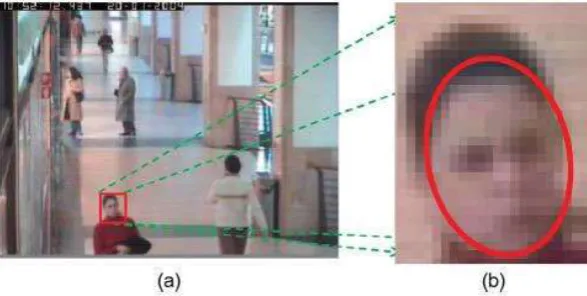
There are two different types in face detection problem including face detection in static image and detection in real time. Most of the face detection frameworks try to extract a portion of the whole face, thus eliminating most of the background. Real-time face detection involves detection of a face from a series of frames from a video capturing device. Although the hardware necessities for such a system are far more inflexible, from a computer vision standpoint, real-time face detection is actually a far simpler process than detecting a face in a static image. This is due to the face that unlike most of our surrounding environment, people are frequently moving. Therefore, face detection has an outstanding importance and plays a critical role in most of the face processing systems and the performance of this step has direct impact on the overall performance of the systems (Xiaoning et al., 2010). Figure 1.1 depicts a video frame in a real time surveillance system, which face recognition systems as the second stage can be applied to identify the face from the video.
Figure 1.1 : Capturing a face from a surveillance video (a) Surveillance system. (b) Detected facial region (Zou et al., 2012).
digital photography archives for all the images of particular people. These scenarios have become feasible today with getting advantage of face detection as well as recognition methods.
Face processing can be divided into several fields including face detection, face recognition, face verification, face tracking and facial expression which face detection is the first step in any of these face-processing systems (Sharma et al., 2009). The main aim of face detection is to detect and locate the places in the given image or video frame which consist of human face. Furthermore, feature extraction is responsible to detect the presence of features in human face such as nose, eyes, ears, mouth etc. This step is widely used in most of the face detection approaches especially for those which work based on the features of the face. In fact, face recognition systems include a database, which compares the detected face and the faces in database. The process continues until the system finds an occurrence of matching. In addition, facial expression, occlusion, and lighting conditions can change the overall appearance of face and can effect on the mentioned applications. In the next sections, several variations that can make significant effect of the face processing systems are described.
The main and general approach of face detection contains of three main modules, which are preprocessing, feature extraction, and classification (Bagherian et al., 2008). In the preprocessing stage, several enhancements can be performed to increase the quality of input image such as normalization and changing in illumination to make it easier for next stages to extract facial features that exist in images (Ming et al., 2008). In the feature extraction stage, the input image is divided into sub windows and then features can be extracted from the sub-windows in order to grab those features, which are related to human face such as eye, lip, nose, forehead etc. The last step is responsible to classify faces from non-face objects.
Figure 1.2 : Sample image from Caltech 10000. (a) Image that is easy to detect face. (b) Image that creates challenges for face detectors.
Most of the face detection algorithms are able to locate the face in Figure 1.2 (a), due to this image is taken in frontal view, without occlusion, centered, and in a good condition of illumination. Hence, to locate such this kind of images there is not much challenging issues. The challenges start when a face detector has to struggle with the second type of images (Figure 1.2 (b)), which creates all the mentioned limitations that is called unstructured settings. The unstructured settings in images may contain several variations such as complex backgrounds, different lighting conditions, poses, races, skin colors, age, gender, face occlusion and etc. (Kemelmacher-Shlizerman and Seitz, 2011). Figure 1.3 also illustrates some samples of images from Labeled Faces in the Wild (LFW) face database which are taken under unstructured settings.
There are number of challenges and difficulties which cause to decrease the performance and accuracy of face detection systems including noise, complex texture, complex background, pose variation, illumination condition, occlusion (Alabbasi and Moldoveanu, 2014). Generally, some of the main reasons, which make it difficult for machines to detect human faces, are categorized as following:
i. Different poses such as frontal or profile and upside down. ii. Different illumination conditions.
iii. Presence or absence of glasses, beards, mustache, etc. iv. Complex background/ texture.
v. Different face size.
vi. Computation time in real time applications.
First challenging issue occurs due to the different position of face in images and changing in plane rotation, and some facial features such as nose or lips may become occluded partly or completely.
Second problem is known as different illumination conditions. The issue occurs when the image is formed; factors such as lighting (spectra, source distribution and intensity) and camera characteristics (sensor response, lenses) affect the appearance of a face and since face images possess a 3-D shape, under lighting in different directions, illumination variations is one of the most important factors. (Goel and Agarwal, 2012).
The next issue is occlusion, that means human face(s) in images may be occluded partially or completely by other objects. For example, one object may partially occludes the face of other people.
Fourth challenging issue is related to the background image which some objects can have same features as human face and wrongly detected by face detector, which is called false positive. A face detection system must be able to detect faces in different sizes due to not all of faces in an image have the same size.
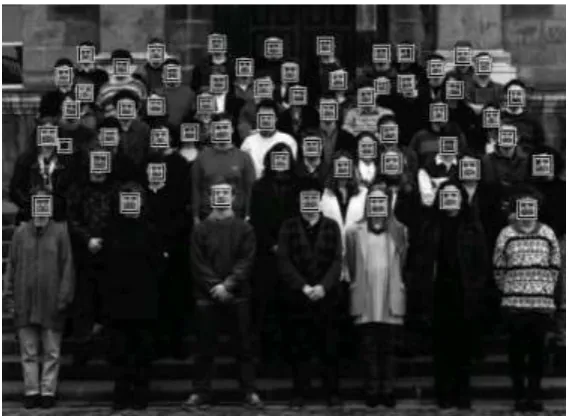
than obtaining the large ones. Figure 1.4 shows an image from CMU database, which contains different face scales.
Figure 1.4 : Sample image includes faces with different scales from CMU database.
The final factor is computation time; is speed of computation, which controls the speed of face detection systems, this is another important factor especially for real time purposes that needs to be improved.
In spite of all these difficulties, tremendous progress has been made in the last decade and many systems have shown impressive real-time performance to detect human face under different variations. There are many researches, which had been conducted in order to improve the performance of face detection systems as stated in the list of challenges and they aimed to improve one specific problem. However, these researches are unable to detect face in other images, which contain other challenging issues (Haider et al., 2014). For example, several studies in face detection are proposed to detect faces
under different illumination conditions, but the same algorithm is not be able to detect face under different poses or the false positive/negative rate is high under the other mentioned challenging issues. Although, many methods have been proposed by scholars aim to improve the performance of face detection, but none of methods can solve all the problems and challenges in face detection in a single algorithm. Omaima (Omaima, 2014) has presented recently result of some face detection systems and is reported a detection rate is vary between 77.9% and 97.3%, which the false positive rate is between 0.5% and 5%. This concluded that face detection systems still need to be improved.
number of objects, which are detected wrongly. The "true negative" is a term that is used when the objects are rejected correctly in a set of images. The "false negative" is also a term used when the object rejected incorrectly in a set of images. The "false alarm" is named when the detector rejects or selects incorrectly. The "detection rate” is a ratio of the number of true positive (detected correctly) by total number of face(s) in the existing dataset. The last but not least is "computation time" which is one of the important factors especially in practical applications and declared by frame per second.
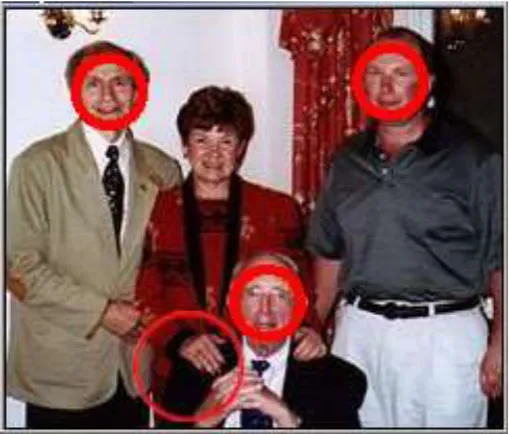
In addition, the main problem and challenging issue, which are addressed in most of the face detection methods, is “high false alarms”, which some objects are selected incorrectly as human face and some other objects, which are human faces are rejected (Li et al., 2014; Inalou and Kasaei, 2010). For example, in a tracking system, if a face
detection algorithm selects a non-face from the video frames of surveillance system, the next stage of tracking will follow an incorrect object and subsequently the whole algorithms will go wrong. In addition, by increasing the face detection rate, the false positive rate also increase accordingly (Li et al., 2014). Researches show that this phenomenon happen in most of the face detection methods and this problem had become worse when some other challenges occur at the same time such as illumination or occlusion in an image (Powar and Jahagirdar, 2012). The problem is illustrated in Figure 1.5, which shows the correct and incorrect selected faces in an image.
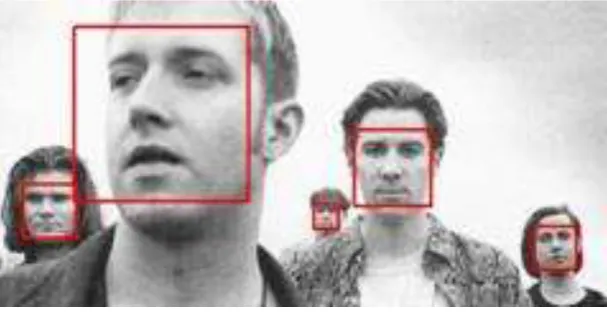
Figure 1.6 also illustrates an image, which indicated there is no any false detection rates, and all of the human faces are selected correctly.
Figure 1.6 : An example of face detector output with high accuracy.
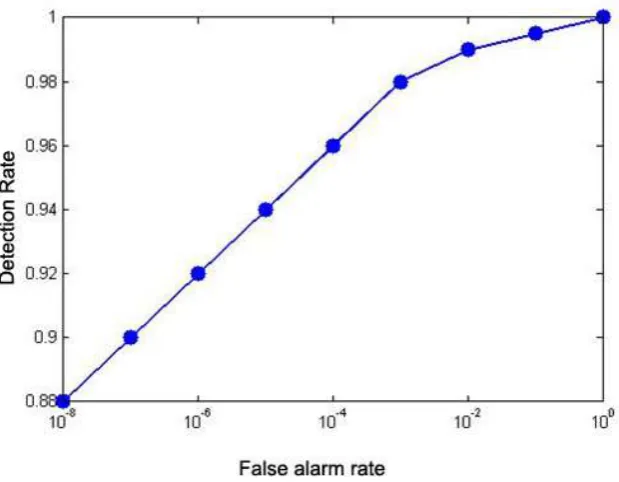
To evaluate the performance of face detection, there are several metrics including detection rate, false alarm rate, missing rate, etc. Most of the practical applications are able to increase the detection rate, and number of false alarm rate accordingly. This is due to the decision threshold that is learned to distinguish between face and non-face under training data set.
Figure 1.7 : Typical ROC curve for face detection(Li and Jain, 2011).
Although, there is requirement to improve the performance of face detection algorithms just for scientific reasons which triggers the interest of researchers, face detection also has marketable demand to be improved. The commercial significance is raised by the interest of the world’s leading camera manufacturers, they interested to include these features in their products (Bakshi and Singhal, 2014).
There are a number of researches associated with face detection problem, which have been conducted in order to provide algorithms to improve the performance of face detection including Template-Based, Feature-Based, Appearance-Based and knowledge-Based methods. Appearance-knowledge-Based methods are designed as learning based system from the training sets using machine learning and they have shown the most efficient result compare to other methods due to the high performance and ability of handling variations such as different poses, different illumination conditions, and partial occlusion in face images (Zhang and Zhang, 2010). Although, most of the proposed methods have aimed to increase the performance of face detection under different conditions. However, there are other challenges, which are remained such as number of false detection rate and computation time (Omaima, 2014).
proposed a method to validate face images for applying in identification documents. These kind of methods are needed to evaluate the performance of face detection systems and allows face recognition systems to be performed successfully (Subasicet al., 2005). Generally, the factor of performance in face detection methods is affected by two main components: face/non-face classifier and post processing (Li and Jain, 2011). These two kinds of data set are needed including training set which are used for training classifier and test set which contains normal images to evaluate the performance.
The present research is mainly concentrates on human face detection problem with the aim of improving the performance of face detection in order to reduce the number of false alarms while keeping high detection rate. According to Omaima (Omaima, 2014), the detection rate is vary between 77.9% and 97.3% which the false positive rate is between 0.5% and 5%. Hence, a face detection framework is proposed to decrease the number of false alarms and subsequently increasing in the detection rate that is the main aim of proposed framework. In addition, the computation time is a main issue in real time application; a skin color segmentation is used to reduce the search space of given image or video's frame.
1.3 Problem Statement
1.4 Research Aim
The main aim of the present research is to propose a new face detection framework for increasing the current accuracy of face detection for human face under different illumination and poses.
1.5 Research Objectives
The main objectives of the present research are described based on the problem statement, as follows:
i. To design a method for reduction of search area using human skin color and morphological operations.
ii. To enhance the current detection process by introducing the validity process for candidate face regions.
iii. To innovate the current face detection framework based on minimized search area and the validity process.
1.6 Research Scope
The research objectives are achieved by identifying the problem scope that covers the following aspects:
i. Proposing a human skin-color segmentation method to remove the background of input image and eliminate the regions, which contains non-skin color objects. ii. Proposing a validity process based on Local Binary Patterns (LBP) to achieve the
rejection of the false positives' occurrences. The validity process has extended the conventional LBP in order to propose an extended LBP (ExLBP) based on two-phase process for training and testing human face objects.
applied to extract features from human face and Adaboost algorithm using several weak classifiers to classify the face and non-face objects based on the learning algorithm which be trained with face and non-face objects.
iv. Evaluation of the performance of the proposed face detection framework method, and compare with the recent methods with respect to the related performance criteria.
v. The pose of the face in images is also known as a challenge in face processing. Frontal view, profile and all of the intermediate positions and upside down are samples of different poses which can be exist in input images.
vi. Images can be captured in a variety of illumination conditions. Illumination variation has extremely complex impact on the image of a face. Illumination invariance is one of the most difficult properties to achieve in a face detection system, which is extremely essential if the images are to be taken at an uncontrolled environment.
vii. Analysis on available standard face databases; the experiments are performed on CMU+MIT frontal, CMU profile, GTAV and Caltech 10000 Web Faces test databases due to accessibility, popularity and the diversity of the images in these databases.
viii. All the coding and implementation is performed on Visual Studio 2010 and by taking advantage of OpenCV library to work with the image commands. Moreover, MATLAB is used in order to plot the data on diagram and some preprocessing parts are used this tool as well.
1.7 Significance of Study
addressed the balance between accuracy and number of false alarms is still a challenging issue, and this problem is caused due to the process of decision-making.
The main reason of challenges in this process can be occurred by discrimination function or threshold selection. In addition, most of the proposed methods aimed to increase the detection rate and decrease the false alarms under specific variations, but the method have low detection rate under some other variations. Furthermore, some methods proposed to modify the structure of classifiers or enhancing the discrimination power of face and non-face samples. Although, the proposed methods had some improvements in terms of detection rate and reduction of false alarms, still the detection rate is not satisfactory due to the lack of validity process to verify the whole procedure.
The current study addresses several contributions in digital image processing including image enhancement, skin color segmentation, feature extraction and classification processes to achieve the objectives of the study, which is stated in Section 1.5. Search space reduction is a challenging issues to find and select the regions which consist of skin colors due to the fact that people have different skin colors and it is more apparent when the comparison is between different races which have different skin colors. The segmentation process must be able to eliminate the background of input images and achieve the regions, which contain skin colors. Indeed, the process aims to reduce search space for next process to have much less amount of processing to achieve the features of human face. An appropriate segmentation method can reduce the computation time of face detection process. In addition, most of the segmentation algorithms are semi-automatic. They need some human interactions to initialize and start the process and the result depend of this initial values and human experience. Moreover, the result of existing face detection frameworks are not fully satisfactory, due to the variation which exist in images. Hence, an automatic verification system can help to reduce number of false alarms. Furthermore, the necessity of this system in face processing is crucial especially in face recognition and video summarization systems. This study will be possible to the scientific community to be as base for other methods or the improvement of our proposed method, which concern the detection of human face in real-time applications.
The validity process is based on the extended local binary pattern and support vector machine. As a result, the main contribution of this study is to keep the detection rate high as well as decreasing the number of false alarms by applying a 3-stage face detection system, which is done, based on Adaboost algorithm and modified Haar-like features in the main stage and final validity process. The second contribution is to construct a classifier in order to select a small number of critical features.
1.8 Thesis Organization
The present study consists of eight chapters and it is organized as following: The present chapter presents an overview of the face detection framework, background of research and the existing challenges involve in this process. In addition, it discusses about several recent research contributions in this area specifically concentrating on skin-color segmentation methods and highlights the challenging issues in the existing methods.
Chapter 2 provides materials about literature review on human face detection frameworks, which are closely related to our study. It demonstrates several advantages and disadvantages of each existing face detection framework.
Chapter 3 presents the research methodology of the proposed face detection framework. This chapter also explains all the proposed techniques involved in implementation of proposed framework on skin color segmentation, feature extraction and classification. In addition, the data collection and definition of evaluation of the face detection frameworks are explained in this chapter.
Chapter 5 elaborates the second main contribution of the study. This chapter discusses more about the methods, which are proposed for the final stage of proposed face detection framework. The main methods include feature extraction and classification. The aim of the validity process is to reject or accept the face windows, which are detected by the main face detection module.
Chapter 6 provides the details of the proposed face detection framework consist of main contribution of study, which are reduction in search space, and rejection of the false positive. In this chapter, information about the feature extraction and classification of the main detection process are provided.
Chapter 7 provides the experimental result of detection process, which includes the search space reduction, feature extraction, classification, and validity process. Moreover, several well-known and recent researches in face detection implemented and compared with this work to evaluate the performance and accuracy of this research. This chapter also presents the comparison between proposed framework and other well-known methods in skin color segmentation and final face detection result based on the available online datasets.
REFERENCES
REFERENCES
Aiping, C., Lian P.,Yaobin T. and Ning N. (2010). Face Detection Technology Based on Skin Color Segmentation and Template Matching. Second International Workshop on Education Technology and Computer Science. 6-7 March 2010. Wuhan,
708-711.
Alabbasi, H.A. and Moldoveanu, F. (2014). Human face detection from images, based on skin color. System Theory, Control and Computing (ICSTCC), 2014 18th International Conference. 17-19 October. Sinaia, 532-537.
Amit, Y., Geman, D. and Jedynak, B. (1998). Efficient focusing and face detection. Face Recognition: From Theory to Applications, NATO ASI Series F', Springer-Verlag,
(pp. 157-173). Berlin: Springer Berlin Heidelber.
Angelova, A., Abu-Mostafam, Y. and Perona, P. (2005). Pruning training sets for learning of object categories. Computer Vision and Pattern Recognition, 2005. CVPR 2005. Computer Society Conference. 20-25 June. Pasadena, CA, 494-501.
Augusteijn, M. F. and Skufca, T. L. (1993). Identification of human faces through texture-based feature recognition and neural network technology. Neural Networks, 1993. 28 March. San Francisco, CA, 392-398.
Azeem, A., Sharif, M., Raza, M., and Murtaza M. (2014). A Survey: Face Recognition Techniques under Partial Occlusion. The International Arab Journal of Information Technology. 11(1), 1-10.
Bagherian, E. and Rahmat, R.W.O.K. (2008). Facial feature extraction for face recognition: a review. Information Technology, 2008. ITSim 2008. International Symposium. 26-28 August. Kuala Lumpur, Malaysia, 1-9.
Bakshi, U., and Singhal, R. (2014). A survey on face detection methods and feature extraction techniques of face recognition. International Journal of Emerging Trends and Technology in Computer Science (IJETTCS) 3(3), 233-237.
Ban, Y., Kim, S.K., Kim, S., Toh, K.A., and Lee, S. (2014). Face detection based on skin color likelihood,” Pattern Recognition, 47(4), 1573–1585.
Human Computer Interaction. Computer Vision and Pattern Recognition Workshop. 16-22 June. Madison, Wisconsin, USA, 53-53.
Breiman, L., Friedman, J., Charles, J. Stone and Olshen, R.A. (1984). Classification and regression trees. Chapman & Hall/CRC.
Bhumika, G.B., Zankhana, H.S. (2011). Face Feature Extraction Techniques: A Survey. National Conference on Recent Trends in Engineering and Technology. 13-14
May. Gujarat, India, 398-404.
Brown, D., Craw, I. and Lewthwaite, J. (2001). A SOM based approach to skin detection with application in real time systems. In : Proccedings of the British machine vision conference. University of Manchester, UK, 491-500.
Brubaker, S. C., Wu, J., Sun, J., Mullin, M. D. and Rehg, J. M. (2008). On the design of cascades of boosted ensembles for face detection. International journal of computer vision. 77(1-3), 65-86.
Chen, X. and Chen, H. (2010). A novel color-edge-detection algorithm in RGB color space. 10th International Conference on Signal Processing (ICSP). 24-28 October. Beijing, 793-796.
Chetverikov, D. and Lerch, A. (1993). Multiresolution face detection. Theoretical foundations of computer vision. Proceedings of the 5th workshop.
Germany,Buckow, 131-140.
CMU Dataset: ftp://whitechapel.media.mit.edu/pub/images/.
Coello, C.A., Gary, B. L. and Veldhuizen, D. A. (2007). Evolutionary Algorithms for Solving Multi-Objective Problems. Genetic and Evolutionary Computation. New York, Inc. Secaucus, NJ, USA 2nd Edition, Springer.
Cooray, S. and O’Connor, N. (2004), Facial feature extraction and principal component analysis for face detection in color images. International Conference on Image Analysis and Recognition. 29 September-1 October, Porto, Portugal, 741-749.
Cortes, C. and Vapnik, V. (1995), Support-vector networks, Machine Learning. (pp. 273-297). Netherland: Kluwer Academic Publishers.
Dai, Y. and Nakano, Y. (1996). Face-texture model based on SGLD and its application in face detection in a color scene. Pattern recognition. 29(6), 1007-1017.
Dalal, N. and Triggs, B. (2005). Histograms of oriented gradients for human detection. Proceedings of the Computer Vision and Pattern Recognition, 2005. CVPR 2005. IEEE Computer Society Conference. 25 June. San Diego, CA, USA,
Ding, L., and Martinez, A. (2010). Features versus Context: An approach for precise and detailed detection and delineation of faces and facial features. transactions on pattern analysis and machine intelligence. 1 November. 2022-2038.
Donato, G., Bartlett, M.S., Hager, J.C., Ekman, P. and Sejnowski, T.J. (1999). Classifying facial actions. Pattern Analysis and Machine Intelligence. 06 August. Redwood City, CA, USA, 974-989.
Du, S. and Ward, R. (2005). Wavelet-Based Illumination Normalization for Face Recognition. Image Processing, 2005. ICIP 2005. International Conference. 11-14 September. Vancouver, BC, Canada, 954- 957.
Fasel, I., Fortenberry, B. and Movellan, J. (2005). A generative framework for real time object detection and classification. Computer Vision and Image Understanding. 98(1), 182-210.
Fink B. and Matts P. (2006). Visible skin color distribution plays a role in the perception of age, attractiveness, and health in female faces. Evolution and Human Behavior. 27(6), 433-442.
Fleuret, F. and Geman, D. (2001). Coarse-to-fine face detection. International journal of computer vision. 41(2), 85-107.
Freund, Y. and Schapire, R. (1995). A decision-theoretic generalization of on-line learning and an application to boosting. Journal of Computer and System Sciences. 55(1). 119-139.
Freund, Y., Schapire, R. and Abe, N. (1999). A short introduction to boosting. Journal-Japanese Society For Artificial Intelligence. 14(5),771-780.
Freund, Y. and Schapire, R. E. (1996). Game theory, on-line prediction and boosting. Proceedings of the Proceedings of the ninth annual conference on Computational
learning theory. Desenzano del Garda, Italy, 325-332.
Garcia, C. and Delakis, M. (2004). Convolutional face finder: A neural architecture for fast and robust face detection. Pattern Analysis and Machine Intelligence. 26(11), 1408-1423.
Garcia, C., Tziritas, G. (1999). Face detection using quantized skin color regions merging and wavelet packet analysis.Multimedia1. 1(3), 264–277.
Ghazali, K. H., Ma, J., Xiao, R., lubis, S. R. (2012). An Innovative Face Detection Based on YCgCr Color Space. International Conference on Solid State Devices and Materials Science. 1-2 April. Macao, 2116–2124.
Goel, P. and Agarwal, S. (2012). An Illumination Invariant Robust and Fast Face Detection, Feature Extraction Based Face Recognition System. Computer and Communication Technology (ICCCT), 2012 Third International Conference. 23-25
November. Allahabad, 110-115.
Goldmann, L., Monich, U.J., and Sikora, T. (2007).Components and Their Topology for Robust Face Detection in the Presence of Partial Occlusions. Information Forensics and Security. 2(3), 559-569.
Gonzales, R.C., and Woods, R.E. (2002), Digital image processing (2nd edition), New York: Prentice Hall.
Graf, H. P., Cosatto, E., Gibbon, D., Kocheisen, M. and Petajan, E. (1996). Multi-modal system for locating heads and faces. Automatic Face and Gesture Recognition, 1996., Proceedings of the Second International Conference. 14 October. Killington, VT, 88-93.
Gui, L., Lin, Y., Wang, S. and Ding, X. (2011). Accurate face segmentation based on fusion of improved GrabCut and ASM. Image and Signal Processing (CISP), 4th International Congress. 15-17 October. Shanghai, 1175-1179.
Guoying, Z. and Matti, P. (2007). Dynamic Texture Recognition Using Local Binary Patterns with an Application to Facial Expressions. Pattern Analysis and Machine Intelligence, 29(6), 915-928.
Gupta1, V. and Sharma, D. (2014). A Study of Various Face Detection Methods. International Journal of Advanced Research in Computer and Communication Engineering. 3(5), 6694-6697.
Guizatdinova, I. and Surakka, V. (2005). Detection of facial landmarks from neutral, happy and disgust facial images. Journal of WSCG. 13(1), 55-62.
Haider, W., Bashir, H., Sharif A., Sharif I. and Wahab A. (2014). A Survey on Face Detection and Recognition Approaches. Research Journal of Recent Sciences. 3(4), 56-62.
Haidi, I. (2012). Adaptive switching median filter utilizing quantized window size to remove impulse noise from digital images. Asian Transactions on Fundamentals of Electronics, Communication & Multimedia. 2(1), 1-6.
Haidi, I., Kuo, C. N., Sin, H. T., Theam, F. N., Derek, C. J. C., and Nik, F. N. S.(2012). Impulse noise model and its variations. International Journal of Computer and Electrical Engineering (IJCEE). 4(5), 1793-8163.
Han, H., Shan, S, Chen, X., Gao, W. (2014). A Comparative Study on Illumination Preprocessing in Face Recognition. Pattern Recognition. 46(6), 1691-1699.
Heisele, B., Serre, T., Prentice, S. and Poggio, T. (2003). Hierarchical classification and feature reduction for fast face detection with support vector machines. Pattern recognition. 36(9), 2007-2017.
Hemalatha, G. and Sumathi C. P. (2014). A Study of Techniques for Facial Detection and Expression Classification. International Journal of Computer Science and Engineering Survey (IJCSES). 5(2), 27-37.
Hjelmås, E. and Low, B. K. (2001). Face detection: A survey. Computer Vision and Image Understanding. 83(3), 236-274.
Hsu, R.L., Abdel-Mottaleb, M. and Jain, A. K. (2002). Face detection in color images. Pattern Analysis and Machine Intelligence. 24(5), 696-706.
Hu, H., Shiguang S., Chen X., Gao W. (2013). A comparative study on illumination preprocessing in face recognition. Pattern Recognition. 46(6), 1691-1699.
Hu, M., Worrall, S., Sadka, A. H. and Kondoz, A. M. (2003). A Fast and Efficient Chin Detection Method for 2-D Scalable Face Model Design. International Conference Visual Information Engineering. 7-9 July. Guildford, UK, 121-124.
Huang, C., Ai, H., Li, Y. and Lao, S. (2006). Learning sparse features in granular space for multi-view face detection. Proceedings of the Automatic Face and Gesture Recognition. 2-6 April. Southampton , 401-406.
Huang, C., Ai, H., Li, Y. and Lao, S. (2007). High-performance rotation invariant multiview face detection. Pattern Analysis and Machine Intelligence. 29(4), 671-686.
Inalou, S.A., and Kasaei, S. (2010). AdaBoost-Based Face Detection in Color Images with Low False Alarm. Computer Modeling and Simulation, 2010. ICCMS '10. Second International Conference. 22-24 January. Sanya, Hainan, 107-111.
Iraji, M. S. and Tosinia, A. (2012). Skin Color Segmentation in YCBCR Color Space with Adaptive Fuzzy Neural Network (Anfis). International Journal of Image, Graphics and Signal Processing (IJIGSP). 4(4), 35-41.
Jaimes, A. and Sebe, N. (2007). Multimodal human–computer interaction: A survey. Computer Vision and Image Understanding. 108(1-2), 116-134.
Jun, B. and Kim, D. (2012). Robust face detection using local gradient patterns and evidence accumulation. Pattern Recognition. 45(9), 3304-3316.
Kanade, T., Cohn, J. F. and YingLi, T. (2000). Comprehensive database for facial expression analysis. Automatic Face and Gesture Recognition. 28-30 March. Grenoble, 46-53.
Kemelmacher-Shlizerman, I., Seitz, S.M. (2011). Face reconstruction in the wild. Computer Vision (ICCV), 2011 IEEE International Conference. 6-13 November.
Barcelona, 1746-1753.
Kim, S. J., Min B. S., and Lim D. K. (2013). Determining Parameters in Contrast Limited Adaptive Histogram Equalization. SERSC International Conference. Seoul, Korea, 204-207.
Kjeldsen, R. and Kender, J. (1996). Finding skin in color images. Automatic Face and Gesture Recognition, Proceedings of the Second International Conference. 14-16
October. Killington, VT, 312-317.
Kovac, J., Peer, P. and Solina, F. (2003). Illumination independent color-based face detection. Image and Signal Processing and Analysis, 2003. ISPA 2003. Proceedings of the 3rd International Symposium. 18-20 September. Slovenia, 510–
515.
Kovac, J., Peer, P. and Solina, F. (2003). Human Skin Colour Clustering for Face Detection. EUROCON 2003. Computer as a Tool. The IEEE Region 8. 22-24 September. Slovenia, 144-148.
Ladislav, L. and Pavel, K. (2014). Automatically Detected Feature Positions for LBP Based Face Recognition. Artificial Intelligence Applications and Innovations, Springer Berlin Heidelberg. 43(6), 246-255.
Lajevardi, S. M., and Zahir M. H. (2009). Local feature extraction methods for facial expression recognition. 17th European Signal Processing Conference (EUSIPCO 2009). August 24-28. Glasgow, Scotland, 60-64.
Lakshmi, H.C.V. and PatilKulakarni, S. (2010). Segmentation Algorithm for Multiple Face Detection for Color Images with Skin Tone Regions. International Conference on Signal Acquisition and Processing, ICSAP '10. 9-10 February.
Bangalore, 162-166.
Lanitis, A., Taylor, C. J. and Cootes, T. F. (1995). An automatic face identification system using flexible appearance models. Image and Vision Computing. 13(5), 393-401. Leung, T., Burl, M. and Perona, P. (1995). Finding faces in cluttered scenes using random
Levi, K. and Weiss, Y. (2004). Learning object detection from a small number of examples: the importance of good features. Proceedings of the Computer Vision and Pattern Recognition. 52(1), 53-60.
Li, S. Z. and Jain, A. K. (2011). Handbook of face recognition. (pp. 1-49). Michigan State University, U.S.A: Springer.
Li, S. Z. and Jain, A. K. (2005). Understanding the Face Image Format Standards. Handbook of face recognition. American National Standards Institute/National Institute of Standards and Technology Workshop. (pp. 1-40). Gaithersburg,
Maryland, USA: Springer.
Li, S. Z. and. Zhang Z. (2004). Floatboost learning and statistical face detection. Pattern Analysis and Machine Intelligence. 26(9), 1112–1123.
Li, W., Fu, P. and Zhou, L. (2012). Face recognition method based on dynamic threshold local binary pattern. Proceedings of the 4th International Conference on Internet Multimedia Computing and Service. 14-16 November. Wuhan, China, 20–24.
Lienhart, R., Kuranov, A. and Pisarevsky, V. (2003). Empirical analysis of detection cascades of boosted classifiers for rapid object detection. DAGM 25th Pattern Recognition Symposium, Magdeburg, Germany, 297–304.
Lienhart, R. and Maydt, J. (2002). An extended set of haar-like features for rapid object detection. Image Processing International Conference. 11 November. Santa Clara, CA, USA, 900-903.
Lin, .C. (2007). Face detection in complicated backgrounds and different illumination conditions by using YCbCr color space and neural network. National Taipei University, Taipei 10433, Taiwan, ROC. 28(16), 2190-2200.
Lin, H., Wang, S., Yen, S. and Kao, Y. (2005). Face Detection Based on Skin Color Segmentation and Neural Network. Neural Networks and Brain, 2005. ICNN and B '05. International Conference. 13-15 October. Beijing, 1144-1149.
Lopez-Molina, C., De Baets, B. and Bustince, H. (2014). A framework for edge detection based on relief functions. Information Sciences. 27(8), 127-140.
McKenna, S. J., Raja, Y. and Gong, S. (1999). Tracking colour objects using adaptive mixture models. Image and Vision Computing. 17(4), 225-231.
Menezes, P., Barreto, J.C. and Dias, J. (2004). Face tracking based on Haar-like features and eigenfaces. 5th IFAC Symposium on Intelligent Autonomous Vehicles, Lisbon, Portugal, 5-7 July.
Meynet, J. (2003). Fast face detection using adaboost. University of Trier.
Miao, J., Yin, B., Wang, K., Shen, L. and Chen, X. (1999). A hierarchical multiscale and multiangle system for human face detection in a complex background using gravity-center template. Pattern Recognition. 32(7), 1237-1248.
Ming, H., Qiang Z., and Zhiping W. (2008). Application of rough sets to image pre-processing for Face detection. Information and Automation, 2008. ICIA 2008. International Conference. 20-23 June. Changsha, 545-548.
Ming, Y., James C., Bruce A., Russell M. and Ying W. (2010). AdaBoost-based face detection for embedded systems. Computer Vision and Image Understanding. 114(11), 1116-1125.
Mita, T., Kaneko, T. and Hori, O. (2005). Joint haar-like features for face detection. Computer Vision, 2005. ICCV 2005. Tenth IEEE International Conference. 17-21
October. Beijing ,1619-1626.
Moallem, P., Mousavi, B.S. and Monadjemi, S.A. (2011). A novel fuzzy rule base system for pose independent faces detection. Applied Soft Computing, 11(2), 1801–1810. Moghaddam, B. and Pentland, A. (1997). Probabilistic visual learning for object
recognition. Pattern Analysis and Machine Intelligence. 19(7), 696-710.
Nosaka, R., Ohkawa, Y. and Fukui, K. (2012). Feature Extraction Based on Co-occurrence of Adjacent Local Binary Patterns. Advances in Image and Video Technology. 70(88), 82–91.
Ojala, T., Pietik, A. M. and Harwood, D. (1996). A comparative study of texture measures with classification based on featured distributions. Pattern recognition. 29(1), 51– 59.
Omaima, N. A. A. (2014). Review of face detection systems based artificial neural networks algorithms. The International Journal of Multimedia and Its Applications (IJMA), 6(1), 1-16.
Osadchy, M., Keren D. (2004). Efficient detection under varying illumination conditions and image plane rotations. Computer Vision and Image Understanding. 93(3), 245-259.
Osuna, E., Freund, R. and Girosit, F. (1997). Training support vector machines: an application to face detection. Computer Vision and Pattern Recognition, 1997. Proceedings., 1997 IEEE Computer Society Conference. 17-19 June. San Juan,
130-136.
Powar, V. and Jahagirdar, A. (2012). Reliable face detection in varying illumination and complex background. Communication, Information and Computing Technology (ICCICT), 2012 International Conference, 19-20 October. Mumbai, 1-4.
Popovici, V. and Thiran, J. P. (2003). Face detection using an SVM trained in eigenfaces space. (pp.1057-1057). Lausanne,Switzerland: SignalProcessing Institute Swiss Federal Institute ofTechnologyLausanne.
Pudil, P., Novovičová, J. and Kittler, J. (1994). Floating search methods in feature selection. Pattern recognition letters. 15(11), 1119-1125.
Rafael, S., Nuno, S., Pedro, M. J. and Arnaldo, A. (2014). Eye Gaze as a Human-computer Interface. Procedia Technology, 17(1), 376-383.
Rafael, C. G. and Richard, E. W. (2008). Digital Image Processing. Third Edition, Prentice Hall, 133-135, 242-275, 485-488.
Rajagopalan, A., Kumar, K. S., Karlekar, J., Manivasakan, R., Patil, M. M., Desai, U. B., Poonacha, P. and Chaudhuri, S. (1998). Finding faces in photographs. Computer Vision, 1998. Sixth International Conference. 4-7 January. Bombay, 640-645.
Rein-Lie, H. and Abdel-Motalleb M. (2002). Face detection in color images. Pattern Analysis and Machine Intelligence. 24(5), 696-706.
Romdhani, S., Torr, P., Scholkopf, B., and Blake, A. (2001). Computationally efficient face detection. Computer Vision, 2001. ICCV 2001. Proceedings. Eighth IEEE International Conference. 7-14 July. Vancouver, BC, 695-700.
Roushdy, M. (2006). Comparative study of edge detection algorithms applying on the grayscale noisy image using morphological filter. GVIP journal, 6(4), 17–23. Rowley, H. A., Baluja, S. and Kanade, T. (1998a). Neural network-based face detection.
Pattern Analysis and Machine Intelligence. 20(1), 23-38.
Rowley, H. A., Baluja, S. and Kanade, T. (1998b). Rotation Invariant Neural Network-Based Face Detection. Computer Vision and Pattern Recognition. 23-25 June. Santa Barbara, CA, 38-44.
Ruan, J. and Yin, j. (2009). Multi-pose Face Detection Using Facial Features and AdaBoost Algorithm. Computer Science and Engineering WCSE '09. Second International Workshop. 28-30 October. Qingdao, 31-34.
Samaria, F. and Young, S. (1994). HMM-based architecture for face identification. Image and Vision Computing. 12(8), 537-543.
Schneiderman, H. (2004). Feature-centric evaluation for efficient cascaded object detection. Computer Vision and Pattern Recognition. 22(1), 29-36.
Schneiderman, H. and Kanade, T. (2000). A statistical method for 3D object detection applied to faces and cars. Proceedings of the Computer Vision and Pattern Recognition, 2000. Proceedings. 13-15 June. Hilton Head Island, SC, 746-751.
Shan, D. and Ward R. (2006). Face recognition under pose variations. Journal of the Franklin Institute. 343(6), 596-613.
Sharif, M., Kamran, A., Mudassar R. and Sajjad M. (2011). Data Reductionality Technique for Face Recognition. In Proceedings of the Pakistan Academy of Sciences. 48(4), 229-234.
Sharifi, M., Fathy, M., Mahmoudi T., M. (2002). A classified and comparative study of edge detection algorithms. The International Conference on Information Technology: Coding and Computing. 8-10 April. Tehran, Iran,
117-120.
Sharma, B., Thota, R., Vydyanathan, N. and Kale, A. (2009). Towards a robust, real-time face processing system using CUDA-enabled GPUs. High Performance Computing (HiPC), 2009 International Conference. 16-19 December. Kochi,
368-377.
Shemshaki, M. and Amjadifard, R. (2011). Face Detection Based on Fuzzy Granulation and Skin Color Segmentation, Computational Intelligence. Communication Systems and Networks (CICSyN), 2011 Third International Conference. 26-28
July. Bali, 219-224.
Sim, T., Baker, S. and Bsat, M. (2002). The CMU pose, illumination, and expression (PIE) database. Proceedings of the Automatic Face and Gesture Recognition, 2002. Proceedings. Fifth International Conference. 20-21 May. Washington, DC, 46-51.
Sirohey, S. A. (1998). Human face segmentation and identification. 69 (Technical Report CS-TR-3176).
Sobottka, K. and Pitas, I. (1996). Face localization and facial feature extraction based on shape and color information. Image Processing, 1996. Proceedings., International Conference. 16-19 September. Lausanne ,483-486.