1
OPTIMAL INNOVATION STRATEGIES IN THE PUBLIC SECTOR
Professor Ani Matei, PhD [email protected]
Lecturer Carmen Săvulescu, PhD
Lecturer Corina-Georgiana Antonovici, PhD Reli Ceche, PhD candidate
National University of Political Studies and Public Administration, Bucharest
Abstract: For the time being, public sector innovation gains new and complex forms of expression: managerial, institutional, technological or communication. This fact is also due to national and international important bodies’ interest for using innovation as resource and tool for public sector development.
Characterised by complexity and adaptation, the innovative processes in the public sector embrace the form of medium and long term innovation strategies, holding high key socio-economic impact on the social utility of public sector innovation. The optimality of innovation strategies becomes a tool for improved decisions in public sector management, providing the methodology for their evaluation related to the objectives of development in the public sector.
Keywords: public sector, innovation strategies, optimality
1. Introduction
The paper approaches the topic of designing and evaluating the innovation strategies in the public sector, thus determining operational conditions of optimality.
In the actual context of the economic development, public sector innovation and social innovation gain increasing importance. Understanding public sector innovation as “the creation and implementation of new processes, services and policies that result in significant improvements in the efficiency, effectiveness and quality of outcomes” (C.C.A., 2013:62), we could imagine its huge social impact in the field of increasing welfare, ensuring public health, micro-funding etc.
The field literature (Bekkers et al., 2014; De Vries et al., 2014) achieves the difference between public sector innovation and social innovation, the latter being “a form of innovation targeted at supporting, developing and enhancing the lives of the most marginalised, disenfranchised and vulnerable population, groups and individuals in society” (C.C.A., 2013:65).
The complexity of the public sector associated with the economic and financial constraints induced by the crisis impose profound approaches,
2
substantiated on models and strategies, aimed to provide the premises and arguments for a new and innovative organisational culture in the public sector.
Only Galbraith provides a description of innovative organizations: “organizations that want to innovate or revitalise themselves need two organizations, an operating organization and an innovating organization” (Galbraith, 1982:6). The continuity of concerns for new innovation processes represents a key feature, associated often to the innovation strategies, compatible with the objectives and outcomes of the organization.
“Successful innovation requires a clear articulation of a common vision and the firm expression of the strategic direction. This is a critical step in institutionalising innovation. Without a strategy for innovation, interest and attention become too dispersed” (Lawson and Samson, 2001:381).
The focus of relevant field literature, research projects and training programmes on the public sector is justified by its role and dimensions in the general social context.
“The public sector plays a key economic role as regulator, service provider and employer. It accounts for more than 25% of total employment and a significant share of economic activity in the EU Member States” (EC, 2015:1).
The Action Plan for Design-Driven Innovation (EC, 2013) substantiated several tools for its implementation:
promoting new collaborative innovation strategies and practices that enable new business models;
applying design methods in multidisciplinary research and innovation programmes that address complex challenges;
building the capacity of public sector administrators to use design methods and to procure design effectively.
The research methodology of this paper uses complex adaptive systems, modelling both the innovation processes in the public sector and the corresponding strategies.
2. Systems of innovations in the public sector
2.1 Innovation: models and systems
Several specialised papers are focused on modelling innovation and describing the adjacent processes in the public sector or SMEs: Engler (2009), Tilebein (2006), Yilmaz (2008).
3
In fact, those models represent five generations of innovation models, introduced and described by Altshuller (2002). The author develops minimal criteria to be met by each theory for innovation modelling:
“be a systematic, step by step procedure;
be a guide through a broad solution to direct to ideal solution;
be repeatable and reliable and net dependent on psychological tools;
be able to access the body of inventive knowledge;
be able to add to the body of inventive knowledge;
be familiar enough to inventors by following a general approach to problem solving” (Engler, 2009:5).
Altshuller (2002:16) establishes five levels of innovation, associating one of the laws related to the Theory of Inventive Problem Solving (TRIZ), known as “Law of Increasing Ideality”. According to this law, the system “evolves towards increasing degrees of ideality”, where “ideality” is defined as the ratio between the sum of the system’s useful effects, , and the sum of its harmful effects, , as also revealed by Equation 1(Engler, 2009:7).
Ideality = ∑ ∑
“Ideality always reflects the maximum utilization of existing resources, both internal and external to the system” (Altshuller, 2002:16).
Approaching the innovation systems as complex adaptive systems, the law of increasing ideality should be re-formulated, and should comprise the fact that the degree of ideality in complex adaptive systems tends to infinite. The justification of the new formulation is based on the fact that harmful effects decrease towards null value due to adaptation capacity in complex adaptive systems.
The creation of an organisational culture enabling innovation could be achieved through profound understanding of the model, principles and operationalization of the innovation systems.
Yilmaz (2008) integrates creativity and motivation within the broader topic of innovation. “Creativity and innovation can be conceptualised as emergent properties of a system of interacting agents within a complex adaptive system” (Yilmaz, 2008:1).
The concept of innovation is controversy both in the public and private sector. Most authors provide simple definitions for innovation:
“a new product that is introduced to an environment” (Stokic et al., 2003:13)
“an iterative process aimed at the creation of new products, processes, knowledge or services through the use of new or existing scientific knowledge” (Kusiak, 2006:508)
4
“new or significant changes to services and goods, operational processes, organizational methods, or the way an organization communicates with users” (Bloch, 2011:13).
The concept of innovation in the public sector “is combined with the overall definition of innovation and with individual types of innovation in the public sector, such as product innovation, process innovation, organizational innovation and communication innovation” (Petkovsek and Cankar, 2013:1330).
Even under those conditions, the innovation systems will describe “all important economic, social, political, organizational and other factors that influence the development, diffusion and use of innovations” (Edquist, 2001:2).
Innovation system management could be defined ”as the development of new policy designs and new standard operating procedures by public organizations to address public policy problems” (Cohen and Eimicke, 1996:1).
In the most comprehensive assertion, an innovation system ( ) in the public sector will comprise all activities, processes and strategies of innovation in a certain period of time.
The specificity of the innovation systems in the public sector consists in their organizational climate, favourable to innovation, these systems becoming systems with positive response to newness. The field literature highlights the impact of complexity on social innovation (Matei and Antonie, 2015) or corporative governance (Matei, 1998; Matei and Drumașu, 2015).
Golden (1996) describes two models of innovation in the public sector:
”the policy planning model. The emphasis in this model is on innovation through creative policy design;
the groping along model. The emphasis in this model is on field – level experimentation with new ideas” (Cohen and Eimicke, 1996:2).
The innovative capability ( ) represents the theoretical and practical capacity of human resources to renew and modernise within the framework of the public strategy and under given competition conditions, using the existent technological capability in the public sector.
In other view, the innovative capability “is the capacity of an organization to create the conditions and apply the resources (people, financial, tools and methods), to enable and support innovation activity” (S.S.C., 2013:4).
Thus, the innovative capability assumes the existence and overlap of two components, namely the human and material ones.
The consolidation of the public market enhances and asserts the necessity to correlate the demand and offer of public goods and services, which will determine the innovative necessary portfolio ( )within the innovation systems.
The ratio = ⁄ will define the innovation trend in the public sector, triggering development, stagnation or decline.
5
The elaboration of an innovation strategy in the public sector should start with the evaluation and analysis of the innovative capability.
2.2. Utility of innovation
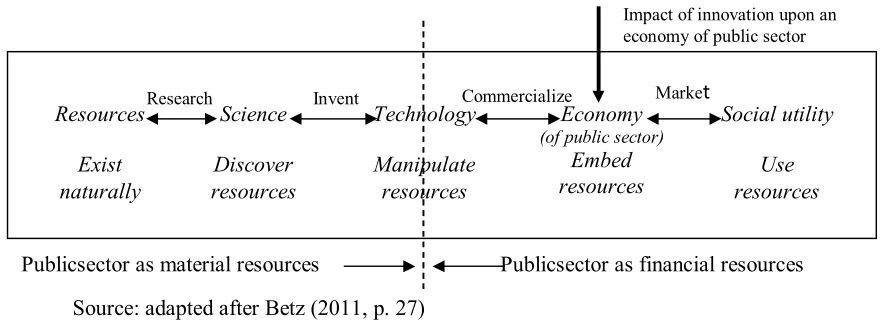
Generally, innovation in the public sector will occur, often, within the interface between knowledge and economy. Betz (2011) describes this interaction process as “a radical innovation process – transforming knowledge of nature into economic utility”.
Innovation in the public sector transcends the border between public goods and services and public market, transforming the resources of the public sector into public utility, which can be quantified only on the public market.
Figure 1. Innovation process in the public sector
Source: adapted after Betz (2011, p. 27)
Figure 1 describes in a suggestive way, the stages and processes of knowledge, creativity and action aimed at creating and highlighting the utility of innovation.
The utility of innovation is turned into account as factor of adjustment for the innovative system.
The concept of utility was introduced by Von Neumann and Morgenstern (1947).
When the concept of utility is adjusted to the general topic of innovation systems (Matei, 1999), we assume the adoption of a system of axioms, describing the properties specific for a function with real values, called function of utility of innovation.
Resources
Exist naturally
Science
Discover resources
Technology
Manipulate resources
Economy (of public sector)
Embed resources
Social utility
Use resources
Publicsector as material resources Publicsector as financial resources
Research Invent Commercialize Market
6
Taking into account the fact that the implementation of any innovation assumes complex technological and managerial activities, we shall associate a technological alternative, to any innovation. Consequently, the function of utility will be as follows:
: { , , … } →
From the economic point of view, the utility of innovation expresses the ratio competition/innovation, generating the feedback of the innovation system.
Similar with the theory of decision, the theory concerning the utility of innovation, based on Von Newmann and Morgenstern (1947) or Marinescu and Marin (2009) axioms involves a subjective estimation, namely a complex and difficult estimation of the utility of innovation.
The above-mentioned argument can also be justified by the application of the principle of emergence (synergy). Thus, the emergent effect of innovation represents a consequence of that principle, namely the overall effect of innovation within the system ( ) will be as follows:
( ) = ( ) + ∆( , … , )
where ( , … , ) represents the outcome further the partial overlap of the technological alternatives and consequently further the interdependency of the subsystems comprised in the innovation system.
3. Innovation strategies
3.1 Generalities
Obviously, the elaboration of some development strategies is approached by the field management literature. Without being exhaustive, we would like to underline several authors: Boldur et al. (1982), Matei (1998), Antoniv and Ruda (2014), etc.
Strategy formulation begins with the identification of objectives and the determination of the methods for searching objectives. Those objectives and activities are then scaled to fit within resource constraints. Each element of a strategy is constrained by political, social, economic and environmental variables. The objectives and activities of public organizations are constrained by the formal authority provided by statute (Cohen and Eimicke, 1996:5).
The innovation strategies comprise finite sequences of innovative activities and processes, ordered in time, related to available resources, innovative capability and objectives of strategic development of the organization or public sector.
The strategies on short or medium term could become sequences of an innovation strategy on long term.
(2)
7
We shall consider that an innovation strategy represents a complex target-oriented, technological, institutional and managerial process.
For an innovation strategy, we shall distinguish the following characteristics:
the objective to be fulfilled through innovation should be accurately defined through various quantitative and qualitative parameters;
a set of operations, consisting in new quantitative and/or qualitative processes and changes, necessary to achieve one or more innovations. The set of operations and innovation processes will represent the structure of the innovation strategy.
Marking the set of operations for an innovation strategy with = { , ,… ,}, the innovation process will be defined as an application, : →
( ), indicating the order of precedence for operations.
Consequently, an innovation strategy may be represented through an oriented graph without circuits, = ( , ), where the peaks signify the operations within the strategy and the arches , indicate the order of precedence, imposed to the operations and , according to the application associated to the innovative process ( ∈ ( )).
The application is defined so that a finite sequence of operations from the innovative process corresponds to each innovation from the innovation strategy.
An integer positive number, marked with di and entitled the duration of operations is associated to each operation , = 1, 2, … , .
At the same time, we shall assume that various k resources are used in order to achieve the innovation strategy, each resource with a constant available level within every period of time. We shall mark the vector of the available resources withD = (D , D , … , D ) and the vector of resources necessary to carry out the operation ∈ in every unit of time with , ,… , .
If = 0, it means that the operation is turning into account the resource p.
For the public sector, we assume that the structure of the strategy comprises operations, independent or not, generally using the same resources.
Consequently, the accomplishment of an innovation strategy involves the problem of ordination, consisting in establishing an order to achieve the operations so that the interdependencies are observed and the total duration for operations is minimal.
3.2 Optimality of the innovation strategies
8
The models of strategies are based on reformulating Bellman’s principle of optimality. Accordingly, an optimal innovation strategy comprises optimal sequences of innovation that are developing in time within the framework of ordination programmes.
A) Unicriterial optimality
Taking into consideration the above conditions, an optimal innovation strategy is based on a linear programming problem in integer numbers.
We use the following notations:
e= the minimum term to start the application of the innovation strategy; T= the maximum term to implement the innovation strategy;
= the minimum term to start the operation, ∈ ; = the maximum term to conclude the operation ∈ ;
The terms ” ” and ” ” are given in the very beginning. Using the algorithm which calculates the critical path, we may determine the terms , , = 1, 2, … , .
We assume that all parameters are positive or null.
Considering:
= 1 if the operation a starts at the moment t ∈ e , l − d 0 in rest
= 1 if the strategy was implemented at the moment t ∈ [e, T] 0
The minimization of the duration for implementing the innovation strategy will represent a main criterion of optimality for problem-solving, thus contributing to the development of the utility of innovation and even to its maximization.
Consequently, we obtain the following problem of optimization:
( )
= 1, = 1,2, … , ;
(4)
(5)
(6)
(7)
9 = 1;
+ ≤ , ∈ ;
+ ≤ , ( , ) ∈
≤ , = 1,2, … , , = , + 1, … , .
where = 1, 2, … , , represents the length of the critical path, = { ∈ ⁄ , =Ф} and L = the set of the arches for graph G = (A, Γ).
The first restriction takes into account the accomplishment of each operation. The second restriction refers to strategy implementation during the period ( , ). The third restriction shows that the strategy implementation has concluded after the end of the final operation, . Other restrictions indicate the direct precedence among the operations, determined by the graph. The next group of restrictions expresses the limit of resources.
In order to determine the optimal solution of the above-formulated problem, we shall introduce and define accurately other notions and concepts, relevant for the innovation strategy implementation.
Thus, we shall specify that the operation a ∈ A precedes the operation a ∈ A and we shall mark a ≺ a if a ∈ Γ (a ). It is assumed that in this case ai proceeds directly a , a ≺≺ a or there is a path that links the peaks aand a in the graph.
10
At the same time, we specify that the operation a ∈ A is parallel with the operation a ∈ A and we shall mark a ‖a if neither the operation a precedes the operation a a ⊀ a or (a ⊀ a ).
A sequence S = {a , a , . . . , a } is achievable if for any operation a , a with p < q, we obtain a ≺ a or a ‖a . For any possible sequence S, a vector V = {v , v , . . . , v } will be denominated as programme of ordination, having the following property: for any pair of operations a , a ∈ A with a ≺≺ a the relation v + d ≤ v is checked.
We notice that the programmes of ordination stipulate the terms for beginning the operations within the framework of a sequence. The duration for a programme of ordination associated to a possible sequence represents a parameter.
T(S) = max
∈ (v + d )
The determination of an optimal solution for the linear programming problem in integer numbers is equivalent to the determination of possible sequences and programmes of ordination, so that the duration of these programmes should be minimal.
B) Example
The approach of the problem concerning the unicriterial optimality of the innovation strategies could be associated to classical problems of linear programming in integers or with a problem of ordination (Boldur et al., 1982: 204-207). Rephrasing one of the examples presented in the mentioned paper, we shall consider an innovation strategy S = {I , I } where I = {a , a , a }, and I = {a , a , a } represent sequences of operations , = 1,6, using scarce resources ( = 1, = 1,3), , = 1,3 according to Table 1.
Resources Innovations
r1 r2 r3
I1 a1 a5 a3
I2 a6 a4 a2
Table 1. Operations
Operations
Innovations a1 a2 a3 a4 a5 a6
I1 1 0 5 0 2 0
I2 0 4 0 5 0 4
Table 2. Length of operations
Maintaining only the achievable sequences, we shall obtain the programmes of ordination:
S1 = (a2, a4, a6, a1, a3, a5), S2 = (a1, a2, a3, a4, a5, a6),
S3 = (a1, a2, a3, a5, a4, a6), S4 = (a1, a3, a2, a4, a5, a6),
S5 = (a1, a3, a5, a2, a4, a6),
11 V1 = (0,2, 7, 11, 12, 17),
V2 = (0, 0, 2, 2, 7, 7), V3 = (0, 0, 2, 7, 9, 14), V4 = (0, 1, 6, 8, 13, 13),
V5 = (0, 1, 6, 6, 8, 13),
T(S1) = 19; T(S2) = 11;
T(S3) = 18; T(S4) = 17; T(S5) = 17.
According to the criterion of optimality, it results that S2 will be the optimal innovation strategy, holding the smallest length of accomplishment.
C) Multi criteria optimality
Most models of optimality of the innovation strategies take into consideration restrictions of time, scarce resources and social utility of innovation. Antoniv and Ruda (2014) describe a mathematical model, applicable to the innovation strategies in the public sector, using the optimal values of “net present value (NPV), integral risk indicator (IR) and coefficient of social utility (SU) of the innovation portfolio” (Antoniv and Ruda, 2014:468). In fact it means the maximization of the net present value and public needs satisfaction and minimization of risk.
Without detailing all the elements and modalities in view to calculate NPVP (tj) - the net present value of innovation strategy, at tj moment, we shall have:
= max
as objective function of a model specific of linear programming.
The second optimal value – integral indicator of risk – is determined by a complex process of risk management, associated with high degree of uncertainty and time gap between the launch of new process of innovation and its implementation (Antoniv and Ruda, 2014:468).
Thus, it derives an objective function of a specific linear programming problem:
= min
Taking into consideration the structure of the innovation strategy as well as the objective criteria concerning time and scarce resources, the social utility will be expressed as a matrix‖U t ‖, whose elements reflect the impact of q - innovation project on the value of public utility of the p - project at tj moment.
Also in this case, we obtain an objective function:
(14)
(15)
12 = max
The profile of the optimal innovation strategy will be determined based on the coefficients of importance of the three optimal values, previously described, and related to the so-called “ideal state” of reference for implementing the criteria of optimality.
D) Empirical considerations
Determining an optimal structure of an innovation strategy is in general difficult when using multiple criteria.
Opting for the three criteria previously suggested in accordance to Antoniv and Ruda (2014), we should highlight the diversity of their evaluation methods.
Referring to the net present value – NPV - of an innovation strategy, Antoniv and Ruda (2014: 467) selects its estimation related to the cash flows for various operations from the structure of the strategy and “discount rate using WACC methods”.
Less general approaches which are providing useful information for a good decision on the optimal innovation strategy use the actual value of investment after a period of time.
In the example above presented, we shall calculate this value also assimilated with NPVP, for each sequence achievable, , = 1, 5, considering a unitary investment. Consequently:
NPV = 1 (1 + r)⁄ ( ), i = 1, 5
where T(Si) represents the period of time necessary for implementing the strategy, and r represents the annual rate of banking actualization.
The evaluation of the risk indicator takes also into consideration multiple factors. Based on several characteristics of the business environment, it includes the attitude before risk in the public sector. In this respect, it is worth to mention the prudential attitude before risk of the public sector. The current approach is accomplished in general conditions of uncertainty. Therefore we shall not assume as known the probabilities for accomplishing various operations from an innovation strategy in the public sector.
Taking into account the above conditions, correlated also with the specificity of the achievable sequences comprised in the innovation strategy, the risk indicator will be calculated for each operation, while for each programme of ordination, it will be considered:
= max
, ( ) , = 1,5
(17)
13
The above optimum is due to the fact that the increasing risk of an operation could induce, under certain conditions, a maximum risk for the entire programme of ordination. Finally, it is worth to mention that we shall consider that the risk indicator is proportional with the length of each operation.
Referring now to the third criterion, the social utility of innovation, we have to take into consideration other approaches of innovation, such as that concerning the utility of a decisional alternative.
In this context, it is necessary to evaluate the utility of each operation, and afterwards, maintaining the prudential attitude, to take into discussion the smallest utility.
Known that utility is a subjective dimension, depending often on preferences, we shall take into account a series of axioms of utility, which transposed to innovation refer to comparability of innovative strategies and operations, linearity of the functions of utility for those strategies etc.
At the same time, both the utility and risk could depend on the time necessary for implementing an operation. Therefore, taking into consideration the lack of risk aversion in the public sector, it could be assumed that the risk is proportional with the mean expected utility, thus triggering:
SU = 2∝ IR , = 1,5
Taking into account the above considerations, for the example formulated, we have found the following values for the three criteria (Table 3).
Vi NPV IRi SUi
V1 0.963 0.895 0.769
V2 0.978 0.636 0.346
V3 0.965 0.777 0.460
V4 0.966 0.764 0.614
V5 0.966 0.764 0.509
Table 3. Empirical values of optimal criteria
In view to determine the optimal programme for an innovation strategy, Antoniv and Ruda (2014: 469) suggest the introduction within the research of “an ideal state”, called also “benchmark of development”, characterised by:
the value of the integral indicator of risk of the innovation strategy is equal to zero;
the coefficient of the social utility is equal to 1;
the value of the net present value is equal to the “ideal” value of NPV* for innovation strategy.
14
This “ideal state” is configured as a reference state in a three dimensional model.
The next step consists in determining the deviation calculated by the distance from the found points to the point of “ideal state”, using the formula:
= ∗− + ( − ) + (1 − ) ∕
Thus, we shall obtain a set of distances, d = (d ), = 1,5 and through minimization it results the index of the optimal programme of ordination.
Consequently, applying (20) to the data from Table 3 and considering NPV∗ =1, we obtain:
d = (0.925, 0.912, 0.947, 0.857, 0.908)
The smallest distance d = 0.857 will correspond to the programme of ordination V4, which becomes the optimal solution for the innovation strategy whenever applying the three criteria.
Taking into consideration several details of the optimal criteria, the authors also propose a model of calculation closer to reality, in view to include the coefficients of importance for the three criteria, enabling to weight formula (20).
Conclusions
The topic of optimal innovation strategies debated by the current paper turns into account interdisciplinary approaches, combining both theories of innovation, complexity of the public sector and analysis of complex systems, modelling and linear programming.
An innovation strategy in a public sector organization will be obtained by overlapping and making compatible two strategic plans: a general one, determining the development objectives on medium and long term of the organization and an operational one, using innovation and its multiple valences, as resource of development.
The specificity of such an approach in the public sector involves the use of complex adaptive systems, revealing and describing the innovation, adaptation or change processes, dominating the actual reality of the public sector.
The optimality of the innovation strategies represents an important component of the evaluation of socio-economic and investment impact of public innovation or social innovation.
The application of more rigorous models of optimality occurs rarely in the practice related to evaluation of the socio-economic impact of innovation in the public sector, providing new perspectives for the approach, theoretical and empirical development of optimal innovation strategies.
(20)
15
REFERENCES
[1] Altshuller, G. (2002). 40 principles: TRIZ Keys to Technical Innovation.
Worcester, MA: Technical Innovation Center, Ink.;
[2] Antoniv, V., Ruda, I. (2014). “The problem of choosing an optimal strategic profile of innovation for a dynamic enterprise”. Actual Problems of Economics, Vol. 153, Issue 3, 463-471;
[3] Bekkers, V., Edelenbos, J., Steijn, B. (Eds). (2011). Innovation in the Public
Sector. Linking Capacity and Leadership (Governance and Public Management, 6). Houndsmills: Palgrave MacMillan;
[4] Betz, F. (2011). Managing Technological Innovation. Competitive Advantage
from Change. 3th Edition, New Jersey: John Wiley & Sons, Inc.;
[5] Bloch, C. (2011). Measuring Public Innovation in the Nordic Countries (MEPIN). Danish Centre for Studies in Research and Research Policy: Aarhus
[6] Boldur, Gh., Ciobanu, Gh., Băncilă, I. (1982). Analiza sistemelor complexe
(Analysis of complex systems). Bucureşti: Editura Ştiinţifică şi Enciclopedică; [7] Cohen, S., Eimicke, W. (1996). “Understanding and Applying Innovation Strategies in the Public Sector”.5th Annual Conference of the American Society for Public Administration, Atlanta, Georgia;
[8] Council of Canadian Academies (CCA). (2013), “Innovation Impacts: Measurement and Assessment”. The Expert Panel on the Socio-economic Impacts of Innovation Investments, Ottawa, Canada, http://www.scienceadvice.ca/uploads/eng/assessments%20and%20publication s%20and%20news%20releases/ontario_inno/roi_fullreporten.pdf;
[9] De Vries, H., Bekkers, V., Tummers, L., G. (2014). “Innovation in the Public Sector: A Systematic Review and Future Research Agenda”. Ottawa: IRSPM Conference;
[10] Drucker, P.F. (1986). Innovation and Entrepreneurship. New York: Harper & Row Publishers Inc.;
[11] Edquist, C. (2001). “The Systems of Innovation Approach and Innovation Policy: An account of the state of the art”. DRUID Conference “National Systems of Innovation, Institutions and Public Policies”, Aalborg, Denmark; [12] Engler, J.J. (2009). Innovation as an adaptive system. MS (Master of
Science) thesis, University of Iowa, http://ir.uiowa.edu/etd/233;
[13] European Commission (EC). (2013). “Implementing on Action Plan for
Design – Driven Innovation”. SWD 380 final,
http://ec.europa.eu/enterprise/policies/innovation/files/design/design-swd-2013-380_en.pdf;
16
http://ec.europa.eu/enterprise/policies/innovation/policy/public-sector-innovation/index_en.htm;
[15]Galbraith, J.R. (1982). “Designing the Innovating Organizations”. Organizational Dynamics, Winter 1982, pp. 3-24;
[16]Golden, O. (1990). ”Innovation in Public Sector Human Services Programs: the Implications of Innovation by Groping Along”. Journal of
Policy Analysis and Management, vol. 9 (Spring), pp. 219-248;
[17] Kusiak, A. (2006). “Innovation Science”. Proceedings of the 11th IEEE International Conference on Emerging Technologies and Factory Automation, pp. 507-414, Prague, Czech Republic;
[18] Lawson, B., Samson, D. (2001). “Developing Innovation Capability in Organizations: A Dynamic Capabilities Approach”. International Journal of Innovation Management, 5 (3):377-400;
[19] Marinescu, D., Marin, D. (2009). ”Risk and Uncertainty: Analyzing the Income and Substitution Effects”. Economic Computation and Economic Cybernetics Studies and Research, vol. 43, no. 1, pp. 41-54;
[20] Matei, A., Antonie, C. (2005). ”Complexity Theory and the Development of the Social Innovation”. Procedia-Social and Behavioral Sciences, Vol. 185, pp. 61-66;
[21] Matei, A., Drumașu, C. (2015). ”Corporate Social Innovation in the Romanian Public Sector”. Procedia Economics and Finance, vol. 23, pp. 406-411;
[22] Matei, L. (1998). Managementul dezvoltării locale. Descentralizare.
Inovație. Risc. București: Editura Economică;
[23] Neumann, J. von, Morgenstern, O. (1947). Theory of Games and Economic
Behavior. NJ, US: Princeton University Press;
[24] Petkovsek, V., Cankar, S.S. (2013). “Public Sector Innovation the European Union and Example of Good Practice”. in Dermol, V., Širca, N. T., Dakovic, G. (Eds.), Active Citizenship by Knowledge Management & Innovation, Proceedings of the Management, Knowledge and Learning International Conference, pp. 1245-1252, Zadar, Croatia, http://www.toknowpress.net/proceedings/978-961-6914-02-4/;
[25] State Services Commission (SSC). (2013). Designing and growing
innovation capability, New Zealand Government,
http://www.ssc.govt.nz/sites/all/files/case-study-growing-innovation-capability.pdf;
[26] Stokic, D., Campos, A., Sorli., M., Gorostiza, A. (2003). “KM system to support incremental innovation in manufacturing industry”. in Cha, J., Jardim-Goncalves, R., Steiger-Garcao, A. (Eds.), ”Advanced Design, Production and Management Systems”, pp. 1143-1150, Proceedings of the 10th ISPE International Conference on Concurrent Engineering, Madeira,
Portugal, http://www.gbv.de/dms/tib-ub-hannover/478480814.pdf;
17