Non-Malleable Codes Against
Bounded Polynomial Time Tampering
Marshall Ball1, Dana Dachman-Soled2, Mukul Kulkarni2, Huijia Lin3, and Tal Malkin1 1 Columbia University
{marshall,tal}@cs.columbia.edu 2 University of Maryland [email protected], [email protected]
3
University of Santa Barbra [email protected]
Abstract. We construct efficient non-malleable codes (NMC) that are (computationally) secure against tampering by functions computable in any fixed polynomial time. Our construction is in the plain (no-CRS) model and requires the assumptions that (1)E is hard forNP circuits of some exponential 2βn (β > 0) size (widely used in the derandomization literature), (2) sub-exponential trapdoor permutations exist, and (3)P-certificates with sub-exponential soundness exist.
While it is impossible to construct NMC secure against arbitrary polynomial-time tampering (Dziembowski, Pietrzak, Wichs, ICS ’10), the existence of NMC secure againstO(nc)-time tampering functions (for any fixed c), was shown (Cheraghchi and Guruswami, ITCS ’14) via a probabilistic construction. An explicit construction was given (Faust, Mukherjee, Venturi, Wichs, Eurocrypt ’14) assuming anuntamperableCRS with length longer than the runtime of the tampering function. In this work, we show that under computational assumptions, we can bypass these limitations. Specifically, under the assumptions listed above, we obtain non-malleable codes in the plain model againstO(nc )-time tampering functions (for any fixedc), with codeword length independent of the tampering time bound.
Our new construction of NMC draws a connection with non-interactive non-malleable commitments. In fact, we show that in the NMC setting, it suffices to have a much weaker notion calledquasi non-malleable commitments— these are non-interactive, non-malleable commitments in the plain model, in which the adversary runs inO(nc)-time, whereas the honest parties may run in longer (polynomial) time. We then construct a 4-tag quasi non-malleable commitment from any sub-exponential OWF and the assumption thatE is hard for some exponential sizeNP-circuits, and use tag amplification techniques to support an exponential number of tags.
1
Introduction
Non-Malleable Codes (NMC) were introduced by Dziembowski, Pietrzak, and Wichs [DPW10] as a modification of error correcting codes, with the goal of achieving security against adversarial tampering functions, that may change every part of a codeword. Informally, a NMC against a classF guarantees that if a codeword is tampered via the application of a function f ∈ F, then the decoding of the tampered codeword will either be exactly the original message, or completely unrelated to the original message. As noted in [DPW10], it is impossible to construct NMC against arbitrary tampering functions, since non-malleability can always be broken by a tampering function which first decodes the codeword to learn the underlying message, then re-encodes a related message. In particular, there can be no efficient NMC against arbitrary polynomial time tampering. Thus, to achieve feasibility, we must restrict the class of tampering functions.
BDSG+18] constructed NMC against AC0 relying on different complexity theoretic techniques, and some works considered (restricted variants of) NMC against space-bounded tampering [FHMV17, BDKM18]. Specifically, the work of Faust et al. [FHMV17] considers space-bounded tampering adversaries in the random oracle model and achieves the security notion of leaky continuous non-malleability. The work of Ball et al. [BDKM18] is information-theoretic, considers streaming, space-bounded tampering adversaries and achieves standard non-malleability. The current work continues this line of research.
In this paper, we focus on the task of constructing NMC against boundedpolynomial time tampering, namely tampering functions that are computable in an arbitaryfixedpolynomial time. This is a very natural class to consider given the impossibility result for (unbounded) polynomial time, and indeed, some of the first works in this line of research have already considered this class. We discuss these next, along with the motivation and goals for our current work.
Cheraghchi and Guruswami [CG14] gave probabilistic constructions of efficient codes for circuits of size O(nc) (where an efficient randomized procedure outputs a “good” code with high probability). Faust et.al [FMVW14] gave an improved (in terms of the dependence on the error bound) construction against the same class, which is explicit, but relies on a model including an untamparable CRS (common reference string). The presence of CRS is undesirable, as not only must the CRS be generated by a trusted party, the CRS is also a non-tamperable component of the scheme. Moreover, both of these works can be viewed as using limited (t-wise) independence to partially derandomize probabilistic constructions. This approach inherently leads to a CRS whose length is at least as long as the bound on the size of the tampering circuits — meaning the tampering circuits cannot even read the entire CRS. We additionally note that if we allowed other size parameters, in particular the codeword size, to be as large as the runtime of the tampering function, then achieving non-malleability would become trivial. This motivates the following questions:
Can we construct efficient NMC against bounded polynomial time adversaries, in the plain model (i.e.withoutCRS)? Ideally, with codeword length that is independent of the runtime of the adversarial tampering function?
As we elaborate next, we achieve this by moving to computational security and restricting our attention to uniform adversaries (while [CG14,FMVW14] gave statistical guarantees against non-uniform adversaries). In addition, as explained shortly below, we allow uniform bounded polynomial time tampering adversaries to have an inverse polynomialadvantage(as in [CG14]) as opposed to having only negligibleadvantage(as in [FMVW14]). We emphasize that to the best of our knowledge, there is no transformation that either (a) eliminates the CRS in the NMC of [FMVW14] to achieve security against uniform (or non-uniform) adversaries or (b) fully derandomizes the monte carlo construction of [CG14],even under derandomization assumptions. Our techniques highlight interesting new connections to complexity theory.
1.1 Our Results
Our construction requires a complexity theoretic assumption that some language in the complexity class
E (the class of languages that can be decided by Turing machines running in time 2O(n)) is hard for NP circuits of some exponential 2βn (for β > 0) size. As surveyed later, such assumptions are widely used in the derandomization literature, often referred to as derandomization assumptions, and have connection with cryptography. Our construction also relies on the following cryptographic assumptions: the existence of subexponential trapdoor permutations andP-certificates (P-cert) with sub-exponential soundness.P-certs (introduced by [CLP13]) are “succinct” non-interactive arguments for languages L ∈P, with proof length which is a fixed polynomial, independent of the time it takes to decide L (see Section 2.4 for a formal definition). We provide more background on these assumptions in Section1.2below.
Theorem 1 (Informal).Assuming
– Existence ofP-cert with sub-exponential soundness
for every constantcA, there is an efficient construction of NMC in the plain (no-CRS) model against uniform,
bounded polynomial ncA-time tampering adversaries, with inverse polynomial indistinguishability (for any polynomial time non-uniform distinguisher). Furthermore, the codeword size is a fixed polynomial independent of ncA.
A few remarks are in order. First, to formalize that a tampered codeword, if not copied from the orginal codeword, must decode to an independent value, the definition of non-malleability requires that the decoded values,u1 and u2, obtained from tampering codewords of different values, v1 andv2 respectively, must be indistinguishable (ub is replaced by same in the case of copying). Our NMC achieves inverse polynomial distinguishing advantage against polynomial-time non-uniform distinguishers .
Second, as mentioned before, it is important that the length of the codeword is smaller than the time-boundncAof the tampering functions; otherwise, achieving non-malleability becomes trivial. Here, we achieve
the ideal case, where thelengthof the codeword is bounded by a fixed polynomial, independent ofncA. As the
adversarial time bound grows, the only parameter that grows is the run time of encode/decode. Moreover, this dependence isnecessary as discussed earlier, since non-malleability is trivially impossible when the class of tampering functions includes the encode/decode functions.
Finally, we note that the assumption of the existence of sub-exponential trapdoor permutation in Theorem1, can be replaced with the assumption of the existence of ZAPs (public coin, two message witness indistinguishable protocols) [DN00] with witness indistinguishability against sub-exponential adversaries and the existence of sub-exponential one-way functions (OWF). Note that ZAPs can be constructed from bilinear maps [GOS06], which are not known to imply trapdoor permutations.
Connection between NMC and Non-Malleable Commitments. Our construction of NMC draws a connection with another important notion of non-malleability – non-malleable commitments [DDN03, LPV08]. The only difference between NMC and non-interactive non-malleable commitments is that the former can be decoded efficiently, whereas decommitment of the latter cannot be done efficiently. A few prior works leverage this connection, showing that NMC can be used to obtain improved non-malleable commitments [GPR16,
CGM+16], and using techniques from the non-malleable commitment literature to obtain NMC [CGL16,
OPVV18]. However, the latter direction—tapping into the wealth of techniques from the non-malleable commitment literature to construct NMC—has been largely unexplored, perhaps due to the fact that NMCs are typically unconditionally secure.
In our NMC construction, we begin with the framework of Ball et al. [BDKM18], which provides a generic way to construct NMC against tampering classesFfor which sufficiently strong average-case hardness results are known, but requires a CRS. We show how to remove the CRS for particular tampering classes, including the class of bounded, poly-time adversaries. One modification is replacing the public key encryption scheme in the framework of [BDKM18] (whose pubic keys are contained in the CRS) with a interactive, non-malleable commitment schemeNMComin the plain model.
the derandomization literature. (For more details on the NMC construction see the technical overview in Section1.3).
Connection between Complexity Theory and Non-Malleable Commitments. Another contribution of this work, is to develop new connections between complexity theory and non-malleable cryptography. Specifically, we show that derandomization assumptions can be employed to build a new primitive we call Quasi Non-Malleable Commitments, which is weaker than standard non-malleable commitments, but nevertheless suffices for constructing NMC. This allows us to avoid adding the assumptions needed for standard non-interactive NMComsuch as time-lock puzzles or hardness amplifiable injective one-way functions [LPS17,
BL18].
Recall that in the setting of non-malleable codes, encode/decode can be in a larger complexity class than the adversary, and so standard non-interactive NMCom is an overkill. This motivates our definition of Quasi Non-Malleable Commitments in which the adversary runs in O(nccom)-time, whereas the honest
parties may run in longer (polynomial) time. To construct Quasi-NMComfrom assumptions that are widely used in the derandomization literature, observe that these assumptions allow us to construct polynomial-time computable functions ψ for which non-deterministic advice does not help speed up the computation. This stands in stark contrast to the case of inversion of a one-way function ρ, which becomes easy with non-deterministic advice (as the advice can contain a pre-image). Following the framework of [LPS17], we construct two types of commitments that are harder than each other in different hardness “axes” — namely “BP-time” (corresponding to probabilistic Turing machines) and “non-deterministic (ND)-size” (corresponding to NP-circuits–see Sections 1.2 and 2.5). More specifically, one type of commitmentcom1 are the standard schemes based on one-way functionsρ, and the othercom2is based on the functionψgiven by derandomization assumptions. The com1 is much harder to break thancom2 in the axis of “BP-time”, as inverting one-way functionρis much harder than computing ψusing probabilistic Turing machines. On other hand,com2 is much harder to break than com1 in the axis of “ND-size”, where both invertingρand computingψcan be done in poly-size, but computingψis significantly harder.
From such mutually harder commitment schemes, we obtain a 4-tag Quasi-NMCom. Then, based on tag-amplification techniques in the literature [KS17b, BL18], we increase the number of tags supported to an exponential. It turns out that the quasi-setting makes amplification hard, which requires us to introduce a notion of “Double-Agent” adversaries. Informally, double-agent adversaries are probabilistic uniform Turing machines with “large” time complexity, that can also be represented as a distribution over circuits with “small” size complexity (see Section2.1 for additional details). Post-amplification, our final Quasi-NMCom construction employs the same assumptions as Theorem 1. We believe these techniques may be useful for other applications in similar quasi-settings.
1.2 Background on Assumptions
In this section we provide some background on the assumptions that we use.
OnP-certificates. P-certificates were introduced by [CLP13] in pursuit of constant-round concurrent zero-knowledge. Loosely, a P-certificate is a non-interactive proof system that allows a prover to convince an efficient verifier of the validity of any statement inPvia a short proof. In particular, both the proof length and the run-time of the verifier are bounded by some fixed polynomial, but the system should work any language in P (the prover’s efficiency should be comparable to the statement). CS-proofs [Mic00] imply
P-certificates, but unlike the former, the latter assumption is falsifiable.
In the 1980s, Yao [Yao82] showed that one-way permutations suffice to create pseudorandom generators (PRG) for poly-time computation. PRGs expand a small sequence of uniform random bits to a long sequence of pseudorandom bits that “fool” classes of procedures in the sense their behavior is essentially the same as if they were given truly random bits. In this sense, PRGs give a canonical technique for derandomizing decision procedures: running the procedure on multiple outputs of the PRG in parallel and taking majority of the obtained result. Later, it was shown that essentially minimal cryptographic assumptions (one-way functions) suffice for constructing PRGs [HILL99].
However, while most cryptography implies non-trivial derandomization, there seem to be inherent barriers to statements of the converse form. In fact, the so-called “cryptographic” PRG’s yield, in two aspects, much more than what is required for derandomization since (a) the output of such PRGs fool any polynomial time procedure (including procedures that run in much more time than the PRG itself) and (b) such PRGs guarantee that the behavior of poly-time procedures is only negligibly different from their behavior on true randomness. On the other hand, one-way functions are not known to imply P = BPP because known constructions only “stretch” random bits into polynomially many random bits (whereas exponential stretch is required for canonical simulation).
Capitalizing on these observations, Nisan and Wigderson [NW94] gave a generic means of constructing PRGs which “fool” a certain class of circuits C, from any function that is hard-on-average for a slightly enlarged class of circuits. In particular, this in some sense reduces the problem of explicit derandomization to proving strong circuit lower bounds on explicit functions. To this end, later work showed that, in fact, simply assuming there is a language inEthat does not have have circuits size 2βnfor someβ >0 (for almost alln), is sufficient to derandomizeBP P [IW97, STV01]. Moreover, becauseEhas complete problems, this yields explicit pseudorandom generators. However, for reasons alluded to above, this assumption is, to best of our knowledge, incomparable to standard cryptographic assumptions.
This latter (worst-case) conjecture and its generalization has appeared in a variety of contexts pertaining to derandomization and other questions in computational complexity [Lip89, NW94, BFNW93, IW97,
STV01,HN10,KVM02,SU06,SU09,FL97,MV05,TV00,SU05,GW02,GSTS03,Dru13].
The conjectures we are concerned with in this work take the following form (following [AASY16]):
Assumption 1 (E is hard for exponential size X-circuit) There exists a problemLinE=DTIME(2O(n))
and a constant β > 0, such that for every sufficiently large n, X-circuits of size 2βn fail to compute the
characteristic ofL on inputs of lengthn.
whereX-circuits in Assumption1can be the circuits of type,{non-deterministic, co-non-deterministic,NP,
Σi}. See section2.5, for definitions of these types of circuits.
While these types of assumptions are independently interesting, in this work we will utilize some surprising implications outside of derandomization.
Recently, Applebaum et al. [AASY16] presented (explicit) constructions of poly-time computable incompressible functions based on the assumption that E is hard for exponential size non-deterministic circuits (based on the extractors for samplable distributions of Trevisan and Vadhan [TV00]). Loosely, a function,ψis incompressible for a class if no procedure in that class can “shrink” an input to the function, x, such thatψ(x) can later be recovered. Note that, to our knowledge, it is not known how to construct incompressible functions from standard cryptographic assumptions (unlike the case of derandomization).
Barak et al. [BOV07] observed that similar assumptions can be used to construct cryptographic primitives. In particular, they showed that ifE=DTIME(2O(n)) contains a function withco-non-deterministiccircuit complexity 2Ω(n), then there exists (explicit) non-interactive witness indistinguishable proof systems for
L∈NP (additionally assuming the existence of trapdoor permutations). They also showed that the same assumption can be used to construct a non-interactive bit commitment scheme from a one-way function.
of [BOV07], as well as the incompressible functions of [AASY16], to obtain our main result: a family of efficient non-malleable codes secure against tampering by uniform algorithms running in timeO(nc).
1.3 Technical Overview
We begin by recalling (a simplified version of) the template for constructing non-malleable codes against complexity classF (based on the Naor-Yung double encryption paradigm [NY90]) introduced in the work of Ball et al. [BDKM18]:
The CRS contains a public keypkfor an encryption schemeE= (Gen,Encrypt,Decrypt), and a CRScrs for a simulation-sound, non-interactive zero knowledge proof (NIZK). For b∈ {0,1}, letDb denote disjoint distributions overx1. . . xn∈ {0,1}n such thatψ(x1. . . xn) =b, whereψis poly-time computable, yet every f ∈ F has low correlation with ψ.
To encode a bit b:
1. Randomly choose stringx1. . . xn fromDb 2. Computec←Encryptpk(b).
3. Compute a NIZK proofT of “consistency”: ∃b0 ∈ {0,1} s.t. x1. . . xn is in the support of Db0 and b0 is
the plaintext underlying c. 4. Output (x1. . . xn, c, T).
To decode (x1. . . xn, c, T): 1. Verify the NIZK proof T. 2. If it accepts, outputψ(x1. . . xn).
The proof of [BDKM18] proceeds (loosely) as follows: In the first hybrid they switch to simulated proof T0. Then they switch c, in the “challenge” encoding to an encryption of garbage c0, and next switch to an alternative decoding algorithm in F, which requires the trapdoor sk (corresponding to the public key pkwhich is contained in the CRS). If, in the final hybrid, decodings of tampered encodings depend onb, a circuit inFcan be constructed, whose output is correlated with the hard functionψ, reaching a contradiction. While [BDKM18] do in fact show that the CRS can be removed for constructions against certain classesF
of tampering, naively, their approach requires a CRS in two seemingly inherent ways: First, the CRS allows the use of the secret key trapdoorsk in the alternate decoding algorithm and second, it allows the use of a simulation-sound NIZK, which requires CRS.
In this work, we make two crucial observations that allow us to eliminate the CRS from the above construction. First, we consider a stronger notion of hardness for ψ, known as incompressibility (in fact, this hardness notion was already implicitly used in [BDKM18] for their multi-bit construction). Briefly, if a function ψ is incompressible by circuit class C, it means that for t n, for any (computationally unbounded) Boolean function F : {0,1}t → {0,1} and any C : {0,1}n → {0,1}t ∈ C, the output of F ◦ C(x1, . . . , xn) is uncorrelated withψ(x1, . . . , xn) (over uniform choice ofx1, . . . , xn). Now, sinceF is allowed to be computationally unbounded, we may consider an F that decrypts the ciphertext c = Encryptpk(b) by brute force search. To elaborate, instead of using sk to efficiently decrypt c in complexity class C, the alternate decoding algorithmD0is split into two partsD0 =D02◦D01, whereD01can be implemented inF, but has short output length, whereasD02 is computationally unbounded. Specifically,D01 checks the proofT and then outputs the entire ciphertextc(which is fine so long as the length ofcis sufficiently smaller thann), and, due to the incompressibility property ofψ, we must still have that the output ofD0=D02◦D01is uncorrelated with ψ(x1, . . . , xn). This eliminates the need of providing a trapdoor to the alternate decoding algorithm and so instead of using a public key encryption scheme, we may use a non-interactive statistically binding commitment scheme, which can be constructed from injective one-way function or from derandomization assumptions and any one-way function [BOV07].4
4
Next, we note that it is possible to construct a NIZK proof system in the plain (no-CRS) model (i.e. “One-Message Zero Knowledge”), with soundness against uniform adversaries. To do so, one first constructs a non-interactive witness indistinguishable proof system (NIWI) in the plain model (based on standard cryptographic assumptions and derandomization assumptions [BOV07]) and then converts from witness indistinguishability to full zero knowledge using the well-known FLS paradigm [FLS99]. Specifically, the simulator will be given a trapdoor witness based on a problem that is computationally hard foruniformPPT adversaries such as finding a collision in a keyless collision resistant hash function. The problem with this approach is that in the proof sketch outlined above, we actually requiresimulation-sound NIZK, as opposed to regular NIZK. In simulation-sound NIZK, the soundness properties must hold, even after the adversary sees a simulated proof of a false statement. Whereas various constructions of (one-time) simulation-sound NIZK rely on embedding a trapdoor within the CRS (cf. [Sah99,Lin03]), our approach to achieve the simulation-soundness property without CRS is to replace the commitmentc(which replaced the encryptionEncryptpk(b) as described above) with a non-interactive, non-malleable commitment scheme. Unfortunately, currently known non-interactive, non-malleable commitment schemes require somewhat non-standard assumptions such as time-lock puzzles or hardness amplifiable injective one-way functions [LPS17, BL18], whereas our goal is to minimize assumptions. As we will see, the fact that our commitment scheme is only required to be non-malleable against adversaries in a restricted circuit class F, allows us to obtain non-interactive, non-malleable commitments, while reducing assumptions.
Instantiating the Paradigm In this work we construct non-malleable codes against the classFof uniform, polynomial-bounded tampering functions. Crucially, we will do so (1) without relying on CRS (2) with codeword length that is independent of the polynomial time bound (note that if the codeword length is longer than the polynomial time bound then the adversary does not even get to read the entire input, also it’s trivial to construct these ) and (3) while reducing computational assumptions, to the extent possible.
Specifically, in addition to standard cryptographic assumptions, we will assume standard derandomization-type assumptions such as those discussed in the previous section. We also require the notion of P-certificates, which seem to be necessary to implement the above high-level paradigm, as we discuss next. To see why this is so, note that the statement proved in NIZK proof T, involves proving that ψ(x1, . . . , xn) is equal to some value. Note thatψ is a polynomial-time computable function, but that intrinsic in the approach is choosingψ that is hard to compute in the specific polynomial time boundT(n) corresponding to tampering classF. Moreover, we require that the size of the proofT be independent of the polynomial time boundT(n), and so in particular the size of the proofT must be independent of the time required to computeψ. This is now exactly the notion of aP-certificate.
We also note that given the above paradigm for encoding of a single bit, it is straightforward to obtain a scheme for the encoding of multiple bits (by individually encoding each bit and then using a single proof T to “wrap” together the individual encodings). The only restriction will be that the number of bits, m, that are encoded, multiplied by the length of a bit commitment,λ, should be sufficiently smaller thann, the input length of the functionψ. See Section3 for additional details.
Instantiation of ψ Recall that for the above approach to work, we must instantiate ψ with a function that is incompressible against polynomially-bounded adversaries. Fortunately, such a construction was given by [AASY16], based on a derandomization-type assumption. See Section5 for additional details.
hard for adversaries represented as exponential size NP-circuits—or circuits with access to a SAT oracle (See Sections 1.2and 2.5 for further discussions on these assumptions). To construct our NMComscheme, we start off with two different types of commitments, Type 0 and Type 1 such that if we get a Type 0 on left, we can extract from Type 1 on the right without breaking the security of Type 0 and vice versa. Each commitment consists of an input xto a Boolean function ψ0 (with logarithmic input length) that is hard forNP-circuits of size 23·input length to compute as well as the outputy of an injective OWFρ, which is hard for ppt adversaries running in time 2input length
0
3
.5Each of these can be considered as a commitment to a bit (givenx, the output ofψ0(x) is the committed value and giveny, a hardcore bit of ρ) and the final committed value is the xor of the two bits committed.
Type 0: input lengthc1log(n) toψ0, input lengthn
0
1 toρ. Type 1: input lengthc2log(n) toψ0, input lengthn
0
2 toρ. Setc2> c1> 01> 02 so that
1. nc1< n3·c2 2. 2n02 <2n03·01
We now consider the two possible cases:
Type 0 on left, Type 1 on right. Extract by inverting the injective OWF ρin deterministic time 2n
0
2 and computing ψ0 in deterministic time nc2. Note that this does not allow breaking injective OWFρ with input lengthn01, which is secure against time 2n03·01 >2n02.
Type 1 on left, Type 0 on right. Extract by computing ψ0 in deterministic time nc1 and inverting the injective OWF ρwith anNP-circuit of sizen01. Note that this does not allow breaking hardness of ψ0
with input lengthc2log(n), which is secure againstNP-circuits of sizen3·c2> nc1. See Figure1 for a summmary and Section6for additional details.
Input length toψ0 Hardness ofψ0 Input length toρHardness ofρ
D ND D ND
Type 0 c1·log(n) n3·c1 n3·c1 n
0
1 2n
0
3·01 n01
Type 1 c2·log(n) n3·c2 n3·c2 n
0
2 2n
0
3·02 n02
Fig. 1.ψ0 and ρare the functions described in the paragraph above. D stands for deterministic and ND stands for “non-deterministic” hardness. We set parameters so thatc2 > c1> 01> 02.
The above 2-tag commitment scheme can then be straightforwardly extended to work for 4 tags, at which point amplification techniques from [KS17b] can be applied to obtainNMCom with number of tags exponential in the security parameter. The analysis of the amplified scheme is somewhat different than in prior work, since our analysis must carefully take into account that some assumptions are inherently uniform (One-Message Zero Knowledge) and some assumptions (hardness ofψ0) are inherently non-uniform (the adversary in the proof is so limited that it does not have time to generate new commitments on its own and therefore must receive them as non-uniform advice when reducing security to the hardness of computingψ0). To solve this problem, we introduce the notion of “Double Agent” adversaries (as discussed in the introduction) and provide a proof of security of our amplified NMComscheme against this class of adversaries. See Section7for additional details.
5
1.4 Related Work
Non-Malleable Codes. Non-malleable codes (NMC) were introduced by Dziembowski, Pietrzak and Wichs in their seminal work [DPW10]. While there has been a long line of important results for various tampering classes, due to space limitations, we discuss here only the results most relevant to this work.
As discussed extensively in the introduction, Faust et.al [FMVW14] constructed efficient information-theoretically secure NMC in the CRS model, resilient against tampering function classes F which can be represented as circuits of size poly(n). Another important result by Cheraghchi and Guruswami [CG14] showed the existence of information theoretically secure NMC against tampering familiesFof size|F | ≤22αn with optimal rate 1−α. They achieve errorε∈O(1/poly(n)) as the run-time of the encoding and decoding algorithms is proportional topoly(1/ε) whereεis the error probability.
Ball et.al [BDKM16] constructed efficient information theoretic secure NMC againstnδ-local tampering functions, for any constant δ > 0. This class includes tampering functions, which can be represented as constant depth circuits with bounded fan-in i.eNC0circuits. Chattopadhyay and Li [CL17] constructed NMC againstAC0tampering functions from seedless non-malleable extractors, although the codeword length of this construction is super-polynomial in the message length n. Faust et.al [FHMV17] considered non-malleable codes against space bounded tampering adversaries in the random oracle model. The construction achieves a new notion ofleaky continuous non-malleable codes (with self-destruct property), where the adversary is allowed to learn some bounded log(|m|) bits of information about the underlying messagem.
Recently, Ball et.al [BDKM18] presented a generic framework to construct NMC against tampering function classes for which average-case hardness bounds are known. They also instantiated their framework to construct the first efficient, computationally secure multi-bit NMC against tampering functions which can be represented as constant-depth circuits with unbounded fan-in (AC0 tampering), as well as against tampering functions which can be represented as bounded depth decision tree. Additionally, they showed that the framework can be used to construct information-theoretic NMC against space-bounded streaming tampering. Information-theoretic secure, efficient NMC againstAC0tampering were subsequently constructed by [BDSG+18].
Derandomization and Cryptography The connection between derandomization techniques with cryptography was first explored by Barak et.al. [BOV07], who constructed one-message witness indistingushable proof systems (non-interactive commitment scheme) in the plain model based on trapdoor permutations (one-way functions) in addition to the derandomization assumptions. Recently, Applebaum et.al. [AASY16] constructed incompressible functions against the class of bounded polynomial time functions from similar assumptions.
Non-Malleable Commitments Non-malleable commitments have been studied extensively since their introduction by [DDN03] in their seminal paper. Great progress has been made in reducing the interaction between the sender and the receiver, while minimizing computational assumptions. We list just some of the results in this line of work [Bar02, PR05a, PR05b, LP09, PW10, Goy11, LP11, GRRV14, GPR16,
2
Definitions
2.1 Notation
When comparing distribution ensemblesD={Dn}n∈N,D
0 ={D0
n}n∈N, we use the notationD
G,S
≈ D0, where G, S are sets, to indicate that for sufficiently large n, every distinguisher D ∈ G distinguishes Dn from
D0
n with probability at mostp(n), for somep(·)∈ S. When comparing functionsp, p0, we use the notation p(n)≈S p0(n), whereS is a set, to indicate that|p(n)−p0(n)| ∈ S.
We consider “Double-Agent” adversaries A in computational classes denoted by
BPtime(T(n))TSIZE(t(n)), for some functions T(
·), t(·). Intuitively, this computational class contains probabilistic uniform Turing machines A with “large” time complexityT(n), that can also be represented as a distribution over circuits with “small” size complexity t(n). Informally, this is possible since A can be split into subroutines in such a way that subroutines that require “large” time complexity can all be replaced with non-uniform advice. Formally,A∈BPtime(T(n))TSIZE(t(n)) if the following hold:
– A= (A1, A2).
– A1∈BPtime(T(n)),A2∈BPtime(t(n)).
– A1receives only security parameter 1n as input and produces output of length at mostt(n).
– A2receives the input ofAas its input, along with the output ofA1.
Note that, since A1 takes only security parameter as input, the output of A1, can be viewed as non-uniform advice toA2. Thus, we can convert such a uniform adversaryA= (A1, A2) into a distribution over non-uniform circuits of sizet(n) with identical behavior toA.
2.2 Non-Malleable Codes
Definition 1 (Coding Scheme). Let Σ,Σb be sets of strings, andκ,bκ∈Nbe some parameters. A coding scheme consists of two algorithms(E,D)with the following syntax:
– The encoding algorithm (perhaps randomized)takes input a message inΣand outputs a codeword inΣˆ. – The decoding algorithm takes input a codeword in Σˆ and outputs a message inΣ.
We require that for any message msg∈Σ,Pr[D(E(msg)) =msg] = 1.
Definition 2 (O(1/p(n))-Non-malleability [DPW10]). Let n be the security parameter, F be some family of functions. For each function f ∈ F, andmsg∈Σ, define the tampering experiment:
Tamperfmsg def=
c←E(msg),˜c:=f(c),msg˜ :=D(˜c). Output: msg.˜
,
where the randomness of the experiment comes from the encoding algorithm. We say a coding scheme(E,D)
isO(1/p(n))-non-malleable with respect toF if for eachf ∈ F, there exists a PPT simulator Simsuch that for any message msg∈Σ, we have
TamperfmsgP P T ,O(1/p(n))≈ IdealSim,msg def
=
˜
msg∪ {same∗} ←Simf(·). Output :msgif output ofSimissame∗;
otherwise ˜msg.
Definition 3 (O(1/p(n))-Medium Non-malleability).Letnbe the security parameter,Fbe some family of functions. Fix msg∈Σ. Letc←E(msg)and letg(·,·)be a predicate such that for every f ∈ F,
Pr[g(c, f(c)) = 1]∧D(f(c))6=msg]≤negl(n).
MediumNMfmsg,g def=
c←E(msg),c˜:=f(c),msg˜ :=D(˜c) Output: same∗ if g(c,˜c) = 1, andmsg˜ otherwise.
The randomness of this experiment comes from the randomness of the encoding algorithm. We say that a coding scheme(E,D) isO(1/p(n))-medium non-malleable with respect to F if there exists ag as above and for any msg,msg0∈Σ and for each f ∈ F, we have:
{MediumNMfmsg,g}n∈N
P P T ,O(1/p(n))
≈ {MediumNMfmsg0,g}n∈N
It is straightforward to check that medium non-malleability implies standard non-malleability.
2.3 Non-Interactive Commitment Scheme
Definition 4 (Commitment Scheme). A (non-interactive) commitment scheme for the message space {0,1}m, is a pair (Com,Open) such that:
– For all msg∈ {0,1}m,(c, d)←Com(m)is the commitment/openingpair for the message msg.
– Open(msg, c, d) → {0,1}, where 1 indicates that d is a valid opening of c to msg and 0 is returned otherwise.
The commitment scheme must satisfy the standard correctness requirement,
∀m∈N,∀msg∈ {0,1}m, Pr [Open(msg,Com(msg)) = 1] = 1
where the probability is taken over the randomness of Com.
We will consider statistically binding commitment schemes. A non-interactive commitment schemeC:= (Com,Open) is statistically-binding if the following hold:
Hiding: It is computationally hard for any adversary A to generate two messages msg0,msg1 ∈ {0,1}m such thatAcan distinguish between their corresponding commitments. Formally, for any ppt adversary
A= (A1,A2) it should hold that:
Pr
"
b=b0
(msg0,msg1, α)← A1(1m), b←r{0,1}, (c, d)←Com(msgb), b0← A2(c, α)
#
≤ 1
2 +negl(m)
Statistical Binding: Formally, for any (unbounded) adversaryAit should hold that:
Pr
"
msg6=msg0
(c,msg, d,msg0, d0)← A(1m), 1←Open(msg, c, d),1←Open(msg0, c, d0)
#
≤negl(m)
Well-formed Commitments: Letval(·) be a function which takes an arbitrary commitmentcas an input.val outputsmsgif∃uniquemsgsuch thatOpen(msg, c,·) = 1, and outputs⊥otherwise.
Definition 5 (Tag-based Commitment Scheme [LPS17]). A commitment scheme (Com,Open) is a
tag-based commitment scheme with τ(m)number of tags if, in addition to the the message msg, the sender (committer) and receiver also receive a “tag” of length poly(log(τ(m))) as common input.
Man In The Middle Execution (MIM): Let (Com,Open) be a tag-based commitment scheme, and A an adversary. For security parameterm, consider the following interactions byA(1m):
– Left interaction: A(1m) interacts with the sender and receives commitment to a messagemsg of length m using identitytagasc←Com(msg,tag).
– Right interaction: A(1m) interacts with the receiver and tries to commit to related message msg˜ using identity tag˜ of its choice. Specifically, for the commitment ˜c sent to the receiver, let msg˜ = val(˜c). Furthermore, if ˜tag=tag, then we setmsg˜ =⊥.
LetmimAC(msg) denote the random variable that describes ˜msgthatAcommits to in the right interaction along with its output in the MIM executionMIMAC(msg) as described above.
Definition 6 (O(1/p(m))-Non-Malleability against G [LPS17]).
A tag-based commitment scheme C= (Com,Open) is said to beO(1/p(m))-non-malleable against G if ∀
A∈ G, the following ensembles are indistinguishable,
mimAC(msg0)
m∈N,msg0∈{0,1}m
G,O(1/p(m))
≈
mimAC(msg1)
m∈N,msg1∈{0,1}m .
2.4 P-Certificates
We first define the notion of aP-certificate, introduced by [CLP13], and then discuss candidate instantiations of the assumption. The following exposition is based heavily on that of [CLP13].
Roughly speaking, we say that (P,V) is aP-certificate system if (P,V) is a non-interactive proof system (i.e., the prover sends a single message to the verifier, who either accepts or rejects) allowing an efficient prover to convince the verifier of the validity of any deterministic polynomial-time computationM(x) =y using a “certificate” of some fixed polynomial length (independent of the size and the run-time ofM) whose validity the verifier can check in some fixed polynomial time (independent of the run-time ofM); that is, any deterministic polynomial-time computation can be certified using a “short” certificate that can be “quickly” verified.
Formally, we consider the following canonical languages for P: for every constant c ∈ N, let Lc =
{(M, x, y) :M(x) =y within|x|c steps}. LetT
M(x) denote the run-time ofM on inputx.
Definition 7 (P-certificate). A pair of probabilistic interactive Turing machines, (Pcert, Vcert), is a P
-certificate system if there exist polynomialsgP, gV, `such that the following holds:
– Efficient Verification: On inputc≥1,1n and a statementq= (M, x, y)∈L
c, andπ∈ {0,1}∗,Vcertruns
in time at most gV(n+|q|);
– Completeness by a Relatively Efficient Prover:For everyc, d∈N, there exists a negligible functionnegl(·)
such that for everyn∈Nand everyq= (M, x, y)∈Lc such that|q| ≤nd, Pr[π←Pcert(c,1n, q) :Vcert(c,1n, q, π) = 1]≥1−negl(n).
Furthermore,Pcerton input (c,1n, q)outputs a certificate of length`(n)in time bounded by gP(n+|M|+ TM(x)).
– Soundness: For everyc ∈N, and every PPT P∗, there exists a negligible function negl(·) such that for every n∈N,
Pr[(q, π)←P∗(c,1n) :Vcert(c,1n, q, π) = 1∧q /∈Lc]≤negl(n).
2.5 Incomputable and Incompressible Functions
Definition 8 (Incomputable Function [AASY16]). A function ψ:{0,1}n → {0,1}m is incomputable
by a function classC if ψis not contained in C. We say thatf is -incomputableby C if for every function
C:{0,1}n→ {0,1}min C,Pr [C(x) =f(x)] ≤ 1
2m +for uniform random x← {0,1}
n.
Definition 9 (Incompressible Function [DI06]). A function f : {0,1}n → {0,1}m is incompressible
by a function C : {0,1}n → {0,1}` if for every function D : {0,1}` → {0,1}m, there exists x ∈ {0,1}n
such that D(C(x)) 6= f(x). We say that f is -incompressible by C if for every function D : {0,1}` →
{0,1}m,Pr [D(C(x)) =f(x)] ≤ 1
2m +for uniform randomx← {0,1}n. We say thatf is `-incompressible (resp.(`, )-incompressible) by a class C if for everyC:{0,1}n→ {0,1}` inC,f is incompressible (resp.
-incompressible) byC.
Definition 10 (Non-deterministic Circuits and NP Circuits [AASY16]). A non-deterministic
circuit C has additional “non-deterministic input wires.” We say that the circuit C evaluates to 1 on x if and only if there exists an assignment to the non-deterministic wires that makesC output1 onx. An oracle
circuitC(·)is a circuit which in addition to the standard gates uses an additional gate (potentially with large
fan-in). When instantiated with specific boolean functionA,CA is the circuit in which the additional gate is A. Given boolean function A(x), an A-circuit is a circuit that is allowed to use A gates in addition to the standard gates. An NP-circuit is aSAT-circuit (where SAT is the satisfiability function).
The size of all circuits is the total number of wires and gates.
We now present commonly used assumptions in the derandomization literature to explicitly construct pseudorandom generators. [BFNW93, NW94, STV01, KVM02, SU06, SU09, FL97, MV05, TV00, SU05,
GW02,GSTS03,BOV07,Dru13]:
Assumption 2 (E is hard for exponential size X-circuits) There exists a problem L in E =
DTIME(2O(n)) and a constant β > 0, such that for every sufficiently large n, X-circuits of
size 2βn fail to compute the characteristic function of L on inputs of length n, where X ∈
{non-deterministic, co-non-deterministic, NP}.
Theorem 2 (Theorem 1.3, 1.10 [AASY16]). If E is hard for exponential size X-circuits, where X ∈ {non-deterministic, co-non-deterministic, NP} (Assumption2), then for every constant c > 1 there exists a constant a > 1 such that for every sufficiently large n, and every r such that alogn ≤r≤ n there is a function ψ:{0,1}r→ {0,1} that is n−c-incomputable for size nc X-circuits, Furthermore,ψ is computable
in timepoly(nc)(orpoly(n)).
2.6 NIZK without CRS Against Uniform Adversaries
We next define NIZK without CRS against uniform adversaries and NIWI.
Definition 11 (Non-Interactive Zero Knowledge [Sah99]). Π = (P,V,Sim) is an efficient single-theorem non-interactive zero knowledge proof system with soundness against uniform Tsound(n)-time
adversaries and zero-knowledge against non-uniform TZK(n)-time adversaries for language L ∈ NP with
witness relationW, if the following are true:
– Completeness: For all x∈L, and allw such thatW(x, w) = 1, we haveV(x,P(x, w))) = 1
– Soundness againstTsound(n): For all uniform adversariesA running in timeTsound(n),Pr[V(x, π) = 1]≤ negl(n). Where, (x, π)←A(1n)andx /∈L.
– Single-Theorem Zero Knowledge against TZK(n): For all non-uniform TZK(n)-time adversaries A= (A1, A2)we have that
|Pr[ExptA(n) = 1]−Pr[ExptSimA (n) = 1]| ≤negl(n)
ExptA(n):
(x, w, κ)←A1(1n) π←P(x, w) returnA2(π, κ)
ExptSimA (n):
(x, w, κ)←A1(1n) π←Sim(x,td) returnA2(π, κ)
We now also definewitness indistinguishablity as additional property of a proof systemΠ.
Definition 12 (Witness Indistinguishability against TWI(n)-time adversaries). Let Π be a
non-interactive proof system with proverPand verifierVfor languageL∈NPand witness relationW :{0,1}∗→ {0,1}∗. We say Π is witness indistinguishable if ∀ non-uniform T
WI(n)-time verifier V∗ and∀x∈ L, and
∀w, w0 such that W(x, w) =W(x, w0) = 1, the view ofV∗ when interacting with P(x, w) is computationally indistinguishable from its view when interacting with P(x, w0).
In the remainder of this section, we focus on instantiations of the above primitives.
Theorem 3 ([BOV07]). Assume thatEis hard for exponential size co-non-deterministic circuits and that (subexponentially secure) trapdoor permutations (resp. one-way functions) exist. Then every language inNP has a (sub-exponentially indistinguishable) NIWI proof system (resp. non-interactive commitment scheme).
Moreover, by correctly setting the output length of the commitment scheme in terms of the security parametern, we obtain a non-interactive perfectly binding and computationally hiding commitment scheme, such that given a commitment c, the committed message (i.e., val(c)) can be computed by a 2n-time algorithm, wherenis the security parameter and is some constant.
To go from NIWI to NIZK, one can apply the well-known FLS technique [FLS99]. The simulator is provided with a trapdoor via non-uniform advice, which is not known to the uniform adversary in the real world. Note that we choose the trapdoor such that it can be obtained by a uniform adversary running in super-polynomial (sub-exponential) time. Formally, [BP04] show how to construct NIZK without CRS against uniform adversaries under the following assumptions:
Assumption A: There exists a NIWI proof system for every language L ∈ NP with WI against
sub-exponential adversaries.
Assumption B:There exists a non-interactive perfectly binding and computationally hiding commitment scheme, such that given a commitment, the message can be computed by a 2n-time algorithm, where nis the security parameter andis some constant.
Assumption C: There exists a language∆∈P and constants 1< 2<1 such that:
∆ is hard to sample in time 2n1: For every probabilistic 2n1-time algorithmA, the probability that A(1n)∈∆∩ {0,1}n is negligible.
∆ is easy to sample in time 2n2
: There exists a 2n2
algorithm S∆ such that for every n ∈ N, Pr[S∆(1n)∈∆∩ {0,1}n] = 1.
Theorem 4 ([BP04]). Under Assumptions A, B and C, there exists a NIZK argument system without
CRS for NP with soundness against exponential uniform adversaries and zero-knowledge against sub-exponential adversaries.
Lemma 1. If E is hard for exponential size non-deterministc circuits and P-cert with soundness against sub-exponential adversaries exists, then Assumption C is true.
Let ∆ be the following language: x= (x0, π) ∈ ∆ ifψ00(x0) = 1 and π is a valid P-cert proving that ψ00(x0) = 0.
We first show that∆6=∅.
Assume ∆ =∅, then to compute ψ00(x0), it would be sufficient to non-deterministically check whether there exists a validP-certificate forx0. But sincex0 has lengthO(logn),P-cert has fixed polynomial length nc4
, the verifier of theP-cert runs in fixed polynomial timenc5. By appropriately setting parameters so that c5≤c3, we obtain a non-deterministic circuit of size at mostnc3 that computesψ00, leading to contradiction. Finally,∆is hard to sample in sub-exponential time 2n1, due to the soundness of theP-cert. Moreover, padding the statements in the language appropriately (i.e. statements are now of the form (x0, π)||0`, for appropriate choice of`∈poly(n), allows us to do a brute force search over the length of the input (x0, π) to
find (x0, π)||0`∈∆in time 2n2 .
Corollary 1. Assuming thatE is hard for exponential size (co-)non-deterministic circuits, the existence of sub-exponential trapdoor permutations, and the existence of P-cert with soundness against sub-exponential adversaries, there exists a NIZK argument system without CRS for NP with soundness against sub-exponential uniform adversaries and zero knowledge against sub-sub-exponential adversaries.
3
Construction for Multi-Bit Messages
Let C = (Com,Open) be a tag-based, non-interactive commitment scheme that is perfectly binding (see Definition 2.3). Let ΠNI = (PNI,VNI,SimNI
) be a non-interactive simulatable proof system. Let
S = (Gen,Sign,Ver) be a one-time signature scheme. LetD0, D1 be disjoint distributions over {0,1}n. For b:=b1, . . . , bm∈ {0,1}m, D
b denotes a draw from the product distribution (Db1, . . . , Dbm). We define the
following language:
LanguageL:s:= ([xi]
i∈[m],c,tag)∈ Liff∃b:=b1, . . . , bm∈ {0,1}msuch that fori∈[m],xi= (xi1, . . . , xin) is in the support ofDbi andcis a commitment tobundertag.
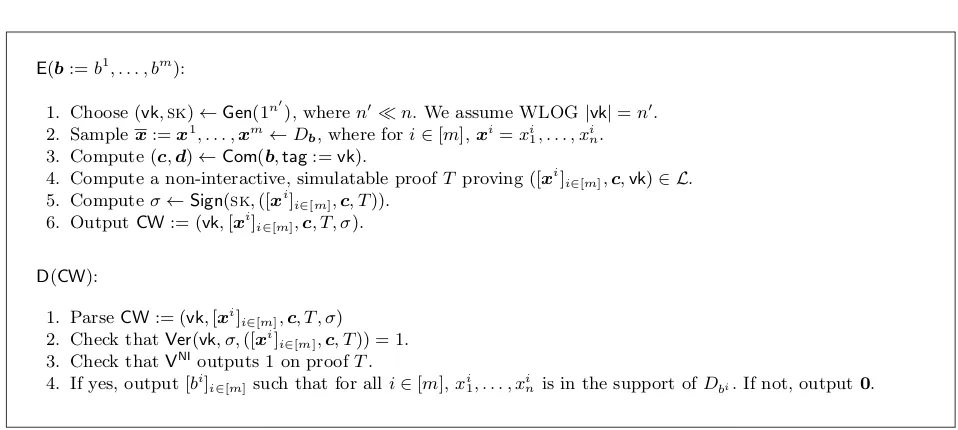
The construction is presented in Figure2:
E(b:=b1, . . . , bm):
1. Choose (vk,sk)←Gen(1n0), wheren0n. We assume WLOG|vk|=n0. 2. Samplex:=x1, . . . ,xm←Db, where fori∈[m],xi=xi
1, . . . , xin. 3. Compute (c,d)←Com(b,tag:=vk).
4. Compute a non-interactive, simulatable proofT proving ([xi]i
∈[m],c,vk)∈ L. 5. Computeσ←Sign(sk,([xi]i∈[m],c, T)).
6. OutputCW:= (vk,[xi]i∈[m],c, T, σ).
D(CW):
1. ParseCW:= (vk,[xi]i∈[m],c, T, σ) 2. Check thatVer(vk, σ,([xi]i
∈[m],c, T)) = 1. 3. Check thatVNI outputs 1 on proofT.
4. If yes, output [bi]i∈[m]such that for alli∈[m],xi1, . . . , x i
n is in the support ofDbi. If not, output0.
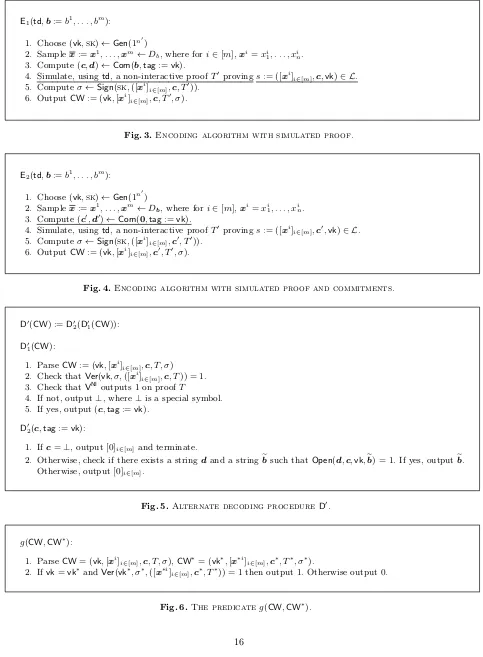
E1(td,b:=b1, . . . , bm):
1. Choose (vk,sk)←Gen(1n0)
2. Samplex:=x1, . . . ,xm←Db, where fori∈[m],xi=xi
1, . . . , xin. 3. Compute (c,d)←Com(b,tag:=vk).
4. Simulate, usingtd, a non-interactive proofT0 provings:= ([xi]i∈[m],c,vk)∈ L. 5. Computeσ←Sign(sk,([xi]i∈[m],c, T
0 )). 6. OutputCW:= (vk,[xi]i∈[m],c, T0, σ).
Fig. 3.Encoding algorithm with simulated proof.
E2(td,b:=b1, . . . , bm):
1. Choose (vk,sk)←Gen(1n0)
2. Samplex:=x1, . . . ,xm←Db, where fori∈[m],xi=xi
1, . . . , xin. 3. Compute (c0,d0)←Com(0,tag:=vk).
4. Simulate, usingtd, a non-interactive proofT0 provings:= ([xi]i
∈[m],c0,vk)∈ L. 5. Computeσ←Sign(sk,([xi]i∈[m],c0, T0)).
6. OutputCW:= (vk,[xi]i∈[m],c0, T0, σ).
Fig. 4.Encoding algorithm with simulated proof and commitments.
D0(CW) :=D02(D 0 1(CW)):
D01(CW):
1. ParseCW:= (vk,[xi]i∈[m],c, T, σ) 2. Check thatVer(vk, σ,([xi]i∈[m],c, T)) = 1. 3. Check thatVNI outputs 1 on proofT
4. If not, output⊥, where⊥is a special symbol. 5. If yes, output (c,tag:=vk).
D02(c,tag:=vk):
1. Ifc=⊥, output [0]i∈[m]and terminate.
2. Otherwise, check if there exists a stringdand a stringebsuch thatOpen(d,c,vk,eb) = 1. If yes, outputeb. Otherwise, output [0]i∈[m].
Fig. 5.Alternate decoding procedureD0.
g(CW,CW∗):
1. ParseCW= (vk,[xi]i∈[m],c, T, σ),CW∗= (vk∗,[x∗i]i∈[m],c∗, T∗, σ∗). 2. Ifvk=vk∗andVer(vk∗, σ∗,([x∗i]
i∈[m],c ∗
, T∗)) = 1 then output 1. Otherwise output 0.
LetΨ(p, x, y, z) be defined as a function that takes as input a predicatep, and variablesx, y, z. Ifp(x, y) = 1, thenΨ outputs them-bit string0. Otherwise,Ψ outputsz.
Theorem 5. Let(E,D),E1,E2,D0 andg be as defined in Figures2,3,4,5and6. LetF be a computational
class. If, for every pair ofm-bit messagesb0,b1 and for every tampering functionf ∈ F, all of the following
hold:
– Simulation of proofs.
1. Pr[g(CW0, f(CW0)) = 1] negl(n)
≈ Pr[g(CW1, f(CW1)) = 1],
2. Ψ(g,CW0, f(CW0),D(f(CW0)))
P P T ,negl(n)
≈ Ψ(g,CW1, f(CW1),D(f(CW1))),
where f ∈ F,CW0←E(b0)andCW1←E1(td,b0).
– Simulation of Commitments.
1. Pr[g(CW1, f(CW1)) = 1] negl(n)
≈ Pr[g(CW2, f(CW2)) = 1],
2. Ψ(g,CW1, f(CW1),D(f(CW1)))
P P T ,negl(n)
≈ Ψ(g,CW2, f(CW2),D(f(CW2))),
where f ∈ F,CW1←E1(td,b0) andCW2←E2(td,b0).
– Simulation Soundness.
Pr[D(f(CW2))6=D0(f(CW2))∧g(CW2, f(CW2)) = 0]∈O(1/nc),
where f ∈ F,CW2←E2(td,b0).
– Hardness of Db relative to Alternate Decoding.
1. Pr[g(CW2, f(CW2)) = 1]
P P T ,O(1/nc)
≈ Pr[g(CW3, f(CW3)) = 1],
2. For every Boolean function, represented by a circuitF overm variables,
F◦D0(f(CW2))
stat,O(1/nc)
≈ F◦D0(f(CW3)),
where CW2←E2(td,b0), andCW3←E2(td,b1).
Then the construction presented in Figure2is aO(1/nc)-non-malleable code for classF. We present the proof of Theorem5 in Section4.
4
Generic Analysis
In this section, we prove Theorem5.
Fix b ∈ {0,1}m. We take g to be the predicate that is used in the MediumNMf
b,g(n) tampering experiment. LetCW←E(b). We must show that for every f ∈ F ⊂P,
Pr[g(CW, f(CW)) = 1]∧D(f(CW))6=b]≤negl(n). Let CW := (vk,[xi]
i∈[m],c, T, σ) and let f(CW) := (vk∗,[x∗i]i∈[m],c∗, T∗, σ∗). If g(CW, f(CW) = 1, it means that vk=vk∗ and Ver(vk∗, σ∗,([x∗i]
i∈[m],c∗, T∗)) = 1 On the other hand, if D(f(CW))6=b, it must mean that ([xi]i∈[m],c, T) 6= ([x∗i]i∈[m],c∗, T∗) But in this case we obtain a PPT adversary A that sees a single signature (σ) on message message ([xi]i∈[m],c, T) under verification key vk and produces a valid signatureσ∗on message ([x∗i]i∈[m],c∗, T∗)6= ([xi]i∈[m],c, T) under challenge verification keyvk, thus leading to a contradiction to the security of the one-time signature schemeS.
Next, we must show that for any b0,b1 and any tampering function f ∈ F,
{MediumNMfb0,g}n∈N
P P T ,O(1/nc)
Hybrid 0:The real game,MediumNMfb
0,g, where the real encodingCW0←E(b0) and the real decoding oracle Dare used.
Hybrid 1:Replace the encoding from the previous game withCW1←E1(td,b0).
Hybrid 2:Replace the encoding from the previous game withCW2←E2(td,b0).
Hybrid 3:Replace the decoding from the previous game, withD0(f(CW2)).
Hybrid 4:Same as Hybrid 3, but replace the encoding withCW3←E2(td,b1).
The proofs of indistinguishability of consecutive hybrids follow identically to [BDKM18].
5
Multi-Bit NMC Against Bounded Poly Adversaries
We describe the underlying components required to instantiate the generic construction. The tampering class
F corresponds to (uniform) tampering functions that run in time O(ncA), where n is security parameter.
The length of the encoding isL:=O(nc`), for some fixed constantc
`. Therefore, the tampering function is allowed to run in timeLcA/c` with respect to the input lengthL.
Letnbe the input length for the hard distribution described in Section5.1. We fix polynomialstψ(n) = ncψ,t
com(n) =nccom where cψ, ccom are constants (both greater than cA) and superpolynomial time bounds Tcom(n),TN IZK0 (n),TZK(n). such that
– cψccom,
– T0
N IZK(n)Tcom(n),
– TZK(n) is subexponential.
The distribution described in Section 5.1 is hard for tψ(n)-time adversaries. m·λn is the length of them-bit commitment using the commitment scheme described in Section5.2,nis set such thatm·λ+n0≤
(m+ 1)·λ∈o(n) (so nis asymptotically larger than the length of the commitment–m·λ–plus the length of the tag–n0.). These commitments are hiding for polynomial-time adversaries and quasi-non-malleable for adversaries inBPtime(Tcom(n))TSIZE(tcom(n)). The the non-interactive simulatable proof system in Section 5.3has soundness against uniform, poly-time adversaries and zero knowledge against TZK(n) time adversaries.
5.1 The Hard Distribution Db (instance lengthn, hard againsttψ(n)-time adversaries)
The following theorem is from [AASY16]:
Theorem 6. If E is hard for exponential size nondeterministic circuits, then for every constant cψ > 1,
there exists a constant d >1 such that for every sufficiently large n, there is a functionψ:{0,1}n→ {0,1}
that is(`, n−cψ)-incompressible for size ncψ circuits, where`=n−d·logn. Furthermore, ψ is computable in timepoly(ncψ)∈O(nccom).
Setting parametersn,cψ,das above, we letDbbe the uniform distribution overx← {0,1}n, conditioned onψ(x) =b. The theorem above immediately implies the following:
Claim. Letn, cψ, d, ψbe as above, letFebe any Boolean function over (m+ 1)·λ≤n−d·logn <(1−α)n
variables, and letCbe a sizencψ circuit with input lengthnand output lengthm. Then, over random choice
ofx← {0,1}n,
e
5.2 Commitment scheme C= (Com,Open) (length λn, hiding for poly-time adversaries, and quasi non-malleable against adversaries in BPtime(Tcom(n))TSIZE(tcom(n)))
We instantiate the commitment scheme C = (Com,Open) with the scheme presented in Section 7. Recall that the scheme has the following properties:
– Non-interactive with no-CRS.
– Perfectly binding,
– Quasi-non-malleable against inBPtime(Tcom(n))TSIZE(tcom(n)).
5.3 Non-Interactive Simulatable Proof System (Sound against uniform ppt adversaries, ZK
against adversaries running in time TZK(n))
LetΠ = (P,V,Sim) be a NIZK proof system for NP with no CRS (Construction given in Section2.6) with soundness against uniform adversaries running in timeTN IZK(n). We additionally require that the trapdoor can be extracted by uniform adversaries running in timeTN IZK0 (n).
Let C0 = (Com0,Open0) be a non-interactive, perfectly binding, commitment scheme with no CRS that
can be extracted in timeTN IZK(n) and is hiding against adversaries running in timeTZK(n).
We also assume the existence of P-certificates with soundness against adversaries running in time TN IZK(n).
We define the proof system ΠNI= (PNI,VNI,SimNI) for languageL defined in Section3as follows: PNI: Recall that a witnesswfor statements:= ([xi]
i∈[m],c,tag)∈ Lconsists of a stringb=b1, . . . , bmand an opening dsuch that (1) Open(c,b,tag) = 1 and (2) for alli∈[m],ψ(xi) =bi. Given a statement s and witnessw, letP be aP-certificate that (1) and (2) hold.
Invoke P from proof system Π with the statement s0 = (s,com) ∈ L0 using proof system Π, where L0 is the language consisting of strings (s,com) such that com is a commitment to (w, P) and P is a P-certificate that (1) and (2) hold for (s, w).Poutputs a proofπ0. PNI outputs proofπ=com||π0. VNI: On input statement s, proofπ and languageL: Parseπ:=com||π0. Run the underlying verifierVon
π0 for statement (s,com) and languageL0 and output whatever it does.
SimNI: On input (td, x), and languageL: Setcomto a commitment to 0 and invoke the underlyingSimfor Π with input (td,(s,com)) and languageL0.
Note that given theP-certificateP, computing the NIZK proof usingΠNIcan be done in fixed polynomial time in the length of the statement (s,com). Moreover, given the trapdoortd, a simulated proof can also be computed in fixed polynomial time. The following claim is straightforward.
Claim. Given the above assumptions, ΠNI = (PNI,VNI,SimNI) is a NIZK argument system for language L
with zero knowledge against adversaries running in timeTZK(n) and trapdoor that can be extracted in time T0
N IZK(n).
5.4 Main Theorem
Theorem 7. For any constantcA>1,Π = (E,D)(presented in Figure2) is a multi-bit, non-malleable code
against (uniform) tampering functions that run in timeO(ncA), if parametersc
ψ, ccom,Tcom(n),TN IZK0 (n), TZK(n)are chosen as described above and the underlying components are instantiated in the following way:
– Forb∈ {0,1},Db is the distribution from Section 5.1.
– C:= (Com,Open)is the commitment scheme from Section5.2. – ΠNI:= (PNI,VNI,SimNI) the simulatable proof system from Section5.3.
Proof. To prove the theorem, we need to show that the necessary properties from Theorem5hold. We next go through these one by one.
Simulation of proofs.
1. Pr[g(CW0, f(CW0)) = 1] negl(n)
≈ Pr[g(CW1, f(CW1)) = 1],
2. Ψ(g,CW0, f(CW0),D(f(CW0)))
P P T ,negl(n)
≈ Ψ(g,CW1, f(CW1),D(f(CW1))),
wheref ∈ F,CW0←E(b0) andCW1←E1(td,b0). This follows by ZK property ofΠNI.
Simulation of Commitment.
1. Pr[g(CW1, f(CW1)) = 1] negl(n)
≈ Pr[g(CW2, f(CW2)) = 1],
2. Ψ(g,CW1, f(CW1),D(f(CW1)))
P P T ,negl(n)
≈ Ψ(g,CW2, f(CW2),D(f(CW2))), wheref ∈ F,CW1←E1(td,b0) andCW2←E2(td,b0).
This follows from hiding property of the commitment schemeC.
Simulation Soundness.
Pr
r[D(f(CW2))6=D
0(f(CW
2))∧g(CW2, f(CW2)) = 0]∈O(1/nccom), wheref ∈ F,CW2←E2(td,b0).
We begin by defining the following:
P0(n) := Pr[D(f(CW0))6=D0(f(CW0))∧g(CW0, f(CW0)) = 0], wheref ∈ F,CW0←E(b0)
P1(n) := Pr
r[D(f(CW1))6=D
0(f(CW
1))∧g(CW1, f(CW1)) = 0], wheref ∈ F,CW1←E1(td,b0)
P2(n) := Pr
r[D(f(CW2))6=D
0(f(CW
2))∧g(CW2, f(CW2)) = 0], wheref ∈ F,CW2←E2(td,b0).
We prove the following sequence of claims, which immediately imply the simulation soundness property.
Claim. P0(n)∈negl(n).
SinceD(f(CW1))6=D0(f(CW1)) can only occur if the NIZK proof verifies, but the statement being proved is false, this follows from the soundness of the NIZK proof systemΠNI.
Claim. |P1(n)−P0(n)| ∈negl(n).
Claim. |P2(n)−P1(n)| ∈O(1/nccom).
Proof. Assume |P2(n) − P1(n)| ∈/ O(1/nccom), we will construct an adversary/distinguisher (A, D) in
BPtime(Tcom(n))T SIZE(tcom(n)) that breaks theO(1/nccom)-non-malleability of commitment scheme C. Specifically, we must show an adversaryA, distinguisherDinBPtime(Tcom(n))TSIZE(tcom(n)) such that D distinguishes the output ofmimAC(b0) frommimCA(0) with advantagea(n)∈/ O(1/nccom).
A= (A1, A2) is specified as follows:
On input security parameter 1n,A
1 does as follows:
– A1generates keys (vk,sk)←Gen(1n)
– A1runs in uniform timeTN IZK0 (n)≤Tcom(n) to recover the trapdoortd of the NIZK.
– A1outputstag:=vkto its challenger as the desired tag and outputstd,sk toA2.
On inputtd,sk,vk,c,A2 does as follows:
– Fori∈[m], samplexi∼D
bi (in timem·poly(ncψ)∈O(nccom), where poly is a fixed polynomial. – Use td to generate a simulated proof T in fixed polynomial time and compute σ ←
Sign(sk,([xi]
i∈[m],c, T)) in fixed polynomial time.
– Computef(vk,[xi]i∈[m],c, T, σ) = [vk0,x
0i
]i∈[m],c0, T0, σ0).
– If the predicategevaluates to 1, the signatureσ0or proofT does not verify, output⊥(this computation takes fixed polynomial time).
– Otherwise, output (c0,out:= [x0i]i∈[m]). Note that in this case,vk06=vk(corresponding to the tag of the commitment) since gevaluates to 0 andσverifies.
DistinguisherDreceives the committed valuev0 =v01, . . . , v0munderlyingc0(or receives⊥) as well asout (the additional output of adversary A).D outputs 0 if for all i∈[m],v0i=ψ(xi) (or if its input is⊥) and outputs 1 otherwise (computed in timem·poly(ncψ)∈O(nccom)).
Clearly,
Pr c←Com(b0,vk)
[D(v0,out) = 1] =P2(n)
and
Pr c←Com(0,vk)
[D(v0,out) = 1] =P1(n)
Thus, we have that
Pr c←Com(b0,vk)
[D(v0,out) = 1]− Pr
c←Com(0,vk)[D(v
0,out) = 1]
/
∈O(1/nccom).
Moreover,A, Dare inBPtime(Tcom(n))TSIZE(tcom(n)). Thus, we obtain a contradiction to theO(1/nccom) non-malleability of the commitment scheme against adversaries, distinguishers in BPtime(Tcom(n)) T
SIZE(tcom(n)).
Hardness of Db relative to Alternate Decoding.
1. Pr[g(CW2, f(CW2)) = 1]
O(1/ncψ)
≈ Pr[g(CW3, f(CW3)) = 1],
2. For every Boolean function, represented by a circuitF overmvariables,
F◦D0(f(CW2))
stat,O(1/ncψ)