Encryption
Payal Chaudhari1 and Manik Lal Das2 1 LDRP - ITR, Gandhinagar,
DA-IICT, Gandhinagar,maniklal [email protected]
Abstract. Attribute Based Encryption (ABE) is a promising public-key cryptographic primitive that can be used for cryptographically enforced access control in untrusted storage. Storing data on untrusted storage not only requires data security for data owners but also poses data protection from untrusted storage server. To address this important requirement, Anonymous Attribute Based Encryption (AABE) is a suitable primi-tive that provides users to access data from untrusted storage without revealing their identities. At the same time user data can be stored in un-trusted storage in an encrypted form. While storing data in an encrypted form, keyword-based query search (and data retrieval) is a challenging research problem. In this paper we present an anonymous attribute based searchable encryption (A2SBE) scheme which facilitates user to retrieve
only a subset of documents pertaining to his chosen keyword(s). User can upload documents in public cloud in an encrypted form, search doc-uments based on keyword(s) and retrieve docdoc-uments without revealing his identity. The scheme is proven secure under the selective ciphertext-policy and chosen plaintext attack (IND-sCP-CPA) model and selective ciphertext-policy and chosen keyword attack (IND-sCP-CKA) model. The scheme requires small storage for user’s decryption key and reduced computation for decryption in comparison to other schemes.
Keywords: Attribute Based Encryption, Anonymity, Searchable En-cryption, Access Structure.
1
Introduction
in untrusted storage. Sahai and Waters [1] first introduced attribute based en-cryption(ABE) scheme. In ABE, both the user secret key and the ciphertext are associated with a set of attributes. A user is able to decrypt the cipher-text if and only if at least a threshold number of attributes overlap between the ciphertext and user secret key. ABE is flexible than the traditional public-key encryption, as ABE is intended for one-to-many encryption in which ciphertexts are not necessarily encrypted to one particular user. There are two variants of ABE - Ciphertext Policy Attribute Based Encryption (CP-ABE)[2] and Key Policy Attribute Based Encryption (KP-ABE)[3]. In CP-ABE while encrypting a document, the access policy related to the document is incorporated in the ciphertext. Each User possess a key specifying the attributes he possesses. If the user’s key satisfies the access policy related to a ciphertext, then only the user is able to decrypt the ciphertext. However, along with ciphertext its access policy specifying the attributes of the intended receiver transmitted in clear form. In KP-ABE scheme access policy is attached with user’s key and attribute list is attached with ciphertext.
Using ABE, on one hand, data access policies can be enforced on storage servers; on the other hand, confidentiality of sensitive data can be well protected against unauthorized entities, including storage servers. In addition to data security, concealing the receiver’s identity becomes an important security feature in some applications such as electronic health record (EHR) system. A patient can up-load his data to EHR system, be accessible by authorized clinicians, where the patient’s privacy should be preserved. Anonymous attribute based encryption (AABE) is a suitable primitive which supports data receiver anonymity in ad-dition to data confidentiality and access control security features. While storing data in encrypted form in storage server for protecting data from storage server, it is required users to search and retrieve data over encrypted documents. In ad-dition, in many instances a user requires only a subset of documents containing a particular keyword, which makes the data access mechanism efficient.
encryption scheme supporting inner product predicates [13]. Relying on the De-cisional Bilinear Diffie-Hellman assumption and DeDe-cisional Linear assumption, Nishidet aland Jinet alhave proposed an efficient anonymous CP-ABE scheme [14] and [15], respectively. Subsequently, a few AABE schemes [16–18] have also proposed in literature. To make the decryption procedure efficient, Zhang et al
proposed a scheme [19] with a technique called amatch-then-decryptprocedure. The technique allows a receiver to check if his attribute private key matches the hidden access policy in ciphertexts without decryption. However, Zhanget al’s scheme is found insecure [20].
Search operation over ABE has been considered a challenging research problem. In recent times, a few schemes [21–25] discuss search operation over ABE, but did not support receiver anonymity. Kooet al [26] proposed a searchable anony-mous ABE scheme where user is able to retrieve a subset of documents based on his search query, where the search query includes a cipher component published by the sender and known as pseudonym. The scheme [26] has the prerequisite that the receiver has to gain the pseudonyms of a data owner from cloud service provider, scramble his key with this pseudonym and send the reformed key to cloud service provider. Shi et al [27] recently proposed a scheme that provides a successful search only if each keyword field entry in the document matches with the searched words in user query. The scheme [27] has a bottleneck that each time generating a new predicate for search word the user requires to pass a request to token generator.
Our Contributions.We present an anonymous attribute based searchable en-cryption (A2SBE) scheme, which facilitates user to retrieve only a subset of documents pertaining to his chosen keyword(s). User can upload documents in public cloud in an encrypted form, search documents based on keyword(s) and re-trieve documents without revealing his identity. The scheme is proven secure un-der the selective ciphertext-policy and chosen plaintext attack (IND-sCP-CPA) model and selective ciphertext-policy and chosen keyword attack (IND-sCP-CKA) model. The scheme requires small storage for user’s decryption key and reduced computation for decryption in comparison to other schemes.
Organization of the paper.The remaining of the paper is organized as fol-lows. We discuss some preliminaries in Section 2. We present the A2SBE scheme in Section 3. We present the analysis of the A2BSE scheme in Section 4. We conclude the paper in Section 5.
2
Preliminaries
2.1 Bilinear Mapping
LetG1andG2be two multiplicative cyclic groups of a large prime order p. Let
g be a generator ofG1andebe a bilinear map,e:G0×G0→G1. The bilinear mapehas the following properties:
– Non-degeneracy: There existsg1,g2 ∈G0 such thate(g1, g2)6= 1.
– There exists an efficient computable algorithm to compute e(g1, g2) for all
g1, g2∈G0.
We say that G0 is a bilinear group if it satisfies the above mentioned three properties.
2.2 Decisional Bilinear Diffie-Hellman (DBDH) Assumption
Let a, b, c, z ∈ Zp be chosen at random and g be a generator of G1. The de-cisional BDH assumption is that no probabilistic polynomial-time algorithmP
can distinguish the tuple (A= ga, B = gb, C =gc, e(g, g)abc) from the tuple
(A=ga,B=gb,C=gc,e(g, g)z) with more than a negligible advantage.
The advantage ofP is Pr[P(A, B, C, e(g, g)abc) = 0] - Pr[P(A, B, C, e(g, g)z) = 0] =.
2.3 Decisional Diffie Hellman (DDH) assumption
Leta, b, z∈Zp be chosen at random andgbe a generator ofG1. The decisional DH assumption is that no probabilistic polynomial-time algorithm P can dis-tinguish the tuple (A=ga, B =gb,C =gab) from the tuple (A=ga, B =gb,
C=gz) with more than a negligible advantage.
The advantage ofP is Pr[P(A, B, C) = 0] - Pr[P(A, B, gz) = 0] =.
2.4 Decisional Linear (D-Linear) Assumption
Let z1, z2, z3, z4, z ∈ Zp be chosen at random and g be a generator of G1. We say that the D-Linear assumption holds inGif no probabilistic polynomial-time algorithmP can distinguish the tuple (g, Z1 =gz1, Z2 =gz2, Z3 =gz1z3,
Z4 = gz2z4, Z = gz3+z4) from the tuplee(g, Z1 = gz1, Z2 = gz2, Z3 = gz1z3,
Z4=gz2z4, Z=gz) with non-negligible advantage.
The advantage of P is Pr[P(Z1, Z2, Z3, Z4, e(g, g)z3+z4) = 0] - Pr[P(Z1, Z2,
Z3,Z4,e(g, g)z) = 0] =.
For the proposed scheme we consider a variant of D-Linear assumption. It states that no probabilistic polynomial-time algorithmP can distinguish the tuple (g,
Z1=gz1,Z2=gz2,Z3=gz2z4 ,Z4=gz3+z4,Z=gz1z3) from the tuple (g,Z1=
gz1,Z
2 =gz2,Z3 =gz2z4,Z4=gz3+z4 ,Z =gz) with non-negligible advantage
.
2.5 Access Structure
Let there benattribute in the universe and each attributei(for all 1≤i≤n) has value set Vi = {vi,1, vi,2,· · ·, vi,mi}. L = [L1, L2, · · ·, Ln] is an attribute
list, where each Li represents one value from the value set of attribute i. A
ciphertext policy is defined as T = [T1, T2, · · ·, Tn], where each Ti represents
the set of permissible values of an attributeiin order to decrypt the ciphertext. An attribute list L satisfies an access structure T, if Li ∈ Ti or Ti = * for all
3
The Proposed A
2BSE Scheme
3.1 Security Goals
The proposed scheme aims to achieve the following goals.
Key Privacy.A valid key can only be generated by the trusted third party using secret parameters of the system. A user himself will not be able to generate a key or modifying a key to include different attributes.
Ciphertext Privacy.Given an encrypted ciphertext, if the user’s key does not include the required attributes then the user will not be able to decrypt the ciphertext. Even if users collude but do not possess the required attributes can not decrypt the ciphertext.
Receiver’s Anonymity. Given an encrypted ciphertext, if the user is not the intended recipient then he will not be able to know the required attributes to decrypt the ciphertext. Even if a user is the intended recipient then he will only be able to decrypt the ciphertext but will not be able to know, who else are the intended recipients for the ciphertext.
Trapdoor Privacy. User’s search query includes his search key masked with the keyword for which the search has to be performed. The adversary will not be able to gain any useful information from the search query. The only information an adversary is able to produce from a search result is the number of documents provided in result of a search query.
3.2 System Model
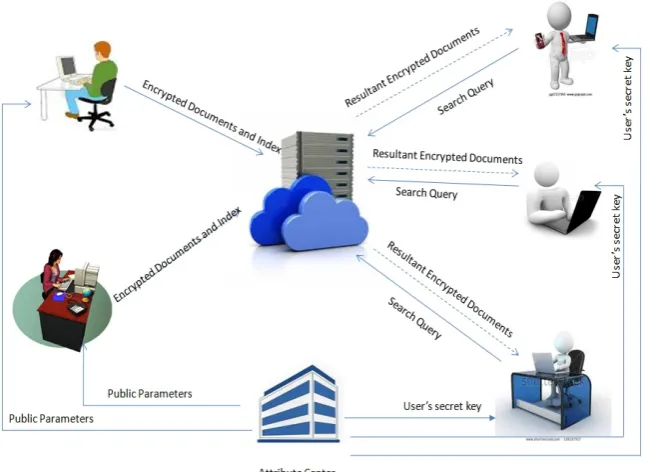
The system (Figure 1) comprises the following entities.
– Attribute Center: Attribute Center is a trusted third party and is responsible for generating system parameters and issuing keys to users.
– User: User of the system who encrypts and uploads documents in the cloud. User can issue search query and retrieve the intended documents from the cloud server in a protected form. For simplicity, we consider two types of users - Data owners and Data retrievers. Data owners are the users who encrypt and store the data on cloud. Data retrievers are the users who issue search query and obtain the documents from the cloud.
– Cloud Service Provider (CSP): CSP provides storage and computation ser-vices to the users of the system. On receiving a search query from user, CSP performs the search on its storage for a proper match and then, for all the matched documents, CSP performs a partial decryption procedure before returning the documents to the user in a protected form.
3.3 Definition of A2BSE
Fig. 1.The System Model of A2BSE
has to be performed. F(L,T) = 1 if the attributes in L can satisfy the access policy specified inT; else, F(L,T) = 0. We also assume that the system has n
categories of attributes and in each category i(1 ≤i≤n) permissible number of attributes aremi.
Definition 1. An A2BSE system consists of seven algorithms Setup, KeyGen,
Encryption, Encrypt Index, QueryGen, Search, and Decryption, defined as fol-lows.
- Setup(1l): The Setup(1l) is run by Attribute Center. It takes as input
pa-rameter a security papa-rameterl and outputs the master private keyMK and public parametersPK.
- KeyGen(MK,L): The KeyGen(MK,L) algorithm takes as input the master keyMK along with a set of attributes L and outputs two secret keysSKs
andSKd comprising components for all attributes inL. The former key is
used for searching anonymously over encrypted data in cloud storage and the later is for decryption of ciphertext.
- Encrypt Index(PK,W,T): The set of wordsW are extracted fromM is given as input to the Encrypt Index(PK,W,T) algorithm along with PK and T. The algorithm outputs an encrypted indexCTW.
- QueryGen(PK,SKs,w): A user runs the QueryGen(PK,SKs,w) algorithm
to make a search query for the documents containing the wordw and for which his keySK satisfies the decryption policy. The algorithm outputs a trapdoortw generated forw.
- Search(tw,CTW): The Search(tw,CTW) algorithm takes as input the
trap-door sent by the user in query and encrypted index associated with a docu-ment. The algorithm returns true if the word in the user query matches with the word in the index of document and user’s key satisfies the access policy of the document. The receiver (data retriever) gets the encrypted documents in result of his query for which the search procedure returns true.
- Decryption(CT,SKd): With Decryption(CT,SKd) algorithm the user
per-forms the decryption for the resultant documentsCT which he has retrieved from the cloud in result of his search query.
3.4 Detailed Construction of A2BSE
Setup(1l). Attribute Center chooses a security parameter l which determines
key length, and follows the following steps to generate system keys and public parameters.
(i) choose two multiplicative cyclic groups G0 and G1 with a prime order p where length ofp is determined by the security parameterl.
(ii) selectg1,g2 as two generators of groupG0 and define a bilinear mappinge :G0 ×G0 →G1.
(iii) define two hash functionsH0 :{0,1}∗→Zp andH1 :{0,1}∗→G0 (iv) choose m+4 random exponents {α, β, y, ϑ, r1, r2, · · ·, rm}. Here, m is
maximum ofmifor (1≤i≤n). These elements serves as private key of the
system.
(v) publish the public key ashg1,g2,g
y
1,g2ϑ,e(g1, g2)y,e(g1, g2)α,{g
α β
2, g
r1 2 , g
r2 2 ,
· · ·, grm
2 } i.
Key Generation(MK,L).Each user in the system will get two keys represent-ing the attributes the user possesses. One key, known as the search key, is used to generate the search query and the second key, known as the decryption key, is used for decrypting the ciphertexts. Let the user possess anjth valuev
i,j for
an attributei, 1≤i≤n. The attribute center chooses two randomrandρ, and generates user’s keys as follows.
Search Key:
– Ds0=g1rβ
– {Ds,i1=g
(H0(ikvi,j)+r)rα1
1 ,Ds,i2=g
(H0(ikvi,j)2+r)rα2
1 ,· · ·,Ds,imi=g
(H0(ikvi,j)mi+r)rmiα
1 }
Decryption Key :
– Dd = (g2Q
n
i=1H1(ikvi,j))y·gρ2, where vi,j ∈L.
– D¯d =g
ρ ϑ
1
Encryption(PK,M,T). LetT ={T1, T2,· · ·, Tn} whereTi {1≤i ≤n} is the
set of values for an attribute i, which are permissible for decryption. When a sender wants to send a document M in encrypted form to a set of users with specific set of attributes, he encrypts the document by following steps.
(i) choose two random secret valuess,t ∈Zp.
(ii) makenportions oftastisuch thatPni=1ti=t. For attribute values included
inTi, he creates the cipher components as
˜
Ci,j =g2tiH1(ikvi,j)st, ifvi,j ∈Ti
˜
Ci,j is a random value, ifvi,j ∈/ Ti.
(iii) ˆC=g1st, ¯C=gstϑ2 are calculated.
(iv) The documentM is encrypted asC0 =M ·e(g1, g2)y(s−1)t. The encrypted document is a tuplehC0, ˆC, ¯C,{{C˜i,j}1≤j≤mi}1≤i≤n i.
Encrypt Index(PK,W,T).The set of wordsW extracted fromM is given as input to this algorithm along with PK and T. The output of this algorithm is an encrypted index CTW. The sender
(i) chooses a random secret valuess0 from Zp.
(ii) generatess01,s02,· · ·,s0n−1 for 1≤i≤n and calculatess0n=s0 -Pn−1
i=1 s0i
(iii) For every attribute fieldi, the sender chooses random values a0i for 1≤i≤n
and then computes:
f(xi) =a0i(xi−H0(ikvi,1))(xi−H0(ikvi,2))· · ·(xi−H0(ikvi,mi)) +s
0
i (1)
where vi,j=jth value of attribute i if it is included in Ti, else it will be a
random value. The resultant equation is
f(xi) =a0i0+a0i1x+a0i2x
2+· · ·+a0
imix
mi. (2)
The matched attribute value when supplied to the equation (2), it gives the values0i, else it gives any random value. Summation of all coefficients except
a0i0from all equations will be calculated asAw =Pni=1(Pmj=1i a0ij).
The sender now computes and sends the following values to cloud server :
Cw1=g
Aw α β
2 ,{Cwi1 = g
a0 i1r1
2 , Cwi2 = g
a0 i2r2
2 , · · ·, Cwimi=g
a0imirmi
2 } for 1≤ i
≤n.
(iv) For each of the word wfrom setW an entry in the index is formed asCw
=e(g1, g2)(s
0−Pa0
i0)αH0(wp)
The algorithm returnsh {Cw |,∀w∈W },Cw1,{{Cwij}1≤j≤mi}1≤i≤n ias the
output.
QueryGen(PK,SKs,w).In order to search for the documents containing word
– D0
s0=g
rβH0(w) 1
– {Ds,i0 1=g(H0(i||vi,j)+r) α r1H0(w)
1 ,Ds,i0 2=g
(H0(i||vi,j)2+r)rα2H0(w)
1 ,· · ·,Ds,im0 i = g(H0(i||vi,j)
mi+r) α
rmiH0(w)
1 } 1≤i≤n
The outputs of QueryGen(PK,SKs,w) is the trapdoortw, which will be used in
the Search algorithm.
Search(tw,CTW). After receiving a search query, the cloud server initiates
following procedure to find a match for the word and access policy.
Rs1=
n Y i=1 ( ni Y j=1
e(Cwij, D0s,ij)) (3)
Rs2=e(C1w, D00) =e(g1, g2)AwαrH0(w)
Rs=
Rs1
Rs2
=e(g1, g2)(s
0−Pa0
i0)αH0(w) (4)
We note that the simplification of equation (3), as illustrated below, makes it easy to understand why the cloud server computesRs2 andRs:
Rs1=
n Y i=1 ( ni Y j=1
e(g
(H0(vi)j+r1)αHrj0 (w)
1 , g
a0ijrj
2 ))
=
n
Y
i=1
(e(g1, g2)( Pmi
j=1a
0
ijH0(vi)j)αH0(w)·e(g 1, g2)
Pmi
j=1a
0
ijrαH0(w))
= (g1, g2) Pn
i=1(s
0 i−a
0
i0)αH0(w)·e(g
1, g2)AwαrH0(w) = e(g1, g2)(s
0−P(a0
i0))αH0(w)·e(g
1, g2)AwαrH0(w)
From the encrypted index of the corresponding document the server searches for a match with result of equation (4). If the match is found then the algorithm returns true and sends the document’s ciphertext for further decryption proce-dure Decryption(CT,SKd).
Decryption(CT,SKd). The user performs the decryption procedure for the
encrypted documents which he received as a result of his search query from the cloud server with the following computation.
User selects ˜Ci,j elements, each related tovi,j value which is included in user’s
secret key.
C0·e(Qn
i=1C˜i,j, gα1)e( ¯C,D¯)
e( ˆC, D)
=C 0·e(Qn
i=1(g
ti
2H1(i||vi,j)st), gy1)e(g
stϑ
2 , g
ρ ϑ
1)
e(gst
1 ,(g2Q
n
i=1H1(i||vi,j))y·g ρ
=M ·e(g1, g2)
(y(s−1))t
e(g1, g2)(y(s−1))t =M
4
Security and Performance Analysis
4.1 Adversary’s Goal and Assumptions
Adversary’s goal of the A2BSE comprises the following:
- Retrieve the plaintext from ciphertext using a single or combination of keys such that none of them alone can decrypt the ciphertext.
- Retrieve the information about underlying access policy. - Gain the information about the word being search for. - Know who are the target recipients.
The security of A2BSE relies on strength of Decisional Linear(D-Linear), De-cisional Bilinear Diffie-Hellman (DBDH) and DeDe-cisional Diffie-Hellman(DDH) assumptions. We divide the functionality of A2BSE in two parts. The first part is for encryption of index and performing search operation over the encrypted index. The second part is for encryption and decryption of a document. It is required that the encrypted message does not reveal any information about the ciphertext and underlying access policy to an adversary. We prove this claim by the security ofIndistinguishability against selective ciphertext-policy and chosen plaintext attack (IND-sCP-CPA) model. We show that unless a correct decryp-tion key is available, the ciphertext is indistinguishable from any other group element. Then, we prove that given an encrypted index and a search token the adversary can only gain information whether the search is successful by In-distinguishability against selective ciphertext-policy and chosen keyword attack (IND-sCP-CKA) model.
IND-sCP-CPA Model.We consider this security model as a game between a Challenger and an Adversary as follows.
Init: The adversary commits two ciphertext access policiesT∗
0 andT1∗ for which he wishes to be challenged upon.
Setup: The challenger gives l as the security parameter to run the Setup algo-rithm and retrieves the master secret keyMK and public parameters P K. The public parametersP K is sent to the adversary.
Phase 1: The adversary is allowed to request for polynomially bounded number of secret keys on attributesL with the restriction that F(L,T∗0)=F(L,T∗1)=0 or F(L,T∗0)=F(L,T∗1)=1.
b ∈ {0,1} and computesCTb as output of Encryption(P K,Mb,Tb∗). TheCTb is
sent to the adversary.
Phase 2: Same as in Phase 1. The adversary issues polynomially bounded num-ber of queries for generating secret keys with the restriction as specified in Phase 1.
Guess: The adversary outputs a guess b0 of b. The adversary wins the game if
b0 =b. The advantage of an adversary A in the game is defined as AdvA(l)=
|P r[b0=b]−1/2|.
Theorem 1. The A2BSE scheme is IND-sCP-CPA secure under the D-Linear
assumption if there is no polynomial time adversary A who can win the above mentioned game with non-negligible advantage AdvA(l) in security parameterl.
Proof. We consider a challengerC, a simulatorS and a polynomial-time adver-saryA. Suppose that the adversary is able to distinguish a valid ciphertext from a random element with advantage 1(l). We build a simulator S that can play the D-Linear game with advantage 1(l)
2 . The simulation proceeds as follows. Let the challenger set the groups G0 and G1 with an efficient bilinear map, e and generator g. The challenger flips a fair binary coin b, outside ofS’s view. Ifb = 0, the challenger sets (g, Z1, Z2,Z3,Z4,Z) = (g,gz1,gz2,gz2z4,gz3+z4,
gz1z3), otherwise it sets (g,Z
1, Z2,Z3,Z4, Z) = (g, gz1,gz2, gz2z4,gz3+z4, gz) for values z1,z2,z3,z4 andzchosen randomly fromZp.
Init: The simulator S runs A. A commits two access policies T0∗ and T1∗ for which he wishes to be challenged upon.
Setup:Stakes the following values:g1=ga,g2=g,gy1 =gaywith the assump-tion thaty=z1. Hereais chosen randomly fromZp. With the selection of random
valueϑfromZp,gϑ2 is calculated asgϑ.H1(ikvi,j) is assumed asg
1
nz1+H 0(ikv
i,j).
Here n denotes the number of attribute categories andH0(i||vi,j) is computed
from random oracle. The simulatorS announces the public key as g1 =ga, g2 =g, gy1 =gaz1, gϑ
2 =g
ϑ, e(g
1,g2)y = e(g,g)az1.
Preprocessing Phase: The attackerAcollects following results in response of his queries made to the simulator.
– WheneverAmakes itskthkey generation query for the setL
k of attributes
such that F(Lk,T0∗ )= F(Lk,T1∗)=0. The simulatorS selects a random value
ρ∈Zpand the key components are generated as.
D= (g2
n
Y
i=1
H1(i||vi,ji))
y
·g2ρ
= (g
n
Y
i=1
gnz11+H
0(ikv
i,ji))z1·gρ
=gz1·g1+Pni=1(H
0(i
kvi,ji)z1)·gρ =Z1·g·Z
Pn i=1(H
0(ikv i,ji))
1 ·g
ρ
¯
D=g ρ ϑ
1 =g
– In response to the query for ciphertext of messages M∗ as per the access policiesT∗ (whereT∗ 6=T0∗ 6=T1∗), submitted byA, the simulator S com-putes the ciphertext with the selection of random numberssandtfromZp.
The cipher components are generated with the public key parameters set by the simulatorS
Challenge: Let the two challenge ciphertext policies submitted by the adversary
A areT∗0 = [v0,1, v0,2, · · ·, v0,n] and T∗1 = [v1,1, v1,2,· · ·, v1,n]. The adversary
outputs two messages M0 and M1 on which he wishes to be challenged upon with respect to the challenge access policyT0∗ andT1∗. If for any key generated in Phase 1 on an attribute listLF(L,T0∗)= F(L,T1∗)=1, thenM0 =M1. Now S flips a random coin v, and encrypts Mv as per access policy T∗v. S
assumes st=z1z3, with the assumptions that s = z z1z3
4(z2+1) and t = z4(z2+ 1). For the values which are included in T∗v, C calculates ˜Ci,j = g2tiH1(i||vi,ji)
st
= gz2z4 +n z4g(
1
nz1+H
0(i||v
i,ji))z1z3 =Zn1
4 Z 1
n
3 ZH
0(i||v
i,ji). For other attribute values
which are not included in T∗v, ˜Ci,j are random values. Cipher components are
calculated byS as ˆC=gst
1 =Za, ¯C=g
stβ
2 =Z
βandC0 =M
v·
e(Z1a,Z)e(g,Z)
e(Za
1,Z4)e(Z1,Z3).
C0 is the correct cipher component only if Z = gz1z3. Else, C0 is a random element. The ciphertext components{{C˜i,j}1≤j≤mi}1≤i≤n,C,¯ C, Cˆ
0 are given to
A.
Post Processing Phase:Ais allowed to run a number of queries for attribute keys and matching phase components with the same conditions as imposed in the preprocessing phase.
Guess:A submits a guess v0 of v. Ifv0 =v, thenS outputs b = 1 to indicate that it was given a valid D-Linear tuple, else, it outputsb = 0 to indicate that the ciphertext is a random element. Therefore, A gains no information about
v, in turn,P r[v 6=v0|b = 0] = 1
2. As the simulator guesses b
0=0 when v 6= v0,
P r[b = b0|b = 0] = 1
2. If b = 1, then A is able to view the valid encryption components with advantage1(l), a negligible quantity in security parameter in
l. Therefore, P r[v = v0|b = 1] = 12 + 1(l). Similarly, the simulator S guesses
b0=1 whenv =v0, in turn,P r[b0 =b|b= 1] = 12 +1(l). The overall advantage of the simulator in D-Linear game is 12×P r[b=b0|b= 0] +12×P r[b=b0|b= 1] - 12 = 12×1
2 + 1 2×(
1
2 +1(l)) -1 2 =
1(l) 2 .
Therefore, if theAhas a non-negligible advantage1(l) in the above game then we can build a simulator (S) which can break the D-Linear problem with non-negligible quantity 1(l)
2 , which is an intractable problem.
Hence, the theorem. ut
Theorem 2. The A2BSE provides receiver anonymity in IND-sCP-CPA game
under the DDH assumption if there is no polynomial time adversaryAwho can distinguish a valid ciphertext and a random element with non-negligible advan-tage AdvA(l)in security parameterl.
Proof. The challenger flips a binary coinµoutside ofSview and assigns a tuple (g,A = ga,B =gb, Z) to A. If µ = 1 then the challenger sets Z as gab else a random value with equal probability.
Init : The simulator S runs A. A commits two access policies T0∗ and T1∗ for which he wishes to be challenged upon. InT0∗andT1∗for one attributeλ,T0∗,λ6=
T1∗,λ. There is at least one valuevλ,r is from value set of attributeλ, such that
vλ,r ∈/ T0∗,λ andvλ,r ∈T1∗,λ. Here, 1≤r≤mλ. For rest of the attributesT0∗,i=
T∗
1,iwhere 1≤i≤nandi6=λ
Setup:Stakes the following values:g1=g,g2=gx2. Herex2is chosen randomly fromZp.H(ikvi,j) is computed as an output of an random oracle. Another two
random secret values are chosen as y and ϑ. The simulator S announces the public key as :g1=g,g2=gx2,g
y
1 =g
x1y,gϑ
2 =gx2ϑ, e(g1,g2)y = e(g,g)x2y.
Phase 1 : The attacker A collects following results in response of his queries made to simulator.
– WheneverAmakes itskthkey generation query for the setL
k of attributes
such thatF(Lk ,T0∗) =F(Lk,T1∗). That is,Ais allowed to issue a valid de-cryption key which can decrypt the challenge ciphertext, with the restriction that the key should be able to satisfy both the challenge access structureT0∗
andT1∗. The simulator S selects a random valueρand the key components are generated as follows.
D= (g2
n
Y
i=1
H1(ikvi,ji))
y·gρ
2 = (g
x2·gH01(ikvi,j))y·gx2ρ
¯
D=g ρ ϑ
1 =g
ρ ϑ
– In response to the query for ciphertext of messages M∗ as per the access policiesT∗ (whereT∗ 6=T0∗ 6=T1∗), submitted byA, the simulator S com-putes the ciphertext with the selection of random numberssandtfromZp.
The cipher components are generated with the public key parameters set by the simulatorS
– The attacker issues the query forH1(ikv(i, j)). For all the attribute values exceptvλ,r, The simulator S runs the random oracle function and provides
as output an element fromG0 . The simulatorS records the queries and its outputs. So that if any query is repeated by attacker then the same result as given in previous query is given in output. For an query for H1(λ||vλ,r)
the output returned isB =gb
– Asubmits two messages M0 and M1 . If the adversary has retrieved a key for any queried L=[L1, L2, · · ·, Ln], such that F(L,T0∗) = F(L,T1∗) = 1 , thenM0 =M1
– S sets st as aand t is selected as any random value chosen from Zp. This
results inA=ga =gst1 = andAx2ϑ=gx2aϑ=gstϑ 2 .
– The simulator S generates n shares of value t and use each share ti for
encrypting the values for attribute i. For all the cipher components Tν,i∗
where 1 ≤ i ≤ n and i 6= λ the cipher components C˜i,j are generated as
gti
2H1(i||vi,j)st =gx2tigH
0
1(i||vi,j)a.
– For valuesvλ,j of attributeTν,λ∗ which are included in both T0,λ and T1,λ,,
the cipher components C˜λ,j are generated as in the real scheme using the
value oftλ.
– For the valuevλ,r which makes a differentiation betweenT0,λand T1,λ, the
cipher componentC˜λ,r is calculated as follows.
• Ifν = 0 then C˜λ,r will be a random value. This is valid becauseC˜λ,r is
not inT0,λas per definition.
• If ν = 1 then C˜λ,r is set asgx2tλZ. Here we have taken the output of
H1(λ||v(λ, j)) from random oracle as gb. If Z is a valid element with value gab then C˜
λ,r will be a correct element else it will be a random
element.
– C0 is calculated as e(g,g)ax2y.
The adversary is given ciphertext components hC0, ˆC, ¯C,{{C˜i,j}1≤j≤m
i}1≤i≤n
i. At the end of the challenge phase the adversary uses following valueshgst
1 =
ga, H
1(λ||v(λ, r))= gb, Cλ,r i to find out the underlying access policy. If Cλ,r
is a correct cipher component then it represents the value gtλ
2 ·gab else it is a random value.
Phase 2:Ais allowed to run a number of queries for attribute keys and cipher-text phase components with the same conditions as imposed in the preprocessing phase.
Guess:A submits a guess ν0 of ν. If ν0 = ν, then S outputs µ=1 to indicate that it was given a valid DDH-tuple, else it outputs µ=0 to indicate that the ciphertext is a random element. Therefore,Agains no information about ν, in turn, Pr[ν 6=ν0 —µ=0 ] = 12. As the simulator guessesµ0=0 whenν 6=ν0, Pr[µ
=µ0 —µ=0 ] = 12. Ifµ= 1, then the adversaryAis able to view a valid cipher components with advantage2(l), a negligible quantity in security parameter in
l. Therefore,P r[ν =ν0|µ= 1] = 12 + 1(l). Similarly, the simulatorS guesses
µ0=1 whenν =ν0, in turn,P r[µ0 =µ|µ= 1] = 12 +2(l). The overall advantage of the simulator in DDH game is 12 ×Pr[µ=µ0 —µ=0 ] + 12 ×Pr[µ =µ0 —
µ=1 ] - 1 2 =
1 2 ×
1 2 +
1 2 ×(
1
2 +2(l)) -1 2 =
2(l) 2 .
Therefore, if theAhas a non-negligible advantage2(l) in the above game then we can build a simulator (S) which can break the DDH problem with non-negligible quantity 2(l)
2 .
Theorem 3. The A2BSE is IND-sCP-CKA secure under DBDH assumption if
there is no polynomial time adversary can win the game, stated in Appendix, with nonnegligible advantage AdvA(l) in terms of security parameterl.
Proof. The proof of the Theorem 3 is provided in Appendix.
4.2 Performance Analysis
The Table 1 shows a comparison of A2BSE scheme with two related schemes [15], [19]. The comparison shows that A2BSE scheme is efficient than [15], [19].
Schemes Parameters
Liet al [15] Zhanget al [19] A2BSE
No. of User key components O(n) O(n) O(1)
No. of Cipher components O(mn) O(mn) O(mn)
N. of Bilinear Mapping Operations O(n) O(n) O(1) Table 1.Efficiency of A2BSE Scheme
Here,nrepresents the number of attributes in the system andmis the maximum value ofmi, wheremidenotes the number of values forithattribute (1≤i≤n).
5
Conclusion
The anonymous ABE provides an interesting security feature receiver anonymity in addition to data confidentiality and fine-grained access control of ABE. While storing encrypted documents in public cloud, an efficient search functionality facilitates user to retrieve a subset of documents for which the user has access rights on stored documents. We proposed an anonymous attribute based search-able encryption (A2SBE) scheme which facilitates user to retrieve only a subset of documents pertaining to his chosen keyword(s). User can upload documents in public cloud in an encrypted form, search documents based on keyword(s) and retrieve documents without revealing his identity. The scheme is proven se-cure under the standard adversarial model. The scheme is efficient, as it requires small storage for user’s decryption key and reduced computation for decryption in comparison to other schemes.
References
1. A. Sahai, B.Waters. Fuzzy Identity Based Encryption. In Proceedings of Advances in Cryptology-EUROCRYPT, LNCS 3494, Springer, pp. 457–473,2005.
3. V. Goyal, O. Pandey, A. Sahai, and B. Waters. Attribute-based encryption for fine-grained access control of encrypted data. In Proceedings of the ACM Conference on Computer and Communications Security, pp. 89–98, 2006.
4. L. Cheung, C. Newport. Provably secure ciphertext policy ABE. In Proceedings of the ACM Conference on Computer and Communications Security, pp. 456–465, 2007.
5. V. Goyal, A. Jain, O. Pandey, A. Sahai. Bounded ciphertext policy attribute based encryption. In Proceedings of Automata, Languages and Programming, pp. 579– 591, 2008.
6. A. Lewko, T. Okamoto, A. Sahai, K. Takashima, B. Waters. Fully secure functional encryption: Attribute-based encryption and (hierarchical) inner product encryption. In Proceedings of Advances in Cryptology-EUROCRYPT, LNCS 6110, Springer, pp. 62–91, 2010.
7. T. Okamoto, K. Takashima. Fully secure functional encryption with general relations from the decisional linear assumption. In Proceedings of Advances in Cryptology-CRYPTO, LNCS 6223, Springer, pp. 191–208, 2010.
8. R. Ostrovsky, A. Sahai, B. Waters. Attribute-based encryption with non-monotonic access structures. In Proceedings of the ACM Conference on Computer and Com-munications Security, pp. 195–203, 2007.
9. B. Waters. Ciphertext-policy attribute-based encryption: An expressive, efficient, and provably secure realization. In Proceedings of Public Key Cryptography-PKC, LNCS 6571, Springer, pp. 53–70, 2011.
10. S. Yamada, N. Attrapadung, G. Hanaoka, N. Kunihiro. Generic constructions for chosen-ciphertext secure attribute based encryption. In Proceedings of Public Key Cryptography-PKC, LNCS 6571, Springer, pp. 71–89, 2011.
11. A. Kapadia, P. P. Tsang, and S. W. Smith. Attribute-based publishing with hidden credentials and hidden policies. In Proceedings of Network and Distributed System Security Symposium, pp. 179–192, 2007.
12. D. Boneh, B. Waters. Conjunctive, subset, and range queries on encrypted data. In Proceedings of Theory of Cryptography, LNCS 4392, Springer, pp. 535–554, 2007. 13. J. Katz, A. Sahai, B. Waters. Predicate encryption supporting disjunctions,
poly-nomial equations, and inner products. In: Journal of Cryptology, 26(2): 191–224, 2008.
14. T. Nishide, K. Yoneyama, and K. Ohta. Attribute-based encryption with partially hidden encryptor-specified access structures. In Proceedings of Applied Cryptogra-phy and Network Security, LNCS 5037, Springer, pp. 111–129, 2008.
15. J. Li, K. Ren, B. Zhu, and Z. Wan. Privacy-aware attribute-based encryption with user accountability. In Proceedings of Information Security, LNCS 5735, Springer, pp. 347–362, 2009.
16. M. Chase, S. S. Chow. Improving privacy and security in multi-authority attribute-based encryption. In Proceedings of the ACM Conference on Computer and Com-munications Security, pp. 121–130, 2009.
17. S. Yu, K. Ren, W. Lou, J. Li. Defending against key abuse attacks in KP-ABE en-abled broadcast systems. In Proceedings of Security and Privacy in Communication Networks, pp. 311–329, 2009.
18. S. Yu, C. Wang, K. Ren, W. Lou. Attribute based data sharing with attribute revocation. In Proceedings of the ACM Symposium on Information, Computer and Communications Security, pp. 261–270, 2010.
Symposium on Information, Computer and Communications Security, pp. 511–516, 2013.
20. P. Chaudhari, M. L. Das, A. Mathuria. Security Weaknesses of an “Anonymous Attribute Based Encryption” appeared in ASIACCS’13. Cryptology ePrint Archive: Report 2014/1028, https://eprint.iacr.org/2014/1028.
21. Y. Shi, J. Liu, Z. Han, Q. Zheng, R. Zhang, S. Qiu. Attribute-based proxy re-encryption with keyword search. In: PloS One 9, no. 12: e116325, 2014.
22. J. Li, L. Zhang. Attribute-based keyword search and data access control in cloud. In Proceedings of International Conference on Computational Intelligence and Security, pp. 382–386, 2014.
23. P. Liu, W. Jianfneg, M. Hua, N. Haixin. Efficient verifiable public key encryption with keyword search based on KP-ABE. In Proceedings of International Conference on Broadband and Wireless Computing, Communication and Applications, pp. 584– 589, 2014.
24. Q. Zheng, X. Shouhuai , G. Ateniese. VABKS: Verifiable attribute-based keyword search over outsourced encrypted data. In Proceedings of IEEE Conference on Com-puter Communications (INFOCOM), pp. 522–530, 2014.
25. C. Wang, W. Li, Y. Li, X. Xu. A ciphertext-policy attribute-based encryption scheme supporting keyword search function. In Proceedings of Cyberspace Safety and Security, LNCS 8300, Springer, pp. 377–386, 2013.
26. D. Koo, J. Hur, H. Yoon. Secure and efficient data retrieval over encrypted data using attribute-based encryption in cloud storage. In: Computers & Electrical En-gineering, Elsevier, 39:34–46, 2013,
27. J. Shi, J. Lai, Y. Li, R. H. Deng, J. Weng. Authorized keyword search on encrypted data. In Proceedings of Computer Security-ESORICS, LNCS 8712, Springer, pp. 419-435, 2014.
Appendix
IND-sCP-CKA Game
Init : The adversary commits to two ciphertext access policies T0∗ and T1∗ for which he wishes to be challenged upon.
Setup : The challenger gives l as security parameter to run the setup algorithm and retrieve master secret key MK and public parameters PK. The public pa-rametersPK is sent to the adversary.
Phase 1: The adversary is allowed to request for polynomially bounded number of secret keys on attributesLwith the restriction that F(L,T∗0)= F(L,T∗1)=0 or F(L,T∗0)= F(L,T∗1)=1.
Challenge : The Adversary outputs two words w0 and w1 on which he wishes to be challenged upon with respect to challenge access policyT0∗and T1∗. Here, the restriction is that if for any key generated in phase 1 on an attribute list L
F(L,T∗0)= F(L,T∗1)=1 then w0=w1. The challenger randomly chooses b∈ {0,1} and computesCTb as output of Encryption(PK,wb,T∗b). TheCTb is sent to the
adversary
Guess: The adversary outputs a guess b0 of b. The adversary wins the game if
b0 = b. The advantage of an adversary A in this game is defined as AdvA(l)=
|P r[b0=b]−1/2|.
The A2BSE is IND-sCP-CKA secure under the DBDH assumption.
Proof. The adversary commits to the challenge ciphertext policiesT∗0= [T0,1,T0,2,· · ·,T0,n]
andT∗1 = [T1,1,T1,2,· · ·,T1,n]. In first section the adversary obtains theskLwith
respect to attribute listLsatisfying the condition ofF(L,T∗0) =F(L,T∗1 ) = 0. We show that if an adversary is able to distinguish an encrypted word from a random element with advantage 1(l), then we can build a simulator S which can break the DBDH problem with advantage 1(l)
2
First the challenger sets the groupG0andG1. Then the challenger flips a binary coinµoutside ofS view. Ifµ= 0 then the challenger sets(g, A, B, C, Z)=(g, ga, gb, gb, e(g,g)abc). Else the challenger sets (g, A, B, C, Z) = (g, ga, gb, gc,
e(g,g)z) for some random valuea ∈
Zp
Init:S initiatesA. TheAgivesStwo challenge access policiesT∗0andT∗1before setup algorithm.
Setup:Sassumesg2=Bandg1=A. AlsoS will choose following random values
α,β, r, r1,r2,· · ·, rm ∈Zp.
Phase 1: The adversary requests for polynomially bounded number of secret keys on attributesL={L1, L2,· · ·, Ln}={v1,p1,v2,p2,· · ·, vn,pn}with the restriction
that F(L,T∗0)= F(L,T∗1)=0.Sprovide keys toAwith following computation{D0
= grβ1 = Arβ,{ {Dij = g
(H(i||vi,j)j+r)rjα
1 =AP
(H(i||vi,j)j+r)rja
}1≤j≤mi }1≤i≤n}.
Challenge:A submits two challenge keywordsw0 and w1. Considerz as the se-cret value used to encrypt the keyword. S flips a random coin b ∈ {0,1}. The simulatorS computes the challenge ciphertext with following values.
– For 1 ≤ i ≤ n-1 select ai, zi and build the equations for each attribute
category as follows :
f(xi) =ai(x−H0(ˆvii))(x−H0(ˆvi2))· · ·(x−H0(ˆvimi)) +zi (5) f(xi) =ai0+ai1x+ai2x2+· · ·aimix
mi (6)
where in equation 5 ˆvij = vij if vij ∈ Tb else if vij ∈/ Tb then ˆvij is some
random value chosen fromZp for 1 ≤j ≤mi.
S computesCi1 =B
ai1
r1 =g
ai1
r1
2 ,Ci2 = B
ai2
r2 = g
ai2
r2
2 ,· · · ,Cimi =B aimi
rmi =
g aimi
rmi
2 for 1≤i ≤n-1
– For the nth attribute category choose random value a
n ∈ Zp and compute
the following equation
f(xi) =an(x−H0(ˆvni))(x−H0(ˆvn2))· · ·(x−H0(ˆvnmn)) (7)
Again ˆvnj = vnj ifvnj ∈Tb, else ˆvnj is some random value chosen from Zp
for 1≤j ≤mn.S computese(g1,g2)´an0,Cn1 = B
an1
r1 = g
an1
r1
2 ,Cn2 =B
an2
r2
=g an2
r2
2 ,· · · ,Cnmn = B anmn
rmn =g
anmn rmn
– Finally e(g1,g2)an0 is computed as follows :
e(g1, g2)an0α=e(g1, g2)´an0αe(g1, g2)znα =e(g1, g2)´an0α
Zα
Qn−1
i=1 e(g1, g2)ziα
(8)
– ComputeCw1 =B
Aw α
β =g
Aw α β
2 . Here,Aw =P n i=1(
Pmi
j=1aij)
– ComputeCwb =
ZH0 (wb)
e(A,B)P
ai0αH0 (wb)
NowS gives ciphertext asCwb,Cw1,{Ci1 ,Ci2 ,· · ·,Cimi}for 1≤i≤n to A.
Phase 2:Amay repeat the private key queries as it did in Phase 1.
Guess : A outputs a guess b0 of b. If b0 = b, then S outputs µ=1 to indicate that it was given a valid DBDH-tuple, else it outputs µ=0 to indicate that the ciphertext is a random element. Therefore, A gains no information about
b, in turn, P r[b 6=b0|µ = 0]= 12. As the simulator guesses µ0=0 when b 6= b0,
P r[µ =µ0|µ = 0] = 12. If µ = 1, then the adversary A is able to view a valid encryption of message with advantage 1(l), a negligible quantity in security parameter l. Therefore, P r[b = b0|µ = 1] = 12 + 1(l). Similarly, the simula-tor S guesses µ0=1 when b =b0, in turn, P r[µ0 =µ|µ = 1] = 12 + 1(l). The overall advantage of the simulator in DBDH game is 12 ×P r[µ = µ0|µ = 0] +1
2×P r[µ =µ
0|µ= 1] - 1 2 =
1 2×
1 2 +
1 2×(
1
2 +1(l)) -1 2 =
1(l)
2 . Therefore, if the A has advantage 1(l) in the above game instance, then we can build a simulator (S) which can break the DBDH problem with negligible quantity (2l). Now we show that the cipher components generated with Encrypt Index algo-rithm obscured the underlying access policy correctly and the advantage of an attacker in computing any function of the underlying access policy is nonnegli-gible.
Init: The ChallengerCinitiated the game.Acommits two challenge ciphertext policies T∗0 = [T0,1, T0,2, · · ·, T0,n] and T∗1 = [T1,1, T1,2, · · ·, T1,n]. Assume
that for some valueλ1≤λ≤n T0,λ6=T1,λ. We assume here thatT1,λincludes
all the values for attribute i, while inT0,λ except only one valuevλ,r (1 ≤r≤
mλ) all other values for attribute i are included.
Setup : C initiates the setup procedure as in the real scheme. The public pa-rameters as specified in the real scheme are given to adversary.
Phase 1: For polynomially bounded number of timesAsubmits attribute lists
L=[L1,L2,· · ·,Ln] = [v1,j1, v2,j2, · · ·, vn,jn] for requesting secret key. If A
sub-mits an attribute List L such thatF(L,T∗0) 6=F(L,T∗1) then C will abort. Else it computes the private key for the requested attribute list asDs0=g
rβ
1 = and
{{Di,j =g
(H(i||vi,j)j+r)/α rj
1 }1≤j≤mi}1≤i≤n.
Challenge:Asubmits two wordsw0 andw1 . If the adversary has retrieved a key for any queriedL=[L1, L2,· · ·, Ln], such thatF(L,T0∗) =F(L,T1∗) = 1, then
w0 = w1. The challengerC flips a random coinb and performs the encryption algorithm for messageMb as per the access policy Tb∗. The encryption
compo-nents are submitted to adversary.
Phase 2: It facilitates same type of queries as in phase1 toAwith the restric-tions defined in the game.
Guess :Aoutputs a guessν0 ofν. Ifν0 =ν thenAwins the game.
Now with following arguments we prove that advantage of adversaryAin win-ning this game is negligible. During encryption all the coefficients of equations are masked by a secret random value rj 1 ≤j ≤m. The way for an adversary
to find out the underlying access policy is if he can calculate any function from cipher components of attribute λ. This is because for every other attribute i
1 ≤i ≤ n and i 6= λ, the cipher components are same for both the challenge access policyT0∗ and T1∗. To fulfill the challenge and disclose the access policy, the adversary needs to compute valuea0λm
λ, that is generated as an coefficient
from equation for attribute λ during encryption procedure 2. This is because to recalculate the equation coefficients for attributeλone needs to retrieve the value of a0λ which is used at the time of generating the equation 1. The value
a0λ for the attributeλis hidden in the valueCwλ,mλ =g
a0λmλrmλ
2 =g
aλrmλ
2 . The
adversary knows the public parameter gr2mλ. If he gets success in getting the value of a0λ from Cwλ,mλ then he can recalculate the equation for attribute λ
and able to find out the cipher components{ Cwλ,j}1≤j≤mλ.
Based on the hardness of discrete logarithm problem we say that the adversary can gain a non-negligible advantage in calculating the coefficients of an equation from the given cipher component. Therefore, even if the search token is available, the adversary will not be able to calculate as which access policy has been used