In This lssue Letters to fhe Editor
Relative Preference and Productivity of Species on Summer Cattle Ranges, Big Horn Mountains, Wyoming
Richard M. Hurd and Floyd W. Pond 109
Competition Between Forbs and Grasses...Don D. Dwyer 115 Measurement of Time and Rate of Growth of Range Plants
with Applications in Range Management
Lorenz F. Bredemeier 119 Sagebrush Control with 2,4-D
Donald R. Cornelius and Charles A. Graham 122
Naiural Sources of Nitrogen and Phosphorus for Grass
Grow~h...___~_~___________________________.___.~~________~~_~__Arthur D. Miles 125 Shrub Invasion of a Southern New Mexico Desert Grass-
land Range...______~____________~~uce L. Branscomb 129 Herbage Production and Grazing Capacity on Annual-Plant
Range Pastures Fertilized with Sulfur
J. R. Bentley, L. R. Green, and K. A. Wagnon 133
Generalized Curves for Gain per Head and Gain per Acre in Rates of Grazing Siudies...~~~~~.~______.____~____Jack R. Harlan 140
Book Reviews: The Federal Lands: Their Use and Manage- ment (Clawson and Held); Poison on the Land (Day);
Aiomic Energy in Agriculture (Dick)._..._...._._____.~__________ 148
Socieiy Business: Report on the Eleventh Annual Meeting:
National Commiffees..._..._.._._...___... 150
With ,the Seciions...__.._..._._..._...__._________.___________________~__.______.___._______ 155
American
Society of Range Management
The American Society of Range Management was created allied teohnologists, and to encourage professional improvement in 1947 to foster advancement in the science and art of grazing of its members.
land management, to promote progress in the conservation and Persons shall be eligible for membership alto are interested greatest sustained use of forage and soil resources, to stimu- in or engaged in practicing range or pasture management or late discussion and understanding of scientific and practical animal husbandry ; admihistering grazing lands ; or teaching, range and pasture problems, to provide a medium for the or conducting research, or engaged in extension activities in exchange of ideas and facts among society members and with range or pasture management or related subjects.
T
he JOURNAL OF RANGE MAN- AGEMENT , published bi-monihly, is the official organ of the American Society of Range Management. The Society, however, assumes no responsibility for the statements and opinions expressed by authors and contributors.Office, Executive Secretary. Address all inquiries and correspondence including memberships, renewals, replacements of JOURNALS, etc., to Executive Secretary, American Society of Range Management, P.O. Box 5041, Portland 13, Oregon. Change of Address. Notices of change of address should be received by the Execu- tive Secretary one month before the date of issue on which the change is to take effect. Both the new and old addresses should be sent to the Executive Secretary.
Dues. Membership dues should be sent to the Executive Secretary. The dues are $6.00 per year of which $4.00 is a subscrip- tion to the JOURNAL OF.RANGE MAN- AGEMENT. Dues for student members are $4.00 per year, including the JOURNAL. All subscriptions mailed outside the North American continent and insular possessions of the U. S. are $7.00 per year. Subscrip- tions must be paid in advance. Remit by draft or check on U. S. banks in U. S. funds. Reprinting. The reprinting of articles or parts of articles published in the JOUR’NAL
OF RANGE MANAGEMENT is author- ized on the express condition that full credit be given the JOURNAL and the author. The date of original publication must be shown with the credit line.
Posf Office Enfry. Entered as second class mail at the post office, Portland, Oregon, under the Act of March 3, 1879, as amended June 11, 1934. Additional entry made at Lincoln, Nebraska.
Printers. The Nebraska Farmer Company, 1420 P Street, Lincoln, Nebraska. Copyright 1958 by the American Society_ of Range Management.
OFFICERS OF THE SOCIETY President:
ROBERT S. CAMPBELL U. S. Forest Service
704 Lowich Bldg., 2026 St. Charles Ave. New Orleans 13, La.
Vice President: Executive Secretary:
DONALD F. HERVEY JOHN G. CLOUSTON Colorado State University P. 0. Box 5041
Fort Collins, Colorado Portland 13, Oregon BOARD OF DIRECTORS
1956-58
JOHN M. CROSS JOE A. WAGNER A-7 Ranch Bureau of Indian Affairs Nanton, Alberta Washington 25, D. C.
1957-59
KENNETH CONRAD E. WM. ANDERSON Wray, Colorado Soil Conservation Service
Pendleton, Oregon 1958-60
JAMES L. FINLEY MELVIN S. MORRIS Holbrooh, Arizona University of Montana Missoula, Montana
Past President: E.W. TISDALE School of Forestry
University of Idaho, Moscow, Jdaho
HISTORIAN: A. A. BEETLE, Dept. of Agronomy, University of Wyoming,
LZramie, Wyoming
JOURNAL OF RANGE MANAGEMENT
EDITOR WARREN C. WHITMAN
Department of Botany, North Dakota Agricultural College Fargo, North Dakota
EDITORIAL BOARD 1956-58
BEN 0. OSBORN CLINTON H. WASSER Soil Conservation Service School of Forestry & Range Mangt. U. S. Department of Agriculture Colorado State University
Washington 25, D. C. Fort Collins, Colorado 1957-59
FRANK GYBERG E. J. WOOLFOLK Cornville, Arizona California 14 orest & Range
Experiment Station Berkeley 1, California 1958-60
ARNOLD HEERWAGEN W. R. HANSON Soil Conservation Service Eastern Rockies Forest 321 New Customs Building Conservation Board
This section is open to comments by any member of the Society. Opinions expressed do not necessarily represent those of the Journal and the Society.
I’m Not Satisfied with the Journal . . . !
Our librarian, one day, asked me, “What has happened to the Range Journal? Not a single article is worth indexing. It’s al- most like the Farm Journal.” Apologetically, I explained that this was true only of the Novem- ber issue, that in the next five issues there would be at least some articles worth indexing.
(The January issue bears this out.) Of course, I shouldn’t have been embarrassed as I didn’t have anything to do with the policy which begat the “Novem- ber issue.” Up to now, passive- ness has been my only mistake. Criticism of the rancher issue is not discrimination against a minority group of contributors. Like the late “student issue”, this collection of papers says in ef- fect that these articles cannot stand by themselves when sand- wiched between the offerings of researchers and experienced writers. Therefore, they must be grouped in the minor leagues so no reader could make the error of comparing a paper by a ranch- er or a student with one by a pro- fessional range manager. The student session held at the tail end of the past annual meetings reflects the same caste-system thinking. More recent annual meetings have heightened the prestige of the Range Society considerably by holding a “tech- nical session”-also stuck on the tail end of the convention.
Now, if the rancher articles were sprinkled evenly through- out the volume, they would not, in fact, compare favorably with the technical articles. This state- ment is true only when made by persons interested in nothing but technical articles. I am told that
ARNOLD M. SCHULTZ
there are range technicians who read rancher articles avidly. Some even write them. On the other hand, I know of no reasons why ranchers who read only rancher articles would spend any money on buying the Journal of Range Management when the Western Livestock Journal, Na- tional Woolgrower, Sheep and Goat Raiser and many others present such fare without so much technical dilution. Those who write the articles would find a bigger reading audience in the popular magazines than they find in the Range Journal. Most technical people have access to the popular magazines-through libraries and routing services- whether they are subscribers or not, so the kind of audience is not an issue.
I am not deprecating the quali- ty of the “rancher” articles in the Journal. Most of them are well written, objective, and easily
read-more than can be said of many of the technical articles. I assume that the rancher writ- ing the article likes to ranch and also likes to write, while many a range technician likes to do re- search but hates to write it up. So the argument is not whether such articles should be written but whether they should be pub- lished in the Journal of Range Management, since there are al- ready many publications devoted to this type of article while there is only one which could be de- voted entirely to professional papers on range management.
It’s a matter of space. Techni- cal journals are limited, for fi- nancial reasons, to a certain maximum number of pages per volume. This naturally limits the number of articles and pages per article that can be published in a volume. What other pure medi- um-devoted entirely to range management-do our range sci- entists have in which to dissemi- nate the results of their research and expound their theories? I have gotten the impression that the chief purpose in forming the American Society of Range Man- agement was to provide this me- dium. A group-all scientists, I believe-who were not satisfied with the attention given to range by two other societies (Society of American Foresters and American Society of Agronomy) initiated the ASRM. Thereafter came the thirst for big member- ship. And although the noble objectives are restated on the inside cover of each issue, the Journal’s policy is considerably watered down to satisfy the thirst.
ranchers! Perennial rancher members, as against the one-year- turnovers who were sold “sub- scriptions” by hucksters in over- zealous section membership drives, enjoy reading and evalu- ating the technical articles writ- ten by the scientists or adminis- trators. The comments about be- ing too technical, when made for themselves, are usually made by people who want everything to come in readily soluble capsules, the uninquisitive, the non-dis- cerning, and the gullible. But more often, the comments are made “altruistically” by semi- technical men turned adminis- trators who feel the need to “talk down” to the rancher and other lay members of the Society. They find the Journal a con- venient tract for this purpose.
As to the question whether the Journal is too technical, let us compare it with publications in allied fields: Ecology’, Agronomy Journal, Journal of Animal Science, and Journal of Forestry. The latter carries four or five good technical articles per is- sue, but the real high-powered ones have recently been siphoned off into Forest Science. The other three journals have only technical papers involving origi- nal research, and review type articles which are scientific, to be sure. Only a few of the papers in these four pertain to range; the others are, in general, no more or no less profound than those on range, and all are sig- nificant contributions to the .par- titular disciplines or professions. The Journal of the British Grass- land Society, which comes closer to our Range Journal than any other publication in subject mat- ter and purpose, is certainly a
LETTERS TO THE EDITOR
scholarly periodical compared to ours.
While I was editor of the Cur- rent Literature section of the Range Journal, I had the pleas- ure of reading all the periodicals which carried articles pertain- ing to range management pub- lished over the period 1954-1957. I was induced to read many in- teresting papers only remotely connected with range manage- ment. The journals which im- pressed me the most were those which achieved uniformity of quality in their contents. Those that disgusted me most had achieved a mixture of evangelis- tic preachments about conserva- tion, testimonials on “how I make it pay back home,” pep rallies for GRASS, and a few technical papers that probably were rejects from the scientific journals.
For the reader not acquainted with the following, I suggest per- using some recent issues of the Journal of Wildiife Management, Journal of Farm Economics, Pro- ceedings of the Soil Science So- ciety o-j America, Forest Science, Canadian Journal of Botany, and others. All of these have carried papers which would have been not only appropriate but good for the Range Journal. The reasons why exceIlent research and pro- gressive theories are reported in these professional journals are many; to us the most important thing is, why weren’t they of- fered to the Journal of Range Management?
More and more members should enjoy the technical aspects of range management as time goes on. Almost every col- lege in the West teaches a course or has a curriculum in this field.
Several offer a Ph. D. degree. This must mean that there is a deep, philosophical side to range management. The courses re- quired for such a degree are in science. None are art courses.
In conclusion, I am firing some bullets as suggestions to improve the Journal. The last one can remain in the chamber unless the first five don’t hit their mark.
1. Journal policy should recog- nize the objectives of the society and realize that the “art” of range management is based only on science. The Journal should reflect this no matter what groups comprise the membership of the Society.
2. All the technical articles should be upgraded. The good papers coming out in other pe- riodicals are being sent there be- cause the Range Journal is thought to be too “popular.”
3. The rancher issue should be cut out-if the articles are good enough to be in the Journal they are good enough to be in any issue. There’s no room for second class articles.
4. Authors should swamp the editor with lots of manuscripts so that he can choose and reject. Remove the stigma of being the Journal of Skimmed Milk.
5. Members should ask them- selves why they joined the so- ciety : to improve the under- standing of range management principles, or to revel in how well we have taken care of the range? OR ELSE:
Journal of
RANGE
MANAGEM
Volume 11, Number 3 May 1958
ENT
on Summer
Mountains,
Relative Preference and Productivity of Species
Cattle Ranges, Big Horn
Wyoming
RICHARD M. HURD AND FLOYD W. POND
Forester and Range Conservationist, respectively, Rocky Mountain Forest and Range Experiment Station, Forest Service, U. S. Department of Agriculture, Fort Collins,
Colorado1
Cattle ranges in the Big Horn Mountains of north central Wyo- ming contain many herbaceous species. Grasses, sedges, and f orbs are all well represented. In gen- eral, the non-timbered areas of the cattle ranges are well cov- ered by the herbaceous vegeta- tion. The abundant ground cover suggests that an ample supply of palatable feed is present.
Palatability of a forage has been attributed to a number of things. In some instances, soil fertility, mineral content, sugar content, vitamin A, protein, moisture content, succulence, and fineness or coarseness of plant material, have been asso- ciated with palatability. While some workers have found palata- bility to be directly related to such things as phosphorus and crude protein content, others found no such relationship. In- stinct of the grazing animal to choose species of the greatest value has been advanced and re- jected. Ivins (1952) states that “Until such times as the theory of nutritional wisdom is con-
1 Central headquarters maintained in cooperation with Colorado State University at Fort Collins. Research being reported was conducted in cooperation with the University of Wyoming, Laramie, Wyoming.
elusively confirmed or dis- approved for such an animal as the dairy cow, then the selection of herbage by the animal is a factor which must be respected by both grassland and livestock authorities alike.” Undoubtedly beef cattle and sheep, grazing on range vegetation, could also be included in this statement.
Research on livestock ranges has shown that some species are grazed readily while others are not grazed or only lightly grazed. In an attempt to so classify spe- cies on Big Horn Mountain cattle
ranges, both utilization and herb- age production were studied from 1951 to 1954. This per- mitted the species to be ranked for preference (palatability), herbage production, and forage production.
As used here, preference is the same as palatability defined by Ivins (1952) and the Society of American Foresters (1950)) in that the term includes the sum of all factors that operate to de- termine whether and to what degree the forage plants are con- sumed by domestic livestock or other animals. This differs from the concept that considers palat- ability to include the degree to which the plant species should be utilized under certain conditions
(Inter-Agency Range Survey Committee, 1937).
The Study Area
Summer cattle ranges of the Big Horn Mountains support a variety of plant species, most of
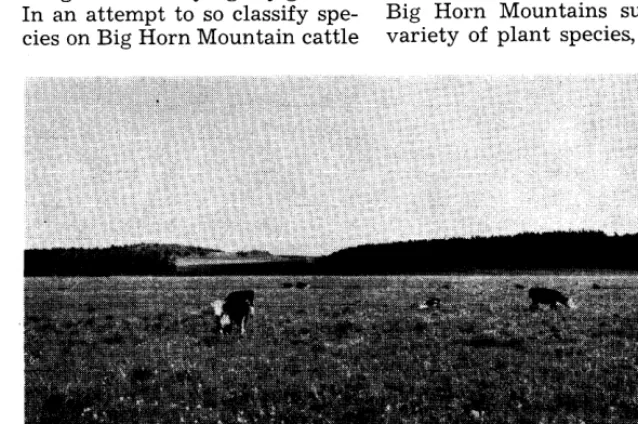
FIGURE 1. Large brush-free openings are characteristic of much of the cattle range.
110 RICHARD M. HURD AND FLOYD W. POND
which are perennials. These ranges are characterized by large parks or openings rimmed by dense stands of lodgepole pine (Pinus contorta), as seen in Figure 1. Engelmann spruce
(Picea engelmunniii) and alpine fir (A&es Zasiocurpu) are some- times associated with the pine or may, in some cases, form the forest canopy. Willows (S&x spp.) are common along the drainages and in the wet mead- ows. Shrubby cinquefoil (Poten- tilla fruticosu) is often locally abundant. Big sagebrush (Atie- misiu tridentutu) is common on some south and west slopes, par- ticularly on soils derived from limestone. Here, as well as in the brush-free parks, perennial grasses, grasslike plants, and forbs are common. Idaho fescue
(Festucu iduhoensis) is often the dominant grass. Some of its com-
mon associates are needleleaf sedge (Curex obtusutu), blue- grasses (Pou spp.), wheatgrasses (Agropyron spp.), needlegrasses (Stipu spp.), silky lupine (Lu- pinus sericeus), avens (Geum triflorum), starry cerastium (Cerustium urvense), yarrow (ArchiZZeu Zunulosu) and herb- aceous cinquefoils (Potentillu spp.) (Beetle, 1956, . Hurd and Kissinger, 1952).
Preference studies were con- fined to non-timbered upland sites, since these were believed to be the principal forage pro- ducing areas. Much of the vege- tation growing along stream bot- toms and wet meadows is readily grazed by cattle, but such sites are relatively small in aggre- gate area. Timber stands, be- cause of the tree growth and sparseness of herbaceous vege- tation, are used primarily for resting, shading, and protection. The grazing season on these cattle ranges is limited to about a four-month season beginning in June and ending in late Sep- tember.
Areas of investigation ranged from 7,200 to 9,000 feet in eleva- tion. Average annual precipita-
tion varies from 19 to 30 inches, depending upon the elevation, exposure, and local topography. Soil depth is variable, as is ap- parent fertility and moisture holding capacity. Both granite ?nd sedimentary parent rocks are present, and, in general, soils de- rived from sedimentary rocks support a greater and more di- versified herbaceous vegetative cover. In addition, there are sev- eral areas where crystalline and sedimentary rocks are inter- mixed. In these deposits of Terti- ary age (Darton, 1906) the vege- tation is similar to that on re- sidual soils formed from granite rocks.
Methods
Utilization estimates were the basis for determining species preference. The assumption was that, since cattle had a free choice of species in the sampled area, they would eat those that they liked. This in turn would be reflected in the utilization estimates. Thus, preference varied directly with utilization, and always the preference of the species could be ranked in a 1, 2, 3, order.
Utilization was determined by estimating the percentage of herbage weight the grazing ani- mals removed from each species growing within the sample plots (Pechanec and Pickford, 1937a). The utilization transects con- sisted of ten 25-sq. ft. circular plots spaced approximately 50 feet apart. These transects sam- pled the grass-forb cover type on
(1) the residual and colluvial soils from sedimentary rocks
(limestones, sandstones, and shales) , and (2) the residual soils from granite rocks (includ- ing here those soils derived from Tertiary deposits). The big sage- brush cover type was sampled also. It constituted the third plant-soil condition studied.
Utilization studies were made in the grass-forb vegetation in each of the 4 years of the study and in the sagebrush cover type
in 1953 and 1954. Every year utilization was estimated at the end of the grazing season on all grasses and grass-like plants. Ad- ditional estimates were made at mid-season in 1951 and 1952; at this time utilization of forbs was also estimated. In 1953, utiliza- tion was estimated on approxi- mately July 10, August 10, Sep- tember 10, and October 3. Both grasses and forbs were estimated on the first three dates, but forbs were omitted in October because most had withered.
Ground cover and herbage production were estimated on a species basis in each area sam- pled by utilization transects. A square frame containing 9.6 sq. ft. was used to outline individual plots, and ten such plots spaced approximately 50 feet apart con- stituted a transect. Cover and herbage production estimates are made at the time most of the perennial grasses had reached maximum height growth. The percentage of ground cover (ver- tical crown projection) was esti- mated for each species providing it amounted to at least 1 per- cent of the plot area. Lesser amounts were classified as “other grasses” or “other forbs.” Herb- age production for each species was estimated and recorded in grams; the technique followed was that described by Pechanec and Pickford (1937b). Herbage samples of most species were col- lected and air dried, so that esti- mated green weights could be
converted to an air dry basis. A total of 340 utilization tran- sects and 65 cover herbage prod- uction transects were used dur- ing the 4-year period. These transects sampled 23 areas on 11 cattle allotments that ranged from 4,000 to 30,000 acres in size.
Some species were found so in- frequently or in such small amounts on the sample plots that they could not be adequately evaluated. Consequently, they are omitted from the tables.
PREFERENCE AND PRODUCTIVITY OF SPECIES ON SUMMER RANGES
111
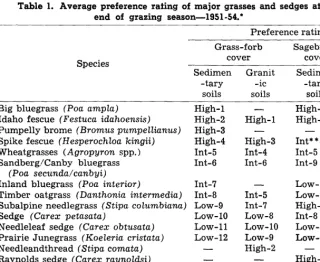
Table 1. Average preference rating of major grasses and sedges at end of grazing season-1951-54.*
Preference rating Grass-forb Sagebrush
SDecies cover cover
Sedimen Granit Sedimen -tary -ic -tary
soils soils soils Big bluegrass (Poa ampla)
Idaho fescue (Festuca idahoensis) Pumpelly brome (Bromus pumpellianus)
Spike fescue (Hesperochloa kingii) Wheatgrasses ( Agropyron spp. >
Sandberg/Canby bluegrass
(Pou secundu/cunb yi) Inland bluegrass (Pou interior)
Timber oatgrass (Dunthoniu intermedia)
Subalpine needlegrass (Stipu columbiunu)
Sedge (Curex petusutu)
Needleleaf sedge (Curex obtusutu)
Prairie Junegrass (Koeleriu cristutu)
Needleandthread (Stipu comutu)
Raynolds sedge (Curex ruynoZdsi)
Nodding brome (Bromus unomulus)
High-l High-Z High-3 High-4 Int-5 Int-6
Int-7 Int-8 Low-9 Low-10 Low-11 Low-12
-
- -
- High-l High-l High-2
- -
High-3 Int* ‘-7 Int-4 Int-5 Int-6 Int-9
- Int-5 Int-7 Low-8 Low-10 Low-9 High-2
-
Low-13 Low-l 1 High-4 Int-8 Low-12 Low-10
-
- High-3 Int-6 * 1953-54 only for sagebrush.
* * Intermediate.
the Rocky Mountain Herbarium,
University
of
Wyoming,
Laramie. Appreciation is ex-
tended to Dr. C. L. Porter, Cur-
ator, for identifying
those
species.
Results
Preference v a r i e d greatly
among species. As a group, the
grass and grasslike species have
a higher preference than forbs.
Average utilization for grasses
and sedges was 21 percent, com-
pared with 2 percent for forbs.
All grasses and sedges were
grazed to some extent, but many
of the forbs were not. For those
forb species that were grazed,
the utilization averaged 8 per-
cent.
Grasses and Sedges
Cattle were also selective in
their choice of grasses and
sedges. For example, throughout
the 4-year period big bluegrass
(Pea ampla) and Idaho fescue
ranked high in preference. In
contrast needleleaf sedge and
prairie Junegrass
(Koeleria cris- tutu)were consistently low in
preference. Wheatgrasses usual-
ly occupied an intermediate po-
sition. Thickspike wheatgrass
(Agropyron dusystuchyum)
was
the only wheatgrass encountered
on the granitic soils. It, as well
as slender wheatgrass
(A.truchycuuZum),
and bearded
wheatgrass
(A.subsecundum),
was found on the other two
plant-soil conditions. The prefer-
ence of the major grasses and
sedges are given in Table 1.
Generally, soil and cover types
appear to have little effect on
preference (Table 1). However,
the relationships are not always
clear-cut. Idaho fescue and big
bluegrass had a high preference
wherever they grew. There was
a tendency for subalpine needle-
grass (Stipu columbiunu) and the
closely allied William’s needle-
grass (S.
williumsii) to have ahigher preference in the sage-
brush cover type than in the
grass-forb cover. In contrast,
timber oatgrass (Dunthoniu in-
termedia),
when growing in the
sagebrush cover, had a lower
preference ranking than it did
on the other two plant-soil con-
ditions. Some species were not
found on all three soil-plant con-
ditions.
Preference for a particular
species did not change much as
the grazing season progressed.
The 1953 data, which contain
four periodic observations, show
that, in general, the preference
position at the beginning of the
grazing season is maintained. The
1951-52 supplemental inf orma-
tion tends to support these re-
sults. However, occasional varia-
tions did occur. For example,
Idaho fescue had an intermediate
preference during the first half
of the grazing season, but it fin-
ished with a high preference rat-
ing except on granitic soils,
where it had a high preference
ranking at all times. In contrast,
subalpine needlegrass declined
in preference as the grazing
season progressed.
Heavy grazing had no material
effect on preference. Usually,
the preferred species
were
grazed more intensively, without
any switch to the less palatable
species. When the estimated
utilization of Idaho fescue in-
creased 15 to 60 percent, it and
big bluegrass were still the pre-
f erred species. Needleleaf sedge
and prairie Junegrass still had
low preference ratings despite 60
to 70 per cent use of the fescue.
The high preference of Idaho
fescue together with its high
ranking in pounds per acre of
herbage produced make it the
leading forage grass (Table 2).
Pumpelly brome and needleand-
thread, although having high
preference (Table
1) ,occurred
infrequently and
in small
amounts. Consequently,
they
112 RICHARD M. HURD AND FLOYD
W.
PONDTable 2. Herbage and forage producfion rating for major grasses and sedges.
Species
Production rating
Grass-forb Sagebrush
cover cover
Sedimentary Granitic Sedimentary
soils soils soils
Herbage Forage Herbage Forage Herbage Forage High-l High-l High-l High-l High-l High-l High-2 High-3 Int-5 High-2 High-3 High-Z High-3 Int-4 Int-6 Int-6 High-2 High-3
High-4 High-2 - - * -
Int-5 Int-5 High-3 High-3 Int-7 Int-6 Idaho fescue
Wheatgrasses
Subalpine needlegrass Big bluegrass
Sandberg/Canby bluegrass Needleleaf sedge Inland bluegrass Timber oatgrass Sedge (C. petasata)
Prairie Junegrass Pumpelly brome Spike fescue Needleandthread Raynolds sedge Nodding brome
* Not present on composition and production sample plots, although occasionally found on the more numerous utilization plots.
Int-6 Int-6 High-2 Int-4 Int-5 Low-9
Int-7 Int-7 - - * -
Int-8 Int-8 Int-7 Low-8 Low-9 Low-10 Low-9 Low-9 Low-10 Low-10 Low-10 Int-8 Low-10 Low-11 Int-4 Int-7 Low-11 Low-11
Low-11 Low-10 - - - -
Low-12 Low-12 Low-8 Low-9 High-4 Int-5
- - Low-9 Int-5 - -
- - - - Int-6 High-4
- - - - Int-8 Int-7
ducer, it assumes an intermedi- ate position as a forage plant.
Forbs
Forbs were common in all soil-plant conditions (Fig. 2). As many as 45 species were found on the sample plots. However, only 19 species were estimated to have been utilized 1 percent or more. The average utilization of these grazed forbs ranged from 6 percent in the sagebrush cover type to 11 percent in the grass- forb-granitic soil condition.
Light and spotty grazing of forbs tends to mask clear-cut preference trends among years. However, b 1 u e 1 e a f agoseris (Agoseris glauca), dandelion
(Taraxacum officinale) , a n d white loco (Oxytropis sericea) had high preference ratings. Silky lupine, one of the two dominating forbs, was grazed sporadically. In some areas all or most of the lupine leaves were removed; in other areas, no evi- dence of grazing was detected. This was particularly noticeable on granitic soils.
Observations s u g g e s t that grazing by mule deer and poss- ibly by elk may contribute to
the high preference rating of such species as white loco, hoary balsamroot (BaZsamorhiza in- cana), elkweed (Frasera speci-
osa) ,
a n d ballhead sandwort(Arenaria congesta). No attempt was made to separate game use from cattle use. However, the high preference ranking of blue- leaf agoseris and dandelion is attributed to cattle because of the consistency with which these species were grazed on the cat- tle ranges.
Utilization of forbs increased as the grazing season progressed. Based on the 1953 data, the av- erage percentage utilization for the grazed forbs was 1, 5, and 10 percent on July 10, August 10, and September 10, respectively. Frosts made utilization estimates unreliable after September.
The importance of forbs as for- age plants increased directly with an increase in the utiliza- tion of grasses and sedges. When the utilization of Idaho fescue in- creased from 20 to 65 percent, the pounds of forb herbage con- sumed increased as much as 12 times in some areas. In one sam- pled area where Idaho fescue was utilized 85 percent, the forbs
supplied 53 percent of the forage. In another area where Idaho fescue was utilized 20 percent, the forbs supplied 8 percent of the forage.
Silky lupine contributed 67 percent of the total forage pro- vided by forbs. It, together with various combinations of blueleaf agoseris, white loco, and dande- lion, produced 86 percent of the f orb forage. Average herbage production of silky lupine during 1953 was 186 pounds per acre air dry. Blueleaf agoseris averaged 19 pounds per acre. Dandelion and white loco were abundant only in local situations.
Average forb herbage produc- tion was twice that of grasses and sedges (560 and 285 pounds per acre air dry, respectively). Forb production was least on the granitic soils. Of the forbs that were grazed, many produced small amounts of forage because of either low preference (light utilization) or small amounts of herbage produced. Some forbs, although abundant, were grazed little or not at all. Starry ceras- tium, pussytoes (Antennaria ro- sea and A. media) showy phlox (Phlox multiflora), paintbrushes
(CastiZZeja spp.) , fleabanes (Eri- geron spp.) , and avens are exam- ples. Avens, when growing in the grass-forb-sedimentary soil condition, produced more herb- age than any other forb and yet was rarely grazed. Forbs ac- counted for 5, 8, and 13 percent of the forage consumed on the grass-f o r b-granitic, sagebrush, and grass-forb-sedimentary con- ditions, respectively.
Discussion
PREFERENCE AND PRODUCTIVITY OF SPECIES ON SUMMER RANGES
such ranges. In the sagebrush cover type, Idaho fescue, the wheatgrasses, (largely slender wheatgrass), and subalpine nee- dlegrass provided 65 percent of the total forage. Again, these species ranked high in prefer- ence and herbage production. A similar situation existed on the grass-forb-sedimentary soil con- dition, where Idaho fescue, big bluegrass, and the wheatgrasses ranked in that order as forage producers. These species pro- vided 69 percent of the forage obtained from grasses and sedges, although as many as 17 grasses and sedges were some- times present. Here, subalpine needlegrass ranked fourth in for- age production, third in herbage production, and ninth in prefer- ence. The combination of these charact.eristics s u g g e s t s that management p r a c t i c e s that would cause this needlegrass to decrease and favor the increase of Idaho fescue, big bluegrass, and the wheatgrasses would re- sult in more pounds of desirable herbage.
Forba are a minor portion of the cattle diet even when it is assumed that cattle are respon- sible for all utilization. Although forbs may supply a relatively small quantity of forage, they may be of some importance nu- tritionally. Cook and Harris (1950) conclude that preference shown by sheep for certain types of forage was important in the nutritional value of the diet. As has been pointed out, forb utili- zation increases as the season progresses. Furthermore, as the utilization of the grasses and sedges increased from light to heavy, the pounds of forbs taken increased as much as 12 times in some areas. This suggests that, under these circumstances, the increase in forb utilization was due to a decrease in availability of the more highly preferred herbage rather than any tend- ency for the cattle to select the forbs.
The utilization of forbs and, to a large measure, grass and
FIGURE 2. Forbs were common on the cattle ranges, produced grasses and sedges combined, and were lightly grazed.
twice as much herbage as
sedges appears to hinge largely on the preference of the species itself rather than such factors as herbage production, percent- age ground cover, or distribu- tion. Several species illustrate this. Silky lupine ranked high in preference among forbs as well as in herbage production and ground cover; also, it is com- mon on the upland sites. Avens, when in the grass-forb- sedimentary soil condition, pro- duced more herbage than any other forb, had an 80 percent frequency (3.1 x 3.1 ft. plot) and yet was rarely grazed. Blueleaf agoseris also had an 80 percent frequency but was a minor spe- cies in the vegetative cover, and yet it ranked high in preference. Idaho fescue was abundant, uni- formly distributed (91 percent frequency), p r o v i d e d more ground cover than any other grass or sedge and was a pre- ferred species. In contrast, sub- alpine needlegrass within the grass-forb-sedimentary soil con- dition had a low preference, al- though it ranked high in herbage production and was fairly well distributed-62 per- cent frequency. Similar exam- ples indicatmg that utilization is
due to preference rather than amount of herbage produced have been reported by Richards and Hawks (1954)) Hurd and Pearse (1944)) and Cook and Harris (1950).
On the cattle ranges sampled, forbs out-yield grasses and sedges approximately 2 to 1. However, only 6 percent of the total forb herbage produced was taken, and the forbs furnished 9 percent of the forage. The gen- eral conclusion, then, is that a shift in the balance toward equal production of forbs and grass- like plants would provide a con- siderable increase in palatable herbage. If this were achieved there would still be ample amounts of forb herbage avail- able for selective grazing. In- vestigations on very lightly used areas and protected exclosures indicate that herbage production of forbs is essentially the same as that of grasses and sedges (Hurd and Kissinger, 1952).
114 RICHARD M. HURD AND FLOYD W. POND
upland sites. Utilization esti- mates formed the basis for giv- ing species a preference rating. In addition, herbage production was estimated for individual spe- cies. ‘Utilization estimate multi- plied by herbage production for a species indicated the impor- tance of the species as a forage plant. A total of 340 ten-plot transects were used for the pre- ference work, and 65 transects, for herbage production. These transects sampled 23 areas on 1‘1 cattle allotments ranging from 4,000 to 30,000 acres in size.
Grasses and sedges were pre- ferred to forbs. Within the grass- sedge group, some species were consistently high in preference while others were low. Through- out the $-year period, both Idaho fescue and big bluegrass were preferred grasses wherever they occurred. Wheatgrasses w e r e generally in the intermediate preference category, while nee- dleleaf sedge and prairie June- grass were least preferred.
Generally, there were no strik- ing changes in preference for grass-sedge species as the graz- ing season progressed. Similarly, no preference changes were no- ticeable when the grazing pres- sure increased; instead, the pre- ferred species were grazed more closely.
Idaho fescue was the number one forage plant. On granitic soils, it alone supplied 75 per- cent of the forage. On the other two. plant-soil conditions, it, to- gether with the wheatgrasses,
big bluegrass, and subalpine needlegrass, provided 65 to 70 percent of the forage.
Forbs, a 1 t h o u g h abundant, were generally lightly grazed. Estimated utilization averaged 8 percent for those species grazed 1 percent or more. Many species were not grazed. Blueleaf agos- eris, dandelion, silvery lupine, and white loco were the -pre- ferred species. Various combina- tions of these four species ac- count for 86 percent of the forb forage.
Forb herbage production was double that of the grass-sedge group. However, only about 6 percent of it was eaten. As graz- ing pressure increased on the grass&edge group, the utilization of forbs rose. Under these condi- tions, silvery lupine became an important producer of forage.
Utilization of a species did not appear to be influenced by fre- quency, abundance, or amount of herbage produced. A species was selected or rejected by cattle be- cause of its preference or palata- bility. Accordingly, those species having a relatively high prefer- ence and high herbage produc- tion were the important forage producers. Management prac- tices should be aimed at main- taining or improving the produc- tion of these important forage species.
LITERATURE CITED BEETLE, ALAN A. 1956. Range sur-
vey in Wyoming’s Big Horn Moun- tains. Wyo. Agr. Exp. Sta. Bul. 341. 40 pp.
COOK, C. WAYNE AND LORIN E. HARRIS. 1950. The nutritive content of the grazing sheep’s diet on summer and winter ranges of Utah. Utah Agr. Exp. Sta. Bul. 342. 66 pp. DARTON, N. H. 1906. Geology of the
Big Horn Mountains. U. S. Geol. Survey Prof. Paper 5 1. 129 pp. Appendix and maps.
HURD, RICHARD M. AND NELAND A. KISSINGER, JR. 1952. Range inves- tigations, Big Horn National For- est, Wyoming. Rocky Mtn. Forest and Range Exp. Sta. Station Paper 10. 24 pp. Appendix Litho.
__ AND C. KENNETH PEARSE. 1944. Relative palatability of eight grasses used in range reseeding. Jour. Amer. Sot. Agron. 36: 162- 165.
INTER-AGENCY RAXGE SURVEY COM- MITTEE. 1937. Instructions for range surveys. (No issuing agency). 28 pp. Mimeo.
IVINS, J. D. 1952. The relative pal- atability of herbage plants. Jour. Brit. Grassland Sot. 7: 43-54. PECHANEC, JOSEPH F. AND G. D. PICK-
FORD. 1937a. A comparison of some methods used in determining percentage utilization of range grasses. Jour. Agr. Res. 54: 753- 766.
.~ AND G. D. PICKFORD. 1937b A weight estimate method for the determination of range or pasture production. Jour. Amer. Sot. Agron. 29: 894-904.
RICHARDS, D. E. AND VIRGIL B. HAWKS. 1945. Palatability for sheep and yield of hay and pasture grasses at Union, Oregon. Oregon Agr. Exp. Sta. Bul. 431. 52 pp.
SOCIETY OF AMERICAN FORESTERS (COMMITTEE ON FOREST TERMI- NOLOGY) 1950. Forest terminology. Society of American Foresters. Mills Bldg. Wash., D. C. 93 pp.
CALL FOR PAPERS FOR THE 1959 ANNUAL MEETING
Members who wish to present papers at the next annual meeting of the Society to be held in Tulsa, Oklahoma, in January 1959, are requested to submit titles and short abstracts to the Program Committee. Final date for titles to reach the Committee is July 15, 1958.-E. H. MCILVAIN, Chair- man Program Committee, U. S. Southern Great Plains Field
Station,
Competition Between Forbs and Grasses
DON D. DWYER
Graduate Student in Botany, Fort Hays Kansas State College, Hays, Kunsus
Competition is occurring all the time among plants of the same as well as those of differ- ent species. However, little is known about how much the re- sults of competition affect the production of grass. There is very little literature available concerning competition between native forbs and grasses. Weaver (1942) has described competition of western wheatgrass (Agro- pyron smithii) with relict vege- tation but there is no discussion of competition between forbs and grasses as such.
Probably one of the most com- prehensive accounts pertaining to plant competition was af- forded by Clements, Weaver, and Hanson (1929). Hopkins (1951) felt that forbs decrease the production of grass, but that this reduction is compensated for by the yield of forbs, even though they may be lower in palata- bility.
Weaver and Clements (1938) stated that competition always occurs where two or more plants make demands for light, nutri- ents, or water in excess of the supply. Competition is essen- tially a decrease in the amount of water, nutrients, or light available for each individual.
The present study was con- ducted in an area near Hays, Kansas, that has been free from grazing or other unnatural dis- turbances for many years. The area, a big bluestem (Andropo- gon gerardi) type, was described by Albertson (1937) as a little bluestem (Andropogon scopar- ius) type. However due to the drought of the 1930’s, big blue- stem has largely replaced little bluestem. Big bluestem alone comprised over 60 percent of the
vegetation (Tomanek and Al- bertson, 1953). The chief associ- ates with this dominant were side-oats grama (Bouteloua cur- tipendula) , 9.4 percent, and little bluestem, 26.6 percent.
The study began at the close of the growing season in order to obtain the results of a full sea- son’s growth. Big bluestem alone was used for the yield determi- nations.
Plan and Method
The object of the study was to determine the amount various forb species reduced the yield of big bluestem. The assumption was made that competition be- tween the forb and grass was the only factor involved in the re- duction. The square-foot method was employed to measure how forbs growing in close contact with big bluestem affected the production of the grass.
It was intended that the com- petition be limited strictly be- tween the grass and a single forb species; therefore, the areas were selected. Selecting a sam- ple involved finding an area where big bluestem was growing with the forb under study. This square foot had no other forb species present. In addition to this quadrat, another comparable area was selected near-by as a control and was represented by a pure stand of big bluestem. A total of ten such samples and controls were taken for each forb species studied.
These square-foot areas were clipped to within one inch of the ground and the forbs and grasses s e p a r a t e d. Air-dry weight of clippings from both quadrats was compared in an ef- fort to measure the degree of competition.
115
Scientific names of the plants cited in this study are in agree- ment with those found in Glea- son (1952). Common names are taken from Standardized Plant Names (1942).
Results Rhizomatous Forbs Of the 5 rhizomatous forbs studied, heath aster (Aster eri- coides) caused the greatest re- duction in grass yield. An aver- age of 19 asters was present in each square foot sampled. The weight of the asters averaged 13.3 grams per square foot
(Table 1). The big bluestem produced an average of 28.5 grams of foliage per square-foot plot in pure stands, but only 9.1 grams in competition with heath aster. The reduction in grass yield averaged 68.1 per- cent.
This great reduction is easily explained when the underground structure is observed. The rhi- zomes are tough and woody, and are intricately interlaced among the rhizomes of big bluestem. In the upper 4 inches of soil, compe- tition is very severe since the rhizomes of the two opposing plants are in direct contact with each other.
Stiff goldenrod (Solidago rig- ida) is a robust plant which has very short rhizomes. These rhi- zomes bunch together forming a large heavy crown that often produces as many as 12 plants. An average of 6 plants occurred in each sample. The average de- crease in grass due to competi- tion was 53.2 percent. Competi- tion for space, in this case, was a factor in decreased grass pro- duction since the goldenrod often exclusively occupied as much as 16 square inches of the square- foot plot.
116
DON D. DWYER
Table 1. Species of rhizomaious forbs sfudied, forb and grass weights, and percent reduction in yields of grass with forb compeefifion.*
Species
Average Per- Wt. of Grass Wt. of Grass cent Decrease
Weight in Quadrat in Quadrat Due to of Forb With Forb Without Forb Competition
gm.
gm.
gm.
Heath aster 13.3 9.1 28.5
Stiff goldenrod 38.8 10.2 21.8
Western ragweed 16.2 11.3 25.5
Aromatic aster 6.2 10.0 20.4
Velvety goldenrod 17.6 13.2 24.6 * All differences were significant at the 5 percent level.
%
68.1 53.2 55.7 51.0 46.4
were strongly intermingled with those of big bluestem and fre- quently, even grew through the heavy root crowns of the grass. There was an average of 6 plants per quadrat.
Although a r o m a t i c aster
(Aster oblongifolius) is rather small in above-ground stature, its u n d e r g r o u n d structure seemed to be very effective, since the yield of big bluestem was reduced 51.0 percent in plots where the aster was present. There were usually 16 plants represented in each quadrat. The rhizome growth characteris- tics of the aromatic aster greatly resemble those of heath aster. However, the former’s rhizomes are a lighter tan in color and not as woody.
Velvety goldenrod (Solidago mollis), one of the less common goldenrods of the area, was rather robust in growth, usually around 15 inches in height, and an average of 11 plants were found in each sample. The rhi- zomes were dichotomous in na- ture, the older branches giving rise to many young shoots. There was an average decrease in the weight of the grass of 46.4 per- cent in the ten samples clipped. Unlike the short rhizomes of stiff goldenrod, the rhizomes of this forb were quite long, often with 4 or 5 plants attached to a single underground stem. These plants then sent out other rhizomes from the base of the shoot. Thus, with such a network of underground stems functioning to serve the numerous above-
ground shoots, it is easy to un- derstand the great reduction in grass yield.
Taproofed Forbs
Five t a p r o o t e d forbs were chosen for study as a contrast to the rhizomatous plants.
Blacksampson (Echinaceu un- gustifoliu) was widely scattered over the study area and there was seldom more than one plant Slimflower scurfpea (Psoralea tenuiflora) is a common inhabi- tant of the mixed prairie. The taproot is quite heavy on a ma- ture plant-usually 2 or 3 inches
in
diameter immediately below the soil surface. It often extends to a depth exceeding 16 feet in a soil with a deep profile. This is far below the reach of prairie grasses and reduces competition between the plants. The weight of big bluestem clipped from the quadrat with the scurfpea av- eraged 20.4 grams while the plot with a pure stand of bluestem produced 23.2 grass. This repre- sents a loss of only 12.8 percent(Table 2).
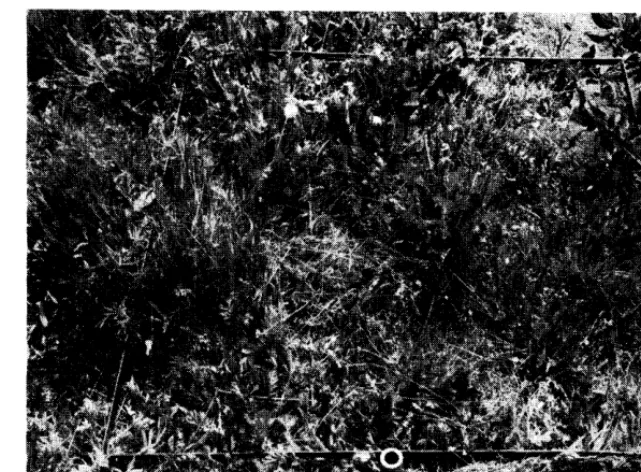
FIGURE 1. One-half meter sods 4 inches
deep of western ragweed in competition with big bluestem (above) compared with one-half square meter of pure big bluestem
(below).
in each sample. The quadrats containing this species produced
Catclaw sensitivebriar
only 18.9 percent less grass yield than those with pure big blue-
(Schrunkiu uncinutu) , is a spine- stem.
covered plant whose decumbent Broom snakeweed (Gutierrexia surothrae) , a semi-woody plant
growth characteristics had little with a heavy taproot, had an av- erage weight of 12.5 grams per quadrat. It caused an average decrease in grass production of 12.4 percent.
Table 2. Species of faproofed forbs studied, forb and grass weights, and percent reducfion in yields of grass wifh forb compefiiion.*
Average Per- Wt. of Grass Wt. of Grass cent Decrease Species Weight in Quadrat in Quadrat Due to
of Forb With Forb Without Forb Competition
gm. gm. gm. %
Blacksampson 2.9 18.9 23.3 18.9
Scurfpea 5.2 20.4 23.2 12.8
Broom snakeweed 12.5 14.9 17.0 12.4
Sensitivebriar 4.2 19.4 21.8 11.1
Prairieclover 5.3 12.7 14.1 9.9
~--
COMPETITION BETWEEN FORBS AND GRASSES 117
effect on the surrounding vegeta-
tion. Usually 2 or 3 plants were
present in each sample.
No distinction was made be-
tween purple or white prairie-
clover (Petalostemon purpurea
or P. candidurn) due to their sim-
ilarity in form and growth hab-
its. This plant usually consisted
of 3 stems about 18 inches tall
arising from a root crown.
Grass production in quadrats
containing these forbs was only
9.9 percent less than in pure
grass quadrats.
The differences were tested
for the taprooted forbs and found
not to be significant at the 5 per-
cent level. However, the de-
creases found due to the pres-
ence of rhizomatous forbs in the
quadrats were all highly signifi-
cant.
Roofs
and rhizomesThe object of this part of the
study was to determine the re-
duction in roots and rhizomes of
big bluestem due to the competi-
tion from rhizomatous forbs.
Sods, one-half square meter in
area by 4 inches deep, were re-
moved. The sod containing rhi-
zomatous forbs in competition
with the grass was compared
with a sod exhibiting a pure
stand of big bluestem (Figure 1).
These sods were taken within a
few feet of each other. Water
spray was used to remove the
soil and reveal the underground
parts. The roots of the forbs
and grass were carefully sepa-
rated and air-dry weight deter-
minations made of each.
The sod containing heath aster
revealed an amazing mass of in-
terlacing rhizomes when the soil
was washed away. These rhi-
zomes tend to occur between the
root crowns of big bluestem and
the soil surface (Figure 2).
Noarea existed in the one-half
square meter which was free of
aster rhizomes.
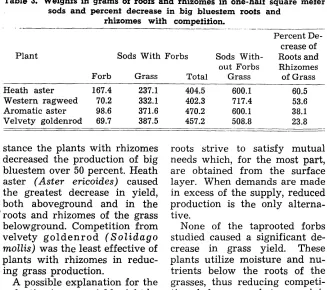
There were 167.4 grams of
heath aster roots and rhizomes
and 237.1 grams of big bluestem
(Table 3). The control quadrat
produced 600.1 grams of big blue-
stem roots and rhizomes. The
loss incurred by the grass roots
due to competition from heath
aster was 60.5 percent.
Aromatic and heath asters
were growing closely enough to-
gether that a single control quad-
rat of pure bluestem was used as
a comparison for both. Roots and
rhizomes of aromatic
aster
weighed 98.6 grams, and the
bluestem roots produced in this
same quadrat
weighed 371.6
grams. In the control, 600.1
grams of roots occurred. The de-
crease of grass roots and rhi-
zomes was 38.1 percent.
The rhizomes of western rag-
weed were found to be mostly
below the crowns of big blue-
stem. Although the weight of
ragweed was small, 70.2 grams,
the reduction in the grass roots
was 53.6 percent.
Velvety goldenrod’s roots and
rhizomes weighed 69.7 grams and
the grass roots with it weighed
387.5. The pure stand of blue-
stem in the control plot with it
produced roots weighing 508.8
grams. The percent loss of grass
roots and rhizomes due to com-
petition from the forb was 23.8.
Summary
The purpose of this study was
to determine the loss in weight
suffered by big bluestem
(An- dropogongerardi) as a result of
competition from both rhizo-
matous and taprooted forbs.
The results obtained readily
reveal that in all but one in-
FIGURE 2. One-half square meter of heath aster and big bluestem roots and rhizomes (above) compared with one-‘half square meter of pure big bluestem roots and rhiimes
(below). Note lighter colored rhizo,mes of the aster intermingled in the sparse bluestem
il8 DON D. DWYER
Table 3. Weights in grams of roofs and rhizomes in one-half square meter Even the combined weights of sods and prcenf: decrease in big bluesfern roofs and
rhizomes with competition. roots and rhizomes of the oppos-
-____ ______ _._~_ _ .____
Percent De-
ing plants did not equal the weight of the bluestem in pure crease of stands.
Plant Sods With Forbs Sods With- Roots and
out Forbs Rhizomes LITERATURE CITED
Forb Grass Total Grass of Grass
Heath aster 167.4 237.1 404.5 600.1 60.5 ALBERTSON, F. W. 1937. Ecology of Western ragweed 70.2 332.1 402.3 717.4 53.6 mixed prairie in west-central Kansas. Ecol. Monog. 7: 481-547. Aromatic aster 98.6 371.6 470.2 600.1 38.1
Velvety goldenrod 69.7 387.5 457.2 ______._ 508.8 23.8 CLEMENTS, H. C. HANSON. 1929. Plant com- F. E., J. E. WEAVER AND ____-_ petition. Carnegie Inst. Wash. Pub.
stance the plants with rhizomes decreased the production of big bluestem over 50 percent. Heath aster (Aster ericoides) caused the greatest decrease in yield, both aboveground and in the ‘roots and rhizomes of the grass belowground. Competition from velvety goldenrod (Solidago mollis) was the least effective of plants with rhizomes in reduc- ing grass production.
A possible explanation for the reduction in grass yield might be that the rhizomes of the two competing plants are in direct contact with each other in the surface 4 inches of soil. The
roots strive to satisfy mutual needs which, for the most part, are obtained from the surface layer. When demands are made in excess of the supply, reduced production is the only alterna- tive.
None of the taprooted forbs studied caused a significant de- crease in grass yield. These plants utilize moisture and nu- trients below the roots of the grasses, thus reducing competi- tion below-ground to a mini- mum.
Competitive effects of rhi- zomatous forbs on big bluestem roots and rhizomes were great.
398. 340 pp. -
GLEASON, H. A. 1952. The new Brit- ton and Brown illustrated flora. Lancaster, Pa.: Lancaster Press. HOPKINS, H. H. 1951. Ecology of the
native vegetation of the loess hills in central Nebraska. Ecol. Monog. 21: 125-147.
TOMANEK, G. W. AND F. W. ALBERT- SON. 1953. Some effects of differ- ent intensities of grazing on mixed prairies near Hays, Kansas. Jour. Range Mangt. 6: 299-305.
WEAVER, J. E. 1942. Competition of western wheat grass with relict vegetation of prairie. Amer. Jour. Bot. 29: 366-372.
WEAVER, J. E. AND F. E. CLEMENTS. 1938. Plant ecology. McGraw-Hill Book Company, Inc., New York. 601 pp.
Summer Society Meeting With T’he Pacific Northwest Section
Kamloops, B. C., July 11-12, 1958
The annual field trip of the Pacific Northwest Section of the Society is to be held in Kamloops, British Columbia on July 11 and 12, 1958. The National Directors will be meeting with us at this time, therefore a cordial invitation is extended to all members of the Society to attend.
This two-day meeting will take the form of a “workshop” in which ranchers and Range Tech- nicians will discuss and analyze range problems as they exist on the areas visited. Everyone pres- ent will have an opportunity to participate and thereby learn.
The first day of the tour will be spent on the Range Experimental Farm and its adjacent ranges. Here will be seen and discussed; irrigated forage production, plant introduction, plant poisoning by timber milkvetch, dryland range seeding, sage- brush control by beetles as well as chemicals, game and beef cattle competition for the range, and the use of managed pastures for breeding beef animals. .
The second day will take the tour into “Timber Ranges” with discussions of management needed,
logging road reseeding, fencing, salting practices, and carrying capacities of the different range types.
Apart from the academic side of this tour we plan to show a little western Canadian hospitality which is guaranteed to relieve any monotony.
You are reminded that this is Centennial year for British Columbia, 1858-1958. We are marking our one hundredth birthday with a tremendous celebration accenting our early history. A visit to our Province this year will prove both enjoyable and interesting.
-
If you are planning to attend the “summer roundup,” and we hope you are, will you let us know by dropping a line to the address below. Everyone loves a roundup so please come and join in ours.
W. L. PRINGLE, CHAIRMAN FIELD TRIP COMMITTEE Box 340