DiSE: Distributed Symmetric-key Encryption
Shashank Agrawal1, Payman Mohassel2, Pratyay Mukherjee3, and Peter Rindal∗4 1Visa Research, [email protected]
2Visa Research,[email protected] 3Visa Research,[email protected]
4Oregon State University, [email protected]
Abstract
Threshold cryptography provides a mechanism for protecting secret keys by sharing them among multiple parties, who then jointly perform cryptographic operations. An attacker who corrupts upto a threshold number of parties cannot recover the secrets or violate security. Prior works in this space have mostly focused on definitions and constructions for public-key cryptography and digital signatures, and thus do not capture the security concerns and efficiency challenges of symmetric-key based applications which commonly use long-term (unprotected) master keys to protect data at rest, authenticate clients on enterprise networks, and secure data and payments on IoT devices.
We put forth the first formal treatment for distributed symmetric-key encryption, proposing new notions of correctness, privacy and authenticity in presence of malicious attackers. We provide strong and intuitive game-based definitions that are easy to un-derstand and yield efficient constructions.
We propose a generic construction of threshold authenticated encryption based on
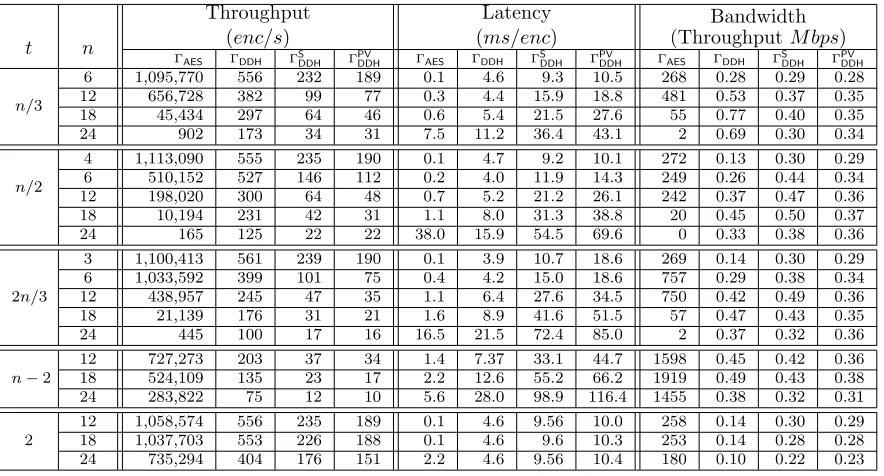
any distributed pseudorandom function (DPRF). When instantiated with the two differ-ent DPRF constructions proposed by Naor, Pinkas and Reingold (Eurocrypt 1999) and our enhanced versions, we obtain several efficient constructions meeting different security definitions. We implement these variants and provide extensive performance compar-isons. Our most efficient instantiation usesonly symmetric-key primitives and achieves a throughput of upto1 million encryptions/decryptions per seconds, or alternatively a
sub-millisecondlatency with upto 18 participating parties.
∗
Contents
1 Introduction 3
1.1 Technical Challenges . . . 4
1.2 Our Contribution . . . 6
2 Technical Overview 7 2.1 Security Requirements . . . 7
2.2 Our Generic Construction . . . 10
3 Related Work 12 4 Preliminaries 14 5 Distributed Pseudo-random Functions: Definitions 15 6 Threshold Symmetric-key Encryption: Definitions 17 6.1 Correctness . . . 18
6.2 Message privacy . . . 19
6.3 Authenticity. . . 20
7 Our Construction: DiSE 22 8 Instantiations of Distributed Pseudorandom Functions 25 8.1 DDH-based construction . . . 25
8.2 PRF-based construction . . . 28
9 Experimental Evaluation 29 10 Acknowledgment 31 A Cryptographic Primitives 37 A.1 Authenticated Encryption . . . 37
A.2 Commitment . . . 38
A.2.1 Concrete instantiations. . . 39
A.3 Secret Sharing . . . 39
A.4 Non-interactive Zero-knowledge . . . 40
B A few failed attempts in detail 41 B.1 Attempt 1: Distributed Encryption Scheme proposed by Naor et al. . . 41
B.2 Attempt 2: DPRF + Authenticated Encryption . . . 42
C Missing Proofs 42 C.1 Proof of Theorem 7.4. . . 42
C.2 Proof of Theorem 7.5. . . 45
C.3 Proof of Theorem 7.6. . . 46
C.4 Proof of Theorem 8.1. . . 48
C.5 Proof of Theorem 8.2. . . 53
1
Introduction
A central advantage of using cryptographic primitives such as symmetric-key encryption is that the safety of a large amount of sensitive data can be reduced to the safety of a very small key. To get any real benefit from this approach, however, the key must be protected securely. One could encrypt the key with another key, protect it using secure hardware (e.g. HSM, SGX or SE), or split it across multiple parties. Clearly, the first approach only shifts the problem to protecting another key. On the other hand secure hardware, co-processors and the like provide reasonable security but are not always available, are expensive or not scalable, lack programmability and are prone to side-channel attacks.
Splitting the key among multiple parties, i.e. threshold cryptography, is an effective general-purpose solution, that has recently emerged in practice as an alternative software-only solution [dya,por,sep]. Surprisingly, prior to our work, there was no formal treatment ofdistributed symmetric-key encryption. Prior formal treatments of threshold cryptography typically focus on the asymmetric-key setting, namely public-key encryption and signature schemes [DF90,DDFY94,GJKR96,CG99,DK01,AMN01,SG02,Bol03,BBH06,GHKR08,
BD10] where the signing/decryption key and algorithms are distributed among multiple par-ties. This is despite the fact that a large fraction of applications that can benefit from stronger secret-key protection primarily use symmetric-key cryptographic primitives wherein secret keys persist for a long time. We review three such examples below:
Secret Management Systems. An increasing number of tools and popular open source software such as Keywhiz, Knox, and Hashicorp Vault (e.g. see [sec]) are designed to automate the management and protection of secrets such as sensitive data and credentials in cloud-based settings by encrypting data at rest and managing keys and authentication. These tools provide a wide range of features such as interoperability between clouds and audit/compliance support. By far, the most commonly adopted primitive for encrypting secrets in the stor-age backend is authenticated encryption with amaster data encryption key that encrypts a large number of records. Some of these systems use secret sharing to provide limited key protection in an initialization stage but once keys are reconstructed in memory they remain unencrypted until the system is rebooted. Consider the following statement from Hashicorp Vault’s architecture documentation [vaua]:
“Once started, the Vault is in a sealed state. . .When the Vault is initialized it generates an encryption key which is used to protect all the data. That key is protected by a master key. By default, Vault uses a technique known as Shamir’s secret sharing algorithm to split the master key into 5 shares, any 3 of which are required to reconstruct the master key. . .Once Vault retrieves the encryption key, it is able to decrypt the data in the storage backend, and enters the unsealed state.”
Multi-device IoT Authentication. The proliferation of a wide range of Internet of Things (IoT) has provided users with new and convenient ways to interact with the world around them. Such devices are increasingly used to store secrets that are used to authen-ticate users or enable secure payments. Many IoT devices are not equipped with proper environments to store secret keys, and even when they are, provide developers with little programmability for their applications. It is therefore desirable to leverage the fact that many users own multiple devices (smart phone, smart watch, smart TV, etc.) to distribute the key material among them (instead of keeping it entirely on any single device) to enable multi-device cryptographic functionalities without making strong assumptions about a de-vice’s security features. Given the limited computation and communication power of many such IoT devices, such distributed primitives should require minimal interaction and limited cryptographic capabilities (e.g. only block-ciphers).
1.1 Technical Challenges
Modeling security As discussed earlier, existing threshold cryptographic definitions and constructions are primarily focused on public-key primitives such as digital signatures and public-key encryption. In fact, to the best of our knowledge, there isnostandard symmetric-key security notions in the distributed setting.
To help highlight the challenges with defining a robust security model, consider a software-based encryption/authentication service wherein long-term secret keys are shared among multiple servers who collectively perform symmetric encryption, decryption, and MAC oper-ations to store data in the cloud in an encrypted form, or to generate authentication tokens that are used to gain access to an external service. For example, the service can be used by cloud storage customers to encrypt/decrypt data on the cloud using a key that is never reconstructed after being distributed among the servers, or can be used to generate authen-tication tokens for a single-sign-on access control system that provides access to multiple services. A subset of these servers (below a threshold) are corrupted by an active adversary and can behave arbitrarily malicious but a secure point-to-point channel is assumed between the honest parties.
Observe that threshold authenticated encryption (TAE) is the appropriate and natural notion here as it would simultaneously solve the confidentiality and the authenticity prob-lem, such that a ciphertext generated by the TAE scheme could be both an authentication tickets and an encrypted message. Unfortunately, while definitions for threshold public-key encryption are well-understood (e.g. see [SG98,CG99,DP08, BD10, BBH06]), they fail to capture important subtleties that only arise in the symmetric-key setting when considering standard AE notions of message privacy and ciphertext integrity [BN00,KY01,RS06].
First note that in the above scenario, servers or parties are simply workers and have no special roles in the application that uses the service. In particular, a party who initiates the ciphertext generation may not be the one initiating the decryption process, and for availability reasons, we do not assume that the same encryptor is online/available during a decryption call. This necessitates aconsistency property where a ciphertext generated by any subset of parties should be decryptable by any other subset that is larger than a threshold.
Capturing all legitimate adversarial interactions in our security games is quite critical and subtle. For example, note that unlike the non-interactive setting, chosen plaintext attack (CPA) security is not sufficient to capture message privacy in the distributed setting where we need to guarantee message privacy not only in the presence of encryption queries but also during decryption queries initiated by the honest parties. In other words, the transcripts of such decryption queries should not revealanything about the message being decrypted to the adversary. Second, unlike the standard (non-interactive) ciphertext integrity notions where it is shown that decryption queries cannot help the adversary and hence can be safely removed from the security game (e.g. see [BGM04]), it is easy to observe that allowing for decryption queries in the threshold setting makes the adversary strictly stronger. For instance, consider a contrived threshold scheme where all parties contacted in the decryption protocol simply return their secrets. Clearly, this scheme is not secure, but it would still satisfy a ciphertext integrity notion that does not allow the adversary to invoke the decryption protocol.
Furthermore, adversarial encryption and decryption queries are of various different flavors. Those where the adversary is the initiator (i.e. the encryptor/decryptor), and those where an honest party initiates the query (indirect queries) but the adversary arbitrarily controls the corrupted parties taking part in the protocol. In case of indirect encryption queries, in the message privacy game, we let the adversary choose the message being encrypted and learn the resulting ciphertext. This captures, for example, a scenario where a cloud storage provider that uses the service is compromised and ciphertexts generated by honest encryptors are revealed. On the other hand, in the ciphertext integrity game, it is crucial not to reveal the ciphertext to the adversary in the indirect encryption queries and require that it cannot learn the full ciphertext based on its interactions. Otherwise, an honest party’s call to the encryption protocol provides the adversary with a valid ciphertext (token) that may give him access to an external service. Similar subtleties arise for decryption queries which we discuss in more detail in Section2.
Finally, unlike the non-interactive case, defining what constitutes a valid forgery in the ci-phertext integrity game is non-trivial. First, note that standard AE requires that cici-phertexts produced via encryption queries are distinct from the forged ciphertext. In the interactive setting where the adversary takes part in the encryption protocol, however, generated ci-phertexts may not be well-defined or valid. Moreover, there are two possible ways of testing validity of a forged ciphertext in the integrity game: (i) decrypt the forgery using an honest decryption (i.e. an execution of the decryption protocol that does not involve any corrup-tion), or (ii) run the decryption protocol wherein adversary controls the corrupted parties. This leads to two different notions of authenticity.
Performance Challenges. In addition to not meeting our security notions, existing thresh-old public-key constructions are too expensive for symmetric-key use cases, as they are dom-inated by more expensive public-key operations and/or require extensive interaction and communication between the parties. Applications that use symmetric-key cryptography often have stringent latency or throughput requirements. Ideally, one would like the dis-tributed encryption/decryption protocols to not be significantly more expensive than their non-distributed counterparts. In particular, the protocols should have low computation and bandwidth cost, and require minimal interaction.
Client Server-1
sk1
Server-2
sk2
Server-3
sk3 Server-4
sk4
Server-5
sk5
Contacted Not contacted
t
k1
t k4
t
k5
DistEnc(m):
− t←commit(m)
− k1, k4, k5←
query(t, {1,4,5})
− k←combine(k1, k4, k5)
− c←Enc(k, m)
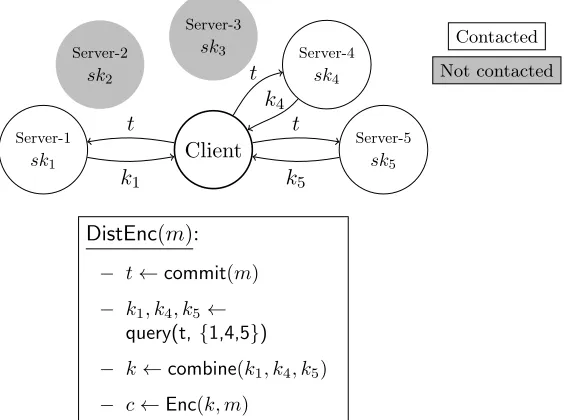
Figure 1: The flow of our distributed encryption protocol forn= 5 andt= 3. Client contacts servers 1, 4 and 5 to encrypt a message m. Servers do not communicate with each other. We show client separate from the servers for simplicity. A simplified outline of the encryption protocol is given in the box. See Figure2 for the actual steps. The flow of decryption protocol is similar to encryption but the steps involved are different.
algorithm, the resulting protocols would be prohibitively interactive, bandwidth-intensive, and would become increasingly expensive for larger number of parties. In this paper, we aim for two-round protocols where one server sends a message to other servers and receives a response, while other servers need not exchange any messages. This minimal interaction model minimizes coordination between the servers and is ideal for low-latency applications.
We review the MPC-based solutions and other related work on protecting cryptographic secrets through splitting them among multiple parties (i.e. secret sharing, threshold PKE and threshold PRFs) in the related work section (Section3).
1.2 Our Contribution
We formalize, design and implement new protocols fordistributed symmetric-key encryption. Our contributions can be summarized as follows:
New security definitions. We initiate a formal study of authenticated encryption in the distributed setting. We propose novel message privacy and ciphertext integrity definitions for threshold authenticated encryption that captures the unique issues that arise in this setting, in presence of amaliciousadversary that corrupts a subset of parties.
Simple and lightweight protocols. We put forward ageneric constructionbased on any
distributed pseudorandom function (DPRF) in the standard model. The construction only assumes one-way functions.
protocols with different security guarantees and efficiency levels (see Figure 8). All our protocols are light-weight: they require only two rounds of communication and incur minimal computation and bandwidth cost. Specifically, the party interested in encryp-tion or decrypencryp-tion sends one request message to other parties and receives one response message in return (see Figure 1for a visual depiction).1 In the most efficient instantia-tion, there are no public-key operations as parties only make PRF calls and hashing.
− We provide the first formal analysis for both the PRF-based and the DDH-based instan-tiations of the DPRF constructions given in Naor et al. [NPR99] by proposing a strong pseudo-randomness property. We also formalize correctness of DPRFs in presence of malicious corruption and extend their DDH-based construction to satisfy this notion.
− Our protocols allow for an arbitrary threshold t such that onlyt−1 other parties need to be contacted to encrypt or decrypt. At the same time, the protocols are resilient to the corruption of t−1 parties (clearly, this is the best one could hope for).
Implementation and Evaluation. We implement several variants of our protocols in C++ and perform extensive experiments to evaluate their performance for applications with high-throughput and low-latency requirements. Our most efficient instantiation achieves a throughput of upto 1 million encryptions/decryptions per seconds, or alternatively a sub-millisecondlatency with upto 18 participating parties. We achieve this high level of perfor-mance through a variety of cryptographic optimization and system level engineering such as full use of hardware accelerated AES and instruction vectorization. The result is a lightweight challenge-response protocol where only one message is sent and received by the participating parties.
2
Technical Overview
2.1 Security Requirements
A primary contribution of this work is to present a formal treatment of symmetric-key au-thenticated encryption in the distributed setting.
Our definitions are inspired by the traditional game-based notions of message privacy and ciphertext integrity for standard (i.e. non-interactive) symmetric-key encryption [BN00,
KY01, RS06]. We intentionally avoid the Universal Composability framework [Can01] be-cause such definitions, proposed in prior work for standard symmetric-key encryption, are cumbersome to work with (e.g. see [KT09]).
We remark that over the past two decades, a large body of work has considered various notions of security for standard authenticated encryption [BN00,Rog02,RS06,Rog13,RS06,
GL15, HRRV15,FFL12, BHT18, HKR15, BT16,BK11, PW12] to address many practical issues such as concrete security, nonce-misuse resistance, online security, and multi-user secu-rity. As the first work to formalize distributed authenticated encryption, we choose to focus on the traditional notion of AE security (i.e. message privacy + ciphertext integrity) as even extending this important notion to the threshold setting raises many new subtleties (as we will see shortly) that do not exist in the non-interactive setting. We leave it for future work to extend threshold AE to the more advanced notions mentioned above.
1
The Attack Model. In the distributed setting, we consider an attacker who controls a subset of parties and behaves arbitrarily malicious while the honest parties are connected via point-to-point secure channels. Moreover, to capture a more realistic scenario, we let the adversary choose its corruption set after receiving the public parameters of the scheme. As we will see shortly, this requires additional care in both the constructions and the security proof.
Threshold Symmetric-key Encryption. Analogous to its non-interactive counterpart, we define athreshold symmetric-key encryption (TSE) scheme consisting of a setup algorithm Setupand two protocols,DistEnc andDistDec, for distributed encryption and decryption, re-spectively. The scheme is parameterized by two positive integers n and t, with n ≥ t ≥ 2 wherendenotes the total number of parties andtthe threshold. We allow at mostt−1 corrup-tions which is clearly optimal in this setting. Setupgeneratesnprivate keyssk1, sk2, . . . , skn,
one for each party, and some public parameterspp. InDistEnc, one of the parties, called the encryptor, who holds a message, sends a request message toanyt−1 other parties in the pro-tocol. The participating parties use their respective secret-keys to compute their individual responses. At the end of the protocol, only the encryptor learns a ciphertext. Analogously, inDistDec, one of the parties (decryptor) with a ciphertext performs a similar process and learns the corresponding message. Note that we do not assume that the same party plays the role of encryptor and decryptor. Ourconsistency property requires that any subset oft
parties should be able to encrypt or decrypt.
Correctness. The natural correctness requirement in the non-interactive setting is that a ciphertext c generated by running an encryption algorithm on a message m must decrypt to m. But in the threshold setting where the adversary is malicious, defining correctness becomes more subtle. Informally, correctness requires that a ciphertext that is generated by an honest encryptor but may involve corrupt parties in the encryption protocol can only be decrypted (by an honest decryptor) to the correct message or results in an abort (i.e. ⊥) even if the decryption involves corrupted parties. This notion may already be sufficient for many applications. We also formalize a stronger notion wherein any execution of an encryption protocol that potentially involves malicious parties either produces a correct ciphertext (by correct we mean that an honest decryption produces the original message) or results in an abort. In other words, a valid ciphertext carries an implicit guarantee that an honest decryption/verification will always be successful. Looking ahead, if we do not impose the stronger correctness requirement, our instantiation is significantly faster—since to achieve the stronger form of correctness we need non-interactive zero-knowledge proofs (NIZK) that require more expensive public-key operations.
Message Privacy. As discussed earlier, our definition has two components, message pri-vacy and ciphertext integrity (also calledauthenticity). In the non-interactive case, message privacy is defined via a chosen plaintext attack (CPA) game where the adversary can engage in encryption queries before and after the challenge phase where the challenge stage consists of guessing between the ciphertexts for two adversarially chosen messages.
indirect encryption queries where it invokes an honest party to initiate an encryption query using an adversary-chosen message and let the adversary learn the ciphertext (despite the fact that the TSE encryption would not necessarily leak the ciphertext to the adversary). This captures scenarios where the application using the service may unintentionally leak ci-phertexts to the adversary (e.g. a cloud storage compromise or authentication token leakage). We then observe that this is not sufficient to capture full message privacy in the distributed setting. In particular, even decryption queries initiated by honest parties should preserve message privacy in presence of a malicious adversary who corrupts a subset of parties. Note that this issue does not arise in the non-interactive case where decryption queries always reveal the message. Hence, we allow these indirect decryption queries in our message privacy game and do not reveal the decrypted message to the adversary. In particular, an adversary could provide its challenge ciphertext to such an indirect decryption query and still should not be able to win the message privacy game.
Ciphertext Integrity. In the ciphertext integrity game, the adversary engages in both encryption and decryption queries, and then needs to create a new valid ciphertext (forgery). Several subtleties arise when defining a valid forgery. Let us start with the different types of encryption/decryption queries.
Similar to the message privacy game, both standard and indirect encryption queries are allowed. The ciphertexts resulting from the former are naturally not considered forgeries since the corrupt party is intended to learn it. However, in the indirect case where an honest party initiates the encryption, the security game does not provide the adversary with the resulting ciphertext. As such, the adversary is allowed to output the ciphertext of an indirect encryption query as a valid forgery if it manages to acquire one. Therefore the TSE scheme is required to prevent such attacks by making them unpredictable to him even while actively participating in the protocols.
Interestingly, we allow three types of decryption queries in the ciphertext integrity game. The adversary (i) either makes a standard decryption query where it initiates the decryption using a ciphertext of its choice and learns the decryption and transcripts of all corrupted parties; or (ii) it makes an indirect decryption query where an honest party initiates the decryption query using a ciphertext provided by the adversary; or (iii) makes an indirect decryption query using a ciphertext it does not know but that was previously generated via an indirect encryption protocol initiated by an honest party. The purpose of the third type (called targeted decryption queries) is to ensure that the decryption protocol initiated by an honest party does not leak the computed ciphertext to the adversary if it is the result of an earlier encryption by an honest party. To capture this, we do not count these ciphertexts towards adversary’s forgery budget; in particular, the adversary wins the game if it outputs one of them as a forgery. In fact, the only decryption queries that we count towards adversary’s forgery budget are of the first type, i.e. those initiated by the adversary itself. See Remark 6.11 for a more detailed discussion and how even this can be avoided at the cost of more expensive constructions.
with a ciphertext it received from the encryption oracle2. Unfortunately, one cannot take a similar approach in the distributed setting. If the adversary initiates an encryption session that involves malicious parties, the output of the session (a ciphertext) may not be available to the honest parties even if they are involved. Thus, it is not clear how to explicitly define the ciphertext learned by the adversary and therefore no straightforward way toprevent the adversary from claiming such ciphertext as a valid forgery.
To circumvent the problem while keeping the definition simple, we keep track of the
maximum number of ciphertexts, say k, the adversary could learn (in an ideal sense) by interacting with honest parties and require that as his forgery, he outputs k+ 1 distinct ciphertexts that successfully decrypt. This implies that at least one of the ciphertexts he outputs is a new and valid ciphertext.
Two Notions of Authenticity. Our definition also needs to specify how the forged ci-phertexts are decrypted to check their validity. The first option is to use an honest decryption (where all parties behave honestly). This is sufficient in applications where an external service would perform the decryption using the whole key (e.g. in case of single-sign-on access to a service). We refer to this variant asauthenticity as it resembles the standard authenticity notions studied in the non-interactive setting. A second (and stronger) option is to continue using the distributed decryption protocol (where adversary actively controls a subset of par-ties) to decrypt the forged ciphertexts too. We refer to this variant as strong authenticity. We design and implement protocols meeting both notions trading off efficiency for higher security.
2.2 Our Generic Construction
We provide a brief overview of our main construction but before doing so, we discuss a few attempts that fail to meet our efficiency or security requirements. A more detailed discussion on the failed attempts can be found in AppendixB.
DPRF. All the constructions we discuss in this section use a Distributed Pseudorandom Function (DPRF) as a building block. A DPRF is a distributed analog of a standard PRF. It involves a setup where each party obtains their secret-key and the public parameters. Evaluation on an input is performed collectively by anytparties wheret(≤n) is a threshold. Importantly, at the end of the protocol, only one special party (evaluator) learns the output. A DPRF should meet two main requirements: (i) consistency: the evaluation should be independent of the participating set, and (ii) pseudorandomness: the evaluation’s output should be pseudorandom to everyone else but the evaluator even if the adversary corrupts all othert−1 parties and behaves maliciously.
In the malicious case, one can think of a slightly stronger property, called (iii)correctness, where after an evaluation involving up to t−1 malicious corruptions, an honest evaluator either receives the correct output or can detect the malicious behavior.3 Naor et al. [NPR99]
2Under the unified definition, the adversary is supposed to distinguish between two worlds, a ‘real’ world
where access to both encryption and decryption oracle is provided, and an ‘ideal’ world where the encryption oracle is replaced with one that just returns random bits and the decryption oracle is replaced with one that just returns⊥.
3
propose two very efficient (two-round) instantiations of DPRF, one based only on symmetric-key cryptography and another based on the DDH assumption. We provide the first formal proof of security for these constructions under a strong pseudo-randomness requirement. These constructions, however, do not satisfy the correctness definition (against malicious adversaries). Interestingly, we note that the recommended approach of obtaining correctness by applying a NIZK to each message of the protocol runs into a subtle technical issue, and show how to circumvent it by modifying the construction such that the public parameters provide a trapdoor commitment to the secret keys of the parties.
Attempt-0: A four-round protocol. As discussed earlier, our goal is to obtain a two-round protocol where one party sends a message to others and receives a response. But it is helpful to review a first attempt that requires four rounds of interaction and meets all our security requirements. We assume a DPRF scheme is already setup. To encrypt a message m, parties evaluate the DPRF on a random message r generated by the encryptor to obtain the output w. The encryptor then encrypts the message m using a CPA-secure symmetric-key encryption with w as the secret-key to obtain a ciphertext c. Parties then run the DPRF protocol one more time on H(c) for a collision-resistance hash function H, such that the encryptor obtains the tag t. Encryptor outputs (r, c, t) as the output of the encryption protocol. The decryption protocol works as expected by first recomputing and checking tand then recovering wto decrypt c.
It is worth noting that this construction is reminiscent of the standardencrypt-then-MAC
approach for obtaining an authenticated encryption scheme, where in one invocation the DPRF is used to generate a fresh random key for encryption and in the second invocation it is used to compute a MAC on the ciphertext. Note that the encryption protocol requires two sequential calls to the DPRF protocol, hence yielding four rounds of interaction. Interestingly, to obtain a two-round protocol, we need to deviate from this and design a protocol that roughly follows the MAC-then-encrypt paradigm but nevertheless meets our strong notions of security. Next we review two 2-round proposals that fail to achieve our notions.
Failed Attempt-1 [NPR99]. The first (to the best of our knowledge) proposal for a distributed encryption is due to Naor et al. [NPR99] (NPR in short). They propose to (i) first encrypt the message m locally to produce a ciphertext e = SEw(m) by a “standard”
symmetric-key encryption schemeSE where the keywis chosen freshly at random; (ii) then invoke the DPRF on the input (jke) for the encryptor to obtainy, where jis the encryptor’s identity; (iii) finally mask the keyw withy. The final ciphertext is of the form (j, y⊕w, e). Although this achieves message privacy, it fails to achieve authenticity since the adversary, after obtaining a valid ciphertext as above, can change the key by maulingwtow0(and hence maul the ciphertext) and decrypt ewithw0 to produce a valid message m0. The crux of the problem is in giving the adversary the flexibility to choose the encryption keyw without any checks or restrictions.
Failed Attempt-2. Another natural approach to construct distributed threshold encryp-tion is to (i) choose a random nonce r, (ii) compute a DPRF valuew on (j, r) and (iii) use
w as a key for a standard authenticated encryption scheme AE to compute e = AEw(m).
of the AE scheme.
Note that both attacks discussed above work even in the semi-honest setting since the corrupt parties behave honestly in all distributed protocols. In fact, the above attempts fail to achieve even a much weaker notion of authenticity which does not allow decryption queries. See AppendixBfor more details.
Our Construction. At a high level, we use a DPRF scheme to generate a pseudorandom keywthat is used to encrypt the messagem. But to avoid the recurring problem in the failed attempts above, we need to ensure that an adversary cannot use the samewto generate any other valid ciphertext. To do so, we bind w to the message m (and the identity of party
j). One way to achieve that is to use (jkm) as an input to the DPRF. First, note that it is necessary to put j inside the DPRF, otherwise a malicious attacker can easily obtain w
by replaying the input of the DPRF in a new encryption query and thereby recovering any message encrypted by an honest encryptor. In the protocol we make sure each party checks if a message of the form (j,∗) is indeed coming from partyj. Second, this does not suffice as it revealsm to all other parties during the encryption protocols originated by honest parties and as a result fails to achieve even message privacy. To overcome this, we instead input a commitment to m to the DPRF. The hiding property of the commitment ensures that
m remains secret, and the binding property of the commitment binds w to this particular message. To enable the verification of the decommitment during the decryption, we need to also encrypt the commitment randomness along withm.
This almost works4 except that the attacker can still generate valid new ciphertexts by
keepingm, j and w the same and using new randomness to encrypt m. We prevent this by making the ciphertext deterministic givenmand w: we inputwto a pseudorandom number generator to produce a pseudorandom string serving as a “one-time pad” that is used to encrypt m just by XOR’ing (this can be thought of as applying a standard stream-cipher usingw as the “random” nonce).
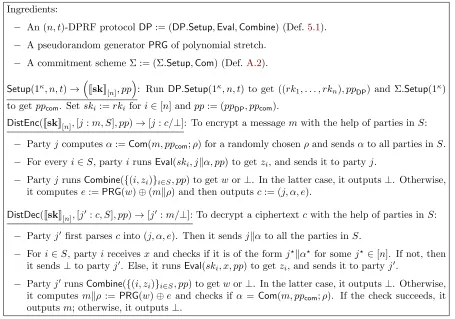
To summarize, our final construction can be informally described as follows: (i) the encryptor with identity j chooses a random ρ to compute α := Com(m;ρ) where Com is a commitment and sends (j, α) to the participating parties, (ii) the participating parties then first check if the message (j, α) is indeed sent by j (otherwise they abort) and then evaluate the DPRF on (jkα) for the encryptor to obtain the output w, (iii) finally, the encryptor computese=PRG(w)⊕(mkρ) and outputs the ciphertext (j, α, e).
In Section 7 we show that the above construction achieves consistency, message privacy and authenticity (ciphertext integrity) against a malicious adversary who corrupts up tot−1 parties if the underlying DPRF is consistent and pseudorandom. Moreover, if the underlying DPRF satisfies our correctness definition, then our TSE achieves strong authenticity. Note that given a DPRF, the only assumption required for the transformation is one-way functions.
3
Related Work
We briefly discuss several related research directions with similar motivations.
Secret-sharing. Secret-sharing schemes can be used to share the key for symmetric-key encryption among multiple parties, sayn. They guarantee that even if up ton−1 parties are
4
compromised, no information about the key is leaked. A popular key management tool called Vault [vaub] takes this approach. It uses Shamir’s secret sharing [Sha79] to split the master secret key intoshards. According to the documentation [vauc], “This allows each shard of the master key to be on a distinct machine for better security.” In practice, however, the master secret key is reconstructed from the shards when the Vault server is started, and remains in the memory of several—potentially, very weakly protected—parties for extended periods of time5. Certainly, Vault makes it easy for multiple applications or services to share the same key material but, at the same time, does not reduce key exposure in a significant way. Effectively, instead of being stored in a permanent way on multiple parties, the key material lives in memory.
Threshold PKE. Threshold public-key encryption is a well-studied problem in cryptog-raphy [Fra90, DF90, DDFY94, SG98, CG99, NPR99, DP08]. Here, the decryption key is shared among a set of parties such that at least a threshold of them are needed to decrypt any ciphertext. In some sense, threshold PKE is an analog of the problem we study here. But as discussed earlier, being a public-key notion, neither the security notions nor the efficiency requirements meet those of symmetric-key applications.
Threshold Pseudorandom Functions. To the best of our knowledge, the only thresh-old constructions designed for symmetric-key primitives are for pseudorandom functions [MS95, NPR99, Nie02, Dod03, DY05, DYY06, BLMR13, ECS+15]. This line of work is primarily focused on distributed PRFs (DPRF) with security in the standard model or ad-ditional properties such as verifiability or key-rotation, but does not provide definitions or constructions for the more general case of symmetric-key encryption. The only exception is the work of Naor et al. [NPR99], which also proposes a mechanism for encrypting messages using their DPRF construction. But as we have discussed (c.f. Sec 2.1, Appendix B), their proposal fails to meet our definition of threshold authenticated encryption. Nevertheless, we use Naor et al.’s DPRF constructions as the main building block in our constructions and implementations.
General-purpose MPC. Secure multi-party computation (MPC) allows multiple parties to evaluate a function over their private inputs without revealing anything about their inputs beyond the function’s output. Since its introduction in early 80s, MPC has grown into a rich area with a number of different solutions of various flavors. In the last decade or so, the performance of general-purpose MPC protocols (which allow arbitrary functions to be computed) has improved substantially in both the two-party and multi-party setting [mpca,
mpcb,mpcc].
However, all general-purpose MPC protocols work with a circuit representation of the function which seems to be an overkill to solve our specific problem. Furthermore, the communication complexity of these protocols typically scales linearly with the size of the circuit and the number of parties. Finally, the number of rounds of interactions is often more than two6 for all practical MPC instantiations; and the protocols require all pairs of
5
If not the master secret key itself, then at least theencryption key remains in memory. The encryption key encrypts the actual data and the master key encrypts the encryption key. We refer to the documentation for details.
6
parties to interact. Thus, a general-purpose MPC protocol for evaluating symmetric ciphers such as AES in any encryption mode [DK10, GRR+16, RSS17, dya] is too expensive of a
solution for many applications of distributed symmetric-key encryption. On the other hand, MPC-based solutions are advantageous in scenarios where the desired encryption scheme is fixed and cannot be changed by the application (due to compatibility with other components or a compliance requirement to use standardized schemes such as AES) since MPC can be used to securely compute arbitrary cryptographic functions.
4
Preliminaries
In this paper, unless mentioned otherwise, we focus on challenge-response style two-round protocols: a party sends messages to some other parties and gets a response from each one of them. In particular, the parties contacted need not communicate with each other.
Common notation. Let N denote the set of positive integers. We use [n] for n ∈ N to denote the set{1,2, . . . , n}. A function f :N→Nis negligible, denoted by negl, if for every polynomialp,f(n)<1/p(n) for all large enough values ofn. We use D(x) =:y ory:=D(x) to denote thaty is the output of the deterministic algorithm D on inputx. Also, R(x) →y
ory ←R(x) denotes that y is the output of therandomized algorithm R on input x. Rcan be derandomized asR(x;r) =:y, wherer is the explicit random tape used by the algorithm. Finally, we write X ∼ DS to denote a random variables X that follows a distribution D
over a setS. For two random variables X and Y we write X ≈comp Y to denote that they are computationally indistinguishable and X ≈stat Y to denote that they are statistically
close. Concatenation of two stringsaand b is either denoted by (akb) or (a, b). Throughout the paper, we usen to denote the total number of parties,t to denote the threshold, and κ
to denote the security parameter. We make the natural identification between players and elements of{1, . . . , n}.
We will use Lagrange interpolation for evaluating a polynomial. For any polynomial P, thei-th Lagrange coefficient for a setS to computeP(j) is denoted by λj,i,S. Matching the
threshold, we will mostly consider (t−1)-degree polynomials, unless otherwise mentioned. In this case, at leastt points on P are needed to compute anyP(j).
Inputs and outputs. We write [j:x] to denote that the valuexis private to partyj. For a protocolπ, we write [j:z0]←π([i: (x, y)],[j:z], c) to denote that party ihas two private inputsx and y; partyj has one private input z; all the other parties have no private input;
cis a common public input; and, after the execution, only j receives an outputz0. We write [i:xi]∀i∈S or more compactlyJxKS to denote that each party i∈S has a private valuexi.
Network model. We assume that all the parties are connected by point-to-point secure and authenticated channels. We also assume that there is a known upper-bound on the time it takes to deliver a message over these channels.
Adversary model. We allow an adversary to take control of up tot−1 parties and make them behave in an arbitrary manner (active/malicious corruption). The set of corrupt parties is not known in advance, but we assume that it does not change during protocol execution (static corruption). We useC to denote the set of parties under the control of an adversary
Cryptographic primitives. We need some standard cryptographic primitives to design our protocols like commitments, secret-sharing, non-interactive zero-knowledge proofs, etc. For completeness we define them formally in AppendixA.
5
Distributed Pseudo-random Functions: Definitions
Micali and Sydney introduced the notion of distributed pseudo-random functions in the mid 90s [MS95]. A DPRF distributes between n parties the evaluation of a function f which is an approximation of a random function, such that only authorized subsets of parties are able to compute f. A party who wants to compute f(x) sendsx to the parties in an authorized subset and receives information which enables her to findf(x). A DPRF must be consistent in the sense that for all inputsx, all authorized subsets should lead to the same valuef(x). A number of constructions and variants have been proposed over the course of more than two decades but they either involve multiple rounds of communication [Dod03], extensive interaction [Nie02, DY05], consider only passive corruption [NPR99, BLMR13], or achieve stronger properties which makes them more expensive [DYY06]. Several pseudo-randomness definitions have also been put forward in the literature, but they are not very formal or general in most cases. There are several attacks that are not explicitly captured by these definitions (though the proposed constructions may be secure against them). First, the adversary is not allowed to choose the set of parties to corrupt based on the public parameters (the only exception we know of is the definition proposed by Boneh et al. [BLMR13]). Second, it cannot obtain DPRF partial evaluations from honest parties on the challenge input (up to the threshold). Third, it is not allowed to participate in computing the DPRF on the challenge input, which may help it in distinguishing the true DPRF value from random. (Note that this last attack makes sense only under an active corruption.)
We allow the adversary to do all of the above in the pseudo-randomness game, thus ob-taining a much stronger security guarantee. Apart from consistency and pseudo-randomness, we also propose a correctness property which ensures that even if corrupt parties are in-volved in a DPRF computation, they cannot make an honest party output a wrong value.7 We build on the constructions of Naor et al. [NPR99] to obtain these properties from our DPRF instantiations.
Naor et al. [NPR99], however, were mainly concerned with DPRF security against semi-honest adversaries. They provide a security definition and two different constructions for such adversaries. They mention briefly that using non-interactive zero-knowledge (NIZK) proofs, one could make their DPRF constructions actively secure. However, they do not give a formal security definition for active security. It turns out that a naive application of NIZK proofs is in fact not sufficient to obtain security against malicious participants. We additionally need trapdoor commitments to satisfy the stronger pseudo-randomness requirement proposed here. Further, the fact that adversaries can obtain DPRF partial outputs on the challenge input and participate in computing the challenge DPRF value makes the proof more intricate.
We now present a formal treatment of DPRF. Similar to NPR [NPR99], we use a threshold
tto capture the authorized subsets, i.e., any set of at leasttparties can compute the function
f. Security is provided against any set of up to t−1 corrupt parties.
7
Definition 5.1 (Distributed Pseudo-random Function) A distributed pseudo-random function (DPRF)DP is a tuple of three algorithms (Setup,Eval,Combine) who satisfy a con-sistency property.
– Setup(1κ, n, t)→((sk1, . . . , skn), pp). The setup algorithm generatesn secret keys (sk1,
sk2,. . .,skn) and public parameters pp. The i-th secret key ski is given to party i.
– Eval(ski, x, pp) → zi. The Eval algorithm generates pseudo-random shares for a given
value. Party icomputes thei-th share zi for a valuex by running Eval with ski,x and
pp.
– Combine({(i, zi)}i∈S, pp) =: z/⊥. The Combine algorithm combines the partial shares
{zi}i∈S from parties in the setS to generate a value z. If the algorithm fails, its output
is denoted by⊥.
Consistency. For any n, t ∈ N such that t ≤ n, all ((sk1, . . . , skn), pp) generated by
Setup(1κ, n, t), any inputx, any two setsS, S0⊂[n] of size at leastt, there exists a negligible functionneglsuch that
Pr[Combine({(i, zi)}i∈S, pp) =Combine({(j, zj0)}j∈S0, pp)6=⊥]≥1−negl(κ),
wherezi ← Eval(ski, x, pp) for i∈S,zj0 ←Eval(skj, x, pp) for j ∈S0, and the probability is
over the randomness used byEval.
Definition 5.2 (Security of DPRF) LetDPbe a distributed pseudo-random function. We say that DP is secure against malicious adversaries if it satisfies the pseudorandomness re-quirement (Def. 5.3). Also, we say that DP is strongly-secure against malicious adversaries if it satisfies both the pseudorandomness and correctness (Def. 5.4) requirements.
A DPRF ispseudorandom if no adversary can guess the PRF value on an input for which it hasn’t obtained shares from at least t parties. It is correct if no adversary can generate shares which lead to an incorrect PRF value. We define these properties formally below.
Definition 5.3 (Pseudorandomness) A DPRFDP := (Setup,Eval, Combine) is pseudo-random if for all PPT adversariesA, there exists a negligible function neglsuch that
|Pr [PseudoRandDP,A(1κ,0) = 1]−Pr [PseudoRandDP,A(1κ,1) = 1]| ≤negl(κ), wherePseudoRand is defined below.
PseudoRandDP,A(1κ, b):
− Initialization. Run Setup(1κ, n, t) to get ((sk
1, . . . , skn), pp). Give pp toA. Initialize a
list L:=∅ to record the set of values for whichAmay know the PRF outputs.
− Corruption. Receive the set of corrupt partiesC fromA, where|C|< t. Give the secret keys{ski}i∈C of these parties toA. Define the corruption gap asg:=t− |C|.
− Pre-challenge evaluation queries. In response to A’s evaluation query (Eval, x, i) for some i ∈ [n]\C, return Eval(ski, x, pp) to A. Repeat this step as many times as A
− Build the list. Add anxtoLif|{i| A made a (Eval, x, i) query}| ≥g. In other words, if
A contacts at leastg honest parties on a valuex, it has enough information to compute the PRF output on x.
− Challenge. A outputs (Challenge, x?, S,{(i, zi?)}i∈U) such that |S| ≥t andU ⊆S∩C.
If x? ∈L, output 0 and stop. Let zi ←Eval(ski, x, pp) fori∈S\U and z? :=Combine
({(i, zi)}i∈S\U ∪ {(i, z?i)}i∈U, pp). If z? = ⊥, return ⊥. Else, if b = 0, return z?;
otherwise, return a uniformly random value.
− Post-challenge evaluation queries. Same as the pre-challenge phase except that if A
makes a query of the form (Eval, x?, i) for some i ∈ [n]\C and i is the g-th party it contacted, then output 0 and stop.
− Guess. Finally, Areturns a guessb0. Outputb0.
Definition 5.4 (Correctness) A DPRF DP := (Setup, Eval, Combine) is correct if for all PPT adversaries A, there exists a negligible function negl such that the following game outputs 1 with probability at least 1−negl(κ).
− Initialization. Run Setup(1κ, n, t) to get ((sk1, . . . , skn), pp). Give pp toA.
− Corruption. Receive the set of corrupt parties C from A, where |C| < t. Give the secret-keys {ski}i∈C of these parties to A.
− Evaluation In response to A’s evaluation query (Eval, x, i) for some i∈[n]\C, return Eval(ski, x, pp) to A. Repeat this step as many times asA desires.
− Computation. Receive a set S of size at least t, an input x?, and shares {(i, z?i)}i∈S∩C
fromA. Letzj ←Eval(skj, x?, pp) forj∈Sandz0i←Eval(ski, x?, pp) fori∈S\C. Also,
let z:= Combine({(j, zj)}j∈S, pp) and z? := Combine({(i, z0i)}i∈S\C∪ {(i, zi?)}i∈S∩C, pp).
Output 1 if z? ∈ {z,⊥}; else, output 0.
6
Threshold Symmetric-key Encryption: Definitions
In this section, we introduce threshold symmetric-key encryption (TSE) and formalize notions of correctness, message privacy, and authenticity for such schemes. We start by specifying the algorithms that constitute a TSE scheme.
Definition 6.1 (Threshold Symmetric-key Encryption) A threshold symmetric-key en-cryption schemeTSEis given by a tuple (Setup,DistEnc,DistDec) that satisfies the consistency property below.
– Setup(1κ, n, t) →(JskK[n], pp) : Setup is a randomized algorithm that takes the security parameter as input, and outputs n secret keys sk1, . . . , skn and public parameters pp.
The i-th secret keyski is given to party i.
– DistDec(JskK[n],[j : c, S], pp) → [j : m/⊥] : DistDec is a distributed protocol through which a party j decrypts a ciphertextc with the help of parties in a set S. At the end of the protocol, j outputs a message m (or ⊥ to denote failure). All the other parties have no output.
Consistency. For any n, t ∈ N such that t ≤ n, all (JskK[n], pp) output by Setup(1κ), for any message m, any two sets S, S0 ⊂ [n] such that |S|,|S0| ≥ t, and any two parties
j ∈S, j0 ∈S0, if all the parties behave honestly, then there exists a negligible function negl such that
Pr
h
[j0 :m]←DistDec(JskK[n],[j 0
:c, S0], pp) |
[j:c]←DistEnc(JskK[n],[j:m, S], pp)i≥1−negl(κ),
where the probability is over the random coin tosses of the parties involved in DistEnc and DistDec.
Definition 6.2 (Security of TSE) LetTSEbe a threshold symmetric-key encryption scheme. We say thatTSEis (strongly)-secureagainst malicious adversaries if it satisfies the (strong)-correctness (Def. 6.4), message privacy (Def. 6.6) and (strong)-authenticity (Def. 6.8) re-quirements.
In the security requirements that follow, the adversary is allowed to make encryption and decryption queries. In a query, it will specify a special partyj who will initiate the protocol, a set of parties whomjwill contact, and the input ofj(message or ciphertext). The protocol will be executed as one would expect: challenger will play the role of all parties not in the control of adversary and exchange messages with it on their behalf. If j is honest, then challenger will initiate the protocol, otherwise, the adversary will initiate it. For 2-round protocols, the interaction between the challenger and adversary will be quite simple. If j
is honest, then the challenger will send every message intended for a corrupt party to the adversary on behalf of j and wait to get a response from it. Challenger will then combine the response together with the response of honest parties (which it generates itself) to get the final output. On the other hand, when j is corrupt, the challenger is just supposed to respond to the messages that adversary sends to the honest parties.
From here on, we will not be explicit about the details of a protocol execution. We will just state that an instance of encryption or decryption protocol is run when adversary requests for it. Also note that although all the games below have separate encryption and decryption phases, this is only to make the definitions easy to read. The adversary is not restricted in this sense and can alternate between encryption and decryption queries.
Remark 6.3 (Relation with standard definitions) Note that our security notion can also be thought of as a generalization of standard (non-interactive) authenticated encryption. In particular, settingn= 1 and t= 0 one gets standard CPA-security from our message pri-vacy definition (Def. 6.6) and standard ciphertext integrity from our authenticity definition (Def.6.8).
6.1 Correctness
A TSE scheme is correct if whenever DistEnc outputs a ciphertext c for an input message
An adversary should not be able to influence the decryption protocol to produce a message different from m. We also consider strong-correctness which additionally requires that c
should only decrypt tom (not even ⊥) when decryption is performed honestly.
Definition 6.4 (Correctness) A TSE scheme TSE := (Setup,DistEnc, DistDec) is correct
if for all PPT adversaries A, there exists a negligible function negl such that the following game outputs 1 with probability at least 1−negl(κ).
− Initialization. Run Setup(1κ) to get (
JskK[n], pp). Givepp toA.
− Corruption. Receive the set of corrupt parties C from A, where |C| < t. Give the secret-keys {ski}i∈C of these parties to A.
− Encryption. Receive (Encrypt, j, m, S) from A where j ∈ S\C and |S| ≥ t. Initiate the protocolDistEnc from partyj with inputsmand S. Ifj outputs⊥at the end, then output 1 and stop. Else, letc be the output ciphertext.
− Decryption. Receive (Decrypt, j0, S0) fromAwherej0 ∈S0\C and |S0| ≥t. Initiate the protocolDistDec from party j0 with inputsc,S0 and pp.
− Output. Output 1 if and only if j0 outputsm or⊥.
A strongly-correct TSE scheme is a correct TSE scheme but with a different output step. Specifically, output 1 if and only if:
− If all parties inS0 behave honestly, thenj0 outputsm; or,
− If corrupt parties in S0 deviate from the protocol, then j0 outputs mor⊥.
Remark 6.5 (Correctness for different applications) In applications like key manage-ment, ciphertexts generated at some point may be decrypted much later when the plaintext is no longer available. In such cases, malformed ciphertexts must be immediately detected, hence strong correctness is needed. In applications like network authentication (Kerberos) or IoT-based payments where ciphertexts are typically decrypted shortly after encryption, the weaker notion of TSE suffices. In such cases, the outcome of decryption is known immediately and, if it is a failure, one can run another encryption session with a different set of parties.
6.2 Message privacy
We allow for two types of encryption queries in the message privacy game: 1) the adversary can initiate an encryption session to obtain both the final ciphertext as well as the transcripts of the parties it corrupts. 2) it can make an indirect encryption query where it invokes an honest party to initiate an encryption session using a message of its choice. To make the definition stronger, we provide the ciphertext output by the honest party to the adversary.
Definition 6.6 (Message privacy) A TSE schemeTSE:= (Setup,DistEnc,DistDec) satis-fiesmessage privacy if for all PPT adversaries A, there exists a negligible functionneglsuch that
Pr
MsgPrivTSE,A(1κ,0) = 1
−Pr
MsgPrivTSE,A(1κ,1) = 1
≤negl(κ),
whereMsgPriv is defined below.
MsgPrivTSE,A(1κ, b):
− Initialization. Run Setup(1κ, n, t) to get (JskK[n], pp). Give pp toA.
− Corruption. Receive the set of corrupt partiesC fromA, where|C|< t. Give the secret keys{ski}i∈C of these parties toA.
− Pre-challenge encryption queries. In response toA’s encryption query (Encrypt, j, m, S), wherej∈Sand |S| ≥t, run an instance of the protocolDistEnc withA8. Ifj /∈C, then
party j initiates the protocol with inputs m and S, and the output of j is given to A. Repeat this step as many times asA desires.
− Pre-challenge indirect decryption queries. In response toA’s decryption query (Decrypt, j, c, S), wherej∈S\Cand|S| ≥t, partyjinitiatesDistDecwith inputscandS. Repeat this step as many times asA desires.
− Challenge. A outputs (Challenge, j?, m0, m1, S?) where |m0| =|m1|,j? ∈ S?\C and
|S?| ≥t. Initiate the protocol DistEncfrom partyj? with inputs mb and S?. Givec? (or
⊥) output byj? as the challenge to A.
− Post-challenge encryption queries. Repeat pre-challenge encryption phase.
− Post-challenge indirect decryption queries. Repeat pre-challenge decryption phase.
− Guess. Finally, Areturns a guessb0. Outputb0.
Remark 6.7 When DistEnc is run in the challenge phase with S?∩C 6=∅, corrupt parties can easily cause the protocol to fail, leadingj? to output⊥. The definition above ensures that the probability that this happens cannot depend on the message mb.
6.3 Authenticity
As discussed in the overview section (Section2.1), we cannot directly generalize the standard (non-interactive) authenticity definition to our setting for multiple reasons. First, the ability to make decryption queries gives additional power to the adversary. Second, ciphertexts generated in indirect encryption and decryption queries should remain unpredictable to the adversary or else they would enable successful forgeries. Thus, the definition we present below departs significantly from the non-interactive version.
In the definition, the variablegcaptures the minimum number of honest parties an adver-sary must contact in order to get enough information to generate one ciphertext. The variable ct counts the total number of times honest parties are contacted in encryption/decryption protocols initiated by corrupt parties. Thus, the definition requires that an efficient adversary should only be able to producebct/gcciphertexts at the end of the game.
8
We present two variants of the definition. In the first notion, the forged ciphertexts output by an adversary at the end of the game are decrypted in an honest manner, i.e., all the parties involved in decryption follow the protocol. On the other hand, our stronger authenticity notion allows the adversary to influence the decryption process. A forged ciphertext that may otherwise not decrypt successfully, could be decryptable if corrupt parties manipulate their responses. Thus, there could be ciphertexts that are valid forgeries in the strong authenticity game but not in the standard one.
Recall that a targeted decryption query provides a way for an adversary to ask an honest party to initiate a decryption session on a ciphertext that was previously generated by some honest party, since such a ciphertext may not be available to the adversary. Just as in regular encryption/decryption sessions initiated by honest parties, the counterctis not updated in a targeted decryption session because we want to capture that the adversary does not get any useful information towards generating new ciphertexts in such a session.
Definition 6.8 (Authenticity) A TSE scheme TSE := (Setup, DistEnc, DistDec) satisfies
authenticity if for all PPT adversariesA, there exists a negligible functionnegl such that
Pr [AUTHTSE,A(1κ) = 1]≤negl(κ), whereAUTH is defined below.
AUTHTSE,A(1κ):
− Initialization. Run Setup(1κ, n, t) to get (JskK[n], pp). Give ppto A. Initialize a counter ct:= 0 and anordered list Lctxt:=∅. Below, we assume that for every query, the (j, S) output by Aare such that j∈S and |S| ≥t.
− Corruption. Receive the set of corrupt parties C from A, where |C| < t. Give the secret keys{ski}i∈C of these parties toA. Define the gap between the threshold and the
number of corrupt parties as g:=t− |C|.
− Encryption queries. On receiving (Encrypt, j, m, S) from A, run the protocol DistEnc withm, S as the inputs ofj. Ifj∈C, incrementctby|S\C|(number of honest parties inS). Else, append the ciphertext output by j toLctxt.
− Decryption queries. On receiving (Decrypt, j, c, S) from A, run the protocol DistDec with c, S as the inputs ofj. Ifj∈C, incrementctby |S\C|.
− Targeted decryption queries. On receiving (TargetDecrypt, j, `, S) from A for some
j ∈S\C, runDistDecwithc, S as the inputs ofj, wherecis the`-th ciphertext inLctxt.
− Forgery. Letk:=bct/gc. Aoutputs ((j1, S1, c1), (j2, S2, c2),. . ., (jk+1, Sk+1, ck+1)) such thatj1, . . . , jk+1 ∈/C and cu 6=cv for anyu6=v∈[k+ 1] (ciphertexts are not repeated).
For every i ∈ [k+ 1], run an instance of DistDec with ci, Si as the input of party ji.
In that instance, all parties in Si behave honestly. Output 0 if anyji outputs ⊥; else
output 1.
A TSE scheme satisfies strong-authenticity if it satisfies authenticity but with a slightly modified AUTH: In the forgery phase, the restriction on corrupt parties in Si to behave
Remark 6.9 (Authenticity for different applications) When protecting data at rest, an application may require that both encryption and decryption are distributed. If adver-sary can also interfere with decryption, the stronger version of authenticity should be used. In case of authentication tokens generated for an external service, the decryption is likely to be performed by a third party who holds the full key in a secure environment. Hence, the weaker notion of authenticity may suffice.
As we will see later, our TSE construction requires a stronger property from the underlying DPRF to achieve the stronger form of authenticity and as a result require the use of zero-knowledge proofs, but the normal form of authenticity can be achieved without it.
Remark 6.10 (Integrity of plaintexts) In the non-interactive setting for authenticated encryption, a weaker form of INT-CTXT, called integrity of plaintexts (INT-PTXT) [BN00], has also been studied. If a forged ciphertext decrypts to a message encrypted earlier by the adversary, then it is not considered a valid forgery in the INT-PTXT game. One can also weaken our authenticity definition in a similar fashion: a sequence of ` forgeries would be accepted only if they decrypt to`unique messages. See Lemma7.5for how this notion comes up in the distributed setting.
Remark 6.11 (Updating counter for decryption) In our current authenticity defini-tions, we increment the counter ct only for decryption queries initiated by the adversary (not for indirect or targeted queries), implying that a ciphertext the adversary could deduce from such an interaction is not considered a successful forgery. Though it may seem at first that we are increasing the attack surface (note that direct encryption queries are already counted towards this), the extra information leakage may not make a significant difference in practice, especially when applications restrict and/or log who initiates decryption and what can be decrypted by whom.
One can modify our construction to satisfy an even stronger notion where even decryption queries initiated by the adversary are not counted towards its forgery budget. For example, in parallel to evaluating the DPRF on jkα, a threshold signature on the same input can be computed. Then, during decryption, parties first check the validity of the signature before responding with their partial share of the DPRF value. However, adding an invocation of a threshold signature scheme to DiSE would be a significant overhead and would eliminate the possibility of a symmetric-key only solution.
7
Our Construction: DiSE
In this section, we put forward our main construction DiSE, based on any DPRF. A full description of the construction is provided in Figure2. (See Section2.2for an overview.) We prove that if the DPRF is (strongly) secure, then DiSE is (strongly) secure too. We provide concrete DPRF instantiations in Section8.
Theorem 7.1 The TSE scheme DiSE of Figure 2 is (strongly)-secure if the underlying DPRF DP is (strongly)-secure.
Proof. We show each property of DiSE separately.
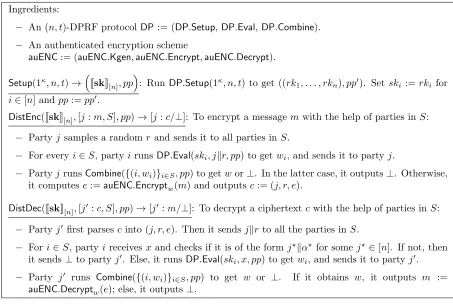
Ingredients:
− An (n, t)-DPRF protocolDP:= (DP.Setup,Eval,Combine) (Def. 5.1).
− A pseudorandom generatorPRGof polynomial stretch.
− A commitment scheme Σ := (Σ.Setup,Com) (Def.A.2).
Setup(1κ, n, t)→JskK[n], pp: RunDP.Setup(1κ, n, t) to get ((rk1, . . . , rkn), ppDP) and Σ.Setup(1κ)
to getppcom. Setski:=rki fori∈[n] andpp:= (ppDP, ppcom).
DistEnc(JskK[n],[j:m, S], pp)→[j:c/⊥]: To encrypt a messagem with the help of parties inS:
− Partyjcomputesα:=Com(m, ppcom;ρ) for a randomly chosenρand sendsαto all parties inS.
− For everyi∈S, partyiruns Eval(ski, jkα, pp) to getzi, and sends it to party j.
− PartyjrunsCombine({(i, zi)}i∈S, pp) to getwor⊥. In the latter case, it outputs⊥. Otherwise, it computese:=PRG(w)⊕(mkρ) and then outputsc:= (j, α, e).
DistDec(JskK[n],[j0:c, S], pp)→[j0 :m/⊥]: To decrypt a ciphertext cwith the help of parties inS:
− Partyj0 first parsescinto (j, α, e). Then it sendsjkαto all the parties in S.
− Fori∈S, partyi receivesxand checks if it is of the form j?kα? for somej?∈[n]. If not, then it sends⊥to partyj0. Else, it runs Eval(ski, x, pp) to getzi, and sends it to party j0.
− Partyj0 runsCombine({(i, zi)}i∈S, pp) to getwor⊥. In the latter case, it outputs⊥. Otherwise, it computes mkρ :=PRG(w)⊕eand checks if α=Com(m, ppcom;ρ). If the check succeeds, it outputsm; otherwise, it outputs⊥.
Figure 2: DiSE: our threshold symmetric-key encryption protocol.
Lemma 7.2 (Correctness) DiSE is a correct TSE scheme.
Proof. A TSE scheme is correct if whenever an honest partyjinitiatesDistEncon a message
m to obtain a ciphertext c(i.e., DistEnc does not fail), any honest partyj0 recoversm itself (or ⊥) when it runs DistDec with c as input (except with negligible probability). In the protocol DiSE,cis of the form (j, α, e) whereα:=Com(m, ppcom;ρ) is generated locally. Any decryptor must verify that the message m0 and randomness ρ0 that it recovers (if Combine does not fail) satisfyα =Com(m0, ppcom;ρ0) or not. If Σ is a binding commitment scheme, then this verification succeeds only ifm=m0, except with negligible probability.
Lemma 7.3 (Strong-correctness) If DP satisfies the correctness property, then DiSE is a strongly-correct TSE scheme.
For the following three lemma, we provide a sketch here and defer formal proofs to Ap-pendixC.
Lemma 7.4 (Message privacy) If DP is a secure DPRF, then DiSE is a message-private
TSEscheme.
Proof sketch. The challenge ciphertextc? has the form (j?, α?, e?) wheree? =PRG(w?)⊕
(mbkρ?), α? = Com(mb, ppcom;ρ?) and w? is the output of DPRF DP on j?kα?. One can think about the masking with PRG as a symmetric-key encryption using a stream cipher. So, an adversary A will find it computationally hard to guess b if w? is indistinguishable from random. The pseudorandomness property of DP ensures this as long asA has no way of evaluating the DPRF onj?kα? itself. (Note thatα? does not reveal information about mb
due to the hiding property of Σ.)
If a corrupt party initiates an encryption protocol, thenAcan learnjkα?for anyjbecause
α? is not hidden from it, but j would never be equal to j? since j? is an honest party. On the other hand, even ifA asks party j? to initiate encryption,j? would compute DPRF on a valueα6=α? due to the binding property of Σ. As a result, no matter how an encryption query is crafted, A cannot compute the DPRF on j?kα?. See Appendix C.1 for a detailed proof.
Lemma 7.5 (Authenticity) If DP is a secure DPRF, then DiSE is a TSE scheme that satisfies authenticity.
Proof sketch. Among the forged ciphertexts output by adversary, suppose there are two ciphertextsc1,c2(c1 6=c2) with the samejand commitmentα. When these two are decrypted with possibly different sets of parties, the DPRF value recovered would be the same due to the consistency property ofDP(it is assumed that all parties involved in decryption behave honestly). As a result, (m1, ρ1) and (m2, ρ2) recovered from c1 and c2, respectively, would be different. Due to the binding property of Σ, α cannot be a commitment to both. Hence, decryption of at least one of c1, c2 fails, and AUTH outputs 0. Therefore, if an adversary must succeed, each of the k+ 1 ciphertexts must have unique (j, α).
Recall that a valid adversary is allowed to contact honest parties strictly less than k·g
number of times. So one can find at least one (j, α) among the forged ciphertexts for which adversary has not contacted g parties. Due to the pseudorandomness property of DP, the adversary does not know the value of DPRF on (j, α). Hence, it can not produce a valid ciphertext with it.
A detailed proof can be found in Appendix C.2. Note that if parties involved in the decryption of forged ciphertexts are allowed to act maliciously, we cannot invoke DPRF’s consistency property. However, the adversary would still not be able to make sure thatc1,c2 decrypt successfully to two distinct messages because the commitment is binding. Thus, DiSE can be shown to satisfy a strong notion of an INT-PTXT-style definition in the distributed setting (see Remark6.10).
Lemma 7.6 (Strong-authenticity) If DPis a strongly-secure DPRF, then DiSE is aTSE
scheme that satisfies strong-authenticity.