A Survey on Real Time Presentation Slide
Sharing over Bluetooth
Prof. Poonam Joshi
1, Sanket Devlekar
2, Indresh Vishwakarma
3, Deepti Kaskar
4, Swati Rai
5Assistant Professor, Dept. of Information Technology, Atharva College of Engineering, Mumbai, India.1 BE Student,Dept. of Information Technology,Atharva College of Engineering, Mumbai, India.2, 3, 4, 5
ABSTRACT: Smartphones and connectivity on the go have become an integral part of our life. There is lack of availability of a convenient system to share presentation slides in real time without Internet connection for conducting short and effective presentations without additional infrastructure setup. The proposed system provides a solution by allowing the smartphone devices to be used as a network of presentation screens over Bluetooth. Bluetooth is widely used wireless technology. Bluetooth can be used to form networks called piconet and scatternet using which we can share data over that network. This system will be a convenient and handy alternative to bulky projectors and costly portable mini projectors for real time slide sharing and conducting presentations in various environments.
KEYWORDS: real time, slide, sharing, Bluetooth piconet, scatternet, portable, presentation, tool.
I. INTRODUCTION
Here is a problem that almost everyone face, whenever you want to convey your idea or present it with an effective presentation you may have to struggle to get the projector ready that consumes time also you may face technical inconvenience or instead you just try to express your idea by getting the audience to imagine what you say. It may also happen that you are at place where you don‟t have appropriate medium to give a presentation. The idea for this project arrived from these inconvenience and unavailability of a system that will enable mobile users to present their ideas and work to a group of people by giving presentation without actually requiring a projector and a huge screen or a separate infrastructure environment setup like presentation room. The immediate solution that one could think of was, using audience‟s smartphones as a wireless network of screens for viewing the presentation slide in real time.
Wireless Technology has improved our life to a great extent. The underlying technology one could use for achieving this was either by Wi-Fi or Bluetooth. Wi-Fi consumes more power as compared to Bluetooth. Bluetooth is the most commonly used wireless technology. It is a wireless technology standard for exchanging data over short distances from fixed and mobile devices and building personal area networks (PANs) [1]. Bluetooth consumes low power as compared to Wi-Fi. This paper introduces a concept of system that would enable to share presentation slide in real time over Bluetooth. The main intention of this paper is to succinctly review and summarize recent progress in Bluetooth ad-hoc network formation techniques, Bluetooth piconet and scatternet formation techniques and algorithms along with discussing how Bluetooth can be used for real time slide sharing.
II. BACKGROUND AND RELATED WORK
Bluetooth® technology is a wireless communications technology that is simple, secure, and omnipresent. There are billions of devices having Bluetooth, primarily every smartphone. Bluetooth technology is ubiquitous, consumes low power and is low cost; every smartphones have Bluetooth. Range of Bluetooth devices is application specific. Range may vary depending on class of radio used in an implementation [1]:
Class 3 radios – have a range of up to 1 meter or 3 feet[1]
The most commonly used radio is Class 2 and uses 2.5 mW of power [1]. Connections between Bluetooth enabled electronic devices allow these devices to communicate wirelessly through short-range, ad hoc networks [1] known as piconets [1].
Figure 1: Bluetooth network connections [2]
The piconet is a network of 8 devices consisting of 1 master device and 7 other devices called slaves. The interconnection of piconets is called as scatternet. In figure 1, nodes with M indicate a master and node with S indicate a slave. The bridge between piconets can either be an M or S. Each device in a piconet can also simultaneously communicate with up to seven other devices within that single piconet and each device can also belong to several piconets simultaneously. This means the ways in which you can connect your Bluetooth devices is almost limitless [1].
Hiranmayi Sreenivas and Hesham Ali [3] introduced a Bluetooth scatternet formation protocol that uses a genetic algorithm to calculate and find the best, or “fittest”, combination of masters, slaves and bridges in a given Bluetooth network. They have developed and simulated a scatternet formation algorithm that produces scatternets with certain desirable characteristics like minimal delay to the end-users during scatternet formation, minimal number of piconets in order to reduce inter-piconet interference during communication and bounded number of slaves to minimize the overhead associated with slave parking and unparking operations in a given Bluetooth network.
Suhela Madummathodi,and Kasim K [4] created a Mobile ad-hoc network (MANET) using already paired Bluetooth devices. The system is continuously learning. Initially all the devices in the paired lists will be checked for a successful transmission. The paths through which successful transfer takes place are recorded. These paths are tried first for transferring data for the same destinations. If no such device in existing path exists then a message is displayed “unable to connect”. Since the intermediate devices are selected from the list of paired devices the security of the system can also be assured.
In [5] a comparative performance of three scatternet formation protocol is studied. The work consists of performance comparison and evaluation among three solutions for forming multi-hop networks of Bluetooth (scatternet formation). The three protocols considered in this paper are BlueTrees, BlueStars and the“New Protocol”. From their study the BlueStars is fastest protocol for scatternet formation but have performance trade off and where the “New Protocol” is better option for stable network of piconets.
III.PROPOSED SYSTEM
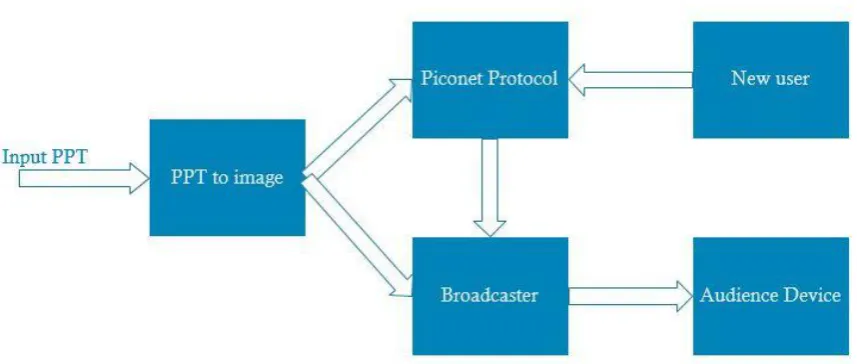
To resolve the problem of unavailability of projector instantly and avoid the required setup time we propose a new approach, „Real Time Slide Sharing over Bluetooth‟. This system will emphasis on sharing of slides in real time with less power consumption. The system is developed for particularly Android OS devices and having Bluetooth support. The presenter will initiate the system. The system will browse and take input as a presentation file; it will convert each slide into image format. Converting each presentation file into a set of images will help in reducing the complexity of the system. The piconet protocol is running in the background, if the new user request to join, it will connect to the piconet. Formation of piconet leads to the broadcasting of current presentation slide to all the connected devices. Thus, the slide will be received by the entire audience devices in the network.
Figure 2: System Block Diagram
IV.METHODOLOGY
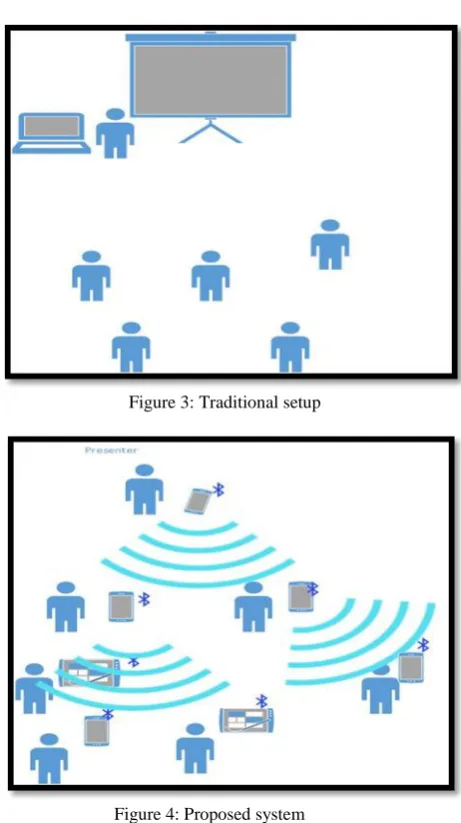
Figure 3: Traditional setup
Figure 4: Proposed system
Initially the scope is to be able to create a piconet, a network of 8 devices in which there will be 1 master and 7 slaves. The master is the presenter who will initialize the system hosting the presentation and the slave is the audience who will be viewing the presentation. Once the piconet is working the scope is extended to form a scatternet.
A. Presenter
B. Audience
The audiences are the nodes that will view the slide in their Android devices. They need connect to the network; audience must start our application which will require the Bluetooth connectivity to be enabled before proceeding. The new node requests the system to join the network. If the master permits the user, then it becomes a part of the network and can receive the broadcast slide. As the slide gets changed in the master, the audience will receive automatically the updated slide. The audience device will be able to receive all the slides which is shown by the master. Thus any new node can join the network and access the slides.
C. Sequence of the proposed system
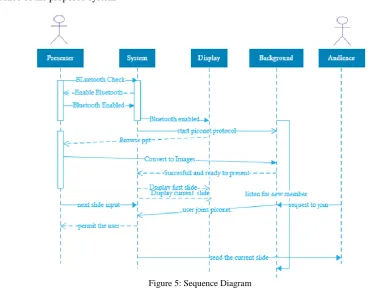
Figure 5: Sequence Diagram
The presenter initiates the communication by checking Bluetooth visibility of the system. When the Bluetooth is enabled, the presenter gets notified by the system. In background, the piconet protocol is initiated and it listens to the request by the new device. When the presenter get the presentation file, it will be converted into image in background and after the successful conversion, the system get notified. As a result, system can display the current slide. In the middle, if new user wants to join in the network, the presenter will permit the user. The audience which is now connected to the network will receive the slide in real time. When the presenter displays the new slide it will be seen in the audience device. Thus, when the Bluetooth is disabled the connection terminates and all the audience members connected in the network will be disconnected.
V. CONCLUSION AND FUTURE WORK
It can be used to develop applications which require transmitting small data like state change information, even in multiplayer games in android devices.
REFERENCES
1. www.bluetooth.com/Pages/Basics.aspx
2. http://www.binaryspectrum.com/clients/case-studies/bluetooth.htm
3. Hiranmayi Sreenivas and Hesham Ali. “An Evolutionary Bluetooth Scatternet Formation Protocol”, Proceedings of the
37th Hawaii International Conference on System Sciences – 2004, 0-7695-2056-1/04 $17.00 (C) 2004 IEEE.
4. Suhela Madummathodi, Kasim K, A Bluetooth Messaging System to Enable Users to Communicate in a Scatternet‟, 2nd
International Conference on Current Trends in Engineering and Technology, ICCTET‟14, IEEE Conference Number – 33344.
5. Mohammad Shafkat Amin, Fahima Amin Bhuyan, M. Lutfar Rahman and Mohammad Shyiq Amin, “Bluetooth Scatternet
Formation Protocol: A Comparative Performance Analysis”, I1-4244-0574-2/06/$20.00 (0)2006 I EEE.
6. Ms Prerna Hingle, Ms Shubhangi Giripunje, “Real Time Multiple Cross Platform Communication through Bluetooth”,
![Figure 1: Bluetooth network connections [2]](https://thumb-us.123doks.com/thumbv2/123dok_us/1474781.1180580/2.595.156.452.223.377/figure-bluetooth-network-connections.webp)