ABSTRACT
PRASHANT GUPTA. A Floor Control Protocol for SIP-based multimedia conferences (Under the direction of Dr. Douglas S. Reeves).
The purpose of this research is to define a protocol to regulate resources among participants in SIP-based centralized multimedia conferences.
Centralized conferences are typical of contemporary conferencing
architectures. SIP is emerging as the signaling protocol of choice for multimedia multiparty sessions. An important problem that needs to be addressed, in such sessions, is that of controlling and ordering access to multimedia resources among participants. This is also known as floor
A FLOOR CONTROL PROTOCOL FOR SIP-BASED MULTIMEDIA CONFERENCES
by
Prashant Gupta
A thesis submitted to the Graduate Faculty of
North Carolina State University
in partial fulfillment of the
requirements for the Degree of
Master of Science
DEPARTMENT OF COMPUTER SCIENCE
Raleigh
2002
APPROVED BY:
Dr. Mladen A. Vouk
Dr. Peng Ning
To my parents,
Chhaya and Ashok Gupta,
for being my guiding star;
my sisters,
Prerna and Yamini,
their happiness means the world to me;
and Kalpana Jogi,
Biography
Prashant Gupta was born in Madras (now Chennai), India, in 1977. After completing his high school in Chennai, he received his Bachelor of Engineering (Hons.) degree in Computer Science from Birla Institute of Technology and Science (BITS), Pilani, Rajasthan, India, in 1999. After that he worked for Aditi Technologies, Bangalore, India as a software developer for about a year.
Acknowledgements
I am grateful to my advisor Dr. Douglas S. Reeves for his support and encouragement. I thank Dr. Mladen A. Vouk and Dr. Peng Ning for consenting to be on my thesis committee. I would like to acknowledge Dr. Jonathan Rosenberg for giving me valuable pointers on work to be done in the area of SIP.
Table of Contents
Acronyms viii
List Of Figures ix
List Of Tables xi
1 Introduction... 1
1.1 The Session Initiation Protocol ... 1
1.2 H.323 ... 2
1.3 Multiparty Multimedia Conferencing ... 2
1.4 SIP vs. H.323 in Conferences ... 3
1.5 Focus ... 3
1.6 Terminology and Conventions used ... 4
1.7 Contribution ... 5
1.8 Structure of thesis ... 6
2 Background... 7
2.1 IP ... 7
2.2 TCP ... 7
2.3 UDP ... 8
2.4 SAP ... 8
2.5 SIP ... 8
2.5.1 Protocol Entities ... 9
2.5.2 Methods ... 9
2.5.3 Responses ... 10
2.5.4 Event Notification Mechanism ... 11
2.6 SDP ... 13
2.7 RSVP ... 15
2.8 RTP/RTCP ... 15
3 Floor Control in SIP... 17
3.1 Definition ... 17
3.2 Literature Review ... 18
3.3 Conference Models in SIP ... 20
3.3.1 Definitions ... 20
3.3.2 Multicast Conferences ... 22
3.3.3 Centralized Conferences ... 23
3.3.3.1 Centralized Server ... 23
3.3.3.2 Endpoint Server ... 25
3.4 Floor Control Architecture ... 28
3.5 FC support in SDP ... 30
3.5.1 Existing Proposal ... 31
3.5.1.1 Resource Identification ... 31
3.5.1.2 FC Channel Definition ... 31
3.5.1.3 FC Indication ... 32
3.5.1.4 Media Channel(s) to Floor Control Channel Mapping ... 32
3.5.2 Proposed Changes ... 33
3.6 FC support in SIP ... 35
3.7 Conference Setup in Centralized model ... 35
3.8 Currently Proposed Floor Control Protocol ... 38
3.8.1 Messages ... 38
4 Protocol Design... 41
4.1 Floor Policies ... 41
4.1.1 Moderated with AccessQ ... 42
4.1.2 Unmoderated with AccessQ ... 42
4.1.3 Moderated/Unmoderated without AccessQ ... 42
4.1.4 Moderated with No AccessQ ... 43
4.1.5 Unmoderated with No AccessQ ... 43
4.1.6 No Floor ... 43
4.2 Service specification ... 44
4.3 Environment description ... 44
4.4 Vocabulary (Operations) ... 45
4.4.1 Moderator Operations ... 45
4.4.2 Participant Operations ... 46
4.5 Syntax (Message formats) ... 47
4.5.1 Schema Definitions ... 47
4.5.1.1 FloorID ... 48
4.5.1.2 UserID ... 48
4.5.1.3 Permissions ... 48
4.5.1.4 Queues ... 49
4.5.1.5 Holdings ... 50
4.5.1.6 Floor Information ... 51
4.5.2 Moderator Requests ... 53
4.5.2.1 moderator-response create-floors(floor-parameters+) ... 53
4.5.2.2 moderator-response freeze-floors(floor-id+) ... 54
4.5.2.3 moderator-response remove-floors(floors-id+) ... 55
4.5.2.4 moderator-response modify-parameters-floors(floor-parameters+) ... 55
4.5.2.5 moderator-response modify-state-floors(floor-state+) ... 56
4.5.3 Participant Requests ... 56
4.5.3.1 participant-response request-floors(user-id, …) ... 57
4.5.3.3 participant-response yield-floors(user-id, to-user-id, …) . 59
4.5.3.4 participant-response cancel-requests(user-id, …) ... 59
4.5.3.5 get-parameters-response get-parameters-floors() ... 60
4.5.3.6 get-state-response get-state-floors() ... 61
4.5.4 Floor Control Events ... 62
4.5.4.1 create-event ... 62
4.5.4.2 freeze-event ... 63
4.5.4.3 remove-event ... 63
4.5.4.4 modify-parameters-event ... 64
4.5.4.5 modify-state-event ... 64
4.6 Procedure rules (Time Sequence diagrams) ... 65
5 Implementation... 72
5.1 Conference Model ... 72
5.2 Architecture of Components ... 73
5.2.1 Focus ... 73
5.2.2 Moderator ... 75
5.2.3 Participant ... 76
5.3 Experimental Setup ... 78
5.3.1 Sample flows ... 79
5.3.1.1 create-floors ... 79
5.3.1.2 request-floors ... 81
5.3.1.3 release-floors ... 82
5.4 Software Tools ... 84
5.5 Limitations ... 84
6 Summary and Future Work... 86
6.1 Differences in approach ... 86
6.2 Protocol Enhancements ... 87
6.2.1 New Functionality ... 87
6.2.2 Structural Modifications ... 88
6.2.3 Policies ... 88
6.3 Future Work ... 88
7 Bibliography... 90
Appendix I – XML Schema 93
Acronyms
3GPP Third Generation Partnership Project IETF Internet Engineering Task Force SIP Session Initiation Protocol
MMUSIC Multiparty Multimedia Session Control RFC Request For Comments
HTTP Hyper Text Transport Protocol IP Internet Protocol
SMTP Simple Mail Transfer Protocol SDP Session Description Protocol SAP Session Announcement Protocol SOAP Simple Object Access Protocol TCP Transmission Control Protocol UDP User Datagram Protocol
XML Extensible Markup Language
NIST National Institute of Standards and Technology RTP Real-time Transport Protocol
RTCP RTP Control Protocol
List Of Figures
Figure 1.1 – Entities In A Centralized Conference 5 Figure 2.1 – IETF Multimedia Conferencing Stack 7 Figure 2.2 – SIP Message exchange (a)REGISTER, (b)INVITE and BYE,
(c)CANCEL and (d)OPTIONS
11
Figure 2.3 – SIP Events Mechanism (a)REGISTER and (b)NOTIFY 12
Figure 2.4 – SDP Message Format 14
Figure 3.1 – A Multicast Conference Example 23
Figure 3.2 – Centralized Server 25
Figure 3.3 – Endpoint Server 26
Figure 3.4 – Media Server 28
Figure 3.5 – Floor Controlled Conference 29
Figure 3.6 – SDP fragment with FC support 33
Figure 3.7 – Modified SDP Fragment 34
Figure 3.8 – Conference Setup with Floor Control 36 Figure 3.9 – Floor Control Operations Overview 37
Figure 4.1 – Floor Identifiers 48
Figure 4.2 – User Identifier 48
Figure 4.3 – Permissions 49
Figure 4.4 – Queue Parameters 49
Figure 4.5 – Queue State 50
Figure 4.6 – Request List 50
Figure 4.7 – Holdings 51
Figure 4.8 – Floor Parameters 52
Figure 4.9 – Floor State 53
Figure 4.10 – Create Floors 53
Figure 4.11 – Create Floor Response 54
Figure 4.12 – Freeze Floors 54
Figure 4.13 – Remove Floors 55
Figure 4.14 – Modify Floor Parameters 55
Figure 4.15 – Modify Floor State 56
Figure 4.16 – Request Floors 57
Figure 4.17 – Participant Response 58
Figure 4.18 – Release Floors 58
Figure 4.19 – Yield Floors 59
Figure 4.21 – Get Parameters 61
Figure 4.22 – Get Parameters Response 61
Figure 4.23 – Get State 62
Figure 4.24 – Get State Response 62
Figure 4.25 – Floor Create Event 63
Figure 4.26 – Floor Freeze Event 63
Figure 4.27 – Floor Remove Event 64
Figure 4.28 – Floor Parameters Modify Event 64
Figure 4.29 – Floor State Modify Event 65
Figure 4.30 – Floor Create Procedure 66
Figure 4.31 – Floor Request Procedure 67
Figure 4.32 – Floor Release Procedure 67
Figure 4.33 – Floor Yield Procedure 68
Figure 4.34 – Request Cancel Procedure 69
Figure 4.35 – Get Floor Parameters and State Procedures 69
Figure 4.36 – Freeze Floor Procedure 70
Figure 4.37 – Remove Floor Procedure 70
Figure 4.38 – Floor State Transition Diagram 71
Figure 5.1 – Conference Model 73
Figure 5.2 – Focus Design 75
Figure 5.3 – Moderator Design 76
List Of Tables
Table 2.1 - Responses Code Classes 10
Table 3.1 – Floor control policies 18
Table 3.2 – Floor Control Data Structures 38
Table 3.3 – Floor Control Messages 39
Table 3.4 – Floor Control Events 39
Table 4.1 – Floor without pre-emption 42
Table 4.2 – Floor with pre-emption 43
Table 4.3 – Transitions 71
Table 5.1 – Software Tools 84
1
Introduction
This chapter provides some background information on the contents of this thesis. It starts off by discussing the Session Initiation Protocol [RFC 3261] and its impact on the current telecommunication industry followed by a brief outline of a related protocol suite, the H.323. We then present a discussion on multimedia conferencing. An overview of SIP vs. H.323
deployment is presented next. The area of work in this thesis is given in the focus section. This is followed by a list of common terminology used. The next section gives an overview of the contributions made in the chosen area by this thesis. Finally the overall structure of the thesis is
presented.
1.1 The Session Initiation Protocol
Work on a signaling protocol started in 1997 in the MMUSIC working group of the IETF. This work resulted in the development of SIP in 1999 as detailed in [RFC 2543]. It is a generic and flexible protocol capable of satisfying diverse signaling needs. Since 1999, it has undergone
significant changes and is now published as [RFC 3261].
In the past few years, there has been considerable interest in the emerging Session Initiation Protocol (SIP). It has been accepted as the protocol of choice for signaling multimedia multiparty sessions in IP-based networks. It is an application layer control protocol that is used to setup, modify and terminate sessions. Voice over IP, multimedia
conferencing and mobile multimedia services are just a few of the areas where SIP has made significant impact.
In the enterprise domain, SIP phones have become commonplace with the move towards converged networks. Many long distance telecom providers are
adopting SIP within their core network because of its significant cost advantage as well as flexibility. SIP offers an easy way to create and deploy new services such as unified messaging, presence based
applications, etc.
future 3G networks by the 3GPP initiative [TS 23-228]. This architecture moves the signaling functions from the network layer into the application layer, leading the way to an all-IP wireless network, as envisioned by the 3GPP.
A related protocol quite of interest is the H.323 standard that is widely used for Voice over IP and multimedia conferencing.
1.2 H.323
H.323 is an umbrella standard that provides a well-defined system
architecture and implementation guidelines that cover the entire call set-up, call control, and the media used in a call. The specifications are defined by the ITU (International Communications Union). H.323 was initially aimed at multimedia communications on LANs, has now been
reworked to provide for services over WANs. Some of the protocols that are included in this specification are H.235 (authentication), H.225.0 (Call signaling protocols and media stream packetization), H.245 (Control
protocol) and T.120 (data conferencing). More information on H.323 may be found at [ITU H323].
1.3 Multiparty Multimedia Conferencing
An application that has been a focus of tremendous interest, in terms of commercial potential, is conferencing. The term conference may be defined as an interaction among an arbitrary number of participants, using an arbitrary set of resources, for an arbitrary length of time. Any of the above parameters may change during the lifetime of a conference.
Conferences may be either centralized or distributed. They may also be prearranged or ad-hoc.
1.4 SIP vs. H.323 in Conferences
The wide deployment of H.323 is primarily due to its initial design requirement of interoperability with the PSTN. Other features - such as support for audio/video/data conferencing, remote camera control and lip synchronization, have lead to an available and working solution, making H.323 more attractive for deployment.
Although current deployment figures of H.323 based conferencing systems are overwhelmingly in favor of H.323, there is a definite move towards supporting SIP-based conferencing. The first SIP-based conferencing products are available in the market today (e.g. SiPEAK available at www.ubiquity.net).
Factors that have hindered deployment of SIP in the telecommunication infrastructure include fluid standards, non-backward compatibility and no inbuilt support for PSTN interoperability.
The deployment of SIP is expected to take off with large scale deployment of end-devices that are SIP enabled. Support for SIP has been inbuilt into Microsoft Messenger XP that allows point-to-point desktop calls. Other features of SIP that are not currently addressed by H.323 are Presence and Unified Messaging.
According to research findings at IEC ([IEC REP-01]), a well-known market research organization, in a survey of all major telcos 52.4% named SIP as the protocol that would be the most important for deploying services in near-future to future networks, while 21.4% named the well established H.323. These findings are supported by articles on the web site of IMTC ([IMTC]) a non-profit organization of about 100 companies to further the growth of and interoperability between conferencing solutions. Initiatives such as the ViDe [VIDE] also support this view.
1.5 Focus
The work contained in this thesis is in the area of centralized
-1. Conference Discovery/Announcement – This aspect deals with
distribution of conference information to potential participants. This requires that a conference be described in a standard manner and this is achieved by SDP [RFC 2327]. SDP is a format that defines conference parameters and the constituent media streams. SDP bodies are distributed, as attachments, by other protocols such as SAP [RFC 2974] to enable dynamic conferences. SAP is a protocol used to
announce conferences primarily on multicast networks. Static means such as making the SDP body available on a web page may also be used.
2. Conference Setup – This facet of the conference deals with set up, modification and teardown of the conference. Important aspects are the exchange of capabilities and session management. SIP [RFC 3261] is used to handle both these aspects. It uses SDP [RFC 2327] to describe the session capabilities.
3. Membership Management – This deals with the issues of defining and implementing conference access rights of participants. Maintaining allowed members list, identity authentication, etc. are some of the tasks involved. The suite doesn’t currently address this function and hence its implementation is largely proprietary.
4. Media Management – deals with managing media specific aspects such as encoding schemes, suitable transport protocol, etc. To handle encoding, there are a large number of schemes available that are specific to the nature of the media. To handle the transport,
protocols such as RTP/RTCP [RFC 1889], UDP [RFC 768], etc. are used. 5. Resource Management - Once the conference is setup an important
function to be performed is that of regulating the resources among the various participants. This is also called floor control.
The area of resource conflict management is the focus of this thesis. Activities that form part of floor control include granting/revoking access to a shared resource by a moderator, requesting access to a resource by a user, etc. Currently there are no standards defined for floor control. Work is in-progress in this area in the IETF with one personal contribution defined in [ID CONTROL-02].
1.6 Terminology and Conventions used
Terms that are used commonly in this text are defined below. Certain terms have additional meaning in a specific context; these are elaborated when encountered. Definitions are also given in the section where they are first used.
Conference - an interaction among an arbitrary number of users, using an arbitrary set of resources, for an arbitrary length of time.
Participant - an entity taking part in a conference.
Moderator - an entity in a conference that owns resources and regulates them among the participants.
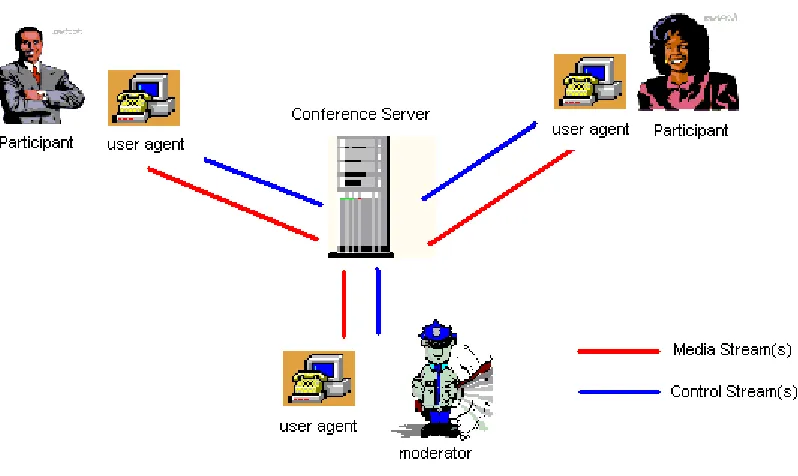
User Agent – is a logical entity that represents a participant. In the context of our discussion, this is typically a piece of software.
Conference Server – is a generic term for an entity that acts as the focal point of a conference. In this text, it functions as a signaling server and a media server.
A typical conference, with the defined entities, is shown in Fig. 1.1
Figure 1.1 – Entities In A Centralized Conference
1.7 Contribution
areas - new functionality, clearer and more elaborate data structures and support for a wider variety of floor control needs.
In the area of new functionality, new participant requests to yield and cancel requests are introduced. Moderators may freeze floors to prevent
any further requests for a floor. It is now possible to specify per user access permissions for each floor. Requests to retrieve floor information have been defined.
There are several changes in the structure definitions of floors, holdings and queues. In floor definitions, parameters such as pre-emptibility and user-permissions are introduced. For floor related state, a
differentiation has been made between a queue specifying the order of access and a queue representing incoming participant requests. Queue information has been classified as queue parameters and queue state. A max-queue-size parameter has been introduced to control queue size.
The protocol supports a wider variety of policies, a discussion on these policies is given in Section 4.1. Other enhancements include creating floors only for required resources and leaving the rest unmoderated.
1.8 Structure of thesis
In the following chapter a review of the IETF multimedia toolkit is presented. The protocols in the toolkit relevant to this thesis are briefly discussed highlighting specific useful features. Chapter 3
2
Background
An architectural view, of the protocols comprising the IETF Multimedia Conferencing Architecture ([ID CONFARCH-03]), is shown in Fig. 2.1. Descriptions of the protocols are provided in the following subsections. The protocols of interest to the area of focus are discussed in detail.
Figure 2.1 – IETF Multimedia Conferencing Stack ([ID CONFARCH-03])
2.1 IP
The Internet Protocol offers a connectionless, best-effort datagram delivery service. It provides a physical network independent abstraction to the transport layers. Important functions provided by this protocol are addressing, routing and fragmentation/reassembly. The IP Specifications can be found in [RFC 791].
2.2 TCP
duplex connections. It is a fairly complex protocol and is used as the transport on the World Wide Web. The specifications for TCP can be found in [RFC 793].
2.3 UDP
The User Datagram Protocol is an important transport layer protocol in the protocol stack. It offers an unreliable, connectionless datagram delivery service. The strengths of this protocol are simplicity and minimal
overheads. It serves as a building block for transport protocols that have payload specific needs, e.g. RTP/RTCP. The UDP specifications can be found in [RFC 768].
2.4 SAP
The Session Announcement Protocol is used to advertise multimedia conferences. It was designed to announce multicast conferences. It announces the existence of a conference by providing to the recipient details such as conference connection info, media streams info, etc. Typically a SAP announcer sends out periodic multicast packets on a well-known address and port. There is no reliability built into the protocol other than what is offered by the lower layers. The protocol does not seek acknowledgement from the listeners and indeed is not even aware if there is any listener receiving the packets hence it is a one-phase protocol. The SAP specifications are detailed in [RFC 2974].
2.5 SIP
2.5.1 Protocol Entities
A Transaction contains a request sent from a client to a server and the response to the request generated by the server.
A User Agent Client (UAC) is a logical entity that creates a new request and gives it to the underlying layers to transmit. The role of a UAC exists for as long as the transaction.
A User Agent Server (UAS) is a logical entity that accepts requests from a UAC and generates either a redirect, accept or reject response in return. Like the UAC, its role also lasts only for the duration of the
transaction.
A Dialog is signaling relationship that exists between two UAs for some amount of time. The CallID, local tag and remote tag fields of requests and responses identify a dialog.
2.5.2 Methods
The following methods are defined in SIP
REGISTER requests are used to create or update current location
information, of a user, in a location service. This location service abstraction is queried to route requests to the appropriate contact address. This is a two-phase protocol. The message exchange in the REGISTER operation is shown in Fig. 2.2(a).
INVITE requests are sent by the User Agent to signal either the intent to
set up a session or to modify an existing session. If the INVITE is sent the first time, it is to setup a new session; else it is to modify an existing session. The INVITE request procedure is three phase protocol, meaning that a request-response-ack sequence completes the operation.
ACK requests are used to complete the three-phase session setup procedure
response to the INVITE from the UAS. A typical INVITE operation is diagrammed in Fig. 2.2(b).
CANCEL requests are used to abort pending INVITE requests. It is not
recommended to use this method to cancel any other operation, since that would result in a race condition. This is a two-phase protocol. A
successful CANCEL operation is illustrated in Fig. 2.2(c).
BYE requests are used to terminate existing sessions. This is a two-phase
protocol. The BYE operation is shown in Fig. 2.2(b).
OPTIONS requests are used by a UA to query another UA about its
capabilities. Capabilities queried can include the methods and content types supported as well as other information such as available codecs, etc. This operation is illustrated in Fig. 2.2(d).
2.5.3 Responses
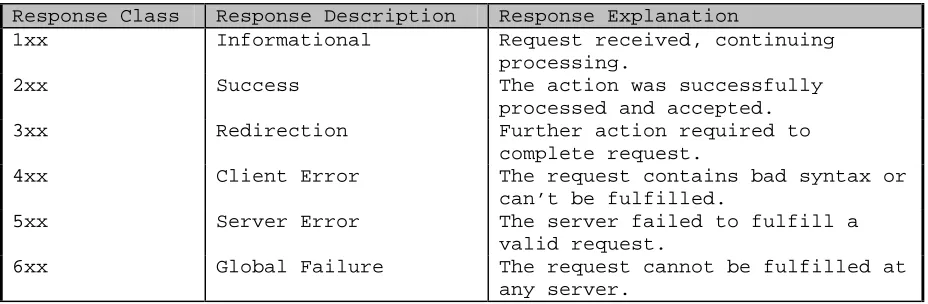
Responses are divided into classes, identified by the first digit in a three-digit number (e.g. for a response code 354, the class is 3xx). This scheme has been adopted from protocols like HTTP. Each class of responses represents a generic outcome of the request. More specific information about a response can be found by looking at the other two digits, but it is sufficient for an entity receiving a response to be able to identify the class of response and react accordingly. The classification is given in Table 2.1 ([RFC 3261]).
Table 2.1 - Response Code Classes
Response Class Response Description Response Explanation
1xx Informational Request received, continuing processing.
2xx Success The action was successfully
processed and accepted.
3xx Redirection Further action required to
complete request.
4xx Client Error The request contains bad syntax or can’t be fulfilled.
5xx Server Error The server failed to fulfill a valid request.
Figure 2.2 – SIP Message exchange (a)REGISTER, (b)INVITE and BYE,
(c)CANCEL and (d)OPTIONS
2.5.4 Event Notification Mechanism
event source as a listener. When an event of interest occurs, all the listeners are notified. There are two operations defined within this framework.
SUBSCRIBE is used by a party to subscribe to events of interest, with the
event source or event distributor. It is also used to renew or remove a subscription. Among other fields, it contains information on where to send the notification and also a time after which the subscription expires. This is a two-phase exchange.
NOTIFY is used by the event source to notify the interested parties of the
occurrence of the event. Apart from when the event occurs, NOTIFY is also sent at every instance that a SUBSCRIBE is completed, i.e., when a
subscription is created, modified or removed. The notification procedure is also a two-phase exchange.
When a SUBSCRIBE message is received by the Notifier, it sends a NOTIFY message along with the current state of the system. This is shown in Fig. 2.3 (a). An event occurrence at the Notifier results in the generation of a NOTIFY message to all the Subscribers. The message exchange is shown in Fig. 2.3 (b).
2.6 SDP
For a conference to be productive, it is necessary to distribute
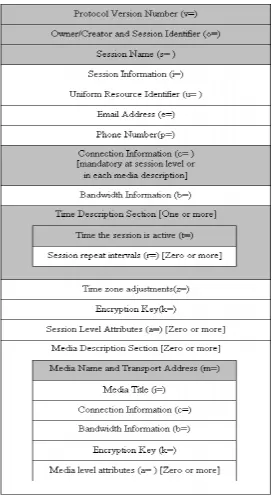
information such as conference address, media compression being used and other conference tool specific information. Session Description Protocol has been designed to fill in this need. It does not define how this information is distributed, but rather provides a standard format for exchanging this information. As defined in [RFC 2327], SDP defines a format to convey sufficient information to discover and participate in a conference. SDP is also a text-based protocol.
Some important session parameters that are defined in the SDP protocol data unit are session name and purpose, contact information about the person responsible for the conference, conference time (start time, end time, etc), media formats being used, connection information about the media streams (protocol, address, port, encoding scheme, etc), bandwidth limitations of the conference, etc. The fields are of two types, either session level or media level. An SDP message has at least one session level section and optionally multiple media level sections.
Figure 2.4 – SDP Message Format
The primary means of extending SDP is by using the attribute tag (a=). Since this attribute is available at the session level and the media level, extensions can be defined at either level. Attributes are of two types, either property attributes of the form a=<flag> (e.g., a=sendonly) or value attributes of the form a=<attribute>:<value> (e.g.,
a=type:moderated). Extensions that are used commonly are registered with the IANA. Unregistered attributes should use a prefix of “X-“ to prevent inadvertent collision with registered names.
2.7 RSVP
Resource ReSerVation Protocol is designed to provide a way for a host to request for reservation of resources to satisfy an application’s quality of service (QoS) requirement. It is unidirectional in the sense that it requests reservation for a single direction of flow. RSVP is composed of two major components - an admission control module and a policy control module. The admission control module ascertains whether sufficient resources are available to satisfy the request while the policy control module determines whether the user has permissions to make the request. The receiver of a data flow makes the reservation requests in RSVP. RSVP is primarily designed to work at the transport layer and hence directly over IP, but it also supports working over UDP for hosts that don’t
support raw network I/O. The specifications for RSVP can be found in [RFC 2205], [RFC 2208] and [RFC 2209].
2.8 RTP/RTCP
Real-time Transport Protocol provides an end-to-end data delivery service for data with real-time characteristics. It typically works over UDP, though it can be made to work over other transport layer protocols. RTP by itself does not guarantee timely delivery or a realization of a QoS
requirement. It provides constructs such as sequence numbers, timestamps and payload identification. It does not guarantee delivery nor can it ensure ordered delivery. RTP does not have inbuilt mechanisms to recover from packet loss.
other users. In particular, participants can learn about the sources contributing to a particular stream by using RTCP. RTCP transmits packets periodically to participants with control information. It uses the same distribution mechanism that is used for the data. Typically RTP/RTCP operate over a pair of ports over UDP.
The core RTP/RTCP specification can be found in [RFC 1889]. It is however not intended to be completely defined, since many parameters are
application specific, to completely define RTP for an application, other documents such as a profile specification document, and a payload format specification document are necessary.
3
Floor Control in SIP
This chapter explains the activity of floor control within the context of conferences. It starts off by defining what floor control is, followed by a review of work done in this area in the past. An overview of
conferencing in SIP follows next. This is followed by a presentation on the architecture of floor control in SIP-based conferences. The support available/required for floor control from SDP [RFC 2327] and SIP [RFC 3261] is detailed next. A message level overview of conference setup is given next. The chapter concludes with a brief synopsis of the protocol proposed in [ID CONTROL-02].
3.1 Definition
As defined in [ID REQ-01], a floor is temporary permission given to a conference participant to access or manipulate a shared resource. Floor control (FC), hence, deals with the regulation of resources, such as media streams, among users in a conference. The primary aim of this activity is to handle resource conflicts that might arise due to simultaneous access of resources in a shared environment.
There are several approaches to handling resource conflicts. Broadly they can be classified into either those that allow conflicts (permissive) and those that don’t (restrictive).
Examples of the permissive approach are (a) allowing conflicts and providing means to resolve them and (b) ordering requests such that dependencies are detected and minimized. Among approaches that are
restrictive, we have those that (a) provide exclusive locks on resources and (b) those that disallow conflicts by using constructs such as tokens. A more thorough handling of this subject is presented in [Dommel 97].
In devising a solution to the floor control problem, it is useful to distinguish between mechanisms (what are the system capabilities) and policies (how these capabilities are used to achieve the desired effect).
To illustrate, consider the floor control problem. To regulate resources, we might implement a token passing mechanism, i.e., only participants with a token may access the given resource. Examples of policies that may be implemented, based on this mechanism, are round-robin access, moderator controlled order, first-come first-served, etc.
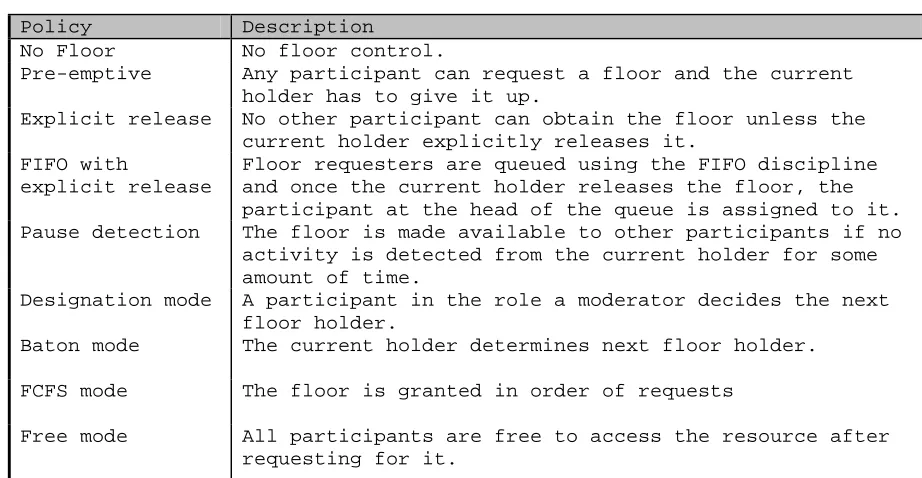
A few policies that have been implemented in experimental multimedia conferencing systems are listed in Table 3.1 These have been extracted from literature presented in the next section and are included here to give an idea of commonly used policies.
Table 3.1 - Floor control policies
Policy Description
No Floor No floor control.
Pre-emptive Any participant can request a floor and the current holder has to give it up.
Explicit release No other participant can obtain the floor unless the current holder explicitly releases it.
FIFO with
explicit release
Floor requesters are queued using the FIFO discipline and once the current holder releases the floor, the participant at the head of the queue is assigned to it. Pause detection The floor is made available to other participants if no
activity is detected from the current holder for some amount of time.
Designation mode A participant in the role a moderator decides the next floor holder.
Baton mode The current holder determines next floor holder. FCFS mode The floor is granted in order of requests
Free mode All participants are free to access the resource after requesting for it.
3.2 Literature Review
Floor Control has been studied in depth and a great deal of literature is available, albeit in the context of shared workspaces.
relying on social protocols and other out-of-band means to prevent conflicts.
The MMConf system described in [Crowley 90] is designed to support group interactions in a distributed, real-time environment. It was the first system that stressed on the difference between floor control mechanisms and floor control policies. Multicasting was used at the mechanism layer to distribute floor control information. The system supported various floor control policies ranging from implicit-request, implicit-grant to no floor control. Work presented in [Ishii 90] introduces the technique of overlaying a user’s collaborative workspace with the user’s individual workspace, hence allowing the use of his or her favorite applications in the virtual shared workspace.
A thorough review of co-ordination systems existing at that time is presented in [Ellis 91]. Taxonomies are presented to classify these systems. An attempt at the formal definition of coordination theory has been made in [Malone 90]. It is shown that coordination is a necessary overhead when several groups are performing a common activity. [Kamel 93] presents another classification scheme to group shared workspaces based on various orthogonal criteria. Audio and video channels are also considered as shared workspaces. This work lists key concepts in floor control such as control modes, floor control privileges, clashes, roles and
subject/object groupings. In [Greenberg 91] an architecture is presented wherein it is possible to implement and switch between different floor control policies with a few primitives.
A generic framework for floor control has been presented in [Dommel 97]. This work delves into the difference between floor control, access control and concurrency control. It attempts to classify media applications and identifies their floor control requirements. It also presents issues to consider when designing floor control protocols. In [Dommel 98] the
authors show that hierarchical group coordination is the most scalable and efficient approach. They also propose a novel protocol that exploits IP Multicasting capabilities to achieve hierarchical group coordination.
detail in later sections, as it relates directly to the content of this thesis.
3.3 Conference Models in SIP
SIP, initially designed to support large multicast conferences on the MBONE, inherently lends itself to centralized conferencing architectures. The work done on conferencing using SIP is in its infancy, since a large part of the core SIP specification focuses on point-to-point calls. Current work in progress focuses on centralized conferences. Within this scope, definitions and usage in various architectures has been described in [ID MODELS-01] and [ID FRAMEWORK-00]. The elements of a conference and a few of the conference configurations that are of interest are detailed below.
3.3.1 Definitions
A Tightly coupled conference is one where there is a central point of communication. This central point provides the various features required for the conference such as media mixing, maintaining SIP point-to-point relationships with the participants, etc. This is the only type of
conference considered in this thesis and hence a conference shall refer to this implicitly, unless stated otherwise.
A Loosely coupled conference is one where there is no central point of control. Media is distributed through multicast media groups. There are no signaling relationships between the participants.
A Focus is a SIP user agent that acts as the central point in a
conference. A SIP URI identifies a focus. Participants maintain one-to-one SIP dialogs with this entity. This is a logical role and is composed of other functions such as event notification, conference policy enforcement and ensuring media delivery (indirectly).
A Participant is a SIP user agent that maintains a dialog with a Focus in a conference. A participant might itself be a Focus for other
A Conference Notification Service is a service provided by the Focus. It implements the event notification mechanism of [RFC 3265] to provide interested parties with notifications of changes in state of the Focus, the Conference Policy and the Media Policy.
A Mixer is an entity that processes media streams and sends them to participants, after combining them in some media-specific manner,
according to some policies. For voice this may mean that a mixer sends to each participant a mixed voice stream of all other participants.
A Conference Policy Server is a function that contains conference rules such as allowed participants, roles of the participants, etc. and means to manipulate these rules. It serves as a storage point of conference
policies. The realization of these policies is the work of the Focus.
A Media Policy Server is a function that manages the rules associated with the media comprising the conference such as a participant’s choice of media that it wishes to receive and from whom, etc. The actual
implementation of these policies is the responsibility of the Focus.
A Floor Control Server (FC Server) is a function that regulates the resources of a conference, such as media, among the participants. It interacts with the Media Policy Server as a client to update media policy changes due to floor control procedures. The server includes at the minimum a Floor Controller function and an Event Notification Service to relay floor events.
A Floor Controller is a function within the FC Server that handles requests from the Participants. Its responsibilities include managing floors, handling requests from Participants and finally communicating with the Media Policy Server to update the Media Policy if required.
A Media Policy is a set of rules that specify how a mixer is to operate on the streams that it receives. An example of a media rule may be that a participant wishes to receive the voice stream of a particular participant only. As with conference policies, there is a need for a standard protocol to manipulate these policies, but the policy description is in no way restricted.
A Floor Control Policy (FC Policy) is a set of rules that specifies how the floor is regulated among the participants. As an example, the floor policies may require that a moderator approve each request before the floor is given to a participant.
A Floor Holder is a Participant who has access to the floor or resource in question. For resources like audio and video, there may be multiple
Participants holding a single floor since the Mixer can combine these streams into a single stream to transmit.
With the above definitions in place, it is possible to present conferencing architectures of interest.
3.3.2 Multicast Conferences
This architecture is an example of a loosely coupled conference. The usage of SIP is only to convey media information, to a participant, such as multicast group to join in order to receive a particular media stream. Once a participant is aware of the multicast group to join, he/she uses multicast protocols to join/leave the group, in effect joining and leaving the conference.
Indeed, in this architecture, SIP can be completely bypassed since it only serves as a means to distribute information about the session. This can be handled by SAP or other means such as emails, web pages, etc. So if a participant is able to obtain information about the conference, he/she may join it without the usage of SIP.
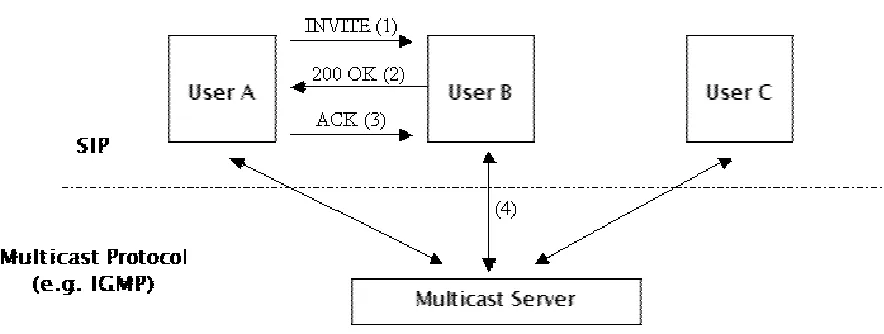
SDP body provides the multicast address/port for the media streams comprising the conference. User B then uses other means to join the multicast group(s) received in the SDP body. Fig. 3.1 depicts this type of conference.
Figure 3.1 – A Multicast Conference Example
3.3.3 Centralized Conferences
The architectures presented in this section are all examples of tightly coupled conferences. These are the most commonly encountered
configurations in the present world of telephony. These models are
characterized by the presence of a central signaling entity that handles interactions with the participants. Media may/may not be handled by this entity.
3.3.3.1 Centralized Server
Participants connect to a central server that is an all-in-one unit. The conference functions of such a server include a Focus, a Mixer and
possibly a Media Policy Server and a Conference Policy Server.
and mixes them in a media specific way before sending them to the participants. In this case, the participants become aware of other media-contributing participants using means such as RTP/RTCP or SIP Events.
Participants can join a conference in this architecture either by sending an INVITE to the conference server or by responding to an INVITE from the conference server.
If a participant knows the conference server URI, a participant sends an INVITE to join the conference. He/She is not aware of the media
capabilities of the session. So the initial INVITE doesn’t contain any SDP body. The response to the INVITE from the server contains the SDP body to be used for the conference. The participant uses this information to setup the media channels. If a conference server INVITEs a participant to a conference, for example using a pre-set participant list, the initial INVITE contains the media description that the conference is composed of. The participant uses this description to setup the media channels.
It is noteworthy that this architecture assumes that the conference
information, such as location to send the initial INVITE to, is available to the participant/server beforehand. As an example scenario, lets
consider the case where three participants User A, B and C are
Figure 3.2 – Centralized Server ([ID FRAMEWORK-00])
3.3.3.2 Endpoint Server
In this model, the participant who wishes to conference acts as a focus and a mixer for the other participants. These conferences are also known as ad-hoc locally mixed conferences.
Initially there exists a regular two-party call between two participants. At some point, one of the participants decides to conference in one or more other participants. This participant now changes its role from being a participant to being a focus/mixer + a participant.
The external interfaces to the focus/mixer, at the new server, are the same as those in the central server model. As with a central server, the functions such as Media Policy Server and Conference Policy Server are optional. Similarly, the existence of other participants in the
Details of interest are that in this transition to a conference server, the participant creates a new conference URI that is used by all
participants; even the existing dialog is modified with a re-INVITE containing the new contact URI. Also, any participant may invite new participants to the conference by acting as an end system mixer, leading to arbitrary conference topologies.
In Fig. 3.3(a) we see a regular two-party call between User A and User B. Fig. 3.3(b) shows the transition of User A to a conference server to
accommodate User C. It must be noted that the interface between the server and participant roles of User A is not defined.
A drawback with this approach is that if User A decides to leave the conference, then the conference is over. This approach is suitable for small conferences such as three way calling.
3.3.3.3 Media Server
This architecture is of commercial importance since it allows the decoupling of the media mixer and the signaling entity. In this model, each conference has two centralized servers. One of them is called the “Application Server” and acts as the focus of the conference. The other is called the “Mixing Server” that handles the actual mixing functions. The Application Server acts as a controller of the Mixing Server, and is hence called the top-level server.
The Application Server acts as the focus of the conference and users maintain signaling relationships with this server. This server may
implement, apart from the mandatory Focus function, a Media Policy Server and a Conference Policy Server.
The Mixing Server is the media handler of the conference. The minimum functionality includes a Focus and a Mixer. This server does not have a Conference Policy Server or the Notification service of the Focus. It has a default conference policy that allows all invitations from the
Application Server. Its media policy also accepts all controls from the top-level server.
The participants connect to the Mixing Server to send/receive media
streams. The Application Server uses third party call control to setup the media streams between the Participants and the Mixing Server. An
Figure 3.4 – Media Server ([ID FRAMEWORK-00])
3.4 Floor Control Architecture
To support floor control in the architectures presented above, the FC Server entity is introduced. The entity is associated with the conference server and interacts with the Media Policy Server to implement FC
Policies. This is consistent with the approach suggested in [ID FRAMEWORK-00] and requirements laid out in [ID REQ-01]. The modified overall
Figure 3.5 – Floor Controlled Conference ([ID REQ-01])
From the Media Policy Server viewpoint, the FC Server is just a client that updates media access policies that are managed by it. The actual message exchanges, which ultimately result in these policy changes, are implemented within the FC Server.
To illustrate, let us consider a moderated media stream where a
With the above architectural overview in place, a more detailed discussion on the support required from SIP/SDP is presented below.
3.5 FC support in SDP
Typically, SDP is used to describe sessions in SIP-based conferences. SDP and its extensions provide a generic set of operations to achieve a broad range of functionality. To be able to use these existing extensions to support FC is the focus of this section. This section starts off by listing the functionality required from SDP to support FC. It then
discusses how these functions are implemented using available extensions, as described in [ID CONTROL-02]. Finally it outlines an alternate usage of the extensions, which we are proposing, along with the rationale behind these changes.
The functions that need to be performed to enable the invocation of an FC entity, within the context of a conference, are
-Resource Identification - To be able to specify which of the streams in
the SDP body is floor controlled we need to label each of the media descriptions using a unique identifier.
FC Channel Definition - To be capable of describing the transport channels
that are to be used for floor control information exchange. These channel descriptions are similar to media descriptions, but instead of them being “audio”/”video”, they are of type “control” and are used by the floor control entity to contact the FC Server.
FC Indication - To be able to set which of the media streams is floor
controlled using the identifier mentioned above.
Media stream to FC Channel mapping - To be able to associate a media
3.5.1 Existing Proposal
This sub-section lists how each of the functions listed above is handled in the protocol proposed in [ID CONTROL-02]. References are made to documents that describe extensions to SDP [RFC 2327] that are available for use to floor control protocols.
3.5.1.1 Resource Identification
To identify each resource uniquely, the media description lines can be labeled using the “a=mid:” attribute defined in [ID FID-06]. These labels are used to identify the floor associated with the resource and to label FC Channels. The syntax is
a=mid:<identification-tag>
<identification-tag>s are unique within a session description. A fragment that shows its usage is given below. The fragment, labels the audio stream on port 5555 as floor1.
m=audio 5555 RTP/AVP 0 a=mid:floor1
3.5.1.2 FC Channel Definition
Defining floor control channels can be done using the “m=control” line. This support already exists in SDP. The syntax is
m=control <port> <transport> <fmt list>
The <port> denotes the port number on which the stream is received/sent. The <transport> specifies which transport layer protocol is being used (e.g. TCP) and <fmt list> represents a protocol specific list of
parameters. As an example consider the following description of a floor control channel.
Here the control channel specifies the transport as HTTP on port 80 and additionally specifies the usage of SOAP as part of the fmt-list.
3.5.1.3 FC Indication
Using SDP it is possible to indicate whether a session is moderated or not. This is done using the “a=type:moderated” session attribute. There is currently no way to specify whether a particular media is moderated or not. The result is that all media channels are assumed to be moderated.
3.5.1.4 Media Channel(s) to Floor Control Channel Mapping
To associate media streams with control channels the “a=group:” attribute proposed in [ID FID-06] is used. This construct specifies the grouping of media streams that are floor controlled to the associated FC Channel. The syntax is shown below.
a=group:FL *(space identification-tag)
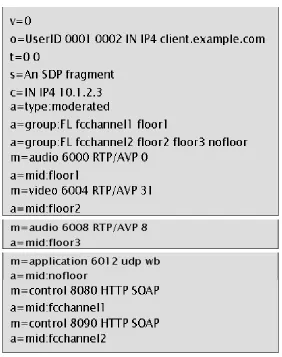
Figure 3.6 – SDP fragment with FC support
In Fig.3.6, we see that there are 4 media channels (floor1, floor2, floor3, nofloor) and 2 floor control channels (fcchannel1, fcchannel2). The associations (floor1 - fcchannel1) and (floor2, floor3, nofloor – fcchannel2) is achieved by using the “a=group:FL” lines.
3.5.2 Proposed Changes
In situations where not all media streams in a conference need to be moderated, the approach presented in [ID CONTROL-02] adds significantly overhead in managing these un-moderated media streams. Our proposal is to avoid this overhead by defining new semantics for the Media Channel to FC Channel mapping mechanism. We remove the session-level “a=type:moderated” attribute unless all media are moderated. Also, we propose that the
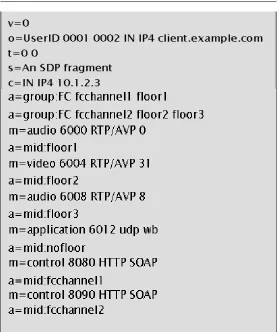
mapping. The syntax of the proposed “a=group:FC” attribute is the same as before, but it is to be interpreted as follows
Figure 3.7 – Modified SDP Fragment
Each media description that appears in an “a=group:FC” attribute is assumed to be floor controlled. Media descriptions that do not appear in any “a=group:FC” attribute are assumed to be not regulated by floor control.
3.6 FC support in SIP
SIP is not a suitable transport for floor control messages since the usage of SIP methods would modify their semantics. It has been proposed in [ID CONTROL-02] to use HTTP as the transport with embedded XML content in the form of SOAP ([W3C SOAP-00], [W3C SOAP-01] and [W3C SOAP-02]) documents. This approach is used in this thesis. Hence SIP requires no modification or new extensions to support floor control. There are however a few
definitions that need to be in place to satisfy the requirements for floor control [ID REQ-01].
1. New events to notify participants about floor control events such as change in floor holder, status of request, etc.
2. New events to notify a moderator(s) about moderator-specific events such as new participant request, etc.
The definition and usage of these events is presented in the next chapter since a more complete and meaningful explanation is possible in the
complete context of the proposed floor control messages.
3.7 Conference Setup in Centralized model
Figure 3.8 – Conference Setup with Floor Control
It may be noted that there are 4 operations here.
1. The Participants send INVITEs to the Centralized Server (Focus), and if the conference policy allows it, the Participant is sent the 200 OK along with the SDP body containing the media channel and FC Channel descriptions. The ACK from the Participant completes the operation of joining the conference.
2. The Participants optionally SUBSCRIBE to the conference event
package at the Focus. This results in the generation of a NOTIFY by the Notification Service at the Focus.
3. The Participants, process the SDP body and use it to setup the channels (either media or floorcontrol) to the corresponding Mixer or FC Server.
Once the conference is setup, the Participants may perform floor control operations such as request, release, etc. These requests are made to the Floor Controller and a response to the request implies that the request has been received and is being processed. The notification mechanism is used to inform the Participant about the outcome of the request. If there is any change in the status of the floor, the FC Controller updates the Media policy at the Conference Server using a yet-to-be proposed protocol. This may result in the generation of a re-INVITE to the Participant with the media permissions updated to reflect the current floor state.
If the intervention of a Moderator is required to complete the request, then a Notification message is sent to the Moderator providing details of the request. The Moderator then responds by sending a floor control
message to the Floor Controller. The above-described procedure is shown in Fig. 3.9
3.8 Currently Proposed Floor Control Protocol
This section presents a brief overview of the protocol proposed in [ID CONTROL-02]. Some key points in this proposal are that a floor may consist of multiple resources and that this protocol is primarily aimed at
moderator based floor control. Before listing the message types and the events, the data structures that are used in the protocol are described in Table 3.2.
Table 3.2 - Floor Control Data Structures
Data Structure Description
floorType This represents the parameters of a floor such as max-holders, resources that constitute this floor, users, moderators, etc.
resourceType This represents each m= line that is floor controlled. Its content is the “a=mid:” value for the media.
usersType This represents Participants in the conference that are allowed to request for floors.
moderatorsType This represents a list of moderators for a floor.
holdingType This is a mapping between participants and the resources that they hold.
claimType This represents the request for a floor and contains information such as resources, expected period of hold, etc. A list of claims is represented by claimsType. operationType This is used to manipulate the queue of requests by the
moderator and has operations such as up, down, top, bottom.
3.8.1 Messages
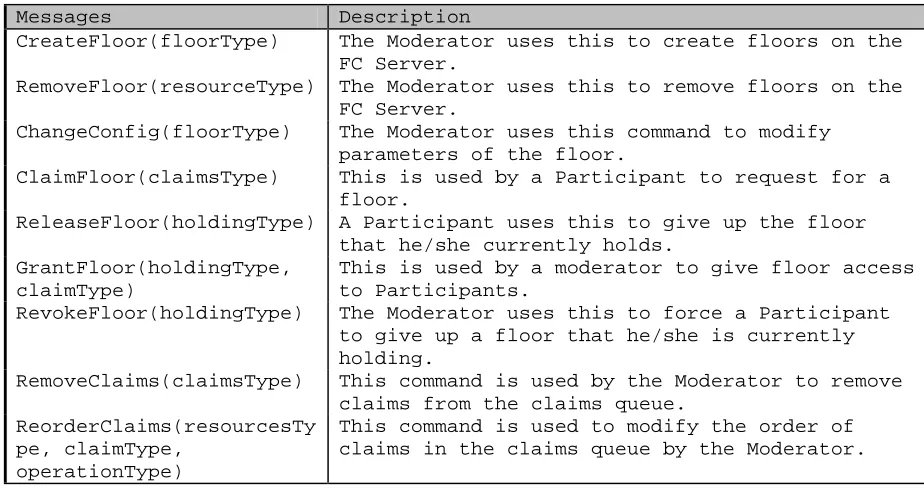
Table 3.3 - Floor Control Messages
Messages Description
CreateFloor(floorType) The Moderator uses this to create floors on the FC Server.
RemoveFloor(resourceType) The Moderator uses this to remove floors on the FC Server.
ChangeConfig(floorType) The Moderator uses this command to modify parameters of the floor.
ClaimFloor(claimsType) This is used by a Participant to request for a floor.
ReleaseFloor(holdingType) A Participant uses this to give up the floor that he/she currently holds.
GrantFloor(holdingType, claimType)
This is used by a moderator to give floor access to Participants.
RevokeFloor(holdingType) The Moderator uses this to force a Participant to give up a floor that he/she is currently holding.
RemoveClaims(claimsType) This command is used by the Moderator to remove claims from the claims queue.
ReorderClaims(resourcesTy pe, claimType,
operationType)
This command is used to modify the order of claims in the claims queue by the Moderator.
Table 3.4 - Floor Control Events
Events Description
FloorCreated This event is generated when there is a new floor created by a moderator. It is distributed to the Participants.
FloorRemoved This event is generated when a floor is removed. It is sent from the FC Server to the Participants.
ConfigChanged When floor parameters (such as moderators, max-holders) are changed, this event is generated. It is sent from the FC Server to the Participants.
floorChanged When there is a change in the list of floor holders, this event is sent from the FC Server to the
Participants.
queueChanged This event is generated when there is a change in the claims queue. This may be the result of a new request. It is sent from the FC Server to the Moderator of the floor.
The above messages and events are sent between the various floor control entities as shown in Fig. 3.9. The messages exchanges between the
All events are generated by the FC Server and distributed to the
Participants except the QueueChanged event that is sent to the Moderator.
4
Protocol Design
As mentioned earlier, it is important to differentiate between mechanisms and policies when designing the protocol so that a relatively small set of primitives satisfy a diverse range of floor control requirements. This chapter starts off by presenting a set of useful policies that the floor control protocol to be designed must support. It is then followed by the elements of protocol definition.
The protocol definition contains a service description that provides a high level overview of the services provided by the protocol. The realization of these services in a particular environment leads to the creation of operations and these are presented next. The format or syntax of these operations is then described. Finally the procedure rules are explained.
4.1 Floor Policies
Three orthogonal criteria are used to classify the configurations being considered.
1. The first is whether there is a moderator present or not. The presence of the moderator indicates that the selection of the next floor holder is made by an entity rather than by factors such as first-come-first-serve.
2. The second criterion used is whether or not there exists a queue of participant requests that specifies the order in which the floor is to be granted to the participants (Access queue or AccessQ for short).
3. The third criterion is whether or not a floor holder is
pre-emptible, i.e., whether the current holder is replaced when a new request is received or whether the request is simply rejected.
Table 4.1 – Floor without pre-emption
Moderated Unmoderated
AccessQ X X
No AccessQ Rejected Rejected
4.1.1 Moderated with AccessQ
A configuration of this nature is used when a moderator sets the order in which the participants get the floor. Requests for the floor are processed and is accepted are put into the AccessQ. The moderator, to change the order of access, can manipulate this queue.
4.1.2 Unmoderated with AccessQ
This combination of elements serves as a preordered queue with no
moderator. As soon as the floor becomes free, the next participant in the queue is give access to the floor. An unmoderated FCFS discipline is its most likely usage, though other queuing disciplines can be implemented (priority based, etc.)
4.1.3 Moderated/Unmoderated without AccessQ
Table 4.2 – Floor with pre-emption
Moderated Unmoderated
AccessQ NA NA
No AccessQ X X
4.1.4 Moderated with No AccessQ
This configuration can be used to implement a variety of policies. As requests come in, they are handled and responded to by the moderator. The selection made is of the next participant to replace the current floor holder. Some examples of policies that can be implemented are baton passing and pre-emption. An open issue is which of the current floor holders to replace in case of multiple floor holders.
4.1.5 Unmoderated with No AccessQ
This setup may be used to implement situations where there might be a limitation in the number of holders a floor can support, but without the intervention of a moderator. The central server may directly accept or reject the request depending on the number of simultaneous holders a floor can accommodate.
4.1.6 No Floor
4.2 Service specification
The purpose of the protocol is to regulate multimedia resources among members of a centralized multiparty conference. The protocol works in conjunction with, and makes maximum utilization of, mechanisms already present in SIP. The protocol consists of request-response messages pairs and asynchronous event notification messages. It takes into consideration that some resources in a session do not require regulation. Mechanisms are designed to support automation of resource allocation. Each resource is associated with one floor. A participant is allowed to request floors and may access them only after the required authorization has been obtained.
4.3 Environment description
The environment in which the protocol is expected to execute consists normally of two or more parties in a centralized SIP based conference. The FC Server acts as the hub for coordinating the message exchanges of the protocol as well as handling session parameter changes. This process has been discussed in Chapter 3. The server maintains state variables such as users with permissions to create floors, etc. These are obtained out-of-band with respect to the protocol being discussed.
The FC Server maintains (optionally) two queues, one is for incoming, unprocessed requests (Request Queue) and one is for requests that have been processed and are to be queued for floor access (Access Queue).
If the media is floor controlled, there is a moderator for that resource. Participants request a resource from the moderator of that resource
through the FC Server. The moderator then decides whether to accept or reject the request. The involved parties are then notified of any changes that might have taken place in the floor control domain.
In the event of a message loss, there is no requirement to reset the state, since no update has taken place on the server. If, however, the response gets lost, the participant will need to timeout and resend the message. Message duplication is handled by the use of sequence number in the messages. So if a server receives a duplicate request, the response is the resent. The loss of events is handled by the event mechanisms proposed in [RFC 3265].
4.4 Vocabulary (Operations)
This section describes the various operations that need to be supported by the protocol being designed. The vocabulary gives an overview of the
functions provided by the protocol. These are not to be confused with protocol primitives, which give the exact message syntax. An operation may require multiple protocol primitives to implement. As an example, the operation of session setup using SIP requires three protocol primitives, an INVITE message, a Response and an ACK.
Depending on the usage, operations are classified into moderator and participant operations. Moderator operations deal with managing of floors and user requests while the participant operations deal with the types of requests made by participants. Unless otherwise noted, all operations are designed to encapsulate multiple requests.
4.4.1 Moderator Operations
Create Floors – The moderator uses this operation, to create floors and
associate resources to them. This also involves setting up of other parametric information such as maximum number of simultaneous floor holders, moderator list, etc.
Freeze Floors – This operation is used to suspend any further requests for
the indicated floors. On success of this operation, the FC Server no longer accepts new requests for the suspended floors.
Manipulate Floors – To change any floor related parameter or state this
operation is used. Examples of change in floor info are manipulation of floor queues, changing the list of moderators for the floors, etc.
Grant Floors – This operation is used to allow a Participant to access a
floor. Typically, the moderator uses it, to respond to a request made by a Participant.
Transfer Floors – The purpose of this operation is to enable the Moderator
to substitute a current floor holder with another Participant. It is useful in situations where a Participant requests that a floor be transferred to another Participant.
Revoke Floors – The aim of this operation is to take away access
permissions from an existing floor holder.
Get Floor Info - The purpose of this operation is for the moderator or any
allowed participant to obtain information about the floor. This includes information such as the parameters of the floor (e.g. max-holders) as well as the status of the floor (e.g. queue status).
4.4.2 Participant Operations
Request Floors – Participants use this operation to request access to
floors.
Release Floors – This operation is used by the Participant to release the
floors that he currently holds.
Yield Floors – This operation is used by a Participant to transfer the
floor to another Participant.
Cancel Floor Requests – To cancel requests that are queued up at the
4.5 Syntax (Message formats)
This section presents the floor control request, response and event primitives and their formats. Along with each request message, the
possible responses are discussed. The events generated are detailed after that. As proposed in [ID CONTROL-02], we use XML Schemas to describe the messages. These can be encapsulated as SOAP messages and transported using protocols such as HTTP. As in the previous section, request messages are discussed under two sub-sections Moderator and Participant Requests. Before presenting the message syntax, we present the XML structures used to describe the data.
Before presenting our work, we first list the elements that have been borrowed from work done in [ID CONTROL-02]. Each of these elements have been modified to account for the difference in approaches between this protocol and the one in [ID CONTROL-02].
1. The idea of using an XML Schema to describe the protocol messages and events.
2. usersType and moderatorsType ([ID CONTROL-02]) are analogous to UserIDType.
3. floorType ([ID CONTROL-02]) is analogous to the FloorStateType with modifications to the structure to accommodate for the two queues. 4. holdingType ([ID CONTROL-02]) is analogous to HoldingType with
changes to accommodate for permissions.
5. floorType ([ID CONTROL-02]) is analogous to FloorParametersType with changes to accommodate for initializing the two queues, pre-emption and a per-user permissions list.
6. claimType ([ID CONTROL-02]) is analogous to the parameters in the request-floors operation with changes to accommodate for user preferred permissions.
![Figure 2.1 – IETF Multimedia Conferencing Stack ([ID CONFARCH-03])](https://thumb-us.123doks.com/thumbv2/123dok_us/1463245.1179274/19.612.80.553.152.435/figure-ietf-multimedia-conferencing-stack-id-confarch.webp)