Artificial Intelligence and Applications
Prajwala B.U1, Shashikala .M 2, A.Kishore Kumar3
6thsem Students, Department of Computer Science Engineering, City Engineering College, Bangalore, India1 2 3
ABSTRACT:Artificial Intelligence is the Science and Engineering of making intelligent machines which are able to perform tasks using human intelligence. Artificial Intelligence is broadly characterized as the study of computations that allow perception, reason and action. Computerized reasoning is slanting to end up noticeably a prevalent field in software engineering as it has upgraded human life in the majority of the regions. Ponder in this field has offered ascend to a rising innovation called Expert System. Applications in this area have a huge impact on different fields of life as the expert systems are used a lot these days to solve complex problems in areas like engineering, medicine, science, business, etc. This paper gives the introduction, history, growth of AI, future, various applications specifically focusing on Artificial Intelligence in Medical Industry, gaming.
KEYWORDS: Artificial Intelligence, Optogenetics, HAL 5, The Da Vinci Si HD Surgical System I. INTRODUCTION
Artificial intelligenceis a science and technology based on disciplines such as Computer Science, Biology, Psychology, Linguistics, Mathematics, and Engineering. A major thrust of AIis in the development of computer functions associated with humanintelligence, such as reasoning, learning, and problem solving. Artificial Intelligence is an integration of computer science and physiology Intelligence in simple language is the computational part of the ability to achieve goals in the world. Intelligence is the ability to think to imagine creating memorizing and understanding, recognizing patterns, making choices adapting to change and learn from experience. Artificial intelligence concerned with making computers behave like humans more human like fashion and in much less time than a human takes. A perfect intelligent machine is a flexible agent whichperceivesits environment and takes actions to maximize its chance of success at some goal.As machines become increasingly capable, mental facilities once thought to require intelligence are removed from the definition. For example,optical character recognitionis no longer perceived as an exemplar of artificial intelligence, it is just a routine technology.At present we use the term AI for successfullyunderstanding human speech, competing at a high level in strategic game systems such as chess, tic-tac-toe,self-driving cars, and interpreting complex data.Some people also consider AI a danger to humanity if it progresses unabatedly.
An extreme goal of AI research is to create computer programs that canlearn, solve problems, and think logically.In practice, however, most applications have picked on problems which computers can do well. Searching data bases and doing calculations are things computers do better than people. On the other hand, "perceiving its environment" in any real sense is way beyond present-day computing.
AI involves different fields likemathematics,linguistics,psychology,neuroscience, andphilosophy. Eventually researchers hope to create a "general artificial intelligence" which can solve many problems instead of focusing on just one. Researchers are also trying to create creative and emotional AI which can possibly empathize or create art. From the soonest crossroads in cutting edge history of the PC, researchers have been trying to create an electronic mind. Of all the advanced mechanical missions, this inquiry to make misleadingly smart (AI) computer frameworks has been a standout amongst the most driven and, as anyone might expect, dubious.
II. HISTORY
Objects that look and act like humans exist even now in major civilizations. While artificial beings which are capable of thought processing appeared as story telling devices in antiquities, the idea of actually trying to build a machine capable of performing useful reasoning may have begun with Ramon Llull in 1300’s.AI research really started with a conference at Dartmouth College in 1956. It was a month long brainstorming session attended by many people with interests in AI. At the conference they wrote programs that were amazing at the time, beating people at checkers or solving word problems. The Department of Defense started giving a lot of money to AI research and labs were created all over the world.Unfortunately, researchers really underestimated just how hard some problems were. The tools they had used still did not give computers things like emotions or common sense. AI research revived in the 1980s because of the popularity of expert systems, which simulated the knowledge of a human expert. By 1985, 1 billion dollars were spent on AI. New, faster computers convinced U.S and British governments to start funding AI research again. However, the market for Lisp machines collapsed in 1987 and funding was pulled again, starting an even longer AI winter.AI revived again in the 90s and early 2000s with its use in data mining and medical diagnosis. This was possible because of faster computers and focusing on solving more specific problems.
III. APPLICATIONS
Artificial Intelligence in the form of neural networks and expert systems has applications in almost all human activities. The combination of high precision and low computation time makes AI a cutting edge technology. Robots are already taking over workshop level jobs in large industries, thus side lining humans into a more supervisory role. Stock brokerage firms are now using Artificial Intelligence to analyze data, make analysis and buy or sell stocks without the interference of any human beings. Some of the applications of Artificial Intelligence are as follows:
1. Expert Systems
Expert Systems are machines that are trained to have total expertise in specific areas of interest. They are developed to solve the problems in niche areas These frameworks utilize factual investigation and information mining to take care of these issues by reasoning the arrangements through a coherent stream of yes-no inquiries. A specialist framework is comprised of 3 sections:
Knowledge base- It stores all the information, rules, data and relationships that are needed by the expert system to have total expertise in its area of interest.
Inference engine- It seeks information from the knowledge base on being presented with a query, analyses it and responds with a solution or recommendation in the way a human expert would.
Rule- It is a conditional statement that links the given conditions to the final solution.
2. Weather Forecasting
Neural systems are these days being utilized for anticipating climate conditions. Past information is given to the neural system, which then examinations the information for examples and predicts the future climate conditions.
3. Gaming Industry
A standout amongst the most generally known uses of AI in the gaming business is its utilization in chess. Despite the fact that these machines are not as astute as people, they utilize brute force calculations and output 100's of positions each second to decide the next move. As expressed before, AI is additionally being utilized as a part of Microsoft Xbox 360, Kinect for body movement location. Be that as it may, it is still in its outset and requires significantly greater progression for it to be utilized as a part of everyday applications.
4. Vision Systems
These frameworks comprehend, decipher, and grasp visual contribution on the PC. For instance, a spying plane takes photos, which are utilized to make sense of spatial data or guide of the ranges. Specialists utilize clinical master framework to analyze the patient. Police utilize PC programming that can perceive the substance of criminal with the put away representation made by criminological craftsman.
5. Intelligent Robots
Robots can play out the errands given by a human. They have sensors to recognize physical information from this present reality, for example, light, warm, temperature, development, sound, knock, and weight. They have proficient processors, various sensors and immense memory, to display knowledge. Furthermore, they are fit for gaining from their mix-ups and they can adjust to the new condition.
6. Application in Medical Industry
significant apparatus for medicinal services experts. The Da Vinci Si HD Surgical System has officially made awesome walks in surgical mechanical technology. The framework offers specialists prevalent perception, accuracy, and solace. Such surgical robots as of now convey littler entry points, decrease understanding torment, limit requirement for medicine, and abbreviate doctor's facility stays; all of which diminish restorative expenses. On account of virtual nearness innovation, you may never need to leave your bed again. Utilizing a remote nearness robot, specialists can draw in with patients and staff without really being there. They can move around and interface practically as viably as though they were available. This permits masters to help patients that will be unable to go to see a specific specialist.
IV. INVENTIVE THOUGHTS ON ARTIFICIAL INTELLIGENCE IN MEDICAL SCIENCE
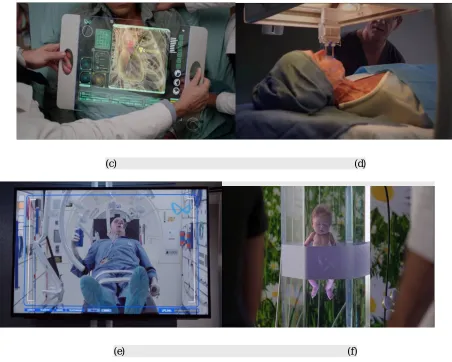
(c) (d)
(e) (f)
Fig (c) Scanner to check the heart, (d) Printing of skin cells, (e) Surgery in Space, (f) Womb Simulator
V. FUTURE ASPECTS
VI. CONCLUSION
Man-made mental ability (AI) developments have made tremendous advances and a flood of organizations are centering, applying these advances to business difficulties and, at the same time, spearheading new trails. While various people should think about automated thinking as something recondite and in the space of science fiction, there are authentic applications that can offer associations some help with illuminating complex issues, for instance, understanding tremendous data, expanding human decision making, or outfitting customers with ace direction. The time is prepared for AI advancements. This is an immediate consequence of the marvelous size of enrolling and limit limits, where get ready power, disseminated registering and quick stockpiling are open at sensible expenses. AI capacities fuse expound thinking models to answer erratic request and deal with complex issues. In the wander space, designers are starting to use AI to build subjective figuring structures. AI is growing brisk in this decade, and Forester predicts it will end up being a bit of the regular engagement of customers with PCs, devices, wearable’s and systems we interface with to finish errands, find solutions, get bolster in settling on decisions and robotize dull exercises. AI can similarly enable associations to look at broad, complex and curated data, mine it, and normally make a keen and intuitive story out of it, or to make inductions or propose proposition in perspective of the examination.
REFERENCES
[1] George F Ludger “Artificial Intelligence - Structures and strategies for complex problem solving” 5th Edition, Pearson, 2009. [2] Girish Kumar jha, "Artificial Neural Networks and its applications" international journal of computer science and issues 2005. [3] Nils J Nilsson American Association for Artificial Intelligence" AI magazine 2005.
[4] SatvikaKhanna et al. “Expert Systems Advances in Education” NCCI 2010 -National Conference on Computational Instrumentation CSIO Chandigarh, INDIA, 19-20 March 2010