Nat. Hazards Earth Syst. Sci., 18, 1493–1516, 2018 https://doi.org/10.5194/nhess-18-1493-2018 © Author(s) 2018. This work is distributed under the Creative Commons Attribution 4.0 License.
Low cost, multiscale and multi-sensor application for flooded
area mapping
Daniele Giordan1, Davide Notti1, Alfredo Villa2, Francesco Zucca3, Fabiana Calò4, Antonio Pepe4, Furio Dutto5, Paolo Pari6, Marco Baldo1, and Paolo Allasia1
1National Research Council of Italy, Research Institute for Geo-Hydrological Protection (CNR-IRPI), Strada delle Cacce 73, 10135 Turin, Italy
2ALTEC S.p.A., 10146 Turin, Italy
3Department of Earth and Environmental Science, University of Pavia, Via Ferrata 1, 27100 Pavia, Italy
4National Research Council of Italy, Institute for the Electromagnetic Sensing of the Environment (CNR-IREA), Via Diocleziano 328, 80124 Naples, Italy
5Civil Protection Service of Turin Metropolitan area, 10095 Grugliasco, Italy 6Digisky S.r.l., 10146 Turin, Italy
Correspondence:Davide Notti ([email protected])
Received: 27 November 2017 – Discussion started: 22 December 2017 Revised: 30 March 2018 – Accepted: 13 April 2018 – Published: 30 May 2018
Abstract. Flood mapping and estimation of the maximum water depth are essential elements for the first damage evalu-ation, civil protection intervention planning and detection of areas where remediation is needed.
In this work, we present and discuss a methodology for mapping and quantifying flood severity over floodplains. The proposed methodology considers a multiscale and multi-sensor approach using free or low-cost data and multi-sensors. We applied this method to the November 2016 Piedmont (north-western Italy) flood. We first mapped the flooded areas at the basin scale using free satellite data from low- to medium-high-resolution from both the SAR (Sentinel-1, COSMO-Skymed) and multispectral sensors (MODIS, Sentinel-2). Using very- and ultra-high-resolution images from the low-cost aerial platform and remotely piloted aerial system, we refined the flooded zone and detected the most damaged sec-tor. The presented method considers both urbanised and non-urbanised areas. Nadiral images have several limitations, in particular in urbanised areas, where the use of terrestrial im-ages solved this limitation. Very- and ultra-high-resolution images were processed with structure from motion (SfM) for the realisation of 3-D models. These data, combined with an available digital terrain model, allowed us to obtain maps of the flooded area, maximum high water area and damaged in-frastructures.
1 Introduction
Floods are natural disasters that cause significant damage and casualties (Barredo, 2007).
et al. (2017). Moreover, the increasing availability of free-of-charge satellite data with global coverage (e.g. Sentinel-1 and -2 from ESA, and Landsat and MODIS satellites from NASA) makes analyses of flooded areas with low-cost so-lutions possible. Flood mapping and damage assessment is also an important issue for European Communities authori-ties that support projects, such as the Copernicus Emergency Management Service mapping (EMSR) and the European Flood Awareness System (EFAS), which manage the acti-vation procedure to acquire satellite data over the areas af-fected by a natural hazard. De Moel et al. (2009) and Pa-protny et al. (2017) described further details about different experiences of flood mapping in Europe.
In urban areas, remote sensing data are often less efficient for the detection of flooded areas, especially if images ac-quired during the maximum of the inundation are not avail-able. A partial solution could be the use of Remotely Piloted Aerial Systems (RPAS) (Perks et al., 2016; Feng et al., 2015), which are usually able to acquire ultra-high-resolution im-ages over small areas (Giordan et al., 2018). Quantification of the maximum water level caused by the inundation is a crucial parameter, in particular in urban areas, because it can supply damage estimations and support civil protection op-erations (Luino et al., 2009; Bignami et al., 2017). Very of-ten, nadiral remote sensed platforms cannot define the level of water, and for this reason, field surveys and ground-based photos are still necessary. A possible solution is the use of models for the estimation of the water depth based on digi-tal terrain model (DTM) or hydraulic models (Bates and De Roo, 2000; Segura-Beltrán et al., 2016), but ground truth val-idation is needed. Recent development of computer vision applications, such as structure from Motion (SfM) (Snavely, 2008), make this system a possible valid alternative for the creation of a 3-D dataset based on terrestrial or aerial image acquisition systems. These datasets can be useful for defin-ing the water depth of flooded areas. The 3-D models derived from SfM are currently used for geomorphological applica-tions (Westoby et al., 2012) and flood mapping. This second application is often assisted using precise DTM derived from lidar (Smith et al., 2014; Meesuk et al., 2015, Costabile et al., 2015). Particular applications of SfM can be used to make 3-D models of facades and acquire a useful dataset for the iden-tification of marks left by water. The combined use of low-cost systems capable of acquire nadiral images and oblique terrestrial pictures is essential for the definition of water lev-els and the estimation of damage, especially for flooded areas in an urban environment (Griesbaum et al., 2017).
Finally, geolocated photos and information derived from the internet and social media (Rosser et al., 2017; Fohringer et al., 2015) or by volunteer geographic information (Hung et al., 2016; Schnebele and Cervone, 2013) can be handy for improving the mapping of flooded areas.
In this work, we present a smart multiscale and multi-platform methodology that was developed for the identifi-cation and mapping of flooded areas. The methodology has
been tested in two areas struck by the flood that occurred in Piedmont (northwestern Italy) in November 2016. The paper presents different case studies that are representative of urban and/or non-urbanised areas.
2 Study areas
The Piedmont (Piemonte) region is located in northwest-ern Italy, and most of the territory is inside the Po River drainage basin (Fig. 1a). The Alps range surrounds the re-gion from north to southwest with an elevation higher than 4000 m a.s.l. In the southern sector, the Ligurian Alps and Apennine Range have lower elevations (1000–2000 m a.s.l.) and separate Piedmont from the Ligurian Sea. On the eastern side, the basin is open to the Po River plain. This orographic setting tends to amplify the effects of some particular me-teorological conditions, such as severe and slow-moving cy-clones located to the west of Italy that cause a wet flow from the southeast that is blocked by the Alps. This meteorologi-cal configuration causes heavy rainfall, especially in autumn when the warm Ligurian Sea is a source of additional en-ergy and humidity (Buzzi et al., 1998; Pinto et al., 2013). In the last 30 years, four main floods hit this region: Septem-ber 1993 (Regione Piemonte, 1996), NovemSeptem-ber 1994 (Luino, 1999), October 2000 (Cassardo et al., 2013) and Novem-ber 2016 (ARPA Piemonte, 2016)
In November 2016, a severe flood hit the Piedmont region (northwestern Italy). In several areas of the Piedmont in the period 21–25 November 2016, different rain gauges regis-tered an amount of rainfall up to 600 mm, which represented 50 % of the mean annual precipitation (Fig. 1a). The basins of the Po and Tanaro rivers were the most affected by the flood that was very similar, for rainfall distribution and river discharge, to the 1994 event, which is considered one of the most destructive that has occurred in the past decades (Luino, 1999). This time, the event caused large damage, activated numerous landslides and debris flows and caused the inunda-tion of large areas. The civil protecinunda-tion system managed the emergency and the number of victims was sharply reduced compared to the 1994 event that caused 70 victims. The 2016 flood caused a victim in Chisone Valley, not far from Turin.
in-D. Giordan et al.: Low cost, multiscale and multi-sensor application for flooded area mapping 1495
Figure 1. (a)Location of Piedmont region in Italy;(a)rainfall in Piedmont region during the 21–25 November flood event (based on ARPA Piemonte data) and location of study area (SB =Savigliano Basin, PP=Poirino Plateau, TH=Turin Hills)(b)Detailed view of the study area with discharge in the stream gauge stations and the location of Pancalieri (1) and Moncalieri (2) local areas case history.
fluence is remarkable with quarry lakes, revetments and em-bankments that constrain the riverbeds (Fig. 1b). The geo-morphology is a crucial factor that constrains the flooded area shape and the water height.
This area was affected by the flooding of the Po River and other tributaries. In particular, the Chisola and Oitana streams caused severe damage. The Po River between the Carig-nano and Turin stations reached a maximum discharge of 2000–2200 m3s−1in the late evening of 25 November 2016. The mean discharge of this monitoring station in November was 70 m3s−1. The Chisola Stream registered a discharge of 200 m3s−1(November average 17 m3s−1) near Moncalieri on the afternoon of 25 November (ARPA Piemonte, 2016).
Inside this area (Fig. 1b), we focused our attention in particular on two sites where high-resolution data were ac-quired:
– The village of Pancalieri, located on the left side of the Po River, just after the confluence with the Pellice River. In this area, it is evident that the ancient Po River mean-ders are present, and they were reactivated by the flood
with damage to some settlements and the destruction of communications roads.
areas, such as Moncalieri, a map of the damage (grading maps Copernicus Emergency Management, 2016b) was also produced. However, the available delineations maps represent the automatic extraction of the flooded area at the moment of image acquisition, and generally not at the maximum extension. In the case of Piedmont, they cannot be used for exhaustive modelling and damage evaluations. The preliminary estimate of the damage to buildings made by the municipality of Moncalieri was approximately EUR 50 million for industrial buildings and EUR 13 million for residential buildings, and another EUR 6 million for damage to other goods (http://www.comune.moncalieri.to. it/flex/cm/pages/ServeBLOB.php/L/IT/IDPagina/3669, last access: 23 May 2018).
3 Materials and Methods
The aim of this study is the definition of a possible method-ology for the identification and mapping of flooded areas us-ing low-cost solutions. For this reason, we have combined and compared data from different sensors. We used differ-ent approaches for flood mapping – some have already been tested for a long time as reported in the literature, and others are more innovative and experimental. We first introduce the concept of “co-flood” and “pre- and post-flood” data. Co-flood data are collected around the time of the maximum inundation, while pre/post-flood data are acquired before or after the flood maximum. In the first case, the mapping of flooded areas is more straightforward, but the acquisition of co-flood images was not always possible.
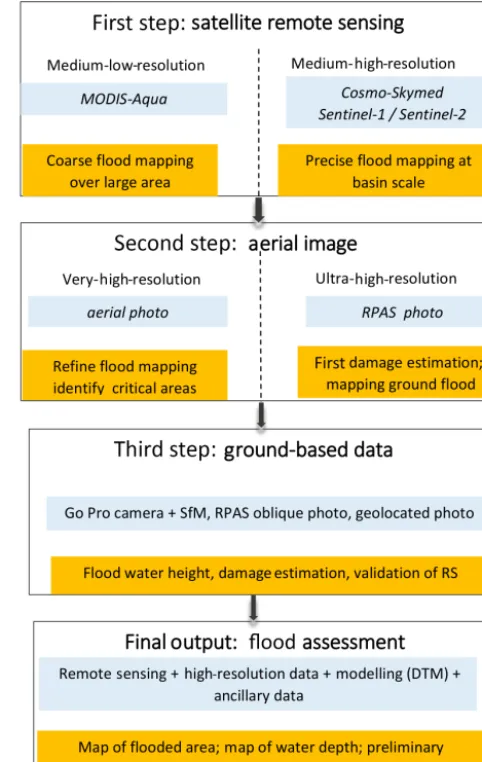
Using a multiscale approach, we developed a methodol-ogy (Fig. 2) that progressively considers the use of satellites and then high and ultra-high-resolution systems. The aim is the acquisition of a dataset that can be used to support the identification of the water depth and extent reached by the flood. The dataset also allowed making a first evaluation of damage in both urbanised and non-urbanised areas.
The first identification of the flooded area can be made using satellite results and in situ information from the civil protection system that collects reports from local authorities (co-flood phase). This first identification phase is mandatory to have a general and fast indication of the involved area and to plan more detailed acquisitions.
The second phase is aimed at acquiring a high definition dataset that can be used for a detailed mapping of the flooded area. For this step, a system is required that is able to fly on demand over large areas and acquire an RGB and multispec-tral dataset with a resolution of 10–20 cm pixel−1. The high-resolution map obtained during this phase can be used for the identification and mapping of flooded areas with acceptable detail. The resolution of the orthophoto can also support the identification of critical elements, such as damaged infras-tructure – bridges, levees, streets and urban areas involved in the flood. The map of the most damaged sectors can be
Figure 2.Flowchart illustrating the multiscale flood mapping ap-proaches proposed in this work.
obtained merging civil defence reports and the analysis of acquired orthophotos. The identification of the most critical sectors is essential for a preliminary evaluation of the damage that occurred and the planning of the first remedial actions.
cor-D. Giordan et al.: Low cost, multiscale and multi-sensor application for flooded area mapping 1497
Figure 3. (a)Reclassified Quicklook Amplitude SAR Image acquired at 05:05 UTC, 25 November 2016 – COSMO-SkyMed©ASI [2016]. (b)Sentinel-1 geocoded backscattering coefficient difference (1σ◦), (b’, b” and b”’) and details of some areas where1σ◦still detect water. (c)Example of change backscattering between the pre- and the postflood image is detectable.
rect reconstruction of what happened. To obtain a 3-D repre-sentation of urbanised flooded areas, we decided to integrate terrestrial and aerial images using the SfM algorithm.
In the following chapters, we present the acquired datasets of the different phases (Table 1). All the proposed systems are low-cost solutions that could be adopted by national or regional authorities with limited effort.
3.1 Flood mapping at a regional scale with satellite data
The developed methodology is based on a multiscale ap-proach that starts from the use of low-resolution regional scale satellite images. The use of different available satellites images can support the identification of flood effects at a low-resolution over large areas and at higher low-resolution at a local scale. The choice of the most appropriate satellite data de-pends on different factors: (i) the characteristics of the study area, (ii) the spatial resolution, (iii) the revisit time, (iv) the
time of the acquisitions with respect to the moment of maxi-mum inundation and (v) the availability and cost of images.
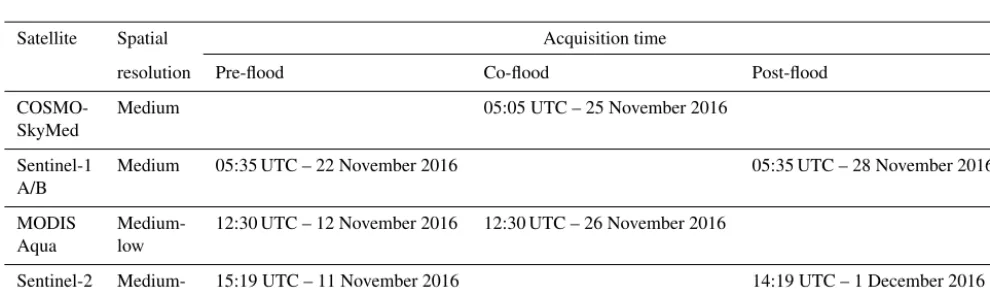
In this paper, only free of charge images were used to assure a low-cost approach. For every considered dataset, we produced a map of the flooded area that represents the synthesis of remote sensing data and geomorphological ev-idence from the 5 m DTM available from the Piedmont Re-gion. We use a visual-operator approach to map the flooded areas that resulted in more precision than automatic classifi-cations, especially in the case of post-flood images. Table 2 presents the satellite data related to the flood phase. We con-sidered as co-flood data all of the images acquired between early 25 November 2016 (start of the first inundation) and the evening of 26 November 2016 (the withdrawal of water). 3.1.1 SAR data
Table 1.Resume of the datasets used to map and characterise flooded areas in this study.
Type Sensor used Spatial resolution (m) Covered area by a Min. revisit time (Day) single scene (km2)
1 – Satellite data
SAR – X band COSMO-SkyMed 60 >1000 4
SAR – C band Sentinel-1A/B 5 (ground range)× >10 000 6
20 (azimuth)
Multispectral MODIS-Aqua 500 >100 000 Daily
Multispectral Sentinel-2 10 / 20 >10 000 10 (5)
2- Aerial data
Very-high-res. Tecnam P92-JS 0.01 100 km2 On-demand
visible band
Ultra-high-res. RPASs CarbonCore 0.02 / 0.03 <10 km2 On-demand
visible band 950 octocopter
DTM lidar Airborne 5 Piedmont Region Archive data
3-Ground-Based
Photo / video from GO-PRO HERO 3+ 0.02 / 0.03 Local / urban On demand
car platform
Table 2.Resume of satellite data in relation with the flood stage.
Satellite Spatial Acquisition time
resolution Pre-flood Co-flood Post-flood
COSMO- Medium 05:05 UTC – 25 November 2016
SkyMed
Sentinel-1 Medium 05:35 UTC – 22 November 2016 05:35 UTC – 28 November 2016
A/B
MODIS Medium- 12:30 UTC – 12 November 2016 12:30 UTC – 26 November 2016
Aqua low
Sentinel-2 Medium- 15:19 UTC – 11 November 2016 14:19 UTC – 1 December 2016
high
increasing the opportunity of providing data corresponding with the flood event.
(I) Co-Flood mapping. If data are available during the maximum flooding phase, it is possible to accurately map the affected area using high-resolution SAR images, such as those acquired by the TerraSAR-X (Giustarini et al., 2013) and COSMO-SkyMed (CSKM) (Refice et al., 2014) satel-lites. In particular, the identification of the flooded area is per-formed by analysing the SAR backscattering, which shows low values in water-covered areas. In our analysis, we used a SAR image acquired by the X-band COSMO-SkyMed satellites constellation (wavelength ∼3 cm) on 25 Novem-ber 2016 (05:05 UTC acquisition time). Data were provided free of charge by the E-Geos and the Italian Space Agency (ASI) in a quick-look preview format with a 60 m×60 m res-olution.
D. Giordan et al.: Low cost, multiscale and multi-sensor application for flooded area mapping 1499
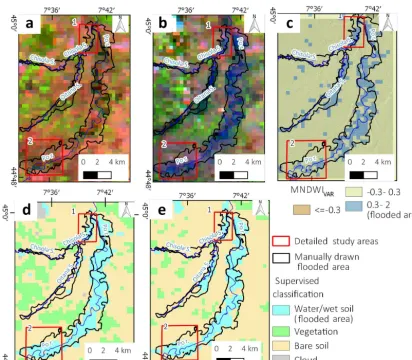
Figure 4.MODIS Aqua satellite image(a)false colour band composition 7-2-1 acquired on 12 November 2016;(b)false colour band com-position 7-2-1 acquired during the 26 November 2016 event;(c)automatic detection of the flooded area using MNDWIvar>0.3; automatic
detection of the flooded area using supervised classification with maximum likelihood method(d)and with spectral angle method(e). The red box identifies the local case history of Moncaleri (1) and Pancalieri (2).
(II) Post-flood mapping.We also performed a post-flood mapping by exploiting data acquired by the Sentinel-1 Mis-sion, which is composed of a constellation of two satellites, Sentinel-1A and Sentinel-1B, launched on 3 April 2014, and 25 April 2016, respectively. Sentinel-1 satellites have been designed to acquire C-band SAR data in continuity with the first-generation ERS-1/ERS-2 and ENVISAT Mission, developed within the European environmental monitoring program of Copernicus. The Sentinel-1A SAR operates at 5.405 GHz and supports four imaging modes providing im-ages with different resolutions and coverim-ages (Torres et al., 2012). We used the Interferometric Wide Swath Mode (IW) acquisition mode by employing the Terrain Observation by Progressive Scans (TOPS). The IW TOPS mode is the pri-mary mode of operations for the systematic monitoring of surface deformation and land changes (De Zan and Monti-Guarnieri, 2006). This acquisition mode provides large swath widths of 250 km with a spatial resolution of 5 m×20 m
(IW). The repeat cycle of the twin Sentinel-1A/B constel-lation was reduced to 6 days.
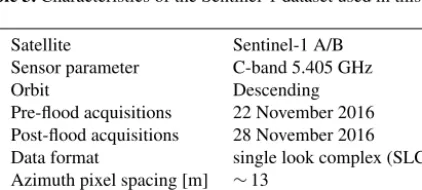
For our analysis, we acquired two IW Sentinel-1A/B im-ages collected over the study area in VH polarisation along the descending satellite passes. In particular, we exploited the data acquired after (on 28 November 2016) and before (22 November 2016) the flooding event (see Table 3).
Figure 5.Sentinel-2 analysis and validation,(a)NDVI variation 10 m of spatial resolution,(b)MNDWI variation 20 m of spatial resolution, (c)Simulation of flooded area water depth for the Po River based on 5 m DTM and river height level registered in the Arpa Piedmont stream gauge.
Table 3.Characteristics of the Sentinel-1 dataset used in this study.
Satellite Sentinel-1 A/B
Sensor parameter C-band 5.405 GHz
Orbit Descending
Pre-flood acquisitions 22 November 2016 Post-flood acquisitions 28 November 2016 Data format single look complex (SLC) Azimuth pixel spacing [m] ∼13
Range pixel spacing [m] ∼2
After these pre-processing steps, to detect land surface changes induced by flooding, we computed the difference between the post- and the pre-flooding geocoded backscatter-ing coefficient images, and produced the map of the temporal variation of the surface backscattering (1σpost−pre−floodingo ). 3.1.2 Multispectral satellite data
In this category, we considered both low- and medium-resolution images. Unfortunately, we found co-flood images only for the low-resolution images.
(I) Medium-low resolution satellite data. MODIS (Mod-erate Resolution Imaging Spectroradiometer) is a system of two sun-synchronous, near-polar orbiting satellites, called
D. Giordan et al.: Low cost, multiscale and multi-sensor application for flooded area mapping 1501
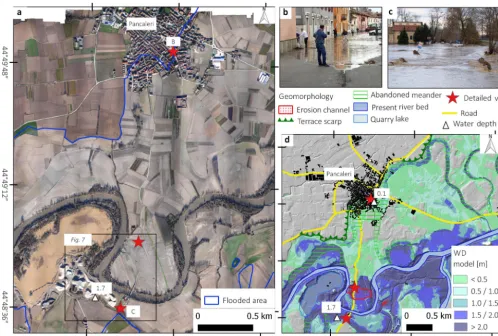
Figure 6. (a)Aerial photo at 10 cm of resolution taken 28 November 2016. Panels(b)and(c)are photos taken from a local newspaper and geo-localised with Google Streetview;(d)Geomorphological elements and model of estimated water depth (m).
(20 km), and the atmospheric parameters for correction avail-able at 1 km of spatial resolution (water vapour, ozone or aerosol) did not show a significant change. For the identi-fication of the flooded areas, we made the following elabora-tions:
a. a false colour image was made with combinations of 7-2-1 bands for a visual interpretation of flooded areas. b. modified normalised difference water index variation
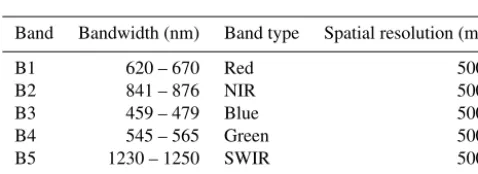
MNDWIvar (Eq. 1). The MNDWI allows the detection of water masses or soil moisture. In the literature, differ-ent combinations for this index have been presdiffer-ented and discussed (Xu, 2006; Zhang et al., 2016; Gao, 1996). In our study, we used the ratio between B1 (red band) and B7 (Short Wavelength Infrared: SWIR). The difference with a non-flooded situation can be used for identifying changes in the soil moisture. We used the results of the supervised classification to mask the cloud cover.
MNDWIvar=MNDWIpost−MNDWIpre
where MNDWI=(B1−B7)
(B1+B7) (1)
Figure 7.The SfM 3-D model obtained from the very high-resolution aerial photo, near the Po River at the south of Pancalieri.(a)Location of 3-D models;(b)the approximate measurement of water depth on sand deposits of a quarry (a);(c)the effect of meander cut: an erosion channel and the destruction along a stretch of road.
D. Giordan et al.: Low cost, multiscale and multi-sensor application for flooded area mapping 1503
Figure 9.3-D Model derived from the RPASs aerial photo and SfM elaborations photo overlap. The model shows the river embankment rupture, point B in Fig. 8a, and the geomorphological effects in the neighbour areas. It is also possible to estimate the water depth from the signs on the embankment.
Table 4.Characteristics of the Aqua MODIS data used in this work.
Band Bandwidth (nm) Band type Spatial resolution (m)
B1 620 – 670 Red 500
B2 841 – 876 NIR 500
B3 459 – 479 Blue 500
B4 545 – 565 Green 500
B5 1230 – 1250 SWIR 500
B7 2105 – 2155 SWIR 500
difficult to have images at the same time of the maximum flood and that are cloud free. However, by comparing two images acquired before and after a flood event, it is possi-ble to calculate the variation of different indices related to changes in the reflectance of the soil and/or of the vegeta-tion. Thus, it is sometimes possible to map the flooded area indirectly (post-flood mapping).
In our study area, we used images taken by Sentinel-2 before the flood (11 November 2016) and after (1 Decem-ber 2016). Sentinel-2 has some bands at 10 m of spatial res-olution and some bands and 20 m of spatial resres-olution (re-ported in Table 5). To detect the flooded area, we first made a visual interpretation using images with different bands’ com-positions of post-flood data. The comparison of the consid-ered images allowed us to calculate the difference between the following two indices:
1. the normalised difference vegetation index (NDVI) vari-ation. The NDVI was calculated with 10 m of spa-tial resolution images from Sentinel-2 using the near-infrared band (NIR – B8), and the red band (B4). The NDVI is related to the activity of vegetation. It is pos-sible, by calculating its variation (Eq. 2), to identify the decrease of the NDVI values as an effect of inundation
Table 5.Characteristics of Sentinel-2 data used in this work.
Band Wavelength (nm) Band type Spatial resolution (m)
B2 490 Blue 10
B3 560 Green 10
B4 665 Red 10
B8 842 NIR 10
B5 705 NIR 20
B6 740 NIR 20
B7 783 NIR 20
B8a 865 NIR 20
B11 1610 SWIR 20
B12 2190 SWIR 20
on vegetation (Ahamed et al., 2017). The detection of this change allows the mapping flooded areas indirectly.
NDVIvar=NDVIpost−NDVIpre where NDVI=(B8−B4)
(B8+B4) (2)
2. the modification of normalised difference water index (MDWI) variation. We used a similar index already tested for the MODIS data. We used Sentinel-2 to cal-culate the MNDWI considering the red edge band (B5) and the SWIR band (B11) at 20 m of spatial resolution. With this approach (Eq. 3), it is possible to map the vari-ation of soil moisture related to recently flooded areas or areas that are still covered by water.
MNDWIvar=MNDWIpost−MNDWIpre where MNDWI=(B5−B11)
(B5+B11) (3)
3.2 Flood mapping at local scale with high- and ultra-high-resolution data
The flood mapping at the local scale was made using high-and ultra-high-resolution images.
Immediately after the event, a research project proposed by CNR-IRPI was conducted with the participation of AL-TEC S.p.A., Digisky s.r.l. and the Civil Protection Agency of the Metropolitan City of Turin. The aim of the project is a methodological analysis of a possible low-cost solution that could be used for the high-resolution mapping of flood ef-fects.
the previous experiences of the CNR IRPI and Civil Protec-tion Agency in the use of small RPAS for the study of geo-hydrological processes (Giordan et al., 2015; Boccardo et al., 2015; Fiorucci et al., 2018; Giordan et al., 2017) were useful for the definition of a correct use of these systems. These pre-vious experiences noted how the use of low-cost systems for the acquisition of RGB images and the application of SfM al-gorithm can be considered as a good solution for the creation of high-resolution 3-D models.
3.2.1 Aerial high-resolution images
Aerial photos taken in a few hours or within a few days after the peak of inundation allow the mapping of flooded areas with high precision over the most involved territories. In our case, aerial photos were acquired after the flood over the Po River near the village of Pancalieri and for the town of Mon-calieri. We used a low-cost aerial platform (Tecnam P92-JS) provided by DigiSky s.r.l., equipped with a 16 Mp mirrorless camera (Panasonic Lumix GX7) that allowed us to acquire aerial photos with a spatial resolution of 10 cm pixel−1. The system also has an onboard GPS that acquires image shoot-ing points and allows the georeferencshoot-ing of the photos se-quence using SfM.
The use of a manned solution has several added advan-tages that can be very useful in this phase: (i) it is possible to fly over urban areas without the strong limitations that char-acterise RPAS; (ii) the system can acquire images over large areas within a limited period of time; and (iii) the system can fly on demand during the flood or immediately after (with favourable weather conditions).
The adopted solution was used to acquire images of the 9.2 km2of the most damaged area of Moncalieri and 9.5 km2 of the flooded area of Pancalieri. These two areas are repre-sentative of different conditions:
1. the area of Pancalieri is a rural area mainly dedicated to agriculture. In this case, the Po River flood covered large uninhabited sectors of the Pancalieri plain and reached part of the town of Pancalieri. Here, using SfM, the plane images were also processed for the creation of a digital surface model (DSM) (resolution of 20 cm) with the aim of mapping geomorphological features related to the flood.
2. the selected area of Moncalieri is a strong urbanised sec-tor of the municipality. In this area there is (i) a mosec-tor- motor-way, (ii) several regional and local streets, (iii) a residen-tial area with recent unfamiliar houses and small condo-miniums and (iv) an industrial and commercial district. The inundation of this area is due to the Chisola Stream levee’s break. The map of Moncalieri was useful for the identification of the most damaged elements, and in par-ticular the levee. In the most critical areas, we also used RPAS to acquire ultra-high-resolution images.
3.2.2 RPAS ultra-high-resolution images
In the ultra-high resolution step, we used the RPAS and the terrestrial system. The RPAS was used to acquire nadiral photo sequences of the most damaged areas and infrastruc-tures. In particular, we tested the possibility of using RPAS for the identification of damage that occurred to the Chisola Stream levee and one of the most damaged sectors of the town of Moncalieri. The employed RPAS is a multi-rotor (CarbonCore 950 octocopter) equipped with a Canon EOS M (Sensor CMOS APS-C, 18 Mp). The system is equipped with a flight terminator and a parachute and can also be used in inhabited areas. The Civil Protection Service of the Turin metropolitan area provided the RPAS. The obtained aerial photos have a spatial resolution of 3 cm pixel−1. Using SfM, the images of the drone were also used to create the 10 cm resolution DSM. All of the flood mapping methodology de-scribed above are very often unable to provide a consistent measurement of water depth. This limitation is not due to the resolution or the time of acquisition, but it is intrinsic in nadi-ral images. For this reason, in the Moncalieri area, we choose to deploy a ground-based solution.
3.2.3 Ground-based ultra-high-resolution images As previously mentioned, we tested a low-cost terrestrial sys-tem for the acquisition of ultra-high-resolution images. In particular, we used an integrated system developed by AL-TEC SpA, which couples a Go-Pro HERO 3+(Black Edi-tion) camera with a GPS and an acquisition module. The sys-tem is able to record a STANAG 4609 geolocated HD video. We installed the experimental system over a CNR IRPI car, and a survey was performed a few days after the flood in the study area of Moncalieri. The continuous record of ge-olocated videos can be a good solution for the acquisition of a significant amount of data immediately after the flood when marks of the water level are still clearly visible along building facades. The identification of water levels of flooded areas based on the measurement of marks over facades is not a novelty, but the manual acquisition of these data has often been a critical task. Citizens often want to quickly obliterate these signs as a reaction to the life-threatening experience that they lived through. The use of field teams that look for these marks can be a time-consuming task that can produce few results with considerable effort because before the sur-vey it is hard to have an idea of the number and the distri-bution of facade marks that can be identified and measured. The number of marks strongly decreases after a few weeks, and for this reason, it is essential to have a system that can acquire very fast geolocated images and that can be easily used over large areas.
D. Giordan et al.: Low cost, multiscale and multi-sensor application for flooded area mapping 1505
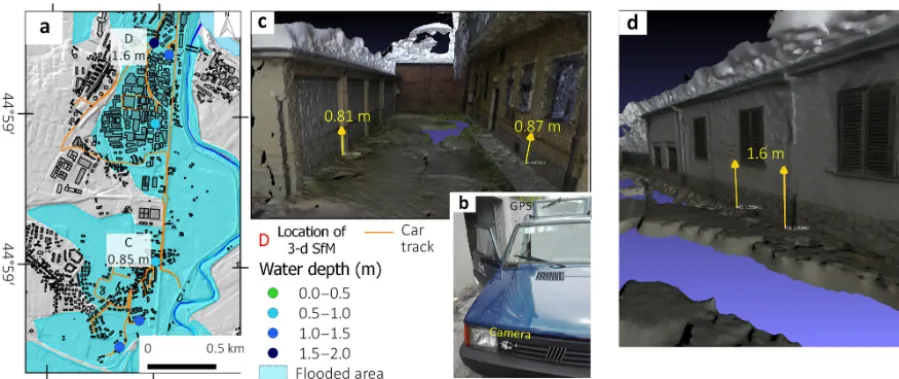
Figure 10. (a)Map of the flooded area by Chisola Stream in the Moncalieri municipality with measured water height and location of 3-D photo,(b)installation of the GO-PRO HERO 3+(Black Edition) camera and GPS antenna over the car (the processing system for STANAG 4609 encoding was installed inside the car)(c)and(d)examples of 3-D models made with SfM in which it was possible to measure the water height.
information of the flood effects that can be used for several purposes. For the identification and mapping of water levels, the video is analysed, and a frame sequence is extracted from it when the operator sees some marks left by water over the facades. The developed system can extract not only frames but also their geocoding information, which are computed using SfM applications. The result is a georeferenced 3-D model of the facade that can be used to measure the water level with a good approximation (few cm). We validated the accuracy of measurements of the water level based on SfM with manual measurements accurately geolocated with GPS RTK positioning.
3.2.4 Field data
Field survey and ancillary data, such as measurements of river discharge stations and civil protection reports, were used to validate the maps derived from remote sensing in-terpretation and the simulation models for the Pancalieri and Moncalieri areas. We made a GPS RTK campaign in the Tetti Piatti and Tagliaferro areas to have direct measurements of the flood marks. In particular, we acquired the 3-D position of marks previously identified using the available video. We used third party materials, such as newspaper reports, photos and videos found on the web with a validation of their reli-ability regarding geolocation and time. Available data were used to check the extension of flooded area and water height mapped with other methodologies.
3.3 Water depth models based on DTM approach As previously mentioned, the primary goal of the presented methodology is the definition of the maximum depth reached
Figure 11. (a)Water depth levee map based on SfM data and 5 m DTM model.(b)Water level reached by Chisola Stream in ARPA Piedmont station.(c)Geolocated third part photo: 25 November 2016 aerial view of flooded area found on the web (https://vivere-moncalieri.it/2016/ 11/30/3760/, last access: 23 May 2018).
4 Results
4.1 Flood mapping from low to medium-high resolutions with satellite data
The satellite data allowed mapping of the flooded areas by the Po River, and the Chisola and Oitana streams, with a reso-lution that ranges from 500 m of MODIS to 10 m of Sentinel-2. We compared raster maps based on the remote sensing data with our perimeter of the flooded area (black polygon in Figs. 3, 4 and 5). We manually extrapolated the flooded area perimeters considering both satellite data and geomor-phological features observed in the hillshade model derived from 5 m DTM of the Piedmont Region. For the evaluation of automatic flooded area maps based on satellite data, we
applied a GIS query for each map to create boolean rasters of the flooded and non-flooded areas. Then, we overlapped the obtained raster with manual polygon for a geo-statistical analysis, as each polygon is reported with the percentage pixel classified as flooded or non-flooded. The main results are reported in Table 6.
D. Giordan et al.: Low cost, multiscale and multi-sensor application for flooded area mapping 1507
Table 6.Accuracy in automatic flooded and non-flooded area detection.
Sector Area Sentinel-2 MODIS-Aqua COSMO- Sentinel-1
km2 SkyMed
MNDWIvar NDVIvar MNDWIvar MLC SA Recl ampl 1σo
Non-flooded 259.5 87 % 87 % 91 % 94 % 95 % 96 % 99 %
Flooded area
– Po 47.8 48 % 37 % 49 % 70 % 64 % 23 % 4 %
– Oitana 11.6 49 % 42 % 60 % 11 % 36 % 37 % 1 %
– Chisola 7.3 21 % 51 % 30 % 24 % 23 % 12 % 1 %
– Chisola urban 1.1 4 % 24 %
4.1.1 Flood mapping with SAR data
(I) Co-flood mapping, the reclassified amplitude of CSKM data. The image classification allowed us to detect three classes of SAR amplitude (Fig. 3a) that were defined by means of empirical thresholds: (i) low, that correspond to water covered area (blue); (ii) intermediate, such as soil and vegetation (green) and (iii) high, that are urban areas (pink). In the map (Fig. 3a), we also overlapped the quarry lake from ancillary data (cyan). The accuracy in the correct detection of land-use type is quite good, ranging up from 80 % for soil and vegetation, and 67 % for the urban area to 61 % for the water body (tested in quarry lakes). Vegetation and buildings are factors that reduce the detection of water covered areas even using full-resolution images and more complex processing (Pierdicca et al., 2018). In a second step, we selected, with a GIS query, the low resolution (water covered) class that mostly corresponded to the inundated areas and we compared them with the real flooded area. Additionally, the accuracy detection of the flooded areas is quite good: it ranges from 57 % in the lower Oitana Stream to 2 % in the Po area near Moncalieri. The low accuracy for some areas is related to the time of the satellite acquisitions (05:05 UTC of 26 Novem-ber 2016) at some hour before the flood peak. The flood wave positions can be appreciated, especially along the Po River, where upstream (near Pancalieri) approximately 42 % of the flooded area was detected, while downstream (Carignano) it decreased to 4 %. The urban area of Moncalieri limits the capability detection of inundated areas. The false positive er-rors are less than 5 % of the area.
(II) Post-flood mapping with Sentinel-1 data. The map of the post- and pre-flood SAR backscatter difference (1σpost−pre−floodingo ) through the application of an empiric threshold allowed us to detect areas covered by water, i.e. flooded (1σo<−1 dB) (Fig. 3b). Such results show that most of the areas classified as flooded by the co-flood analy-sis were no longer covered by water on 28 November 2016. Only small depressed areas, e.g. ancient meanders of the Po River, were still flooded (Fig. 3b’, 3b” and 3b”’). The case of Pancalieri will be discussed in more depth in Sect. 4.2.
4.1.2 Flood mapping with multispectral data
(I) Multispectral low resolution, Aqua. The MODIS-Aqua satellite took an image reasonably free of clouds, over the entirety of the Piedmont region during the late morning of 26 November 2016. The image allowed the detection of the flooded areas with a resolution of 500 m.
From the false colour images (Fig. 4b), even if the area at the south of Turin was not yet directly flooded, it was only possible to detect that the soil was saturated with water (dark green–blue in false colour composition). The compari-son with the pre-flood image of 12 November 2016 (Fig. 4a) improved the detection of the flooded area.
We also tried to extract, in an automatic way, the flooded area with the equations previously described.
We identified the flooded area using a GIS query with the value MNDWIvar≥0.3 (Fig. 4c). This value is an empirical threshold that allows the selection of most of the flooded area and minimises false positive errors. The results show a good correspondence between the manually drawn and the au-tomatically classified flooded area; however, approximately 35 % of the flooded area was not identified. The mismatch can be explained with the satellite acquisition at the end of the co-flood stage when water started to withdraw. It is also possible to see some false positive pixels (<10 %) that cor-respond to the shadow of the clouds or haze that was not possible to entirely filter out.
worse results for the area flooded by the Chiosla and Oitana streams.
For both indices, it is possible to see that the town of Mon-calieri (red square 1 in Fig. 4) that was flooded by Chisola Stream is not well identified.
(II) Multispectral medium-high resolution post-flood map-ping Sentinel-2. We analysed the data of Sentinel-2 by means of visual interpretation of RGB composite image, using two different indices (NDVI and MNDVI) to identify the flooded areas (Fig. 5). For both indices, we used GIS queries with empirical thresholds to extract the flooded area:
1. NDVI variation (NDVIVAR)at 10 m of spatial resolu-tion (Fig. 5a). The results show that for the Po, Chisola and Oitana a clear pattern of negative NDVI variation corresponds to the flooded area. The study area is al-most flat and al-mostly occupied by cultivated fields and in November it was characterised by a tillering of wheat. The flood caused the deposition of a thin layer of silt sediment that caused a decrease of vegetation activity (most of the flooded area shows an NDVIVAR<−0.06) that could be detected using the available dataset. In contrast, the wheat field outside the flooded area shows an increasing or stationary NDVI. In the maps are the visible negative NDVIVAR and also outside the flooded area are related to a (i) winter decrease of activity of nat-ural vegetation or some cultivations and (ii) the longest building shadow in the urban areas. The presence of false positives hampers the use of automatic classifi-cations of flooded areas, and a visual interpretation is necessary. It is possible that flood effects and the lay-ers of silts could have also affected the crop productiv-ity with relative economic damage, as reported in other cases (Tapia-Silva et al., 2011; Shrestha et al., 2017), but this evaluation is not the aim of this study.
2. MNDWI variation (MNDWIVAR)at 20 m of spatial res-olution. The index is directly related to the presence of water or high soil moisture. The results show that for the Po, Chisola and Oitana floodplain (Fig. 5b), there is a clear pattern of positive MNDWIVARthat in-dicates an increase of soil moisture and the presence of some areas that were still inundated. It is possible to see that a threshold of MNDWIVAR+0.1 is the best to delimit the flooded areas. However, as with NDVI, the presence of many areas with positive variations out-side the flooded sector makes more accurate a man-ual interpretation compared to an automatic classifica-tion. The evidence also suggests that for this index, it is important to have images taken within few days af-ter the flood when the affected areas are still covered by water or with very wet soil. Table 6 shows the accu-racy statistic for the automatic mapping of flooded areas based on satellite data: MNDWI shows slightly better accuracy than NDVI. Note that for both MNDWIVAR and NDVIVARthe flooded area is well detectable in and
around the village of Pancalieri (>50 % of accuracy) where land use is mostly cultivated land. In contrast, it is more difficult to detect the flooded area in the highly urbanised town of Moncalieri (<20 % of area detected). (III) Water depth model. We created a WD model for the Po River (Fig. 5c) following the procedure described in Sect. 3.3. The simulated WD model has a good match with the benchmark polygon and the evidence from Sentinel-2 (Fig. 5a and b) and MODIS data (Fig. 4). It is also possi-ble to observe some discrepancy at the southeast of Mon-calieri, where a large area should be flooded according to the model, but in reality was not affected. This mismatch could be explained by the presence of artificial structures (e.g. em-bankments) that protected the flood-prone areas and that our model cannot simulate. The uncertainty of our WD model is complicated to evaluate because it depends on many fac-tors: the main limit is the number of ground-based WD mea-surements, their reliability and their geolocation. The inter-polation to obtain the water table is also another source of error. The accuracy of the lidar DTM in the Piedmont Re-gion ranges from±0.3 m to±0.6 m elevation in urban areas. Over this vast area, we do not have a ground measure for validation, but it is possible to estimate it from some pho-tos found on the web that shows the model error is approxi-mately 0.5 m. In the high-resolution WD model of Pancalieri and Moncalieri, shown in Sect. 4.2, it was possible to validate data with ground-truth evidence.
The final limits of the flooded area are the result of both remote sensing and WD model interpretation. Its accuracy can be considered acceptable for large cultivated and flooded areas by the Po River but it is less accurate for urban zones, especially in Moncalieri, where a local high-resolution anal-ysis is needed to quantify the severity of the flood.
4.2 Flood mapping at local scale with high-resolution data
Inside the area analysed using remote sensing systems, we chose the most critical sectors of Moncalieri and Pancaleri to test the high- and ultra-high-resolution images. As previ-ously mentioned, the high resolution has been acquired using an aircraft, and the ultra-high resolution using RPASs and a ground-based photosystem. All of the images were processed using SfM that allowed us to obtain orthophotos and 3-D models.
4.2.1 High-resolution aerial photo, Pancalieri
D. Giordan et al.: Low cost, multiscale and multi-sensor application for flooded area mapping 1509
DSM at 0.2 m of spatial resolution derived from SfM, we also mapped geomorphological features, such as erosion (mean-ders cut), deposition areas and road damage (Fig. 7c). The integration of the aerial photo and DSM also allowed us to make a 3-D model, in which it was possible to measure the water depth for some points where the water level marks are well detectable (Fig. 7b).
Using the procedure described in Sect. 3.3, we produced a WD model for the Pancalieri area (Fig. 6d) with higher accuracy with respect to the rest of the Po Valley. The higher accuracy of the model was obtained using: (i) high-resolution aerial photos; (ii) spot measurements derived from SfM; and (iii) different videos and photos found on the web and geo-localised with the help of Google Streetview (e.g. Fig. 6b and c). The model shows that there was a modest height of the water-flooded part of the Pancalieri village (<0.5 m), while near the Po River, the WD reached 2–3 m with a fast flow that caused an erosion channel. From the map of the flooded area (Fig. 6d), note that during the flood, ancient meanders at the east of Pancalieri were reactivated, and as a consequence, some areas were flooded that are quite far from the Po River’s main course.
Some months after the flood (April 2017), satellite pho-tos available on Google Earth (0.5 m spatial resolution) still show some traces of the floods, such as erosion, and areas covered by sand deposits. The flooded area is much more difficult to identify and confirms the importance of acquiring data as soon as possible after a flood event.
4.2.2 High-resolution aerial photo and ultra-high-resolution RPAS 3-D models, Moncalieri
Some parts of Moncalieri municipality (Tetti Piatti, Carpice and Tagliaferro localities) were flooded in the late morning of 25 November by the Chisola Stream that breached its em-bankment in different points (Fig. 8b). On the left side of the Chisola, the area with a very dense residential and in-dustrial settlement suffered severe damage. Civil Protection evacuated hundreds of people. In the evening of 25 Novem-ber, The Po River flooded another sector of the Moncalieri municipality.
A few days after the flood, the area flooded by the Chisola was analysed with different methodologies.
1. High-resolution aerial photos. As in Pancalieri, on 29 November a very-high-resolution (0.1 m pixel−1) aerial photo using the aerial platform of DigiSKY was taken over an area of approximately 9.2 km2. The aerial photo allowed us to refine the map of the flooded areas (Fig. 8a) and to detect the points where the river em-bankment collapsed (Fig. 8b).
2. Ultra-high-resolution RPASs photos. On 3 Decem-ber 2016, the RPAS acquired photos (resolution of 0.02/0.03 m pixel−1) over some of the most critical
ar-eas (e.g. Tetti Piatti – Fig. 8c) for precise mapping of the flood effects. In this area, ultra-high resolution allowed us to detect some of the damage, such as the toppling of a wall in a recently built urban area, or the waste ac-cumulation derived from damaged objects initially lo-cated in houses or industrial warehouses. The presence of these deposits is clear evidence of the damage that occurred, as well as a confirmation that nadiral images are not able to supply a sufficient dataset for the identi-fication and evaluation of damage in urban areas. The DSM based on RPAS photos also allowed us to cre-ate a detailed 3-D model of the river embankment rupture (Fig. 9). The presented 3-D model confirmed that the level of the Chisola during the flood was very critical, with a dif-ference of fewer than 0.5 m from the top of the levee. The maximum water level considered under the security limits suggested by Po River authorities is 1 m for the top of the embankment. The RPAS model also allowed us to map the geomorphological effects of the rupture of the embankment. In particular, the ultra-high-resolution photos (Fig. 8a) and 3-D model (Fig. 9) allowed us to map a massive erosion of a field near the break and a pseudo alluvial fan created by the flow of water.
4.2.3 Measurement of water depth with SfM model from terrestrial camera, Moncalieri
In the same days of the RPAS aerial photo campaign, a field survey using an integrated system provided by ALTEC S.p.A. installed on a car (Fig. 10b) was made in the same urban areas of Moncalieri flooded by the Chisola (Fig. 10a). The survey had the aim of measuring the maximum water level reached and making a rapid evaluation of the damage. The survey lasted approximately 1 h for 12 km of the path along the road of the most critical area hit by the flood.
val-Table 7.Water height measurements obtained from structure-from-motion, GPS survey and simulation with DTM.
Measure point coordinates Water depth (m)
UTM X UTM Y SfM GPS DTM
(±0.05) (±0.2)
395132 4983240 1.56 1.60 1.61
395242 4983152 1.45 1.40 1.42
395140 4982644 0.84 0.78 1.01
395142 4981624 0.82 0.81 0.78
395022 4981188 1.28 1.35 1.56
394877 4980993 1.40 1.37 1.34
idated the information obtained from SfM with a manual wa-ter height measurement geocoded with the GPS RtK systems for the six points and other additional five points. The ac-curacy of the measurement, considering that it is a low-cost solution and one of the first experimental uses of this system, is excellent; the average error comparing the SfM water level measurement with a manual measurement can be estimated to within a few centimetres (see Table 7).
4.2.4 High-resolution water depth models and ancillary data for damage evaluation, Moncalieri
The combined use of measurements derived from (i) a car camera elaborated with SfM, (ii) manual GPS RTK and (iii) the hydrometric level of Chisola Stream registered by ARPA Piemonte station (Fig. 11b) represents a useful dataset for the estimation of the WD. Using the 5 m DTM lidar of the Piedmont Region, we obtained the WL and the WD rasters (Fig. 11a). The result shows that in a large part of the anal-ysed area, the water height was between 0.5 and 1 m. Unfor-tunately, in some morphological depressions, the level was higher than 1.5 m. The model also shows that in the culti-vated area close to the left of the Chisola embankment, the water probably reached 2–3 m in height.
The water level map can suffer from some errors from spot measurements. These are related to the quality of DTM or the effect of local structures that can modify the water flow and height at a local scale. The comparison of the water level measured with SfM/GPS and the calculated level with DTM show variation within 0.2 m, a good result (Table 6).
Ancillary data, such as photos or videos found on the web (local newspaper, social media), and geolocated with Google Streetview, allowed us to improve and validate the map of the flooded areas and the height of the water (Fig. 11c). On the web, it is possible to find many photos or video of the flood event; however, only a small part of them can be geolocated with adequate precision and validated.
The water height map was crossed with a building database of the Piedmont Region to assign the average water height reached by the flood (Fig. 12a) on each building. The water height is one of the leading parameters that can be used
for a preliminary estimation of the potential damage. We di-vided the water height into three main classes, corresponding to low (<0.5 m), medium (0.5–1.5 m) and high (>1.5 m), in terms of the damage expected. These thresholds have been empirically defined by Luino et al., (2009) and Amadio et al., (2016). The obtained map is a good representation of the level of damage caused by the flood that could be considered the final product of the presented methodology.
We compared this result with ground data where possible. For example, in the industrial warehouse shown in the focus map (Fig. 12b) it was estimated that there was an average value of 0.8 m water level (medium degree of damage ex-pected). The evidence from a geolocated photo from the La Stampa newspaper confirms this value.
4.3 Flood mapping strategy flowchart
The flowchart (Fig. 13) shows the approach that we propose for the choice of instruments and methods to map the flooded areas, based on the results of this study. If free satellite data are available, it is possible to sort them, taking into account the parameters of time elapsed from the flood and the spatial resolution:
(I) The priority is to search for co-flood images that allow for easy mapping. In case of night and cloudy conditions, it is necessary to use SAR images (Sentinel-1), while for multi-spectral data acquired during the day, the choice is related to the spatial resolution. For example, Sentinel-2 or Landsat-8 data are more resolute than MODIS data.
(II) In the case of a post-flood satellite pass, only multi-spectral data can be used. Additionally, for post-flood data, the spatial resolution and time elapsed from the flood are the parameters that should drive the choice. The use of post-flood data implies more complicated post-processing (e.g. bands index variation) and the support of ancillary data and DTM to extract the flooded area map. In general, the rapid access to a data portal of free satellite data allows us to download the data and to make an evaluation of the best solution for the case under study; however, these data do not necessarily have a high spatial resolution.
D. Giordan et al.: Low cost, multiscale and multi-sensor application for flooded area mapping 1511
Figure 12. (a)Water level height map based on SfM data and 5 m DTM model;(c)Zoom on the building of panel(d);(b)and(d)Photo where it is possible to observe the water depth from the newspaper “La Stampa” geolocated using Google Streetview.
Urban area flood mapping (case 3 of Fig. 13) can be con-sidered a hotspot priority inside the general flood map. It needs more accurate and high-resolution mapping with the use of ground-based measurements (such as the SfM model based on the car photos), RPAS survey and the creation of a water depth model that is essential for a precise flood magni-tude assessment.
Note that it is not possible to select a priori which type of data and processing are better for flood mapping. The best method to use depends on different factors: (1) satellite ac-quisition and time elapsed from flood peak, (2) type of satel-lite data (SAR/multispectral, spatial resolution), (3) study area features and risk (dimension, cloud cover, land-use and element at risk) and (4) affordable cost (e.g. we used com-mercial satellite data or traditional aerial photos only if they give significant advantages to flood mapping).
5 Discussion and conclusions
In this work, we tested different methodologies for a low-cost and rapid flood mapping and water depth assessment us-ing the November 2016 Piedmont flood as a case history. We used a multiscale and multi-sensor approach to find the pros and cons of each methodology in regard to the site condi-tions and available data. We also proposed a flowchart model to map flooded areas from satellites to ground-based data.
Figure 13.Flowchart of the proposed flood mapping strategy.
approximately 66 km2were flooded by the Po River and the Chisola and Oitana streams. The WD models show that some areas were flooded up to 2 m of water height.
Concerning SAR data, we reclassified a simple preview low-resolution CSKM amplitude image acquired some hours before the co-flood time. The results show that the time of satellite pass is fundamental if the area is covered by water (such as the upstream part of Po River), up to 60 % of the pix-els was correctly classified as flooded, and it was possible to observe a definite pattern. We compared pre- and post-flood SAR images of the Sentinel-1, making SAR the backscatter-ing difference of radiometrically calibrated images. The re-sult shows that SAR is weaker for post-event mapping; in our case 3 days after the flood (Sentinel-1), less than 4 % of the flooded area was still detectable. By considering the obtained results, it is also clearly important to have free and constant SAR satellite data provided by a national agency. A short
re-visit time and a constant acquisition are factors that increase the probability of having a SAR image for real-time flood mapping. For example, the two Sentinel-1 satellites provided free images every six days all over Europe, while other satel-lites have quite high costs and the acquisition is often on-demand. Moreover, most of the time, the on-demand acqui-sitions are activated only when authorities activate an emer-gency procedure (e.g. the EMSR of the European Union or by civil protection).
The low-resolution MODIS image acquired near the co-flood stage allowed a good identification of the co-flooded areas using different methods: MNDWI variation and supervised classifications. The detection accuracy is good, especially for the area flooded by the Po River where approximately 70 % of the flooded area was correctly identified.
D. Giordan et al.: Low cost, multiscale and multi-sensor application for flooded area mapping 1513
NDVI and MNDWI variations for the detection of flooded ar-eas, based on the comparison of pre- and post-event images. Both methodologies show quite good performance in culti-vated land (40–45 % of accuracy). Here, it was possible to detect a clear pattern: inside the inundated area, the percent-age of pixel classified as flooded was 4 times greater than in the non-flooded area. The inundated areas are more difficult to detect in the dense urban area of Moncalieri (only 4 % of the area was correctly mapped). The water depth model of the Po River and DTM helped greatly in the improvement of the flood map based on remote sensing data. In the last few years, the revisit time for free multispectral data was sharply reduced (Landsat-8 has a revisit time of 16 days and Sentinel-2 has a revisit time of 5 days from March 2017 with the launch of the second satellite). This increases the proba-bility of having an image free of clouds within few days or weeks after the flood or, in some cases, during the inunda-tion phase. At the local scale, flood mapping showed a good agreement with regional scale mapping.
The high-resolution aerial photo and ultra-high resolu-tion aerial photo from RPAS allowed the mapping of the flooded areas with more precision. The application of SfM allowed creating high-resolution DSM that was useful to map the geomorphological effects (e.g. meander cuts) and the widespread damage (embankment ruptures) in the Pancalieri and Moncalieri areas.
In the urban area of Moncalieri, where satellite data have a low accuracy, and precise evaluation of water depth is nec-essary for flood damage evaluation, the solution is the in-tegration with ground-based data. In our work, we tested a low-cost solution with a GO-PRO HERO 3+(Black Edition) camera installed on a car that allowed us to make 3-D mod-els and to measure the water height reached during the flood. These measurements, validated with GPS, showed good ac-curacy, but it is necessary to do the survey within a few days after the flood when many water signs are visible. A proposal for the future is to use this system during the emergencies, for example on a civil protection car, to have a map of the water depth with a much higher density of points.
Using these measurements and a high-resolution DTM, it was possible to generate a raster model of water depth that has a good match with the ground truth, with approximately ±0.2 m of accuracy. We used the WD model results for a preliminary evaluation of building damage. The model could also be used in the future for flood prevention policies or civil protection plans.
Finally, from our work the importance of collecting ancil-lary data from the new sources on the web is also clear and the photos and videos collected during the flood by local cit-izens can be a great help in the validation of flooded area maps.
Data availability. MODIS data were downloaded from NASA LAADS–DAAC portal (http://ladsweb.nascom.nasa.gov/, Vermote, 2015):
– 12 November 2016:
MYD09.A2016317.1215.006.2016319043220. – 26 November 2016:
MYD09.A2016331.1225.006.2016333031908.
Sentinel data were downloaded from Copernicus Sci-hub: https: //scihub.copernicus.eu/ (ESA, 2016).
Sentinel-2:
– 1 December 2016:
S2A_OPER_MSI_L1C_TL_SGS__20161201T104644_ 20161201T141912_A007541_T32TLQ_N02_04_01 – 8 November 2016:
S2A_OPER_MSI_L1C_TL_SGS__20161108T103641_ 20161108T154744_A007212_T32TMQ_N02_04_01
Sentinel-1:
– 28 November 2016:
S1A_IW_GRDH_1SDV_20161128T053526_ 20161128T053551_014138_016D3F_7094 – 22 November 2016:
S1B_IW_GRDH_1SDV_20161122T053445_ 20161122T053514_003067_005376_AD1
COSMO-SkyMed Image ID 627100 acquired on 25 Novem-ber 2016, 05:11 UTC; COSMO-SkyMed©ASI [2016] available at: http://catalog.e-geos.it/\T1\textbackslash#product:productIds= 627100 (E-Geos, 2016).
5 m lidar DTM Regione Piemonte is available at: http://www.geoportale.piemonte.it/geonetworkrp/srv/ita/metadata. show?id=2552&currTab=rndt, (Regione Piemonte, 2011).
Competing interests. The authors declare that they have no conflict of interest.
Acknowledgements. The authors gratefully acknowledge Italian Space Agency (ASI) and E-GEOS for the permission of the free use of COSMO-Skymed quick-look data, and ARPA and the Piedmont Region for the meteorological and hydrological data of 2016 flood event.
Edited by: Kai Schröter
Reviewed by: Salvatore Manfreda, Domenico Capolongo, and one anonymous referee
References
Amadio, M., Mysiak, J., Carrera, L., and Koks, E.: Improving flood damage assessment models in Italy, Nat. Hazards, 82, 2075– 2088, https://doi.org/10.1007/s11069-016-2286-0, 2016. ARPA Piemonte: Evento alluvionale 21–26 novembre 2016 –
rapporto preliminare (Italian), 21–25 November flood event preliminary report, available at: http://www.arpa.piemonte.gov. it/pubblicazioni-2/relazioni-tecniche/analisi-eventi/eventi-2016/ rapporto-preliminare-novembre-2016-def.pdf/at_download/file (last access: 1 December 2017), 2016.
Arrighi, C., Brugioni, M., Castelli, F., Franceschini, S., and Maz-zanti, B.: Urban micro-scale flood risk estimation with parsi-monious hydraulic modelling and census data, Nat. Hazards Earth Syst. Sci., 13, 1375–1391, https://doi.org/10.5194/nhess-13-1375-2013, 2013.
Barredo, J. I.: Major flood disasters in Europe: 1950–2005, Nat. Hazards, 42, 125–148, https://doi.org/10.1007/s11069-006-9065-2, 2007.
Bates, P. D. and De Roo, A. P. J: A simple raster-based model for flood inundation simulation, J. Hydrol., 236, 54–77 https://doi.org/10.1016/S0022-1694(00)00278-X, 2000. Bignami, D. F., Rulli, M. C., and Rosso, R.: Testing the use of
reimbursement data to obtain damage curves in urbanised ar-eas: the case of the Piedmont flood on October 2000, J. Flood Risk Manag., 11, S575-S593, https://doi.org/10.1111/jfr3.12292, 2017.
Boccardo, P., Chiabrando, F., Dutto, F., Tonolo, F. G., and Lingua, A.: UAV deployment exercise for mapping purposes: Evaluation of emergency response applications, Sensors, 15, 15717–15737, https://doi.org/10.3390/s150715717, 2015.
Boni, G., Ferraris, L., Pulvirenti, L., Squicciarino, G., Pierdicca, N., Candela, L., Pisani, A. R., Zoffoli, S., Onori, R., Proietti, C., and Pagliara, P.: A prototype system for flood monitor-ing based on flood forecast combined with COSMO-SkyMed and Sentinel-1 data, IEEE J. Sel. Top. Appl., 9, 2794–2805, https://doi.org/10.1109/JSTARS.2016.2514402, 2016.
Brakenridge, R. and Anderson, E.: MODIS-based flood detection, mapping and measurement: the potential for operational hy-drological applications, Nato. Sci. S. Ss. Iv. Ear., 72, 1–12, https://doi.org/10.1007/1-4020-4902-1_1, 2006.
Brivio, P. A., Colombo, R., Maggi, M., and Tomasoni, R.: In-tegration of remote sensing data and GIS for accurate map-ping of flooded areas, Int. J. Remote Sens., 23, 429–441, https://doi.org/10.1080/01431160010014729, 2002.
Buzzi, A., Tartaglione, N., and Malguzzi, P.: Numer-ical simulations of the 1994 Piedmont flood: Role of orography and moist processes, Mon. Weather Rev., 126, 2369–2383, https://doi.org/10.1175/1520-0493(1998)126<2369:NSOTPF>2.0.CO;2, 1998.
Carraro, F., Collo, G., Forno, M. G., Giardino, M., Maraga, F., Perotto, A., and Tropeano, D.: L’evoluzione del reticolato idro-grafico del Piemonte centrale in relazione alla mobilità quater-naria (Italian) – The evolution of the hidrographic network in the central Piedmont related to the Quaternary mobility, in: Rapporti Alpi-Appennino Accad. Naz. Scienze, edited by: Polino, R. and Sacchi, R., 14, 445–461, 1995.
Cassardo, C., Cremonini, R., Gandini, D., Paesano, G., Pelosini, R., and Qian, M. W.: Analysis of the severe flood of 13th–16th Oc-tober 2000 in Piedmont (Italy), Cuadernos de Investigación Ge-ográfica, 27, 147–162, https://doi.org/10.18172/cig.1120, 2013.
Clement, M. A., Kilsby, C. G., and Moore, P.: Multi-Temporal SAR Flood Mapping using Change Detection, J. Flood Risk Manag., https://doi.org/10.1111/jfr3.12303, 2017.
Copernicus Emergency Management Service (©2016 European Union), EMSR192 – Floods in Northern Italy, available at: http://emergency.copernicus.eu/mapping/list-of-components/ EMSR192, (last access: 1 December 2017), 2016a.
Copernicus Emergency Management Service (©2016 European Union), [EMSR192] Moncalieri: Grading Map, available at: http://emergency.copernicus.eu/mapping/list-of-components/ EMSR192/ALL/EMSR192_18MONCALIERI (last access: 1 December 2017), 2016b.
Costabile, P., Macchione, F., Natale, L., and Petaccia, G.: Flood mapping using LIDAR DEM. Limitations of the 1-D modeling highlighted by the 2-D approach, Nat. Hazards, 77, 181–204, https://doi.org/10.1007/s11069-015-1606-0, 2015.
de Moel, H., van Alphen, J., and Aerts, J. C. J. H.: Flood maps in Europe – methods, availability and use, Nat. Hazards Earth Syst. Sci., 9, 289–301, https://doi.org/10.5194/nhess-9-289-2009, 2009.
De Zan, F. and Monti-Guarnieri, A.: TOPSAR: Terrain observation by progressive scans, IEEE T. Geosci. Remote, 44, 2352–2360, 2006.
E-Geos: Image ID 627100 acquired on 25 November 2016 05:11 UTC, COSMO-SkyMed©ASI [2016] available at http: //catalog.e-geos.it/#product:productIds=627100 (last access: 23 May 2018), 2016.
Farfaglia, S., Lollino, G., Iaquinta, M., Sale, I., Catella, P., Martino, M., and Chiesa, S.: The use of UAV to monitor and manage the territory: perspectives from the SMAT project, in: Engineering Geology for Society and Territory, Springer, Cham, 5, 691–695, https://doi.org/10.1007/978-3-319-09048-1_134, 2015. Fayne, J., Bolten, J., Lakshmi, V., and Ahamed, A.: Optical and
Physical Methods for Mapping Flooding with Satellite Imagery, in: Remote Sensing of Hydrological Extremes, 83–103, Springer International Publishing, Cham, https://doi.org/10.1007/978-3-319-43744-6_6, 2017.
Feng, Q., Liu, J., and Gong, J.: Urban flood mapping based on unmanned aerial vehicle remote sensing and random for-est classifier – A case of Yuyao, China, Water, 7, 1437–1455, https://doi.org/10.3390/w7041437, 2015.
Fiorucci, F., Giordan, D., Santangelo, M., Dutto, F., Rossi, M., and Guzzetti, F.: Criteria for the optimal selection of remote sens-ing optical images to map event landslides, Nat. Hazards Earth Syst. Sci., 18, 405–417, https://doi.org/10.5194/nhess-18-405-2018, 2018.
Fohringer, J., Dransch, D., Kreibich, H., and Schröter, K.: So-cial media as an information source for rapid flood inunda-tion mapping, Nat. Hazards Earth Syst. Sci., 15, 2725–2738, https://doi.org/10.5194/nhess-15-2725-2015, 2015.
Gao, B. C.: NDWI – A normalized difference water index for re-mote sensing of vegetation liquid water from space, Rere-mote Sens. Environ., 58, 257–266, https://doi.org/10.1016/S0034-4257(96)00067-3, 1996.
D. Giordan et al.: Low cost, multiscale and multi-sensor application for flooded area mapping 1515
Giordan, D., Manconi, A., Facello, A., Baldo, M., dell’Anese, F., Allasia, P., and Dutto, F.: Brief Communication: The use of an unmanned aerial vehicle in a rockfall emer-gency scenario, Nat. Hazards Earth Syst. Sci., 15, 163–169, https://doi.org/10.5194/nhess-15-163-2015, 2015.
Giordan D., Manconi A., Remondino F., and Nex F.: Use of un-manned aerial vehicles in monitoring application and manage-ment of natural hazards, Geomatics, Natural Hazards and Risk, 8, 1–4, https://doi.org/10.1080/19475705.2017.1315619, 2017. Giordan, D., Hayakawa, Y., Nex, F., Remondino, F., and
Tarolli, P.: Review article: the use of remotely piloted air-craft systems (RPASs) for natural hazards monitoring and management, Nat. Hazards Earth Syst. Sci., 18, 1079–1096, https://doi.org/10.5194/nhess-18-1079-2018, 2018.
Giustarini, L., Hostache, R., Matgen, P., Schumann, G. J. P., Bates, P. D., and Mason, D. C.: A change de-tection approach to flood mapping in urban areas us-ing TerraSAR-X, IEEE T. Geosci. Remote, 51, 2417–2430, https://doi.org/10.1109/TGRS.2012.2210901, 2013.
Griesbaum, L., Marx, S., and Höfle, B.: Direct local building inun-dation depth determination in 3-D point clouds generated from user-generated flood images, Nat. Hazards Earth Syst. Sci., 17, 1191–1201, https://doi.org/10.5194/nhess-17-1191-2017, 2017. Hung, K. C., Kalantari, M., and Rajabifard, A.: Methods for
assess-ing the credibility of volunteered geographic information in flood response: A case study in Brisbane, Australia, Appl. Geogr., 68, 37–47, https://doi.org/10.1016/j.apgeog.2016.01.005, 2016. Ireland, G., Volpi, M., and Petropoulos, G. P.: Examining the
ca-pability of supervised machine learning classifiers in extract-ing flooded areas from Landsat TM imagery: A case study from a Mediterranean flood, Remote Sens.-Basel, 7, 3372–3399, https://doi.org/10.3390/rs70303372, 2015.
Justice, C. O., Vermote, E., Townshend, J. R., Defries, R., Roy, D. P., Hall, D. K., Salomonson, V. V., Privette, J. L., Riggs, G., Strahler, A., and Lucht, W.: The Moderate Resolution Imag-ing Spectroradiometer (MODIS): Land remote sensImag-ing for global change research, IEEE T. Geosci. Remote, 36, 1228–1249, 1998. Kreibich, H., Piroth, K., Seifert, I., Maiwald, H., Kunert, U., Schwarz, J., Merz, B., and Thieken, A. H.: Is flow velocity a significant parameter in flood damage modelling?, Nat. Hazards Earth Syst. Sci., 9, 1679–1692, https://doi.org/10.5194/nhess-9-1679-2009, 2009.
Luino, F.: The flood and landslide event of November 4–6 1994 in Piedmont Region (Northwestern Italy): Causes and related effects in Tanaro Valley, Physics and Chemistry of the Earth, Part A: Solid Earth and Geodesy, 24, 123–129, https://doi.org/10.1016/S1464-1895(99)00007-1, 1999. Luino, F., Cirio, C. G., Biddoccu, M., Agangi, A., Giulietto,
W., Godone, F., and Nigrelli, G.: Application of a model to the evaluation of flood damage, Geoinformatica, 13, 339–353, https://doi.org/10.1007/s10707-008-0070-3, 2009.
Mason D. C., Giustarini L., Garcia-Pintado J., and Cloke H. L.: De-tection of flooded urban areas in high resolution Synthetic Aper-ture Radar images using double scattering, Int. J. Appl. Earth Obs., 28, 150–159, https://doi.org/10.1016/j.jag.2013.12.002, 2014.
Meesuk, V., Vojinovic, Z., Mynett, A. E., and Abdullah, A. F.: Urban flood modelling combining top-view LiDAR data with
ground-view SfM observations, Adv. Water Resour., 75, 105– 117, https://doi.org/10.1016/j.advwatres.2014.11.008, 2015. Merz, B., Kreibich, H., Schwarze, R., and Thieken, A.: Review
article “Assessment of economic flood damage”, Nat. Hazards Earth Syst. Sci., 10, 1697–1724, https://doi.org/10.5194/nhess-10-1697-2010, 2010.
Nigro, J., Slayback, D., Policelli, F., and Brakenridge, G. R.: NASA/DFO MODIS near real-time (NRT) global flood mapping product evaluation of flood and permanent water detection, Eval-uation, Greenbelt, MD, 2014.
Paprotny, D., Morales-Nápoles, O., and Jonkman, S. N.: Effi-cient pan-European river flood hazard modelling through a combination of statistical and physical models, Nat. Hazards Earth Syst. Sci., 17, 1267–1283, https://doi.org/10.5194/nhess-17-1267-2017, 2017
Perks, M. T., Russell, A. J., and Large, A. R. G.: Technical Note: Advances in flash flood monitoring using unmanned aerial vehicles (UAVs), Hydrol. Earth Syst. Sci., 20, 4005–4015, https://doi.org/10.5194/hess-20-4005-2016, 2016.
Pierdicca, N., Pulvirenti, L., and Chini, M.: Flood Mapping in Vege-tated and Urban Areas and Other Challenges: Models and Meth-ods, in: Flood Monitoring through Remote Sensing, Springer, Cham, 135–179, https://doi.org/10.1007/978-3-319-63959-8_7, 2018
Pinto, J. G., Ulbrich, S., Parodi, A., Rudari, R., Boni, G., and Ulbrich, U.: Identification and ranking of extraordi-nary rainfall events over Northwest Italy: The role of At-lantic moisture, J. Geophys. Res.-Atmos., 118, 2085–2097, https://doi.org/10.1002/jgrd.50179, 2013.
Pulvirenti, L., Chini, M., Pierdicca, N., Guerriero, L., and Ferrazzoli, P.: Flood monitoring using multi-temporal COSMO-SkyMed data: Image segmentation and signa-ture interpretation, Remote Sens. Environ., 115, 990–1002, https://doi.org/10.1016/j.rse.2010.12.002, 2011.
Rahman, M. S. and Di, L.: The state of the art of spaceborne remote sensing in flood management, Natural Hazards, 85, 1223–1248., https://doi.org/10.1007/s11069-016-2601-9, 2017.
Refice, A., Capolongo, D., Pasquariello, G., D’Addabbo, A., Bovenga, F., Nutricato, R., Lovergine, F. P., and Pietranera, L.: SAR and InSAR for flood monitoring: Examples with COSMO-SkyMed data, IEEE J. Sel. Top. Appl., 7, 2711–2722, https://doi.org/10.1109/JSTARS.2014.2305165, 2014.
Regione Piemonte: Gli eventi alluvionali del settembre-ottobre 1993 in Piemonte (Italian), available at: http: //www.arpa.piemonte.gov.it/approfondimenti/temi-ambientali/ geologia-e-dissesto/pubblicazioni/immagini-e-files/ev93 (last access: 1 December 2017), 1996.
Regione Piemonte: RIPRESA AEREA ICE 2009–2011 – DTM5 File ID r_piemon:224de2ac-023e-441c- 9ae0-ea493b217a8e, available at: http://www.geoportale.piemonte.it/geonetworkrp/ srv/ita/metadata.show?id=2552&currTab=rndt (last access: 16 February 2018), 2011.
Rosser, J. F., Leibovici, D. G., and Jackson, M. J.: Rapid flood inundation mapping using social media, remote sens-ing and topographic data, Nat. Hazards, 87, 103–120, https://doi.org/10.1007/s11069-017-2755-0, 2017.

![Figure 3. (a) Reclassified Quicklook Amplitude SAR Image acquired at 05:05 UTC, 25 November 2016 – COSMO-SkyMed©ASI [2016].(b) Sentinel-1 geocoded backscattering coefficient difference (�σ ◦), (b’, b” and b”’) and details of some areas where �σ ◦ still detect water.(c) Example of change backscattering between the pre- and the postflood image is detectable.](https://thumb-us.123doks.com/thumbv2/123dok_us/8326716.1380440/5.612.71.524.68.425/reclassied-quicklook-amplitude-backscattering-coefcient-difference-backscattering-postood.webp)