University of South Carolina
Scholar Commons
Theses and Dissertations
2018
Marsilio Ficino’s Neo-Platonist Concepts of Power
As Represented in Selected Paintings by Sandro
Botticelli: A Study in Representation, Iconography,
Iconology and Reasoning
Frank C. Martin, II
University of South Carolina
Follow this and additional works at:https://scholarcommons.sc.edu/etd Part of thePhilosophy Commons
This Open Access Dissertation is brought to you by Scholar Commons. It has been accepted for inclusion in Theses and Dissertations by an authorized administrator of Scholar Commons. For more information, please [email protected].
Recommended Citation
Marsilio Ficino’s Neo-Platonist Concepts of Power As Represented in Selected Paintings by Sandro Botticelli:
A Study in Representation, Iconography, Iconology and Reasoning
by
Frank C. Martin, II
Bachelor of Arts Yale University, 1976
Master of Arts
Hunter College, The City University of New York. 1990
___________________________________________________________
Submitted in Partial Fulfillment of the Requirements
For the Degree of Doctor of Philosophy in
Philosophy
College of Arts and Sciences
University of South Carolina
2018
Accepted by:
Jeremiah Hackett, Major Professor
Ann Bezuidenhout, Committee Member
Jerald Wallulis, Committee Member
Martin Donougho, Committee Member
William Eiland, Committee Member
© Copyright by Frank C. Martin, II, 2018
DEDICATION
This study is dedicated to my parents, Mr. & Mrs. Frank C. Martin, in recognition of their
unwavering love and support of each of my endeavors, and to my uncle & aunt, Dr. &
Mrs. Edward W. Martin, in acknowledgement of their extraordinary embodied examples,
in my formative years, of cultivation, awareness, and proceptive understanding; and
finally, to Shirley Fields-Martin, who, better than most, grasps the extraordinary power of
Socratic irony.
“Αυτό που δεν ξέρω, δεν νοµίζω ότι το ξέρω ”1
1 A paraphrase from Plato’s Apology, or the Απολογia Σωκράτouς , with an English translation
ACKNOWLEDGMENTS
A debt of gratitude is owed to the individuals and institutions cited below. Although this
list is long, it is yet abbreviated. To all of my many supporters who may not have been
included here due to limitations of space, I also offer this heartfelt, “Thank You”:
The Grace Jordan McFadden Doctoral Professors’ Program (formerly the African
American Professors’ Doctoral Scholars’ Program of the University of South Carolina),
under the direction of Dr. John McFadden, and with the administrative supervision of
Mrs. Rhittie Gettone, to whom I owe more than gratitude for being a second home on the
campus of the University; Dr. Thomas Stewart, Prof. Christopher Tollefsen, Prof.
Konstantin Pollok, Mrs. Barbara Delaney, Dr. Alison McLetchie, Dr. Tolulope Filani, Dr.
Learie Luke, Mr. Giordano Angelletti, Dr. Argiri Agoulopolou, Michael Dodd, Attorney
Catherine Johnson, all of the members of my examining committee, Mrs. Theresa
Martin-Johnson, and Ms. Cautia A. Martin; The staff of the Pensione Annalena , in
Florence; the staff of the library of the Centro Nazionale di Studi del Rinascimento; The
staff of the Kunsthistorisches Institut im Florenz and Dr. Paula Langer, Mrs. Suzanne
Arcomoni of the Villa I Tatti, Harvard University, The staff of the Thomas Cooper
Library at the University of South Carolina for their impeccable assistance with a
multitude of challenges of various kinds, and the Graduate School and Department of
ABSTRACT
Marsilio Ficino's Neo-Platonist assessments of differing aspects of powers or
capacities associated with the human soul (spiritual, conceptual, influential, and the
capacity to engender effects upon material reality), as represented within selected
religious and secular paintings by Sandro Botticelli, are discussed in this study for an
analysis of the innovative, syncretic conceptual unity of ancient North-African,
Middle-Eastern, Greco-Roman and early Christian and Medieval philosophical and theological
traditions which are advocated by Ficino’s theoretical formulations.
Botticelli's paintings are considered for the manner in which they may be
understood, within the context of Ficino's conceptual systems, as externalizing, serving as
a catalyst for, demonstrating, or disseminating philosophical activity by means of
stimulating responses via the perceptions of unique, individual perceivers. Individual
works of art are discussed as potentially active, rather than passive agents for engagement
with cultural ideas and ideals, serving to promote Platonic concepts in accord with
PREFACE
This study of the influences of philosopher, Marsilio Ficino upon the ideas and
themes presented in seven images created by painter, Sandro Botticelli, discusses the role
such works of art may have played in support of the dissemination of philosophical
reasoning, in this instance, particularly Ficino’s Neo-Platonist formulations, to a larger
public discourse. The included pictures identify, and in some instances provide
demonstrations of particular powers associated with the soul, that correspond to
discussions in Ficino’s essays and commentaries. Ficino’s ideas and responses to
pre-Pythagorean, Platonist, and Neo-Platonist approaches to metaphysics, ontology,
epistemology, and aesthetics help us to understand the evolution of the complex
iconographic imagery based in Western visual traditions, and the iconological references
based in literature and documents.
Ficino’s theory of active, extromissionist perception inheres the possibility of
perceiving a painted image, by means of its presence and theme, as a stimulus
participating in an active edification of the perceiver, producing an impact or effect as a
consequence of its contemplation by that perceiver. For the purposes of this study, I have
narrowed my scope of consideration, to the extent possible, in seeking to avoid the many
controversies associated with this particular area of study (i.e., Renaissance philosophy,
the idea of “meaning” in art images by Botticelli, and the role of Ficino as an influence
avoiding controversy, but certainly it has not been my intention to introduce new ideas,
so much as to understand how claims of talismanic power for art images, as discussed in
Ficino’ s works (particularly the Three Books of Life), may have had a meaningful social
function during Ficino’s time in supporting his circle in their advocacy of philosophical
engagement.
Thus, this study concentrates upon the idea that images by Botticelli, whatever
their various, iconological, iconographic, indexical, or symbolic interpretations by
different scholars in different areas of academic endeavor may be, are indeed agents of
philosophical engagement, not merely by allusion, but also by demonstration within the
largely Ficino-directed or inspired, Renaissance-Neo-Platonist structures within which
they had been conceptualized.
The method of analysis employed here has not been in accordance with an
analytic, linguistic, logical, or communications-based theoretical frameworks, although it
is an accepted component of the operant thesis for this research that the images identified
are understood to be functioning as a form of (Austin-like) conversational implicature.2
That is to say that if we focus upon an image “X”, it may be understood to propose a
statement in the form of “P”, and then imply a request for confirmation or accord: “This
is a representation of Venus/ Beauty, which is itself, ‘beautiful,’ is it not?” As we, in
response, observe a work of art and its configuration of lines and shapes, in tandem with
its denotative and connotative or implied forms, its use of color, or representation of
2For a succinct summary of John L. Austin’s approach to speech acts see Kepa Korta and John
identifiable objects, we may begin the process of constructing meaning. In this action of
meaning construction, the process will be both a social and an individual one. As a result,
I have concentrated upon a phenomenological and intuitive approach to this subject
matter, which I consider appropriate to the theoretical framework within which I am
attributing the motivations of my visual subject, Sandro Botticelli, and the individual I
am claiming as an important catalytic resource for his creations, Marsilio Ficino.
Certainly Ficino was not by any means an individual with any exclusive intellectual or
inspirational impact upon Botticelli; however, I am claiming that Ficino’s ideas were an
important and powerful influence, both directly upon the artist and others who may also
have influenced Botticelli in the creation of his works of art.
If we examine the works of the many dedicated scholars, beginning perhaps with
Aby Warburg, or Ernst Cassirer, and review the ideas of many others; luminaries such as
E.H. Gombrich, Erwin Panofsky, Charles Dempsey, or Phillipa Berry, all of whom
discuss particular literary and poetic sources for the imagery we may see in certain
paintings by Botticelli, the fact is simply that those congruences or divergences in accord
regarding sources are not the principal area of interest, here. I have, instead chosen to
focus upon the processes of aesthesis in accordance with Ficino’s Neo-Platonist
interpretation of perception theory and how those processes, support the teleological
claims within the metaphysical theses of Marsilio Ficino. Therefore, I propose that the
paintings, on many differing levels of meaning and signification are concerned with the
dissemination of philosophical reasoning and are intended as tools within the larger
who proactively sought to create a Renaissance of conceptual engagement with classical
and pre-classical reasoning. The scope of interest, lead by Ficino, at the time, was not
merely in the tenets of Platonism, or Neo-Platonic ideas, but in a holistic understanding
of the contemplation of divinity with Plato as the focus of a claim of prisci theologi
extending backward to Zoroaster, Hermes Tresmigestus (who is perhaps in fact Thoth the
ancient Egyptian three-in-one. Priest-Philosopher-Healer), through a chain of thinkers
including Pythagoras, Socrates, and Plato, as well as Aristotle, Theophrastus, Plotinus,
Iamblichus, Porphery, Proclus, Augustine, Aquinas and to Ficino, who is likely to have
styled himself as a hierophantic prophetic contemporary voice.
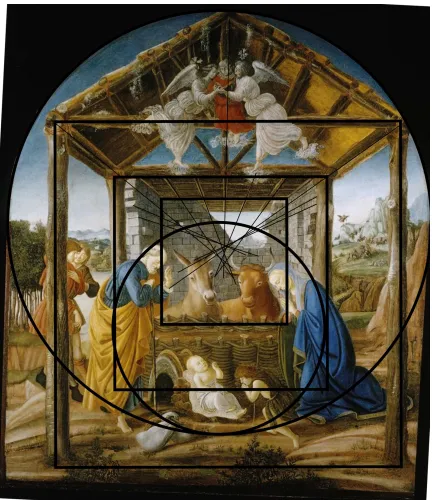
Images, such as the Columbia Museum’s Nativity, not only initiated the processes
of this journey for me personally, but also represents the reasoning for engaging in the
activity of contemplating the painter’s works which provide edifying themes from
religion, mythology, history, or human experience. Contemplation in Neo-Platonism is
the first act of God leading to diversification and the generation of all phenomena in the
Universe. Emulation of this activity in an aspiration to discover truth and divinity is
suggested as the process which initiates the aesthetic experiences that are intended to
edify us.
Contemplation is understood to arouse a response, or emotion a patheia such as
adoration, devotion, or some form of motivational power, which may lead to the
1475-1476), shows the evocative power of devotion, reminding us that beauty may be
deeply felt as well as seen.
The arousal of emotion by a stimulus produces an Influxus or “influence” upon
the spectator, highlighting the capacity of the sentient precipitant to be affected by input,
particularly of emotion, and as a subsequent demonstration of the taking in of new
information, which transforms the thinking subject. The powerful arousal of emotion
engenders an internal action, and the Washington Nativity & Adoration (c. 1478-1482) is
included as a representation of the idea of the influxus of energeia; the internal action
which represents inner power capable of eliciting action, and the inner force which may
transform us for better or worse.
Actions, such as the creative generation of works of art align with the concept of
genesis, and this form of creativity is not merely the power to generate material things,
but is the generative power of ideas and of concept dissemination. In this regard, the
image of The Primavera (c. 1483-1486) is discussed as an image of generative power, an
aspect of the power the soul’s capacity for Love and the fecundity not merely of the
material generation of things but also for the sharing of spiritus, life-force and the
generation of ideas, of complexity, and of emanationist increase outward from some
source.
Excellence in action is one of the attributes of Virtue and the power of integrity,
Centaur (c. 1482) as the embodiment of Arete- the power of virtue and the force of
phronesis, that power of wisdom in action which is goodness an emulative act of
aspiration toward God and Beauty.
The brute physical power or dynamis/ kinesis; consideration of our ability to move
and affect the material world, is implied in Botticelli’s Mars and Venus (c. 1483),
however–consideration of the power of physical force and the capacity of the
motivational power of love/eros to mitigate and arrest physicality is an implication
conveyed by the representation of sleeping Mars with vigilant Venus; mere physical force
overcome by Love
Finally, our capacity to perceive Beauty, to inform the mind by sense perception,
the capacity of making judgments, of Aestheis is celebrated by the image of the Birth of
Venus, an allusion to the soul’s capacity to perceive phenomena and process judgments
informing an internalized reality : The Birth of Venus (c. 1483-1486); an homage to
consciousness, per se, to perception, proception, and reception and all activities of
judgment signals the final stage of the journey through which we recognize the processes
of internal change, culminating the study with the donation of Humanity to humanity
citing the parallel sacrifices of Ouranos, god of the sky (space), and the Christ, both of
whom experience tragedy for the benefit of human kind. The study intentionally uses an
homage to Pythagorean and Platonic conventions of number; the Introduction is
chapters; the intention is to propitiate the heavenly forces by using numbers symbolizing
perfection.
Meaning, in this study, is constituted as a multivalent contextual, and even
opportunistic construct: The images do not necessarily “mean” for their perceivers in
univocal, fully coherent ways, but sustain their roles as catalytic devices for thought.
Indeed, the information consulted as part of the research for this project confirms that
even as modern viewers, we are in the continuing process of socially constructing
meanings for these objects that have been preserved for over 500 years. We continue to
cogitate over the connotative and denotative significations of these images as as did the
original viewers at the time they were created. This use of the image as a form of
oikonomic conversational implicature, based in a networked, socially constructed matrix
of meaning(s) generated in the act of functioning is an important part of the role of art as
it may be understood here.
Ficino’s own soteriological, eschatological (i.e., in the case of Ficino, the
juxtapositioning of Saturn and Jupiter of 1484, which astronomical event set the stage for
Renaissance transformations creating the ambient in which the possibility of producing
something new occurred) and hierophantic esoteric principles – provided guidance to the
new divinity claims of continuity. The subsequent meaning of “meaning” discourse based
in a method stemming from understanding a living universe, the source of Warburg’s
“bewegtes Beiwerk” or “animated details” within Botticelli’s images, which may have
engagement of the spectator’s awareness, is understood here as a purposive social
function of art images.3
I apologize to my readers for the inadequacies of this study as it stands, yet it is
best to allow my critics and detractors access the ideas offered here in order to gain acces
to those ideas which may improve the quality of this endeavor by adding their voices to
this discussion as an important component of the socially-motivated construction of
meaning this research is intended to both articulate and celebrate. I have achieved what I
could with the limited resources currently at my disposal. Admittedly, I have had some
unavoidable constraints of time and resources. I sincerely regret these shortcomings but
am unable to mitigate their effects at this time.
I am deeply grateful to the members of my committee for their support. I also
wish to thank the Philosophy program at The University of South Carolina for what, at
times, has been the pro-active defense of my very being through many challenges at
various stages of my study. I would like to acknowledge also the former African
3 The foundational study by Abraham (Aby) Moritz Warburg, Sandro Botticells “Geburt der
American Professors’ Program, now the Grace McFadden Doctoral Scholars’ Program at
The University of South Carolina, for their exceptional support and guidance in helping
me to navigate a maelstrom of potential difficulties. Both have contributed to my study in
very tangible ways, including a trip to Florence in 2012 to view the Uffizi Adoration and
the three mythological paintings, and in addition support for a visit to England in 2014 to
present at the conference of the Arts in Society and see the Mars and Venus in the
National Gallery in London. I am also very grateful to every member of the dissertation
committee for the continued commitment to a complicated, extended project, and I must
single out for special praise, Dr. Jeremiah Hackett, a tireless resource of infinite and
indefatigable knowledge, the close reading and absolute dedication of Dr. William
Eiland, whose suggestions were invaluable, the rich intellectual interrogations of Dr.
Martin Donougho, and the supportive optimism of both Dr. Jerald Wallulis and Dr. Ann
Bezuidenhout, who has served as my mentor, and logistical expert for much of this
project.
In an paraphrase of Aristotle’s concept of phronesis, true wisdom would be a
capacity to offer the right thing in the right way to the right person at the right time;
certainly, I have not achieved this aim, but I continue, inspired by my mentors,
conscientiously, to work toward it.
FM
August 16th 2018
TABLE OF CONTENTS
DEDICATION………...iii
ACKNOWLEDGEMENTS………..………..….…..iv
ABSTRACT………..………..……….…...v
PREFACE ………..………..……….vi
LIST OF FIGURES…………...………..………..………..xvii
INTRODUCTION………..………..………….……..1
CHAPTER I ~ The Columbia Nativity ………..……….... 127
CHAPTER II ~ The Uffizi Adoration of the Magi………. 156
CHAPTER III ~ The Washington Adoration of the Magi……….……….…… 180
CHAPTER IV ~ The Primavera ……….…..……..206
CHAPTER V ~ Camilla/Pallas/Minerva and the Centaur……….….250
CHAPTER VI ~ Mars and Venus……….……….. 268
CHAPTER VII ~ The Birth of Venus……….……… .283
SUMMARY & CONCLUSIONS ……….…. 303
BIBLIOGRAPHY……….……….. 308
APPENDIX A: LETTER OF MARSILIO FICINO TO LORENZO DI
PIERFRANCESCO DE’MEDICI………315
APPENDIX B: LETTER OF MARSILIO FICINO TO GIORGIO ANTONIO
VESPUCCI...317
APPENDIX C: LETTER OF LORENZO PIERFRANCESO DE’ MEDICI TO
APPENDIX D: THE LETTERS OF MARSILIO FICINO TO
IACOPO BRACCIOLINI...320
LIST OF FIGURES
Figure 1.1 The Columbia Nativity, c. 1473-1475, dimensions: 64 ½ x 54 inches (161.3 x 137.2 cm)……….146
Figure 1.2 The Columbia Nativity c. 1473-1475The detail :original dimensions: 64 ½ x 54 inches (161.3 x 137.2 cm) The central section of the overall composition, showing two figures in contemporary dress who may symbolize the presentation of the Christ to the Gentiles………..……147
Figure 1.3 Columbia Nativity c. 1473-1475 detail: original dimensions: 64 ½ x 54 inches (161.3 x 137.2 cm) Clouds being trodden upon by angels with
golden radiances………..148
Figure 1.4 The Columbia Nativity c. 1473-1475 detail: original dimensions: 64 ½ x 54 inches (161.3 x 137.2 cm) image of the base of the clouds with golden radiances and the descent of the golden radiance toward the Infant Christ; the head of St. Joseph, with partial images of the Ass, Ox, and The Virgin Mary…………..……….149
Figure 1.5 The Columbia Nativity c. 1473-1475detail: original dimensions: 64 ½ x 54 inches (161.3 x 137.2 cm) detail showing the descent of golden connective
species………..…150
Figure 1.6 The Columbia Nativity c. 1473-1475detail: original dimensions: 64 ½ x 54 inches (161.3 x 137.2 cm) The Infant Christ in a radiance, with young St. John the Baptist………..……151
Figure 1.7 The Columbia Nativity c. 1473-1475, detail: original dimensions: 64 ½ x 54 inches (161.3 x 137.2 cm) Problematic perspective orthagonals and concentric circular patterns overlapping a series of squares. ……….…152
Figure 1.8 The Columbia Nativity c. 1473-1475, detail: original dimensions: 64 ½ x 54 inches (161.3 x 137.2 cm) (Pentagonal geometric form within the composition…...…153
Figure 1.9 Portrait of Marsilio Ficino by Domenico del Ghirlandaio; detail from a fresco, the Church of Santa Mar Novella, Capella Tornabuoni , 1486-1490………..…154
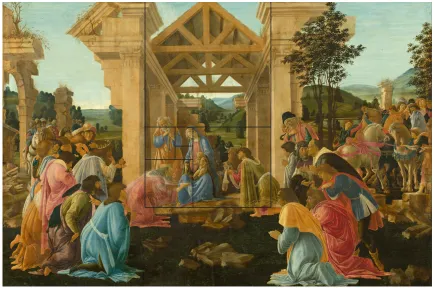
Figure 2.1 The Guaspari del Lama Adoration of the Magi, Galleria degli Uffizi c. 1475-1476, dimensions : 44 x 53 inches (111 x 134 cm)……….172
Figure 2.2 The Guaspari del Lama Adoration of the Magi, Galleria degli Uffizi c. 1475-1476, detail: dimensions : 44 x 53 inches (111 x 134 cm) central composition including Cosimo de’Medici grasping the foot of the Infant Christ, utilizing the humeral veil….173
Figure 2.3 Detail of the Guaspari del Lama Adoration of the Magi, Galleria degli Uffizi c. 1475-1476, detail: dimensions: 44 x 53 inches (111 x 134 cm) 2.3 detail: probable portrait of Sandro Botticelli from the viewer’s right of the original artwork; dimensions: 44 x 53 inches (111 x 134 cm). ……….……….…174
Figure 2.4 The Guaspari del Lama Adoration of the Magi, Galleria degli Uffizi c. 1475-1476, detail: Golden Section composition - dimensions: 44 x 53 inches
(111 x 134 cm) ………...175
Figure 2.5 he Guaspari del Lama Adoration of the Magi, Galleria degli Uffizi c. 1475-1476, detail: dimensions: 44 x 53 inches (111 x 134 cm) eliptical formation of compositional group. ………..… 176
Figure 2.6 The Guaspari del Lama Adoration of the Magi, Galleria degli Uffizi c. 1475-1476detail: dimensions: 44 x 53 inches (111 x 134 cm) compositional pyramid within concentric squares………...…177
Figure 2.7 The Guaspari del Lama Adoration of the Magi, Galleria degli Uffizi c. 1475-1476, detail: dimensions: 44 x 53 inches (111 x 134 cm) intersecting sight lines and triangular forms, within the compositional focus area. ………..178
Figure 2.8 he Guaspari del Lama Adoration of the Magi, Galleria degli Uffizi c. 1475-1476, detail: dimensions: 44 x 53 inches (111 x 134 cm) : equilateral triangular compositional element within the square. ………..……179
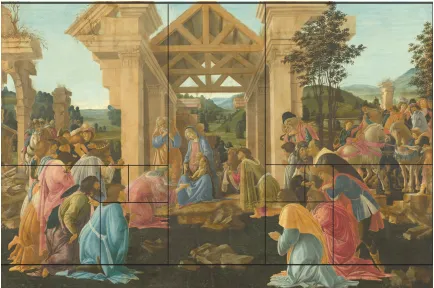
Figure 3.1 The Adoration of the Magi, Washington, D.C., c. 1478-1482, dimensions: 26 ¾ x 40 3/16 inches ( 68 x 102 cm). ………..………198
Figure 3.2 The Adoration of the Magi, Washington, D.C., c. 1478-1482, dimensions: 26 ¾ x 40 3/16 inches ( 68 x 102 cm) repeat of the elliptical composition…………..….199
Figure 3.3 The Adoration of the Magi, Washington, D.C. , c. 1478-1482, original
dimensions: 26 ¾ x 40 3/16 inches ( 68 x 102 cm) repeat of the elliptical composition – detail. ……….…………. 200
Figure 3.5 The Adoration of the Magi, Washington, D.C. c. 1478-1482, original dimensions: 26 ¾ x 40 3/16 inches ( 68 x 102 cm) central Golden Section
compositional detail………202
Figure 3.6 The Adoration of the Magi, Washington, D.C. c. 1478-1482, original dimensions: 26 ¾ x 40 3/16 inches ( 68 x 102 cm) lateral replications of the Golden Section within the composition – detail. ……….203
Figure 3.7 The Adoration of the Magi, Washington, D.C. c. 1478-1482, original dimensions: 26 ¾ x 40 3/16 inches ( 68 x 102 cm) compositional detail of rearing and docile horses; An interesting visual allusion to the character of the Dioscuri, Castor and Pollux. ……….………204
Figure 3.8 Leonardo da Vinci, Adoration of the Magi, Galleria degli Uffizi, (c. 1481) This composition may have influenced the Washington image……….……..…...205
Figure 4.1 La Primavera Galleria degli Uffizi c. 1482, dimensions: 80 x 124 inches (202 x 314 cm) ………..…..…243
Figure 4.2 La Primavera Galleria degli Uffizi c. 1482: dimensions: 80 x 124 inches (202 x 314 cm) From right to left: Zephyr, Chloris, Flora…an example of the primum in aliquo genere. ………244
Figure 4.3 La Primavera Galleria degli Uffizi c. 1482, dimensions: 80 x 124 inches (202 x 3. 14 cm) ; detail of central, triangular composition. ………...…245
Figure 4.4 La Primavera Galleria degli Uffizi c. 1482, dimensions: 80 x 124 inches (202 x 314 cm) ; use of the Golden Section………..………...……246
Figure 4.5 La Primavera Galleria degli Uffizi c. 1482, dimensions: 80 x 124 inches (202 x 314 cm): inversion of use of the Golden Section. ……….………...247
Figure 4.6 La Primavera Galleria degli Uffizi c. 1482, dimensions: 80 x 124 inches (202 x 314 cm) ; lateral replications of the Golden Section………248
Figure 4.7 La Primavera Galleria degli Uffizi c. 1482, dimensions: 80 x 124 inches (202 x 314 cm) Image of compositional geometry copied from Umberto Baldini, Primavera: The Restoration of Botticelli’s Masterpiece, pp. 98 & 99. ……….…………249
Figure 5.1 Pallas/Athena/ Camilla and the Centaur, c. 1482, Galleria degli Uffizi;
dimensions : 80 x 58.1 inches (204 x 147.5 cm) ………..……….…263
Figure 5.3 Pallas/Athena/ Camilla and the Centaur, c. 1482, Galleria degli Uffizi; dimensions : 80 x 58.1 inches (204 x 147.5 cm) foundation for subdivisions within the Golden Section (a symbolic imposition of reason upon chaos) ………..…………265
Figure 5.4 Pallas/Athena/ Camilla and the Centaur c. 1482, Galleria degli Uffizi; dimensions : 80 x 58.1 inches (204 x 147.5 cm) compositional subdivisions within the Golden Section. ………..……….266
Figure 5.5 Pallas/Athena/ Camilla and the Centaur c. 1482, Galleria degli Uffizi; dimensions : 80 x 58.1 inches (204 x 147.5 cm) compositional subdivisions within the Golden Section. ………..…….267
Figure 6.1 Mars & Venus c. 1483, National Gallery, London, dimensions: 2ft 3 inches x 5ft 8 inches (69 x 173cm) ………...………277
Figure 6.2 Mars & Venus c. 1483, National Gallery, London; dimensions: 2ft 3 inches x 5ft 8 inches (69 x 173cm); detail of Mars asleep; playful satyrs and wasps above the head of sleeping Mars. ……….278
Figure 6.3 Mars & Venus c. 1483, National Gallery, London; dimensions: 2ft 3 inches x 5ft 8 inches (69 x 173cm) ; overlapping examples of the Golden Section……….…….279
Figure 6.4 Mars & Venus c. 1483, National Gallery, London; dimensions: 2ft 3 inches x 5ft 8 inches (69 x 173cm) ; compositional design with overlapping examples of the Golden Section without figures. ………280
Figure 6.5 Mars & Venus c. 1483, National Gallery, London; dimensions: 2ft 3 inches x 5ft 8 inches (69 x 173cm); compositional design with mirrored vertical inclusions of the Golden Section with figures. ……….……….281
Figure 6.6 Image of a Roman sarcophagus, Second Century AD, showing the reclining Venus and Mars with Putti (taken from E. H. Gombrich, fig. 47). ………282
Figure 7.1 . The Birth of Venus, c. 1484-1486, Galleria degli Uffizi, Florence;
dimensions: 67.9 x 109.6 inches ( 172.5 x 278.9 cm) ………294
Figure 7.2 Lorenzo Ghiberti, Baptism of Christ, Florence Cathedral, Baptistery of San Giovanni, North Doors 1404-1424……….……….…295
Figure 7.3 Figure 7.2 Lorenzo Ghiberti, Baptism of Christ , Baptismal Font,
Siena, 1427.……….….…296
Figure 7.4 The Birth of Venus, c. 1484-1486, Galleria degli Uffizi, Florence; dimensions: 67.9 x 109.6 inches ( 172.5 x 278.9 cm); equilateral triangular composition bracketed by two scalene triangular shapes and with the central triangle subdivided
Figure 7.5 The Birth of Venus, c. 1484-1486, Galleria degli Uffizi, Florence; dimensions: 67.9 x 109.6 inches ( 172.5 x 278.9 cm); composition showing mirrored images of the Golden Section flanking the figure of Venus/Aphrodite. ………..…………298
Figure 7.6 The Birth of Venus, c. 1484-1486
Galleria degli Uffizi, Florence; dimensions: 67.9 x 109.6 inches ( 172.5 x 278.9 cm); multiple reflected iterations of the Golden Section, with overlapping examples anchoring the composition of the figure of Venus/Aphrodite. ………299
Figure 7.7 The Birth of Venus, c. 1484-1486
Galleria degli Uffizi, Florence; dimensions: 67.9 x 109.6 inches ( 172.5 x 278.9 cm); multiple reflected iterations of the Golden Section, with overlapping ascending spiral archs extending from the figure of the Hora, toward Venus/Aphrodite, and Zephyrus with Chloris. ………..……….………300
Figure 7.8 The Birth of Venus, c. 1484-1486
Galleria degli Uffizi, Florence; dimensions: 67.9 x 109.6 inches ( 172.5 x 278.9 cm); use of the Golden Section, with spiral arch extending from the figure of the Hora, toward Venus/Aphrodite, and Zephyrus with Chloris engulfing the entire composition, observed from viewers’ right to left. ……….…….301
Figure 7.9 The Birth of Venus, c. 1484-1486;
INTRODUCTION:
I. Statement of Purpose
Platonic theology forms the foundation of the philosophy of Marsilio Ficino and
constitutes the basis of this inquiry into conceptual and interpretive intentions stemming
from seven images attributed to noted Renaissance artist, Sandro Botticelli.4 The
discussion presented here supports the thesis that Ficino’s complex interpolation of the
Platonic and Neo-Platonic views of God, beauty, Love, and his apologia for a hierarchical
explanation of the nature of “being,” explains both formal and theoretical aspects of the
design and configuration of figures in several of Botticelli’s works. The evolution of
Ficino’s ideas and the increasing complexity of Botticelli’s iconography incorporate
meaningful insights into a theory for a simultaneous, corresponding aesthetic
development between the writings of the philosopher, and the images of the painter. The
earliest painting cited here is a Nativity from the Kress Collection of ca. 1475, acquired
by the Columbia Museum of Art in 1954, and the last work in the group under
4 The research for this study was precipitated in 2009-2010, by an examination of the
consideration is, The Birth of Venus of c. 1486 in the collection of the Galleria degli
Uffizi, in Florence.5
Ficino’s ties to Platonic thought and his influence upon Botticelli’s conceptual
process as the artist works through the content and context of his images, is discussed in
consideration of the different levels of signification the paintings may entail. This
assessment will include some consideration of how the concepts of the powers of
perception and their relationship to what Ficino described as the purpose of the human
soul, extends from the Columbia Nativity (as an exemplification of Platonic and
Neo-Platonic ideas) to the philosophically complex iconographic and iconological references
of the Birth of Venus, one of Botticelli’s most recognized works.
Ficino’s Neo-Platonist conceptualizations revolutionized philosophical praxis in
the 15th and 16th centuries. His assessments of differing aspects of power (spiritual,
5 See the website of the Columbia Museum of Art for further details. The Nativity is dated c.
1473-1475; fresco transferred to canvas; Gift of Samuel H. Kress Foundation; CMA 1954.29. The following narrative is taken from the Columbia Museum site: “This delicate painting was painted by the master, Botticelli, and is filled with the charm of Renaissance Florentine art. Painted as a fresco, it was detached early in the 20th century and mounted on a canvas support. It is one of the artist's early works and is considered a very important piece because of its aesthetic value as well as its historical significance in regard to the development of the style of the master. It shows the influence of two artists -“ Fra Filippo Lippi (1406-1469), a teacher of Botticelli and Lippi's son Filippino (1457/8-1504), one of Botticelli's students.” For additional information , see
material, and conceptual) as represented in the selected religious and secular works by
Alessandro di Mariano di Vanni Filipepi, better known as Sandro Botticelli, will be
evaluated. The selected examples of Botticelli’s paintings serve to symbolize, exemplify,
represent, and demonstrate Ficino’s ideas, and are intended to advocate for an innovative,
syncretic conceptual unity of ancient, Greco-Roman, and Christian philosophical and
theological traditions. Analysis of Ficino’s ideas pertaining to varying iterations of
powers of the soul, intended to be understood within the context of Ficino’s theoretical
system of metaphysical functioning, alluded to or represented in the selected works of art,
is undertaken. This analysis, in the interest of understanding whether these works of art
may have been intended to externalize into visible form, an explanation for the activity of
unique individual souls, which through contemplation of art images, would generate
activity within the percipient souls aligned with the true aims of philosophy and religion.6
Platonic theology synthesized with Christian dogma infuses Ficino’s aesthetics
and offers interpretive insights for Botticelli’s works.7 Ideas based in Platonic thought,
6 Of particular interest is the idea that Ficino may have been advocating a theory of how
individuals could be influenced by material images based upon a naturalistic, and intuitive explanation, relying solely on nature for understanding the possibility of how material images may affect transformations within a soul through the transmission of simulacra, obviating the need for explanations of transformation due to supernatural, or daemonic interventions. More on this idea is discussed below in the sections on Ficino’s metaphysical ideas, particularly the residual influences of Lucretius and Epicurean atomisic materialism on the formation of Ficino’s ideas from the Platonic Theology. For more on Ficino’s ideas pertaining to an explanation of influences on the soul, see Mary Quinlan-McGrath Influences: Art, Optics, and Astrology in the Italian Renaissance, The University of Chicago Press, Chicago and London, 2013, see also James G. Snyder, “Marsilio Ficino’s Critique of the Lucretian Alternative,” Journal of the History of Ideas, The University of Pennsylvania Press, Vol. 72, No. 2, April 2011, pp. 165-181.
7 For instance, in the compositional structure of the first image, the Columbia Nativity of 1473-75,
and stemming, in part, from the influences of Plato’s principal early interpreters, the
philosopher Plotinus and his followers, will be discussed as supporting the modes of
representation employed by Botticelli which were created under the powerful intellectual
and creative influence of Ficino’s philosophical interpretations and discussions of
Platonic and Neo-Platonic systems for assessing the nature of reality.
Botticelli’s images are discussed as visual realizations and demonstrations of
Ficino’s intention to offer a coherent integration of Neo-Platonic theology, with
traditional, Christian symbolism. Ficino’s interpretations of Platonic concepts and the
influence of his ideas on Botticelli’s works, specifically discussion of how the selected art
images exemplify Platonic and neo-Platonic ideas, are employed to discuss the
importance of these images for their roles as active rather than passive agents working in
the interest of the dissemination of Platonic, and Neo-Platonic philosophical ideas.
Marsilio Ficino (October 19, 1433 - October 1, 1499) was the son of a physician
from the region of Val d’Arno, in Tuscany.8 Considered perhaps the most significant
Florentine humanist of the 15th century, in combination with Giovanni Pico della
Mirandola and Angelo Poliziano, Ficino remains one of the originators of a
comprehensive system of Renaissance thought transforming the philosophy of the
Cinquecento and Seicento and creating the basis for later thinkers such as Giordano
Bruno and others.9
8 See The Letters of Marsilio Ficino: Translated from the Latin by Members of the Language
Department of the School of Economic Science, London, preface by Oskar Kristeller, Shepheard-Walwyn, London, Vol. I, 1975, page 21, which notes the name of Ficino’s father as Diotifeci, who was doctor to Cosimo de’Medici, and the authors suggest that Ficino’s mother, Alessandra, was clairvoyant.
9 For some discussion of the extent of Ficino’s influence upon contemporary and later humanists,
After having studied the texts of Galen, Hippocrates, Aristotle, Averroes, and
Avicenna, Ficino came under the protection of Cosimo di Medici, Il Vecchio, noted by
the philosopher as his “second father,” and it was Cosimo who designated the task to his
protégé, the young Ficino, to bring the Platonic tradition to Florence.10 In conjunction
with this mission to bring or to return to the importance of Platonic ideas over a
thirty-year period, Ficino added translation of the Corpus Hermeticum, the writings of Hermes
Trismegistus, Plotinus’ Enneads and various Neo-Platonic texts.11
10 The early history of Cosimo’s patronage is noted by Ficino’s first biographer, Giovanni Corsi
in The Life of Marsilio Ficino written in 1506, translated by members of the Language Department of the School of Economic Science, London, in The Letters of Marsilio Ficino Vol. III, 1981, Fellowship of the School of Economic Science London, available on line @ http://easyweb.easynet.co.uk/~orpheus/corsi.htm. (accessed July 25, 2014) Paul Oskar Kristeller in his work on The Philosophy of Marsilio Ficino and Michael J.B. Allen in his Introduction to Marsilio Ficino: The Philebus Commentary, University of California Press, 1975 pp. 1-58, offer detailed, helpful accounts of the early history of Cosimo’s donations of texts to Ficino. See also, Stephane Toussaint, who notes that Ficino was instrumental in advancing Platonic ideas that had earlier been initiated by Leonardo Bruni, Traversari, and the Byzantine philosophers Bessarion and Plethon from the period of the Concilio (a conference centered upon reconciling the Eastern Greek Orthodox Church and the Church of Rome) until 1439. Toussaint notes “…aver studiato sui testi di Galieno, Ippocrate, Aristotele, Averroè ed Avicenna, Ficino fu scelto da Cosimo de' Medici il Vecchio (chiamato da lui stesso «secondo padre») per riportare a Firenze la tradizione platonica, già reintrodotta da Leonardo Bruni, dal Traversari e dai bizantini Bessarione e Pletone fin dai tempi del Concilio del 1439.” The references are to Leonardo Bruni (1370-1444), Ambrogio Traversari (1386-1439), Basilios Bessarion (1403-1472), Gemisthos Plethon also known as Georgius Gemistus (1355-@1452/54) See also, D. F. Lackner, "'The Camaldolese Academy: Ambrogio Traversari, Marsilio Ficino & the Christian Platonic Tradition'" in Marsilio Ficino: His Theology, His Philosophy, His Legacy, ed. Michael J.B. Allen & Valery Rees, with Martin Davies, Brill, Leiden, 2001, pp. 14-44, available on line (accessed July 25, 2014) @: http://books.google.com/books?id=CX06dsbZ_ .
11 See Michael Allen, Marsilio Ficino: The Philebus Commentary, University of California Press,
After the death of Ficino’s principal patron, Cosimo de’Medici, Il Vecchio, who
was designated as pater patriae by the Florentines, his son Piero and then later his
grandson, Lorenzo, Il Magnifico sustained the translation efforts of Ficino’s works.12
Between 1474 and 1497 Ficino translated into Latin, the Greek texts of Plotinus, Proclus,
Porphyry, Iamblichus, and Pseudo-Dionysios.13 Ficino’s works were understandably
destined to revolutionize Western culture which had become estranged from the original
Platonic texts and their ideas, as well as introducing Neo-Platonic interpretations of
Plotinus, Proclus and above all, reviving the interest in Platonic theories in the wake of
the powerful influence of Aristotle.14
12 The ongoing Medici support of Ficino’s translation project is discussed in Paul Michael Allen,
Philebus Commentary, pp. 1-58; see also Toussaint, who notes “Dopo la morte di Cosimo, furono Piero, suo figlio, e poi Lorenzo il Magnifico a sostenere l'opera di traduttore e di pensatore del Ficino.” Cosimo was referred to as the “father of the Florentine Republic” or pater patriae and as Il Vecchio to distinguish him from his 16th-century descendant, Cosimo I, First Grand
Duke of Tuscany. See “Cosimo de’Medici,” Encyclopædia Britannica online, accessed 8-9-2018, https://www.britannica.com/biography/Cosimo-de-Medici.
13 See Giovanni Corsi, The Life of Marsilio Ficino (c.1506), translated by members of the
Language Department of the School of Economic Science, London, in The Letters of Marsilio Ficino, volume 3, © 1981 Fellowship of the School of Economic Science, London, text and notes to the text 1-60; See also Michael J. B. Allen, Marsilio Ficino: The Philebus Commentary, University of California Press, Berkeley, 1975; See, Toussaint, “E così, varî incarichi ecclesiastici permisero a Marsilio di dedicarsi interamente tra il 1474 e il 1497 alle traduzioni in latino di Plotino, di Proclo, di Sinesio, di Porfirio, di Giamblico, di Psello e dello Pseudo-Dionigi.”
14 For a discussion of the struggle to establish the proofs for the claim that the human soul does
`It is evident from suggestions in Ficino’s commentaries in the Platonic Theology
and Symposium that his own original thought proposes a vision of humanity with
powerful cosmic and magical affinities in the midst of a providentially directed world,
highly animated with its own proper spiritual ethos.15
A fundamental function of humanist thought is to achieve, via an imaginative
illumination utilizing “spiritus” and “fantasia,” a sense of the rational and intellectual
self-sufficient consciousness of one’s own immortality and to acknowledge human grace
using signs and symbols of the soul’s celestial origin. The aggregate human experience in
notes the acceptance of the contributions of Aristotle particularly in the period of the 13th century
by the Scholastics.
15 See Marsilio Ficino, Platonic Theology, translated by Michael J. B. Allen with John Warden,
its combination of artistic, technical, philosophical and religious elements of existence
expresses at its depth the divine presence of an infinite, universal mind motivated by a
cyclical vision of history based in the grand Platonic myth of reincarnation and rebirth
which humanists intended to harmonize with the Christian view of resurrection and
renewal.16
An important aspect of Ficino’s significance is the transformation in emphasis
from Aristotelian-based scholasticism to a more intuitive, humanist Platonism his
aesthetic and intellectual innovations generated, which permeated the late-Medieval
Italian and European sensibility. Eco has written convincingly on the differences between
ancient, classical aesthetic concentration upon the natural world as contrasted with
Medieval adherence to and inspiration from the classical tradition per se rather than its
sources in nature.17 Ficino’s concern for the importance of intelligible beauty combined
with a true appreciation for sensible beauty, is an innovation to the medieval
16 Intimations of the complexity of this resurrection of the prisci theologi are considered in many
texts; a particularly interesting summary is given by Frances Yates in Giordano Bruno and the Hermetic Tradition, pp. 76-79 where she notes Ficino’s devotion to Orphic magic, based in an understanding of Orpheus as a priscus magus antecedent to Plato whose melodic hymns incorporated the celestial music of the heavenly spheres cited by Pythagoras. By participating in the methods of these ancient theologians, including figures like Hermes Trismegistus, Ficino’s idea was to return to the practices that anticipated and predicted the coming of the Chrisitian Holy Trinity. Aspects of this idea were grounded in some historical errors pertaining to the historicity and chronology of the figures venerated within the Ficinian system. The goal was to utilize the magic of the spiritus mundi which infused with life everything on earth, since every element of the Universe was en-souled, to group natural forces in order to produce beneficial effects. Yates, pp. 72-73 notes that Ficino considered the cross a talismanic device with foundations in the magical evocations of the ancient Egyptians who used a form of the cross on Serapis, thus offering a kind of prophetic anticipation of the coming of Christ, since the cross symbolized future life. Talismans were considered a standard part of medical practice in Ficino’s time, as was the appropriate use of astrology. See also Toussainte, op. cit., ibid.
17 See Umberto Eco, Art and Beauty in the Middle Ages, translated by Hugh Bredin, Yale
preoccupation with internal experience which signals a new understanding of how the
ancient, pagan material and natural considerations of beauty could be philosophically
applicable for reinterpreted, spiritual, immaterialist neo-Platonic/Christian synthesis of
disparate traditions into what gave every appearance of being an harmonious unity of
vision.18 Ficino appears to have had a mistaken interpretation of the works of Averroes,
whose ideas he may have primarily encounterd mediated through the writings of Thomas
Aquinas; it was Ficino’s personal mission to move beyond the Medieval and scholastic
preoccupation with Aristotelianism and to shift humanist concerns to Plotinian-inspired
interpretations of Platonic, hierarchical, transcendent conceptions of “the beautiful,”
which retained the didactic preoccupations of medieval sensibilities, but reconsidered the
rejection of ornament and artifice, subordinating these devices in a structured universal
order, and placing sensual beauty in the service of divine purposes by elevating the
aspirations of the human soul.19
18 Ibid, 1986, pp. 4-16; See Eco’s essay, “The Medieval Aesthetic Sensibility” in Art and Beauty
in the Middle Ages, which cites the concentration, during the Medieval era, upon internal conceptions of the beautiful privileged over sensual, representations of beauty. Eco makes the important distinction that the Scholastics and Medieval scholars, citing passages from St. Bernard in particular, showing that the Medievals were powerfully susceptible to sensual beauty, but the demands of their asceticism often precipitated its rejection in order to avoid the confusions engendered by distractions from devotion provoked by excessive ornament, and material wealth.
19 Much of Ficino’s contra-Aristotelianism takes the form of counter-Averroeism, provided
Ancient thinkers had undertaken the discourse on the relative merits of
philosophy contrasted with visual or the poetic arts in the human search for truth. Plato
suggests differing theories of the role of art in his various dialogues, with the most
famous contrast stemming from the suggestions of a divinely inspired idea in the early
Socratic conversation of the Ion, to the later rejection of the potentially dangerous
(deceptive), mimetic character of art, widely acknowledged in Book X of the Republic.20
Contrasting with these Platonic formulations, the neo-Platonic suggestions advanced by
Plotinus’ emanation theory, imply that we may discern the consequence of a material
contact with the One presented as an extension of the idea of beauty within a form, which
is not itself the beautiful, but is an indication of the presence of the beautiful, referring us
to the origin of beauty within the One.21 That is to say that Plotinus, contrasting with
his perception of a movement away from piety within philosophical tradition; see particularly p. 654..
20 See Edith Hamilton and Huntington Cairns, editors, Plato: The Collected Dialogues –Including
Letters, Bollingen Series LXXI, Princeton University Press, 1989, pp. 215-228, Ion, and Book X of The Republic, pp. 819-834, 595a-608e. The Platonic discussion centers on the potentially harmful character of a deceptive, merely mimetic, illusionism which is a distraction from the intellection of pure abstraction and conceptual Formal truth.
21 Plotinus’ metaphysical structures depend upon an emanationist account of being hierarchies,
Plato’s suggestion of art as a form of deception, instead posits that art is an indexical sign
within a form of the presence of the One, and may thus be understood as an extension of
what is divine.
II. Ficino’s Metaphysics
An introductory assessment of Ficino’s philosophical system, its metaphysics, his
theory of perception and the essentials of his theory of Love, which supports and infuses
the structural, hierarchical relations and metaphysical claims of the philosophical system
as a whole, is crucial to evaluation of the role of art as a means of disseminating
philosophical consciousness within Ficino’s Neo-Platonist interpretation of the concepts
of knowledge, understanding, and awareness. This foundation will then be discussed for
its relationship to the images claimed here, to both reflect and inform Neo-Platonist ideas,
summarizing the roles of those concepts within the telos of the philosophical system’s
goal of the soul’s return to its source. This discussion will be followed by a brief,
concluding statement for the Introduction, prior to investigating the individual pictures
and how each may be categorized for relevance within the Ficinian system. It should be
clear from the complexity of the iconographic and iconological source materials that
Botticelli is by no means to be construed as a mere minion of Ficino’s ideas, a pawn who
undertakes to “illustrate” a text; instead Botticelli is understood as a proceptive
represents to our consciousness now (as he did to the members of the society of his own
time) the extensions and powers of the soul as explained within the hierarchical
metaphysics of Ficino’s philosophical discourse.22
Botticelli was an important presence in Ficino’s Medici-influenced circle and the
increasing complexity, refinement and nuance of Ficino’s ideas, which emerge as his
philosophical system works through and responds to his translations of Plotinus, Hermes
Trismegistus, readings of Augustine and Aquinas and translations of Plato, appears to
find a true correspondence in Botticelli’s works; images that offer a natural, organic, and
a more than merely serendipitous or coincidental conceptual evolution. As Ficino
provides his hermeneutic insights through conversations, lectures, publications, and
letters to the members of his intellectual circle, Botticelli’s works appear to demonstrate a
systematic increase in conceptual complexity, possibly suggesting a response culled from
the likely interactions, discourses on varied topics, and probable exchanges that were a
part of the closely-knit Florentine society in which both the philosopher and the artist
were profoundly engaged. This comparatively small group of friends within which both
individuals communicated, served as a kind of intellectual conservatory. Although it is
likely to be the case that these developments are fully intentional, that is not necessarily
an argument that must be made here, instead, I am suggesting that a form of contextual
22 The use of the term “proceptive” refers, here, to an application of consciousness to the elements
infusion occurs quite naturally as the consequence of an organic, and largely social
process through which the increasingly complex iconographical components of
Botticelli’s images, stemming from his likely discourse with patrons and friends, appear
to evolve within the selected works, which are themselves indeed intentional
representations and embodiments (or rather demonstrations) of certain philosophical
ideas. Although the infusions of philosophical commitments could be accidental or
incidental outgrowths of a process rather than intentionally instrumentalist propaganda,
the point suggested here, is that a simultaneous, corresponding evolution of
philosophical discourse and iconographic complexity is evident.23 The Botticelli works
show representations of particular philosophical commitments, but may also simply be
suffused with ideas derived from the ambient discourse of the social and professional
circles of the artist stemming from the era within which the works selected
(c.1475-c.1486) were actually generated. This period is an important time during the shift from
the early stages of the developing Renaissance of the second half of the 15th century,
toward its ultimate expressions and most noted achievements of the first quarter of the
16th century, and Botticelli may be responding to the impact of the social and cultural
developments of this burgeoning intellectual influxus in large part less by intention of
either philosopher or artist, and possibly more due to the intellectual and social outcomes
of a peculiarly Hegelian form of cultural Zeitgeist.24
23 The suggestion that a parallel development in Ficino’s philosophical complexity corresponds to
the icongraphic and iconological complexity indicate in Botticelli’s images is not one I am aware of having been made elsewhere as a speculative explanatory rationale for how artworks may be understood to function within the Ficino-inspired, Neo-Platonist philosophical systems of the Renaissance.
24 This passage refers to the fecund period particularly between the time Leon Battisa Alberti
It is important to these developments that the reader understand how the Ficinian
system is predicated upon the assumption of a divinely determined, a priori -
“essence-before-existence”, eternal, individual, persistent, immortal soul, derived from God. The
soul has an appetitus naturalis, that is to say, a “natural appetite” to return to its source.
The return to its source is a unique, teleological function of this immortally constituted
soul, and this function is its ultimate goal (the system is thus purposive and teleological,
and we may infer that the soul exists for a reason; that reason being, to return to its
origin). The return to God is therefore also the source of the soul’s ultimate happiness and
the Ficinian system is thus fundamentally eudaimonic. The activities of a soul (directing a
body) thus stem from desires to return to and rest within God. Subsequently, the works of
art would be in the service of this teleological structure.25
In Ficino’s conception of the cosmos, the life force of celestial bodies, which
were not considered inanimate entities, but vital, living forces, as was indeed the earth
itself, could have a powerful interactive effect, one upon the other, and of course these
powerful, en-souled entities could also have an impact upon the life force of things on
earth. 26 Thus, transitively, celestial entities could have an impact upon the lives of
individuals on earth, moved by and infused with spiritus.27 This universe, described by
25 See Marsilio Ficino, Commentary on Plato’s Symposium On Love, (op. cit)., pp. 89-95
pertaining to the spiritual nature of vision, and on page. 90, Jayne translates Chapters 4, 5, and 6, in which Ficino specifies how beauty is perceived as an incorporeally motivated process directed by the presence of light and that the perception of the world is not in the form of bodies but is determined by the light which is infused into the eyes of the perceiver reflected from corporeal bodies. The resultant, incorporeal nature of vision, is what permits the recognition of truth transferred from within the Divine Mind to the rational soul and then to the individual perceiver (depending upon his or her receptivity and soul preparation or power/capacity to receive “truth”. The spiritual role of vision offers a logical association with the importance of art as a means of concept transmission, working in tandem with Ficino’s Metaphysics of imagination, soul, and interactions as were prefaced by St. Augustine. See also David Summers, “Augustine on inspiration and vision,” in Summers’ Chapter 6 pertaining to spiritus, in The Judgment of Sense, 1987, pp. 112-117.
26 See Marsilio Ficino, The Platonic Theology, IV, I , 25, p. 291. (op. cit).
27 Ficino remarks more than once upon the living force of the celestial spheres and of the element
Ficino, suffused with life force, emanating from God, could be interpreted as sending
forth soul energies that could influence being, and consequently, any means through
which this energy might be purposively directed for benefit would be considered a
“good”; that is to say that, as the influences of the celestial bodies radiated downward
toward earth in a graded structure affecting earth and the materials of earth, as well as the
entities of earth composed of body (material entities composed from any earthly
materials), and all were therefore derived from and filled with earth’s God-given life
force. Ficino’s discussion of the structure of reality and role of sense and judgment
pertaining to determining what actually exists and what does not exist, or what is or is
not a simulation of existence (for Ficino), provides clarification for the role of art within
the Ficinian system overall. 28 In accordance with the thinking of Neo-Platonist
metaphysicians, Ficino considered being as a graded, cosmic structure, which descends or
emanates outward from God, growing in material presence as it progresses, or in fact
“descends,” away from its ultimate source within the intelligible realm of divine
thought.29 This graduated concept of being gains in coarseness at it radiates farther and
28 See Frances A. Yates, Giordano Bruno and the Hermetic Tradition, University of Chicago
Press, Chicago, 1964, rprt. 1991, pp. 62-83 for a more extended discussion of the vital forces of the planetary bodies and stars upon the earth and the role of these influences upon Ficino’s theory of natural magic, which he tried to concord with Thomas Aquinas regarding the potentially beneficial effectiveness of talismans, used at the time for medicinal purposes, as being based upon the powers of the natural elements connected to the God-given forces of the earth and natural influences rather than relying on the efficacy of images per se or daemonic effects.
29 Ficino’s ideas pertaining to the cosmic structure are explained in the eighteen books of the
farther outward from God in a complex interaction of hierarchical levels of the
transformation from the abstraction and immateriality of an intelligibility that slowly
grades into perceptibility and material presence. In the Third Book of the Theologia
Platonica, Ficino draws an analogy between the planets and the hierarchy of being as
well as offering an argument by analogy showing the relations between the various
elements and the levels of being. 30 In the opening section of the First Book, and repeated
important innovations to the ancient triadic hypostases as discussed in Allen’s article, “Ficino’s Theory of the Five Substances and the Neoplatonists,” Journal of Medieval and Renaissance Studies, 12, 1982, pp. 19-44. Plotinus’ tripartite structure was dominated by the One, followed by Intellect, and finally Soul. Proclus expounds upon a nuanced relationship among these components of being, distinguishing between intelligible Being, what is being perceived by intellect, and intellective being, equated with Being, Life, and Intellect. For further discussion see also Lloyd, Gerson, "Plotinus", The Stanford Encyclopedia of Philosophy (Summer 2014 Edition), Edward N. Zalta (ed.)http://plato.stanford.edu/entries/plotinus/. Accessed July 24, 2014; and Christoph Helmig and Carlos Steel, "Proclus", The Stanford Encyclopedia of Philosophy (Summer 2012 Edition), Edward N. Zalta (ed.) http://plato.stanford.edu/entries/proclus/. Accessed July 24, 2014.
30 See Marsilio Ficino, Platonic Theology, English translation by Michael J. B. Allen with John
Warden, Latin text edited by James Hankins with William Bowen, The I Tatti Renaissance Library, Harvard University Press, Cambridge, MA, Vol. I, Books I-IV, 2001, pp. 212-247. Ficino’s opening statement in Book III offers a Latin text which reads:
Descensus per quinque gradus fit, per quos est factus ascensus. Qui gradus invicem congrue comparantur. Ascendimus hactenus a corpore in qualitatem, ab hac in animam, ab anima in angelum, ab eo in deum unum, verum et bonum, auctorem omnium atque rectorem. Corpus appellant Pythagorici multa, qualitatem multa et unum, animam unum et multa, angelum unum multa deum denique unum.
Allen’s translation reads:
“We descend through the five levels by which we ascended and set up an appropriate comparison between them. So far we have made our ascent from body to quality, from quality to soul, from soul to angel, and from angel to God, the one, the true and the good, author and ruler of all things. The Pythagoreans describe body as “the many,” quality as “ the many and the one,” soul as “the one and the many,” angel as “the one-many,” and God as “the one.””
in the Third Book, the five categories of being are listed, essentially moving backward
from the confines of our earthly experience as bodies, ascending upward toward God.
The five components in reverse are body, quality, soul, angel, and then the source of all,
God. All existing reality in Ficino’s system is understood as some aspect of expression
within this cosmic structure. In this system, formal abstraction is the most authentic mode
of reality, and is coequal to the presence of God. Material existence is a kind of
“reflected” even secondary form of being and is represented as a form of degradation
from the perfect abstraction and conceptual being of intelligibles. Ficino’s concern with
form and matter, that is to say, with a concept of the persistence of conceptual reality and
intelligibility, may derive from and be informed by his rejection of Epicurean and
Lucretian materialism, ideas he entertained as a young philosopher, an approach to reality
which challenged the possibility of mankind possessing an autonomous, eternal human
soul. 31 Kristeller notes that the influence of Lucretius remains present in Ficino’s
philosophical ideas throughout his career.32 This presence takes both a negative and an
affirmative form, in that Ficino valued friendships, simple pleasures, and quiet activities
very much in the Epicurean vein (Epicurus providing a kind of anticipation of Christian
concepts of “fellowship” perhaps?), but Ficino’s overall philosophical project, as stated
quite clearly in Book I, Chapter I, paragraph II is to “show clearly how best the minds of
communicating between the divine and the material realms serves in a connective capacity as does the element, air between fire (abstraction and volatility) and water.
31 For a compelling discussion of the influence and importance of Lucretius for Ficino’s
metaphysical commitments, see James G. Snyder, “ Marsilio Ficino’s Critique of the Lucretian Alternative,” Journal of the History of Ideas, University of Pennsylvania Press, vol. 72, No. 2, April, 2011, pp. 165-181. Accessed online, June 12, 2014.
32 See Paul Oskar Kristeller, Eight Philosophers of the Italian Renaissance, Stanford University