Frame Definition
Departure time Departure time of a train Return departure time Departure time of the return Arrival time Arrival time of a train Return arrival time Arrival time of the return
Fare Cost of the trip
Origin Departure town or station Destination Arrival town or station Trip time How long the trip takes
Stop at Stations or towns where the train stops during the trip Departure day Date of departure
Arrival day Date of arrival
Train type Type of train used on the trip Trip type One-way or round trip Service Class of the seat, services
Table 1: Frames definition for the Basurde task
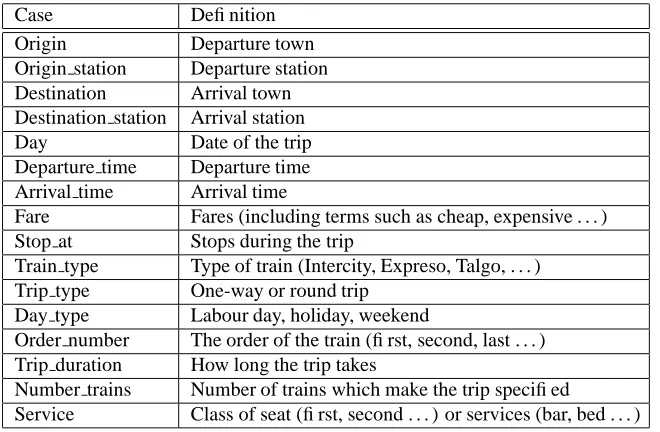
Case Definition
Origin Departure town
Origin station Departure station Destination Arrival town Destination station Arrival station
Day Date of the trip
Departure time Departure time Arrival time Arrival time
Fare Fares (including terms such as cheap, expensive . . . ) Stop at Stops during the trip
Train type Type of train (Intercity, Expreso, Talgo, . . . ) Trip type One-way or round trip
Day type Labour day, holiday, weekend
Order number The order of the train (first, second, last . . . ) Trip duration How long the trip takes
Number trains Number of trains which make the trip specified
Service Class of seat (first, second . . . ) or services (bar, bed . . . )
Table 2: Cases definition for the Basurde task
between clearly confirmed or rejected data and new data.
8. For user questions which do not have a clear objetive frame, a default frame is defined (in our case, Depar-ture time). This is an arbitrary decision based on the analysis of the dialogues of the task.
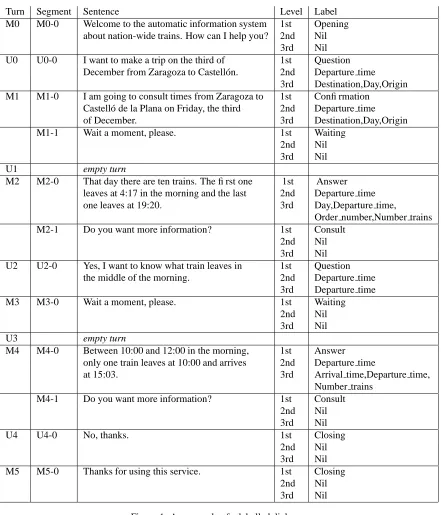
An example of a labelled dialogue1is presented in
Fig-ure 1.
4.
Applying the Labelling to Obtain
Stochastic Models
In this section, we explain some of the applications of the labelling. These applications are directed towards ob-taining stochastic models which are used in several tasks in the field of dialogue systems: automatic labelling, synthetic dialogue generation and dialogue modelling.
1
The original dialogue was in Spanish.
4.1. Automatic Dialogue Labelling
Manual dialogue annotation is a hard task which takes a long time and is sometimes very complex. Therefore, a tool which can automatically annotate the dialogues it would be very useful. This annotation tool should take a dialogue and return the same dialogue with its corresponding dialogue acts assigned for each turn.
This process can be seen as a transduction process: given a sequence of words (the dialogue), a sequence of dialogue acts and a segmentation of the word sequence is obtained. Therefore, stochastic transducers seem appro-priate for this task. There is a transducer inference tech-nique, called MGTI (Casacuberta, 2000) which can auto-matically build this transducer from a set of annotated and categorized dialogues. Categorization is necessary in or-der to avoid excessive data sparseness; the categorization in this work included towns, times, numbers and train types among other concepts. This technique was applied in the Basurde corpus to automatically annotate most of the cor-pus.
cor-Turn Segment Sentence Level Label M0 M0-0 Welcome to the automatic information system 1st Opening
about nation-wide trains. How can I help you? 2nd Nil 3rd Nil U0 U0-0 I want to make a trip on the third of 1st Question
December from Zaragoza to Castell´on. 2nd Departure time 3rd Destination,Day,Origin M1 M1-0 I am going to consult times from Zaragoza to 1st Confirmation
Castell´o de la Plana on Friday, the third 2nd Departure time
of December. 3rd Destination,Day,Origin
M1-1 Wait a moment, please. 1st Waiting
2nd Nil 3rd Nil U1 empty turn
M2 M2-0 That day there are ten trains. The first one 1st Answer leaves at 4:17 in the morning and the last 2nd Departure time
one leaves at 19:20. 3rd Day,Departure time,
Order number,Number trains
M2-1 Do you want more information? 1st Consult
2nd Nil 3rd Nil U2 U2-0 Yes, I want to know what train leaves in 1st Question
the middle of the morning. 2nd Departure time 3rd Departure time
M3 M3-0 Wait a moment, please. 1st Waiting
2nd Nil 3rd Nil U3 empty turn
M4 M4-0 Between 10:00 and 12:00 in the morning, 1st Answer only one train leaves at 10:00 and arrives 2nd Departure time
at 15:03. 3rd Arrival time,Departure time,
Number trains
M4-1 Do you want more information? 1st Consult
2nd Nil 3rd Nil
U4 U4-0 No, thanks. 1st Closing
2nd Nil 3rd Nil
M5 M5-0 Thanks for using this service. 1st Closing
2nd Nil 3rd Nil
Figure 1: An example of a labelled dialogue
rect annotations of the dialogues. Despite this fact, this tool can be used as a help in obtaining a previous anno-tation which only has to be revised by a human expert. The results obtained using this tool are presented in Table 3. Details on the process are reported in (Mart´ınez-Hinarejos and Casacuberta, 2000b). As can be seen, this process ad-equately labels nearly half of the turns, and obtains a label which is almost correct in 24% of the turns.
4.2. Synthetic Dialogue Generation
The main drawback of the stochastic modelling is that it needs lots of data. For several tasks (speech recognition, language modelling, etc . . . ) it is easy to obtain new data. However, obtaining new data for dialogue is much more
Total Correct Minor errors Major errors
Turns 2655 1239 643 773
Prop - 46.67 % 24.22 % 29.11 %
Table 3: Automatic labelling results
difficult. For instance, if the WoZ technique is used, a hu-man specialist is required and the transcription of the dia-logues is complicated. Therefore, a tool which could gen-erate synthetic dialogues would be very useful.
C. D. Mart´ınez-Hinarejos and F. Casacuberta. 2000a. Modelado probabil´ıstico de sistemas de di´alogo. In Pro-ceedings of the I Meeting on Language Engineering, to appear.
C. D. Mart´ınez-Hinarejos and F. Casacuberta. 2000b. A pattern recognition approach to dialog labelling by using finite-state transducers. In Proceedings of 5th. IberoAmerican Symposium on Pattern Recognition, pages 669–677.
C. D. Mart´ınez-Hinarejos and F. Casacuberta. 2002. Prob-abilistic dialogue modelling. Submitted to 40th. Aniver-sary Meeting of Association for Computational Linguis-tics.
A. Stolcke, N. Coccaro, R. Bates, P. Taylor, C. Van Ess-Dykema, K. Ries, E. Shriberg, D. Jurafsky, R. Martin, and M. Meteer. 2000. Dialogue act modeling for auto-matic tagging and recognition of conversational speech. Computational Linguistics, 26(3):1–34.