International Journal of Scientific Research in Computer Science, Engineering and Information Technology © 2018 IJSRCSEIT | Volume 3 | Issue 4 | ISSN : 2456-3307
AI in Cyber Security- A Review
Govind Kumar1, Dr. R. Chinnaiyan2
1PG Scholar , Department of MCA, New Horizon College Of Engineering, Bangalore, Karnataka, India 2Professor, Department of MCA, New Horizon College of Engineering, Bangalore, Karnataka, India
ABSTRACT
The speed of processes and the quantity of knowledge used in cyber area can not be handled by humans nor sizeable automation. It is trouble to developed software system with standard algorithm for effectively against the dynamically evolving attacks in networks. When measuring the papers obtainable regarding AI applications in cyber security, we will conclude that helpful applications exist already. Initial of all, to applications of artificial neural nets in security and a few alternative cyber security areas.
Keywords : Cyber Security, Syber Attacks, Artificial Intelligence, Cyber Kill Chain, Integrated Security Approach, Artificial Neural Network
I.
INTRODUCTION
Since 1988, when the first denial-of-service (DOS) attack was launched, the sophistication, number, and impact of cyber attacks have increased significantly. As cyber attacks have become more targeted and powerful so have cyber security countermeasures. While the first security tool was limited to spotting signatures of viruses and preventing their execution, today we find solutions that are designed to provide holistic protection against a wide range. Implement resilient and continuous protection, security systems need to constantly adjust to changing environments, threats, and actors involved in the cyber play. Cyber reality, however, appears somewhat different. Security approaches are regularly tailored to known attacks, and due to a lack of flexibility and robustness, security systems typically are unable to adapt automatically to changes in their surroundings. Even with human interaction, adaption processes are likely to be slow and insufficient.
Due to their flexible and adaptable system behavior, artificial intelligence (AI) techniques can help overcome various shortcomings of today’s cyber
security tools. Although AI has already greatly improved cyber security, there are also serious concerns. Some view AI as an emerging existential risk for humanity. Accordingly, scientists and legal experts have expressed alarm at the increasing role that autonomous AI entities are playing in cyberspace and have raised concerns about their ethical justifiability.
The purpose of this work is to highlight the shortcomings of traditional security measures as well as the progress that has been made so far by applying AI techniques to cyber security. In addition, this work summarizes the risks and concerns linked to this development, by exploring AI’s status quo, addressing present concerns, and outlining directions for the future.
II.
CHALLENGES OF CYBER SECURITY
organizations, non-state actors to governmental organizations, all aiming to protect their cyber assets, attack those of others, or both. In addition, the sources of cyber threats are manifold: cyber threats basically arise from potential malicious acts due to financial, political, or military reasons.
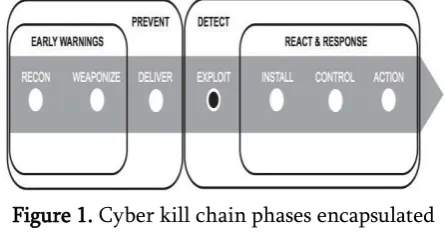
However heterogeneous and dynamic the nature of cyberspace might be, certain similarities of attacks and their countermeasures can be used to describe and allow for a holistic security framework. Most cyber attacks follow certain attack phases that can be described as a cyber kill chain. This framework assumes that every attack sequence starts with a reconnaissance phase, in which an attacker tries to locate gaps and vulnerabilities of a target system. The weaponizing phase follows, during which the uncovered weaknesses are used to develop targeted malicious code. This is followed by the delivery phase when the malware is transferred to the potential target. After the malware is delivered successfully, the exploit phase occurs during which the malware triggers the installation of an intruder’s code. Afterwards, the compromised host system allows the establishment of a command and control channel so that the attacker can initiate malicious actions. Counteractions can be determined depending upon where a malicious action appears in the cyber kill chain.
The integrated security approach (ISA) provides key ideas for a holistic view on cyber defense and a framework for such categorization. The main aim of the ISA is to generate early warnings, or alarms, preferably before the attack is launched (before the exploit phase).
The alarm is supposed to generate a relevant warning message that translates newly gathered threat data into actionable tasks.By this means, the message further supports the selection of countermeasures or already contains dedicated counteractions to prevent organizations from being victims of an attack. If an intrusion can not be prevented in advance, the
extent of the attack must be detected, followed respectively by reaction and response. These measures should include actions to stop or counterattack the invader, in addition to defining recovery procedures to quickly rollback the system to its initial state.
Figure 1. Cyber kill chain phases encapsulated countermeasures integrated security approach
Figure 1 above depicts the interconnection of cyber attacks, described by the cyber kill chain, with their countermeasures, covered by the ISA. The diagram depicts the cyber kill chain, here visualized as the gray arrow in the center, encapsulated by the ISA. The cyber kill chain includes the seven phases of a cyber attack, whereas the ISA consists of four counteraction phases. For detecting and blocking attacks as early as possible, all attack phases of the cyber kill chain need to be considered within the comprehensive ISA framework. As stated above, the emphasis is on preventing attack and detecting malicious activities during the first three phases of an intrusion, here visualized as recon, weaponize , and deliver on the left side of the diagram within the gray arrow.
III.
CHALLENGES IN GATHERING CYBER
organization’s security requires gathering and analysis of a range of information for gaining cyber intelligence. There are challenges, however, in acquiring relevant data as well as in processing, analyzing, and using it. Therefore, related efforts to effectively prevent, detect, and respond to malicious intrusions are regularly aided by security tools that aim to automate supporting security processes. The main challenges in acquiring relevant data tracks are- Amount of data: The amount of data has increased exponentially since electronic devices and their use has become ubiquitous in our work and daily lives. For the implementation of an ISA, data from all systems across entire organizations may need to be considered. Heterogeneity of data and their sources: The variance in data and its sources makes it difficult to identify and collect those data; moreover, both are spread across organizational and national borders. Even if the relevant heterogeneity within the cyber environment is identified, topology and behavior of systems and networks may change and, thus, require constant adaption.Artificial Neural Networks to Prevent Malicious Intrusions
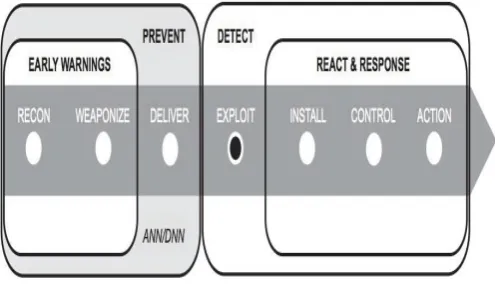
Another technique that emerged from the field of AI is the artificial neural network (ANN). ANNs are statistical learning models imitating the structure and the function of the human brain. They can help to learn and solve problems, especially in environments where algorithms or rules for solving a problem are difficult to express or are unknown. Since ANNs’ system behavior is kind of elusive, they are considered undefined black-box models. In cyber security, ANNs have been used successfully within all stages of ISAs and, hence, can encapsulate all phases of the
cyber kill chain. Integrated in cyber security, ANNs can be used for monitoring network traffic. As depicted in Figure 2 below, malicious intrusions can be detected already during the delivery phase and before an actual attack occurs. This is a desired goal of cyber security, and it is a great achievement when cyber attacks can be hindered before they take place, thus, elaborating upon the main idea of perimeter defense. ANNs can be successfully used to learn from past network activities and attacks in order to prevent future attacks from actually transpiring.
Figure 2. Artificial Neural Networks to Prevent Attacks within an Integrated Security Approach
Compared to conventional techniques used for cyber defense, the great advantage of using ANNs is their learning ability. As mentioned above, patterns that describe normal and abnormal network activities are
traditionally defined manually by security
professionals based on their expert knowledge.
Within an anomaly-based IDPS approach, it was shown that ANNs can be successfully utilized to
were classified as malicious and rejected by the IDPS. This dedicated approach has shown that the overall detection rate of attempted intrusions has improved without generating any false positive or false negative alarms. While traditional IDPSs, both signature-based and anomaly-based, work mostly against known intrusions, this ANN approach has successfully protected against instances of intrusions that were previously unknown. In summary, ANNs are said to support a viable approach to building robust, adaptable, and accurate IDPS.
IV.
EXPERT SYSTEMExpert systems are computer programs designed to provide decision support for complex problems in a domain; these are the most widely used AI application. Conceptually, an expert system consists of a knowledge base, which stores the expert knowledge, and an inference engine, which is used for reasoning about predefined knowledge as well as finding answers to given problems.
VI.
REFERENCES
[1].ProfEnn Tyugu, "Artificial Intelligence in Cyber Defense," in Proceedings of 3rd International Conference on Cyber Conflict [ICCC], 7–lO June, 2Oll Tallinn Estonia, eds. C. Czosseck, E. Tyugu, and T. Wingfield (Tallinn, Estonia: CCD COE, 2011), pp.
[2].www.techopedia.com [3].www.tutorialspoint.com [4].www.youtube.com
[5].My Digital Shield, "A History of Cybersecurity: How Cybersecurity Has Changed in the Last 5
Years," October 5, 2015,