Corpus-based Referring Expressions Generation
Hilder V. L. Pereira, Eder M. de Novais, Andr´e C. Mariotti, Ivandr´e Paraboni
School of Arts, Sciences and Humanities, University of S˜ao Paulo Av. Arlindo Bettio, 1000 - S˜ao Paulo, Brazil
[email protected], [email protected], [email protected], [email protected]
Abstract
In Natural Language Generation, the task of attribute selection (AS) consists of determining the appropriate attribute-value pairs (or semantic properties) that represent the contents of a referring expression. Existing work on AS includes a wide range of algorithmic solutions to the problem, but the recent availability of corpora annotated with referring expressions data suggests that corpus-based AS strategies become possible as well. In this work we tentatively discuss a number of AS strategies using both semantic and surface information obtained from a corpus of this kind. Relying on semantic information, we attempt to learn both global and individual AS strategies that could be applied to a standard AS algorithm in order to generate descriptions found in the corpus. As an alternative, and perhaps less traditional approach, we also use surface information to build statistical language models of the referring expressions that are most likely to occur in the corpus, and let the model probabilities guide attribute selection.
Keywords:Text Generation, Referring Expressions, Attribute Selection
1.
Introduction
In Natural Language Generation (NLG) Systems, Referring Expressions Generation (REG) is the task of providing lin-guistic forms to describe discourse objects, as in ‘the man with a red hat’, ‘him’, ‘Mr. Johns’, etc. Much of the re-search in the field has focused on the computation of the semantic contents of referring expressions to be realised as definite descriptions (e.g., ‘Please followthe left corridor’), known as the attribute selection (AS) task. AS is also the focus of this paper.
Attribute selection consists of determining the appropriate attribute-value pairs (or semantic properties) that represent the contents of a referring expression. The definition of what exactly an ’appropriate’ attribute is remains an open research question, but it is generally agreed that these at-tributes should help ruling out potential distractors (i.e., other objects in the same context as the intended referent) whilst preventing false conversational implicatures in the sense defined by H. P. Grice (Grice, 1975).
Existing work on AS includes a wide range of algorith-mic solutions (Dale and Reiter, 1995; Krahmer et al., 2003; Paraboni et al., 2007). In recent years, however, the avail-ability of corpora annotated with referring expressions data such as TUNA (van Deemter et al., 2006; van Deemter et al., 2011) and GRE3D (Viethen and Dale, 2008) suggests that corpus-based AS strategies become possible as well. In this work we tentatively discuss a number of AS strate-gies using both semantic and surface information obtained from the TUNA corpus. Relying on semantic information, we attempt to learn both global and individual AS strategies that could be applied to the Incremental algorithm (Dale and Reiter, 1995) in order to generate TUNA descriptions. As an alternative, and perhaps less traditional approach, we also use surface information to build statistical language models of the referring expressions that are most likely to occur in the corpus, and let the model probabilities guide at-tribute selection using the graph-based approach described in (Krahmer et al., 2003).
2.
Background
One of the best-known approaches to AS is the Incremen-tal algorithm described in (Dale and Reiter, 1995), which takes as an input a context set C containing domain objects with their corresponding properties, and a list P represent-ing the order in which the attributes will be considered for selection. One particular object in C is the target r to be de-scribed by means of a referring expression (i.e., a uniquely identifying set of properties), and the remaining objects are assumed to be distractors. The goal of the algorithm is to compute a list of attributes L such that L uniquely describes r and no other distractor in C.
The Incremental algorithm works by iterating over the list of preferred attributes P and adding to the description L un-der construction the attributes of the target object r that help ruling out at least one distractor, until the point in which L uniquely describes r. For instance, consider the following domain entities and their properties:
E1: (type, chair), (size, small), (colour, black)
E2: (type, chair), (size, large), (colour, white)
E3: (type, desk), (size, small), (colour, black)
E4: (type, chair), (size, small), (colour, red)
Example 1 - A context set conveying four entities and their referable attribute-pair values
In this example, assuming the preferred order P = {type, size, colour}, we may refer toE1as L ={type-chair,
size-small,colour-black}, which could be realised as ‘the small black chair’. The reference to thesize attribute rules out E2, which is large (i.e., not small), the reference to type
rules outE3, which is a desk, and the reference tocolour
rules outE4, which is red. Using the same P strategyE2
would be described as ‘the large chair’,E3simply as ‘the
desk’ and E4 as ‘the small red chair’. Attributes that do
sin-stands for P ={type,size,colour}. In our training data we identified 120 distinct AS strategies, although nearly a third of them are highly infrequent, occuring less than 10 times each. The expected output descriptions are included in Ta-ble 1 for illustration purposes only, and they are not learn-ing attributes.
Example d type d size d colour Pj
E1 small black chair 1 1 2 tsc
E2 white chair 1 3 3 tcs
E3 small desk 3 1 2 tsc
E4 red chair 1 1 3 tcs
Table 1: Examples of learning instances for Global AS clas-sification considering the context in previous Example 1.
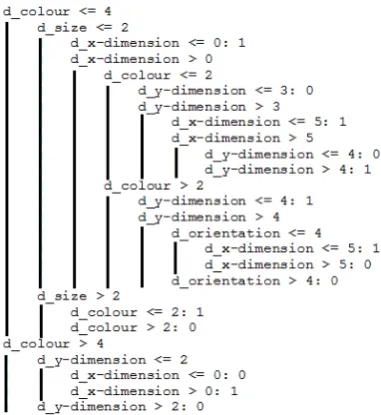
Using a training set as above, we applied J48 decision tree-induction (Witten and Frank, 2005) to build a model that, given a context of reference, selects an appropriatePj strat-egy for each input. However, given that the choice for one attribute may rule out others, we notice that this is not ex-pected to be a highly accurate model of AS, but simply an estimate of which initial P strategy to use in each case, with average Precision = 0.562, Recall = 0.989 and F-measure = 0.715 using 10-fold cross-validation. Figure 1 shows the pruned tree for the most frequent AS strategies, which in-cludes attributes that we have not considered in the previous examples.
Figure 1: Global AS classifier
Given a target object r and the set V of discriminatory power values of the input context C, a description of r is generated by submitting the input information to the model, and then using the resulting class Pj as the P parameter in the Incremental algorithm, which in turn generates the output description L. This procedure can be summarised as follows.
Input:
r: the target object
W: the set of discriminatory power values in C C: the context set
P ←GlobalClassifier(W)
L←MakeReferringExpression(r,C,P)
return(L)
The algorithm consists of making a call to the decision tree model to obtain the strategy P applied to the Incremental
al-gorithm. The results obtained by this method are discussed in Section 5.
3.2. Individual AS classification
As an alternative to the Global AS classifier, we also at-tempt to learn whether to select each attribute individually as follows. For each TUNA trial taken from a training por-tion of the corpus, we generate one training instance for every referable attributeaj except type, thus creating five training instances for each TUNA trial. As in the previ-ous approach, the learning attributes represent the discrim-inatory power of each attribute of the target object. In the present method, however, the class to be learned is defined as a binary condition representing whether eachajattribute (colour, size, orientation, x-dimention and y-dimension) was actually selected to appear in the output description.
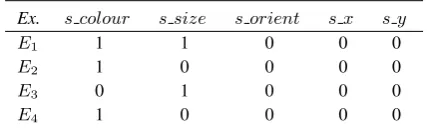
Table 2 shows examples of learning classes for the exam-ple descriptions in previous Table 1 (s colour represents whether thecolourattribute should be selected etc.) The last three classes have all their values set to zero because these attributes were not used in the previous examples. For the learning attributes under consideration, we refer to pre-vious Table 1.
Ex. s colour s size s orient s x s y
E1 1 1 0 0 0
E2 1 0 0 0 0
E3 0 1 0 0 0
E4 1 0 0 0 0
Table 2: Examples of learning classes for Individual AS classification. The learning attributes are the same from Global AS classification (d type,d sizeandd colour).
From this data set we induced five J48 classifiers using 10-fold cross-validation to determine whether to select colour, size, orientation, x-dimension and y-dimension attributes independently. However, this method was only successful for the selection of size and orientation attributes. These results are shown in Table 3.
Class Precision Recall F-measure
Colour 0.643 0.514 0.500
Orientation 0.784 0.806 0.790
Size 0.886 0.895 0.891
X-dimension 0.621 0.516 0.501
Y-dimension 0.640 0.558 0.561
Table 3: Individual AS classification
Figure 2: IndividualsizeAS classifier
Figure 3: IndividualorientationAS classifier
The use of the individual classifiers as part of a simple REG algorithm is illustrated as follows, in which TheRulesOut() function is taken to return the set of objects for which the given property is true.
Input:
r: the target object
P: the list of possible attributes, sorted by frequency W: the set of discriminatory power values in C C: the context set
L← ∅
for eachai∈Pdo
if(IndividualClassifier(ai, W) == true ) P←P−ai
L←L∪(ai, vi)
C←C−RulesOut(ai, vi) repeat
if(C==∅) return(L) for eachai∈Pdo
if(RulesOut(ai, vi)6=∅) L←L∪(ai, vi)
C←C−RulesOut(ai, vi) if(C==∅) return(L) repeat
return(L)
The algorithm starts by including allattributes suggested by the binary classifiers in the description L under construc-tion. If L still remains ambiguous after all classifiers have been attempted, the algorithm iterates over a fixed P pref-erence order based on frequency. The list P starts with the attributetype, which has the highest frequency in the cor-pus, and which is always included in the description, as in (Dale and Reiter, 1995). Additional attributes are selected (in this case against the classifiers advice) until L becomes uniquely distinguishing, or until there is no more properties to be considered in P. The results of this method are also discussed in Section 5.
4.
Word-based Attribute Selection
Our previous approaches take full advantage of the seman-tic annotation provided by the TUNA corpus to learn possi-ble AS strategies. However, since this kind of information is unlikely to be available in other domains, it is tempting to ask whether we can extract AS strategies directly from word strings. Thus, in a third corpus-based approach to REG, we attempt to use surface information taken from the corpus to guide the (otherwise strictly semantic) AS task. The word-based approach consists of a standard implemen-tation of the Graph-based algorithm described in (Krahmer et al., 2003) using a modified cost function based on lan-guage model probabilities. Briefly, this algorithm takes as an input a context graph V in which nodes represent entities and the edges are properties (self-loops are atomic proper-ties and edges linking two nodes are relational properproper-ties.) The goal of the Graph algorithm is to build a sub-graph H that represents a uniquely distinguishing description of the target object. This is achieved by tentatively adding each possible attribute (or graph edge) to the sub-graph under construction with lowest possible cost, which is determined by a customisable cost function. For details regarding the Graph-based algorithm, see (Krahmer et al., 2003). We use the Graph-based algorithm with a cost function de-fined by word string probabilities obtained from a language model as follows. First, the word strings in the training portion of the corpus were translated into our target lan-guage (Portuguese) and a trigram lanlan-guage model of the target expressions was created. The use of the language model in the cost function of the REG algorithm is illus-trated below. The functions addEdge()andremoveEdge() are standard graph methods, the functionRealise()is taken to call an auxiliary surface realisation engine, and the func-tionperplexity()evaluates the language model for the given word string.Input:
aj: the candidate attribute under consideration L: the graph under construction
M: the language model
addEdge(L,aj) sj←Realise(L) p←perplexity(M,sj)
removeEdge(L,aj) return(p)
termi-A. Gatt, termi-A. Belz, and E. Kow. 2009. The tuna-reg chal-lenge 2009: Overview and evaluation results. In Pro-ceedings of the 12th European Workshop on Natural Language Generation, pages 174–182.
H. P. Grice, 1975.Logic and conversation, pages 41–58. E. Krahmer, S. van Erk, and A. Verleg. 2003. Graph based
generation of referring expressions. Computational Lin-guistics, 29(1):53–72.
D. J. Lucena and Ivandr´e Paraboni. 2008. Combining fre-quent and discriminating attributes in the generation of definite descriptions.Springer Lecture Notes in Artificial Intelligence, 5290:252–261.
D. J. Lucena, D. B. Pereira, and Ivandr´e Paraboni. 2010. From semantic properties to surface text: the genera-tion of domain object descripgenera-tions. Inteligencia Artifi-cial, 14(45):48–58.
I. Paraboni, K. van Deemter, and J. Masthoff. 2007. Gen-erating referring expressions: Making referents easy to identify. Computational Linguistics, 33(2):229–254. K. van Deemter, I. van der Sluis, and A. Gatt. 2006.
Build-ing a semantically transparent corpus for the generation of referring expressions. InProceedings of the Interna-tional Natural Language Generation Conference (INLG-2006).
K. van Deemter, A. Gatt, I. van der Sluis, and R. Power. 2011. Generation of referring expressions: Assessing the incremental algorithm. Cognitive Science, pages 1– 38.
J. Viethen and R. Dale. 2008. The use of spatial relations in referring expressions. InProceedings of the 5th Inter-national Conference on Natural Language Generation, pages 59–67, Salt Fork, OH.