© 2019 IJSRCSEIT | Volume 5 | Issue 1 | ISSN : 2456-3307
DOI : https://doi.org/10.32628/CSEIT195155
A Review Paper on IoT Based Smart Irrigation System
Anjali Dokhande1, Chetna Bomble1, Rakshanda Patil1, Puja Khandekar1, Nayan Dhone1, Prof. Chandrashekhar Gode2
1BE Students, Department Computer Science and Engineering, Priyadarshini J.L. College of Engineering,
Nagpur, Maharashtra, India
2Assistant Professor, Department Computer Science and Engineering, Priyadarshini J.L. College of Engineering,
Nagpur, Maharashtra, India
ABSTRACT
Automation of farm activities can transform agricultural domain from being manual and static to intelligent and dynamic leading to higher production with lesser human supervision. This paper proposes an automated irrigation system which monitors and maintains the desired soil moisture content via automatic watering. Microcontroller ATMEGA328P on arduino uno platform is used to implement the control unit. The setup uses soil moisture sensors which measure the exact moisture level in soil. This value enables the system to use appropriate quantity of water which avoids over/under irrigation. IOT is used to keep the farmers updated about the status of sprinklers. Information from the sensors is regularly updated on a App using WiFi modem through which a farmer can check whether the water sprinklers are ON/OFF at any given time. Also, the sensor readings are transmitted to a Thing speak channel to generate graphs for analysis.
Keywords : Irrigation System, Soil Moisture Sensor, Temperature Sensor, Humidity Sensor, IOT, Android
I. INTRODUCTION
In our country, agriculture is a major source of food production to the growing demand of the human population. In agriculture, irrigation is an essential process that influences crop production by supplying water to the needed land. Farmers have to visit their land to check how much amount of water is required for their field. This irrigation method takes a lot of time and effort particularly when a farmer needs to irrigate multiple agriculture fields distributed in different geographical areas. Traditionally farmers will present in their fields to do irrigation process. But nowadays farmers need to manage their agricultural activity along with other occupations. Automation in irrigation system makes farmer work much easier. Sensor-based automated irrigation system provides a
properly utilized. Agriculture is one of those areas which consume a lot of water. The aim of the paper is to develop an intelligent irrigation system controller which measures the moisture of the soil and temperature of the atmosphere and helps to take decision accordingly to turns on or off the water supply system. It is important to know the amount of water that has been used in the irrigation process during agriculture. This paper describes a simple system by using Arduino microcontroller and Android software to automate the existing manual irrigation system.
II. RELATED WORK
A. Moisture Measurement
Soil is comprised of blend of segments including mineral and natural particles, with water and air making up the spaces in the middle. Soil can be essentially characterized into following 4 classes:
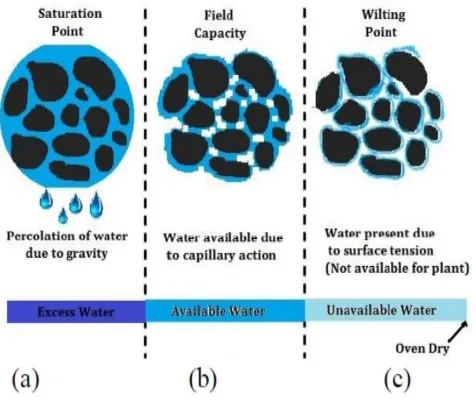
It is encouraged to break down soil to reason its classification. Every classification has distinctive properties henceforth their water holding limit changes from one sort to the next. As water invades soil, it begins to fill the hole between the void spaces in the middle of soil particles (Fig. 1(a)), when every one of the spaces are totally immersed with the water, the state is known as immersion point. This state goes on for brief time. With time overabundance water permeates descending through water profile because of gravitational power. At same time narrow activity give inverse power to gravity and give adjusted condition so descending development of water is ruined.
Fig 1. water holding property of soil
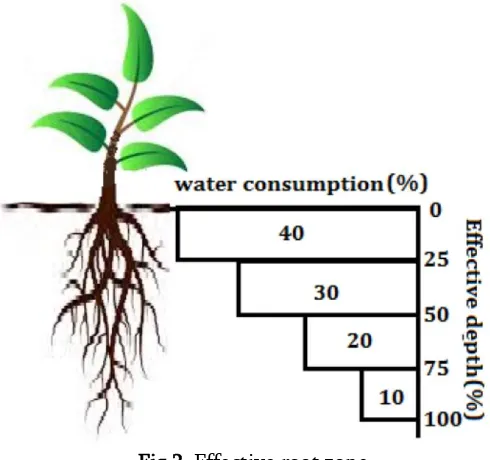
This stage is called as the field limit. Void spaces are currently loaded with water and air parcels (Fig. 1(b)). Each harvest has a Critical Soil Moisture Deficit level, enabling soil to dry out past this level, water pulling from edit can't occur, diminishing the yield. Advance more water expulsion from soil lead little holding of water by soil particles much firmly on account of surface strain impact for the yield to remove this is said to be as withering point as appeared in figure 1(c). The accessible water limit is the measure of water a dirt can make accessible to plants, by and large characterized as the contrast between measure of water put away in a dirt at field limit and the measure of water put away in the dirt at the lasting shrinking point. Plants get the vast majority of water from the upper part of the root zone.
Fig 2. Effective root zone
Numbers of techniques are produced for soil moisture estimation from straightforward feel strategy to most progress electronic ones.
B. Temperature Measurement
Temperature monitoring is key in numerous modern situations. It likewise assumes imperative part in plant development subsequently monitoring temperature is basic for good farming practice. Numerous standard methods exist which relies on estimation of physical properties of the working material that differs with temperature. Thermocouple, thermistor, RTD, pyrometer, Langmuir tests, infrared, and so forth are a portion of the cases.
C. Humidity Measurement
There are three approaches to speak to Humidity. It is the measure of water vapour (water that has abandoned a fluid to an undetectable gas) noticeable all around. Outright humidity is the genuine measure of water vapour in a predetermined volume of air. Relative humidity is the proportion of moisture noticeable all around when contrasted with the most extreme measure of moisture the air can hold, which
changes relying upon the air temperature. More sizzling air, for instance, can hold more moisture.
III. LITERATURE REVIEW
For the development of automated irrigation structure, soil moisture content is increasingly basic parameter when stood out from others as it has a significant part in plant improvement segment and availability of water for irrigation is genuine stress for the farmers uncommonly the ones who are dependent on rain. In this manner, water organization has a high need while arranging an automated irrigation system as saw in most of the composition. The experts have used distinctive systems to evaluate moisture substance precisely. The electrical conductivity estimation is the most fundamental, sagacious and control capable strategy for all. In any case, it isn't correct and its results vacillate after some time. In spite of its burdens, it is comprehensively supported by various investigators. [5] Have used this technique to execute an automated irrigation control structure using spill irrigation framework. The data was accumulated and arranged by the ARM7 board. To give UI GSM technique was used and at the customer end android based application was created to demonstrate data and with that information, the customer can pick what move to make. According to the call given by the customer, the solenoid valve was attempted to control the irrigation. An abnormal state of flexibility was obtained with this execution. The remaining burden for the farmer was decreased and moreover increase in the benefit of the estate was viewed.
methodology for moisture estimation is assessing assortment in dielectric steady [7]. Dielectric unfaltering of water is (~80) high when appeared differently in relation to dry soil (2-3). In [8] assortment of the dielectric was assessed as an assortment in the capacitor using capacitor and resistor interface. The response is generally immediate which is required in case of exactness agriculture. S. S. Mathurkar and D. S. Chaudhari [9] showed a model in perspective of moisture, temperature and humidity sensor. All of the sensors were balanced for the examination. It is overcome selection of optical and IR pictures of plant overhang. This particular enrollment speaks to a couple of challenges as no anticipated essential segment or right organizing can be found from the data pictures. X. Wang et al [10] developed an Automatic Cross-Correlation course of action count which uses the information of smart picture structure yet clears out the effect of picture shading and power in the relationship method and thusly achieves a pleasing enlistment result. They similarly realized capable computation approach which can fundamentally diminish the estimation eccentrics of the ACC count while keeping up needed exactness. Game plan control was also improved by accepting N-maxima procedure in the control point count. Preliminary comes about showed that the proposed system defeated each and every other procedure for region-based methods. J. Gutierrez et al [11] executed amazingly capable automated system with remote sensor arrange. The remote interface was given through the GPRS module (MTSMC-G2-SP). The structure has two information parameters at first is
V. COMPONENTS USED
• Soil Moisture Sensor
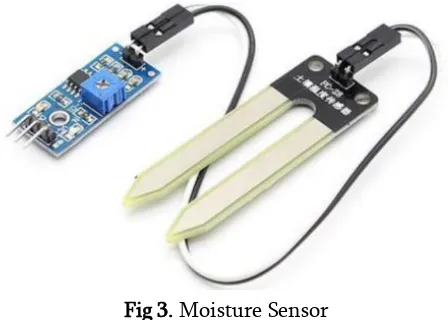
Soil Moisture sensor is used to measure the moisture content present in the soil. When the soil moisture value read by the sensor is above the threshold value, low level (0V) will be the digital output and if it is below the threshold level, high level (5V) will be the digital output. The digital pin is used to directly read current soil moisture value to see if it is above threshold or not. The threshold voltage can be regulated with help of potentiometer.
Fig 3. Moisture Sensor
• DHT11 SENSOR
DHT11 sensor is used for measuring temperature and humidity. It uses a capacitive humidity sensor and a thermistor to measure the surrounding air. This sensor is cost effective, provides low power consumption and up-to 20 meter signal transmission is possible.
Fig 4. DHT11 Sensor
• Wi-Fi Module
The ESP8266 Wi-Fi module is a self-contained SOC (System on Chip) with integrated TCP/IP (Transmission Control Protocol/Internet Protocol) protocol stack that can give any microcontroller access to any Wi-Fi network. Each ESP8266 module comes preprogrammed meaning, it can be simply hooked up to Arduino device to get Wi-Fi ability. This module has a powerful enough on-boarding process and high storage capacity that allows it to be integrated with the sensors and other application specific devices.
VI. APPLICATION
• On different region of land: It can be used on shallow soil-hilltops, hillsides and throughout mountain regions.
• For Greenhouse: Smart Greenhouse parameter-watering of crops, on fertilizers, temperature and moisture level.
• Very Efficient for Paddy, Rice Fields-This plant
requires much water that’s why apply system on
their farm.
• Irrigation in Fields: This is used to give watering to the crop fields.
• Food production and safety etc.
VII.ADVANTAGES
• Increase the productivity: Productivity on farmland is going too increased.
• Reduce water consumption. • No manpower required.
• Reduce soil erosion and nutrient leaching. • Cost effective method.
• High quality crop production.
VIII. CONCLUSIONS
In light of all above talk it can be reason that programmed irrigation framework utilizing remote innovation can give effective framework equipped for moderating assets and human exertion. The framework likewise encourages ongoing remote monitoring of the current ecological state of field. Present day innovation can be consolidated to let down the cost. These electronic frameworks are control proficient thus devours less power and depend on auxiliary sources such sunlight based vitality for finish independence.
IX. REFERENCES
[1]. Plant Growth Factors: Temperature, Colorado State University, And Available (as on
14-09-2015) at:
http://www.ext.colostate.edu/mg/Gardenno-tes/143.html#heat.
[2]. Plant Growth Factors: Water, Colorado State University, And Available (as on 14-09-2015) at: http://www.ext.colostate.edu/-
mg/Gardennotes/144.html.
[3]. Harriot Bigas (Ed.), The Global Water Crisis: addressing an urgent security issue‖, Paper for InterAction Council, Hamilton, Canada: UNO-INWEH, 2011-12. based automated irrigation control system using drip irrigation methodology, International Journal of Scientific and Engineering Research, Vol. 4, Issue 5, pp. 146-151, May 2013.
[6]. F. Adamo, An acoustic method for soil moisture measurement, IEEE transactions on
Instrumentation and Measurement, Vol. 53, No. 4, pp. 891-898, May 2004.
[7]. Darold Wobschall, A frequency shift dielectric soil moisture sensor, IEEE Transactions on Geoscience Electronics, Vol. 16, No. 2, pp. 112-118, Apr. 1978.
[8]. S. Saxena and G. M. Tayal, Capacitive moisture meter, IEEE Transaction on Industrial Electronics and Control Instrumentation, Vol. 28, No. 1, pp. 37-39, Feb. 1981.
[9]. S. Mathurkar and D. Chaudhari, Smart Sensors Based Monitoring System for Agriculture using
Field Programmable Gate Array”, International
Journal of Innovative Technology and Exploring Engineering (IJITEE), Vol. 3, Issue 4, May 2013. [10]. X. Wang, W. Yang, A. Wheaton, N. Cooley, and
B. Moran, Efficient registration of optical and IR images for automatic plant water stress assessment, Comput. Electron. Agricult., vol. 74, no. 2, pp. 230–237, Nov. 2010.
[11]. J. Gutiérrez, J. F. Villa-Medina, A. Nieto-Garibay, and M. Á. Porta-Gándara, Automated irrigation system using a wireless sensor network and GPRS module, IEEE transactions on instrumentation and measurement, Vol. 16, Issue 1, pp. 166-176, 2013.
[12]. P. Bhosale and V. Dixit, Water saving-irrigation automatic agricultural controller, International Journal of Scientific and Technology Research, Vol. 1, Issue 11, Dec. 2012.
Cite this article as :