An Agglomerative Hierarchical Clustering Algorithm for Labelling
Morphs
Burcu Can
Department of Computer Engineering Hacettepe University
Beytepe, Ankara 06800 Turkey
Suresh Manandhar Department of Computer Science
University of York
Heslington, York, YO10 5GH, UK
Abstract
In this paper, we present an agglomera-tive hierarchical clustering algorithm for labelling morphs. The algorithm aims to capture allomorphs and homophonous morphemes for a deeper analysis of mentation results of a morphological seg-mentation system. Most morphological segmentation systems focus only on seg-mentation rather than labelling morphs ac-cording to their roles in words, i.e. inflec-tional (cases, tenses etc.) vs. derivainflec-tional. Nevertheless, it is helpful to have a better understanding of the roles of morphs in a word to be able to judge the grammatical function of that word in a sentence; i.e. the syntactic category. We believe that a good morph labelling system can also help part-of-speech tagging. The proposed cluster-ing algorithm can capture allomorphs in Turkish successfully. We obtain a recall of 86.34% for Turkish and 84.79% for En-glish.
1 Introduction
Most morphological segmentation systems (Creutz and Lagus (2002; Creutz and Lagus (2004; Goldsmith (2001)) perform only the segmentation of words and do not label morphs according to how they function in a word. As a rule, some morphemes function as inflective, whereas some morphemes function as derivative. However, we do not aim to distinguish inflection or derivation within a word, but we aim to dis-tinguish between various types of morphs which are either inflective or derivative, e.g. allomorphs, homophonous morphemes. Labelling morphs not only helps with analysing the segmentation of a word, but can also help other natural language problems, i.e. part-of-speech tagging.
The main purpose of this paper is to serve as a post-processing tool to label morphs that have been discovered by a morphological segmenta-tion system. Our main aim is directed towards the Morpho Challenge competition (Mikko Ku-rimo (2011)), which provides a platform to com-pare participant morphological segmentation sys-tems. In Morpho Challenge, morph labels in a seg-mented word and the respective morph labels in its gold standard are compared.
Example 1.1 For example, the gold standard analyses of ‘arrangements’ and ‘standardizes’ in Morpho Challenge are given as:
arrangements arrange V ment s +PL standardizes standard A ize s +3SG
Although in both analyses -s occurs, their la-bels are different; +PL (plural) and +3SG (third person singular).
There is not much work done in morpheme la-belling. Spiegler (Spiegler, 2011) presents two algorithms for morpheme labelling: one of them learns morpheme labels once morphological seg-mentation is completed and the other finds mor-pheme labels during morphological segmenta-tion. Both algorithms work in a supervised set-ting in which ground truth morphemes are pro-vided. Bernhard (Bernhard, 2008) suggests an-other morpheme labelling algorithm which labels morphemes as a stem, suffix, base, or prefix. Therefore, the proposed labelling method does not consider any allomorphs or homophonous mor-phemes.
The paper is organised as follows: section 2 gives the intuition behind this work, section 3 de-scribes our clustering algorithm, section 4 presents our experiment results, and finally section 5 and section 6 conclude the paper with a discussion on the obtained results.
2 Intuition
Most morphological segmentation algorithms consider only segmenting words into its morphs and ignore labelling morphs. However, morph labels are not only useful for other NLP prob-lems (e.g. PoS tagging), but also they give a bet-ter understanding on the morphological analysis of words. There are different types of morphs having different grammatical functions. The al-gorithm presented in this paper aims to group morphs according to their functions within a word. This grouping is accomplished by considering two types of distinction among morphemes: allo-morphs and homophonous morphemes.
2.1 Allomorphs
Morphs may differ in shape but still can carry out the same function in words, such as the plural mor-pheme-sand-iesin English. Allomorphs are also seen quite often in some languages where vowel harmony1takes place, such as in Turkish, Hungar-ian, Finnish, etc. Some examples in Turkish are given below:
• The plural form (i.e. -lar, -ler): e.g. elmalar (apples),evler(houses).
• The possessive case (i.e. -in, -un, -¨un): e.g. Ali’nin (Ali’s), Banu’nun (Banu’s),
¨
Ust¨un’¨un( ¨Ust¨un’s).
• The present tense (i.e. -ar, -ir): e.g. yapar (he does),gelir(he comes).
• The prepositional case (i.e. -de, -da): e.g.
evde(at home),okulda(in the school).
Vowel harmony is not the only phonological change which causes allomorphs in Turkish. Fur-thermore, morphs that are attached to an unvoiced consonant ending word are also harmonised and the first morph letters become also an unvoiced consonant (i.e.p,c¸,t,k,s,s¸, andh):
• The ablative case (i.e. -den, -ten): e.g.
¨ulkeden (from the country), sepetten (from the basket).
• The locative case (i.e. -de, -te): e.g. s¸ehirde (in the city),kentte(in the town).
1Vowel harmony involves rules on vowels that follow each
other within a word.
• The third person singular (i.e. -dir, -tir): e.g.
nefistir(it is delicious),zekidir(she is clever).
Due to vowel and consonant harmonies, Turkish comprises of many examples of morphs that have the same function but that are phonological vari-ants of each other. It would be beneficial to group the allomorphs in the same cluster by assigning the same morpheme label as described before.
2.2 Homophonous morphemes
In contrast to allomorphs, some morphemes might sound the same phonetically; however, they might function differently. These morphemes are called homophonous morphemes (i.e. homophones). Homophonous morphemes belong to different clusters, due to the difference in their meanings. Some examples of homophonous morphemes in Turkish are given below:
• kalemi: -imight correspond to either an ac-cusative form (e.g. his/her pen) or a posses-sive form (e.g.give me the pen) which can be determined from the context.
• yapınandkapının:-ıncorresponds to an im-perative form in the first example, whereas it corresponds to a possessive form in the latter.
• geliyorlar and yataklar: -lar corresponds to 3rd person plural in the first example, whereas it corresponds to plural in the latter.
Although homophonous morphemes do not oc-cur as often as allomorphs, it is crucial to deter-mine homophony in order to be able to distin-guish morphemes which have different functions and thereby meanings. Homophonous morphemes should be grouped in different clusters; however, allomorphs should be grouped in the same cluster.
3 The Algorithm for Clustering Morphemes
For morph labelling, we propose a bottom-up ag-glomerative hierarchical clustering algorithm in which morphs showing functional similarities are clustered together. The functional similarities of the morphs are defined by a set of features as an input to the algorithm. Therefore, a feature vector is constructed to represent each morph by a feature vector. Each feature vector consists of a sequence of features which are given below:
• Previous morph that precedes the current morph in the analysis of the same word.
• Following morph that follows the current morph in the same word.
• Stem of the word.
• The last morph of the preceding word.
• The last morph of the following word.
• Morph position in the word (i.e. if the morph comes just after the stem, then it is 0. If the morph is the last morph of the word, then it is 2, and if it is surrounded by other morphs, this value is 1.)
• Morph length in letters.
Example 3.1 In Turkish, the morph -ıl that occurs in the analysed sentence “O+n+lar ceza+lan+dır+ıl+acak+lar.” (i.e. they will be punished) has got the features given below:
• Current morph: -ıl
• Previous morph: -dır
• Following morph: -acak
• Stem of the word: ceza
• The last morph of the preceding word: -lar
• The last morph of the following word:
-• Morph position in the word: 1
• Morph length: 2
Constructing the feature vector of each morph initially, morph are placed in distinct clusters. In each iteration of the clustering algorithm, the two clusters having the minimum distance are merged. The distance between two clusters is measured by Kullback-Leibler (KL) divergence through all fea-tures in their feature vectors. Recall that KL di-vergence is not a distance metric, since it is not symmetric:
KL(pkq) =X
i
p(i)logp(i)
q(i) (1)
KL divergence can be formed into a symmetric measureD(pkq)as follows:
D(pkq) =KL(pkq) +KL(q kp) (2)
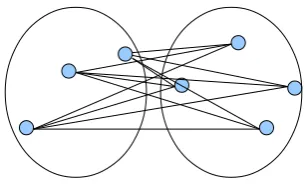
Figure 1: Average linkage clustering.
We use average linkage clustering, an in-stance of agglomerative clustering, for clustering morphs. In average linkage agglomerative cluster-ing, the distance between two clusters is the aver-age distance which is calculated through all pairs of data points in the clusters (see Figure 1):
D(R, S) = 1 NR×NS
NR X
i=1
NS X
j=1
d(ri, si) (3)
where the total distance between two clusters R andS with sizes NR and NS respectively is the
summation of distances between each data pair in the clusters. The distance is normalised with the number of pairs. The cluster pair having the mini-mum distance is merged in each iteration.
In contrast to single-linkage and complete-linkage clustering, average-linkage clustering takes each data member into account; thereby leads to a more realistic measurement.
Using average linkage clustering, each cluster is defined by a feature vector which keeps all the in-formation that comes from each morph in the clus-ter. For example, the previous morph in a cluster is a combination of all previous morphs that are owned by each morph in the cluster. While quali-tative features are combined, quantiquali-tative features, such as morph position and morph length, are av-eraged for the feature vector of the cluster. Hav-ing a feature vector for each cluster, the similarity between two clusters, c1 and c2, is measured as
follows:
Sim(c1, c2) = αD(CurM orc1kCurM orc2)
+ βD(P reM orc1kP reM orc2)
+ δD(F olM orc1 kF olM orc2)
+ γD(Stemc1kStemc2)
+ πD(P reW M orc1kP reW M orc2)
+ κD(F olW M orc1 kF olW M orc2)
+ x|posc1−posc2|
where CurM orc1 denotes the set of current morphs P reM orc1 denotes the set of previous morphs, F olM orc1 denotes the set of follow-ing morphs, Stemc1 denotes the set of stems, P reW M orc1 is the set of last morphs of previous words and F olW M orc1 is the set of last morphs of following words inc1. In addition to the
qualita-tive features, quantitaqualita-tive featuresposc1 andlenc1 refer to the average position and the average length of the morphs belonging to the cluster c1. Here,
the quantitative features (i.e. posci,lenci) are
sim-ply subtracted to find the distance between them. The weights of each feature are denoted byalpha, β,δ,γ,π,κ,x, andy.
Imagine that we have two clusters and let the current morphs be: c1: {-i,-u}and c2: {-i,-¨u}. In order to compute D(CurM orc1 k CurM orc2), we use Equation 2 over each morph in the com-bination of two sets; c1+c2: {-i,-u,-¨u}. We ap-ply add-n smoothing to eliminate counts having a zero value in the vectors (e.g. the probability of-u
would be zero forc2otherwise).
The algorithm starts with N morphs, each be-longing to a distinct cluster. In each iteration, the two clusters with the minimum KL divergence are merged until all the morphs are merged in one cluster. The final cluster will be the root node in the hierarchical tree.
4 Experiments & Results
We used the gold standard analyses of words in Turkish and English for all of our experiments, which are provided by the Morpho Challenge (Mikko Kurimo, 2011). The word lists contain 552 English words and 783 Turkish words. Words are segmented and the morphemes are labelled in the gold standard, such that:
abacuses abacus N PL
abstained abstain V PAST
We modified the analyses manually, by replac-ing morpheme labels with actual morphs, such as:
abacuses abacus es
abstained abstain ed
As an input to the clustering algorithm, we ex-tracted all morphs in the lists. The final lists con-tain 567 morphs in English and 1749 morphs in Turkish. We constructed the feature vectors of all
Morphemes Words
-ism, -ion, heroism, deductionetc.
-ed, -ing inserted, roofed, leaked, arising, pulsing, ratingetc. -ness, -ity extensiveness, community,
earthinessetc.
-s townsman, yachts, yachtsman etc.
-er baby-sitters, planners, match-makers etc.
-s’ humanities’, protestants’, swimmers’, reductions’etc.
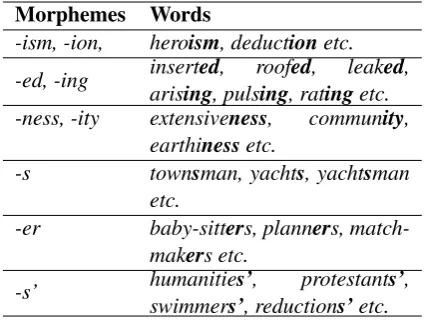
Table 1: Some morph clusters in English.
morphs and applied the hierarchical clustering al-gorithm as described before. Once the trees were constructed, we cut the trees at different levels to retrieve the final clusters. Some resulting clusters in English are given in Table 1.
Since English is not a morphologically rich language, no homophonous morphemes or allo-morphs could be captured. The reason for this is that morphs do not have sufficient contextual in-formation. Nevertheless, morphs that show sim-ilar functional properties (i.e. tenses, derivative morphemes) are captured by the clustering algo-rithm. For example, both-ismand-ionare deriva-tive morphemes that make the word a noun; -ed
and-ingare inflectional morphemes that define the tense of a verb and -ness and -ity are derivative morphemes. There are many redundant clusters that have only one type of morpheme, such as plu-ral morpheme-s, possessive morpheme-s’etc.
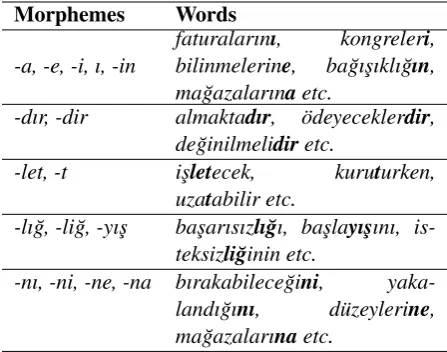
Experiments in Turkish provide a better under-standing of what type of clusters are obtained from the clustering algorithm. Some resulting clusters in Turkish are given in Table 2. It is easier to see from the results that a good number of allo-morphs are captured in Turkish due to the widely used vowel harmony. For example, allomorphs-i
andı;-dırand-dir, and-nıand-niare captured. In addition to allomorphs, functionally similar mor-phemes -a, -e, -i and -ı, -in that refer to dative, accusative and genitive case respectively are also captured.
Morphemes Words
-a, -e, -i, ı, -in
faturalarını, kongreleri, bilinmelerine, ba˘gıs¸ıklı˘gın, ma˘gazalarınaetc.
-dır, -dir almaktadır, ¨odeyeceklerdir, de˘ginilmelidiretc.
-let, -t is¸letecek, kuruturken, uzatabilir etc.
-lı˘g, -li˘g, -yıs¸ bas¸arısızlı˘gı, bas¸layıs¸ını, is-teksizli˘ginin etc.
-nı, -ni, -ne, -na bırakabilece˘gini, yaka-landı˘gını, d¨uzeylerine, ma˘gazalarınaetc.
Table 2: Some morph clusters in Turkish.
commutation Cluster50 mutate +Cluster34 contradiction contradict +Cluster34
decoded Cluster50 code +Cluster43 knifed knife +Cluster43
Suffixes were inserted with a plus sign, whereas the other morphs were inserted with their labels. This provides a more comprehensive analysis on affixes and non-affixes separately.
We applied the evaluation method that Morpho Challenge (see Mikko Kurimo (2011)) follows. In the Morpho Challenge evaluation method, seg-mentations are evaluated through word pairs that have common morphemes. For example, in order to decide whether book-sis segmented correctly, another word in the results having the morph-sis found. Let’s imagine we findpen-sin the results to make a word pair withbook-s. In order to decide whetherbook-sis segmented correctly, we find the two words in the gold standard segmentations and check whether they really share a common morph. In that case, it does not matter whether the morphs or morph labels are used.
We tested our algorithm with different combina-tions of features. The results for Turkish by using the features, previous morph, following morph, current morph, stem and morph position are given in Table 3. The results consist of 162 clusters. The number of clusters is chosen in accordance with the highest evaluation score obtained.
Here, two types of analyses are presented: non-affixes and non-affixes. As mentioned above, the evalu-ation with non-affixes considers only non-affixes; whereas the evaluation with affixes considers the rest of the morphemes (i.e. stems and prefixes). Scores show that the algorithm is better at la-belling suffixes than prefixes.
Non-affixes Affixes Total Precision 84.53 62.14 68.02
Recall 77.62 28.40 42.86
F-measure 80.93 38.98 52.58
Table 3: Evaluation results according to 162 clus-ters in Turkish by employing previous morph, fol-lowing morph, current morph, stem and morph po-sition as features.
Non-affixes Affixes Total Precision 87.15 57.45 65.04
Recall 79.51 31.76 45.79
F-measure 83.15 40.91 53.74
Table 4: Evaluation results according to 162 clus-ters in Turkish by employing previous morph, fol-lowing morph, current morph, stem, morph posi-tion and morph length as features.
Results from another experiment that employs previous morph, following morph, current morph, stem, morph position and morph length are given in Table 4 for Turkish. The results are analysed ac-cording to the same number of clusters in order to investigate the impact of using different features. Here we can observe that using morph length as a feature improves the results.
The third experiment explores the impact of us-ing the last morph of the previous word and the following word. The results of the experiment that uses previous morph, following morph, cur-rent morph, stem, the last morph of the previous word and the last morph of the following word are given in Table 5 for Turkish. The results show that using the last morph of the previous and follow-ing word does not improve the scores, but reduces contrarily.
All experiments that are presented above use equal weights for the features. We carried out an-other experiment by assigning weights to the fea-tures according to their importance. We set the weights manually, such that:
Sim(c1, c2) = 0.3D(CurM orc1 kCurM orc2)
+ 0.2D(P reM orc1kP reM orc2)
+ 0.2D(F olM orc1kF olM orc2)
+ 0.2D(Stemc1 kStemc2)
+ 0.1|posc1−posc2| (5)
algo-Non-affixes Affixes Total Precision 87.93 46.95 61.06
Recall 73.05 12.03 29.96
F-measure 79.80 19.15 40.20
Table 5: Evaluation results according to 162 clus-ters in Turkish by employing previous morph, fol-lowing morph, current morph, stem, morph posi-tion, the last morph of the previous word and fol-lowing word as features.
Non-affixes Affixes Total Precision 93.82 69.64 80.23
Recall 86.34 44.08 74.41
F-measure 89.92 53.98 77.21
Table 6: Evaluation results by employing weighted features, which are previous morph, fol-lowing morph, current morph, stem and morph po-sition in Turkish.
rithm that employs the previous morph, following morph, current morph, stem and morph position are given in Table 6 for Turkish.
We also evaluated the algorithm for English by employing previous morph, following morph, current morph, stem, morph position and morph length as features. We obtained the results accord-ing to 100 clusters. The results are given in Ta-ble 7. In the experiment, the features were also weighted the same as the previous experiment.
5 Discussion
We tested the proposed clustering algorithm with various combinations of features. It should be noted that using previous and following morphs in English is not very beneficial due to the simple morphology of the language. However, we used these two features because of a number of words having more than one morph. Since Turkish is richer in morphology compared to English, pre-vious and following morphs are more beneficial in clustering of Turkish morphs.
Another issue in Turkish morphology that needs to be noted that is the ambiguity of morphs. Words can be segmented in different ways depending on the meaning of the word, which can be discov-ered by looking at the context of the word. Hence, it also makes sense to employ the context of a morph in clustering. We employ the last morphs of the previous and following words to make use of
Non-affixes Affixes Total Precision 95.60 90.72 92.93
Recall 84.79 34.46 70.59
F-measure 89.87 49.95 80.24
Table 7: Evaluation results according to 100 clus-ters in English by weighting features, which are previous morph, following morph, current morph, stem, morph position, the last morph of the pre-vious word and the last morph of the following word.
the context in clustering. This makes a consider-able amount of improvement in the results because Turkish grammar has noun phrases, subject-verb agreement etc.
In all experiments we manually assign weights to the features. Weighting features improves re-sults since the features are not equally important in clustering. We leave the issue of estimating weights to be explored in the future.
6 Conclusion & Future Work
In this paper, an agglomerative hierarchical clus-tering algorithm is presented for labelling morphs. The algorithm aims to capture allomorphs and ho-mophonous morphemes for a deeper analysis of morphological segmentation results. Most mor-phological segmentation systems focus only on segmentation, rather than labelling morphs. Nev-ertheless, it is helpful to label morphs in order to have an idea about the grammatical function of the word in a sentence; i.e. the syntactic category. We believe that a good morph labelling system will help PoS tagging, as well.
The presented algorithm can find allomorphs in Turkish by clustering them together. However, as far as we could observe from the results, it cannot show the same accuracy for homophonous mor-phemes.
References
Delphine Bernhard, 2008. Simple Morpheme
La-belling in Unsupervised Morpheme Analysis, pages
873–880. Springer-Verlag, Berlin, Heidelberg.
Mathias Creutz and Krista Lagus. 2002. Unsuper-vised discovery of morphemes. InProceedings of the ACL-02 workshop on Morphological and
phono-logical learning - Volume 6, MPL ’02, pages 21–
30, Stroudsburg, PA, USA. Association for Compu-tational Linguistics.
Mathias Creutz and Krista Lagus. 2004. Induction of a simple morphology for highly-inflecting languages. InProceedings of the 7th Meeting of the ACL Special Interest Group in Computational Phonology: Cur-rent Themes in Computational Phonology and
Mor-phology, SIGMorPhon ’04, pages 43–51,
Strouds-burg, PA, USA. Association for Computational Lin-guistics.
John Goldsmith. 2001. Unsupervised learning of the morphology of a natural language. Computational Linguistics, 27(2):153–198.
Sami Virpioja Ville Turunen Mikko Kurimo, Krista Lagus. 2011. Morpho challenge 2010.
http://research.ics.tkk.fi/events/ morphochallenge2010/, June.
Sebastian Spiegler. 2011. Machine Learning For The
Analysis Of Morphologically Complex Languages.