Statistical Sandhi Splitter and its Effect on NLP Applications
Prathyusha Kuncham
[email protected]
IIIT-Hyderabad
Kovida Nelakuditi
[email protected]
IIIT-Hyderabad
Radhika Mamidi
[email protected]
IIIT-Hyderabad
Abstract
This paper revisits the work of (Kuncham et al., 2015) which developed a statistical sandhi splitter (SSS) for agglutinative languages that was tested for Telugu and Malayalam lan-guages. Handling compound words is a major challenge for Natural Language Processing (NLP) applications for agglutinative lan-guages. Hence, in this paper we concentrate on testing the effect of SSS on the NLP applica-tions like Machine Translation, Dialogue Sys-tem and Anaphora Resolution and show that the accuracy of these applications is consist-ently improved by using SSS. We shall also discuss in detail the performance of SSS on these applications.
1
Introduction
Sandhi which has its origin from Sanskrit ‘samdhi’ meaning “combination”, it refers to a set of morphophonological changes i.e. fusion of final and initial sounds/characters at either mor-pheme or word boundaries. Sandhi is of two types; (i) Internal sandhi and (ii) External sandhi. “Macdonell, 1926”
Internal Sandhi: It refers to morphophonologi-cal changes that occur within a word i.e. across morpheme boundaries. For example, consider an English word “impatient” where /n/ in the nega-tive morpheme “in-” has changed to /m/. This is seen for all the words starting with bilabial sounds that are prefixed with the “in-” mor-pheme.
External Sandhi: It refers to morphophonologi-cal changes that occur across word boundaries. When different words combine to form a com-pound word, we call it external sandhi. This type of sandhi occurs predominantly in Italian “Absa-lom et al., 2006” andDravidian languages.
Ex1: ‘pUjayyAkA’ -> ‘pUja’+‘ayyAkA’
1
All the examples are from Telugu language.
after having finished the prayer prayer finished Here, we can observe the morphophonological change (a -> a + a) at the word boundaries.
“Kuncham et al., (2015) handled one type of external sandhi that is prominent in many agglu-tinative languages and poses many challenges to NLP applications as seen below.”
Machine Translation
akkaDikeLLu -> akkaDiki + veLLu go there there go
When ‘akkaDikeLLu’ is given as input to Google “Telugu to English” Translate, it could not analyze the input and the English translation was ‘Akkadikellu’ which is wrong. But if the compound word is split and then given as input, Google Translate gave correct translation as ‘Go there’.
Anaphora Resolution
nEnoccAnu -> nEnu + vaccAnu I came I came
For the proper functioning of the Anaphora Res-olution system, it is important to identify the pronoun ‘nEnu’ (I) in the input which is only possible by splitting the input.
Dialogue System
raMgEmiTi -> raMgu + EmiTi what is the color color what
If the compound word is given as input to a Dia-logue system, it is very important to identify the question word ‘EmiTi’ (what) to give the correct answer.
From the above examples, we can see the im-portance of sandhi splitter in NLP applications. In this paper we show the performance and the effect of SSS on three NLP systems namely, (i) Telugu-English Machine Translation system, (ii) Dialogue System for ‘Tourism’ domain in Telu-gu and (iii) Anaphora Resolution system for Tel-ugu.
2
Related Work
Previous efforts on sandhi splitting primarily concentrated on building rule based systems to identify different words in the compound word. “Nair and Peter (2011) developed rules to identi-fy all possible splits in any compound word i.e. both external and internal sandhi in Malayalam, an agglutinative language.” “Joshi Shripad, (2012) implemented a rule based algorithm to split compound words into meaningful sub-words in Marathi.”
Apart from the traditional rule based systems, there are statistical systems for sandhi splitting as well. “Vempaty and Nagalla (2011) proposed a method using simple finite state automata for finding possible words in a given compound word.” Finite state transducer (FST) is built from the syllables of base words and is used to identify possible candidates for a compound word. This approach fails for out-of-vocabulary (OOV) words i.e. if base word of any compound word doesn’t exist in the FST. “Kuncham et al., (2015) built a statistical sandhi splitter (SSS) which identifies and generates meaningful words in a compound word using conditional random fields (CRFs).” “Natarajan and Charniak (2011) used statistical methods like Dirichlet Process and Gibbs Sampling for Sanskrit sandhi split-ting.”
In the recent years, the use of hybrid systems is increasing. Hybrid systems combine both sta-tistical and rule based techniques. “Devadath, (2014) identifies split point statistically and uses character level rules specific to language to split the compound word accordingly.”
“Popovi ́c et al., (2006) and Macherey et al., (2011) have discussed the challenges faced in machine translation due to compound words and handled compound words within the machine translation task.” To the best of our knowledge, no one has shown the effect of sandhi splitting on various NLP applications.
In this paper, we discuss the effect of SSS (which gives better performance than the existing systems in Telugu language) on three different NLP applications i.e. Machine Translation, Anaphora Resolution and Dialogue System in Telugu. The results show that the performance of these systems is better after adopting SSS.
3
Statistical Sandhi Splitter (SSS)
In agglutinative languages, it is a common phe-nomenon to combine different words to form a compound word. So, sandhi splitting is an
im-portant step for any NLP application for these languages. SSS uses a statistical approach using CRF for the task of sandhi splitting. The ap-proach consists of two stages namely, Segmenta-tion and Word GeneraSegmenta-tion.
3.1 Segmentation
In this stage, the boundaries between different words i.e. positions where morphophonological changes occur in a compound word are identified using CRF. The input for this task is a word and the output is the segments that show the bounda-ry/split points in the input. The resulting seg-ments may or may not be meaningful words which can be seen in the below example.
Example:
Input: ‘rAmuDoccADu’ (Ramudu came) Output: ‘rAmuD’-‘occADu’
Here, ‘rAmuDoccADu’->‘rAmuDu’+‘vaccADu’ Ramudu came Ramudu came In this example we can see that the segments ‘rAmuD’, ‘occADu’ are not meaningful words in Telugu language.
3.2 Word Generation
In this stage, meaningful words are generated from the segments obtained from the Segmenta-tion stage. The input for this stage is the seg-ments of a compound word and output is a mean-ingful word for each segment in the input. This stage consists of two components, (i) Class Label Assignment and (ii) Word Formation.
3.2.1 Class Label Assignment
The number of morphophonological changes occurring in any word is finite. The change can be either addition or deletion of characters at the end or at the starting of the segment. Each such change is taken as a separate class. Classes are extracted from the training data automatically. In this stage a class label is assigned to each seg-ment using CRF.
Example:
In continuation to the example discussed in Segmentation stage, we have,
Class Label Assignment: ‘rAmuD’ _u
‘occADu’ -o+va
3.2.2 Word Formation
This component generates meaningful words from the segments using class label information from Class Label Assignment stage.
The output of the Word Formation step for the example ‘rAmuDoccADu’ discussed in section 3.1 and 3.2.1 is as follows.
‘rAmuDoccADu’ -> ‘rAmuDu’ + ‘vaccADu’ Ramudu came Ramudu came
4
Effect on NLP applications
“Kuncham et al., (2015) claim that compound words pose a problem for various NLP applica-tions and that SSS is an attempt to reduce this effect.” Here, we examine that claim by using SSS as a plugin before NLP applications like Machine Translation, Anaphora Resolution and Dialogue system. In this section we report our observations with respect to each of these appli-cations.
4.1 Machine Translation
We use Google Translate2 for Telugu-English Translation because it is one of the state-of-the-art commercial machine translation systems used today. Google Translate applies statistical learn-ing techniques to build a translation model based on both monolingual text in the target language and aligned text consisting of examples of hu-man translations between the languages.
We tested on 514 Telugu sentences which had 1890 words.
Fig 1: Cumulative N-gram BLEU scores on Telugu sentences in different experiment scenarios
BLEU score reported on manually sandhi divid-ed data is 0.5003. This BLEU score would be the benchmark. BLEU score on sandhi combined data is 0.4506. We can observe the difference in the BLEU scores which tells us the importance
2
http://translate.google.com/translate_t
of sandhi splitting in machine translation. As Telugu is a relatively morphologically rich lan-guage than English, it is very important that we split the compound words in Telugu when trans-lating from Telugu to English. The BLEU score obtained by using SSS is 0.4810, which shows an improvement of 0.0304 over the sandhi com-bined data.
From the above reported BLEU scores, we can see that Google Translate fails to perform well in certain scenarios owing to the differences in the languages and mainly due to the high existence of compound words in Telugu. We will discuss through various examples how the differences in languages and compound words pose a challenge to machine translation. We further discuss the effect of SSS on Google Translate.
Different languages view the world with mi-croscopes of different sensitivities. We may not find two languages with one to one mapping in their vocabulary and rules of the language. This is the very reason, Machine Translation is a chal-lenging area of research. Following are some special constructions in Telugu that pose a prob-lem for Machine Translation.
Examples
1. panIpATa cEsukuMTuMdi. -> At panipata She is doing her work.
If we observe the above sentence from the source language (Telugu), the word ‘panIpATa’ is a compound word which has two words namely, ‘panI’, ‘pATa’, where the first word means work and the second word means ‘things done af-ter/during work’ when used along with the for-mer. This kind of word formation is unique in Indian languages and not found in English. Translating such kinds of words is problematic and not dealt by Google Translate which can be seen from its output ‘At panipata’.
2. eMduku mAneSAvu.-> Why quit why did you stop
task and we see that it is not properly handled by Google Translate.
3. rAmulu pAlu tAne pitukutADu . Ramulu himself milks.
-> Ramulu he milked milk.
Ellipsis poses a problem for translation in any language. In this example, the English translation for the Telugu sentence is “Ramulu himself milks”. Here, we can observe that the object of verb “milk” is missing and it is only from the context we understand the sentence as “Ramulu milks the cows himself.” Handling such cases require contextual knowledge. Recognizing el-lipsis and bringing out the missing information in the target languages is a big challenge.
Positive Negative
True 119 1655
False 61 55
Table 1: Confusion matrix of SSS on Telugu sentenc-es
Now we discuss the problems of compound words and the performance of SSS on machine translation. Table 1 gives the confusion matrix of SSS on 514 sentences which are discussed below in detail.
True positives
This category includes all the compound words that should be split and are correctly split by SSS.
1. Correct split, correct translation
WS:3 tana iMTiki vacci koMceM annaM tec-ciMdi. (She came to her house and brought some rice.)
GT: To come to his house and brought some rice.
WoS: tana iMTikocci koMceM annaM tecciMdi.
GT: Intikocci brought her a little rice.
‘iMTikocci’ (came home) is the compound word which is not recognized by Google Translate. But once it is correctly split into these two words ‘iMTiki’ (home), ‘vacci’ (came) the translator not only recognizes the words but also gives an answer close to the correct translation.
3 WS –With SSS
WoS – Without SSS
GT – Google Translate Output AS – Actual Split
WS: tulasi lEdu ani aDDaMgA tala UpiMdi. (Tulasi shaked her head.)
GT: Shakes head across the basil.
WoS: tulasi lEdani aDDaMgA talUpiMdi .
GT: The basil is not repeated horizontally.
In this example, we can observe that the com-pound word ‘lEdani’ (not) is recognized by Google Translate but is not translated correctly into English. When the compound word is split, the output of Google Translate is close to the correct translation.
2. Correct split, wrong translation
WS: ippuDu tulasiki nayamu ayiMdi. (Now Tu-lasi is healed.)
GT: Now tulasiki was serious.
WoS: ippuDu tulasiki nayamayiMdi .
GT: Tulasiki healing now.
In this example, even though the compound word ‘nayamayiMdi’ (healed) is correctly split, the translation is incorrect to the extent that it gives an opposite sense.
True negatives
This category includes all the compound words that should not be split and are not split by SSS.
WS: I gOlIlu vEsuko. (Take these tablets)
GT: This can be marble.
This sentence does not contain any compound word, so no split is required.
False positives
This category includes words that should not be split but are split by SSS.
WS: sAyaM kAlaM rAmulu vaccADu. (Ramulu came in the evening.)
GT: Ramulu came to the aid of the season.
WoS: sAyaMkAlaM rAmulu vaccADu
GT: Ramulu returned in the evening.
Here, ‘sAyaMkAlaM’ (evening) is the word that ideally should not be split, but SSS splits it.
False negatives
(a) WS: raktaMtO idaMdutuMdi. (This is sup-plied with blood.)
GT: Idandutundi blood.
‘idaMdutuMdi’ (this is supplied) should be split into ‘idi’ (this) and ‘aMdutuMdi’ (supplied), but SSS doesn’t split it resulting in non-identification of the word and thus incorrect translation by Google Translate.
(b) WS: vALLa mIda ottiDu ekkuva. (More pressure on them)
GT: More pressure on them. AS: vALLa mIda ottiDi ekkuva
GT: Another pressure
Here, there are two compound words ‘vAL-LamIda’ (on them) and ‘ottiDekkuva’ (more pressure). The first word is correctly split into ‘vALLa’ (them) and ‘mIda’ (on) whereas the latter is wrongly split. The correct split for the second one is ‘ottiDi’ (pressure), ekkuva’ (more) which can be seen in AS (Actual Split). But strangely, Google Translate gives correct transla-tion for the wrong split instead of the correct split.
Some Special Cases:
1(a). WS: kAni mUTa kanipiMca lEdu. (But the package is not seen.)
GT: But the package is not visible. WoS: kAni mUTa kanipiMcalEdu .
GT: But the package did not.
1(b). WS: idi aMtA jariginA raMgaDu lEva lEdu. (Rangadu did not get up even after all this)
GT: Lev rangadu not it at all. WoS: idaMwA jariginA raMgaDu
lEvalEdu
GT: Rangadu risen at all this.
In the above sentences, SSS splits ‘lEdu’ (not) from words - ‘kanipiMcalEdu’ (not visible), ‘levalEdu’ (did not get up). Google Translate gives correct translation in sentence 1 (a) but not in sentence 1(b). The decision to split in this case is dependent on context, which SSS doesn’t take into consideration.
2(a). WS: I mUTalanu mA tAtaki aMdiMcAli. (Give these packages to my grandfather.)
GT: These kits provide our tataki.
Manual split: I mUTalanu mA tAtaku
aMdiMcAli .
GT: These kits provide our grandfather.
In WS, ‘tAtaki’ (to grandfather) is not identified by the Translator as we can see, it is just translit-erated in the English translation. But a variant of ‘tAtaki’, ‘tAtaku’ (to grandfather) (in manual split) is identified by the Google Translate. In general both these words are used alternatively in Telugu.
2(b). WS: civaraki oka cOTa pani dorikiMdi. (Finally found a work at one place.)
GT: Finally found a place to work. Manual split: civaraku oka cOTa pani
doVrikiMdi
GT: Finally found a place to work.
In 2(a), the variants ‘tAtaki’ and ‘tAtaku’ are
translated differently whereas in 2(b), the similar variants ‘civaraki’ (finally) and ‘civaraku’ are translated to same meaning in English.
4.2 Anaphora resolution
Anaphora resolution is the problem of resolving references to earlier or later items in the dis-course. These items are usually noun phrases representing objects in the real world called ref-erents but can also be verb phrases, whole sen-tences or paragraphs.
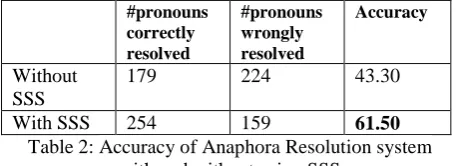
An effort was made for building an Anaphora Resolution system for Telugu dialogues at IIIT-H. This system is a rule based system that han-dles nominal pronominal anaphora for human to human conversations. We examine the effect of SSS on this system and present our results in this section.
The corpus we used consists of 95 human conversations, each conversation may contain around 2-8 dialogues. Total pronouns in the cor-pus are 413. Most of the conversations in the corpus have been taken from the web.
#pronouns correctly resolved
#pronouns wrongly resolved
Accuracy
Without SSS
179 224 43.30
With SSS 254 159 61.50
Table 2: Accuracy of Anaphora Resolution system with and without using SSS
that were initially not identified by the Anaphora Resolution system as seen in Table 3.
Total pronouns #pronouns
iden-tified without
SSS
#pronouns iden-tified with SSS
413 359 412
Table 3: Pronouns identified with and without SSS by Anaphora Resolution system
Even though the number of pronouns identified by SSS is close to total pronouns in the corpus, there is a 5% error in splitting the compound words by SSS. The errors are of two types; (i) Wrong split and (ii) No split.
Wrong split:
ninnanE -> ninnu + anE only yesterday you particle
In Telugu, ‘ninnanE’ has two senses, (a) ‘only you’ and (b) ‘only yesterday’. If the word occurs with sense (a), it should be split and not in the case of (b) and the sense is decided only from the context. Here, ‘ninnanE’ should not be split but the split resulted into a pronoun ‘ninnu’ (you) which is wrong. From our analysis, this type of error was more than others i.e. 2.5% of total er-rors.
AvidelA -> Avida + elA how she she how
This is the correct split for the compound word ‘AvidelA’ but the output from SSS is ‘Avidu’ and ‘elA’. ‘Avidu’ is an unknown word in Telu-gu. This type of error constitutes of 1.6% of total errors.
No split:
In this type of error, SSS could not split some compound words like the following example. This error constitutes of about 0.9% of total er-rors.
EMTadi -> EMTi + adi what is that what that Here, ‘EMtadi’ is not split by SSS.
4.3 Dialogue System:
A Dialogue System is a computer program that is designed to communicate with humans in a natu-ral way in natunatu-ral language. As mentioned in “Sravanthi et al., 2015”, Sandhi is a challenge to Dialogue Systems and the effect of SSS on this system is discussed in this section.
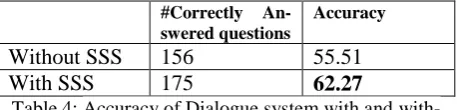
We prepared 281 questions on ‘Tourist places in Hyderabad’ domain in Telugu. Accuracy of the Dialogue System with and without using SSS is shown in Table 4.
#Correctly An-swered questions
Accuracy
Without SSS 156 55.51
With SSS 175 62.27
Table 4: Accuracy of Dialogue system with and with-out SSS
From this table we can see that there is an im-provement in the overall accuracy of Dialogue system after using SSS but the increase in the accuracy is only 6.8%. This is because of the following reasons.
1. Borrowing of English words is common in Telugu language. If the compound words contain English words, it makes the split difficult for SSS. Moreover, occurrence of English words in ‘Tourism’ domain is high resulting in the in-crease in the percentage of errors.
gOlkoMDekkaDuMdi -> gOlkoMDa + where is Golconda Golconda ekkaDa + uMdi
where present
This is the actual split for the compound word ‘gOlkoMDekkaDuMdi’ but SSS gives wrong split as ‘gOlkoMDu’, ‘ekkaDa’, ‘uMdi’. Since
‘gOlkoMDa’ (Golconda) is not identified in the question, the Dialogue system gives wrong an-swer.
TaimiMgsEMTi -> TaimiMgs + EMTi what are the timings timings what The above is the correct split for ‘TaimiMgsEMTi’ but SSS couldn’t split it. It fails to split if English words like ‘timings’, ‘ad-dress’, ‘monuments’ etc., occur in the compound words.
2. Presence of context dependent particles.
gOlkoMDanE Taimulo cUDaccu? What time can Golconda be visited?
3. Wrong splits by SSS.
cirunAmA (address) which should not be split but split by SSS as ‘ciruni’ and ‘Ama’ which have no sense in Telugu.
5
Conclusion
In conclusion, we can say that the presence of compound words degrade the performance of any NLP application for agglutinative languages which can be improved significantly by using SSS. We have presented our efforts in discussing the detail analysis of the performance and the effect of SSS on different NLP applications. As discussed in sections 4.2 and 4.3, splitting of some words depend on contextual information. SSS can be extended to handle these context de-pendent particles by considering whole sentences for training and learning features.
Acknowledgement:
This work is partially supported by Information Technology Research Academy (ITRA), Gov-ernment of India under ITRA-Mobile grant ITRA/15(62)/Mobile/VAMD/01
References
Kuncham, P., Nelakuditi, K., Nallani, S., and Mamidi, R. (2015). Statistical sandhi splitter for agglu- tinative languages. In Computational Linguistics and Intelligent Text Processing, pages 164–172. Springer.
A. A. Macdonell, A Sanskrit Grammar for students.
New Delhi, India: D.K. Printworld (P) Ltd., 1926.
M. Absalom and J. Hajek, “Prosodic phonology and raddoppiamento sintattico: a re-evaluation,” in Se-lected Papers from the 2005 Conference of the Australian Linguistic Society, Melbourne: Monash University. http://www. arts. monash. edu. au/ling/als, 2006.
Nair, L. R. and Peter, S. D. (2011). Development of a rule based learning system for splitting compound words in malayalam language. In Recent Advances in Intelligent Computational Systems (RAICS), 2011 IEEE, pages 751–755. IEEE.
Joshi Shripad, S. (2012). Sandhi splitting of Marathi compound words. Int. J. on Adv. Computer Theory and Engg, 2(2).
Vempaty, P. C. and Nagalla, S. C. P. (2011). Auto-matic sandhi spliting method for telugu, an indian lan-guage. Procedia-Social and Behavioral Scienc-es, 27:218–225.
Natarajan, A. and Charniak, E. (2011). S3-statistical sam. dhi splitting.
Devadath V V, Litton J Kurisinkel, D. M. S. V. V. (2014). A sandhi splitter for malayalam.(accepted but yet to be published in proceedings of ICON 2014.)
Popovi ́c, M., Stein, D., and Ney, H. (2006). Statisti- cal machine translation of german compound words. In Advances in Natural Language Pro-cessing, pages 616–624. Springer.
Macherey, K., Dai, A. M., Talbot, D., Popat, A. C., and Och, F. (2011). Language-independent com- pound splitting with morphological operations. In Proceedings of the 49th Annual Meeting of the As-sociation for Computational Linguistics: Human Language Technologies-Volume 1, pages 1395– 1404. Association for Computational Linguistics.