Named Entity Recognition with Stack Residual LSTM and Trainable Bias
Decoding
Quan Tran, Andrew MacKinlay and Antonio Jimeno Yepes
IBM Research Australia
[email protected], [email protected], [email protected]
Abstract
Recurrent Neural Network models are the state-of-the-art for Named Entity Recog-nition (NER). We present two innovations to improve the performance of these mod-els. The first innovation is the intro-duction of residual connections between the Stacked Recurrent Neural Network model to address the degradation prob-lem of deep neural networks. The sec-ond innovation is a bias decoding mech-anism that allows the trained system to adapt to non-differentiable and externally computed objectives, such as the entity-based F-measure. Our work improves the state-of-the-art results for both Span-ish and EnglSpan-ish languages on the standard train/development/test split of the CoNLL 2003 Shared Task NER dataset.
1 Introduction
In Natural Language Processing, the term “Named Entity” refers to special information units such as people, organizations, location names, numerical expression (Nadeau and Sekine, 2007). Identify-ing the references to these special entities in text is a crucial step toward Language Understanding. Thus, there have been many works on these areas. Some of the early systems employed hand-crafted rules (Rau, 1991; Sekine and Nobata, 2004), however, the vast majority of current sys-tems rely on machine learning models (Nadeau and Sekine, 2007) such as Conditional Random Field (CRF) (McCallum and Li, 2003), Hidden Markov Model (HMM) (Bikel et al., 1997) and Support Vector Machine (SVM) (Asahara and Matsumoto,2003). Although the traditional ma-chine learning models do not rely on manual rules, they require a manual feature engineering process,
which is rather expensive and dependent on the domain and language.
In recent years, Recurrent Neural Network (RNN) models such as Long-Short-Term-Memory (LSTM) (Hochreiter and Schmidhuber,1997) and Gated Recurrent Unit (GRU) (Chung et al.,2014) have been very successful in sequence modeling tasks, for example, Language Modeling (Mikolov et al., 2010;Sundermeyer et al., 2012), Machine Translation (Bahdanau et al., 2014) and Dialog Act Classification (Kalchbrenner and Blunsom, 2013;Tran et al., 2017). RNN models can learn from basic components of text (i.e. words and characters). This generalization capability facil-itates the construction of Language Independent NER models (Ma and Hovy,2016;Lample et al., 2016) that rely on unsupervised feature learning and a small annotated corpus.
One simple way of adding representational power to a neural network is layer stacking. A tra-ditional feed forward neural network usually has three fully connected layers: an input layer, a hid-den layer, and an output layer. For a Convolutional Neural Network (CNN) or Recurrent Neural Net-work, the number of stacked layers might be much larger (Amodei et al., 2016). One problem with this stacking scenario is the degraded representa-tion problem (He et al.,2016). The proposed solu-tion for this problem is the residual-identity con-nection (He et al., 2016). With the information from the lower-level inputs, the upper neural net-work layers can learn to compensate for the rep-resentation errors of lower layers. We adopt this idea for Stacking RNN, however, with a different implementation.
Most of the RNN-based models for NER and machine translation are trained with some form of maximum log-likelihood loss. How-ever, it is often desirable to optimize task-specific metrics (Xu et al.,2016), for example, F-measure
in NER, but optimizing the F-measure directly is not trivial (Busa-Fekete et al.,2015), especially in the case of complex Deep Neural Network models. It is even more difficult considering the way the F-measure is calculated in Named Entity Recog-nition in the CoNLL-2003 shared task1 , where
it depends on the actual/predicted entities andnot on each token-prediction for which the system is trained for. Inspired by the idea of trainable decod-ing recently proposed in machine translation (Gu et al.,2017), we introduce a trainablepercentage bias decodingsystem that manipulates the outputs of a base system trained with normal loss to adapt to a new objective. Our trainable bias decoding system also bears similarity to the thresholding technique (Lipton et al.,2014), traditionally used to maximize F-measures given a classifier. The proposed decoding system is trained directly on the externally computed F-measures (which relies on the the CoNLL evaluation script) using finite different gradient.
In the next sections, we describe the proposed innovations with detailed motivations and discus-sions. Results show that our proposed innovations improve the NER state-of-the-art for the English and Spanish languages in the CoNLL-2003 shared task data set.
2 Models
We describe first our RNN-CRF base architecture and then we describe our two modelling innova-tions: the Stack Residual RNN and the bias de-coding.
2.1 The base RNN-CRF architecture
Our system is built upon the RNN-CRF architec-ture for Named Entity Recognition. Let us denote the input sequence of words asw0, ..., wn. In
gen-eral, the RNN component encodes the words into a sequence of hidden vectors h0, ..., hn. This
se-quence of hidden vectors is then treated as features for a linear-chain CRF layer. The training objec-tive will then be the log-likelihood of the correct sequence.
FollowingLample et al. (2016);Ma and Hovy (2016);Yang et al.(2016), we employ the charac-ter level information and word-embeddings as fea-tures in NER. Similar toLample et al.(2016), in our system, character information is encoded us-1https://www.aclweb.org/aclwiki/index.
php?title=CONLL-2003_(State_of_the_art)
ing a bi-directional RNN (biRNN) over characters. Given a wordwk∈w0, ..., wnwithmcharacters,
let us denote the character-embedding sequence of this word as c0, ...,cm, the biRNN function as ρ
and the concat function asψ. The character em-bedding representation hc
k of word wk is
calcu-lated using a biRNN as in Equation 1, in which
f0, ...,fmandb0, ...,bmdenote the hidden units in
the forward and backward RNNs respectively.
f0, ...,fm=ρ(c0, ...,cm) b0, ...,bm=ρ(cm, ...,c0)
hc
k=ψ([fm,bm])
(1)
The feature vector xk of word wk is then the
concatenation of hc
k and the traditional
word-embeddingek as shown in Equation2. Figure 1
shows the feature extraction procedures. All the parameters of the biRNN as well as the embedding tables are jointly trained with other component of the model. The word embedding table is initial-ized with a pre-trained embedding table.
xk=ψ([hck,ek]) (2)
The most simple architecture would be a one-directional RNN over the word features:
h0, ..., hn = RNN(x0, ..., xn). However, it has
been shown to be beneficial to have a bidirectional RNN over the input layer, as a bidirectional RNN captures both the left and the right context of a word:h0, ..., hn=ρ(x0, ..., xn).
The final sequence of hidden vectorsh0, ...,hn
is treated as the features for a linear-chained CRF layer. Similar toLample et al.(2016), the observa-tion scoresλare calculated with a linear transfor-mation from the hidden vectors, as show in Equa-tion 3, where λi is the vector observation scores
for all the labels inith time-step,Wp is anl×d
weight matrix, and bp is a bias vector of size l
(withdis the size of vectorhi), and lis the size
of the label setY(including the special sequence begin and end labels).
λi =Wphi+bp (3)
Given a sequence of input words S =
w0, ..., wn, the score of a particular sequence of
Figure 1: Extracting word features with word embeddings and character level biRNN
score between the label in positionjand the label in positionj + 1in sequence Y, andλi(Y[i])is
the observation score ofi-th labelY[i].
ζ(Y, S) = X
i:[0..n]
λi(Y[i])
+ X
j:[0..n−1]
δ(Y[j], Y[j+ 1]) (4)
The probability of a sequence Y is calculated using a softmax over all the possible sequencesY
(Equation5).
P r(Y|S) = P eζ(Y,S) ¯
Y∈Yeζ( ¯Y ,S) (5) During training, we maximize the log-likelihood of the correct sequence Yc. The
loss function L is defined in Equation 6. Be-cause we employ a linear-chain CRF, the term
log(PY¯∈Yeζ( ¯Y ,S)) in Equation 6 can be
effi-ciently calculated with dynamic programming.
L(Yc) =ζ(Yc, S)−log( X
¯ Y∈Y
eζ( ¯Y ,S)) (6)
During decoding, the best sequence can be found using the Viterbi algorithm. The original Viterbi decoding algorithm builds an l×nscore
tableξ in whichl is the size of the label set (in-cluding the beginning and end labels) andnis the length of the sequence. ξj(yi) denotes the score
of the most probable partial path (up to positionj) with positionjhaving the labelyi.ξj(yi)is
calcu-lated using dynamic programming as in Equation 7.
ξj(yi) = X
yk∈Y
(ξj−1(yk) +δ(yk, yi)) +λj(yi)
(7)
At the end of the decoding process, sequenceYˆ
is predicted by selecting the best score at the end of the sequence j = n and then completing the sequence with a backward pointer (Equation 8). Figure3depicts the whole RNN-CRF architecture
ˆ
Y[n] = arg max
yi ξn(yi) ˆ
Y[n−1] = arg max
yk (ξj−1(yk) +δ(yk, ˆ
Y[n])) (8)
2.2 Stacked Residual RNN
Figure 2: The application of percentage bias to Viterbi decoding
Figure 3: The RNN-CRF architecture
layers of neural networks suffers from the degra-dation problem (He et al., 2016). This is due to the difficulty in training a lot of stacked layers and fit these layers to desired underlying mappings, which leads to representational degradation.
The solution proposed to this problem, the residual connection (He et al., 2016; Prakash et al.,2016) tries to create shortcuts between non-consecutive layers. However, the original addi-tional residual connection (adding the input vec-tor to the hidden representation) adds several con-straints on the dimensionality of the hidden and input layers, which might require vector clip-ping (Prakash et al., 2016), and it might lead to a loss of information.
In the original residual connection proposed for image recognition, the residual information is summed to the output of the upper layers (F(x) +
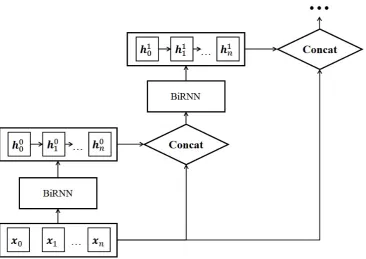
x). In our proposal, we want the upper layer of a neural network to have direct access to the origi-nal input, thus, the origiorigi-nal input is now appended to the output of the lower layers instead of being
summed. With this formulation, there is no di-mensionality restriction, and furthermore, we ar-gue that our proposed residual connection can be used to mix feature learners of different complex-ity (Figure4). For example, when equipped with our proposed residual connection, the top neural network layer can act like a shallow one-layer fea-ture learner. The two top layers can act like a deeper two-layer feature learner. Equation set 9 shows the exact formulation of our proposed resid-ual connection within the Stack RNN. Similar to the Equation1, we denote the biRNN function as
ρ and the concat function as ψ. This modelling procedure is depicted in Figure4.
h00, ...,h0n=ρ(x0, ...,xn)
ˆ
h00, ...,ˆh0n=ψ([x0,h00]), ..., ψ([h0n,xn]) h1
0, ...,h1n=ρ(ˆh00, ...,hˆ0n) hM
0 , ...,hMn =ρ(ˆh0M−1, ...,ˆhMn−1)
(9)
2.3 The bias decoding
Usually NER systems are evaluated with some form of F-measure. For example, for the CoNLL 2013 Shared Task NER dataset, the evaluation is performed by an external script using entity-based F1-measure. Although it has been noted that training on the evaluation metric is benefi-cial (Xu et al.,2016), most of the deep models for NER are trained with log-likelihood. The main reason for this discrepancy is the difficulty in train-ing with F-measures. Instead of trytrain-ing to train on F-measure directly, we look into a hybrid solution where we train a model on log-likelihood first, and then use a simpler “adaptation model” to manipu-late the output of the base model to fit it to the F-measure.
Figure 4: Feature learner mixture with residual connection
explore the possibility of adding trainable noise to the Viterbi decoding process. Analogously to the traditional threshold technique for maximizing the F1 score in binary classification, we introduce a simplepercentage noiseto the decoding process. That is, during the construction of the score table
ξ (Equation7), a label-specific percentage bias is added to the calculation as in Equation10. Figure 2shows the application of this bias to the Viterbi decoding.
ξj(yi) = X
yk∈Y
(ξj−1(yk) +δ(yk, yi)) +byλj(yi)
(10) To test this new percentage bias idea, we per-form a quick experiment, where we limit the use of bias to the most numerous class in the CoNLL tag set, class O (words that do not belong to any entity). We search for the best biasbO from the
range of[0.5,1.5]using a value loop with step of 0.1. For each value of bO, we calculate the
F1-measure on the validation set, and choose the value with the highest F1. We use our trained model based on the Stack Residual architecture above as the base probabilistic model. We find that the best
bOvalue is1.1(a value of1.0means without any
bias). Using thisbO bias for the test data yields
the F1-measures of91.22compared to the original score of91.07in the test set. This experiment sup-ports our claim that the base model trained with log-likelihood might not optimize well on a differ-ent performance measure, and adding this percdiffer-ent- percent-age bias noise is really beneficial.
We extended this idea treating the biases as pa-rameters. Thus the trainable bias decoding system has the number of parameters equal to the num-ber of classes. Training with gradient descent with CoNLL’s entity-based F1 loss is rather difficult, as it is hard to calculate the exact gradient. This is solved using the numerical gradient methods as an approximation, which is shown in Equation11.
fb0 ∼ f(b+)2−f(b−) (11)
The training procedure is then very similar to stochastic gradient descent. Details on the choice of hyper parameters and other experimental set-tings are presented in the Experiment section.
3 Experiments
3.1 Dataset and Experimental settings
set2(Tjong Kim Sang and De Meulder,2003).
We have reused the training, development and test set configuration of the CoNLL-2003 Shared Task in our study.
The training set has been used to train the system using several hyperparameter configura-tions, the development set has been used to se-lect the best configuration and the reported per-formance of the final system is based on the test set. The Spanish dataset has 8323/1915/1517 sentences in train/dev/test sets respectively. The English dataset is almost twice as large with 14041/3250/3453 sentences in train/dev/test set. For all of our models, the word-embedding size is set to 100 for English and 64 for Spanish. The hid-den vector size is 100 for both English and Span-ish sets without the LM embeddings. With the LM embeddings, the hidden vector size is changed to 300 for English. We trained the model with Stochastic Gradient Descent (SGD) with momen-tum, using the learning rate of 0.005. For the bias decoding, the hyperparameter for each update is randomly chosen from a range of[0.01, ...,0.1] with step-size of 0.01. Because the base model trained with sequence level log-likelihood fits very well on the training set, the gradient calculated with Equation 11 might be every small, thus we opt to calculate the finite difference with respect to the loss:log2(1−F1/100)instead of theF1to boost the gradient information in the points where F1 is very close to 100 (perfect classification). The learning rate for bias training is also set to 0.005. Statistical significance has been determined using a randomization version of the paired sample t-test (Cohen,1996).
We first conduct several series of experiments to confirm the effectiveness of our two proposed ideas: the Stack Residual RNN and the bias de-coding, and the new Language Model embedding in sub-section 3.2. The second sub-section: 3.4 compares our method with state-of-the-art results.
3.2 Component Analysis Adding stack Residual RNN
Due to computational complexity, there is a prac-tical limit on how many RNN layers we can stack. In this series of experiment, we tested our model without Stacked Residual RNN, and with 2, 3 and 4 Stacked layers. The word embeddings are initialized using the pre-trained word vectors
de-2http://www.cnts.ua.ac.be/conll2003/ner
scribed below. The result of this series of ex-periements is presented in Table1.
From the result, we can see that the performance seems to increase as we add more stacked layers, and peak at three before dropping. We continue to analyze other components using 3 Stacked Resid-ual Layers of CRF-RNN as the base model, we call this model3 Res-RNN for short.
For English, the 3 and 4 stacked layer improve-ments are significant (p < 0.025) compared to the baseline model and between the stacked layer models, the improvement between 2 and 3 layers is significant (p <0.035).
For Spanish, the 3 stacked layer improvement is significant (p <0.03), with respect to the baseline model. Improvement between the 3 stacked layer and the 4 stacked layer models is significant (p <
0.03).
Adding Language Model Embedding
Pre-trained word embeddings have shown useful in Natural Language Processing tasks, but provide information about the word but not about its con-text. Previous work has explored using language models in addition to word embeddings (Peters et al., 2017) with positive results. We have eval-uated our system using pre-trained language mod-els using the 3 Stacked Residual Layer configura-tion. First, we test the models with forward-only LM embeddings (foreLM), then we test the model with both forward and backLM (backLM). The re-sult of this series of experiments is presented in Table2.
The gain from the LM embedding is not con-sistent. It seems to work very well with English, where it improves performance substantially even though this improvement is not specially signifi-cant. However, the LM does not improve the per-formance at all in Spanish. Adding the foreLM and backLM significantly decreases performance.
Adding Bias Decoding
System F1 English F1 Spanish
CRF-RNN no Stack Residual 90.43 85.41
CRF-RNN 2 Stack Residual 90.72 85.88
CRF-RNN 3 Stack Residual 91.07? 86.24?
[image:7.595.109.486.62.132.2]CRF-RNN 4 Stack Residual 91.02? 85.51
Table 1: Analysis of the Stack Residual Component. ?indicates significance (p < 0.05) versus CRF-RNN no Stack Residual.
System F1 English F1 Spanish
3 Res-RNN 91.07? 86.24?
3 Res-RNN+foreLM 91.43? 86.13?
3 Res-RNN+foreLM +backLM 91.66? 85.83
Table 2: Analysis of the Language Model Embedding. ?indicates significance (p <0.05) versus CRF-RNN no Stack Residual in Table1.
For English, adding bias to the 3 Res-RNN without LM yields a significant improvement (p <
0.013), while for Spanish, the boost from adding bias to the 3 Res-RNN + foreLM + backLM model is significant (p <0.011).
3.3 External Knowledge Learning 3.3.1 Word embedding
English word embedding was obtained from Word2vec-api3. The embedding dimension is 100
and it was trained using GloVe with AdaGrad. For the generation of Spanish word embeddings we followedLample et al.(2016), using Spanish Gi-gaword Third Edition4 as corpus with an
embed-ding dimension of 64, a minimum word frequency cutoff of 4 and a window size of 8.
3.3.2 Language Modeling
In some experiments, we used both forward and backward language models. The English forward language model was obtained from TensorFlow5
using the One Billion Word Benchmark6 (Chelba
et al., 2013) and has a perplexity of 30. As the code generating this pre-trained model is not available, we made use of a substitute which pro-duces a higher perplexity language model. For the backward English language model and the Span-ish forward and backward ones, they were gener-ated using an LSTM based baseline7 (Jozefowicz
3
https://github.com/3Top/word2vec-api/blob/master/README.md
4https://catalog.ldc.upenn.edu/ldc2011t12
5https://github.com/tensorflow/models/tree/master/lm 1b 6
https://github.com/ciprian-chelba/1-billion-word-language-modeling-benchmark
7https://github.com/rafaljozefowicz/lm
et al., 2016). This code estimates a forward lan-guage model and was adapted to estimate a back-ward language model. Language models were es-timated using the One Billion Word benchmark. The vocabulary for the backward English model is the same as the pre-generated forward model. The perplexity for estimated backward English lan-guage model is 46; despite the discrepancy in plexity with the forward language model the per-formance using this language model still improves the named entity recognition task. The vocabulary for the Spanish language models was generated using tokens with frequency>2. The perplexity for the forward and backward Spanish language models are 56 and 57 respectively.
3.4 Comparative performance
Table 4 shows the performance of our best sys-tems compared to the state-of-the-art results on ConLL dataset. We focus our comparison to the systems with the same experimental setups (stan-dard train/val/test split, without the use of external label data). The best previous systems (Ma and Hovy,2016;Lample et al.,2016) are based upon a similar architecture (CRF-RNN) to ours. Lample et al.(2016) employed LSTM for character-based embedding, whileMa and Hovy(2016) employed CNN for character-based embedding8. Overall,
we achieve state-of-the-art results on both English and Spanish.
8There are several other works reporting very strong
System F1 on English F1 on Spanish
3 Res-RNN 91.07? 86.24?
3 Res-RNN + foreLM 91.43? 86.13?
3 Res-RNN + foreLM + backLM 91.66? 85.83
3 Res-RNN + bias 91.23?† 86.31?
3 Res-RNN + foreLM + bias 91.45? 86.14?
[image:8.595.128.474.62.158.2]3 Res-RNN + foreLM + backLM + bias 91.69? 86.00?†
Table 3: Analysis of the bias decoding. ?indicates significance (p <0.05) versus CRF-RNN no Stack Residual in Table1. †indicates significance versus the configuration with no bias.
System F1 on English F1 on Spanish
CRF-RNN no Stack Residual 90.43 85.41
(Passos et al.,2014) 90.05 –
(dos Santos and Guimar˜aes,2015) – 82.21 (Gillick et al.,2016) 84.57 81.83 (Lample et al.,2016) 90.94 85.75
(Ma and Hovy,2016) 91.21 –
3 Res-RNN + bias 91.23 86.31
3 Res-RNN + foreLM + bias 91.45 86.14
3 Res-RNN + foreLM + backLM + bias 91.69 86.00
Table 4: Compare our model with systems with comparable experimental settings
4 Discussion
Overall, our model achieves the state-of-the-arts for both English and Spanish Named Entity Recognition. For Spanish, our base model with three layers of Stacked Residual RNN already out-performs the current state-of-the-art.
From the results above, we can see that our in-novations, the Stacked Residual connection and bias decoding consistently improve the perfor-mance across both data sets. However, the im-provements from bias decoding is somewhat small in some models. The numerical gradient for train-ing is noisy, and sometimes the SGD process might take several epochs to find an improvement on the development set. This happens especially on the English dataset because the base model trained with sequence level log-likelihood fits very well on the training set. Even with the boost-ing trick presented durboost-ing the Experiments sec-tion, the training is still very slow. At first, we expected that the biases might give us some ideas about the trade-off between precision and recall similar to the thresholding technique for binary classification, i.e. the based log-likelihood model might favors precision or recall. However, from the analysis of the biases, we found no obvious trends favoring precision or recall.
Interestingly, the Language Model embeddings seem to have opposite effects on Spanish and En-glish. While it is very helpful in English, it only degrades the performance for Spanish. The En-glish LMs also improve convergence rate, while it is the opposite for Spanish. We attribute this difference in the quality of the Language Model involved. For English, the LMs are arguably bet-ter, with much lower perplexities than the LMs for Spanish. The Spanish models also have less data to train with, and it might affect the performance.
5 Conclusions and Future Work
We have explored two innovations over the base-line CRF-RNN model for sequence classification: the Stacked Residual Connection, and bias decod-ing. With these two improvements, it is possible to achieve state-of-the-art performance in Named Entity Recognition for both English and Spanish.
[image:8.595.123.471.207.347.2]References
Dario Amodei, Sundaram Ananthanarayanan, Rishita Anubhai, Jingliang Bai, Eric Battenberg, Carl Case, Jared Casper, Bryan Catanzaro, Qiang Cheng, Guo-liang Chen, et al. 2016. Deep speech 2: End-to-end speech recognition in english and mandarin. In In-ternational Conference on Machine Learning. pages 173–182.
Masayuki Asahara and Yuji Matsumoto. 2003. Japanese named entity extraction with redundant morphological analysis. InProceedings of the 2003 Conference of the North American Chapter of the Association for Computational Linguistics on Hu-man Language Technology-Volume 1. Association for Computational Linguistics, pages 8–15.
Dzmitry Bahdanau, Kyunghyun Cho, and Yoshua Ben-gio. 2014. Neural machine translation by jointly learning to align and translate. arXiv preprint arXiv:1409.0473.
Daniel M Bikel, Scott Miller, Richard Schwartz, and Ralph Weischedel. 1997. Nymble: a high-performance learning name-finder. InProceedings of the fifth conference on Applied natural language processing. Association for Computational Linguis-tics, pages 194–201.
Robert Busa-Fekete, Bai´azs Sz¨or´enyi, Krzysztof Dem-bczy´nski, and Eyke H¨ullermeier. 2015. Online f-measure optimization. In Proceedings of the 28th International Conference on Neural Information Processing Systems. MIT Press, Cambridge, MA, USA, NIPS’15, pages 595–603.
Ciprian Chelba, Tomas Mikolov, Mike Schuster, Qi Ge, Thorsten Brants, Phillipp Koehn, and Tony Robin-son. 2013. One billion word benchmark for measur-ing progress in statistical language modelmeasur-ing. arXiv preprint arXiv:1312.3005.
Jason PC Chiu and Eric Nichols. 2015. Named en-tity recognition with bidirectional lstm-cnns. arXiv preprint arXiv:1511.08308.
Junyoung Chung, Caglar Gulcehre, KyungHyun Cho, and Yoshua Bengio. 2014. Empirical evaluation of gated recurrent neural networks on sequence model-ing. arXiv preprint arXiv:1412.3555.
Paul R Cohen. 1996. Empirical methods for artificial intelligence. IEEE Intelligent Systems(6):88. C´ıcero Nogueira dos Santos and Victor Guimar˜aes.
2015. Boosting named entity recognition with neu-ral character embeddings. CoRRabs/1505.05008. Dan Gillick, Cliff Brunk, Oriol Vinyals, and Amarnag
Subramanya. 2016. Multilingual language process-ing from bytes. InProceedings of the 2016 Confer-ence of the North American Chapter of the Associ-ation for ComputAssoci-ational Linguistics: Human Lan-guage Technologies. Association for Computational Linguistics, San Diego, California, pages 1296– 1306.
Jiatao Gu, Kyunghyun Cho, and Victor OK Li. 2017. Trainable greedy decoding for neural machine trans-lation.arXiv preprint arXiv:1702.02429.
Kaiming He, Xiangyu Zhang, Shaoqing Ren, and Jian Sun. 2016. Deep residual learning for image recog-nition. In Proceedings of the IEEE Conference on Computer Vision and Pattern Recognition. pages 770–778.
Sepp Hochreiter and J¨urgen Schmidhuber. 1997. Long short-term memory. Neural computation
9(8):1735–1780.
Rafal Jozefowicz, Oriol Vinyals, Mike Schuster, Noam Shazeer, and Yonghui Wu. 2016. Exploring the limits of language modeling. arXiv preprint arXiv:1602.02410.
Nal Kalchbrenner and Phil Blunsom. 2013. Recurrent convolutional neural networks for discourse compo-sitionality.arXiv preprint arXiv:1306.3584.
Guillaume Lample, Miguel Ballesteros, Sandeep Sub-ramanian, Kazuya Kawakami, and Chris Dyer. 2016. Neural architectures for named entity recognition. InProceedings of the 2016 Conference of the North American Chapter of the Association for Compu-tational Linguistics: Human Language Technolo-gies. Association for Computational Linguistics, San Diego, California, pages 260–270.
Zachary C Lipton, Charles Elkan, and Balakrishnan Naryanaswamy. 2014. Optimal thresholding of clas-sifiers to maximize f1 measure. In Joint European Conference on Machine Learning and Knowledge Discovery in Databases. Springer, pages 225–239.
Xuezhe Ma and Eduard Hovy. 2016. End-to-end sequence labeling via bi-directional lstm-cnns-crf.
arXiv preprint arXiv:1603.01354.
Andrew McCallum and Wei Li. 2003. Early results for named entity recognition with conditional random fields, feature induction and web-enhanced lexicons. In Proceedings of the seventh conference on Natu-ral language learning at HLT-NAACL 2003-Volume 4. Association for Computational Linguistics, pages 188–191.
Tomas Mikolov, Martin Karafi´at, Lukas Burget, Jan Cernock`y, and Sanjeev Khudanpur. 2010. Recur-rent neural network based language model. In Inter-speech. volume 2, page 3.
David Nadeau and Satoshi Sekine. 2007. A sur-vey of named entity recognition and classification.
Lingvisticae Investigationes30(1):3–26.
Matthew E Peters, Waleed Ammar, Chandra Bhagavat-ula, and Russell Power. 2017. Semi-supervised se-quence tagging with bidirectional language models.
arXiv preprint arXiv:1705.00108.
Aaditya Prakash, Sadid A Hasan, Kathy Lee, Vivek Datla, Ashequl Qadir, Joey Liu, and Oladimeji Farri. 2016. Neural paraphrase generation with stacked residual lstm networks. arXiv preprint arXiv:1610.03098.
Lisa F Rau. 1991. Extracting company names from text. In Artificial Intelligence Applications, 1991. Proceedings., Seventh IEEE Conference on. IEEE, volume 1, pages 29–32.
Satoshi Sekine and Chikashi Nobata. 2004. Definition, dictionaries and tagger for extended named entity hi-erarchy. InLREC. pages 1977–1980.
Martin Sundermeyer, Ralf Schl¨uter, and Hermann Ney. 2012. Lstm neural networks for language modeling. InInterspeech. pages 194–197.
Erik F Tjong Kim Sang and Fien De Meulder. 2003. Introduction to the conll-2003 shared task: Language-independent named entity recognition. In
Proceedings of the seventh conference on Natural language learning at HLT-NAACL 2003-Volume 4. Association for Computational Linguistics, pages 142–147.
Quan Hung Tran, Ingrid Zukerman, and Gholamreza Haffari. 2017. A hierarchical neural model for learn-ing sequences of dialogue acts. InProceedings of the 15th Conference of the European Chapter of the Association for Computational Linguistics: Volume 1, Long Papers. Association for Computational Lin-guistics, Valencia, Spain, pages 428–437.
Wenduan Xu, Michael Auli, and Stephen Clark. 2016. Expected f-measure training for shift-reduce parsing with recurrent neural networks. InProceedings of the 2016 Conference of the North American Chap-ter of the Association for Computational Linguis-tics: Human Language Technologies. Association for Computational Linguistics, San Diego, Califor-nia, pages 210–220.
Zhilin Yang, Ruslan Salakhutdinov, and William Co-hen. 2016. Multi-task cross-lingual sequence tag-ging from scratch. arXiv preprint arXiv:1603.06270