Learning Web Query Patterns for Imitating Wikipedia Articles
Shohei Tanaka†Naokaki Okazaki‡ [email protected]
Mitsuru Ishizuka† [email protected]
†Graduate School of Information
Science and Technology University of Tokyo
‡Interfaculty Initiative in
Information Studies University of Tokyo
Abstract
This paper presents a novel method for ac-quiring a set of query patterns to retrieve documents containing important informa-tion about an entity. Given an existing Wikipedia category that contains the tar-get entity, we extract and select a small set of query patterns by presuming that formulating search queries with these pat-terns optimizes the overall precision and coverage of the returned Web informa-tion. We model this optimization prob-lem as a weighted maximum satisfiabil-ity (weighted Max-SAT) problem. The experimental results demonstrate that the proposed method outperforms other meth-ods based on statistical measures such as frequency and point-wise mutual informa-tion (PMI), which are widely used in rela-tion extracrela-tion.
1 Introduction
Wikipedia1is useful for obtaining comprehensive
information of entities and concepts. However, even with 3.3 million English articles, Wikipedia does not necessarily include articles about an en-tity and concept of interest to a user. The ultimate goal of this study is to generate articles about an entity of a specified category from the Web by us-ing Wikipedia articles in the same entity category asexemplars.
This study follows previous work of the other authors on query-biased/focused summa-rization (Tombros and Sanderson, 1998; Berger
1http://en.wikipedia.org/
and Mittal, 2000) for modeling the target article generation process. In that model, when a user in-puts an entity of interest, Web pages are retrieved that describe the entity by issuing queries to an information retrieval system. Using the retrieved pages as an information source, an article (sum-mary) can be produced specialized for the target entity. From the application point of view, the arti-cle should include the concepts that best describe the target entity. In addition, articles concerning the entities of a category should cover concepts that are typical of the category. For example, an article about an actor is expected to mention his nationality, date of birth, movie credits, awards, etc.
A great number of researchers have ad-dressed the problem of query-focused summariza-tion (Carbonell and Goldstein, 1998; White et al., 2003; Dang, 2005; Daum´e and Marcu, 2006; Varadarajan and Hristidis, 2006; Fuentes et al., 2007; Gupta et al., 2007; Wang et al., 2007; Ka-nungo et al., 2009). However, these studies as-sume that a document collection is provided for the summarization systems. In other words, col-lecting source documents that include important concepts for the target entity is not in the scope of these studies. For example, queries such as “(actor) was born in,” “(actor) born on,” “(actor) plays,” and “(actor) won” may be more suitable than the simple query “(actor)” for obtaining con-cepts concerning the actor.
Pennac-chiotti, 2006; Blohm et al., 2007). These stud-ies typically use statistical measures, such as fre-quency and point-wise mutual information (PMI), to assess the scores of the query patterns. How-ever, these studies cannot eliminate the redun-dancy of concepts retrieved by a query set because they are designed to extract entities for each rela-tion independently. For example, the query “(ac-tor) born on” would not be necessary if the query “(actor) was born in” could gather documents re-ferring to both the actor’s nationality and date of birth.
In this paper, we propose a novel method for acquiring a set of high-quality query patterns that can gather source documents referring to impor-tant concepts about a specified entity. Given a category in which the entity is expected to be in-cluded, we use existing Wikipedia articles in this category to extract query patterns so that, when used together with the entity, they can retrieve im-portant concepts related to the entity. We then select a small subset of query patterns that max-imize the coverage and precision of the query re-sult by modeling the query selection task as a weighted maximum satisfiability (weighted Max-SAT) problem.
2 Proposed method
First, let us define the terminology used in this paper. An entityis a topic for which we need to obtain an article (summary). Note that this defi-nition is different from that used in other studies (e.g., named entity recognition). A conceptis a noun phrase that has a specific relation to an en-tity. Aquery patternis a lexical pattern that con-tains a slot filled by an entity. Used with an entity, a query pattern instantiates a query that collects related concepts. For example, “X was born in” is a query pattern in which X is a slot. When replac-ing X with an entity (e.g., “Dustin Hoffman”), the query pattern instantiates a query that may return the birthplace.
The goal of this study is, for a given entity category (e.g., American actor), to acquire a set of query patterns (template) for collecting related concepts from the Web. We learn the template by using Wikipedia articles of the category as super-vision data. The method consists of three steps.
1. Triplet extraction identifies, for each
Wikipedia article, entity mentions, concepts, and phrases that form a bridge between the entity mentions and concepts. In the context of learning query patterns from Wikipedia, we assume that a Wikipedia article is writ-ten for an entity. By identifying entity men-tions and concepts in the article, we ob-tain bridging phrases between entity men-tions and concepts as candidates for query patterns.
2. Pattern assessment verifies whether each
candidate query pattern can actually retrieve concepts from the Web. This step issues queries of the form “(entity) (pattern)” to an information retrieval system, analyzes the re-trieved Web pages, and examines whether each concept is found in the same sentence as the query expressions.
3. Pattern selection obtains a template by
choosing a small subset of patterns such that the retrieved Web pages contain as many kinds of concepts as possible. We also elimi-nate query patterns that can retrieve descrip-tions other than concepts. We formalize this step as a weighted Max-SAT problem.
2.1 Triplet extraction
We first analyze Wikipedia articles to extract triplets of entities, query patterns, and concepts. Because a Wikipedia article usually describes a single entity, we identify the entity from the ti-tle of the article. We then search for occurrences of the entity in the body of the article. How-ever, we might need to resolve coreference expres-sions because the entity might be described by a number of surface variations. For example, the Wikipedia article titled “Dustin Hoffman” might refer to the entity using “he” and “Hoffman” as well as “Dustin Hoffman”; the entity “Microsoft Corporation” might be described by “Microsoft” and “the company” in the article.
Hoffmanwas born in[Los Angeles], [California], the second and youngest son of Lillian and Harry Hoffman, a [Russian]-born father who worked as a prop supervi-sor/set decorator at [Columbia Pictures] before becom-ing a furniture salesman. Hoffmanis from a[Jewish] family, although he did not have a religious upbring-ing. Hegraduated from[Los Angeles High School] in 1955. Heenrolled at[Santa Monica College] with the intention of studying medicine but left after a year to join the [Pasadena Playhouse].
Figure 1: A snippet of a Wikipedia article about “Dustin Hoffman.”
1. Any token (split by spaces) that appears in the title of the article.
2. The phrase that appears the most frequently with the four anaphoric expressions “he,” “she,” “they,” and “thenoun.”
The first rule deals with anaphoric expression caused by an ellipsis, e.g., “Dustin Hoffman” is referred to by “Dustin” and “Hoffman.” The second rule resolves the coreference expressions caused by pronouns and definite noun phrases.
After detecting the entity mentions, we identify the concepts concerning the entity in the article. In this study, we employ WikiLink texts (anchor texts linked with other Wikipedia articles) that co-occur with the entity mentions in the same sen-tences. Finally, we identify a candidate of a query pattern as a phrase that satisfies the following con-ditions:
1. It consists of alphanumeric letters and hy-phens only.
2. Its length is no longer than 6 tokens.
3. It appears between an entity mention and a concept in a sentence.
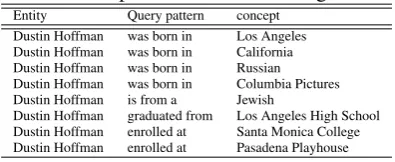
Figure 1 shows a snippet of the Wikipedia article about “Dustin Hoffman.” The underlined expres-sions are identified as entity mentions; the text in square brackets represents a WikiLink text. Be-cause all WikiLink texts appear in sentences with the entity mentions, we identify all expressions with square brackets as concepts. Italic texts are candidates of the query patterns.
[image:3.595.313.511.90.171.2]Finally, we extract triplets of the form hEk,Pi,Cji from the Wikipedia article, where
Table 1: Triplets extracted from Figure 1. Entity Query pattern concept
Dustin Hoffman was born in Los Angeles Dustin Hoffman was born in California Dustin Hoffman was born in Russian Dustin Hoffman was born in Columbia Pictures Dustin Hoffman is from a Jewish
Dustin Hoffman graduated from Los Angeles High School Dustin Hoffman enrolled at Santa Monica College Dustin Hoffman enrolled at Pasadena Playhouse
Ek (k ∈ {1, ...,L}) denotes the entity, Pi (i ∈
{1, ...,M}) denotes a query pattern, andCj (j∈
{1, ...,N}) denotes a concept. For each conceptCj
found in the Wikipedia article, we build a triplet by setting Ek as the entity of the article and Pj
as the query pattern that precedes the conceptCj.
Repeating this process forLWikipedia articles in the same category, we obtain triplets withMquery patterns andNconcepts.
Table 1 shows the eight triplets obtained from Figure 1. Here, it might not be clear whether the indefinite articleais necessary in the pattern is from a. Although we do not address this is-sue directly in this paper, we determine the pop-ularity and usefulness of the pattern by analyzing Wikipedia articles in the same category. Similarly, some concepts (e.g., Russian) are not so impor-tant for the entity. It may be better to filter out the concept, but we expect that errors in concept iden-tification are negligible when selecting the query patterns.
2.2 Pattern assessment
In this step, we verify whether each patternPican
actually retrieve concepts of the entities from the Web. More specifically, for every combination of an entity mentionEk and a patternPi, we issue a
query “Ek Pi” (e.g., “Dustin Hoffman graduated
from”) to Yahoo! Search BOSS2. We download
the top 10 Web pages retrieved by each query and examine whether any of the concepts,Cj, appear
in the same sentence as the query phrase. To de-scribe the capability of the patterns for retrieving concepts, we introduce anm×nmatrix calledR,
Ri j=
(
1 (patternPican retrieve conceptCj)
0 (otherwise) .
DVD
the News blogs
won the Academy Award
was born in
California
Los Angeles 1 9 3 7 Dustin Hoffman
graduated from grew up in
in
[image:4.595.80.278.71.184.2] [image:4.595.308.513.381.556.2]L.A. High School Figure 2: Patterns – collected concepts graph.
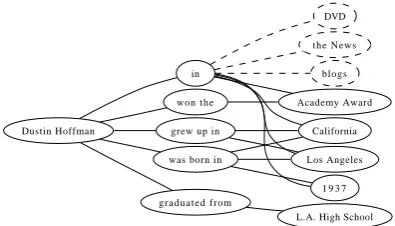
Figure 2 illustrates a bipartite graph between the patterns and concepts with R as the biadja-cency matrix. Here, nodes with dotted lines are expressions other than concepts but are retrieved by the patterns. For example, the pattern “in” can retrieve four concepts Academy Award, Califor-nia, Los Angeles, and 1937, but it also retrieves non-concepts such asDVD,the News, andblogs. In other words, this pattern can retrieve sentences with a number of concepts, but it also gathers un-necessary sentences. Thus, we define the error rate of patternPi
εi=1− (# sentences with concepts)
(# total sentences retrieved byPi).
2.3 Pattern selection
Based on the pattern assessment in Section 2.2, this step chooses a small set of query patterns as the template. Letw1, ...,wmdenotemBoolean (0–
1 integer) variables, each of which (wi) indicates
whether the corresponding query patternPi is
se-lected (1) or unsese-lected (0). Choosing a subset of query patterns is equivalent to assigning Boolean values to the variablesw1, ...,wm. The number of
selected patterns is∑mi=1wi.
Given an assignment of variablesw1, ...,wmfor
the query patterns, we can examine whether the conceptCj is retrieved from the patterns by using
the logical sum,
cj=w1R1j∨w2R2j∨...∨wmRm j= m _
i=1
wiRi j.
Here,cjis a Boolean (0–1) variable indicating that
conceptCj is retrieved (1) or not retrieved (0) by
the template. In Figure 2, if either the “in” or “was born in” pattern is selected, we can retrieve the concept “1937” from the Web search.
To choose a set of query patterns, we maxi-mize the number of concept coverages∑n
j=1cj as
well as minimize the number of patterns selected ∑m
i=1wi and the total of the error rates of the
se-lected patterns∑m
i=1εiwi. This is achieved by
solv-ing the followsolv-ing problem.
Problem 1.
Maximize
∑
nj=1
cj−α m
∑
i=1wi−β m
∑
i=1εiwi,
subject to: c1= m _
i=1
wiRi1
...
cn= m _
i=1
wiRin,
wi∈ {0,1}.
Here, α andβ are the parameters for control-ling the preference of a smaller number of patterns (α) and the preference of accurate patterns (β).
To solve this problem, we rewrite it as a weighted maximize satisfiability (weighted Max-SAT) problem.
Problem 2.
Maximizen
∑
+mk=1λk
xk
Subject to: x1= m _
i=1
wiRi1 (λ1=1)
... (...)
xn= m _
i=1
wiRin (λn=1)
xn+1=¬w1 (λn+1=α+βε1)
... (...)
xn+m=¬wm (λn+m=α+βεm)
wi∈ {0,1}
Instead of subtracting the penalty terms from the objective value, we give bonus weights (α+ βεi) if the pattern Pi is not selected. This is
achieved by introducing additional clauses xn+1,
...,xn+mthat are satisfied by¬w1, ...,¬wm,
respec-tively. Therefore, the optimization process tries to find a compromise between selecting patterns (clausesx1, ...,xn) and rejecting patterns (clauses
xn+1, ..., xn+m). Although the complexity of the
3 Evaluation
To verify the performance of the proposed method, we compare the precision, coverage, and F’-score of the information retrieval process by using the template obtained by the proposed method with that by three other baseline methods.
3.1 Experimental Settings 3.1.1 Data
We use articles of five categories in Wikipedia as the data for evaluation: American actors, Ge-netic disorders, American tennis players, Soft-ware companies, andOperas. Among these cat-egories, the first two (American actors, Genetic disorders) have been commonly used as evalua-tion data in previous research on text summariza-tion (Sauper and Barzilay, 2009). The other three (American tennis players, Software companies, Operas) are categories about three distinct topics (sport,business,entertainment).Table 2 shows in-formation about these categories.
We divide the article set of a given category into six subsets. We use one subset as thedevelopment setfor tuning the parametersα andβ in the pro-posed method. The remaining five subsets are the training setand thetest set, which are used for the 5-fold cross-validation. We create the template by using the training set and evaluate it with the test set. For evaluation of the baseline methods, we use only thetraining setand thetest set.
3.1.2 Baselines Random Selection
The baseline “Random Selection” randomly se-lects 10 query patterns from the candidate query patterns as the template for the category.
Frequency
In this baseline method, we sort the query patterns for each category in the order of frequency of oc-currences in the category. We then select the top 10 frequent query patterns as the template for the category.
PMI-Web
[image:5.595.306.517.90.346.2]The baselinePMI-Webchooses the query patterns that are the most “reliable.” Following KnowIt-Now (Cafarella et al., 2005) and Espresso (Pan-tel and Pennacchiotti, 2006), the “reliability” of a
Table 2: The five categories used for evaluation. Category #Articles #Patterns #Concepts American actors 1864 2951 10495 American tennis players 444 1039 2826 Software companies 1890 1992 5087 Genetic disorders 657 1087 2400
Operas 1425 2125 6365
Figure 3: Relation between coverage and query pattern frequency.
pattern is defined by using the strength of the as-sociation of the pattern with the entities and con-cepts co-occurring with the pattern. In KnowIt-NowandEspresso, PMI (point-wise mutual infor-mation) is used to measure the strength of this as-sociation. PMI is estimated with the Web search hit counts as follows:
pmi(Ek,Pi,Cj)≈ hit(Ek,Pi,Cj)
hit(Ek,Pi)·hit(Cj),
where hit(EkPi), hit(Cj) are the Web search hit
counts for the query “Ek,Pi,” “Cj”(Ek,Pi,Cjis
en-tity, pattern, concept), and hit(Ek,Pi,Cj)is the hit
count for the query “Ek Pi” and “Cj.” The
relia-bility score of the query pattern is defined as the following formula:
Score(Pi) = 1
|S|(Ek
∑
,Cj)∈Spmi(Ek,Pi,Cj), whereSis the set of pairs ofentity EkandconceptCj co-occurring with thepattern Piin a sentence.
The methodPMI-Webchooses the top 10 patterns that have the highest reliability scores.
3.1.3 Experiments
query patterns in the template. We remove the query patterns occurring only once in each cat-egory from the candidate patterns because these patterns may be too entity-specific or noisy.
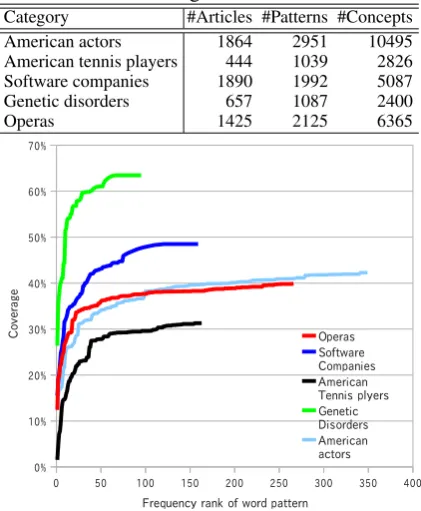
Figure 3 shows the coverage of the concept re-trieval process when we use the topN frequently appearing patterns in the candidate pattern set. We observe that the coverage does not reach 100% even if we use all the query patterns. This is be-cause some concepts cannot be retrieved by any query pattern. Moreover, we consider a Wikilink as a concept, even though some Wikilink texts do not actually represent a concept.
We use query patterns that occur no less than 3 times (for American actors, American ten-nis players, Software companies, and Operas) or twice (for Genetic disorders) in the correspond-ing Wikipedia articles so that the query patterns reach 95% of the upper bound of the coverage. This small subset comprises the final candidate patterns. For the candidate patterns, we use the proposed method (solving the weighted Max-SAT problem) and the three baselines described above to chooseNquery patterns.
The precision, coverage and quasi F-score (F’-score) of the information retrieval process by each template are defined as follows:
precision=freq(Ek,Pi,Cj)
freq(Ek,Pi) ,coverage=
Ccollected
Ctotal ,
F0=2·precision·coverage
precision+coverage,
where freq(Ek,Pi) is the frequency of the phrase
“EkPi” in the retrieved documents, freq(Ek,Pi,Cj)
is the frequency of co-occurrence of the phrase “Ek Pi” and “Cj” in the sentences. Ctotalis the
to-tal number of distinct concepts in the data set, and Ccollectedis the number of distinct concepts which
can be collected by the template.
3.2 Result
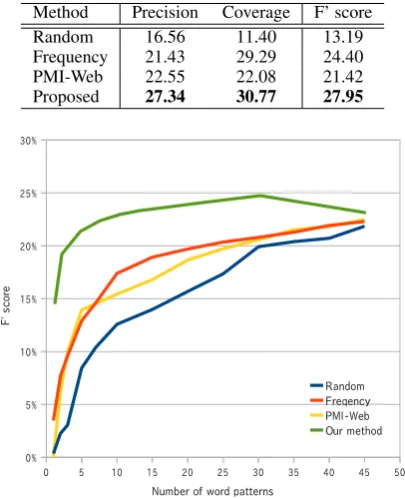
[image:6.595.310.513.119.369.2]Table 5 shows the average of the precision, cover-age and F’ scores of the five categories when we choose 10 query patterns (N=10). The proposed method obtains the highest score of all methods. Moreover, the proposed method outperforms the baselines not only for the average of all categories, but also for each category. This result indicates
Table 5: Performance of the templates produced by the proposed method and the three baselines (N=10).
Method Precision Coverage F’ score
Random 16.56 11.40 13.19
Frequency 21.43 29.29 24.40 PMI-Web 22.55 22.08 21.42 Proposed 27.34 30.77 27.95
Figure 4: Number of query patterns (N) in tem-plate and F’ score inAmerican tennis players.
that the proposed method is able to choose query patterns that precisely and comprehensively col-lect the target concepts.
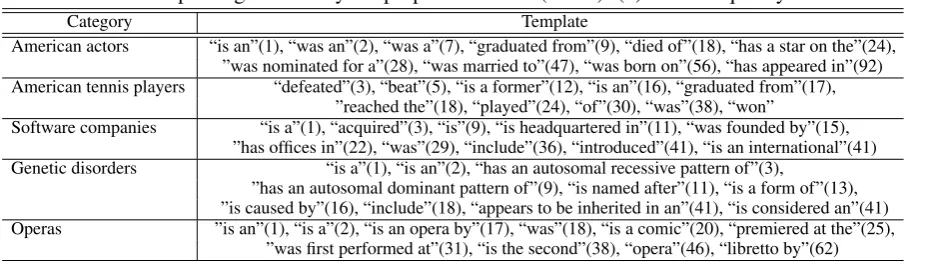
Table 3: Templates generated by the proposed method (N=10): (n) is the frequency rank.
Category Template
American actors “is an”(1), “was an”(2), “was a”(7), “graduated from”(9), “died of”(18), “has a star on the”(24), ”was nominated for a”(28), “was married to”(47), “was born on”(56), “has appeared in”(92) American tennis players “defeated”(3), “beat”(5), “is a former”(12), “is an”(16), “graduated from”(17),
”reached the”(18), “played”(24), “of”(30), “was”(38), “won”
Software companies “is a”(1), “acquired”(3), “is”(9), “is headquartered in”(11), “was founded by”(15), ”has offices in”(22), “was”(29), “include”(36), “introduced”(41), “is an international”(41) Genetic disorders “is a”(1), “is an”(2), “has an autosomal recessive pattern of”(3),
”has an autosomal dominant pattern of”(9), “is named after”(11), “is a form of”(13), ”is caused by”(16), “include”(18), “appears to be inherited in an”(41), “is considered an”(41) Operas ”is an”(1), “is a”(2), “is an opera by”(17), “was”(18), “is a comic”(20), “premiered at the”(25),
”was first performed at”(31), “is the second”(38), “opera”(46), “libretto by”(62)
Table 4: Templates generated by different methods for theOperacategory (N= 10).
Method Template Pre. Cov. F’
Random “was an,” “of the complete operas of the,” “was on,” “was commissioned by,” 15.79 8.12 10.73 “by,” “is,” “popular,” “for the,” “New York,” “the same name by”
Frequency “is an,” “is a,” “the,” “by,” “of the,” “in,” “and,” “of,” “was a,” “a” 16.83 27.12 20.77 PMI-Web “was created by,” “is a three act,” “premiered at the,” “was an,” “is an,” 30.25 18.29 22.80
“is an opera composed by,” “is a Hindi language,” “premiered on” “was commissioned by,” “was first performed at the,”
Proposed “is an,” “is a,” “is an opera by,” “was,” “is a comic,” “premiered at the,” 31.18 27.28 29.10 “was first performed at,” “is the second,” “opera,” “libretto by”
various types of concepts. This implies that the method achieves high coverage even for concepts that cannot be retrieved by generic patterns.
The baseline Frequency obtains the second highest F’-score. It achieves high coverage but low precision. This is because this method chooses high-frequency patterns that can appear with every concept. Therefore, it is able to retrieve concepts with high coverage. However, these pat-terns do not retrieve specific information concern-ing a concept. Moreover, some high-frequency patterns, such as “the ” and ”by,” lead to sentences that do not describe any concept.
Table 4 shows the patterns generated for the cat-egoryOperaby each method. We can observe that the methodFrequency chooses very generic pat-terns, such as “is a,” “and,” and “the,” which are not specific toOpera.
In contrast, the methodPMI-Webachieves high precision but low coverage. This is because this method chooses highly reliable patterns (e.g., “was commissioned by”), which are strongly as-sociated with a specific kind of concept. How-ever, these patterns cannot retrieve a broad range of concepts related to the target entity. This ex-plains why the method cannot achieve high
cover-age.
Figure 4 shows the F’ scores when we vary the number of selected query patterns (N) for the cat-egoryAmerican tennis players. We observe that the templates generated by the proposed method achieve the highest F’-score at every value ofN. The maximum F’-score is 24.7, which is achieved whenNis 30. Moreover, the proposed method re-quires only five query patterns to achieve the F’-score of 21.4. Therefore, the proposed method achieves a high F’-score by using only a small number of patterns. This implies that the method achieves high performance in a short query pro-cessing time.
4 Related Work
explored a method for generating a series of sum-maries of various lengths by using information from Wikipedia.
Sauper and Barzilay (2009) proposed an ap-proach for creating a summary of many chunks of text that are related to an entity and retrieved from the Web. They used Wikipedia not only for producing the template, but also for improv-ing the summaries. Although the target of their work is very close to that of our study, the focus of each study is different. They address the method for selecting appropriate sentences for summa-rization, whereas we consider the method for se-lecting query patterns that can generate a compre-hensive summary of an entity.
Various studies have addressed Web page summarization and query-focused summarization, from search result summarization (Kanungo et al., 2009) to query biased summarization (Wang et al., 2007). Furthermore, Fujii and Ishikawa (2004) presented a method to automatically compile en-cyclopedic knowledge from the Web.
Similar to relation extraction, the proposed method retrieves information concerning an entity by using query patterns. This is because query patterns for relation extraction are also appro-priate in sentence extraction for multi-document summarization (Hachey, 2009). However, the re-lation extraction task primarily obtains query pat-terns that retrieve instances of a specific relation. This is different from the goal of this study, which is obtaining a set of patterns that are able to re-trieve a large range of topics related to an entity. 5 Conclusion
We present a novel method to acquire a set of query patterns for retrieving documents that con-tain important information regarding an entity. Especially, we concentrate on the method for se-lecting query patterns that are able to compre-hensively and precisely retrieve important con-cepts concerning an entity. The experimental re-sults demonstrate that the proposed method out-performs methods based on statistical measures such as frequency and point-wise mutual infor-mation (PMI), which are widely used in relation extraction.
Currently, we use the text between an entity
and a WikiLink as a candidate for a query pat-tern. In the future, we plan to use the text between two noun phrases as query patterns to increase the number of candidates for the pattern selection pro-cess. Moreover, we intend to build a text summa-rization application based on the proposed method to confirm that the selected pattern set is able to generate a comprehensive summary for an entity.
References
Agichtein, Eugene and Luis Gravano. 2000. Snow-ball: Extracting relations from large plain-text
col-lections. InProc. of the fifth ACM conference on
Digital libraries, pages 85–94.
Berger, Adam and Vibhu O. Mittal. 2000.
Query-relevant summarization using FAQs. InProc. of the
38th Annual Meeting on Association for Computa-tional Linguistics, pages 294–301.
Biadsy, Fadi, Julia Hirschberg, and Elena Filatova. 2008. An unsupervised approach to biography
pro-duction using Wikipedia. In Proc. of the 46th
Annual Meeting of the Association for Computa-tional Linguistics on Human Language
Technolo-gies, pages 807–815.
Blohm, Sebastian, Philipp Cimiano, and Egon Stemle. 2007. Harvesting relations from the Web:
quantifiy-ing the impact of filterquantifiy-ing functions. InProc. of the
22nd national conference on Artificial intelligence, pages 1316–1321.
Brin, Sergey. 1999. Extracting patterns and relations
from the World Wide Web. Selected papers from
the International Workshop on The World Wide Web and Databases, pages 172–183.
Cafarella, Michael J., Doug Downey, Stephen Soder-land, and Oren Etzioni. 2005. KnowItNow: Fast, scalable information extraction from the Web. In
Proc. of the conference on Human Language Tech-nology and Empirical Methods in Natural Language Processing, pages 563–570.
Carbonell, Jaime and Jade Goldstein. 1998. The use of MMR, diversity-based reranking for reordering
documents and producing summaries. In Proc. of
the 21st annual international ACM SIGIR confer-ence on Research and development in information retrieval, pages 335–336.
Dang, Hoa Trang. 2005. Overview of DUC 2005. In
Document Understanding Conference (DUC) 2005.
Daum´e, III, Hal and Daniel Marcu. 2006. Bayesian
International Conference on Computational Lin-guistics and the 44th annual meeting of the Associa-tion for ComputaAssocia-tional Linguistics, pages 305–312.
Filatova, Elena, Vasileios Hatzivassiloglou, and Kath-leen McKeown. 2006. Automatic creation of
do-main templates. InProc. of the 21st International
Conference on Computational Linguistics and the 44th annual meeting of the Association for Compu-tational Linguistics, pages 207–214.
Fuentes, Maria, Enrique Alfonseca, and Horacio Rodr´ıguez. 2007. Support vector machines for query-focused summarization trained and evaluated
on pyramid data. InProc. of the 45th Annual
Meet-ing of the ACL on Interactive Poster and Demon-stration Sessions, pages 57–60.
Fujii, Atsushi and Tetsuya Ishikawa. 2004. Summa-rizing encyclopedic term descriptions on the Web. In Proc. of the 20th international conference on Computational Linguistics, pages 645–651.
Gupta, Surabhi, Ani Nenkova, and Dan Jurafsky. 2007. Measuring importance and query relevance in topic-focused multi-document summarization. In
Proc. of the 45th Annual Meeting of the ACL on In-teractive Poster and Demonstration Sessions, pages 193–196.
Hachey, Ben. 2009. Multi-document summarisation
using generic relation extraction. In Proc. of the
2009 Conference on Empirical Methods in Natural Language Processing, pages 420–429.
Hearst, Marti A. 1992. Automatic acquisition of
hyponyms from large text corpora. In Proc. of
the 14th conference on Computational linguistics, pages 539–545.
Heras, Federico, Javier Larrosa, and Albert Oliveras. 2008. MiniMaxSat: An efficient weighted
Max-SAT solver. Journal of Artificial Intelligence
Re-search, 31:1–32.
Kanungo, Tapas, Nadia Ghamrawi, Ki Yuen Kim, and Lawrence Wai. 2009. Web search result summa-rization: Title selection algorithms and user
satis-faction. InProceeding of the 18th ACM conference
on Information and knowledge management, pages 1581–1584.
Pantel, Patrick and Marco Pennacchiotti. 2006.
Espresso: Leveraging generic patterns for
automat-ically harvesting semantic relations. InProc. of the
21st International Conference on Computational Linguistics and the 44th annual meeting of the Asso-ciation for Computational Linguistics, pages 113– 120.
Sauper, Christina and Regina Barzilay. 2009. Auto-matically generating Wikipedia articles: a
structure-aware approach. InProc. of the Joint Conference of
the 47th Annual Meeting of the ACL and the 4th In-ternational Joint Conference on Natural Language Processing of the AFNLP, pages 208–216.
Tombros, Anastasios and Mark Sanderson. 1998. Ad-vantages of query biased summaries in information
retrieval. InProc. of the 21st annual international
ACM SIGIR conference on Research and develop-ment in information retrieval, pages 2–10.
Turney, Peter D. 2001. Mining the Web for synonyms:
PMI-IR versus LSA on TOEFL. InProc. of the 12th
European Conference on Machine Learning, pages 491–502.
Varadarajan, Ramakrishna and Vagelis Hristidis. 2006. A system for query-specific document
sum-marization. InProc. of the 15th ACM international
conference on Information and knowledge
manage-ment, pages 622–631.
Wang, Changhu, Feng Jing, Lei Zhang, and Hong-Jiang Zhang. 2007. Learning query-biased Web
page summarization. InProc. of the sixteenth ACM
conference on information and knowledge
manage-ment, pages 555–562.
White, Ryen W., Joemon M. Jose, and Ian Ruthven. 2003. A task-oriented study on the influencing ef-fects of query-biased summarisation in Web search-ing. Information Processing and Management, 39(5):707–733.
Ye, Shiren, Tat-Seng Chua, and Jie Lu. 2009.
Sum-marizing definition from Wikipedia. InProc. of the