MarsaGram
: an Excursion in the Forests of Parsing Trees
Philippe Blache, St´ephane Rauzy, Gr´egoire Montcheuil
Laboratoire Parole et Langage - UMR 73095 avenue Pasteur, 13100 Aix-en-Provence, France [email protected]
Abstract
The question of how to compare languages and more generally the domain of linguistic typology, relies on the study of different linguistic properties or phenomena. Classically, such a comparison is done semi-manually, for example by extracting information from databases such as theWALS. However, it remains difficult to identify precisely regular parameters, available for different languages, that can be used as a basis towards modeling. We propose in this paper, focusing on the question of syntactic typology, a method for automatically extracting such parameters from treebanks, bringing them into a typology perspective. We present the method and the tools for inferring such information and navigating through the treebanks. The approach has been applied to 10 languages of the Universal Dependencies Treebank. We approach is evaluated by showing how automatic classification correlates with language families.
Keywords:Typology, Treebank, Syntactic properties, Grammar extraction
1.
Introduction
Treebanks becoming available for many different languages (see for example (Nivre et al., 2015)), they are now impor-tant resources especially in a typology perspective. Asso-ciating syntactic information to large scale natural data of-fers both the extraction of regularities and the description of specific realizations of syntactic constructions. Further-more, thanks to the use of a precise annotation guide, it becomes possible to extract automatically information and apply machine learning techniques to study the distribution of different phenomena.
However, the type of information classically encoded into a treebank remains at a high level of generality, that more-over very often remain implicit. For example, constituency-based treebanks encode an implicit phrase-structure gram-mar, that can be sometimes enriched with the annotation of the main syntactic relations. In this case, in order to ren-der such information explicit, it is possible to automatically extract the grammar from the treebank and identify all the realizations of its rules. On top of this, it is also necessary to describe finer-grained information, such as government phenomena, linear order, cooccurrence, etc., which char-acterize better a language than the strict set of grammar’s rules.
The same kind of questions arises in a typology perspec-tive: comparing the grammars extracted from treebanks of different languages is not meaningfulper se. On the other hand, typology very often focus only on specific informa-tion such as verb/arguments relainforma-tion or head/modifiers or-ders.
We propose in this article an approach based on a specific representation of the syntactic information, in the perspec-tive of characterizing languages in a typology point of view. This approach mainly relies on a new tool,MarsaGram1, making it possible to automatically infer the typological in-formation, independently of the formalism (constituency or dependency). We present in the following the type
informa-1Available on the Ortolang platform,
hdl:11041/ortolang-000917
tion that can be extracted and illustrate the approach with different treebanks.
2.
Methods
2.1.
Infering the context-free grammar of a
constituency treebank
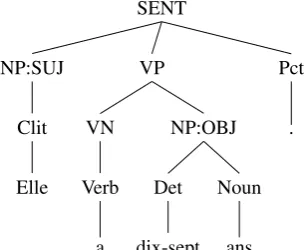
The extraction of a context-free grammar (CFG) from a constituency treebank is based on the classic method de-scribed in (Charniak, 1996): each internal node of the pars-ing tree is converted into a rule whose left-hand side (LHS) is the node’s constituent tag and the right-hand side (RHS) is the sequence of children nodes’ tags. The implicit gram-mar is formed by the set of such extracted rules. As an ex-ample, the figure 1 and 2 show the constituent tree for the French sentence “Elle a dix-sept ans.” (She is seventeen.), and the corresponding CFG rules.
SENT
Figure 1: a small constituent tree
SENT → NP:SUJ VPPct NP:SUJ → Clit
VP → VN NP:OBJ
VN → Verb
NP:OBJ → Det Noun
2.2.
Filtering the rules
Our goal being to extract properties from the CFG gram-mar, which is highly dependent from the set of rules, the tool integrates different filters according the granularity of tags, the syntactic structures and the rule distribution:
Tag granularity Tags are made of the POS or the phrase type (e.g. Noun,NP) and the syntactic functions (e.g. SUJ). Thecoarse grainfilter conserves only the first level of information and then groups syntactic units independently from their function.
None elements Some formalisms make use of compo-nents without projection in order to represent some linguistics phenomenons (such as ellipsis) or indicate relations between constituents. The none filter sup-press these empty elements and their traces in the tree. Coordinations Coordination constructions are frequent phenomena, that multiply the set of realized rules without providing much information on the relations between constituents. Thecoordinationfilter reduces expressions that match certain prototypical coordina-tion patterns.
Frequency A large number of rules (in other words local trees) appear rarely in the treebank, which can intro-duce noise. Thefrequency filter remove rules based on a minimal number of occurrences, or their ranks or frequencies among the rules of same LHS.
Experiment
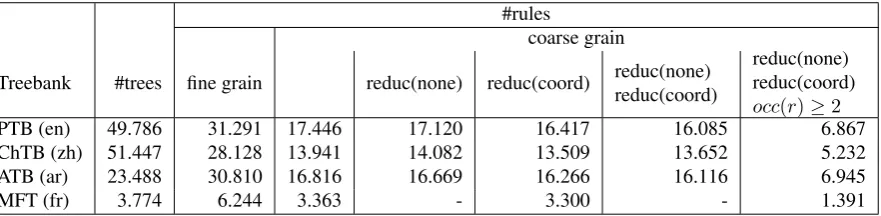
We use in this experiment 4 constituency treebanks, three of them being in the Penn treebank framework: thePenn Tree-bank itself (Marcus et al., 1995) itself, theChinese Tree-bank(Xue et al., 2010) and theArabic Treebank(Maamouri et al., 2010a; Maamouri et al., 2011; Maamouri et al., 2010b) all of them distributed by LDC. We also use the Modified French Treebank (Schluter and van Genabith, 2007) a subset of theFrench Treebank(Abeill´e et al., 2003) developed and distributed by LLF. The table 1 shows the extracted grammars sizes, when applying different filters.
2.3.
Adaptation to dependency treebanks
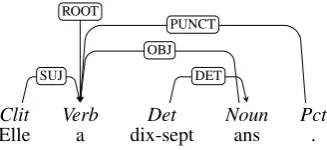
We apply a similar approach to dependency treebanks: in-ternal nodes (LHS of the rules) are now the head category, and children nodes (RHS) are the list of dependents, re-specting their projection order, plus an extra node with the symbol “*” indicating the head projection. The figures 3 and 4 show the dependency tree for the same French sen-tence of figure 1 and the CFG rules extracted.
Clit Verb Det Noun Pct
Elle a dix-sept ans .
SUJ
OBJ
DET PUNCT ROOT
Figure 3: a small dependency tree
Verb:ROOT → Clit:SUJ * Noun:OBJ Pct:PUNCT
Noun:OBJ → Det:DET*
Figure 4: infered CFG rules
2.4.
Inducing the syntactic properties
It remains difficult to explore or compare the syntactic char-acteristics of various languages using the complete gram-mar (independently of the formalism, constituents or de-pendencies). On the other hand, it is possible to compare some specific properties, in accordance with established practices in typology. For example, a classical typology consists in studying the verb/arguments relations and their linearity. We propose to induce from the treebanks some properties used to settle typologies. This properties are identified in the frame ofProperty Grammar.
Our tool focuses on 4 types of properties governing syntac-tic components, as described in (Blache and Rauzy, 2012).
Linearity : two components (A,B) have a linearity relation when the occurrence order of these two components is always the same.
Requirement : two components (A,B) have a requirement relation when the presence of one requires the pres-ence of the other.
Exclusion : two components (A,B) have an exclusion re-lation when they do not occur together.
Unicity : a component A has an unicity property if it never occurs several times in the RHS of the rules with a same LHS.
We note a property as a4-tuplep=< C, rel, A, B >where
C is the context (i.e. the LHS component),relone of the relations (precede, require, exclude, unicity) andAand
Bare the two components (B=Ain the case ofunicity).
Validating and violating subsets
In order to infer these properties, for each distinct LHS (syntactic unit or head), we first compile the set of com-ponents (i.e. the elements that occur in a RHS). In a second stage, for each pair of components(A, B), we separate the rules where A and/or B occur (together or not) according to whether they satisfy or violate a property as show on the table 2. Starting from these subsets, it becomes possi-ble to consider only the properties that are always satisfied (i.e without any violating rules). It is also possible to relax this constraint and make use of weighted properties, dis-tinguishing betweenstrong(frequent and (almost) always satisfied) andweaker (less frequent and/or more often vio-lated) properties.
Weigthing the properties
A first weightw0(equation (1)) can be directly obtained by
calculating the ratio of occurrences of the validating rules to the sum of both subsets — the properties satisfied in all cases corresponding then tow0 = 1. However, ifw0
#rules
coarse grain
Treebank #trees fine grain reduc(none) reduc(coord) reduc(none) reduc(coord)
reduc(none) reduc(coord)
occ(r)≥2
PTB (en) 49.786 31.291 17.446 17.120 16.417 16.085 6.867
ChTB (zh) 51.447 28.128 13.941 14.082 13.509 13.652 5.232
ATB (ar) 23.488 30.810 16.816 16.669 16.266 16.116 6.945
MFT (fr) 3.774 6.244 3.363 - 3.300 - 1.391
Table 1: some context-free grammars sizes
propertyp r∈V alidating(p) r∈V iolating(p)
< C, precede, A, B > AandBoccur in the RHS ofrand all occurrences ofAare before the firstB
AandBoccur in the RHS ofrand at least one occurrence ofAis after aB < C, require, A, B > AandBoccur in the RHS ofr Aoccurs, butBno.
< C, exclude, A, B > OnlyAor onlyBoccur in the RHS ofr BothAandBoccur
< C, unicity, A, A > Only oneAoccurs in the RHS ofr VariousAin the RHS ofr
Table 2: validating and violating rules
probable that one of their linearity relations has aw0of 1
(or close to 1); nevertheless it would be more relevant to consider the exclusion property even if itsw0is lower. We
introduce then a second weightw1(equation (2)) that
bal-ancesw0 with the frequency of validating rules in relation
to the entire set of rules (with the same LHS i.e.Rules(C)).
w0=
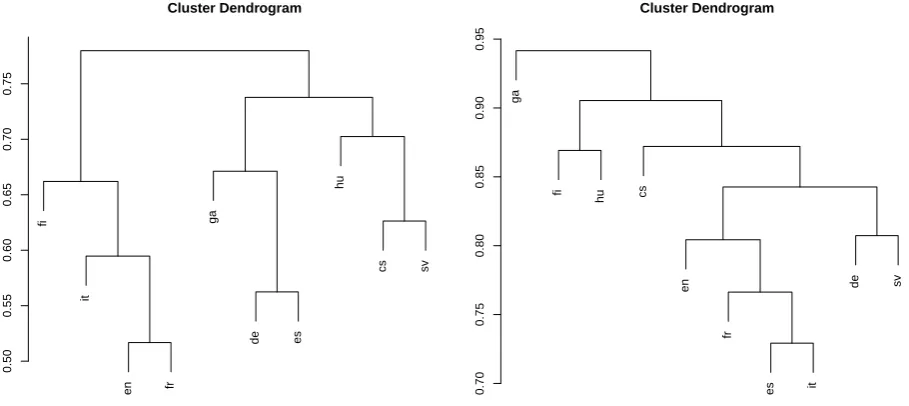
This experiment relies on the first version of the Univer-sal Dependency Treebank (Nivre et al., 2015), a family of dependency treebanks for 10 languages (Czech, German, English, Spanish, Finnish, French, Irish, Hungarian, Italian and Swedish) using an unique tagset : 17 Part-Of-Speech tags based on (Petrov et al., 2012), and 40 standardized de-pendencies relations described in (de Marneffe et al., 2014). As all languages use a common tagset, we can compare the properties extracted from each treebank and define a sim-ilarity between two languages based on the proportion of common properties. We build a hierarchical clustering of the 10 languages of the Universal Dependency Treebank (using thehclustfunction ofR). The figure 5 shows the re-sulting dendrograms either using all types of properties or only the linearity properties (precede). If the first cluster-ing, using all properties does not allow to bring out clear
aggregations. The second one, restricted to linearity prop-erties, is more convincing: we find in a same branch the romance languages (es, it and fr), two of the germanic lan-guages (de, sv) — English is grouped with the romance languages before joining the germanic branch — or the two uralic languages (fi, hu) (see table 3 for language families and features).
3.
Visualizing the data
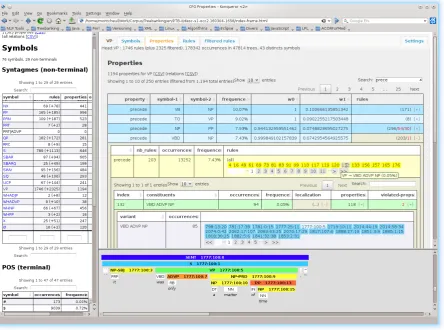
MarsaGramis also a tool to visually explore treebanks. The program genarates a set of dynamic html pages to navigate, for each LHS, through the elements composing the RHS, the extracted properties and the list of retained and filtered rules. The figure 6 shows a general view of the interface, divided in three part: an index on the left side, the data in-formation on the main part and a visualization of treebank’s occurrences in the lower part. The index lists all symbols of the treebank with their frequency and, for the symbols that are the LHS of some rules, the number of associated rules and extracted properties. A link on each LHS symbol loads the corresponding information on the main part of the windows.
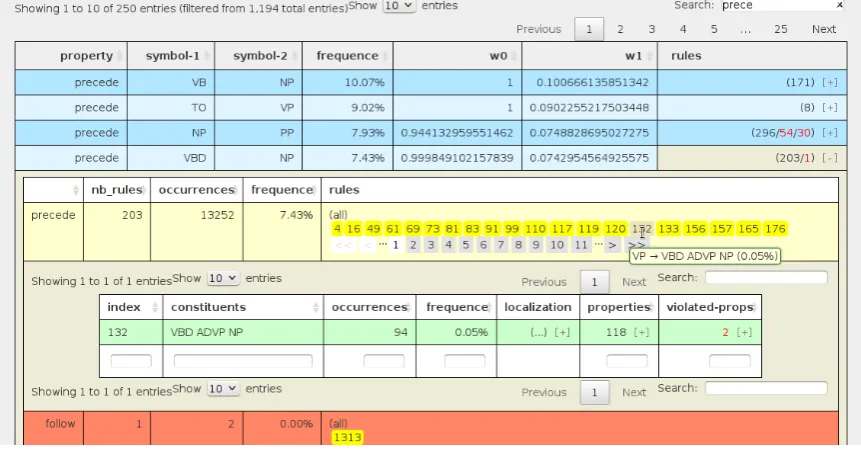
The main part offers three combinable “axes” of explo-ration: the list of symbols composing the RHS part of the rules, the extracted properties and the retained rules. Three tabs allow to switch between these axes as a starting point. Then we can progress in the exploration, combining the others axes as show the figures 7 to 10. Starting with the list of properties (figures 7, for the verbal phrase (VP), filtered to show only the precede relation), a click on a property opens a sub-table listing the various rules indexes that are related to the property, as shows figure 8 (property
fi
Figure 5: Comparing languages : all properties(left) and linearity properties(right)
Code Language Family Genre typologic features
cs Czech Indo-European Slavic SVO2, stress-timed, free word order
de German Indo-European Germanic V2 and SOV, inflectional, accusative, stress-timed, dy-namic accent
en English Indo-European Germanic SVO, inflectional, accusative, stress-timed, dynamic accent
sv Swedish Indo-European Germanic SVO, inflectional, accusative, stress-timed, pitch accent
es Spanish Indo-European Romance SVO, syllabic
fr French Indo-European Romance SVO, inflectional, accusative, syllabic it Italian Indo-European Romance SVO, syllabic
ga Irish Indo-European Celtic inflectional, accusative, VSO, stress-timed, dynamic accent
fi Finnish Uralic Finnic SVO, free word order
hu Hungarian Uralic Ugric SOV, free word order, agglutinative, accusative
Table 3: some languages features
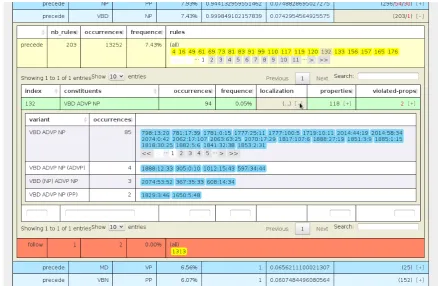
rule appears as a tooltip, and by a click it is selected to ap-pear on a sub-table showing rules and some data (figure 9 : occurrences, number of validated and violated properties). From these rules data table, a click opens a sub-table (fig-ure 10) with more details on the rule: its several variants when some reductions are used (none elements, coordina-tion) and, for each variant, the number of occurrences and their indexes in the treebank, with a link that shows the ac-tual occurrence in the lower part of the window.
When filters are used, another tab allows to inspect the list of filtered rules and access in a similar way to their actual occurrences.
4.
Conclusion
We have presented in this paper the method used to infer properties from treebanks, independently of the formalism (constituency or dependency). This method integrates dif-ferent filtering options making it possible to tune the prop-erties extraction. An application of this method to the Uni-versal Dependencies Treebankhas shown the validity of the approach in a typology perspective: a hierarchical
cluster-ing based on a subset of properties led to the reconstitution of language families. The system we have developed in this perspective,MarsaGram, is freely available and integrates as a side effect a possibility to use it as a treebank browser.
5.
Acknowledgments
This work has benefited from the French State support via its “Investissements d’avenir” programs ORTOLANG (ANR-11-EQPX-0032), BLRI (ANR-11-LABX-0036) and A*MIDEX (ANR-11-IDEX-0001-02).
6.
Bibliographical References
Blache, P. and Rauzy, S. (2012). Enrichissement du FTB : un treebank hybride constituants/propri´et´es (Enriching the French Treebank with Properties) [in french]. In Actes de la conf´erence conjointe JEP-TALN-RECITAL 2012, volume 2: TALN, pages 307–320, Grenoble, France, June. ATALA/AFCP.
2SVO, SOV or VSO are the relative order of the Sujet, Verbe
Figure 6: MarsaGram interface
Figure 8: properties’ rules
Figure 10: rule’s variants and localisation
Charniak, E. (1996). Tree-bank grammars. InProceedings of the Thirteenth National Conference on Artificial Intel-ligence, pages 1031–1036.
de Marneffe, M.-C., Dozat, T., Silveira, N., Haverinen, K., Ginter, F., Nivre, J., and D. Manning, C. (2014). Univer-sal stanford dependencies: A cross-linguistic typology. InProceedings of the Ninth International Conference on Language Resources and Evaluation (LREC-2014). Eu-ropean Language Resources Association (ELRA). Petrov, S., Das, D., and McDonald, R. (2012). A
univer-sal part-of-speech tagset. In Nicoletta Calzolari (Con-ference Chair), et al., editors, Proceedings of the Eight International Conference on Language Resources and Evaluation (LREC’12), Istanbul, Turkey, may. European Language Resources Association (ELRA).
7.
Language Resource References
Abeill´e, A., Cl´ement, L., and Toussenel, F. (2003). Corpus arbor´e pour le franc¸ais / French Tree-bank. Laboratoire de Linguistique Formelle. URL: http://www.llf.cnrs.fr/fr/Gens/ Abeille/French-Treebank-fr.php.
Maamouri, M., Bies, A., Kulick, S., Gaddeche, F., Mekki, W., Krouna, S., Bouziri, B., and Zaghouani, W. (2010a). Arabic Treebank:Part 1 v4.1. Linguistic Data Consor-tium, Arabic Treebank, 4.1. ISLRN 512-715-458-848-0. Maamouri, M., Bies, A., Kulick, S., Krouna, S., Gaddeche, F., and Zaghouani, W. (2010b). Arabic Treebank:Part 3 v3.2. Linguistic Data Consortium, Arabic Treebank, 3.2. ISLRN 770-467-034-042-0.
Maamouri, M., Bies, A., Kulick, S., Gaddeche, F., Mekki, W., Krouna, S., Bouziri, B., and Zaghouani, W. (2011).
Arabic Treebank:Part 2 v3.1. Linguistic Data Consor-tium, Arabic Treebank, 3.1. ISLRN 758-179-408-820-5. Marcus, M., Santorini, B., and Marcinkiewicz, M. A. (1995). Penn Treebank 2. Linguistic Data Consortium, Penn Treebank, 2. ISLRN 650-146-755-602-3.
Nivre, J., Bosco, C., Choi, J., de Marneffe, M.-C., Dozat, T., Farkas, R., Foster, J., Ginter, F., Goldberg, Y., Hajiˇc, J., Kanerva, J., Laippala, V., Lenci, A., Lynn, T., Man-ning, C., McDonald, R., Missil¨a, A., Montemagni, S., Petrov, S., Pyysalo, S., Silveira, N., Simi, M., Smith, A., Tsarfaty, R., Vincze, V., and Zeman, D. (2015). Universal Dependencies 1.0. LINDAT/CLARIN digital library at Institute of Formal and Applied Linguistics, Charles University in Prague, Universal Dependencies, 1.0. Handle: hdl:11234/1-1464.
Schluter, N. and van Genabith, J. (2007). Modified French Treebank. National Centre for Language Technology. URL:http://doras.dcu.ie/15265/.