Experiments in Mutual Exclusion Bootstrapping
Tara Murphy and James R. Curran School of Information Technologies
University of Sydney NSW 2006, Australia
{tm, james}@it.usyd.edu.au
Abstract
Mutual Exclusion Bootstrapping (MEB) was designed to overcome the problem of se-mantic drift suffered by iterative bootstrap-ping, where the meaning of extracted terms quickly drifts from the original seed terms (Curran et al., 2007). MEB works by
ex-tracting mutually exclusive classes in paral-lel which constrain each other.
In this paper we explore the strengths and limitations of MEB by applying it to two
novel lexical-semantic extraction tasks: ex-tracting bigram named entities and WordNet lexical file classes (Fellbaum, 1998) from the Google Web 1T 5-grams.
1 Introduction
Extracting lexical semantic resources from text with minimal supervision is critical to overcoming the knowledge bottleneck in Natural Language Process-ing (NLP) tasks ranging from Word Sense
Disam-biguation to Question Answering.
Template-based extraction is attractive because it is reasonably efficient, works on small and large datasets, and requires minimal linguistic pre-processing, making it fairly language independent. Hearst (1992) proposed template-based extraction for identifying hyponyms using templates likeX, Y, and/or other ZwhereXandYare hyponyms ofZ.
Riloff and Shepherd (1997) proposed iterative bootstrapping where frequent neighbours to terms from a given semantic class are extracted in multi-ple bootstrap iterations. Roark and Charniak (1998)
improved its accuracy by optimising the bootstrap-ping parameters. In mutual bootstrapping (Riloff and Jones, 1999) the terms, and the contexts they oc-cur in, are extracted. Similar approaches have been used in Information Extraction (IE) for identifying
company headquarters (Agichtein et al., 2000) and acronym expansions (Sundaresan and Yi, 2000).
InMutual Exclusion Bootstrapping(MEB), we
as-sume the semantic classes partition terms into dis-joint sets, that is, the classes are mutually exclusive
(Curran et al., 2007). Each class is extracted in par-allel using separate bootstrapping loops that each race to collect terms and contexts. Although this as-sumption is clearly false, it significantly reduces the extraction errors of existing approaches.
This paper presents two applications ofMEBthat allow some insight into MEB’s strengths and limi-tations. First, we extendMEB to extractingbigram BBNnamed entity types (Weischedel and Brunstein, 2005). We discover that both unigram and bigram
MEB are very sensitive to the context window
sur-rounding the extracted terms. Surprisingly, MEBis insensitive to the order the semantic classes are pre-sented and the noise in the terms themselves.
Second, we extract common nouns using 25 se-mantic classes defined by the WordNet lexical files (Fellbaum, 1998). We use a closed vocabulary of WordNet unigram nouns, so the evaluation can be performed automatically against WordNet. We find thatMEBperforms well on classes with narrow def-initions and thus more coherent contexts, such as
animal, but performs poorly on classes like cogni-tion. We also find that increasing the number of seed terms increases the accuracy significantly.
2 Mutual Exclusion Bootstrapping
Mutual bootstrapping (Riloff and Jones, 1999) has the advantage that it can identify new templates or
contexts, which in turn identify new terms, signifi-cantly increasing recall. Unfortunately, erroneously adding a term with a different predominant sense or a context that weakly constrains the terms, quickly leads to semantic drift, where erroneous terms or contexts infect the semantic class.
Mutual Exclusion Bootstrapping(MEB) attempts
to minimise semantic drift in both the terms and con-texts (Curran et al., 2007). It does this by extracting all of the semantic classes in parallel, using an inde-pendent bootstrapping loop for each class, with the constraint that a term or context must only be used by oneclass. We assume that each term has only one sense and that each context only extracts terms with one sense, that is, the semantic classes aremutually exclusivewith respect to terms and contexts.
This assumption is far from realistic, but it is very effective at reducing the degree of semantic drift. For many terms, especially the bigram named en-tities, there is a clearly dominant semantic class. However, for some pairs of semantic classes, e.g. na-tionalitiesandlanguages, there is a significant lexical overlap and so they are far from mutually exclusive. The MEBalgorithm is shown in Algorithm 1. In
each iteration, contexts and then terms are added to each semantic class. If more than one class attempts to extract a context or term in the current iteration then it is eliminated, leading to mutual exclusion between the semantic classes. The terms and con-texts are ranked in the same way as Riloff and Jones (1999), our only addition inMEBis the parallel mu-tual exclusion constraint.
Mutual exclusion is very strict and many terms and contexts are discarded. This is not a major is-sue when precision is paramount and we are using a large dataset, e.g. Web 1T, but it can be problematic on smaller datasets. It is a significant problem when the semantic classes are far from mutually exclusive because many viable contexts are rejected when the terms they extract are polysemous, even though the contexts themselves reliably select one sense.
MEBis potentially sensitive to the order the con-texts and terms are added to semantic classes, since once they are added to a class they cannot be added
in : Seed word listsSk∀categoriesk
in : Raw contextsC and termsT
in : # termsNT and contextsNCper iteration
out: TermTk and contextCklists∀categoriesk Tk←−Sk∀categoriesk;
foreachiterationdo foreachc∈C do
count # timescoccurs with eacht∈Tk;
discardcif occurs with multiple classes; foreachclass kdo
sort set ofcby above occurrence counts; add topNCcontexts toCk;
foreacht∈T do
count # timestoccurs with eachc∈Ck;
discardtif occurs with multiple classes; foreachclass kdo
sort set oftby above occurrence counts; add topNT terms toTk;
Algorithm 1: Mutual Exclusion Bootstrapping
elsewhere (by the mutual exclusion assumption). In this sense, the individual bootstrapping loops com-pete in parallel to reach a term or context first, and claim it for themselves. Polysemous terms may be added to just one semantic class if it is not identified by contexts from multiple semantic classes simulta-neously, and this also applies for contexts. There is no guarantee that the predominant sense of a term will be reached first, although if it is significantly more frequent, it is likely to be reached first since it will appear in more contexts.
3 Using the Google Web 1T n-grams Riloff and Jones (1999) used contexts extracted from POS tagged and chunked text by AutoSlog-TS (Riloff, 1996). Our goal was to keep MEB lan-guage independent to maintain this key advantage of template-based approaches. We also wanted to demonstrate thatMEBscales efficiently to extremely large datasets and vocabularies.
sta-tistical techniques. The individual words in the n-grams occurred ≥200 times, otherwise they were replaced with <UNK>. Each n-gram appears ≥40 times. There is 25GBof compressed data.
We use the 3-, 4-, or 5-grams from Web 1T as our raw data, depending on the experiment. The middle token (for unigrams) or tokens (for bigrams) form the term and the one or two tokens on either side form the context. This context definition is quite language independent (except for languages without word segmentation). Unfortunately, we can only ex-tract terms consisting of one or two words, and the contexts are noisier than those extracted from parsed text, cf. Curran (2004).
For the bigram experiments we follow the pro-cess described in Curran et al. (2007). We removed n-grams with non-titlecase middle token(s) because we only extract proper noun named entity types, and we removed all contexts containing numbers. For the WordNet experiments we only included n-grams where the middle token(s) were a term in WordNet. In every experiment, we eliminate contexts that only appear with one term, and thus terms that only ap-pear in one context, since they cannot be reached.
The size of the resulting dataset varied depend-ing on the experiment from 176MB(for the bigrams
heavily filtered using the t-test) to 1.2GB(for the bi-grams with a window of one word either side and the WordNet experiments). All of the data must be loaded into memory and for the largest experi-ments this requires 1.6GBofRAM using our space-optimised C++ implementation.
4 Named Entity Classes
In our first set of experiments we continue our previ-ous work on proper-noun named entities. We based our semantic classes on the 29 entity types used to annotated the BBNPronoun Coreference and Entity Type Corpus (Weischedel and Brunstein, 2005). We ignored entity types that did not primarily include proper nouns, for example the DESCRIPTIONtypes,
CHEMICALSandQUANTITIES.
For the unigram experiments we reused our previ-ous classification where we ignored entity types that were almost exclusively multi-word terms, for ex-ampleWORKS OF ARTandLAWS. We also split the
PERSON class into MALE andFEMALE first names
LABEL UNI BI DESCRIPTION NAME • Person: name
‘Katie Holmes’ ‘Adam Smith’
FEM • Person: female first name
Mary Patricia Linda Elizabeth
MALE • Person: male first name
James John Robert Michael William
LAST • Person: last name
Smith Johnson Williams Jones Brown
TITLE • • Honorific title
President Dr Lord Miss Major
NORP • • Nationality, Religion, Political (adj)
Republican Christian ‘South African’
FAC • • Facility: names of man-made structures
Broadway Legoland ‘Golden Gate’
ORG • • Organisation: e.g. companies, gov.
Intel Microsoft ‘American Express’
GPE • • Geo-political entity
Canada China London ‘Los Angeles’
LOC • • Locations other than GPEs
Africa Asia Pacific Earth ‘Middle East’
DATE • • Reference to a date or period
January May Friday ‘Easter Day’
LANG • • Any named language
English Arabic Hebrew ‘Scots Gaelic’
EVENT • Battles, sporting, and other named events
‘World War’ ‘Hurricane Katrina’
LAW • Document that has been made into a law
‘Reform Act’ ‘First Amendment’
Table 1: The semantic classes used for the proper noun unigram (Column 2) and bigram (Column 3) experiments. Bigram examples are shown in quotes.
and LAST names to investigate more fine-grained
distinctions for this class.
For the bigram experiments, we kept a single class
NAMEfor person name, and reintroduced the LAW
and EVENT classes. Most classes are common to
both the unigram and bigram experiments. As in our previous experiments, some classes were easier to evaluate manually because we were only extracting unigrams, whilst others were more difficult. Similar difficulties exist in the bigram classes as well. The complete list of semantic classes used in the named entity experiments are summarised in Table 1.
5 Named Entity Evaluation
re-quired for manual evaluation.
Although the seed lists were mutually exclusive, for the purposes of evaluation, ambiguous words such as Frenchwere counted as correct if they ap-peared in either valid category (NORPorLANG).
If a single word was an clearly part of a multi-word term we counted it as correct (e.g. Coast as a LOC) with the exception of the mixed unigram-bigram experiments. If the word was not strongly indicative of a semantic class (e.g. The) it was not counted as correct. Mis-spellings of words (e.g. Ja-nuray) were also counted as correct. The extracted terms that were unrecognised by the human evalua-tor were checked using Wikipedia and Google.
We calculate accuracy at n – the percentage of correct terms in the top n ranked terms, following previous bootstrapping work. This is averaged over the semantic classes (Av(n)). We manually evalu-ated all semantic classes down ton=50, which ade-quately discriminates between most configurations. We vary the number of seeds (nS), and terms (nT) and context (nC) added in each iteration.
6 Named Entity Experiments
Our initial expectation was that bigram named en-tities would be an easier task than unigram named entities because they had fewer senses and so bet-ter satisfied the mutual exclusion assumption. Also, we expected them to be easier to evaluate since they were less ambiguous. However, the results did not match our intuition and so we experimented with un-igrams and bun-igrams to determine the cause.
6.1 Context Geometry
A major disadvantage for the bigram and longer n-gram experiments is that the size of the context must be reduced to accommodate the term itself within a fixed sized n-gram (e.g. the Web 1T 5-grams). Even if longer n-grams were collected for bootstrapping, there would still be the problem of sparser counts (even from one trillion words).
We started by repeating our original unigram named entity experiments but this time we reduced the context window to one token on the left and/or right, as shown in Table 2. Table 3 shows the impact of context geometry on unigram accuracy. Our previous best unigram results are UNI5GMS
NAME TEMPLATE
UNI5GMS w1w2Xw3w4 UNI4LEFT w1w2Xw3 UNI4RIGHT w1Xw2w3 UNI3GMS w1Xw2 BI5LEFT w1w2X Xw3 BI5RIGHT w1X Xw2w3 BI4GMS w1X Xw2
Table 2: Unigram and bigram Web 1T templates.
nS nT nC Av(10) Av(50)
UNI5GMS 5 5 10 90 78
UNI4LEFT 5 5 10 86 74
UNI4RIGHT 5 5 10 76 49
UNI3GMS 5 5 10 74 48
Table 3: Effect of context geometry on unigrams.
nS nT nC Av(10) Av(50)
BI5LEFT 5 5 10 92 68
BI5RIGHT 5 5 10 83 51
BI4GMS 5 5 10 77 48
Table 4: Effects of context geometry on bigrams.
with 78%. Removing a token from the right con-text (UNI4LEFT) makes almost no difference to the results, but removing a token from the left con-text (UNI4RIGHT) makes an enormous difference (a loss of almost 30%). The effect of removing both (UNI3GMS) is slightly worse again.
We should also note that the UNI3GMS and UNI4GMS experiments use the Web 1T 3- and 4-gram data, so the counts are larger and more reli-able, and the chance of shared contexts is greater. This suggests that the impact of removing the left context is even greater than these results indicate.
We also considered the minimum number of con-texts a term had to appear in to be included. Our previous experiments required two contexts – other-wise a term cannot be discovered. Increasing this cutoff to 10 made no significant difference.
The impact of context geometry on bigram accu-racy is shown in Table 4. The penalty for removing some left context was not as great for bigrams, drop-ping from 68% withBI5GMSto 48% withBI4GMS. The remaining unigram experiments use UNI5GMS
STOP mean Av(50) σ Av(50)
NO 69 2.9
YES 75 3.0
Table 5: Effects of category order on unigrams.
6.2 Class Ordering and Stop Classes
One criticism of theMEBalgorithm is that it may be highly dependant on the order in which the classes are considered. Because of the mutual exclusion (i.e. once a word has been assigned to a particular class, it can’t be assigned to any other class) the class order clearly has the potential to impact the results.
To test this we have run a set of ten unigram ex-periments with the classes arranged in random per-mutations. The results are shown in Table 5. The standard deviation of the ten sets is 3.0, around a mean of 75. This shows that although it has some impact, MEBis reasonably robust to changes in the category order. The standard deviation from these experiments can be used as an indication of the scat-ter across theMEBexperiments in general.
We also compared the accuracy of using, and not using, the stop classes, which are used to con-strain specific semantic drift problems (Curran et al., 2007). When the stop classes were used, they al-ways appeared first in the same order, before the ran-domly permuted semantic classes. The difference in the means in Table 5 between the set with and with-out stop classes shows that using stop classes does improve the accuracy ofMEB.
6.3 Number of Contexts
Our experiments with unigrams in Curran et al. (2007) showed that the best results were obtained by adding 10 contexts per iteration of the bootstrap-ping process. We have repeated this experiment for bigrams, with the results shown in Table 6.
These experiments show that that best results are obtained for numbers of contexts between 5 and 20. There is a significant drop-off in accuracy (∼ 10−20%) for values of nC less than 5 or greater than 20. This demonstrates a preference for hav-ing more evidence for new terms behav-ing reliable than for simply adding more terms in each iteration. It also shows that keeping the number of terms added per iteration (nT) and the number of contexts (nC) added per iteration reasonably well balanced is the
nS nT nC Av(10) Av(50)
5 5 1 73 52
5 5 2 76 50
5 5 5 92 71
5 5 10 92 73
5 5 20 93 70
5 5 50 87 58
5 5 100 84 59
Table 6: Effects of changing the number of contexts added per iteration.
best strategy. This makes sense if we consider the extreme cases: adding 5 terms and only 1 new con-text per iteration would mean that it was difficult for the system to expand into new space; adding 5 terms and 100 new contexts per iteration would mean that many of the contexts may not be representative of the contexts that those 5 terms appear in.
6.4 Filtering Using Collocations
One issue that arises when extracting bigrams (or longer n-grams) is the possibility that random com-binations of tokens may be selected by chance in the
MEBprocess. To investigate this we have carried out
a series of experiments on data that was pre-filtered using collocation statistics.
We filtered the Web 1T data so that we only kept bigrams that were significant collocations based on their frequency in the Web 1T corpus. We chose the t-test as our measure of significance as it is simple to calculate and we do not have any low frequency values (<5) for which the t-test is known to per-form badly. Our calculation follows Manning and Sch¨utze (1999, pg. 165). If f(w)and f(w1,w2)are the unigram and bigram frequencies from Web 1T, then thet-test is:
t= p(w1,w2)−p(w1)p(w2)
p(w1,w2)
N−1
(1)
where N is the number of tokens. Using the Maxi-mum Likelihood Estimates (MLE) we have:
p(w1,w2) = f(w1,w2)
N−1 (2)
p(w) = f(w)
N (3)
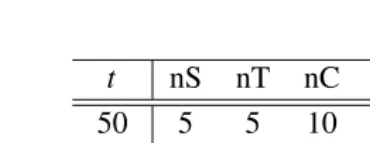
t nS nT nC Av(10) Av(50)
50 5 5 10 86 69
100 5 5 10 87 70
250 5 5 10 85 68
500 5 5 10 81 58
Table 7: Effects of using only significant colloca-tions. A value of 100 in column 1 means that only bigrams with a significance oft≥100 were used.
show that the filtering had no statistically significant result on the accuracy ofMEB. In a sense, this is not surprising, as theMEBprocess of ranking new terms
on the number of contexts they occur in is already performing a form of significance testing.
However, filtering on collocations does have the advantage of significantly reducing the size of the vocabulary without a significant loss of accuracy at the Av(50) level. For example the number of unique bigram terms in theBI5LEFTexperiments in previ-ous sections is 1 858 097, compared to 482 053 for thet≥100 filtered subset (∼25%) and 87 537 for thet≥250 filtered subset (∼5%). This is particu-larly important when dealing with massive corpora.
6.5 Multi-word Expressions
Of greater interest than extracting unigrams or bi-grams alone is the application ofMEBto the general case of extracting n-grams of any length. Since the maximum length of the term and context in the Web 1T corpus is five tokens, and given the decline in accuracy that comes with reducing the length of the context (see Tables 3 and 4) it would be impractical to extract terms with more than two tokens.
Hence our final experiment with proper noun named entity extraction combines the unigram and bigram data together. This serves as an initial test of extracting multi-word expressions as it is not spe-cific to only unigrams or only bigrams. The data consists of that used forUNI4LEFTandBI5LEFT, so that the context surrounding the unigram or bigram has the same length and geometry.
The categories we used for this experiment are those in Table 1 that are marked as suitable for both unigrams and bigrams. The results for this experi-ment are shown in Table 8. These are comparable to our best results for bigram extraction.
nS nT nC Av(10) Av(50)
5 5 10 84 69
Table 8: Results for extracting bi- and unigrams
UNI5GMS WordNet
terms 263 613 29 157
contexts 10 449 412 18 832 474 terms-contexts 42 039 483 88 178 856
Table 9: Comparison of the datasets used in the
UNI5GMS and WordNet experiments. The number
of unique terms, unique contexts and unique term-context combinations is shown.
7 WordNet Common Nouns
In our second set of experiments we investigate the application ofMEBto common nouns. For these ex-periments we used the noun classes from WordNet, as described in the next section. We expected the performance on this task to be worse than for proper nouns for a number of reasons. Firstly, common nouns have a larger number of senses, on average, compared to proper nouns. This breaks the mutual exclusion assumption that is central to MEB’s suc-cess. Secondly, common nouns are likely to occur in a wider range of contexts than many proper nouns. Thirdly, the common noun categories are more gen-eral and less well defined than for proper nouns, and abstract nouns are also likely to be harder to cate-gorise than concrete nouns.
One factor that favours common noun extraction is that the WordNet classes are designed to have rea-sonably complete coverage of the semantic space. This is not the case in the BBNnamed entity cate-gories, which is one of the reasons why we intro-duced stop classes (Curran et al., 2007).
Table 9 compares the size of the initial dataset for theUNI5GMSexperiments (Section 6) and the
Word-Net common noun experiments. Even though we have∼10 times fewer unique terms in the WordNet dataset, the number of unique term-context combi-nations is double that in the UNI5GMS dataset. The total size of the dataset used for the common noun experiments is 1.2GB.
7.1 WordNet Categories
seman-CATEGORY #WORDS #UNI #BI
act 6650 4917 1512
animal 7509 5010 2227
artifact 11587 7176 4163
attribute 3039 2646 322
body 2016 930 898
cognition 2964 2118 724
communication 5607 3788 1557
event 1074 844 216
feeling 428 396 31
food 2573 1347 1131
group 2624 1218 1012
location 3209 2272 788
motive 42 31 9
object 1545 1000 455
person 11087 9426 1516
phenomenon 641 332 285
plant 8030 4200 3382
possession 1061 492 514
process 770 594 162
quantity 1275 806 287
relation 437 266 150
shape 341 252 78
state 3544 2403 991
substance 2983 1869 1060
time 1028 574 375
Table 10: Noun categories in WordNet and the num-ber of words, unigrams and bigrams in each.
tic classes employed by lexicographers in the initial phase of inserting words into the WORDNET
hier-archy, called lexicographer files(lex files). For the noun hierarchy, there are 25 lex files and a file con-taining the top level nodes in the hierarchy called
Tops. Lex files form a set of coarse-grained sense distinctions within WORDNET. These categories and the number of WordNet words in each category are shown in Table 7.1.
7.2 WordNet Evaluation
These experiments only involved unigrams seen in WordNet and hence we could evaluate directly against WordNet as a complete gold standard. We extracted the unigrams from all of the noun cate-gories in WordNet. We then filtered the Web 1T corpus to extract only contexts where a WordNet un-igram was the central token. The rest of the filtering,
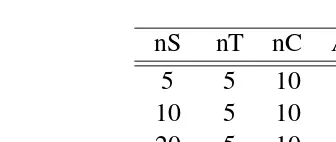
nS nT nC Av(10) Av(50)
5 5 10 29 22
10 5 10 51 43
20 5 10 67 52
100 5 10 73 59
Table 11: Effects of number of seed words.
evaluation and scoring details follow the principles described in Section 5.
Each proposed term was marked as correct if it appeared in that WordNet semantic category. The advantage of a closed system is the ease of evaluat-ing the results. However, an obvious disadvantage is that the system cannot be marked correct for valid unigrams it discovers in a category, that are not listed under that category in WordNet. A full manual eval-uation may produce better results.
8 WordNet Experiments
Creating seed lists using the Web 1T frequencies, as we had done in previous experiments, was compli-cated by skew towards web-related senses. For ex-ample,thumbnailwas the 5th most frequent word in thebodycategory andsitewas the 2nd most frequent word in thelocationcategory. In the number of seeds experiments we chose the seeds based on their fre-quency alone, but in the remaining experiments we manually created seed lists.
8.1 Number of Seed Words
We use thenmost frequent words that were unique to each category as seeds, regardless of whether they have obvious web-related senses. The results for increasing the number of seed words are shown in Table 11. Note that the seed words are not in-cluded in the accuracy calculation. The limited num-ber of terms in some categories (in particular, mo-tive) causes a decrease in accuracy when more seeds are used because many of the correct proposed syn-onyms are now seed words.
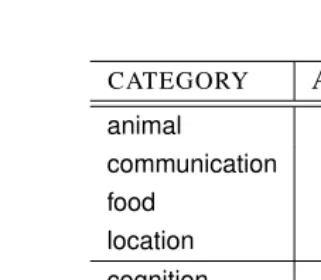
CATEGORY Av(10) Av(50)
animal 100 92
communication 100 94
food 100 96
location 100 98
cognition 0 12
feeling 60 24
object 40 20
relation 60 22
Mean 62 44
Table 12: Results for a selection of high and low per-forming common noun categories. The mean was calculated across all the semantic classes. The other parameters were (nS, nT, nC)=(5, 5, 10).
8.2 Comparison of Semantic Classes
To compare performance across semantic classes, we manually selected 5 seed words from the 20 most frequent words in each category (as measured in the Web 1T corpus). This allowed us to excluded words which we knew to have web-related senses that would dominate on the Web 1T data.
The accuracy obtained was 44%, which is sub-stantially lower than for the named entity unigram experiments (maximum 78%). However, the vari-ation in performance across the categories was ex-tremely high, as demonstrated in Table 12. Some categories, such ascognitionare extremely difficult.
This demonstrates that MEB is very good at
ex-tracting certain kinds of lexical semantic knowledge – primarily for categories that are very well defined, with frequent terms that appear in fairly constrained or idiomatic contexts, for exampleanimalsandfood. For these categories,MEBperformed just as well on common nouns as it did on many of the proper noun named entity categories.
Conclusions
We have presented two novel applications of Mutual Exclusion Bootstrapping (MEB): extracting bigram named entities and common nouns from WordNet. We confirmed that MEB is sensitive to the geome-try of the context window surrounding the extracted terms. As expected, a larger context leads to higher accuracy, but interestingly, this is almost entirely due to extra context on the left of the target term. Overall, this makes bigram and longer n-gram
ex-traction more difficult on fixed-sized window data, such as the Web 1T corpus.
Surprisingly, we discovered thatMEBis relatively insensitive to the order the semantic classes are pre-sented and to noise in the possible terms themselves. We appliedMEB to common nouns using 25
se-mantic classes defined by the WordNet lexical files. We performed automatic evaluation using a closed vocabulary and found that MEB performed well on
classes with narrower definitions such asanimal, but poorly on classes such ascognition. This is partly due to the concrete categories having more coherent con-texts. We found that increasing the number of seed terms improved the accuracy, even with poor quality seed terms.
We now plan to experiment with loosening the mutual exclusion assumption to allow for some overlap between categories. There are many pos-sibilities for improving the performance of MEBon common nouns – here we have presented only a pre-liminary analysis of the WordNet results. We also plan to experiment with text other than the Web 1T corpus so that we can test whether allowing wider contexts will further improve performance.
The experiments we have presented in this paper have demonstrated that MEB is an efficient and ac-curate method of extracting semantic classes over both unigram and bigram named entities. We have also demonstrated its potential for extracting seman-tic classes from WordNet for common nouns.
Acknowledgements
Both authors were funded on this work under ARC Discovery grants DP0453131 and DP0665973. We would like to thank the anonymous reviewers for their useful feedback.
References
Eugene Agichtein, Eleazar Eskin, and Luis Gravano. 2000. Combining strategies for extracting relations from text collections. Technical Report CUCS-006-00, Department of Computer Science, Columbia Uni-versity, New York, March.
James R. Curran, Tara Murphy, and Bernhard Scholz. 2007. Minimising semantic drift with mutual exclu-sion bootstrapping. In Proceedings of the Confer-ence of the Pacific Association for Computational Lin-guistics, pages 172–180, Melbourne, Australia, 19–21 September.
James R. Curran. 2004. From Distributional to Seman-tic Similarity. Ph.D. thesis, University of Edinburgh, Edinburgh, UK.
Cristiane Fellbaum, editor. 1998. WordNet: an elec-tronic lexical database. The MIT Press, Cambridge, MA USA.
Marti A. Hearst. 1992. Automatic acquisition of hy-ponyms from large text corpora. InProceedings of the 14th international conference on Computational Lin-guistics, pages 539–545, Nantes, France, 23–28 July.
Chris Manning and Hinrich Sch¨utze. 1999. Founda-tions of Statistical Natural Language Processing. MIT Press, Cambridge, MA.
Ellen Riloff and Rosie Jones. 1999. Learning dictio-naries for information extraction by multi-level boot-strapping. InProceedings of the Sixteenth National Conference on Artificial Intelligence, pages 474–479, Orlando, FL USA, 18–22 July.
Ellen Riloff and Jessica Shepherd. 1997. A corpus-based approach for building semantic lexicons. In Proceed-ings of the Second Conference on Empirical Meth-ods in Natural Language Processing, pages 117–124, Providence, 1–2 August.
Ellen Riloff. 1996. Automatically generating extrac-tion patterns from untagged text. InProceedings of the Thirteenth National Conference on Artificial Intel-ligence, pages 1044–1049.
Brian Roark and Eugene Charniak. 1998. Noun-phrase co-occurrence statistic for semi-automatic se-mantic lexicon construction. In Proceedings of the 17th International Conference on Computational Lin-guistics and the 36th annual meeting of the Associa-tion for ComputaAssocia-tional Linguistics, pages 1110–1116, Montr´eal, Qu´ebec, Canada, 10–14 August.
Neel Sundaresan and Jeonghee Yi. 2000. Mining the web for relations. In Proceedings of the 9th Inter-national World Wide Web Conference, Amsterdam, Netherlands, 15–19 May.