Cross-checking WordNet and SUMO Using Meronymy
Javier ´
Alvez, Itziar Gonzalez-Dios, German Rigau
LoRea Group, IXA Group, IXA GroupUniversity of the Basque Country (UPV/EHU)
[email protected], [email protected], [email protected]
Abstract
We report on the practical application of a black-box testing methodology for the validation of the knowledge encoded in WordNet, SUMO and their mapping by using automated theorem provers. Our proposal is based on the part-whole information provided by WordNet, out of which we automatically create a large set of tests. Our experimental results confirm that the proposed system en-ables the validation of some pieces of information and also the detection of missing information or inconsistencies among these resources.
Keywords:Meronymy, Knowledge validation, Automated Theorem Proving
1.
Introduction
Despite being created manually, knowledge resources such as WordNet (Fellbaum, 1998) and SUMO (Niles and Pease, 2001) are not free of errors and inconsistencies. Un-fortunately, improving, revising and correcting such large knowledge bases is a never-ending task that has been mainly carried out manually. A few automatic approaches have also been applied focusing on checking certain struc-tural properties on WordNet e.g. Daud´e et al. (2003) and Richens (2008) or using automated theorem provers on SUMO e.g. Horrocks and Voronkov (2006) and ´Alvez et al. (2012). Just a few more have studied automatic ways to validate the knowledge content encoded in these resources by cross-checking them. For instance, ´Alvez et al. (2008) exploit the EuroWordNet Top Ontology (Rodr´ıguez et al., 1998) and its mapping to WordNet for detecting many on-tological conflicts and inconsistencies in the WordNet nom-inal hierarchy.
In ´Alvez et al. (2017), we proposed a method for the auto-matic creation ofcompetency questions(CQs) (Gr¨uninger and Fox, 1995), which enabled to evaluate the competency of SUMO-based ontologies. Our proposal was based on several predefined question patterns (QPs) that were in-stantiated using information from WordNet and its map-ping into SUMO (Niles and Pease, 2003). In addition, we described an application of automated theorem provers (ATPs) for the automatic evaluation of the proposed CQs. This proposal was used in ´Alvez and Rigau (2018) for a preliminary validation of WordNet, SUMO and their map-ping.
The main contribution of this paper is a proposal for the au-tomatic validation of WordNet, SUMO and their mapping. For this purpose, we create a new set of CQs that is ob-tained on the basis of the part-whole data of WordNet and which is an improved version of the set proposed in ´Alvez and Rigau (2018). By means of our proposal, we demon-strate the practical capabilities of the method introduced in
´
Alvez et al. (2017) for the automatic detection of semantic agreements and inconsistencies in large-scale knowledge resources. For example, the knowledge encoded in the WordNet relations part(elementary particle1n,atom1n),
member(national1n,country3n) and
substance(cartilage1
n,cartilaginous structure3n) can also be inferred from SUMO. On the contrary, according to our interpretation of the meronymy relations of WordNet, the knowledge in the relations part(cell2n,cell nucleus1n) and
substance(grape1n,wine1n) is incompatible with SUMO. In addition, our proposal enables the detection of missing knowledge: for instance, WordNet relates waist1n and
torso1nbypart, but the resulting conjectures are not proved to be entailed by SUMO in our experiments using ATPs. By a manual inspection of the ontology, we discover that this issue is due to the fact that the SUMO concepts connected to waist1n and torso1n according to the map-ping between WordNet and SUMO —Waist and Torso
respectively— are not related in SUMO.
Outline of the paper. In the following three sections, we in-troduce WordNet (Section 2), SUMO (Section 3), and their mapping (Section 4). Then, we describe the process for the creation of CQs in Section 5. Next, we report on and dis-cuss our evaluation results in Sections 6 and 7 respectively. Finally, we conclude in Section 8.
2.
Meronymy Relations in WordNet
In WordNet, meronymy —the part-whole relation— holds between synsets likebackrest1
n andseat1n (i.e. parts) and
chair1
n(i.e. whole). Parts are inherited from their superor-dinates: if a chair has a seat, then an armchair has a seat as well. But parts are not inherited “upward” as they may be characteristic only of specific kinds of things rather than the class as a whole: chairs and kinds of chairs have a seat, but not all kinds of furniture have a seat.
There are 3 main meronymy relations in WordNet v3.0 that relate noun synsets: i) part, the general meronymy rela-tion; ii)member, which relates particulars and groups; and iii) substance, which relates physical matters and things. In total, there are 22,187 (ordered) meronymy synset pairs (around a %10 of the synset pairs in WordNet): 9,097 pairs usingpart, 12,293 pairs usingmemberand 797 pairs using
substance. For example, the synsetspolice officer1nand
3.
SUMO
SUMO1 has its origins in the nineties, when a group of engineers from the IEEE Standard Upper Ontology Work-ing Group pushed for a formal ontology standard. Their goal was to develop a standard upper ontology to promote data interoperability, information search and retrieval, au-tomated inference and natural language processing. Currently, SUMO consists of about 20,000 terms and about 70,000 axioms organized in several levels. In the upper two levels —Top and Middle levels— the concepts, relations and axioms that are meta, generic or abstract can be found. From now on, we refer to the upper two levels of SUMO as itscore. On the basis of these two levels, concepts that are specific to particular domains are in the so-called domain
ontologies. Adimen-SUMO ( ´Alvez et al., 2012) is obtained by means of a suitable transformation of the knowledge in the core of SUMO into First-Order Logic (FOL), which en-ables its use by FOL ATPs such as Vampire (Kov´acs and Voronkov, 2013) and E (Schulz, 2002).
The knowledge in SUMO is organized around the notions of individuals and classes —the main SUMO concepts. These concepts are respectively defined in Adimen-SUMO by means of themeta-predicates$instanceand$subclass. SUMO objects and classes are not disjoint, since every SUMO class is defined to be instance of Class, and thus every SUMO class is also a SUMO object. Additionally, SUMO differentiates relationsandattributes. In particu-lar, SUMO distinguishes between individual relation and attributes —that is, instances of the SUMO classesRelation
andAttributerespectively— andclassesof relations and at-tributes —that is, subclasses of the SUMO classesRelation
andAttributerespectively. SUMO provides specific predi-cates for dealing with relations and attributes. Some of the most important ones aresubrelation,subAttribute,holdsk
andattribute. For example, in the next SUMO axiom the predicateattributeis used for the characterization of subAt-tribute:
(forall (?ATTR1?ATTR2) (1)
(=>
(subAttribute ?ATTR1?ATTR2)
(forall (?OBJ)
(=>
(attribute ?OBJ?ATTR1)
(attribute ?OBJ?ATTR2)))))
From now, on we denote the nature of SUMO concepts by adding as subscript the following symbols:
• oSUMO individuals that are neither classes nor rela-tions nor attributes
• c SUMO classes that are neither classes of relations nor classes of attributes
• rindividual SUMO relations
• aindividual SUMO attributes
1http://www.ontologyportal.org
• Rclasses of SUMO relations
• Aclasses of SUMO attributes
For example, Cellc represents the Cell class, memberr thememberindividual relation andLarvala theLarval at-tribute.
4.
The Mapping Between WordNet and
SUMO
WordNet is linked to SUMO by means of the mapping de-scribed in Niles and Pease (2003). This mapping connects synsets of WordNet to terms of SUMO using three rela-tions: equivalence,subsumption andinstance. The rela-tion equivalence denotes that the related WordNet synset and the SUMO concept are equivalent in meaning, whereas the relations subsumption and instance indicate that the WordNet synset is subsumed by the SUMO concept or is an instance of the SUMO concept respectively. Further-more, the mapping uses the complementaries of equiva-lenceandinstance. We denote mapping relations by con-catenating the symbols ‘=’ (equivalence), ‘+’ ( subsump-tion), ‘@’ (instance), ‘=’ (complementary ofb equivalence) and ‘+’ (complementary ofb subsumption) to the
corre-sponding SUMO concept. For example, the synsetswaist1 n andtorso1
nare connected toWaisto=andTorsoc+ respec-tively.
From the 82,115 noun synsets defined in WordNet v3.0, 73,472 noun synsets are directly connected to concepts that are defined in the core of SUMO —and, thus, in Adimen-SUMO—, while only 7,578 synsets are linked to SUMO concepts defined in domain ontologies. As described in
´
Alvez et al. (2017), those synsets linked to concepts defined in domain ontologies can be connected to concepts from the core of SUMO by means of the SUMO structural rela-tions$subclass,subrelationrandsubAttributer. Finally, it is worth to remark that some noun synsets are connected to several SUMO concepts (concretely, 1,043 synsets). The knowledge in the mapping between WordNet and SUMO can be formalized by means of Adimen-SUMO statements as described in ´Alvez et al. (2017). For this purpose, we take advantage from the fact that most of the SUMO knowledge is based on the notion ofobjectsand that only a few of SUMO predicates provide information at the level ofclasses. Thus, the proposed Adimen-SUMO state-ments relate synsets to sets of SUMO objects in most cases. For the construction of those Adimen-SUMO statements, we choose the most suitable SUMO predicate according to nature of the SUMO concepts to which the synset is con-nected: equalr for SUMO objects, $instance for SUMO classes and attributer for SUMO attributes.2 In addition, we use $subclassfor the construction of Adimen-SUMO statements in the few cases where synsets have to relate the knowledge of SUMO at the level of classes. Indepen-dently from the SUMO predicate that is selected, we intro-duce a new variable that is associated to the given synset in the proposed Adimen-SUMO statement. For exam-ple, the next Adimen-SUMO statements relate the synsets
2The mappings to SUMO relations are discarded for the
Meronymy Pairs 1stQP 2ndQP 3rdQP 4thQP Total
relations Total Error Pairs CQs Pairs CQs Pairs CQs Pairs CQs Pairs CQs
part 9,097 1,367 6,797 1,346 122 110 750 445 61 59 7,730 1,960
member 12,293 11,939 318 88 19 19 15 12 2 2 354 121
substance 797 632 147 47 6 6 10 9 2 2 165 64
Total 22,187 13,938 7,262 1,481 147 135 775 466 65 63 8,249 2,145
Table 1: CQs obtained from WordNet meronymy
waist1n,atom1nandpolice officer1n—respectively connected toWaisto,AtomcandPoliceOfficera— to sets of SUMO ob-jects by introducing the new variables?W,?Aand?O:
(equal ?WWaist) (2)
($instance ?AAtom) (3)
(attribute ?OPoliceOfficer) (4)
Similarly, the next Adimen-SUMO statement relates the synsetscartilage1
n, which is connected toTissuec, to a set of SUMO classes introducing the new variable?T:
($subclass ?TTissue) (5)
Finally, the quantification of the introduced variables is decided according to the mapping relation that connects synsets and the SUMO concepts:
• If the given synset is connected using equivalence
(resp. the complement of equivalence), then we can assume that the synset is related to all (resp. is not re-lated to any of) the potential SUMO objects that are characterized by the Adimen-SUMO statement pro-posed above. For this purpose, the variable associ-ated to the given synset is considered to be universally quantified.
• Otherwise —the synset is connected using subsump-tion (resp. the complement of subsumption) or
instance—, we can only assume that the synset is re-lated to (resp. is not rere-lated to) some of the potential SUMO objects that are characterized by the Adimen-SUMO statement proposed above. This means that the variable associated to the given synset is considered to be existentially quantified.
In the next section, we describe the use of question patterns for the combination of the Adimen-SUMO statements that are obtained for the synsets in a given WordNet pair.
5.
Competency Questions Based on
Meronymy
The automatic validation of WordNet and SUMO on the ba-sis of CQs and ATPs requires to translate all the information into a formal language. By means of Adimen-SUMO, the core information of SUMO is already written in FOL. In addition, the mapping information between WordNet and SUMO can be translated into Adimen-SUMO statements as we describe in the above section. Thus, it suffices to translate the semantics of the WordNet meronymy relations in terms of Adimen-SUMO. For this purpose, we have in-spected SUMO in order to find the relations that are syn-onym or semantically similar to them. In SUMO, the main
meronymy relation is partr and we can find 30 different subrelations of partr in its core. Among them, we have selected the SUMO predicatespartrandmemberras coun-terpart of the WordNet relationspartandmember respec-tively. In addition, we have selectedmaterialr, which is not subrelation ofpartr, as counterpart ofsubstance. As for every SUMO relation, SUMO providesdomainaxioms that restrict the set of SUMO objects that can be related by the above predicates as follows:
• partrrelates pairs ofObjectcindividuals.
• memberr relates SelfConnectedObjectc objects (first argument) toCollectioncobjects (second argument).
• materialr relates subclasses of Substancec (first ar-gument) toCorpuscularObjectcobjects (second argu-ment).
Additionally, SUMO provides incompatibilities be-tween SUMO objects. Among others, objects of
CorpuscularObjectc are incompatible with both
CollectioncandSubstancec.
On the basis of the above formalization of the meronymy information of WordNet in terms of Adimen-SUMO, we proceed to the creation of CQs. For this purpose, we propose 4 QPs depending on the mapping relation by which the synsets in the given WordNet pair are connected to SUMO. Those QPs are instantiated by using (a) the Adimen-SUMO statements that formalize the mapping in-formation of synsets, and (b) the SUMO predicate that is se-lected depending on the given WordNet meronymy relation. During the process of instantiation, we can already detect some incompatibilities on the basis of individual SUMO in-compatibilities.
We report on the number of WordNet pairs tested and the number of CQs resulting from each QP in Table 1 and in the next subsections we describe the proposed QPs.
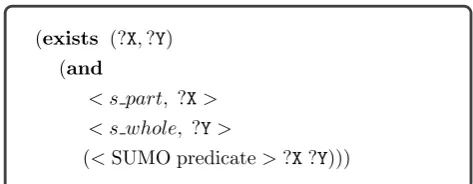
(exists (?X,?Y) (and
< s part, ?X> < s whole, ?Y>
(<SUMO predicate>?X?Y)))
Figure 1: First question pattern for hs part, s wholei
5.1.
First Question Pattern
The first question pattern is designed to be applied to meronymy pairs where both synsets are connected using (the negation of)subsumptionandinstance.
In Figure 1, we describe the combination of the selected SUMO predicate and the Adimen-SUMO statements that result from the mapping information of synsets by consid-ering the introduced variables to be existentially quantified.
hcountry3ni: [Groupc+]
hnational3ni: [Humanc+]
hmemberi ? [memberr]
Figure 2:national1nandcountry3n.
Next, we illustrate the instantiation of the result-ing question pattern by considerresult-ing the WordNet pair
member(national1n,country3n). As described in Figure 2, the synsets in that pair are respectively connected toHumanc+ andGroupc+. Thus, the combination of the SUMO state-ments that result from their mapping information with the SUMO predicatememberryields the following CQ:
(exists (?X,?Y) (6)
(and
($instance ?XHuman)
($instance ?YGroup)
(member ?X?Y)))
In the same way, the synsets in the WordNet pair
substance(cartilage1n,cartilaginous structure1n) are respec-tively connected toTissuecandBodyPartc. In this case, we have to relatecartilaginous structure1nwith a set of SUMO classes, since the selected SUMO predicate is materialr. Thus, the resulting CQ is:
(exists (?X,?Y) (7)
(and
($subclass ?XTissue)
($instance ?YBodyPart)
(material ?X?Y)))
Using this first QP, we obtain 1,481 CQs from 7,262 Word-Net pairs (see Table 1).
5.2.
Second Question Pattern
The second question pattern is designed for the meronymy synset pairshs part, s wholeiwheres partis connected by (the negation of)equivalenceands wholeis connected by (the negation of)subsumptionorinstance.
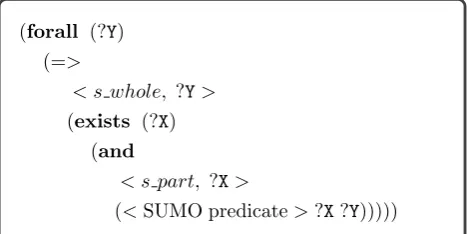
In this case, the variable associated to s wholeis consid-ered to be universally quantified, while the variable associ-ated tos part is considered to be existentially quantified. The resulting question pattern is described in Figure 3.
(forall (?X)
(=>
< s part, ?X>
(exists (?Y)
(and
< s whole, ?Y>
(<SUMO predicate>?X?Y)))))
Figure 3: Second question pattern for hs part, s wholei
meronymy pairs
htorso1
ni: [Torsoc+]
hwaist1ni: [Waisto=]
hparti ? [partr]
Figure 4:waist1nandtorso1n.
In order to illustrate the instantiation of this second question pattern, we consider the synset pair part(waist1n,torso1n), where the involved synsets are respectively connected to
Waisto=andTorsoc+as described in Figure 4. On the ba-sis of the above mapping information, the selected SUMO predicate ispartrand we obtain the following CQ:
(forall (?X) (8)
(=>
($instance ?XWaist)
(exists (?Y)
(and
($instance ?YTorso)
(part ?X?Y)))))
As reported in Table 1, from this QP we obtain 135 CQ on the basis of 147 WordNet pairs.
(forall (?Y)
(=>
< s whole, ?Y>
(exists (?X)
(and
< s part, ?X>
(<SUMO predicate>?X?Y)))))
Figure 5: Third question pattern for hs part, s wholei
5.3.
Third Question Pattern
The third question pattern is the dual of the second one because it is designed for meronymy synset pairs
hs part, s wholeiwheres partis connected by (the nega-tion of)subsumptionorinstance, ands wholeis connected by (the negation of)equivalence. Consequently, the vari-ables associated tos whole ands part are considered to be universally and existentially quantified respectively, as described in Figure 5.
hcomittee2ni: [Commissionc+]
hcommittee member1ni: [Humanc+]
hmemberi ? [memberr]
Figure 6:committee member1
nandcommittee1n.
This third question pattern is applied to synset pairs like member(committee1n,committee member1n), where synsets are respectively connected to Humanc+ and
Commissionc=. By using the SUMO predicatememberr, the resulting CQ is:
(forall (?Y) (9)
(=>
($instance ?YCommission)
(exists (?X)
(and
($instance ?XHuman)
(member ?X?Y)))))
Using this third QP, we obtain 466 CQs from 775 WordNet pairs (see Table 1).
5.4.
Fourth Question Pattern
The last question pattern is designed for its application to meronymy pairs where both synsets are connected using (the negation of)equivalence.
In this case, the question pattern is obtained by the con-junction of the second and the third question patterns (see Figure 7). In order to illustrate its application, we consider the synset pair part(elementary particle1n,atom1n), where synsets are respectively connected toSubatomicParticlec=
(and
(forall (?X)
(=>
< s part, ?X>
(exists (?Y)
(and
< s whole, ?Y>
(<SUMO predicate>?X?Y))))) (forall (?Y)
(=>
< s whole, ?Y>
(exists (?X)
(and
< s part, ?X>
(<SUMO predicate>?X?Y))))))
Figure 7: Fourth question pattern for hs part, s wholei
meronymy pairs
hatom1
ni: [Atomc=]
helementary particle1ni: [SubatomicParticlec=]
hparti ? [partr]
Figure 8:elementary particle1
nandatom1n.
andAtomc=as described in Figure 8. The resulting CQ is:
(and (10)
(forall (?X)
(=>
($instance ?XSubatomicParticle)
(exists (?Y)
(and
($instance ?YAtom)
(part ?X?Y)))))
(forall (?Y)
(=>
($instance ?YAtom)
(exists (?X)
(and
($instance ?XSubatomicParticle)
(part ?X?Y))))))
Meronymy QPs Total
relations QP #1 QP #2 QP #3 QP #4
Pairs CQs Pairs CQs Pairs CQs Pairs CQs Pairs CQs Pairs CQs
part +3,272 599 +122 56 +288 162 +8 8 +3,690 825 47.74% 42.09%
-21 6 -0 0 -1 1 -5 5 -27 12 0.35% 0.61%
member +20 10 +1 1 +1 1 +0 0 +22 12 6.21% 9.92%
-24 9 -0 0 -0 0 -0 0 -24 9 6.78% 7.44%
substance +94 17 +1 1 +3 2 +0 0 +98 20 59.39% 31.25%
-0 0 -2 2 -0 0 -0 0 -2 2 1.21% 3.13%
Total +3,386 626 +124 58 +292 165 +8 8 +3,810 857 46.19% 39.95%
-45 15 -2 2 -1 1 -5 5 -53 23 0.64% 1.07%
Table 2: Evaluation results
6.
Evaluation
In this section, we discuss the results obtained from the experimental evaluation of the set of CQs described in the above section. This experimentation has been per-formed in an IntelR XeonR CPU [email protected] with 2GB of RAM memory per processor and different. All the required knowledge resources—the ontology Adimen-SUMO v2.6,( ´Alvez et al., 2017) the set of CQs and con-jectures, the mapping between Adimen-SUMO v2.6 and WordNetv3.0, WordNet v3.0 meronymy pairs— and the re-sulting execution reports are publicly available.3
For the evaluation of CQs, we have applied the framework proposed in ´Alvez et al. (2017). By following this proposal, we get two conjectures for each CQ: i) the conjecture that describes the CQ itself, which is expected to be entailed by the ontology (calledtruth-test), and ii) its negation, which is expected not to be entailed (calledfalsity-test). Each of the resulting 4,830 conjectures has been tested using several versions of Vampire4(Kov´acs and Voronkov, 2013) and E5 (Schulz, 2002). In each test, we provide the conjecture to-gether with Adimen-SUMO as input to the ATP system. If a truth-test is proved to be entailed by the ontology, then we decide that the knowledge in the WordNet pairs that yield the corresponding CQ iscompatiblewith SUMO and the mapping information. Thus, we conclude that those WordNet pairs arewell-aligned—or simplyaligned— with SUMO and the mapping information. On the contrary, if a falsity-test is proved to be entailed by the ontology, then the knowledge in the WordNet pairs that yield the correspond-ing CQ isincompatible with SUMO and the mapping in-formation. Consequently, we say that those WordNet pairs aremisalignedwith SUMO and the mapping information. If either the truth-test or the falsity-test of a given CQ is proved to be entailed by the ontology, then we say than the corresponding CQ isresolved.
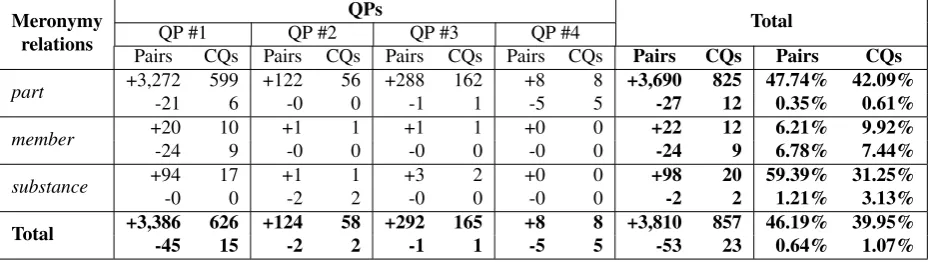
In Table 2 we summarize our experimental results as fol-lows. For each meronymy relation (1st column) and each QP, we provide the following information from the 2nd to
3http://adimen.si.ehu.es/web/AdimenSUMO 4
Using the following parameters: --proof tptp --output axiom names on --mode casc -t 600
-m 2048.
5
Using the following parameters: --auto
--proof-object -s --cpu-limit=600 --memory-limit=2048.
the 9thcolumn:
• In Pairs columns, prefixed by ‘+’ (resp. by ‘-’) we give the number of WordNet pairs that are well-aligned (resp. misaligned) with SUMO and the mapping in-formation.
• In CQs columns, we give the number of truth-tests/falsity-tests that have been proved for the classi-fication of WordNet pairs as aligned/misaligned with SUMO and the mapping information.
In addition, in the last 4 columns we summarize the number/percentage of WordNet pairs that are well-aligned/misaligned with SUMO and the mapping informa-tion, and the number and percentage of truth-tests/falsity-tests that have been proved.
To sum up, the knowledge in 3,810 WordNet pairs (46.19 % of the tested WordNet pairs) is decided to be compati-ble with SUMO and the mapping information, while the knowledge in only 53 WordNet pairs (0.64 % of the tested pairs) is decided to be incompatible. Among them, it is easy to see thatpartandsubstancepairs are better aligned with the knowledge in SUMO thanmemberpairs: on one hand, 3,690 part pairs (47.74 % of the testedpart pairs) and 98 substance pairs (59.39 % of the tested substance
pairs) are decided to be well-aligned with SUMO and the mapping information against 22memberpairs (6.21 % of the tested member pairs); on the other hand, 24member
pairs (6.78 % of the tested member pairs) are decided to be misaligned with SUMO and the mapping information, against 27partpairs (0.35 % of the testedpartpairs) and 2
substancepairs (0.64 % of the testedsubstancepairs). Fur-ther, if we consider the total number of meronymy pairs, the percentage ofpartpairs that are well-aligned with SUMO and the mapping information —40.56 % (3,690 from 9,097
partpairs)— is clearly larger than the percentage of mem-berandsubstancepairs that are well-aligned —0.18 % (22 from 12,293memberpairs) and 12.3 % (98 from 797 sub-stancepairs respectively). Finally, the percentage of mem-berpairs that are tested —only 2.88 % (354 from 12,293
one, lead us to conclude that the mapping information of the involved synsets can be substantially improved. With respect to CQs, ATPs are able to successfully re-solve 880 CQs (41.03 % of 2,145 CQs): 857 truth-tests (39.95 % of 2,145 truth-tests) plus 23 falsity-tests (1.07 % of 2,145 falsity-tests). It is worth noting that the percent-age of meronymy-based CQs that are resolved by ATPs is quite similar to the percentage of CQs for the validation of the knowledge in the ontology that were resolved by ATPs in the experimentation reported in ´Alvez et al. (2017). Re-garding QPs, the percentage of CQs obtained from the the first 3 QPs that are resolved —43.28 % (641 from 1,481 CQs), 44.44 % (60 from 158 CQs) and 35.62 % (166 from 466 CQs) respectively— is clearly larger than the percent-age of CQs obtained from the last QP that are resolved — 20.63 % (13 from 63 CQs). This fact is not surprising since the truth-tests that result from the first 3 QPs are much weaker than the truth-tests that are obtained from the last QP.
7.
Discussion
In this section, we proceed to discuss some of the particular results that we have extracted from our experiments. First of all, our proposal enables the detection of semantics agreements between WordNet, SUMO and their mapping. For example, the synset pairsmember(national1n,country3n),
substance(cartilage1n,cartilaginous structure3n) and
part(elementary particle1n,atom1n) are decided to be well-aligned with SUMO and the mapping information since the truth-tests obtained from CQs (6,7,10) are proved to be en-tailed by Adimen-SUMO v2.6. Similarly, the synsets in the pairmember(police officer1
n,police force1n) are respectively connected to PoliceOfficera=and PoliceOrganizationc+. Thus, by applying the second QP we obtain the following CQ:
(forall (?Y) (11)
(=>
(attribute ?YPoliceOfficer)
(exists (?X)
(and
($instance ?XPoliceOrganization)
(member ?X?Y)))))
The above CQ is resolved by ATPS since its truth-test is proved to be entailed by Adimen-SUMO v2.6. Conse-quently, the pair member(police officer1n,police force1n) is decided to be well-aligned with SUMO and the mapping information.
Second, our proposal enables the detection of inconsis-tencies among WordNet, SUMO and their mapping. In-deed, we do not always require the help of ATPs, since some inconsistencies can be discovered during the pro-cess of instantiation of QPs on the basis of incompati-bilities among SUMO objects. For instance, the synsets
grape1n and wine1n are related by substance and respec-tively connected FruitOrVegetablec+ and Winec=. Ac-cording to our interpretation of the semantics ofsubstance
and the mapping information, we have to use the third
QP and the SUMO predicate materialr in order to trans-late the knowledge in substance(grape1n,wine1n) in terms of Adimen-SUMO. However,FruitOrVegetablecis defined to be subclass of CorpuscularObjectc in SUMO. There-fore, FruitOrVegetablec is incompatible with Substancec, which prevents the use ofmaterialrfor the instantiation of the third QP. This fact leads us to discover that the pair
substance(grape1
n,wine1n) should be better represented by
substance(grape juice1n,wine1n), wheregrape juice1nis con-nected toSubstancec+. This also would require a new re-lation between grape1n andgrape juice1n. Additional ex-amples can be taken from many synset pairs related by
member, where both synsets are connected to the same SUMO concept although the first one denotes an individual organism and the second one the species, genus or fam-ily to which the organism belongs. For instance, bear1n andursidae1nare both connected toMammalc+, which re-veals the existence of an incompatibility according to our interpretation of the meronymy relations in WordNet and the mapping information. Anyway, inconsistencies are also detected by means of the use of ATPs. For exam-ple, the synsets inpart(cell2
n,cell nucleus1n) are connected toCellc=andCellNucleusc=respectively. Hence, we ob-tain the following QP by the instantiation of the fourth QP:
(and (12)
(forall (?X)
(=>
($instance ?XCellNucleus)
(exists (?Y)
(and
($instance ?YCell)
(part ?X?Y)))))
(forall (?Y)
(=>
($instance ?YCell)
(exists (?X)
(and
($instance ?XCellNucleus)
(part ?X?Y))))))
ATPs are able to prove the falsity-test that results from the above CQ, which enables the detection of an inconsistency according to our interpretation of the knowledge in Word-Net and the mapping information. Concretely, the falsity-test that results from our interpretation is incompatible with the fact that some cells lack a nucleus, as stated by the fol-lowing SUMO axiom:
(=> (13)
($instance ?CRedBloodCell)
(not
(exists (?N)
(and
($instance ?NCellNucleus)
Similarly, the knowledge in the pair mem-ber(malacosoma americana1n,genus malacosoma1n) is detected to be incompatible with SUMO and the mapping information. As the involved synsets are respectively con-nected toInsectc+andLarvala+, we obtain the following CQ by the instantiation of the first QP:
(exists (?X,?Y) (14)
(and
($instance ?XInsect)
(attribute ?YLarval)
(member ?X?Y)))
By inspecting the proof of the falsity-tests that results from the above CQ, we discover that the problem is due to the mapping of genus malacosoma1
n to Larvala+, since the second argument of memberr is restricted to be instance ofCollectioncandLarvala+cannot be applied to instances ofCollectionc.
Finally, our proposal also enables the detection of missing knowledge. For example, ATPs cannot prove the truth- and falsity-tests inherited from (8) because Waisto andTorsoc are not properly related in SUMO, as discussed in Sec-tion 1. In the same fashion, we discover that SUMO lacks the appropriate knowledge relating the concepts ofHumanc andCommissionc bymemberrsince the truth- and falsity-tests inherited from (9) cannot be proved by ATPs.
8.
Conclusions and Future Work
By analysing our experimentation results, we can conclude that our proposal enables a sophisticated cross-checking of the information in WordNet, SUMO and their mapping. In particular, by means of practical examples, we have illus-trated that the proposed system enables (a) the validation of some pieces of knowledge and (b) the detection of in-consistencies and missing knowledge. Further, our results also demonstrate the suitability of the involved resources for their application to practical tasks related to natural lan-guage processing. In future work, we plan to correct some of the issues detected with the mapping information and to augment the knowledge in SUMO in order to increase the level of alignment among WordNet, SUMO and their map-ping.9.
Acknowledgements
This work has been partially funded by the Span-ish Projects TUNER (TIN2015-65308-C5-1-R) and GRAMM (TIN2017-86727-C2-2-R), the Basque Project LoRea (GIU15/30) and the UPV/EHU project OEBU (EHUA16/33).
10.
Bibliographical References
´Alvez, J. and Rigau, G. (2018). Towards cross-checking WordNet and SUMO using meronymy. In P. Vossen, et al., editors, Proceedings of the 9th Global WordNet
Conference (GWC 2018). ´
Alvez, J., Atserias, J., Carrera, J., Climent, S., Laparra, E., Oliver, A., and Rigau, G. (2008). Complete and con-sistent annotation of WordNet using the Top Concept
Ontology. In Nicoletta Calzolari, et al., editors, Proc. of the 6th Int. Conf. on Language Resources and Eval-uation (LREC 2008), pages 1529–1534. European Lan-guage Resources Association (ELRA), may.
´
Alvez, J., Lucio, P., and Rigau, G. (2012). Adimen-SUMO: Reengineering an ontology for first-order rea-soning.Int. J. Semantic Web Inf. Syst., 8(4):80–116. ´
Alvez, J., Lucio, P., and Rigau, G. (2017). Black-box test-ing of first-order logic ontologies ustest-ing WordNet. CoRR, abs/1705.10217.
Daud´e, J., Padr´o, L., and Rigau, G. (2003). Making Word-Net mapping robust. Procesamiento del lenguaje natu-ral, 31.
C. Fellbaum, editor. (1998).WordNet: An Electronic Lexi-cal Database. MIT Press.
Gr¨uninger, M. and Fox, M. S. (1995). Methodology for the design and evaluation of ontologies. In Proc. of the Workshop on Basic Ontological Issues in Knowledge Sharing (IJCAI 1995).
Horrocks, I. and Voronkov, A. (2006). Reasoning sup-port for expressive ontology languages using a theorem prover. In J. Dix et al., editor,Foundations of Informa-tion and Knowledge Systems, LNCS 3861, pages 201– 218. Springer.
Kov´acs, L. and Voronkov, A. (2013). First-order theorem proving and Vampire. In N. Sharygina et al., editors,
Computer Aided Verification, LNCS 8044, pages 1–35. Springer.
Niles, I. and Pease, A. (2001). Towards a standard upper ontology. In Guarino N. et al., editor,Proc. of the 2nd Int. Conf. on Formal Ontology in Information Systems (FOIS 2001), pages 2–9. ACM.
Niles, I. and Pease, A. (2003). Linking lexicons and on-tologies: Mapping WordNet to the Suggested Upper Merged Ontology. In H. R. Arabnia, editor, Proc. of the IEEE Int. Conf. on Inf. and Knowledge Engin. (IKE 2003), volume 2, pages 412–416. CSREA Press. Richens, T. (2008). Anomalies in the WordNet verb
hi-erarchy. In Proc. of the 22nd Int. Conf. on Computa-tional Linguistics-Volume 1, pages 729–736. Association for Computational Linguistics.
Rodr´ıguez, H., Climent, S., Vossen, P., Bloksma, L., Peters, W., Alonge, A., Bertagna, F., and Roventini, A. (1998). The top-down strategy for building EuroWordNet: Vo-cabulary coverage, base concepts and top ontology. In
EuroWordNet: A multilingual database with lexical se-mantic networks, pages 45–80. Springer.
Schulz, S. (2002). E - A brainiac theorem prover. AI Com-munications, 15(2-3):111–126.