Prevention of Attacks for Key Recovery Using
Role Based Access Permissions
Damini Deore
Master of Engineering Student, Department of Computer Engineering, D. Y. Patil College of Engineering, Pune,
Maharastra, India
ABSTRACT: Key recovery system is the difficult tasks in data sharing system. When any authorized person is user
access the file then authorized user send the key to the user that user will get the file as well as the key to decrypt that file which is send by authorized user. But after some time interval if user found that there is no longer authorized then data owner may block that user. The main problem is that user is still having the key so there may be possibility that authorized user can share that key with others user so we have to recover that problem data owner resign the particular file so even the user try to leak the information about the key then there is no problem of accessing the file. In this system there are two type of key recovery algorithms Black box and Gray box key recovery. In the most anomaly detection systems based on machine learning algorithms which is to derive a different model of normality that is another used to detect attacks. Related works conducted over the some years have pointed out that such machine learning algorithms are generally susceptible to deception, notably in the form of attacks carefully constructed to evade detection. Various learning schemes have been proposed to overcome this weakness. One such system is KIDS (Keyed IDS), introduced at DIMVA10. KIDS core idea is to the functioning of some secret key element of different primitives like cryptography, namely to introduce a secret keys into the scheme so that some operations are infeasible without knowing it. In KIDS the detecting model and learning model and the computation of the anomaly score are both key-dependent, a fact which presumably prevents an attacker from creating evasion attacks. In this paper the System that recovering the key is very easy and simple provided that the attacker can interact with users that KIDS and get feedback about probing requests from the data owner. System realistic attacks for two different adversarial settings and show that recovering the key requires only a small amount of queries, which indicates that KIDS does not meet the claimed security properties. We finally revisit the Systems of KIDS it is the central idea of the particular system and provide heuristic arguments about its suitability and limitations.
KEYWORDS: Upload files generates Key, Request for key, Access File.
I. INTRODUCTION
Evasion attacks exploit weaknesses in the underlying classifiers, which are often unable to identify a malicious sample that has been conveniently modified so as to look normal. Examples of such attacks abound. For instance, spammers regularly obfuscate their emails in various ways to avoid detection, e.g., by modifying words that are usually found in spam, or by including a large number of words that do not. Similarly, malware and other pieces of attack code can be carefully adapted so as to evade intrusion detection systems (IDS) without compromising the functionality of the attack. A few detection schemes introduced since from few last years. The system have attempted to incorporate defenses against different attacks like bypassing an information security from any device in order to deliver an exploit, attack, or other form of malware to a systems without any detection systems. One such system is keyed intrusion detection system (KIDS), introduced by Mrdovic and Drazenovicat DIMVA10. A KIDS is an one of the detection systems which Is plays an application-layer network which is introduced in the anomaly systems means something is deviates from the what is standard and what is the normal of that particular system that extracting a number of features (words) from each payload. The system then builds a model of normality based both on the frequency of observed features and their relative positions in the payload. KIDS core idea to impede evasion attacks is to incorporate the notion of a key, this being a secret element used to determine how classification features are extracted from the payload. The security argument here is simple: even though the learning and testing algorithms are public, an adversary who is not in possession of the key will not know exactly how a request will be processed and, consequently, will not be able to design attacks that thwart detection.
II. RELATED WORK
The key recovery system is one of the problem of computing the different optimal strategies which we have to modify on the different attacker. so that it modify the network attacks we can say that evades detection systems it is introduced by one of the classifier is Bayes classifier. They derive the plan of the problem in game-theoretic terms, where each and every modification is done through an specific examples which is comes from at a price, and successful detection and evasion have measurable utilities to the classifier and the adversary, respectively. The authorized user study how to detecting such systems that normally modified different samples or instances by adopting the decision surface of the Bayes classifier which is used in this systems and also discussing that how the as opposed to idealized ones, are referred to as attackers or we can say that it is adversary might react to this attackers. The many different setting used in considering an adversary with full knowledge based of the classifier to be expressed or knowledge based applications to be evaluated. In Short after all, how evasion can be done when such information is unavailable in the systems. They evaluate the adversarial classifier reverse engineering problem (ACRE) as the one of the task of learning required information about a classifier to construct attacks also it is learning the sufficient information about the secret key element, instead of looking for different optimal strategies.
The authorized user use a membership oracle as implicit adversarial model: the attacker is gives the opportunity to query the classifier with any chosen instance from the elements to determine whether it is labeled as malicious or not. Consequently, a reasonable objective is to find instances that evade detection with an affordable number of queries. A classifier is said to be ACRE learnable if there exists an algorithm to finding the minimum elements from a minimal cost in the form of instance evading detection using only polynomials defines the many queries. Similar way, a one classifier is ACRE k-learnable if the cost is not minimal but bounded by k. Among the results given, it is proved that linear classifiers with continuous features are ACRE k-learnable under linear cost functions. Therefore, these classifiers should not be used in adversarial environments. Subsequent work by generalizes these results to convex-inducing classifiers, showing that it is generally not necessary to reverse engineer the decision bound ary to construct undetected instances of near minimal cost. For the most of the problems and open challenges related to the classifier evasion problem. More generally, some additional works have revisited the role of machine learning in security applications, with particular emphasis on anomaly detection.
III.PROPOSED SYSTEM
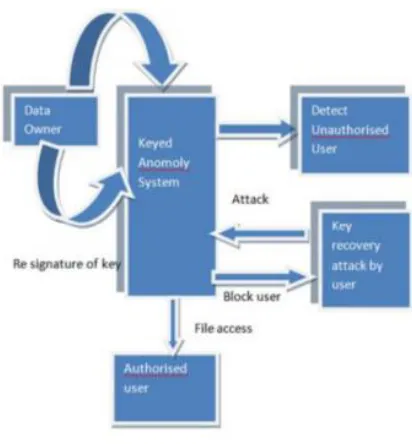
Fig 1. System Architecture
The Attacks can be prevented using various prevention techniques, if payload words length keep maximum then it will get prevented or including such quantities as classification features. A. Key-Recovery on Black-Box KIDS In this payload will be normal with properly structured tail.The tail contain the large number of unseen words separated with delimeter.In Black Box recovery algorithm attacker tries to recover the w1(word 1) and w2(word 2).For this the attacker tries different combination till the length of payload.If w1 recover then the w2 can be easily recoverd.
Proposed Algorithm:
Input:
Set of payload Q=qi word w2 s.t. n(w2)=0 Parameter l¿1
for each qi belongs Q do Di ¡– a
for d=0 to 255 do
p¡—(qi——d——w2——d——...——d—— w2) if anom(p)=true then
Di¡– Di U d end if end for end for return D=Di
B. Key-Recovery on Gray-Box KIDS In this attack assume the attacker has access to the anomaly score assigned to a chosen payload. Furthermore, it is reasonable to assume that some normal payloads are known too.
Algorithm
Input:
D2¡–a
for d=0 to 255 do
p¡—(w1 —— d —— w2)
if s(p)=S(w1 —— d —— w2) then D1¡– D1 U d
else D2¡– D2 U d end if
end for return D2 return D1
IV.SIMULATION RESULTS
The result which we are getting from the above two algorithms are tabulates as follows.
V. CONCLUSION AND FUTURE WORK
In this paper system introduced the strength of KIDS against key-recovery attacks because key recovery system is the difficult tasks in data sharing system. System presented Key recovery attacks according to two different adversarial settings, depending on the feedback given by KIDS to probing queries also depending on the performance of authorized user which is given by the data owner. The focus in this work has been on recovering the secret key element through efficient procedures using in this systems. it is demonstrating that the classification process leaks information about it that can be leveraged by an attacker. However, the alternative goal of the system is to evade the system, and system just considered that knowing the secret key is essential to things or craft an attack that evades detection or at least, that significantly facilitates the process. It remains to be seen whether a keyed classifier such as KIDS can be just evaded without explicitly recovering the key.
REFERENCES
1. Juan E. Tapiador, Agustin Orfila, Arturo Ribagorda, and Benjamin Ramos Key-Recovery Attacks on KIDS, a Keyed Anomaly Detection
System IEEE Transactions On Dependable And Secure Computing, Vol. 12, No. 3, May/June 2015
2. [M. Barreno, B. Nelson, A.D. Joseph, and J.D. Tygar, The Security of Machine LearningMachine Learning, vol. 81, no. 2, pp. 121148, 2010.
3. B. Biggio, G. Fumera, and F. RoliAdversarial Pattern Classification Using Multiple Classifiers and Randomisation pp. 500-509, 2008.
4. B. Biggio, B. Nelson, and P. LaskovSupport Vector Machines Under Adversarial Label NoiseJ. Machine Learning Research, vol. 20, pp.
97-112, 2011.
5. N. Dalvi, P. Domingos, Mausam, S. Sanghai, and D. Verma Adversarial Classification, Idea Group Publishing pp. 99- 108, 2004.
6. ] B. Nelson, B.I.P. Rubinstein, L. Huang, A.D. Joseph, and J.D. Tygar, Classifier Evasion: Models and Open Problems, Proc. Intl
ECML/PKDD Conf. Privacy and Security Issues in Data Mining and Machine Learning (PSDML 10), pp. 92-98, 2011.
7. B. Nelson, B.I.P. Rubinstein, L. Huang, A.D. Joseph, S.J. Lee, S. Rao, and J.D. Tygar,
8. Query Strategies for Evading Convex-Induc- ing Classifiers, J. Machine Learning Research, vol. 13, pp. 1293- 1332, May 2012.
9. K. Rieck, Computer Security and Machine Learning: Worst Ene- mies or Best Friends? Proc. DIMVA Workshop Systems Security (SYSSEC),
2011.
10. J.E. Tapiador and J.A. Clark, Masquerade Mimicry Attack Detec- tion: A Randomised Approach, Computers & Security, vol. 30, no. 5, pp.
297-310, 2011.
11. M. Barreno, B. Nelson, R. Sears, A.D. Joseph, and J.D. Tygar, Can Machine Learning be Secure? Proc. ACM Symp. Information, Com- puter
and Comm. Security (ASIACCS 06 ), pp. 16-25, 2006.
BIOGRAPHY
Ms. Damini Deore Student In Master of Engineering, Department of Computer Engineering, D.Y. Patil College of