Vol. 4, Issue 3, March 2016
A Smart Public Ration Distribution System
Shubham Maheshwari1, Mukesh Tiwari 2
M.Tech Student, Department of Electronics and Communication, SSSIST, Sehore, M. P, India1
Dean of Academic, SSSIST, Sehore, M. P, India 2
ABSTRACT: The paper is all about automation in the field of Ration Distribution in India. We have used near field RFID card for individuals ration card identification and a 4 digit password based security. The main objective of the project is to get a more secure and interactive approach for automization of Public Distribution System (PDS). Indian Government provide a subsisted food under the public distribution scheme, but yet face a lot of problems like corruption, ration hijack, false ration delivery and etc. these problems have been resolved by the solution developed.
KEYWORDS: E-PDS, FPS, RFID, OTP, GUI, DBMS, Embedded System, ARM7, GSM.
I. INTRODUCTION
The execution of PDS scheme in a country like India is not an easy task; India is capital of largest chain of Fair Price Shops (FPS). The PDS is being executed and maintained by food and public distribution (PD) ministry of Indian Government [3]. Government provides various grains like, Wheat, Rice, kerosene etc. on a subsidized rate, thus the poor’s can be benefited. Even after knowing that PDS plays an important role in food security bill of Indian Government, yet this PDS system is affected by corruption, ration hijack and etc [1,6]. The aim behind this paper is to organize and atomize the ration distribution scheme. in order to make it centralize and secure system for ration distribution we used user interface(UI) MS-SQL DBMS for a large database of ration, one time password (OTP) for securing the delivery of ration, RFID cards as Ration cards.
The Windows Operating Systems are widely used OS, so the user interface is designed to support windows OS using visual studio instigated development environment (IDA). India is a country where a large number of Fare Price Shops (FPS) are serving public to deliver ration on subsidized cost, and so a large number of user are there. To store the data of the users a database is needed. OTP is widely used term now a day’s incorporating with online shopping, e-trading, e-banking. OTP is providing a highly secure way for doing e-activities [2].
The system we have designed is build around a 32-bit RICS instruction set architecture computer (i.e. LPC2148 microcontroller a member of ARM7 microcontroller: Advanced RISC Machine). LPC2148 is work on 32-bit ARM instruction set and it also supports 16-bit Thumb instruction set, it has 40 kB of RAM, 512 kB of flash programmable memory, on-chip boot-loader software for ISP (In-System Programming) and IAP (In Application Programming). 8kb of RAM is available for USB2.0 DMA, 10-bit DAC – one, 10-Bit ADC – fourteen, I2C –Bus – Two, UART – Two, SPI, SSP, PWM – six, GPIO – 45 and etc[4]
II. RELATED WORK
The existing PDS system is a complex system in which all records maintained in stock registers of FPS shops, daily purchase/sails registers. Everything is maintained by FPS manager i.e. entries, measurement of grains, delivery everything. This results in non-monitoring for government on PDS system. Corruption can encounter in this manual PDS system, to enhance the performance and reduce the corruption some research have been carried out.
Vol. 4, Issue 3, March 2016
Mudalkar to develop this solution. They have developed a web based solution that can only capable of maintain a large database of information and no-hardware control. For the sack of feedback they used email and SMS based feedback system. Various levels of authorities can login to this server for access the database Login, State Level login, District level etc. Instead of an embedded system they just developed a web based solution.
III.PROPOSED ALGORITHM
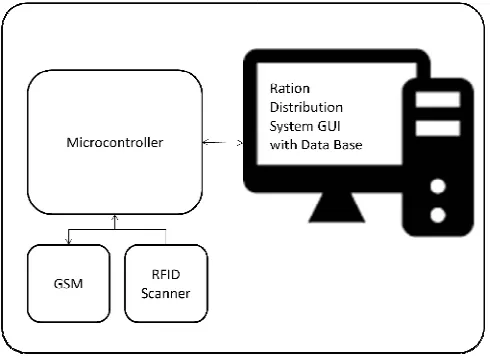
After The system architecture is the major part that decides how your system is structured and communicates with each other. Figure 1 here shows the system architecture. E - Ration Distribution System have these main four parts, first is microcontroller (used for controlling peripherals connected to it), second is GSM (used for provide access to GSM network for sending text message to users), third is RFID scanner (used for reading the data stored in a RFID card) and GUI (used for providing interactive software solution for user).
Figure 1 System Architecture
We have used software hardware co-design approach for developing our system. Hardware and Software are designed concurrently with the interfacing between hardware and software. The identification and verification of user is done by RFID cards and password for logging in to account. For increasing the security OTP’s are used for further verification of user, this OTP is sent to user by using GSM (SIM-900) module. For developing software for E - Ration Distribution System, we used Visual Studio IDE which, and for storing a large number of data of users needed to store then MS-SQL database management system is used, with the help of this a user can create different database and table in it as per needs.
Hardware response table
S. no Command Response by Hardware
1 A Enter Card Scan Mode (Send Card data to PC)
2 B Login Successful Notification
3 C Logout Successful Notification
4 D Reset
5 E Card Registration Successful Notification
6 F Fill User Detail Notification
7 G Collection Ration (Send Text Message to user)
Vol. 4, Issue 3, March 2016
9 N Fetch Name of user from PC
10 O Fetch OTP from PC and Send Message to User
11 S Establish Communication Between Hardware and Software
Table 1 : SAC Protocol
Sequential Alphabetic Command is being designed for communication between hardware and software of E - Ration Distribution System. Few commands have shown below. This protocol is a part of methodology we have adopted (i.e. Hardware software co-design); it is the interfacing part of our system. The table shown below contains command and respective hardware response.
IV.WORKING AND FLOWCHART
The block diagram of system is shown in figure 2, with following components described below with circuit diagram.
Figure 2: Block Diagram of E-Ration Distribution System
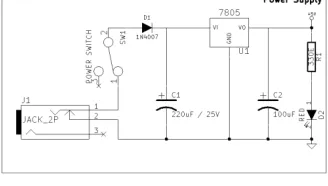
Power Supply, Every system is need power to run, the system we have develop uses a 5V 1A supply for main board and 5V 2A for GSM module. The output 5V 1A has been derived by standard 12V 1A adopter. Circuit diagram of the power supply is shown in figure 3, regulator IC LM7805 is used to regulate the input 12V to 5V, capacitors are used to remove ripples from power supply if any occur, and LED D2 is used to indicate the status of power.
Figure 3: Power Supply Circuit Diagram
Vol. 4, Issue 3, March 2016
Figure 4: RFID Reader Circuit Diagram
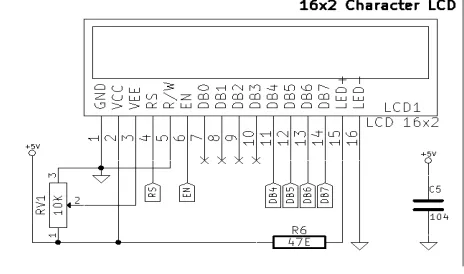
LCD16x2, The circuit diagram of LCD16x2 is shown below it configured to work in 4-bit data formation. Vcc, GND and Vee are supply inputs of LCD, voltage at vee sets the contrast of LCD and this is fed by a variable resistance RV1.
Figure 5: LCD16x2 Circuit Diagram
Vol. 4, Issue 3, March 2016
Figure 6: Microcontroller Circuit Diagram
V. RESULT
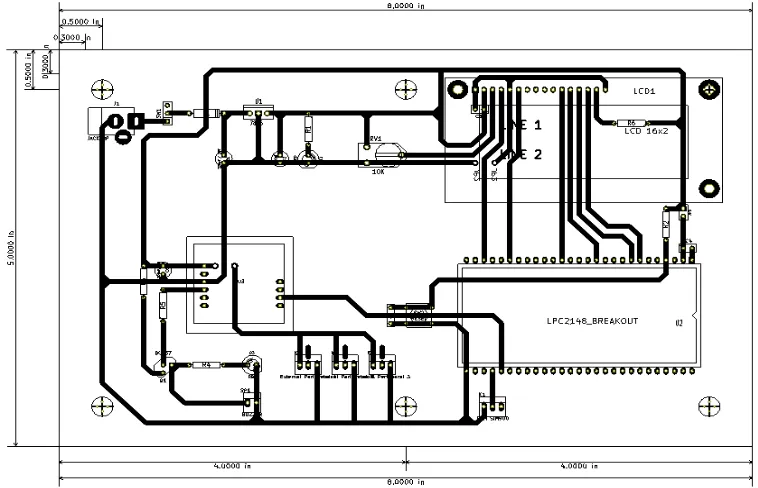
The problems stated in previous paper have been resolved [10]. Final PCB layout of the system is shown in figure 7 below.
Vol. 4, Issue 3, March 2016
Software layout that has been designed for our system is shown in figure 8. For the sack of controlling hardware that has been designed for rationing system is controlled through this software. This UI help user for either registering new cards or accessing already registered cards and collect ration.
Figure 8: Software Layout
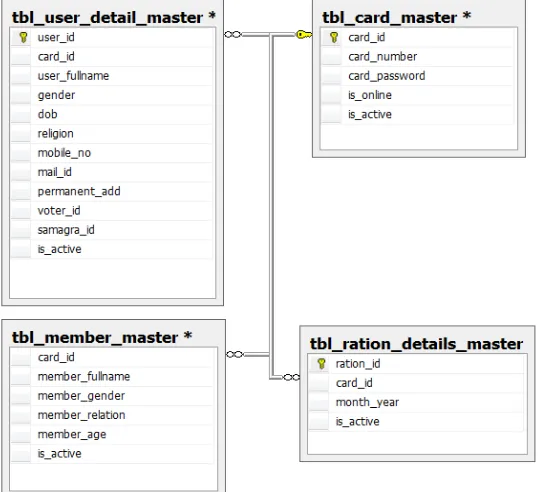
Database architecture is shown in figure 9; this is used to interlink data of user with each other. Each table contains some column and information of any user will be store in rows of table. card_id column is the primary key (PK)of "tbl_card_master" table, this key is used to interlink database tables to each other(i.e. PK - is used for interlink of all fields of different tables).
Vol. 4, Issue 3, March 2016
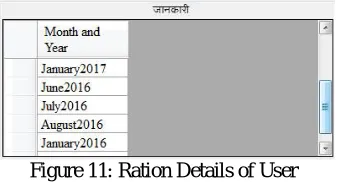
The software output window is shown below. As the user scan the card and login into account all details are fetched from database and bind with the user detail form, shown below in figure 10, user can also view his previous transaction details figure 11 contains the information of ration.
Figure 10: User Details Fetched from Database
Figure 11: Ration Details of User
VI.CONCLUSION AND FUTURE WORK
FPS network in India is very big hence it has some major problems in distribution of ration like ration hijack, less quantity delivery, wrong goods etc. Thus to help this we proposed a system with RFID based user identification and password based authentication system with a 4-digit OTP system to add additional security in ration distribution. We also presented admin control panel where admin can alter and delete information in database. First this kind of system does not have such kind of OTP based security in ration distribution. We also introduce voice announcement feature in our system. GSM is used for sending information like ration arrival, OTP etc. to the user. We can further enhance the entire system by including biometric identification like voice, fingerprint and face identification to add more security and also we can make a web based solution to give a high level of accessibility. But these additional features may increase the overall cost of distribution system but yet a powerful approach to make high level FPS network maintainable.
REFERENCES
Vol. 4, Issue 3, March 2016
Volume 19, Issue 4, Ver. II, pg.93-100, Apr. 2014, 4.LPC214x_User_Manual, Philips
5.Mohit Agrawal, Manish Sharm, Bhupendra Singh and Shantanu, IEEE, “Smart Ration Card Using RFID and GSM Technique”, IEEE - 978-1-4799-7/14
6.Nikhil S.Virdande, Shraddha R.Wankhade, Chandan L. Shelke, Shubham G. Kale, Swati S. Mithe, “Automatic Ration Distribution System (ARDS)”, International Journal For Engineering Applications and Technology, pg. 2321-8134
7.Prasanna Balaji. R and Manikandan.T.“Automatic Public Distribution System”, IJCSMC, Vol. 2, Issue. 7, pg. 93 – 107, July 2013 8.Rahul J. Jadhav and Dr. Pralhad K. Mudalkar, Smart Card Based e-PDS System, IJARCCE, Vol. 2, Issue 10, pg. 2278-1021, October 2013 9.Sham Nayse , and A.N. Madur, “Automation in Rationing System using Arm 7”, IJIREEICE, Vol. 1, Issue 4, pg. 2321 – 2004, July 2013 10.Shubham Maheshwari, Prof Jaikaran Singh, “Review Report on Public Ration Distribution System for India” , International Journal of Engineering and Management Research, Volume-5, Issue-6, pg. 70-72, December-2015
BIOGRAPHY