Multivariate Correlation Information Based
SVM Method for Dos Attack Detection
Subhash Pingale1, Ranjeetsingh Parihar2, Prajakta Solankar3
Assistant Professor, Dept. of Computer Science and Engineering, SKN Sinhgad College of Engineering Pandharpur,
India1
Assistant Professor, Dept. of Computer Science and Engineering, SKN Sinhgad College of Engineering Pandharpur,
India2
M.E Scholar, Dept. of Computer Science and Engineering, SKN Sinhgad College of Engineering Pandharpur, India3
ABSTRACT: In recent days network technology is developing rapidly and the network security is important issue. DoS attack is serious threat in network. Denial of service attack forces victim machine out of service several days or few minutes.DoS attack degrades the system performance. This paper constitutes detecting denial of service attack using Multivariate correlation analysis method. This approach is used to characterize the network traffic features. This MCA method consists of Triangular area determination method for correlation analysis. Normalization is used before this process to remove the bias of data .Normalization technique has greater impact on the performance.
KEYWORDS: Multivariate correlation analysis, Triangular area, denial of service attack
I. INTRODUCTION
In this paper method based on triangular area generation is used for correlation analysis to well characterize the network traffic features. Various attacks are presents in the literature which affects on host or network. There is necessity of detecting attack and this attack detection problem is called as Intrusion detection technique. There two types of intrusion detection systems are presents. These are host based IDS and Network based IDS.Network based IDS is used in this paper for detecting dos attack. Network based IDS is divided into two categories i.e Misuse based IDS and Anomaly based IDS. Anomaly based technique is effective than Misuse based technique because Misuse based technique need to store attack signatures manually and in Anomaly based technique there is not necessary to keep signature database instead it is based on profiles generation. The profiles of various features are generated and deviation from this profile database is treated as attack. The following fig. shows distributed denial of service attack. In the figure1 dotted line represents control messages and without dotted line represents attack traffic. [1], [2], [3].The following fig1.shows DDoS attack architecture.
II. RELATED WORK
Yu Chen, Kai Hwang et.al. detected ddos attack. They used distributed change point detection mechanism by the use of change aggregation trees [4].In [5] traffic flooding attack detection is performed by SNMP MIB using SVM.The SNMP MIB statistical data is taken from SNMP agents. For classification of attack, support vector machine (SVM) is used. The author Arman Tajbakhsh et. al. used data mining methods for detecting intrusion. They used Association based classification which is the core part of Intrusion detection system. They used Fuzzy Association rules for building classifiers.Kddcup99 dataset is used to evaluate the performance of the system [6]. In [7] real time intrusion detection system is developed. In this paper principle component analysis method is used for preprocessing of the data. To find the hidden correlation MDM (Mahalnobis distance Map) is used. Dimitris Gavrilis described DDos attack behavior using the statistical descriptors. They used Radial Basis function Neural Network for classification purpose. The author trained RBF-NN and evaluated in two experiments. In the first experiment they set up 100 Mpps network and DDoS attack was launched in the University of Patras central library on the main web server in the second experiment [8]. Christos Douligeris et. al. described DDos attack , architecture of DDos attack and also various mechanisms and classification methods. They showed different defense mechanism for the DDos attack problem. Various DDos attack tools are also described in this paper. [9].
In [10] intrusion detection system is developed and used 19 critical features by using the gradually feature removal method. They developed efficient classifier using the combination of support vector machine, ant colony technique and clustering algorithm. They performed experiment using the kddcup99 dataset. They used k-means to reduce the dataset and which is the powerful method in the literature. Shuyuan jin,Danial so Yeung and Xizhao Wang [11] designed covariance matrix based method for mining multivariate correlation of sequential sample. They performed experiments using decision tree and threshold method. S.Yu et. al.[12] discriminated DDos attack from the flash crowd by using the flow correlation coefficient. In [13] computer attacks are detected using the Support vector machine and Independent component analysis (ICA). They used ICA for extracting the features from the multivariate data. Support vector machine classifies data in two categories.
III. PROPOSED SYSTEM ARCHITECTURE
The system consists of two main phases i.e. training phase and test phase, as shown in fig.2. In the training phase profiles are determined and test phase consists of classification of attack.Kddcup99 dataset is used as input to the proposed system which consists of different types of records: normal, smurf, teardrop, Neptune etc.
Fig2. Proposed DoS attack detection System framework
MCA
TAM
Generation
Normalization
n
There are 41 features in the dataset. These are duration, source bytes, protocol etc.Only useful features of kddcup99 dataset are used in the proposed system.In normalization step the features coming from the network or the features of the kddcup99 dataset are normalized to remove the bias from the data. The advantage of this is accuracy increases. From literature surveyed, we analyzed that detection rate increases. So normalization is used before features are extracted.
IV.PROPOSED ALGORITHM
1. First loading kddcup99 dataset as input 2. Selecting useful features by feature selection
3. Normalizing selected features by min-max normalization (eqn1)
4. Determine triangular area among network features using Area=(Xi*Xj)/2 (Where Xi and Xj are two distinct features of dataset instance)
5. After TAM (triangular area map generation) considers only lower triangular matrix i.e lower TAM because of TAM is symmetric matrix.(eqn2)
6. Generate covariance matrix using lower triangular matrices and then calculate Mahalnobis distance(computed in equations eqn 4 and eqn5)
7. SVM-SMO generates model by using training dataset 8. Finally classifies dos attack records from normal traffic data.
a. Normalization:
Min-max normalization is used in the proposed system.Min-Max normalization transforms value from X to Y in range [A, B]. The determination takes place by using formula mentioned below in eqn (1).
Y= ( )
( . ) * (B-A) +A ... eq
n (1)
b. Multivariate correlation analysis:
TAMilower = [TrAreai2, 1 TrAreai3,1 …….TrAreaim,1 TrArea3,2
TrAreai4,2 TrAreaim,2 …. TrAreaim, m-1] ……eqn (2)
TAMilower = ∑ TAM ………… eqn (3)
Covariance Matrix =
( , , , ) ⋯ ( , , , )
⋮ ⋱ ⋮
( , , , ) ⋯ ( , , , )
……… eqn (4)
c. SMO SVM:
SMO algorithm is used with SVM because of its high speed. It gives high accuracy results as shown in experiment analysis.SMO algorithm solves the problem by breaking problem into sub problems and solves the problem analytically.SMO uses Lagrange multiplier for this purpose. Algorithm consists of Lagrange multipliers, threshold determination, and heuristic to select the multiplier for optimization.
V.ABBREVIATIONS
Table.1.List of abbreviations and its meaning
No. abbreviation Meaning
1 DOS Denial of service
2 TAM Triangular area map
3 MCA Multivariate correlation analysis
4 SVM Support vector machine
5 DDoS Distributed denial of service
6 IDS Intrusion detection system
7 SMO Sequential minimal optimization
VI.RESULTS
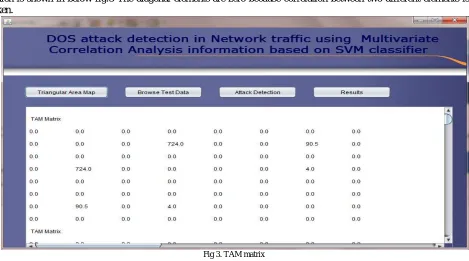
The Triangular area map is generated using the step 4 of algorithm. The Triangular area matrix is symmetric matrix which is shown in below fig.3 The diagonal elements are zero because correlation between two different elements is taken.
Fig 3. TAM matrix
Fig.4 Detection rate of SMO,MLP , ZereR
The detection rate, false positive rate is determined by using following terminology.
Detection Rate (DR) =
( )
* 100
False positive rate (FPR)
= * 100Fig.5.false positive rate of SMO, MLP , ZeroR
Accuracy is determined for 100,200,300,400,500 instances of kddcup99 dataset. It gives more than 97 percent accuracy for SMO. The comparative analysis graph of 100,200,300,400,500 instances of dataset is shown in figure 6. And Table2 describes accuracy of SMO, MLP, zeroR for 100,200,300,400,500 instances of kddcup99 dataset. Accuracy of proposed system is determined by using formula:
Accuracy =
* 100
Instances SMO MLP ZeroR
100 instance dataset 99.18% 87.80% 50.40%
200 instance dataset 98.37% 85.36% 53.65%
300 instance dataset 99.18% 86.17% 50.40%
400 instance dataset 99.18% 99.18% 50.40%
500 instance dataset 99.18% 78.04% 50.40%
Fig.6 SMO,MLP , ZereR accuracy chart
VIII.CONCLUSION AND FUTURE WORK
The proposed system classifies dos attack from normal traffic data by using support vector machine algorithm and also uses triangular area based MCA methodology. We evaluated the system by detection rate and false positive rate and accuracy for different instances of kdd dataset. Our method SMO SVM gives better results than zeroR and MLP methodology. zeroR technique gives very low results. The detection rate of our method is high and very low false positive rate. In proposed system Kddcup99 dataset is used as input data. Kddcup99 dataset is well known dataset, many researchers uses this for research purpose. As future work we will use real time data packets for the evaluation.
REFERENCES
[1] Dorothy E. Denning “An Intrusion – Detection Model”
[2] Zhiyuan Tan “Detection of Denial-of-Service Attacks Based on Computer Vision Techniques” Thesis Copyright by Zhiyuan Tan, 2013
[3] Zhiyuan Tan, Aruna Jamdagni, Xiangjian He, Priyadarsi Nanda and Ren Ping Liu,“A System for Denial-of-Service Attack Detection Based on
Multivariate Correlation Analysis” IEEE transaction on parallel and distributed systems, vol. 25, no. 2, February 2014.
[4] Yu Chen, Kai Hwang, and Wei-Shinn Ku “Collaborative Detection of DDoS Attacks over Multiple Network Domains” IEEE
TRANSACTIONS ON PARALLEL AND DISTRIBUTED SYSTEMS, vol.18,no.12,pp.1649-1662.
[5] Jaehak Yu, Hansung Lee, Myung-Sup Kim , Daihee Park “Traffic flooding attack detection with SNMP MIB using SVM” Computer
Communications,vol. 31,no.17 ,pp.4212–4219, 2008.
[6] Arman Tajbakhsh, Mohammad Rahmati, Abdolreza Mirzaei “Intrusion detection using fuzzy association rules” Applied Soft Computing ,vol.
9 ,pp.462–469, 2009.
[7] Aruna Jamdagni , Zhiyuan Tan , Xiangjian He , Priyadarsi Nanda , Ren Ping Liu “RePIDS: A multi tier Real-time Payload-based Intrusion Detection System”Computer Networks,vol. 57,pp.811–824, 2013.
[8] Dimitris Gavrilis, Evangelos Dermatas “Real-time detection of distributed denial-of-service attacks using RBF networks and statistical
features” Computer Networks,vol. 48 ,pp.235–245, 2005.
[9] Christos Douligeris and Aikaterini Mitrokotsa “DDoS attacks and defense mechanisms: classification and state-of-the-art”Computer Networks ,
vol.44, pp.643–666, 2004.
[10] Yinhui Li , Jingbo Xia, Silan Zhang , Jiakai Yan, Xiaochuan Ai , Kuobin Dai “An efficient intrusion detection system based on support vector
machines and gradually feature removal method” science direct Expert Systems with Applications,vol. 39,pp. 424–430, 2012.
[11] Shuyuan Jin,Danial So Yeung and Xizhao “Network intrusion detection in covariance feature space”sciencedirect Pattern Recognition,vol. 40
[12] S. Yu, W. Zhou, W. Jia, S. Guo, Y. Xiang, and F. Tang, “Discriminating DDoS Attacks from Flash Crowds Using Flow Correlation Coefficient,” IEEE Trans. Parallel and Distributed Systems, vol. 23, no. 6, pp. 1073-1080, June 2012.
[13] Surat Srinoy,Witcha Chimphlee and Siriporn Chimphlee “A Fusion of ICA and SVM for Detection Computer Attacks” Proceeding of the 5th
WSEAS International Conference on Applied Computer Science,Hangzhou,china, (pp987991), April 16-18, 2006.
[14] Fatin Norsyafawati Mohd Sabri and Norita Md.Norwawi et.al “Identifying False Alarm Rates for Intrusion Detection System with Data
Mining” IJCSNS International Journal of Computer Science and Network Security, VOL.11 No.4, April 2011
[15] A. M. Riad and Ibrahim Elhenawy “VISUALIZE NETWORK ANOMALY DETECTION BY USING K-MEANS CLUSTERING
ALGORITHM” International Journal of Computer Networks & Communications (IJCNC) Vol.5, No.5, September 2013
BIOGRAPHY