Parameters in Air seeded Arc-plasma
*
Vijay Kumar Jha
1, Lekha Nath Mishra
2and Bijoyendra Narayan
31Department of Physics, Amrit Campus, Thamel, Kathmandu(Tribhuvan University), Nepal
2Department of Physics, Patan Campus, Patandhoka, Lalitpur (Tribhuvan University), Nepal
3Dr. S.K. Sinha Women's College, Motihari (B.R.A.Bihar University, Muzaffarpur), India
Plasma parameters like electron temperature (Te), electron density (ne), Debye length (D) and
plasma frequency (fp) were measured using Langmuir probes in air seeded arc-plasma at low
pressure range of 0.10 mbar to 0.16 mbar. Double slope method, Dote method and Interception method were used to calculate the electron temperature (Te) and mean value of electron
temperatures obtained from these three methods was used to calculate the electron density, Debye length and plasma frequency. To investigate the effect of pressure and discharge voltage on the plasma parameters at low voltage and low pressure is the main objective of the study. It was observed that Te, ne and fp gradually increased respectively but D decreased on increasing
the voltage from 500 V to 600 V. It was also observed that on increasing the pressure there was decrease in Te and D but increase in ne and fe.
Key Words: Langmuir probes, electron temperature, electron density, Debye length, plasma frequency, plasma densities, Dote method, Bohm velocity, plasma diagnostic, plasma processing.
INTRODUCTION
The DC arc discharges have been extensively used in thin film deposition, sputtering, etching, surface modification of the materials and many other kinds of plasma processing (Brockhaus et al., 1994; Bogaerts Neyts et al., 2002; Chiad et al., 2009). For understanding, developing and maintaining these processes it is interesting to determine the basic plasma parameters and their dependence on discharge voltage and operating pressure. The widely used method for the plasma diagnostic is the Langmuir probe method. Double probe method (Johnson and Malter, 1950; Pilling et al., 2006) for the plasma characterization over a wide range of plasma densities is one of the suitable methods to measure plasma parameters. In this method electron current is completely controlled by the ion saturation current so that probe draws very little amount of current without disturbing the plasma condition. Other importance of the double probe method is that it measures local parameters of studied plasma whereas almost all
other techniques give information averaged over a large volume of plasma (Chen, 1965; Mijovic et al., 2008). Also, the simplicity of the used equipment allows us to receive results quickly. In this piece of study we have used three different methods such as Double slope, Dote method and Intercept method to measure the electron temperature. The average value of electron temperature obtained from these three methods respectively is used to evaluate the electron density, Debye length and plasma frequency.
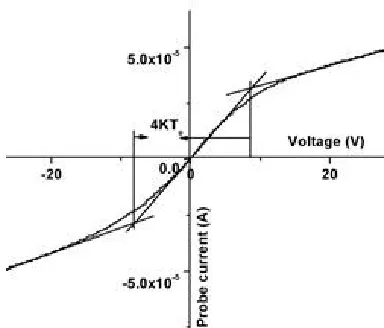
Figure 1:Low temperature plasma-reactor Figure 2:Measurementof electron temperature with Langmuir double probe. from double slope method
MATERIALS AND METHOD
The low temperature plasma reactor for the low pressure arc discharge in air is shown in Figure 1 in which air pressure is changed from 0.10 mbar to 0.16 mbar and the voltage is changed from 500 V to 600V. Two identical cylindrical probes are inserted in the discharge region and they are powered by the digital voltage sweep. Data are taken from Tektronix TDS oscilloscope and it is transferred to the computer through data storage device for the further analysis. Specification of the double probe for its operation is listed in Table1.
Table 1: Specifications for the Double Probe Method
S. N. Specification
1 Probe material: Tungsten
2 Length of the probe: 6 mm
3 Diameter of the probe: 0.5mm
4 Diameter of the electrode: 10 mm
5 Distance between two electrodes: 8 cm
6 Maximum voltage across electrodes: 1kV
7 Biased voltage range: – 33V to + 33V
8 Current sensing resistor: 10 kΩ
9 Maximum probe current: 3.5 mA
In the double slope method [Figure 2] one tangent is drawn at the point of inflection and the another tangent in the ion saturation current region. The ordinate of the intercept gives the ion saturation current. The electron temperature (Te) can be obtained by using the relation (Konuma, 1992).
Te =
Isat
2
dVdI
d Vd = constant
. . . (1)
In Dote method, electron temperature can be obtained by using following relation [Dote (1968)].
Te =
S Ipo
4
d i
dVd Vd = constant – 0.82S. . . (2)
Where,
d Vd i
d Vd = constant= slope of the current voltage
characteristic at the point of inflection [Figure 3],
S = slope at the positive ion saturation current, and ΣIpo =
total ion saturation current
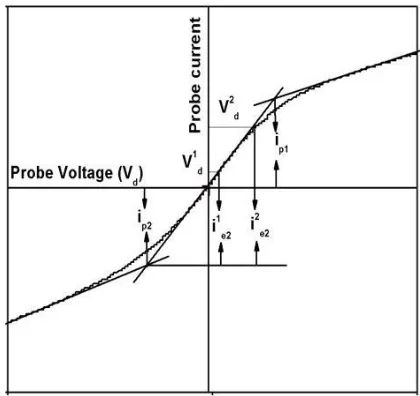
Similarly, in the Intercept method the electron temperature can be obtained [Figure 4] by using following
Relation (Johnson et al., 1950).
Te =
Vd 2
–Vd
1
ln
F – 1D – 1
. . . (3)
Where F = ip
i1e
2
and D = ip
i1e
2
Where F = S ip i1e
2
and D = S ip i1e
2
In our experiment we have chosen Vd
2
and Vd
1
as around 2V and 5V respectively
The electron density is measured and electron temperature using the following equation:
Te = 0.6 e A ne
KTe
Mi . . . (4)
The factor 0.6 is due to the reduction of the ion density in the pre-sheath region over which the ions are accelerated up to the Bohm velocity (Chung et al., 2006; Merlino, 2007).
Similarly, Debye length and the plasma frequency can be obtained by using following relations respectively
D= e0 KTe ne
2 . . . (5)
And
fe =
1 2
e ne
Figure 3:Schematic diagram of the doubleProbe characteristics Figure 4:Schematic diagram of the double Probe characteristics
Figure 5: Variation in electron temperature(Te) with V Figure 6: Variation in electron density(ne) with V
RESULTS AND DISCUSSION
The electron temperature is calculated using equations (1), (2) and (3) respectively in Double probe method, Dote method and Intercept method. The graphical representation (Figure 5) of the mean value of electron temperature obtained mentions three methods as a function of the discharge voltage at different constant pressure .
It is observed that the electron temperature (Te) gradually
increases with the increase in discharge voltage at a particular pressure. The increase in Te might be due to the
increase in kinetic energy of the electrons gained from the electric field (Naz et al., 2011; Kim, 2004). It is also clear that there is decrease in Te with increase in pressure at a
constant voltage. The reason for the decrease in Te can be
explained from the equation (7). The mean energy of the electron is given by,
–
E = eEe =
e e V
d . . . (7)
, where E is the electric field strength, e is the mean free
path of the electrons, V is the discharge voltage and d is the distance between electrodes. As the discharge pressure inside the discharge chamber increases, electron collision frequency with neutral atoms also increases and the mean free path between two successive collisions decreases, which shows that rather than gain of energy by the electrons from the electric field more and more energy is transferred to the neutral species as a result of which Te
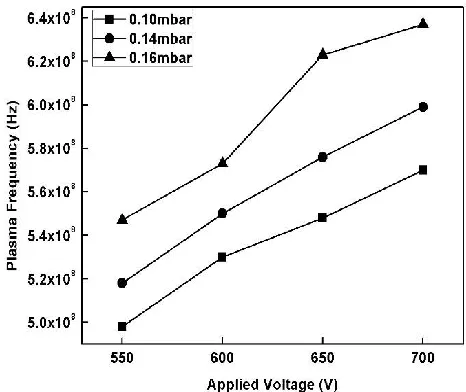
Figure 7:Variation of the Debye length with Figure 8:Variation of the plasma frequency with discharge voltage at constant pressure discharge voltage at constant pressure
The Debye length is a characteristic scale length in plasma and it is a measure of the distance that the potential of a charged object penetrates into the plasma. It depends upon the electron temperature and electron density. But on increasing the voltage, electrons become energetic and some of the fast moving electrons can inter inside the positive sheath region and reduce the number of positive ions which leads to increase in the Debye length. On the other hand increasing the pressure increases the electron density. The increase in electron density increases the shielding effect at short distance. The variation of Debye length with applied voltage and at different constant pressure is shown in Figure 7. The decrease in Debye length in both cases is due to the increase in electron density. The plasma frequency is the fundamental property of the plasma and represents the frequency at which the electron cloud oscillates with respect to the ion cloud and it entirely depends upon the plasma density. The variation of the plasma frequency with discharge voltage or pressure is shown in Figure 8. Both, increase in voltage or pressure increases the electron density and hence the plasma frequency.
CONCLUSION
Results of the Langmuir double probe method obtained for plasma parameters show that on increasing the discharge voltage at different pressures in an air-seeded arc-plasma electron temperature, electron density, and plasma frequency increase but Debye length decreases. Also, there is decrease in electron temperature and Debye length with increase in electron density and plasma frequency on increasing the pressure at different constant voltages. The measured values of the plasma parameters is in good agreement with the expected values of the Arc-discharge plasma.
REFERENCES
Bogaerts Neyts AE, Gijbels R and van der Mullen J (2002). Gas discharge plasmas and their applications.
Spectrochimic Acta Part B. 57: 609-658.
Brockhaus A, Borchardt C, Engemann J (1994). Langmuir probe measurements in plasma.
Sources Sci. Technol. 3: 539-544.
Chen FF (1965). Electric probe Plasma Diagnostic Techniques. Edited by Huddleston and Leonard, Academic Press, New York.
Chiad BT, Al-Zubaydi TL, Khalaf MK and Khudiar AI (2009). Construction and characterization of a low pressure plasma reactor using glow discharge. Journal of Optoelectronics and Biomedical Materials. 1(3): 255-262.
Chung TH, Shin YM and Seo DC (2006). Comparision of two methods of interpretation of Langmuir probe data for an inductively coupled oxygen plasma. Contrib. Plasma Phys. 46(5-6): 348-353.
Chung TH, Yeom GY and Kwon KH (2001). Characterization of an oxygen plasma by using a Langmuir probe
in an inductively coupled plasma. Journal of the Korean Physical Society. 38(3): 259-263.
Dote T (1968). A new method for determination of plasma electron temperature in the floating double probe. Japanese Journal of Applied Physics.7: 964-965. Johnson EO, Malter L (1950). A Floating double probe
method for measurements in gas discharges. Physical Review. 80(1): 58-68.
Kim CK, (2004). Analysis of Langmuir probe data in high density plasmas. Korean J. Chem. Eng., 21(3): 746-751.
Scientific Instruments. 74(7): 3341-3346.
Accepted 27 August, 2017
Citation: Jha VK, Mishra LN, Narayan B (2017). Effect of Pressure and Discharge Voltage on Plasma Parameters in Air seeded Arc-plasma. Journal of Physics and Astronomy Research, 3(1): 074-078.