INTERNATIONAL JOURNAL FOR MATHEMATICS TEACHING AND LEARNING 2018, Vol 1. 112-129
Secondary School Students’ Conception of Quadratic Equations
with One Unknown
Makbule Gözde Didiş Kabar Tokat Gaziosmanpaşa University
In recent years, researchers have become more interested in quadratic equations. This study explores the conceptions high school students have concerning quadratic equations with one unknown, while using concept definition and images as theoretical framework. The data was gathered through semi-structured interviews with 14 eleventh grade high school students. Analysis of the data revealed that none of the students could provide an exact and correct definition of a quadratic equation and their attempted definitions were not consistent with the formal (standard) definition of quadratic equation. Moreover, the findings showed that students’ concept image of quadratic equation was quite limited and dominated by ideas concerning factoring. Students’ conceptions of quadratic equations also showed that participating students lacked three types of prerequisite knowledge: degree of a polynomial, variable and equals sign. In order to enrich students’ concept definition and images, both procedurally and conceptually, lessons from this study need to be used in teaching. The implications of the findings are discussed.
Keywords: Algebra, Quadratic Equations, Secondary School Students
Introduction
The standard definition of a quadratic equation with one unknown is presented as “the equation in the formax2bx c 0, witha 0, is called as quadratic equation where a, b and c are the coefficients of the equations and x is the variable (unknown)”. In order to solve quadratic equations, different methods, such as factoring, the quadratic formula, completing the square, geometrical and graphical, are used. However, while three symbolic methods— factoring, the quadratic formula and completing the square—are preferred as methods to introduce students to quadratic equations, graphical and geometrical methods are largely ignored (Allaire & Bradley, 2001). That is, the symbolic algebraic manipulations (procedural methods) for solving quadratics are given priority. For this reason, student perception of the quadratic equation is based on strong symbolic representations or formula aspects. A few years ago, research on teaching and learning quadratic equations was sparse (e.g., Olteanu & Holmqvist, 2012; Vaiyavutjamai, & Clements, 2006). However, current research in algebra education shows an upswing in interest (e.g., Block, 2015; Didiş & Erbaş, 2015; Joarder, 2015; Lòpez, Robles, & Martínez-Planell, 2016; Olteanu & Holmqvist, 2012; Tall, Lima, & Healy, 2014).
Secondary school students’ conception of quadratic equations with one unknown Kabar
research focusing on students’ understanding, conceptual obstacles and errors commonly emphasizes that students have difficulty making flexible sense of quadratic equation solutions, and their difficulties in learning how to solve quadratic equations stems from their lack of understanding. For example, Zakaria and Maat (2010) studied students’ errors in learning to solve quadratic equations and reported that students commonly made errors in transformation and process skills when solving quadratic equations. On the other hand, Didiş & Erbaş (2015) investigated the performance and difficulties of tenth grade students in formulating and solving quadratic equations. Their findings revealed that, whereas students’ difficulties in solving symbolic problems were related to arithmetic and algebraic manipulation errors, students’ main difficulties in quadratic word problems stemmed from comprehending the problem’s context. Furthermore, in her study examining students’ conceptual obstacles in learning quadratic functions, Zaslavsky (1997) remarked that students had difficulty understanding the relation between a quadratic function and a quadratic equation. She explained that students think that the function 2
f (x)x 2x - 3 is
equivalent to 2
f (x)2x 4x 6 since x22x 3 0 is equivalent to2x24x - 60. On the other hand, studies focusing on the classroom situation during the teaching and learning of quadratic equations (e.g., Olteanu & Holmqvist, 2012; Olteanu & Olteanu, 2012) indicate that differences in students’ success in solving quadratic equations are due to the differences in classroom instruction. These studies discuss which differences in instruction were crucial and which were trivial for learning.
Secondary school students’ conception of quadratic equations with one unknown Kabar
conceptions for solving a perfect square and using the quadratic formula in different types of contexts. In addition, they lacked flexibility in using different solution methods to solve quadratic equations. Further, the researchers indicated that the four components of genetic decompositions (SR, QF, F and G) are seemingly isolated in students’ minds, and they concluded that many students did not construct a coherent schema for solving quadratic equations. Moreover, using a written instrument, the researchers investigated 121 science and engineering students’ understanding of two specific mental constructions conjectured in the genetic decomposition, use of SR. Their findings highlighted that science and engineering students did not have process conceptions regarding the properties described in SR as “ 2
y y ” and “𝑤2 = 𝑐 𝑤 = ∓ √𝑐 for the non-negative values of c”. Therefore, they had difficulties solving equations by using square root and completing the square.
Theoretical Framework
Concept image and definition, as defined by Tall and Vinner (1981), will serve as a theoretical framework for this study. Concept image and definition have been studied and discussed in many papers (e.g., Tall & Vinner, 1981; Vinner, 1983; Vinner & Dreyfus, 1989; Vinner & Hershkowitz, 1980). Tall and Vinner (1981) explained concept image as “the total cognitive structure that is associated with the concept, which includes all the mental pictures and associated properties and processes” (p. 152). Further, Vinner and Dreyfus (1989) stressed that a mental picture includes any kind of representation such as a picture, symbolic form, diagram or graph. They also pointed out that, whereas several mathematical concepts contain strong graphical aspects, some concepts do not include graphics. Therefore, the images for these concepts mostly involve symbolic representations, formulas and properties related to the concept. For example, a person’s concept image regarding functions might be a graph representing algebraic expressions of functions or the symbol 𝑦 = 𝑓(𝑥). Tall and Vinner (1981) pointed out that a concept image may also include conscious or unconscious mental attributes. Furthermore, they indicated that students might have both correct and incorrect concept images. For instance, as Vinner and Hershkowitz (1980, p.177) exemplified, either “somebody incorrectly might think that an altitude in a triangle should always fall inside the triangle” or “somebody correctly might think that a triangle has 180°”. Many of students’ concept images might be sourced back to specific examples given by teachers (Tall & Vinner, 1981).
Secondary school students’ conception of quadratic equations with one unknown Kabar
Vinner, 1981). Further, Vinner and Dreyfus (1989) pointed out that students mostly decide whether a given mathematical object is an example or non-example of the concept based on their concept image instead of their concept definition. Furthermore, Vinner and Hershkowitz (1980) claimed that, because concept definitions will be passive or even forgotten, concept images will be paramount in students’ minds.
Many researchers have studied students’ and teachers’ conceptions of advanced mathematical topics, such as functions, derivatives, limits and continuity, as well as some basic geometrical concepts (e.g., Akkoç, 2008; Gutiѐrrez & Jaime, 1999; Przenioslo, 2004; Tall & Vinner, 1981; Vinner & Dreyfus, 1989; Vinner & Hershkowitz, 1980; Wawro, Sweeney & Rabin, 2011; Yanık, 2014). For instance, Vinner and Hershkowitz’s (1980) study, where they tested students’ images in grades 7, 8 and 9 regarding some simple geometrical concepts (including obtuse angle, straight angle, right triangle and altitude of a triangle), showed that students’ concept images contain “only obtuse angles with horizontal rays, only horizontal straight angles, a right triangle with a vertical side and a horizontal side” (p.181-182). Moreover, students had a common image that an altitude of a triangle should always fall in the triangle. Vinner and Dreyfus (1989) examined 271 first year college students’ and 36 junior high school mathematics teachers’ images and definitions for the concept of a function through a seven-question questionnaire. They found that students’ and teachers’ concept definitions involved correspondence, dependence relations, rules, formulas, operations and representations. However, their concept images included one-valuedness, discontinuity, split domains and exceptional points. In addition, Vinner and Dreyfus (1989) indicated that knowing individuals’ starting points is crucial in teaching functions to a group of individuals. Moreover, when Akkoç (2008) explored six pre-service mathematics teachers’ concept images of the radian, she discovered that their concept images of radian were dominated by their concept images of degree. A more recent study conducted by Yanık (2014) investigated sixth grade students’ concept images of geometric translations and possible sources of students’ conceptions through a written instrument, student and teacher interviews, and document analysis. He found that students had two major concept images of geometric translations: (i) translation as translational motion, and (ii) translation as translational and rotational motion. Moreover, he indicated that students’ concept definitions were inconsistent with the formal concept definition of geometric translation.
Quadratic equations are one of the fundamental concepts taught in secondary mathematics because they have a strong connection with many mathematical and geometry topics, such as quadratic functions and inequalities, polynomials, and parabolas (Didiş & Erbaş, 2015; Olteanu & Holmqvist, 2012; Sağlam & Alacacı, 2012). Further, quadratic education research studies indicate that more research is needed to understand students’ conceptions of quadratics. Therefore, this study aimed to look at high school students’ conceptions of quadratic equations with one unknown, taking into consideration students’ emerging conceptual obstacles, and using concept definition and images as the underlying theoretical framework. This study is driven by the following questions:
How do high school students define the concept of the quadratic equation with one unknown?
What are high school students’ concept images of the quadratic equation with one unknown?
Secondary school students’ conception of quadratic equations with one unknown Kabar
This study will contribute to the growing body of the research regarding quadratic equations in both national and international contexts. Secondly, the findings of this study have the potential to contribute to teachers’ knowledge of students’ conceptions of quadratic equations. As researchers (Tall & Vinner, 1981; Vinner, 1983; Vinner & Dreyfus, 1989) have indicated, understanding students’ concept images is crucial for teaching. If a teacher knows the students’ possible concept images, it may be possible to erase any incorrect images. Moreover, knowing students’ concept images of quadratic equations may help teachers understand the students better and thereby improve their teaching.
Method
In this study, a qualitative approach was used to understand and describe high school students’ conceptions of quadratic equations.
Participants
This study was conducted during the second semester of the 2015-2016 academic year. Fourteen eleventh grade high school students participated in this study. They were in mathematics-natural science programs, mainly majoring in mathematics, physics, chemistry and biology. The students were 16 to 17 years old.
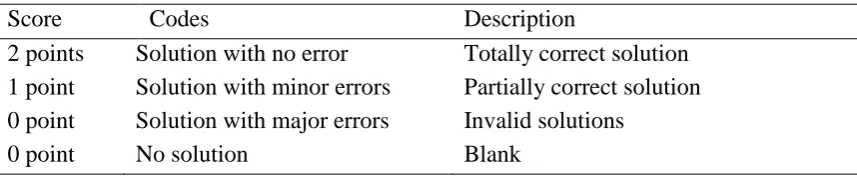
The participating students were purposively selected for this study. Initially, the researcher implemented a self-designed diagnostic questionnaire in three grade eleven classes at a public high school in Tokat, Turkey. A total of 84 students took the questionnaire (29, 34, 21 students, respectively, from each class). The diagnostic questionnaire included five open-ended questions. Four of the questions were traditional and ordinary symbolic questions, and one was a graph question (see Appendix). The traditional symbolic questions were used to assess the students’ performance in solving quadratic equations via three different methods: factoring, the quadratic formula, and completing the square. The graph question was used to assess the students’ understanding of the graphical method for solving quadratic equations. Specifically, it examined understanding of the relation between the roots of the quadratic equation and the x-intercepts of the graph of a quadratic function (x-intercepts are the points at which y=f(x)=0; students can find x-(x-intercepts by solving the equation). The students had nearly 40 minutes during one class period to complete the questionnaire. Next, each student’s solutions were scored by the researcher according to the rubric in Table 1. Analysis of the questionnaire data surprisingly revealed that majority of the students’ overall scores were quite low.
Table 1
Questionnaire Scoring Rubric
Score Codes Description
2 points 1 point 0 point 0 point
Solution with no error Solution with minor errors Solution with major errors No solution
Totally correct solution Partially correct solution Invalid solutions
Blank
Secondary school students’ conception of quadratic equations with one unknown Kabar
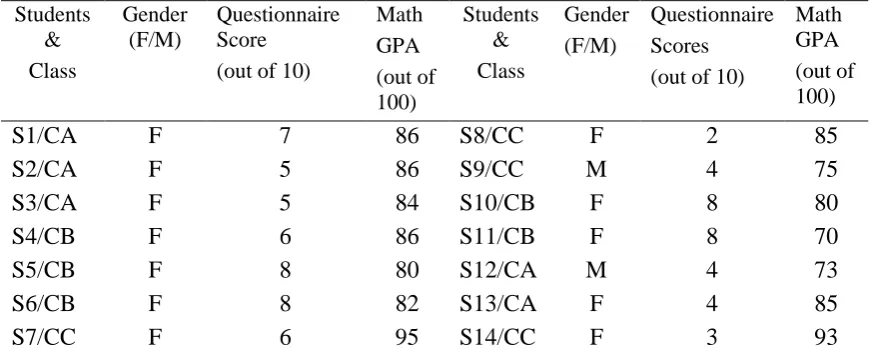
Moreover, in selecting students from this group for interviews, the students’ mathematics course grades (math GPA) also were considered. That is, the students whose mathematics course grades were either very good or good, were selected for interviews (see Table 2). A total of 15 students (five students from each class) were selected, and, although not all of the selected students were successful in solving the questionnaire’s quadratic equations (as seen in Table 2), their performance was relatively better than other students in their class. One of the selected students did not volunteer to participate in this research, so the interviews were conducted with fourteen students.
Table 2
The Description of Participant Students with their Questionnaire Score and Math GPA 1,2
Students & Class
Gender (F/M)
Questionnaire Score
(out of 10)
Math GPA (out of 100)
Students & Class
Gender (F/M)
Questionnaire Scores (out of 10)
Math GPA (out of 100)
S1/CA F 7 86 S8/CC F 2 85
S2/CA F 5 86 S9/CC M 4 75
S3/CA F 5 84 S10/CB F 8 80
S4/CB F 6 86 S11/CB F 8 70
S5/CB F 8 80 S12/CA M 4 73
S6/CB F 8 82 S13/CA F 4 85
S7/CC F 6 95 S14/CC F 3 93
1Note: Grading system in Turkish high schools: When the score interval is 85-100, grade description is very
good; 70-84 is good; 55-69 is average; 45-55 is weak/passing, and 0-44 is very weak/failing.
2 Note: S1/CA: Student numbered 1 selected from Class A
The high school students had studied quadratics (e.g., quadratic equations, quadratic functions and quadratic inequalities) prior to their participation in this study. With regard to quadratic equations, these students had studied the definition of quadratic equation, solving quadratic equations with one unknown by using various methods, and forming quadratic equations when the roots are given in the second semester of 10th grade. In addition, they also studied how to find the solution sets of equations that are reducible to quadratic equations and solving systems of quadratic equations in two unknown (variables) in the first semester of 11th grade.
Data Collection
The semi-structured individual interviews were conducted with fourteen students. The aim of these interview questions was to collect all mental pictures associated with the quadratic equation concept. Therefore, the existing literature regarding concept definition and image (Vinner, 1983; Vinner & Dreyfus, 1989; Wawro, Sweeney & Rabin, 2011; Yanik, 2014) and quadratic equations (Lòpez et al., 2016) was examined and used to develop the interview protocol. The interview protocol consisted of two parts. In the first part, the students were asked:
Secondary school students’ conception of quadratic equations with one unknown Kabar
quadratic equations with one unknown. So, when you think about everything you know about this topic, please write down here everything you know. They can be any kind of representations such as formulas, verbal expressions, symbols, graphs or algebraic expressions. (iv) Please write a quadratic function and write the difference (if any, the relationship) between a quadratic function and a quadratic equation.
The first question was asked to examine students’ definitions. The second question was used to further clarify students’ definitions. Then, in order to reveal students’ conceptualizations regarding fundamental aspects of quadratic equations with one unknown, students were asked (iii) and (iv). Students were also asked to express themselves out loud while writing their answers. In the second part, the interview focused on the students’ written solutions to the original in-class questionnaire in order to get additional information about their conceptions. For each question in the questionnaire, students were asked to clearly explain how they solved the problem, which method they preferred, what their reasons for using this method were, and any other method they could use to solve the question. Furthermore, during the entire interview, students were asked several follow-up questions and for further explanations, when needed.
The interviews took place in the participant students’ high school. Each interview was audio and video-recorded and lasted about 50 minutes. The interviews were the main data source for this study, and written responses to the questionnaire were used as a secondary data source.
Data Analysis
First, all videotaped interviews were transcribed. Then, the students’ verbal and written explanations were open-coded. Accordingly, the codes evolved from the data itself (Corbin & Strauss, 2008). The author of this study and another researcher, who is also a mathematics educator, independently examined the data line by line. The dominant conceptions/ideas and the most frequently used words were identified during this process.
To trace the students’ concept definitions, we analysed interview questions (i) and (ii). In addition, the students’ responses to the remaining questions were coded to uncover related concept images. During the open coding, the codes “factoring, unknown, discriminant, finding value of x, equal to zero, functions and graphs, formulas, symbols, solution roots, power of unknown, difference of two squares, assign a value to variable, complex number, inequalities” evolved. However, some of the codes were thought to be related and combined. The data was re-coded accordingly. Then, the patterns in all the students’ data were examined. Next, the codes were clustered and the categories created.
To ensure this study’s reliability, two researchers coded and compared the data through regular meetings. During this process, when disagreements emerged, the researchers discussed until they reached an agreement. For the most part, the researchers reached consensus.
Results
Students’ Definitions of Quadratic Equations in One Unknown
Secondary school students’ conception of quadratic equations with one unknown Kabar
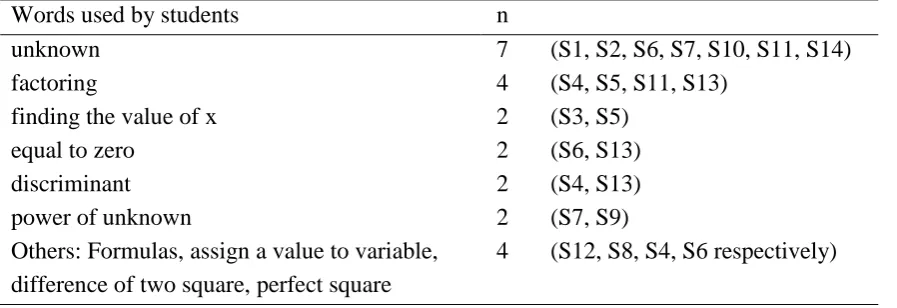
quadratic equation with one unknown. Some of the students explicitly indicated their difficulty in defining the quadratic equation. One student (Student 12, denoted S12) said “I cannot define it. There are just formulas in my mind.” Another student (S14) said Hmmm…now...how I can explain…maybe, unknown…there are two unknown… I cannot explain it because we usually solve quadratic equations…,” and another student (S3) said “Uhh…the aim is to find x, what x is…I do not know…defining it is so odd.” Moreover, none of the students could provide an exact and correct definition of a quadratic equation. Instead, all the students used similar words while trying to define/explain what a quadratic equation is. Commonly used words or expressions were: unknown, finding x value, factoring something, two unknowns, equal to zero, and discriminant. They are presented in Table 3.
Table 3
The Words Used by Students in Defining Quadratic Equation
Words used by students n
unknown 7 (S1, S2, S6, S7, S10, S11, S14)
factoring 4 (S4, S5, S11, S13)
finding the value of x 2 (S3, S5)
equal to zero 2 (S6, S13)
discriminant 2 (S4, S13)
power of unknown 2 (S7, S9)
Others: Formulas, assign a value to variable, difference of two square, perfect square
4 (S12, S8, S4, S6 respectively)
As Table 3 shows, some of these words (e.g., unknown, equal to zero, the value of x) were not specifically related to the quadratic equation concept; instead, they are more closely associated with the algebraic equation concept.
Furthermore, analyses of students’ explanations of their examples of quadratic equations in interview question (ii) revealed that three students (S3, S8 and S10) were confusing linear equations with quadratic equations. The following dialogue between S3 and the researcher (R) illustrates the student’s confusion.
R: Could you please define/explain, in your own words, what the quadratic equation with one unknown is?
S3: Uhh…the aim is to find x, what x is…I do not know…defining it is so odd. Which values x takes… It takes many values… [silence]
R: Ok, could you write down an example of a quadratic equation in one unknown?
S3: [silence] Student writes “3𝑥 + 2𝑦 = 8 and 𝑥 + 5𝑦 = 5”. Normally, we eliminate y, and then find the value of x, and then find the value of y.
R: Why did you call these equations quadratic?
S3: Because we learnt it in the course, we always do them in the courses.
R: Well, how did you decide the degree of the equations?
Secondary school students’ conception of quadratic equations with one unknown Kabar
Similarly, the examples presented by S8 and S10 included both linear equations and quadratic expressions. For instance, the examples given by S8 were “x22x2”, “
4 1
x y and x4x5”, and the examples written by S10 were “ 2
3 24
x x ”, “ 2
20 x
” as well as “x6.”
Students’ Concept Images of Quadratic Equation in One Unknown
The data for this section comes from both parts of the interviews. Analysis of the data showed that “factoring of quadratic equations,” “discriminant (quadratic formula)” and “x as an unknown” played a major role in all students’ written and verbal explanations. Moreover, the data revealed that students’ concept images of quadratic equations were dominated by the factoring method.
When students were asked to write quadratic equations, they could not write quadratic equations spontaneously. Rather, they tried to write equations that can be solved by factorization. Eleven of the fourteen students (all except S2, S3, and S8) paid attention to writing factorable quadratic equations. All these students initially started to write the equation with the term “x2.” Then, some of them wrote the constant term second and left a blank for the middle term. Next, they thought a few seconds about the numbers that multiply together to give a constant term and add together to give the middle term. After they decided the factors of the constant term, they wrote the middle term. Others preferred to write the middle term second and left a blank for the constant term. Then, they paid attention to the coefficient of and the sign of the middle term that they wrote. Next, they determined what two numbers add together to give the middle term, and they wrote the constant term in line with these numbers.
For instance, the following excerpt exemplified one student’s (S5) strategy in writing quadratic equations (this student preferred to leave a blank for the middle term).
R: Ok, please write a quadratic equation with one unknown.
S5: [She writes without using an equals sign] “x2.... 12 ”, then decided on the middle term, and wrote the equation as “ 2
7 12
x x *”
R: How did you decide on these numbers? [Researcher points out the numbers 7 and 12]
S5: I initially did not write the middle term, rather I wrote the last term [she refers the constant term]. In this way, writing the middle term becomes easy for me.
[*Note that the written algebraic expressions were not quadratic equations; instead, they were quadratic expressions. This issue will be discussed in a later section].
On the other hand, another student (S9) initially preferred to write the middle term, left a blank for the constant term, and then tried to decide which number(s) the constant term should be.
R: Could you write an example of a quadratic equation with one unknown?
S9: [he initially writes] x2 x ... [ask himself, what can the constant be? and then he decides it can be 12, and writes without using an equals sign], x2 x 12
R: How did you decide the numbers? Why did you write it like that?
S9: I wrote to find it easily. [He means finding the roots of the quadratic equation] We can easily factor this equation.
Secondary school students’ conception of quadratic equations with one unknown Kabar
S9: [He initially writes] “x2 x ...”, [and then he says] the constant term can be 20, and [He writes without using an equals sign] “x2 x 20”, x15 and x2 4
R: What did you write now?
S9: The factors of 20 [the dialogue continues]
Like S5, S4 also preferred to a leave blank for the middle term and after she wrote the constant term, she decided to write the middle term. Conversely, she was aware that there can be quadratic equations that do not necessarily have to be solved by factoring. She thought that the quadratic formula could be used to solve such equations. However, her explanations showed that the factoring method was dominant in her mind:
R: Please write a quadratic equation with one unknown.
S4: [She initially writes] “ 2
x ... 6 ” [then, she writes the factors below the constant term as -2 and -3] and thenx25x 6 0.
R: Well, why did you do these operations?
S4: The multiple of the numbers should be equal here [showing the constant term] and the sum of the numbers should be equal to the middle term.
R: Well, would there be any quadratic equation in which you do not need to do such operations?
S4: At that time, we use the discriminant [Student has started to write the quadratic formula]
R: Well, can I write a quadratic equation like “x2 5x120”? Is it a quadratic equation?
S4: [silence] Normally, it is different from mine. If I apply the discriminant...[however, student has suddenly started to factorize it]…Uhh..it does not work. Maybe I can use the discriminant.
R: What is the problem?
S4: I could not factorize it.
R: Ok. Is it a quadratic equation?
S4: Yes, it is, because there is one unknown.
R: Well, you mean that it is quadratic equation in with one unknown. How do you understand whether it is a quadratic equation?
S4: There are two roots.
R: How do you know?
S4: Hmmm…For example, if two roots appear when I apply the discriminant…
In addition to students’ attempts to write factorable quadratic equations, the data showed that almost all the correctly presented examples were prototypical examples of quadratic equations. That means that the presented quadratic equations were in the standard form of quadratic equations “ 2
0
ax bx c ”, the letter used as the variable (unknown) was x, and
a=1. Additionally, the coefficients of the 𝑥2 and x terms, as well as constant term, of the all presented quadratic equations were also integers, and they were simply factorable. Only two examples, given by S7 and S13, had 𝑎 = 2. They were “ 2
2x 2x 8 0” and “
2
2x 8 4x0.” Moreover, S14 presented three examples ((x4)(x3),x242and
2
(x 4) ) as quadratic equations, but she wrote these expressions without using an equals
sign. Other examples, like “ 2
x 5x0, 2
a 49, 2
m 5 4m or 𝑥2+2
Secondary school students’ conception of quadratic equations with one unknown Kabar
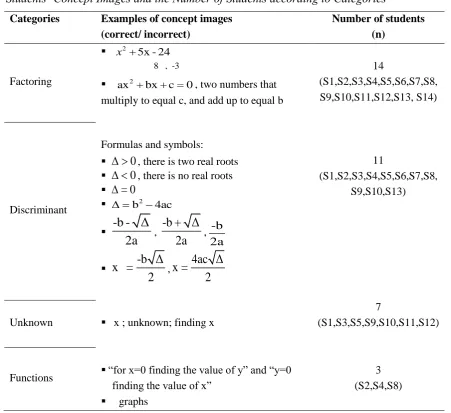
Moreover, students’ answers to interview question (iii) contained many different representations and associated properties of the quadratic equation concept. However, the students’ concept images of quadratic equations were comprised mainly of “factoring, discriminant and unknown,” as presented in Table 4. It should be noted that Table 4 contains more than 14 observations because students included more than one aspect apiece. For example, the concept images of S1, S3, S5, S9 and S10 included three aspects, which were “factoring, discriminant and unknown.”
Table 4
Students’ Concept Images and the Number of Students according to Categories
Categories Examples of concept images (correct/ incorrect)
Number of students (n)
Factoring
2
+ 5x - 24 x
2
ax + bx + c = 0 , two numbers that multiply to equal c, and add up to equal b
14
(S1,S2,S3,S4,S5,S6,S7,S8, S9,S10,S11,S12,S13, S14)
Discriminant
Formulas and symbols:
0, there is two real roots
0, there is no real roots
= 0
2
b 4ac
-b - Δ
2a ,
-b + Δ 2a ,
-b
2a
x = -b Δ
2 ,
4ac Δ x =
2
11
(S1,S2,S3,S4,S5,S6,S7,S8, S9,S10,S13)
Unknown x ; unknown; finding x
7
(S1,S3,S5,S9,S10,S11,S12)
Functions “for x=0 finding the value of y” and “y=0 finding the value of x”
graphs
3 (S2,S4,S8)
Furthermore, students’ solutions of quadratic equations in the questionnaire and their explanations regarding these solutions in the interviews also revealed that, whereas factoring was the favourite method for solving a quadratic equation, the use of the discriminant was their second preference. The methods used by students to solve quadratic equations in the questionnaire are presented in Table 5.
Secondary school students’ conception of quadratic equations with one unknown Kabar
Table 5
The Number of Students with respect to Method They Used (correctly or incorrectly) to Solve the Quadratic Equation in Each Question
The Method
Used Questions
Factoring (n)
Discriminant/Quadratic Formula
(n)
Completing the Square
(n)
Question 1 14 - -
Question 2 9 5 -
Question 3 - 14 -
Question 4 1 4 5
For the first question, all students reported that finding the factors of the given quadratic equation was quite easy; therefore, they preferred to use the factoring method to solve it. For the second question, five students who attempted to use the quadratic formula expressed that they initially tried to factor the given quadratic equation; however, they were unsuccessful. Then, they decided to use the discriminant, that is, the quadratic formula. Similarly, for the third question, all students reported that their initial attempt was to factor the given quadratic equation. However, since the given quadratic equation could not be factored, they used the quadratic formula to solve it. On the other hand, in question 4, students were specifically asked to solve the given quadratic equation by using completing the square. However, many of the students reported that they either did not learn or remember that method at all. Therefore, four left the question blank, four students used the quadratic formula, one student used the factoring method and five students used completing the square to solve the question. Moreover, all students indicated that they could solve the given quadratic equations either with the factoring method or the quadratic formula, but they could not offer any other methods to solve the equations.
Students’ Conceptual Obstacles/Confusion
While the students were talking about quadratic equations, it became apparent that they lacked understanding regarding the variable concept, degree of a polynomial, and equation concept.
Students’ lack of understanding of the variable. The data revealed that several students thought that the two x’s in a quadratic equation represent different variables (unknowns). That is, students think that when two x’s appear in an equation, the equation includes two variables. The following excerpt exemplifies how S10 thinks that the term “x2”and the term “3𝑥” stand for two different unknowns.
R: Could you write an example of quadratic equations with one unknown?
S10: [she writes] x23x24 [without using an equals sign] R: Why did you write it like that?
Secondary school students’ conception of quadratic equations with one unknown Kabar
R: Why do you think that this equation includes two unknowns?
S10:[she shows] the term “𝑥2” and the middle term “3𝑥”. We need to find these values.
R: Could you write another example?
S10: [she writes] x220 [without using an equals sign] R: Well, this time you wrote 2
x 20
S10: Yes…because it includes one unknown.
Next, the following excerpt shows that S8 has a similar conception. She thinks that in her example “𝑥2” and “2𝑥” are two different unknowns, and that this indicates that the written equation is a quadratic equation. In addition, she also thinks that “𝑥 = 4𝑦 + 1” may be a quadratic equation because this equation includes both “𝑥” and “𝑦” variables.
R: Could you write me an example of a quadratic equation with one unknown?
S8: [She writes] x22x2 [without using an equals sign] R: Ok. You wrote this one: “x22x2”
S8: Yes, I can find the value of x.
R: How can you find it?
S8: For example, if I write here−2, and then here 1, and then 𝑥1 = 2 and 𝑥2 = −1. I remember the signs are reversed.
R: Ok, could you write another example?
S8: [she writes] 𝑥 = 4𝑦 + 1. Here, we can find the value of x. This is an equation but I do not remember if it is a quadratic equation. For example, if y is equal to zero, the value of x is equal to 1.
R: So, is it a quadratic equation? How do you distinguish if an equation is a linear or quadratic equation?
S8: Uh…my problem is not to learn the title of the topics. I just look at the general view of the given questions.
R: Well, now, you cannot tell, right?
S8: Yes [smiling].
R: Ok, for example, you wrote here “x22x2” and told me it could be a quadratic equation. What did you think? Why is it a quadratic equation?
S8: For instance, could it be? Uh...[struggling] I do not remember now…It is…there are two unknowns, well...there are “𝑥” and “𝑥”, [she shows the term 𝑥2and 2𝑥]
R: Ok, for example, you also wrote “𝑥 = 4𝑦 + 1”. Here, there are “𝑥” and “𝑦”. What do you think about the degree of this equation?
S8: Well, actually, it should be a quadratic equation because there are two different…
Secondary school students’ conception of quadratic equations with one unknown Kabar
Table 3). For example, the following excerpt illustrates S2’s conception regarding the unknown and its relation to the quadratic equation.
R: Could you please define/explain in your own words what a quadratic equation with one unknown is?
S2: There is only one unknown but we use this unknown in two places, for example, 𝑥2− 3𝑥. “x” is the only one unknown, but we use it in two places.
R: What do you mean “two different places”?
S2: For example, we used it both in 𝑥2 and in 3𝑥.
R: Could you write down it for me?
S2: [She writes]𝑥2− 3𝑥 + 5 = 0
R: Did you write a quadratic equation in one unknown?
S2: Yes.
R: Could you write other examples?
S2: Well, they are similar…[she writes] 3𝑥 + 𝑥 − 8 = 0 and 5𝑥 + 𝑥 − 13 = 0
R: Are they quadratic equations with one unknown?
S2: Yes, they are.
R: How do you decide whether something is a quadratic?
S2: The unknown appears in two places…that is, the unknown is both here [shows 3x] and here [shows x]. However, if 𝑥 + 5 is equal to 0 (𝑥 + 5 = 0), it is a first degree equation
R: Any other examples? (Similar or different)
S2: 5𝑥 − 𝑥 − 13 = 0
As seen in the excerpt above, S2 thinks that the use of x in two places in an equation indicates that it is a quadratic equation.
Students’ lack of understanding of the meaning of the equation. The issue appeared when students were required to write quadratic equations. Only five students’ (S1, S6, S7, S12 and S13) examples were totally correct. That is, they were in the standard form of the quadratic equation. Other students ignored the “equals sign.” As exemplified in some excerpts in the section above, many examples presented by students as quadratic equations were not set “equal to zero”, “a number” or “a variable including x or x2”. They were like “
2
20
x x ”, “x242” or “x25x6”. They were correct as quadratic expressions; however, they were not quadratic equations. Students treat these quadratic expressions as quadratic equations.
Discussion and Conclusions
Secondary school students’ conception of quadratic equations with one unknown Kabar
concept (Vinner, 1983). Moreover, the findings indicated that students’ concept definitions were consistent with the students’ concept images. That means, as Tall and Vinner (1981) stated, this study showed that students’ definitions of quadratic equations were the descriptions/reflections of their concept images. Secondly, the data revealed that the participating high school students hold various (conscious and unconscious) concept images regarding quadratic equations, but students’ concept images were quite limited. Students’ concept images included “factoring and quadratic formula” as the quadratic equation solution methods, as well as “the symbol x as unknown.” However, students’ responses indicated that they overwhelmingly relied on the factoring method while describing quadratic equations, presenting examples of quadratic equations and solving quadratic equations. That is, students assimilated quadratic equations with the factoring method, and their concept images were dominated by the idea of factoring. Moreover, the findings also showed that, although there is a wide variety of a quadratic equation, students’ concept images also involved prototypical examples of quadratic equations.
On the other hand, the findings also indicated that discriminant () as a part of quadratic formula existed in students’ concept images. Many students’ concept images included the discriminant as b24accorrectly, but the quadratic formula to find roots of quadratic
equations incorrectly as 2
b
and
4 2
ac
.
Tall and Vinner (1981) expressed that many of the students’ concept images might have their source in the specific examples given by their teachers. Moreover, in their research, Olteanu and Holmqvist (2012) pointed out that teachers’ focus on different aspects of quadratic equations implied different learning outcomes. Therefore, considering Tall and Vinner’s (1981) claim and Olteanu and Holmqvist’s (2012) research, the findings of this study suggest that students’ concept images concerning factoring could be related to the classroom instructions where teachers may prefer mostly factorable quadratic equations as examples. Alternatively, based on students’ expressions during the interview, students’ comprehension of quadratic equation solution methods could be asserted. In general, for teaching the solution of quadratic equations, the quadratic formula is also emphasized by teachers since the quadratic formula works for all quadratic equations (Tall et al., 2014). However, comprehending and remembering the quadratic formula was hard for many students, as Tall et al. (2014) and Didiş and Erbaş (2015) stated. Moreover, comprehension of the factoring method might be easier than comprehension of other methods for solving quadratics. These findings could also be the result of students’ greater experience with the factoring method over other methods. In the Turkish high school mathematics curriculum, students learn the factoring method while learning both quadratic equations and polynomials. Particularly, teaching the factoring of polynomials is located as a sub-learning domain in tenth grade mathematics and teaching factoring is given plenty of time in the curriculum (Ministry of National Education [MoNE], 2013). Because this study was not focused on possible sources of students’ concept images of quadratic equations, future research is needed to investigate how students concept images of quadratic equations might be the result of classroom instructions/practice, as well as other possible sources of students’ developed concept images.
Secondary school students’ conception of quadratic equations with one unknown Kabar
equals sign. The findings of this study showed that students’ lack of understanding of the variable concept and determining the degree of a polynomial resulted in them confusing the quadratic equation concept with the linear equation concept. Some students thought that the use of two variables “x” and “y” or the use of x twice in an equation resulted in a second degree equation. On the other hand, many of the students wrote quadratic expressions, not quadratic equations. This finding indicates that students ignore the meaning of the equation concept. That is, inadequate prerequisite knowledge posed an obstacle when the students attempt to build a coherent schema regarding the structure and meaning quadratic equations. Fox (1999) stated that even though polynomials, roots and radicals, quadratic equations and parabolas are connected topics that are allocated plenty of time in their mathematics curriculum, these topics are left unconnected. Similarly, all these topics were presented as connected in Turkish secondary school mathematics curricula, and plenty of time was allotted to their mastery (MoNE, 2013); however, students’ conceptions of quadratics also demonstrated that degree of polynomials and the meaning of quadratic equations were left unconnected to the rest of the material, as Fox (1999) claimed.
Overall, the findings of this study showed students’ inadequate knowledge of the quadratic equation concept definition, students’ limited concept images and students’ lack of some prerequisite knowledge for comprehending quadratic equations. In order to enrich students’ concept definition and images, both procedurally and conceptually, lessons from this study need to be used in teaching. Knowing and understanding the formal definition of a quadratic equation is important for conceptually understanding relationships beyond symbolic computations in solving quadratic equations. Therefore, this study suggests that teachers should spend more time and attention on introducing the definition of a quadratic equation. On the other hand, as the findings revealed, students overwhelmingly relied on the factoring method for solving quadratic equations, and their concept images involve prototypical examples of quadratic equations. Based on these findings, this study suggests that classroom instruction should not only include typical examples of quadratics, but also different types of quadratic equations. Furthermore, teachers should also provide examples of non-quadratic equations (including linear equation with two variables, cubic equations, etc.) and discuss the differences between examples and non-examples of quadratics. The findings of this study also point out the importance of connecting polynomials and quadratic equations, and suggest that polynomials and quadratic equations should be taught in relation to each other. Therefore, teachers should design activities for students in which the students discover the connection among topics such as polynomials, quadratic equations and quadratic functions (parabolas).
This study will initially contribute to teachers’ awareness of students’ conceptions of quadratic equations, but it may help teachers offer improvements to their quadratic equation instruction. The present study will also contribute to the growing body of research concerned with teaching and learning quadratic equations.
References
Akkoç, H. (2008). Pre-service mathematics teachers’ concept images of radian. International Journal of Mathematical Education in Science and Technology, 39(7), 857-878.
Allaire, P., & Bradley, E. R. (2001). Geometric approaches to quadratic equations from other times and places. Mathematics Teacher, 94(4), 308–313.
Secondary school students’ conception of quadratic equations with one unknown Kabar
Clark, M. K. (2012). History of mathematics: Illuminating understanding of school mathematics concepts for prospective mathematics teachers. Educational Studies in Mathematics, 81(1), 67–84.
Corbin, J., & Strauss, A. (2008). Basics of qualitative research: Techniques and procedures for developing grounded theory. Thousand Oaks: Sage Publications.
Didiş, M. G., & Erbaş, A. K. (2015). Performance and difficulties of students in formulating and solving quadratic equations with one unknown. Educational Sciences: Theory & Practice, 15(4), 1137-1150. Fox, W. P. (1999). Quadratic connections. PRIMUS, 9(3), 275-278.
Gray, R., & Thomas, M. (2001). Quadratic equation representations and graphic calculators: Procedural and conceptual interactions. In J. Bobis, B. Perry & M. Mitchelmore (Eds.), Numeracy and beyond (Proceedings of the 24th Conference for the Mathematics Education Research Group of Australasia, pp. 257–264). Sydney: MERGA.
Gutiérrez, A., & Jaime, A. (1999). Preservice primary teachers’ understanding of the concept of altitude of a triangle. Journal of Mathematics Teacher Education, 2(3), 253-275.
Joarder, A., H. (2015) Factorising a quadratic expression with geometric insights. Australian Senior Mathematics Journal,29(1), 25-31.
López, J., Robles, I., & Martínez-Planell, R. (2016). Students' understanding of quadratic equations. International Journal of Mathematical Education in Science and Technology, 47(4), 552-572.
Ministry of National Education [MoNE] (2013). Ortaöğretim matematik (9, 10, 11 ve 12. sınıflar) dersi öğretim programı. [Secondary mathematics curriculum for grades 9-12]. Ankara, Turkey.
Olteanu, C., & Holmqvist, M. (2012). Differences in success in solving second-degree equations due to the differences in classroom instruction. International Journal of Mathematical Education in Science and Technology, 43(5), 575-587.
Olteanu, C., & Olteanu, L. (2012). Equations, functions, critical aspects and mathematical communication. International Educational Studies, 5(5), 69-78.
Przenioslo, M. (2004). Images of the limit of function formed in the course of mathematical studies at the university. Educational Studies in Mathematics, 55(1-3), 103–132.
Radford, L., & Guérette, G. (2000). Second degree equations in the classroom: A Babylonian approach. In V. Katz (Ed.), Using history to teach mathematics: An international perspective (pp. 69–75). Washington: MAA.
Sağlam, R., & Alacacı, C. (2012). A comparative analysis of quadratics unit in Singaporean, Turkish and IMDP mathematics textbooks. Turkish Journal of Computer and Mathematics Education, 3(3), 131–147. Tall, D., de Lima, R. N., & Healy, L. (2014). Evolving a three-world framework for solving algebraic equations
in the light of what a student has met before. The Journal of Mathematical Behavior, 34, 1-13.
Tall, D., & Vinner, S. (1981). Concept images and concept definition in mathematics with particular reference to limits and continuity. Educational Studies in Mathematics, 12(2), 151-169.
Vaiyavutjamai, P., & Clements, M. A. (2006). Effects of classroom instruction on students’ understanding of quadratic equations. Mathematics Education Research Journal, 18(1), 47–77.
Vinner, S. (1983). Concept definition, concept image and the notion of function. International Journal of Mathematical Education in Science and Technology, 14(3), 293-305.
Vinner, S., & Dreyfus, T. (1989). Images and definitions for the concept of function. Journal for Research in Mathematics Education,20(4), 356–66.
Vinner, S. & Hershkowitz, R. (1980). Concept images and some common cognitive paths in the development of some simple geometric concepts. In R. Karplus (Ed.), Proceedings of the Fourth International Conference for the Psychology of Mathematics Education, (pp. 177–184). Berkeley: University of California.
Wawro, M., Sweeney, G., F., & Rabin, J. M. (2011). Subspace in linear algebra: investigating students’ concept images and interactions with the formal definition. Educational Studies in Mathematics, 78(1), 1–19. Yanik, B., H. (2014). Middle school students’ concept image of geometric translation. Journal of Mathematical
Behavior, 36, 33-50.
Zakaria, E., & Maat, M. S. (2010). Analysis of students’ error in learning of quadratic equations. International Education Studies, 3(3), 105–110.
Zaslavsky, O. (1997). Conceptual obstacles in the learning of quadratic functions. Focus on Learning Problems in Mathematics, 19(1), 20-44.
Appendix
Secondary school students’ conception of quadratic equations with one unknown Kabar
1. Solve x22x 48 0 2. Solve 10x29x 7 0 3. Solve x2 8x 5 0
4. Solve x210x 39 0 using the completing square method