http://pjpr.net Vol: 04 Issue: 01 PP: 21-25
Faculty of Pharmacy, Bahauddin Zakariya University Multan, Pakistan
ISSN: 2410-6275 Jan, 2018 DOI: 10.22200/pjpr.2018121-25
Introduction
Pain and inflammation is a global issue. Severe medical illness, emergency, trauma, natural calamities, poor dietary conditions and overburdened life are some of the reasons that needs management (Dolin et.al.). The Support study (1995) concluded that almost half of patients with diseases had moderate to severe pain (during their end days of life) (Joranson et.al., 2000). Its management is done at different level depending upon the condition of patients. Among various analgesics used in pain
management non-steroidal anti-
inflammatory drug substance NSAIDS are most common (Karmoker et.al., 2016). Diclofenac is frequently prescribed as (NSAID) (Siddik et.al., 2001), commonly indicated in reducing pain, inflammation (Huang et.al., 2008) and in various other conditions (rheumatoid arthritis, acute injury, osteoarthritis, gout attacks, spondy arthritis, and in kidney stone pain). Menstrual pain acute migraines, post traumatic pain, female
breast cancer and body metastatic pain can be well managed by diclofenac (Tunçay et.al., 2000). Gastrointestinal disturbances are the major adverse effects of diclofenac therapy after oral administration due to reason. This drug is usually formulated as coated tablets. Tablets that have enteric coating along with sustained release effect give a new perspective to gastroirritant active pharmaceutical ingredients. These advanced formulations provide an initial release of dosage form to initiate sufficient therapeutic effect and then a gradual release of maintenance dose over a prolonged period of time. Hence these type of formulation exhibits quick onset of action and continued for extended period (Dutta et.al., 2011). The in-vitro dissolution process always played a pivotal role in releasing drug from tablet matrix and in making inference whether it is obtainable for subsequent gastrointestinal absorption (Bravo et.al., 2002). The nature of formulation, process of manufacturing, and drug physiochemical properties contributes to In-vitro dissolution process. To check the quality of the product and differentiation among formulations Syed Nisar Hussain1 Shah, Zohaib Muzaffar1, Mueen Mohsin2 and Huma butt2*
A Comparative analysis: In-vitro dissolution study of different
commercially available brands of diclofenac sodium
Research Article
Abstract
The study was aimed to compare in-vitro release behavior of four commercially available brands of diclofenac sodium sustained release tablets. Most commonly used brands of tablets were taken randomly that contained same quantity of active ingredients but differ in type or amount of excipients used. USP references standard Diclofenac Sodium was used to obtain standard curve. In-vitro dissolution was performed by USP Paddle apparatus employing two different dissolution medium one acidic (pH 1.2) and other buffer medium (pH 6.8). Weight variation of these formulations was found to be 1.4%, 2.1%, 2.6% and 0.9%. In-vitro dissolution rate of these commercially available brands of diclofenac sodium were 97.867%, 90.979%, 95.639% and 99.494% respectively. The result showed variability in release profile. Sustained quality control and constant market monitoring on these products and its formulation factors can lead to improvement in quality of medicine.
Received: Feb, 14, 2018 Revised: Apr, 17, 2019 Accepted: Jun, 29, 2019 Online:
1Department of Pharmaceutics, Bahauddin Zakariya University, Multan Pakistan
2Department of Pharmacy, Islamia University Bahawalpur Pakistan
Keywords: Release rate, Sustained release tablets, diclofenac sodium
(Alpha 1 -antitrypsin).
*Corresponding Author: Huma butt Address:Department of Pharmacy, Islamia
University Bahawalpur
(same therapeutic agent but different pharmaceutical excipients) (Maggio et.al., 2008), in-vitro dissolution studies serve as an effective tool, as it is an indicator for evaluation of formulation (Löbenberg et.al., 2000).
Different brands of diclofenac sodium are available in Pakistan under different names. Our comparative study involved randomly selected three national as well as one international brand of diclofenac sodium sustained release matrix tablets.
Material and Methods
Chemicals: USP references standard of Diclofenac Sodium (Merk, Germany).
Reagents: Hydrochloric acid (Merk, Germany); Sodium Hydroxide (Merk, Germany); Ortho-phosphoric acid (Merk, Germany):
Equipments: Simadzu UV
spectrophotometer; Digital pH meter; Electrolab Tablet Dissolution Test machine (XXII);Sartorius electronic balance.
Dosage forms
Three local and one multinational brand of (manufactured date less than four months from purchasing) diclofenac sodium SR purchased from different stores. These test products were examined for manufacturing license, batch history, manufacture date and expiry prior to buy.
They were labelled (DS-1, DS-2, DS-3) for local brands and (DS-X) multinational brand. The blister packs of all four brands were stored at temperature of 25±2°C for one month before the experiment to check any tablet defect in formulations. Statistics of the brand under study are given in Table 1 and practical data for drug release experiment is given in Table 2:
Table 1: Statistics of brand under study
Statistics of Brands under study
Code Brand Manufacturer Batch.No Mfg.Date Exp.Date
DS- 1 Dicloran SAMI 04k 1-2011 12-2013
DS-2 Sofac Saffron 00618 1-2009 11-2014
DS- 3 Diclocon Alcon 0002 1-2010 4-2012
DS-X Voltral Novartis J0218 1-2011 12-2015
Table 2: Practicle data for drug release experiment
Parameters for Drug release experiment No.of replicates
Dissolution Medium
Volume of Dissolution
Temperature
Rotation speed
Sampling Time
Determination of Release of
Diclofenac Sodium
6 Tablets per experiment
Phosphate buffer of PH 1.2 & 6.8 900ml 37 C 50rpm 15minutes Paddle appratus
UV-spectrophotometer at wavelength of max.at 276nm
Weight Variation
All the brands were analysed, according to USP specifications (for their uniformity of weight). Twenty tablets (of each brands) were selected randomly and were weighed on Sartorius
electronic balances. The average weight of those twenty tablets was calculated, weight deviations were estimated by equation 1 (Attama et.al., 2003) to comply with the USP standrads.
Weight variation = (Iw - Aw)/Aw × 100% equation (1)
Iw = Individual weight of the tablet Aw = Average weight of the tablet Dissolution study
0 0.2 0.4 0.6 0.8
0 50 100
Abs
o
rba
nce(
A)
Conc. mg/ml
Standerd Curve
Standerd Curve results vessel, corresponding tablets and vessel
position have assigned the same number. The result was identified for each individual tablet with a particular vessel and position. The duration of dissolution study was 3 hours where in first 2 hours the tablets were exposed to simulated gastric media (0.1N HCl pH 1.2) and in last 10 hour the tablet matrices were exposed to simulated intestinal media (Buffer pH 6.8). Table 2 shows the technical data for drug release experiment.
Preparation of simulated gastric medium
1000 ml solution was prepared by adding 11.4 ml of 0.1 N Hydrochloric acid (32% w/v, pH 1.2) and sufficient water to make up final volume.
Preparation of simulated intestinal medium
1000 ml buffer solution (pH 6.8) was prepared, it is composited from 20 ml Sodium Hydroxide (25% w/v) in quantity sufficient water. The pH was adjusted using 0.1 N Hydrochloric acid to 6.8 by the USP XXIII procedure with minor modification (adding 1.2 ml O -phosphoric acid).
Preparation of standard curve
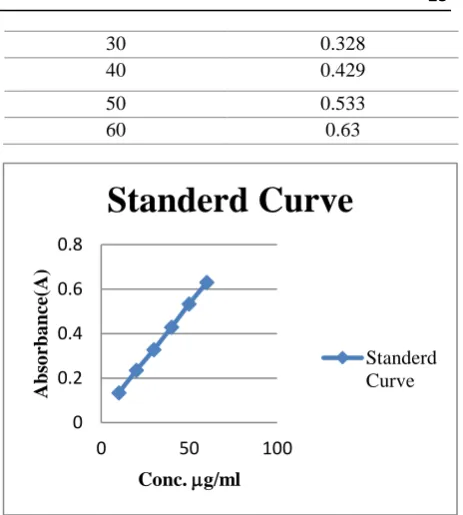
Stock solution of diclofenac sodium reference substance was prepared, serial dilutions were made and calibration curves were obtained by measuring the absorption of each dilution at the maximum absorption wavelength of 277 nm (Table 3, Figure 1). Limit of detection and limit of quantification was performed six times and their values were calculated (table 4) from calibration curve using formula 3.3s/S (LOD) and LOQ (10s/S), S is slope of calibration curve and s is standard deviation.
Table 3: Standard curve for diclofenac sodium Diclofenac Sodium Standard Curve Concentration (µg/ml) Absorbance (A)
10 0.134
20 0.235
30 0.328
40 0.429
50 0.533
60 0.63
Figure 1: Standard curve of diclofenac sodium reference.
Table 4: Validation parameters
Parameters Values
Working λ.max 277nm
Beer’s lambert limt 0-60 µg
Slope 0.009
LOD 0.951
LOQ 3.17
R2 0.999
Results and discussion Weight variation
Weight variation of various brands of diclofenac sodium DS-1, DS-2, DS-3 and DS-X are shown in table. The average percentage deviation of all these different brands of diclofenac sodium comes out to be
1.49%, 1.13%, 1.32% and 0.66%
respectively (Table 5). Similar results have been shown in one of the previous studies on diclofenac sodium prolonged released tablets (Bertocchi et.al., 2005).
Table 5: Data Table of weight variation Test
Sr. No DS-1 DS-2 DS-3 DS-X
Weight % Deviation
Weight % Deviation
Weight % Deviation
Weight % Deviation
1 0.283 g 0.70 0.230 g 0 0.254 g 0.7 0.220 g 0
2 0.280 g 0.3 0.232 g 0.8 0.254 g 0.7 0.222 g 0.9
0 20 40 60 80 100 120
3 4 5 6 7 8 9 10 11 12
P
er
ce
n
t d
ru
g
r
elea
se
%
Time hrs.
DS-1 DS-2 DS-3 DS-4
4 0.276 g 1.7 0.229 g 0.4 0.254 g 0.7 0.220 g 0
5 0.286 g 1.7 0.227 g 1.3 0.252 g 0.7 0.224 g 1.8 6 0.284 g 1.0 0.231 g 0.4 0.252 g 0.7 0.217 g 1.3 7 0.277 g 1.4 0.238 g 3.4 0.263 g 3.2 0.221 g 0.4 8 0.290 g 3.2 0.225 g 2.1 0.261 g 2.8 0.217 g 0.4 10 0.285 g 1.4 0.235 g 2.1 0.247 g 2.6 0.222 g 0.9 Average
weight
0.281 g ±1.49 0.230 g ±1.13 0.253 g ±1.32 0.220 g ±0.66
Dissolution
Four commercially available brands of diclofenac sodium were tested using USP II dissolution apparatus, in acidic as well as in basic medium. In acidic stage, 900 ml 0.1N hydrochloric acid was poured in the vessel and accurately weighed six tablets from each brand then put in the baskets. The process time was of 2 hours. 10 ml of the sample was drawn at regular time interval and drug
released was analyzed using UV
spectrophotometer at 277 nm. The
concentration of the different brands of diclofenac sodium at acid stage is given below in table 6.
Table 6: Drug release Percentage of DS-1, DS-2, DS-3 and DS-x at pH 1.2
Time (Minutes)
DS-1 DS-2 DS-3 DS-x
% age % age % age % age
0 0 0 0 0
15 0.9 1.04 1.64 0.58
30 2.3 1.86 3.42 1.8
45 3.8 3.3 4.66 3.4
1 h 5.4 4.64 6.02 4.2 1 h 25 min 6.2 5.8 7.5 5.2 1.h 30 min 7.6 7.0 8.8 6
1h 45 min 8.84 8.4 9.9 7.5
2 h 9.7 9.5 11.2 8
After carrying the procedure for 2 hours in the acid medium, 20 ml sodium hydroxide (25%) was poured to the previous medium. The pH was set to 6.8 ±0.05 by adding O -phosphoric acid (1.2ml). The process was carried out for 10 hours and sample was again withdrawn at regular time interval. The dissolution medium was then replaced to maintain the volume of medium. The withdrawn samples (10ml filtered, diluted and analysed at 277nm for diclofenac sodium
by spectrophotometer). Standard or calibration curves formed from the Standard solution of USP reference standard test drugs were then used to analyse the quantity of drug in the samples.
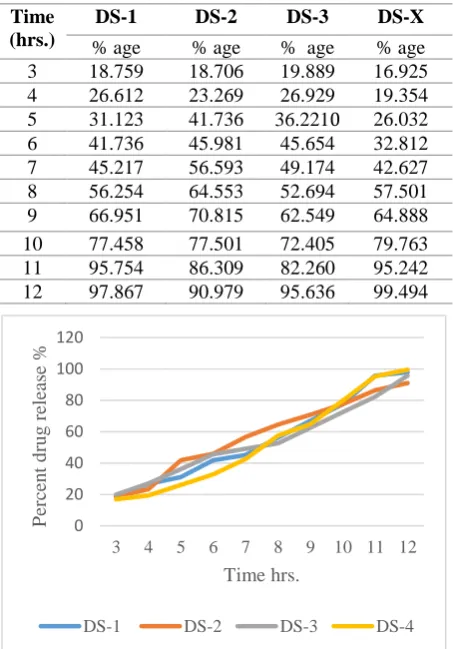
Table 7: Percentage drug release of DS-1, DS-2, DS-3 and DS-X at pH 6.8
Time (hrs.)
DS-1 DS-2 DS-3 DS-X
% age % age % age % age 3 18.759 18.706 19.889 16.925 4 26.612 23.269 26.929 19.354 5 31.123 41.736 36.2210 26.032 6 41.736 45.981 45.654 32.812 7 45.217 56.593 49.174 42.627 8 56.254 64.553 52.694 57.501 9 66.951 70.815 62.549 64.888 10 77.458 77.501 72.405 79.763 11 95.754 86.309 82.260 95.242 12 97.867 90.979 95.636 99.494
Figure 2: Percent drug release of DS-1, DS-2, DS-3 and DS-X at pH 6.8
compare to other formulations (90.979%). Another study has shown in which all of the drug released between 80 and 100% within 8h and showed quicker releases at pH 6.8 due to less pka pf diclofenac sodium (Bertocchi et.al., 2005).
Conclusion
It was concluded that all commercially available brands of diclofenac sodium sustained release tablets meet official criteria but showed difference in their release profile to some extent. Few exhibited less drug release compared to others, the reason can be the manufacturing process, use of different excipients and other formulation factors that affected its drug release. There is need of constant quality control of all pharmaceutical products which will help in improvement of quality of medicine and quality of life.
References
Dolin SJ, JN Cashman, JM Bland. Effectiveness of acute postoperative pain management: I. Evidence from published data. British Journal of Anaesthesia,89(3):409-423
Joranson DE, KM Ryan, AM Gilson, JL Dahl (2000). Trends in medical use and abuse of opioid analgesics.
JAMA,283(13):1710-1714
Karmoker JR, S Sarkar, P Joydhar, SF Chowdhury (2016). Comparative in vitro equivalence evaluation of some Aceclofenac generic tablets marketed in Bangladesh. Pharma Innovation J,5(3):03-07
Siddik SM, MT Aouad, MI Jalbout, LB Rizk, GH Kamar, AS Baraka (2001). Diclofenac and/or propacetamol for postoperative pain management after cesarean delivery in patients receiving patient controlled analgesia morphine. Regional Anesthesia and Pain Medicine,26(4):310-315
Huang Y-M, C-M Wang, C-T Wang, W-P Lin, L-C Horng, C-C Jiang (2008). Perioperative celecoxib administration for pain management after total knee arthroplasty – A randomized, controlled study. BMC Musculoskeletal Disorders,9(1):77
Tunçay M, S Çaliş, HS Kaş, MT Ercan, İ Peksoy, AA Hincal (2000). Diclofenac sodium incorporated PLGA (50:50) microspheres: formulation considerations and in vitro/in vivo evaluation. International Journal of Pharmaceutics,195(1):179-188
Dutta M, AK Nath, MZ Uddin, MA Hossain, MM Morshed, MH Kawsar (2011). Effect of fruit juice on the dissolution of diclofenac sodium sustained release matrix tablets. International journal of pharmaceutical sciences and research,2(12):3109
Bravo SA, MC Lamas, CJ Salomón (2002). In-vitro studies of diclofenac sodium controlled-release from biopolymeric hydrophilic matrices. J Pharm Pharm Sci,5(3):213-219
Maggio RM, PM Castellano, TS Kaufman (2008). A new principal component analysis-based approach for testing “similarity” of drug dissolution profiles.
european journal of pharmaceutical sciences,34 (1):66-77
Löbenberg R, J Krämer, VP Shah, GL Amidon, JB Dressman (2000). Dissolution testing as a prognostic tool for oral drug absorption: dissolution behavior of glibenclamide. Pharmaceutical research,17(4):439-444 Attama A, I Nzekwe, P Nnamani, M Adikwu, C Onugu (2003). The use of solid self-emulsifying systems in the delivery of diclofenac. International Journal of Pharmaceutics,262(1-2):23-28
Yeole P, U Galgatte, I Babla, P Nakhat (2006). Design and evaluation of xanthan gum-based sustained release matrix tablets of diclofenac sodium. Indian journal of pharmaceutical sciences,68(2):