INTRODUCTION
There should be no question that one of the most pervasive technology trends in modern computing is an increasing reliance on network connectivity and inter-host communication. Along with the tremendous opportunities for information and resource sharing that this entails comes a heightened need for information security, as computing resources are both more vulnerable and more heavily depended upon than before.
One subset of infor mation secur ity research that has been the subject of much attention in recent years is that of intrusion detection systems. The National Institute of Standards and Technology classifies intrusion detection as “the process of monitoring the events occurring in a computer system or network and analyzing them for signs of intrusions, defined as attempts to compromise the confidentiality, integrity, availability, or to bypass the security mechanisms of a computer or network”¹. This definition captures the essence of intrusion detection but fails to address the
Appraise the recitation of
intrusion detection system at training time
ANURAG LAL
CSE Department, CIT, Rajanadgaon (India) (Received: April 23, 2010; Accepted: May 17, 2010)
ABSTRACT
Network Intrusion Detection aims at distinguishing the behavior of the network. It is an inseparable part of the information security system. Due to rapid development of attack pattern it is necessary to develop a system which can upgrade itself as new threats are detected. Also detection rate should be high because the rate with which attack is carried out on the network is very high. In response to this problem AdaBoost Based Algorithm is proposed which has high detection rate as well as low false alarm rate. In this algorithm decision stumps are used as weak classifier. The decision rules are provided for both categorical and continuous features. Weak classifier for continuous features and weak classifier for categorical features are combined to form a strong classifier. Strategies for avoiding the over fitting are adopted to improve the performance of the algorithm.
Keywords: Intrusion Detection System, Adaboost Algorithm, Security, Machine Learning, Neural Networks.
methods by which Intrusion Detection Systems (IDS’s) automate this process. The concepts of false positive and false negative are essential to this classification process. False positives are those sequences of innocuous events that an IDS erroneously classifies as intrusive, while false negatives refer to intrusion attempts that an IDS fails to report: the reduction of both false positives and false negatives is a critical objective in intrusion detection.
Modern IDS’s are extremely diverse in the techniques they employ to gather and analyze data. Most rely, however, on a common architecture for their structure: a detection module gathers data that may contain evidence of intrusions, an analysis engine processes this data to identify intrusive activity, and a response component repor ts intrusions. One of the most commonly used approaches in expert system based intrusion detection systems is rule-based analysis using Denning’s profile model³. Rule-based analysis depends on sets of predefined rules that are provided by an administrator. Exper t systems require frequent updates to remain current. This design approach usually results in an inflexible detection system that is unable to detect an attack if the sequence of events is slightly different from the predefined profile4. Considered that, the intruder
is an intelligent and flexible agent while the rule based IDSs obey fixed rules. This problem can be tackled by the application of soft computing techniques in IDSs. Soft computing is a general term for describing a set of optimization and processing techniques. The principal constituents of soft computing techniques are Fuzzy Logic (FL), Artificial Neural Networks (ANNs), Probabilistic Reasoning (PR), and Genetic Algorithms (GAs)4.
Related Work
Supervised Learning Based Approaches In recent years, methods from machine learning and pattern recognition have been utilized to detect intrusions. Both supervised learning and unsupervised learning are used. There are mainly super vised neural network (NN)-based approaches5,6, and support vector machine
(SVM)-based approaches7,8 are used in supervised learning
for intrusion detection.
a) NN-based approaches
Bonifacio et al. 9 have proposed an neural
network for distinguishing between the behaviours of intrusions and normal. They unify the coding of categorical fields and the coding of character string fields in order to map the network data to an neural network. Rapaka et al. 10 use execution numbers of
system calls in a host machine as the features of network behaviours to train the neural network. Zhang et al. 6 propose an approach for intrusion
detection using hierarchical neural networks. Han
and Cho11 use evolutionary neural networks to
detect intrusions.
b) SVM-based approaches
Mukkamala et al. 12,13 use SVMs to
distinguish between normal and intrusions network behaviours and further identify important features for intrusion detection. Mill and Inoue14 propose the
TreeSVM and ArraySVM for solving the problem of inefficiency of the sequential minimal optimization algorithm for the large training data set in intrusion detection. Zhang and Shen8 propose an approach
for online training of SVMs for real-time intrusion detection based on an improved text categorization model. Also for intrusion detection, decision tree15
and discriminate analysis16 are applied.
Comparisons between different classifiers and fusion of multiple classifiers for intrusion detection are studied in 18,19, and 17.
Unsupervised Learning Based Approaches Supervised learning methods for intrusion detection can only detect known intrusions. Unsupervised learning methods can detect the intrusions that have not been previously learned. K-means-based approaches and self-organizing feature map (SOM)-based approaches are the examples of unsupervised learning for intrusion detection20,21.
a) K-means-based approaches:
For intrusion detection, Guan et al. 22
propose a K-means-based clustering algorithm, which is named Y –means. Xian et al. 23 combine
the fuzzy K-means method and a clonal selection algorithm to detect intrusions. Jiang et al. 24 use the
incremental clustering algorithm that is an extension of the K-means algorithm to detect intrusions. b) SOM-based approaches:
Hoglund et al. 25 extract features that
describe network behaviors from audit data, and they use the SOM to detect intrusions. Kayacik et al. 21 propose a hierarchical SOM approach for
intrusion detection. Specific attention is given to the hierarchical development of abstractions, which is sufficient to permit direct labeling of SOM nodes with connection type. Sarasamma et al. 26 propose
dimensions of the data set to detect anomalies. Their results are among the best known for intrusion detection 27.
While these existing methods can obtain a high detection rate (DR), they often suffer from a relatively high false positive rate (FPR), which wastes a great deal of manpower. Meanwhile, their computational complexities are also oppressively high, which limits their applications in practice, because an IDS would affect the regular tasks of the target systems if it employs too much resource. Adaboost is one of the most prevailing machine learning algorithms in recent years. Its computational complexity is generally lower than SOM, ANN and SVM in the case that the size of the data set is voluminous while the dimensionality is not too high. For this and other advantages, we employ Adaboost algorithm for our network-based IDS.
System Architecture
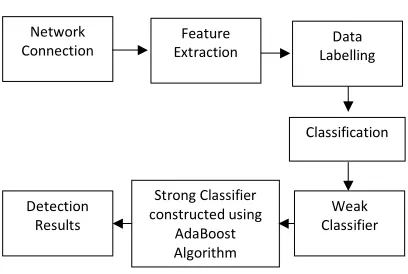
Fig. 1: System Architecture
• Feature extraction: For every network connection, we extract three major groups of features for detecting intrusions: “Basic features of individual TCP connections”, “Content features within a connection suggested by domain knowledge” and “Traffic features computed using a two-second time window” 28. The framework for constructing
these features can be found in 29.
• Data labeling: Because Because the AdaBoost algor ithm uses super vised learning, a set of data has to be labeled for
training. This labeled data set should contain both normal samples labeled as “+1” and attack samples labeled as “-1.” We explain two points: 1) In contrast to misuse detection, which utilizes signatures of attacks to detect intrusions, and anomaly detection, which detects intrusions by modeling nor mal behaviors, our algorithm models both attacks and normal behaviors to detect intrusions. 2) It is hard to obtain a large amount of labeled data in realistic settings
• Weak classifiers design: Adaboost requires a group of weak classifiers designed beforehand. “Weak (or basic)” means that the classifying accuracy of an individual classifier is relatively low.
• Strong classifiers construction: A strong classifier is obtained by combining the weak classifiers. The strong classifier has higher classification accuracy than each weak classifier.
After training, a strong classifier is obtained. Then a new networ k connection represented by the same three groups of features can be sending to the strong classifier and classified as either “normal” or “attack”, shown in Figure 1 as detecting result.
Methodology
Weak Classifier Design
A group of weak classifiers has to be prepared as inputs of Adaboost algorithm. They can be linear classifiers, ANNs or other common classifiers. In our algorithm, we select “decision stumps” as weak classifiers due to its simplicity. For every feature f, its value range could be divided into two non overlapping value subsets
C
pf andC
nf , and the decision stump on f takes the form as follow:f n
f p f
C
f
x
C
f
x
x
h
∈
∈
⎩⎨
⎧
−
+
=
)
(
)
(
1
1
)
(
where x(f) indicates the value of x on feature f.
Algorithm
In the AdaBoost algorithm, weak classifiers are selected iteratively from a number of candidate weak classifiers and are combined linearly to form a strong classifier for classifying the network data.
Network Connection
Strong Classifier constructed using
AdaBoost Algorithm
Classification Feature
Extraction Labelling Data
Weak Classifier Detection
Let H =
~
}
{
h
f be the set of constructed weak classifiers. Let the set of training sample data be{(
x
1,
y
1),...(
x
i,
y
i),....,
(
x
n,
y
n)}
, wherex
i denotes the thi
feature vector,y
i∈
{
+
1
,
−
1
}
is the label of the feature vector, denoting whether the feature vector represents a normal behavior or not; and n is the size of the data set.Let
{
w
1,...,
w
i,...,
w
n}
be the sample weights that reflect the importance degrees of the samples and, in statistical terms, represents an estimation of the sample distribution.The AdaBoost-based algorithm for intrusion detection is described as follows:
Step1) Initialize Weights as:
Step 2) Observe the following for (t = 1, ……,T ). a) Let be the sum of the weighted classification errors for the weak classifier hj
(1)
Where,
(2)
Choose, from constructed weak classifiers, the weak classifier h(t) that minimizes the sum of the weighted classification errors
(3) b) Calculate the sum of the weighted classification errors for the chosen weak classifier.
c) Let
(4)
d) Update the weights by
(5)
where Z(t) is a normalization factor
(6)
Step 3) The strong classifier is defined by
(7)
We explain two points:
• By combining the decision stumps for both categorical and continuous features into a strong classifier, the relations between categorical and continuous features are handled naturally, without any forced conversions between continuous and categorical features.
• The decision stumps minimize the sum of the false-classification rates for normal and attack samples. It is guaranteed that the misclassification rates for the selected weak classifiers are lower than 50% this ensures the convergence of the algorithm30,31.
EXPERIMENTS Intrusion Data Set
We utilize the KDD CUP 1999 data set32
for our experiments. It was originated from MIT’s Lincoln Lab and developed for IDS evaluations by DARPA33. Despite of several drawbacks mentioned
in 28, it has served as a reliable benchmark data set
for many researches on network based intrusion detection algorithms. In this data set, each TCP/IP connection has been labeled, and 41 features had been extracted, some of which are continuous and others are categorical. So we don’t have to do the task of “Feature extraction” and “Data labeling” shown in Figure 1, then we can focus on the effectiveness and efficiency of the core algorithm of our IDS framework.
∑
==
=
n i i iw
satisfying
n
i
w
1
(
1
)
1
)
,...,
1
(
)
1
(
[
]
∑
=≠
=
n i i j i ij
w
t
I
y
h
x
1
)
(
)
(
ε
⎩
⎨
⎧
=
=
=
true
false
I
γ
γ
γ]
0
1
,
,
[j H hj
t
h
(
)
=
arg
min
∈ε
⎟⎟⎠
⎞
⎜⎜⎝
⎛ −
=
)
(
)
(
1
log
2
1
)
(
t
t
t
ε
ε
α
⎟⎟⎠
⎞
⎜⎜⎝
⎛
−
=
+
)
(
))
)(
(
)
(
exp(
)
(
)
1
(
t
Z
x
t
h
y
t
t
w
t
w
i i ii
α
∑
=−
=
n i k ki
h
t
x
y
t
t
Z
(
)
exp(
α
(
)
(
)(
))
There are four general types of attacks appeared in the data set: DOS (denial of service), U2R (user to root), R2L (remote to local) and PROBE. In each of the four, there are many low level types of attacks. Detailed descriptions about the four general types can be found in 33, 34. The
number of samples of various types in the training set is listed in Table 1.
Table 1: Number of Samples in Training Data Set Attack
DOS U2R R2L PROBE
Normal 391458 52 1126 4107 Total
97278 396743 494021
Experimental Results
First, we run the classical Adaboost algorithm, whose result is shown in Table 2, which shows the performance of Adaboost algorithm with the help of confusion matrix. The overall accuracy with training data set is found to be 99.95%.
Table 3 shows the False Positive Rate and the Detection Rate in training data set with proposed algorithm.
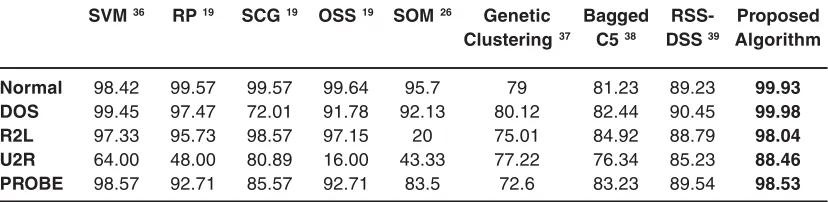
Table 4 shows the comparative accuracy of our proposed algorithm with different intrusion detection models in training data set. The experimental result reveals that our proposed method performs more accurately. From this we can say that the performance of proposed algorithm is much better than others.
Table 2: Performance of Algorithm in Training Data Set (Confusion Matrix)
Normal DOS R2L U2R PROBE %
Normal 97218 19 9 0 32 99.93
DOS 20 391413 3 4 18 99.98
R2L 15 0 1102 4 5 98.04
U2R 5 0 0 45 2 88.46
PROBE 40 11 9 0 4047 98.53
% 99.92 99.99 98.22 85.18 98.58
Table 3: Detection Rate in Training Data Set Training Set
FPR (%) DR (%)
0.06 99.7
Table 4: Comparison of Accuracy with different IDS Models in Training Data Set SVM 36 RP 19 SCG 19 OSS 19 SOM 26 Genetic Bagged RSS- Proposed
Clustering 37 C5 38 DSS 39 Algorithm
Normal 98.42 99.57 99.57 99.64 95.7 79 81.23 89.23 99.93
DOS 99.45 97.47 72.01 91.78 92.13 80.12 82.44 90.45 99.98 R2L 97.33 95.73 98.57 97.15 20 75.01 84.92 88.79 98.04 U2R 64.00 48.00 80.89 16.00 43.33 77.22 76.34 85.23 88.46
CONCLUSIONS
The AdaBoost Algorithm is an extremely powerful mechanism for automatic mathematical characterization of acceptable system activity. In the above paper we have described how we can use AdaBoost algorithm for building an Intrusion Detection System. We have explained the system architecture and the flow diagram for the Adaboost algorithm.
We have constructed an intrusion detection system with Adaboost, a prevailing machine learning algorithm, and described how each part of the whole system works in this paper. An improvement concerning about getting low FPRs and balancing the importance of normal samples and attack samples have been proposed. Hence the performance of the system is improved in training data set. The experiment results have shown that our IDS obtain an extremely low false positive rate with a fairish detection rate.
1. V. K. Pachghare, Dr. Parag Kulkarni, and Deven Nikam, “Over view of Intr usion Detection Systems”, International Journal of Computer Science and Engineer ing Systems, Vol. 3, No. 3, 265-268, 2009. 2. V. K. Pachghare, Dr. Parag Kulkarni, “Network
Security Based On Pattern Matching: An Overview”, International Journal of Computer Science and Network Security, Vol. 8, No. 10, 314-318, Oct. 2008.
3. Y. G. Liu, K. F. Chen, X. F. Liao, and W. Zhang, “A genetic clustering method for intrusion detection,” Pattern Recognit., vol. 37, no. 5, pp. 927– 942, May 2004.
4. D. Song, M. I. Heywood, and A. N. Zincir-Heywwd, “Training genetic programming on half a million patterns: An example from anomaly detection,” IEEE Trans. Evol. Comput., vol. 9, no. 3, pp. 225–239, Jun. 2005.
5. C. Zhang, J. Jiang, and M. Kamel. “Intrusion detection using hierarchical neural networks”. Patter n Recognition Letters, In Press, Corrected Proof, Available online, November 2004
6. P. Hong, D. Zhang, and T. Wu. “An intrusion detection method based on rough set and svm algor ithm”. In Proceedings of Inter national Conference on Communications, Circuits and Systems, volume 2, pages 1127–1130, June 2004. 7. Z. Zhang and H. Shen, “Online training of
SVMs for real-time intrusion detection,” in Proc. Int. Conf. Adv. Inf. Netw. Appl., 2004, vol. 1, pp. 568–573.
8. S. J. Han and S. B. Cho, “Evolutionary neural networks for anomaly detection based on the behavior of a program,” IEEE Trans. Syst.,
REFERENCES
Man, Cybern. B, Cybern., vol. 36, no. 3, pp. 559–570, Jun. 2006.
9. T. Abbes, A. Bouhoula, and M. Rusinowitch, “Protocol analysis in intrusion detection using decision tree,” in Proc. Int. Conf. Inf. Technol.: Coding Comput., 2004, vol. 1, pp. 404–408. 10. M. O. Depren, M. Topallar, E. Anarim, and K. Ciliz. Network-based anomaly intrusion detection system using soms. In Proceedings of the IEEE 12th Signal Processing and Communications Applications Conference, pages 76– 79, April 2004.
11. J. Xian, F. Lang, and X. Tang, “A novel intrusion detection method based on clonal selection clustering algorithm,” in Proc. Int. Conf. Mach. Learn. Cybern., 2005, vol. 6, pp. 3905–3910.
12. S. Jiang, X. Song, H.Wang, J. Han, and Q. Li, “A clustering-based method for unsupervised intrusion detections,” Pattern Recognit. Lett., vol. 27, no. 7, pp. 802–810, May 2006.
13. S. T. Sarasamma, Q. A. Zhu, and J. Huff. “Hierarchical kohonenen net for anomaly detection in networ k security”. IEEE Transactions on Systems, Man and Cybernetics, Part B, 35(2):302–312, April 2005.
14. C. Rudin, I. Daubechies, and R. E. Schapire, “The Dynamics Of Adaboost: Cyclic Behavior And Convergence Of Margins”, J. Mach. Learn. Res., vol. 5, pp. 1557–1595, Dec. 2004.