R E S E A R C H A R T I C L E
Open Access
The burden of headache is associated to
pain interference, depression and headache
duration in chronic tension type headache:
a 1-year longitudinal study
Stella Fuensalida-Novo
1, Maria Palacios-Ceña
1,2, Juan J. Fernández-Muñoz
3, Matteo Castaldo
2,4,5, Kelun Wang
2,
Antonella Catena
5, Lars Arendt-Nielsen
2and César Fernández-de-las-Peñas
1,2*Abstract
Background:To investigate variables associated at one year (longitudinal design) with the physical or emotional component of burden in chronic tension type headache (CTTH).
Methods:One hundred and thirty (n= 130) individuals with CTTH participated in this longitudinal study. Clinical features were collected with a 4-weeks headache diary at baseline and 1-year follow-up. The burden of headache was assessed at baseline and one -year follow-up with the Headache Disability Inventory (HDI), physical (HDI-P) or emotional (HDI-E) component. Sleep quality (Pittsburgh Sleep Quality Index), anxiety and depression (Hospital Anxiety and Depression Scale-HADS), and quality of life (SF-36) were also assessed at baseline. Hierarchical regression analyses were conducted to determine the associations between the baseline variables and the headache burden at 1-year. Simple mediation models were also applied to determine the potential mediation effect of any intermediary variable. Results:Regression analyses revealed that baseline pain interference and depression explained 32% of the variance in the emotional burden of headache, whereas baseline emotional burden of the headache, pain interference, and headache duration explained 51% of the variance in the physical burden of headache (P< .01) at 1-year. The mediation models observed that the effect of baseline pain interference on emotional burden of headache at 1-year was
mediated through baseline depression, whereas the effect of baseline pain interference on the physical burden of headache at 1-year was mediated through baseline emotional burden of headache (bothP< .05).
Conclusions:The current study found a longitudinal interaction between pain interference and depression with the burden of headache in individuals with CTTH.
Keywords:Tension type headache, Burden, Depression, Emotional, Pain
Background
Tension type headache is a common headache disorder showing a global prevalence of 42% in the general popu-lation [1] and an important socio-economic impact [2]. In the last Global Burden of Disease Study, headache was found to be the 3rd most prevalent pain condition
in terms of global prevalence, the 6th in terms of global incidence and 28th in terms of years of life lived with disability [3]. The Eurolight project found that the burden of migraine and TTH in Europe is substantial, mostly related to lost days from work, lost days with household activity, lost family, social or leisure activities [4]. The general costs of headache, most related to migraine and TTH, in Europe in 2010 were €13.8 billion [5]. The Eurolight project estimated that indirect costs accounted for 92% of the financial burden of TTH [6]. In fact, recent data derived from the Eurolight project have confirmed that the burden of TTH is also substantial in middle-income * Correspondence:[email protected]
1Department Physical Therapy, Occupational Therapy, Rehabilitation, and
Physical Medicine, Facultad de Ciencias de la Salud, University Rey Juan Carlos, Avenida de Atenas s/n, 28922 Alcorcón, Madrid, Spain
2Center for Sensory-Motor Interaction (SMI), Department of Health Science
and Technology, Faculty of Medicine, Aalborg University, Aalborg, Denmark Full list of author information is available at the end of the article
European countries such as Lithuania [7]. Similarly, head-ache burden is also similar in low-income countries, e.g., Ethiopia [8]. Therefore a better understanding of those potential variables associated with the burden of headache can assist clinicians in understanding which factors may play an important role in the management of TTH.
The concept of burden can be defined from different viewpoints. The Eurolight project focused, but not limited, the definition of burden in relation to work productivity [4, 6], although this project clearly shows that headache has negative impact on different aspects of life including education, career and earnings, family, or social life. Therefore, the term burden includes several components (physical or emotional) of an individual. Lampl et al. de-fined the term burden as“any loss of health or well-being attributable to a headache disorder”[9]. This definition of burden will be used in the current study.
It seems clear that headache can have physical and emotional repercussions on the life of the individual. Therefore, emotional factors may be crucial for the bur-den and perception of the disease. There is evibur-dence suggesting that subjects with TTH exhibit co-morbid anxiety, depression [10], or sleep disturbances [11]. Some studies have previously investigated the association be-tween depression and the burden of headache, but most of them included patients with migraine, but not TTH [12, 13]. Zebenholzer et al. observed that coexistence of depression and anxiety had a significant impact on the burden in patients with TTH and migraine [14]. It would be conceivable that different variables can interact at dif-ferent levels to headache-associated burden. No study has previously investigated variables associated with the bur-den of headache in patients with TTH in a longitudinal design. Therefore, the purpose of the current study was to investigate potential variables associated at one year (longitudinal design) with the physical or emotional component of burden in a cohort of patients with chronic tension type headache (CTTH).
Methods
Study design
The current analysis is included as part of a multicenter international headache study. Some patients from the current study were also included in a previous part of the study which data have been already previously published [15]. This study presents new data by including new pa-tients, different outcomes, different statistical analysis, and a different design since we had used a longitudinal desing, instead just only a cross-sectional design.
Participants
Patients with a diagnosis of TTH were recruited from three different university-based hospitals (Hospital Universitario Fundación Alcorcón-Spain, Aalborg University
Hospital-Denmark, University Hospitals Parma Medical Center-Italy) from September 2014 to June 2016. Diag-nosis was conducted according to the criteria of the International Classification of Headache Disorders, third edition (ICHD3 beta, 2013) down to third-digit level (codes 2.2, 2.3) by a neurologist expert in headaches [16]. They were excluded if presented: 1, epidosic headaches; 2, other primary or secondary headaches; 3, medication overuse headache as defined by the ICHD-III; 4, history of neck or head trauma; 5, any systemic degenerative disease; 6, diag-nosis of fibromyalgia syndrome; 7, have received anesthetic blocks or botulinum toxin the previous 6 months; 8, have received physical treatment in the neck or head the previ-ous 6 months; or, 8, pregnancy.
All participants read and signed a consent form prior to their participation. The local Ethics Committee ap-proved the study (URJC 23/2014, HUFA 14/104, Aalborg N20140063, CESU 5/2015).
Headache diary
A headache diary for 4 weeks was used to substantiate the diagnosis and to record the headache clinical features [17]. This diary was recorded at baseline and at one-year follow-up. On the diary, patients registered the frequency of headaches (days per week), the headache intensity on an 11points numerical pain rate scale [18] (NPRS; 0: no pain, 10: the maximum pain), and the duration of each headache attack (hours per day).
Burden of headache
The Headache Disability Inventory (HDI) was used to assess the burden of headache. This questionnaire uses 25 items that inquire about the perceived impact of headache on emotional functioning and daily life activ-ities [19]. Possible answers for each item include YES (4 points), SOMETIMES (2 points) and NO (0 points). Thirteen items assess the emotional burden (HDI-E, maximum score: 52) whereas the remaining 12 items as-sess the physical burden (HDI-P, maximum score: 48). A greater score suggests a greater burden of headache for each subscale. The HDI has exhibited good stability at short and long-term in patients with headache [20]. The HDI was assessed at baseline and at 1-year follow-up. The main outcome of this study was the burden of head-ache (HDI) at one-year follow-up.
Anxiety and depressive symptoms
and internal consistency for being used in subjects with headache [23]. Anxiety and depressive symptoms were assessed at baseline.
Sleep quality
The Pittsburgh Sleep Quality Index (PSQI) as used to assess sleep quality [24]. This questionnaire assesses the quality of sleep over the previous month by including 19 self-rated questions and 5 questions answered by bedmates or roommates. Items use varying response categories re-cording usual bed time, usual wake time, number of actual hours slept, and number of minutes to fall asleep. All questions are answered on a Likert-type scale (0–3). The total score ranges from 0 to 21 where higher score indicates worse sleep quality. This questionnaire has good internal consistency and test-retest reliability [25, 26]. Sleep quality was assessed at baseline.
Health-related quality of life
Quality of life was assessed with the Medical Outcomes Study Short Form 36 (SF-36) questionnaire [27]. This questionnaire includes the following 8 domains: physical functioning, physical role, bodily pain (pain interference), general health, vitality, social function, role-emotional, and mental health. Total score range from 0 (the lowest quality of life) to 100 (the highest quality of life) [28]. Health-related quality of life was assessed at baseline.
Statistical analysis
Means and confidence intervals were calculated to describe the outcomes. The Kolmogorov-Smirnov test revealed that all data had a normal distribution (P> .05). To determine the relationship between the dependent measure (the emotional or physical burden of headache at one-year follow-up) and the independent outcomes (headache intensity, headache duration, headache frequency, sleep quality, HADS-D, HADS-A, physical functioning, phys-ical role, pain interference, general health, vitality, so-cial function, role-emotional, mental health at baseline), several Pearson product-moment correlation coefficients were first assessed. This correlational statistical analysis was used to check for multicollinearity and shared vari-ance between the outcomes.
First, two regression models were used to assess the in-dependent variables that contributed significantly to the variance in the emotional (HDI-E) and physical (HDI-P) burden of headache, separately. To examine the propor-tions of explained variance of the burden of headache, a hierarchical regression analysis was conducted. Changes in R2 were reported after each step of the regression model to determine the association of the additional variables. Last, variables that significantly contributed to the score on the emotional or physical burden of headache were selected for inclusion into parsimonious final
regression model. The significance criterion of the critical F value for entry into the regression equation was set at P< .05.
After the stepwise regression analyses, simple mediation models were applied to determine the potential mediation effect of depression (HADS-D) or emotional burden of headache (HDI-E) in the correlation between pain interference (bodily pain) and the emotional (HDI-E) or physical (HDI-P) burden of headache at 12 months, re-spectively. According to Baron and Kelly [29] in order to check a mediation hypothesis, previously it is neces-sary to develop several simple regression models be-tween all variables included at the model for checking the following steps: 1, pain interference (bodily pain) as the predictable variable has a significant correlation with the emotional burden of headache (HDI-E) at one-year follow-up; 2, the predictive variable is related significantly with depression (HADS-D); 3, checking the mediated variable, in the first case, depression (HADS-D), is re-lated with the criteria variable (the emotional burden of headache at 1-year) when the effect from the predictable variable is constant; and, 4, showing as the direct effect from pain interference (bodily pain) is significantly lower than when the mediated variable is included at the model (indirect effect) [30].
Results
Clinical data of the sample
A total of 200 individuals with headache were screened for possible eligibility criteria. Finally, 172 patients with CTTH (120 women, 50 men, mean age: 48 ± 15 years) satisfied all eligibility criteria, agreed to participate and signed the informed consent at baseline. Twenty-eight were excluded for the following reasons: co-morbid mi-graine (n= 17), episodic tension type headache (n= 5) previous whiplash (n= 3), fibromyalgia (n= 2) and medi-cation overuse headache (n = 1). One hundred and thirty (n= 130, 76%, 95 women, 35 men, mean age: 47 ± 20 years) were also assessed at one-year follow-up and therefore included in the main analysis.
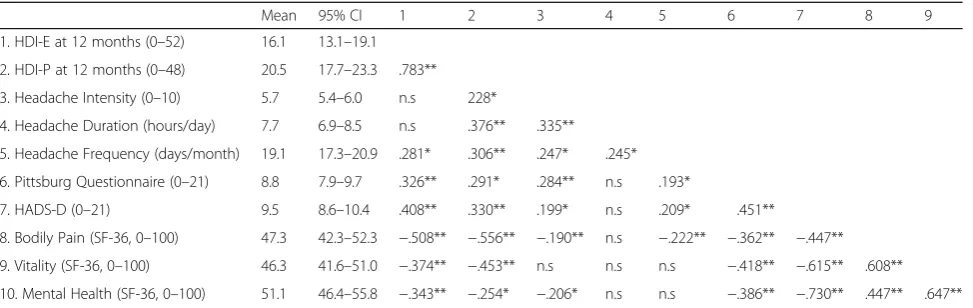
Correlation analysis
P< .001), vitality (r=−.374;P= .001) or mental health (r=−.343; P= .002) at baseline were also found: the lower the vitality, pain interference or mental health score, i.e., the lower vitality, the higher experience of pain or the worse mental health, at baseline, the higher the emotional burden of the headache one year after.
Significant positive correlations were observed between the physical burden of headache (HDI-P) at 1-year and headache intensity (r= .228;P= .045), frequency (r= .306; P= .008) and duration (r= .376;P= .009), sleep quality (r= .291; P= .01), and depression (r= .330; P= .004) at baseline: the higher the headache frequency, the higher the intensity of headache, the longer the headache dur-ation, the worse the sleep quality, or the higher the de-pressive symptoms at baseline, the higher the physical burden of the headache one year after. Finally, signifi-cant negative correlations between the physical burden of the headache (HDI-P) at one-year and pain interfer-ence (r=−.556;P< .001), vitality (r=−.453; P < .001) or mental health (r=−.254; P= .03) at baseline were also observed: the lower the vitality, the pain interference or mental health score, i.e., the lower vitality, the higher experience of pain or the worse mental health at base-line, the higher the physical burden of the headache one year after.
Regression analyses
Table 2 summarizes the hierarchical regression analysis conducted for the emotional burden of headache (HDI-E) at one-year. In this analysis, baseline pain interference (bodily pain) approximately contributed 27.2% (P< .001), whereas baseline depression (HADS-D) contributed an additional 5% (P < .001) to the variance of emotional burden of headache (HDI-E) at one-year follow-up. When combined, both variables explained 32.2% of the variance in the emotional burden of headache (r2adjusted: 0.322, F = 11.33,P< .01).
The hierarchical regression analysis conducted for the physical burden of headache (HDI-P) at one-year is summarized in Table 3. In this analysis, baseline emo-tional burden of headache (HDI-E) contributed 46% (P< .001), pain interference (bodily pain) an additional 6% (P< .01) and baseline headache duration an add-itional 3% (P< .001) of the variance of physical burden of headache (HDI-P) at one-year. When combined, all variables explained 51.1% of the variance in the phys-ical burden of headache (r2 adjusted: 0.511, F = 27.77, P< .01).
Mediation effects
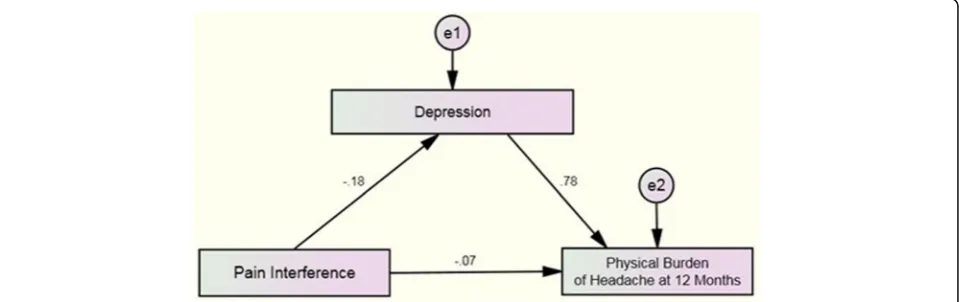
Figure 1 summarizes the standardized effect of the first simple mediation model. First, the total effect from pain interference (bodily pain) on depression (HADS-D) was statistically significant (B =−0.18, P< .001). Second, the total direct effect from pain interference (bodily pain) on emotional burden of headache (HDI-E) at one-year was significant (B =−0.27, P < .001). Third, the total direct effect from depression (HADS-D) to the emotional burden of headache (HDI-E) at one-year was signifi-cant (B = 0.78,P< .001). Finally, the total indirect effect of pain interference on the emotional burden of headache Table 1Pearson-Product Moment Correlation Matrix for Functional and Psychological Variables at Baseline Statistically Associated with the Physical or Emotional Burden of Headache at One Year
Mean 95% CI 1 2 3 4 5 6 7 8 9
1. HDI-E at 12 months (0–52) 16.1 13.1–19.1
2. HDI-P at 12 months (0–48) 20.5 17.7–23.3 .783**
3. Headache Intensity (0–10) 5.7 5.4–6.0 n.s 228*
4. Headache Duration (hours/day) 7.7 6.9–8.5 n.s .376** .335**
5. Headache Frequency (days/month) 19.1 17.3–20.9 .281* .306** .247* .245*
6. Pittsburg Questionnaire (0–21) 8.8 7.9–9.7 .326** .291* .284** n.s .193*
7. HADS-D (0–21) 9.5 8.6–10.4 .408** .330** .199* n.s .209* .451**
8. Bodily Pain (SF-36, 0–100) 47.3 42.3–52.3 −.508** −.556** −.190** n.s −.222** −.362** −.447**
9. Vitality (SF-36, 0–100) 46.3 41.6–51.0 −.374** −.453** n.s n.s n.s −.418** −.615** .608**
10. Mental Health (SF-36, 0–100) 51.1 46.4–55.8 −.343** −.254* −.206* n.s n.s −.386** −.730** .447** .647**
95% CI95% confidence interval,HDIHeadache Disability Inventory (EEmotional,PPhysical),HADSHospital Anxiety and Depression Scale (DDepression) *P< 0.05; **P< 0.01
Table 2Summary of Stepwise Regression Analyses to Determine Baseline Predictors of the Emotional Burden of Headache at One Year (r2= 32.2%)
Independent Variable B SE B β t F P
Step 1
Bodily Pain −.272 .052 −.532 −5.246 27.51 <0.001
Step 2
Bodily Pain −.222 .057 −.433 −3.925 11.33 <0.01
HADS-D .689 .342 .222 2.014
R2
= .272 for step 1; R2
= .322 for step 2
(HDI-E) at one-year mediated through baseline depression (HADS-D) was also significant (B =−0.07,P= .04). To con-sider statistically significant the partial effect of mediation at this first model, Zobel test was significant (z =−2.52, P= .01) with a confidence level not including the value 0 (LLCI: -0.1546, ULCI: -0.0236).
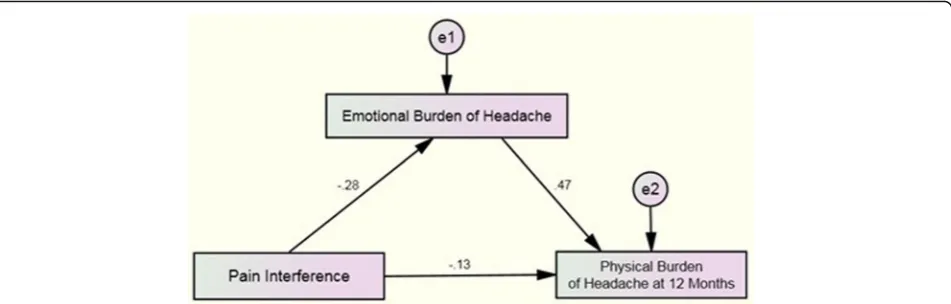
The standardized effect of the second simple medi-ation model is shown in Fig. 2. First, the total effect from pain interference (bodily pain) on the emotional burden of headache (HDI-E) was statistically significant (B =−0.28, P< .001). Second, the total direct effect from pain interfer-ence (bodily pain) on the physical burden of headache (HDI-P) at one-year was also statistically significant (B =−0.19, P= .04). Third, the total direct effect from the baseline emotional burden of headache (HDI-E) on the physical burden of headache (HDI-P) at one-year was significant (B = 0.47, P < .001). Finally, the total indirect ef-fect from pain interference (bodily pain) on the physical burden of headache at one-year mediated through the baseline emotional burden of headache (HDI-E) was also significant (B =−0.13, P = .04). Again, to consider
the partial effect of mediation statistically significant at the second model, the Zobel test revealed that the model was significant (z =−3.74,P= .002) with a confi-dence level not including the value 0 (LLCI: -0.2200; ULCI: -0.0734).
Discussion
This is the first longitudinal study investigating the vari-ables associated with the burden of headache in individ-uals with CTTH. We observed that the emotional burden of headache was associated to baseline pain interference and depression whereas the physical burden of headache was associated to baseline emotional aspects of the burden, pain interference, and headache duration. Baseline depression and the emotional burden mediated the effects of pain interference with the emotional or physical burden at one-year follow-up, respectively.
The findings from this study show two important as-pects. First, pain interference was longitudinally associated with both emotional and physical components of burden; and second, a relevant role of emotional aspects in pa-tients with CTTH since depression and emotional compo-nent of burden indirectly mediated the effect of pain inference on the headache burden. Our results support an important association of pain interference with burden, which would agree with the conception that pain is a dimension associated to burden perception. In fact, the duration of the headache attack was also independently associated to the physical component of burden; sup-porting that not only the presence of pain, but also its duration, is relevant for burden perception. This may be related to the fact that pain interference refers to limitations on daily life activities due to the presence of pain and headache duration is related to the time with pain; therefore, this outcome reveals two different spheres of the pain spectrum.
We also found that the effects of pain interference on the emotional burden were mediated by depression, Table 3Summary of Stepwise Regression Analyses to Determine
Baseline Predictors of the Physical Burden of Headache at One Year (r2= 55.1%)
Independent Variable B SE B Β t F P
Step 1
HDI-E .598 .077 .678 7.721 59.61 <0.001
Step 2
HDI-E .453 .088 .514 5.143 37.54 <0.01
Bodily Pain −.144 .048 −.297 −2.790
Step 3
HDI-E .423 .087 .480 4.852 27.77 <0.01
Bodily Pain −.148 .047 −.305 −3.124
Headache Duration .513 .243 .174 2.113
R2
= .460 for step 1 R2
= .521 for step 2; R2
= .551 for step 3
HDIHeadache Disability Inventory (EEmotional)
suggesting a relevant role of depression in patients with CTTH. It has been previously observed that depression has a marked impact on the burden in patients with chronic headaches since it increases the risk of feeling less understood by the family and friends as well as an increased risk of avoiding to tell other people about the headache [14]. In fact, it has been previously suggested that depression contributes to chronic pain via supra-spinal mechanisms and emotional modulation of pain [31]. Our results support this mechanism since depression mediated the effect of pain interference on the emo-tional burden of headache.
Similarly, the effect of pain interference on the phys-ical burden was mediated by emotional aspects of bur-den, supporting a relevant role of emotional factors. It seems that emotional (stressful) factors are common precipitating factors of headache episodes in patients with TTH [32] since they may trigger hyperalgesic re-sponses within the central nervous system [33]. There-fore, it is possible that emotional (stressful) factors can trigger more headache attacks inducing an increasing in the frequency of headaches, which would lead to worse pain interference and, therefore, higher self-perceived burden. In fact, the presence of mood disorders is more associated to the frequency of headaches rather than to headache diagnosis [34].
Uncertainty over biological mechanisms withstanding in these interactions, our results have clinical implica-tions. Since emotional stress is the most common trigger for pain in subjects with TTH, proper management of emotional factors may be relevant for avoiding chronifi-cation and an increase of burden perception. In fact, emotional stress and depression represent two modifiable risk factors implicated in the progression from episodic to chronic headaches [35]; therefore, their management could also lead to better control of the headache burden. Our study found that depression and emotional aspects of burden were mediating factors in the association between
pain interference and the burden of headache. Therefore, proper copying strategies for management of potential stressful emotional events and a reduction of depressive symptoms may be those factors associated with a reduc-tion of the headache burden. Current findings would sug-gest that management of patients with CTTH should include therapeutic interventions targeted to decrease the emotional burden of headache (copying strategies or cog-nitive behavioral techniques) and to decrease depressive symptoms (i.e., psychological approaches) with the aim to decrease the burden of headache.
Although strengths of the current study include a large sample size, the inclusion of patients accordingly to the most updated diagnostic criteria, the use of diagnostic diaries and a longitudinal design, some limitations should be also recognized. First, we included patients with CTTH from a tertiary headache center; therefore, they may be not representative of the general population. Second, the im-pact of medication intake was not considered in the medi-ation models. Third, it should be noted that the HADS is a screening rather than diagnostic instrument for depressive symptoms with a tendency to underestimate its prevalence [36]. In fact, we noted that depression levels observed in our sample of CTTH patients were low; therefore, it is pos-sible that the mediating effect between pain interference and the emotional burden of headache may be different in individuals experiencing higher levels of depression. Fi-nally, we assessed the emotional or physical component of burden with the HDI. Previous studies assessing the bur-den of headache had used the HALT index which con-siders the days lost completely or partially because of headache in the preceding months and covers professional work, household activities or chores, and family, social or leisure activities. Although current and previous data [3] suggest that TTH should not be considered as a minimal form of headache due to its repercussions, current results should be considered in this context of headache burden, but not in the economic factor of headache.
Conclusions
The current study found that pain interference and de-pression were longitudinally associated to the emotional burden of headache whereas the emotional headache burden, pain interference, and headache duration were longitudinally associated to the physical burden of head-ache in individuals with CTTH. Baseline depression and the emotional burden mediated the effects of pain inter-ference with the emotional or physical burden at one-year follow-up, respectively. This study suggests that emotional factors play a relevant role in the association between pain interference and burden in patients with CTTH.
Abbreviations
CTTH:Chronic tension type headache; HADS: Hospital Anxiety and Depression Scale; HDI: Headache Disability Inventory; ICHD3: International Classification of Headache Disorders, third edition; NPRS: Numerical Pain Rate Scale; PSQI: Pittsburgh Sleep Quality Index; SF-36: Health-related quality of life questionnaire; TTH: Tension type headache
Acknowledgements
Not applicable
Author’contributions
All authors contributed to the study concept and design. JJFM and CFdlP did the main statistical analysis and interpretation of data. SFN, MPC and CFdlP contributed to draft the report. LAN obtained funding. LAN, KW, MC, AC provided administrative, technical, and material support. LAN and CFdlP supervised the study. All authors revised the text for intellectual content and have read and approved the final version of the manuscript.
Ethical approval and consent to participate
The local Ethics Committee approved the study (URJC 23/2014, HUFA 14/104, Aalborg N20140063, CESU 5/2015). All participants read and signed a consent form prior to their participation.
Funding
No funds were received for this study.
Availability of data and materials
All data is available at request to the corresponding author.
Disclosures
Financial disclosure statements have been obtained, and no conflicts of interest have been reported by the authors or by any individuals in control of the content of this article.
Consent for publication
Not applicable
Competing interests
The authors declare that they have no competing interests.
Publisher’s Note
Springer Nature remains neutral with regard to jurisdictional claims in published maps and institutional affiliations.
Author details
1
Department Physical Therapy, Occupational Therapy, Rehabilitation, and Physical Medicine, Facultad de Ciencias de la Salud, University Rey Juan Carlos, Avenida de Atenas s/n, 28922 Alcorcón, Madrid, Spain.2Center for
Sensory-Motor Interaction (SMI), Department of Health Science and Technology, Faculty of Medicine, Aalborg University, Aalborg, Denmark.
3Department of Psychology, Universidad Rey Juan Carlos, Alcorcón, Spain. 4Master in Sport Physiotherapy, University of Siena, Siena, Italy.
5Poliambulatorio Fisiocenter, Collecchio, (Parma), Italy.
Received: 20 November 2017 Accepted: 18 December 2017
References
1. Ferrante T, Manzoni GC, Russo M, Camarda C, Taga A, Veronesi L et al (2013) Prevalence of tension-type headache in adult general population: the PACE study and review of the literature. Neurol Sci 34:S137–S138
2. Dowson A (2015) The burden of headache: global and regional prevalence of headache and its impact. Int J Clin Pract Suppl 182:3–7
3. GBD 2016 Disease and Injury Incidence and Prevalence Collaborators (2017) Global, regional, and national incidence, prevalence, and years lived with disability for 328 diseases and injuries for 195 countries, 1990-2016: a systematic analysis for the global burden of disease study 2016. Lancet 390:1211–1259 4. Steiner TJ, Stovner LJ, Katsarava Z, Lainez JM, Lampl C, Lantéri-Minet M, Rastenyte D, Ruiz de la Torre E, Tassorelli C, Barré J, Andrée C (2014) The impact of headache in Europe: principal results of the Eurolight project. J Headache Pain 15:31
5. Raggi A, Leonardi M (2015) Burden and cost of neurological diseases: a European north-south comparison. Acta Neurol Scand 132:16–22 6. Linde M, Gustavsson A, Stovner LJ et al (2012) The cost of headache
disorders in Europe: the Eurolight project. Eur J Neurol 19:703–711 7. RastenytėD, MickevičienėD, Stovner LJ, Thomas H, Andrée C, Steiner TJ
(2017) Prevalence and burden of headache disorders in Lithuania and their public-health and policy implications: a population-based study within the Eurolight project. J Headache Pain 18:53
8. Zebenigus M, Tekle-Haimanot R, Worku DK, Thomas H, Steiner TJ (2017) The burden of headache disorders in Ethiopia: national estimates from a population-based door-to-door survey. J Headache Pain 18:58
9. Lampl C, Thomas H, Stovner LJ, Tassorelli C, Katsarava Z, Laínez JM, Lantéri-Minet M, Rastenyte D, Ruiz de la Torre E, Andrée C, Steiner TJ (2016) Interictal burden attributable to episodic headache: findings from the Eurolight project. J Headache Pain 17:9
10. Lampl C, Thomas H, Tassorelli C, Katsarava Z, Laínez JM, Lantéri-Minet M, Rastenyte D, Ruiz de la Torre E, Stovner LJ, Andrée C, Steiner TJ (2016) Headache, depression and anxiety: associations in the Eurolight project. J Headache Pain 17:59
11. Uhlig BL, Engstrøm M, Ødegård SS, Hagen KK, Sand T (2014) Headache and insomnia in population-based epidemiological studies. Cephalalgia 34:745–751 12. Rao AS, Scher AI, Vieira RV, Merikangas KR, Metti AL, Peterlin BL (2015) The
impact of post-traumatic stress disorder on the burden of migraine: results from the national comorbidity survey-replication. Headache 55:1323–1341 13. Oh K, Cho SJ, Kim J, Chu MK (2014) Combination of anxiety and depression
is associated with an increased headache frequency in migraineurs: a population-based study. BMC Neurol 14:238
14. Zebenholzer K, Lechner A, Broessner G, Lampl C, Luthringshausen G, Wuschitz A, Obmann SM, Berek K, Wöber C (2016) Impact of depression and anxiety on burden and management of episodic and chronic headaches - a cross-sectional multicentre study in eight Austrian headache centres. J Headache Pain 17:15
15. Palacios-Ceña M, Fernández-Muñoz JJ, Castaldo M, Wang K, Guerrero-Peral Á, Arendt-Nielsen L, Fernández-de-las-Peñas C (2017) The association of headache frequency with pain interference and the burden of disease is mediated by depression and sleep quality, but not anxiety, in chronic tension type headache. J Headache Pain 18:19
16. ICHD-III (2013) International classification of headache disorder: headache classification Subcommittee of the International Headache Society, 3nd edition. Cephalalgia 33:629–808
17. Jensen R, Tassorelli C, Rossi P, Allena M, Osipova V, Steiner T, Sandrini G, Olesen J, Nappi G, Basic Diagnostic Headache Diary Study Group (2011) A basic diagnostic headache headache diary (BDHD) is well accepted and useful in the diagnosis of headache. A multicentre European and Latin American study. Cephalalgia 31:1549–1560
18. Jensen MP, Turner JA, Romano JM, Fisher L (1999) Comparative reliability and validity of chronic pain intensity measures. Pain 83:157–162 19. Jacobson GP, Ramadan NM, Norris L, Newman CW (1994) The Henry ford
hospital headache disability inventory. Neurology 44:837–842 20. Jacobson GP, Ramadan NM, Norris L, Newman CW (1995) Headache
disability inventory (HDI): short-term test-retest reliability and spouse perceptions. Headache 35:534–539
22. Herrmann-Lingen C, Buss U, Snaith R (2011) Hospital Anxiety and Depression Scale–Deutsche Version (HADS-D) Verlag Hans Huber, Bern
23. Juang KD, Wang SJ, Lin CH, Fuh JL (1999) Use of the hospital anxiety and depression scale as a screening tool for patients with headache. Zhonghua Yi Xue Za Zhi (Taipei) 62:749–755
24. Cole JC, Dubois D, Kosinski M (2007) Use of patient-reported sleep measures in clinical trials of pain treatment: a literature review and synthesis of current sleep measures and a conceptual model of sleep disturbance in pain. Clin Ther 29:2580–2588
25. Buysse DJ, Reynolds CF, Monk TH, Berman SR, Kupfer DJ (1989) The Pittsburgh sleep quality index: a new instrument for psychiatric practice and research. Psychiatry Res 28:193–213
26. Carpenter JS, Andrykowski M (1998) Psychometric evaluation of the Pittsburgh sleep quality index. J Psychosom Res 45:5–13
27. Ware JE, Sherbourne CD (1992) The MOS 36-item short-form health survey (SF-36). I. Conceptual framework and item selection. Med Care 30:473–483 28. McHorney CA, Ware JE, Raczek AE (1993) The MOS 36-item short-form
health survey (SF-36): II. Psychometric and clinical tests of validity in measuring physical and mental health constructs. Med Care 31:247–263 29. Baron RM, Kenny DA (1986) The moderator-mediator variable distinction in
social psychological research: conceptual, strategic and statistical considerations. J Personality Social Psychol 51:1173–1182
30. Hayes AF (2013) Introduction to mediation, moderation and conditional process analysis. A regression based approach. The Guilford Press, Nueva York 31. Terry EL, DelVentura JL, Bartley EJ, Vincent AL, Rhudy JL (2013) Emotional
modulation of pain and spinal nociception in persons with major depressive disorder (MDD). Pain 154:2759–2768
32. Wang J, Huang Q, Li N, Tan G, Chen L, Zhou J (2013) Triggers of migraine and tension-type headache in China: a clinic-based survey. Eur J Neurol 20:689–696
33. Cathcart S, Petkov J, Winefield AH, Lushington K, Rolan P (2010) Central mechanisms of stress-induced headache. Cephalalgia 30:285–295 34. Zwart JA, Dyb G, Hagen K et al (2003) Depression and anxiety disorders
associated with headache frequency: the Nord-Trøndelag health study. Eur J Neurol 10:147–152
35. Rains JC (2008) Chronic headache and potentially modifiable risk factors: screening and behavioral management of sleep disorders. Headache 48:32–39 36. Steel Z, Marnane C, Iranpour C, Chey T, Jackson JW, Patel V, Silove D (2014)