The Thirty-Third AAAI Conference on Artificial Intelligence (AAAI-19)
Human Action Transfer Based on 3D Model Reconstruction
Shanyan Guan,
1∗Shuo Wen,
1∗Dexin Yang,
1∗Bingbing Ni,
1,2,3†Wendong Zhang,
1Jun Tang,
1,2Xiaokang Yang
1,2,31MoE Key Lab of Artificial Intelligence, AI Institute, Shanghai Jiao Tong University
2SJTU-UCLA Joint Research Center on Machine Perception and Inference 3Shanghai Institute for Advanced Communication and Data Science
{shyanguan, wenshuo, HaDean1998, nibingbing, diergent, tangjun1994, xkyang}@sjtu.edu.cn
Abstract
We present a practical and effective method forhuman action transfer. Given a sequence of source action and limited target information, we aim to transfer motion from source to tar-get. Although recent works based on GAN or VAE achieved impressive results for action transfer in 2D, there still ex-ists a lot of problems which cannot be avoided, such as dis-torted and discontinuous human body shape, blurry cloth tex-ture and so on. In this paper, we try to solve these prob-lems in a novel 3D viewpoint. On the one hand, we design a skeleton-to-3D-mesh generator to generate the 3D model, which achieves huge improvement on appearance reconstruc-tion. Furthermore, we add a temporal connection to improve the smoothness of the model. On the other hand, instead of directly utilizing the image in RGB space, we transform the target appearance information into UV space for further pose transformation. Specially, unlike conventional graphics ren-der method directly projects visible pixels to UV space, our transformation is according to pixel’s semantic information. We perform experiments on Human3.6M and HumanEva-I to evaluate the performance of pose generator. Both quali-tative and quantiquali-tative results show that our method outper-forms methods based on generation method in 2D. Addition-ally, we compare our render method with graphic methods on Human3.6M and People-snapshot. The comparison results show that our render method is more robust and effective.
Introduction
Recently, human action comprehension (such as action recognition and detection) has attracted great interest and attention from academic society and there are plentiful remarkable achievements (Sigurdsson, Russakovsky, and Gupta 2017; Fan et al. 2018; Yang, He, and Porikli 2018; Zhou et al. 2018). However, researches on human action transfer are still in progress. In terms of human action trans-fer, given the appearance of the target person and a video (motion sequence) of the source person, our task is to im-pose the motion of the source person on the target person.
With the development of deep generative model, there have been several works that can perform human action transfer in both image level (Esser, Sutter, and Ommer 2018)
∗
Equal contribution †
Corresponding author: Bingbing Ni
Copyright c2019, Association for the Advancement of Artificial Intelligence (www.aaai.org). All rights reserved.
Target
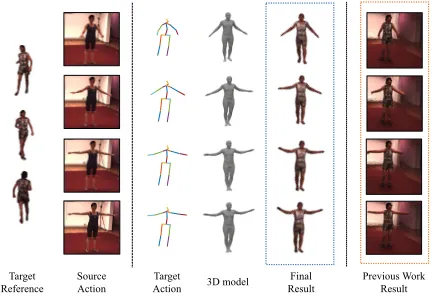
Reference Source Action Action Target 3D model ResultFinal Previous Work Result
Figure 1: Given the appearance of the target person and a video of the source person, our model impose the motion of the source person on the target person.
and video level (Chan et al. 2018). All of these works are built on the image to image translation architecture, which tries to solve this problem only in 2D space.
However, this task is still very challenging due to two major reasons: (1) Discontinuity of body shape between ad-jacent frames and between distant frames often occurs. (2) Detailed texture is difficult to be preserved when using im-age generation based methods such as GAN or VAE. For example, the weight of the target’s arm may change in dif-ferent frames; the pattern printed on clothes will be blurred. Both of these difficulties are caused by that image generation based methods have an upper bound on the performance of generation quality due to its intrinsic large searching space on high dimensions. Large number of data is needed for these methods to learn appearance and pose information and to generate high-quality image.
skeletons to a realistic 3D human model, while maintaining the completeness and consistency of human body shape.
To preserve the detailed texture of the target person, we propose a new method for texture extraction which only needs 3 images of the target person on different views. Moreover, different from methods like (Chan et al. 2018) which need a distinct model trained for each target person with skeleton-image paired dataset, our method to extract and render texture is easily generalized to different target person without additional training.
Furthermore, as for the texture extraction and rendering step, there have been many works using graphics methods (Alldieck et al. 2018), which often require the target person to be at the fixed pose (such as A-pose or T-pose) to avoid occlusion problems. Our method, however, can work with the target person at various poses with the help of seman-tic map provided by DensePose (G¨uler et al. 2018), which enables us to accurately determine which part of the human that each pixel belongs to
We apply our method on Human3.6M dataset (Ionescu et al. 2014; Ionescu 2011) and HumanEva dataset (Sigal, Balan, and Black 2009), then evaluate it with the structural similarity (SSIM) (Wang et al. 2004) and Peak Signal-to-Noise Ratio (PSNR). The experimental results indicate com-petitive performance of our method compared to image gen-eration based methods.
As a summary, the contribution of this paper is as follows:
• We propose a novel framework for human action transfer based on 3D human body model generation, which main-tains human shape completeness and consistency.
• We propose a new method for texture extraction to pre-serve detailed texture with only3 appearance images of different views.
• Our framework can be easily generalized to perform ac-tion transfer on various target person without addiac-tional training.
Related Work
Human action video generation based on GAN or VAE has two common problems: discontinuous body shape and blur-ring texture. Although the retargeting effect of (Chan et al. 2018) works well, the structure of the hands and feet will still be distorted or disappeared in the demo they released a few days ago. To preserve human body structure, we adopt parametric 3D model generation which has strong structure prior. To overcome occlusion problem, we generate human texture in UV space using three images of different views, and render them using barycentric transform. Here we re-view action transfer or retargeting method and 3D human shape generation and clothing for monocular images.
Motion Retargeting.This task is first introduced in 3D animated characters (Gleicher 1998; Choi 2000; Tak and Ko 2005), where they retargeted motion between two 3D char-acters by applying forward kinematics (FK) with inverse kinematics (IK) techniques and space constraints. Extending these techniques, motion retargeting can be performed on more varied user-created morphologies (Hecker et al. 2008;
Bellini, Kleiman, and Cohen-Or ). Most works mentioned above regard motion retargeting task as an optimization problem and solve them with hand-designed kinematic con-straints for particular motions. Recently, (Villegas et al. 2018) used deep learning methods and achieved unsuper-vised motion (skeleton) retargeting by applying cycle con-sistency objective.
3D Human Shape Generation and Rendering.Most of 3D human model generation works are based on SMPL, which is a parametric model decided by shape (β) and pose (θ). (Bogo et al. 2016) reconstruct 3D human model with 2D joints constraints. However, reconstructing a 3D model with only a single frame of 2D skeleton information often re-sults in opposite rere-sults. Thus, (Huang 2017) use multi-view 2D joints and adds discrete cosine transform to deal with it. Most of 3D reconstruction works (Lassner et al. 2017; Kanazawa et al. 2018; Zanfir et al. 2018; Pavlakos et al. 2018) are aimed to estimate 3D shape for image. (Alldieck et al. 2018) propose a new method oriented to video sequence. More importantly, they propose a render method based on graphics. Although many works have made progress in re-constructing 3D models from images or videos, but as far as we know, there is no work dedicated to transforming skele-tons to 3D human models.
Method
Different from (Chan et al. 2018), we focus on using 3D hu-man model (SMPL) to solve the problem of body shape dis-tortion or even disappearance. SMPL is a triangulated naked mesh model withN = 6890 vertices. It is decided by two sets of parameters, which areshapeβ ∈R10( representing individual’s weight, height, etc. ) andposeθ∈R72
(repre-senting relative rotation ofK = 173D joints in kinemat-ics tree ). The deformations generated by β andθ are lin-early superimposed on a statistical mean modelTµ, showed in Eq 1. As shown in Eq 2, based on 3D jointsJ, SMPL can generate various of models with differentθandβthrough a linear blend-skinning function.
T(β, θ) =Tµ+Bs(β) +Bp(θ), (1)
M(β, θ) =W(T(β, θ), J, θ,W), (2)
whereT(β, θ)is a deformed template;W is a linear blend-skinning function;Wis the function weight. Meanwhile, 3D jointsJ can also be obtained by linear regression from the final verticesM(β, θ),
J =R(β, θ), (3)
whereJ ∈R23×3, andRis a linear regression function.
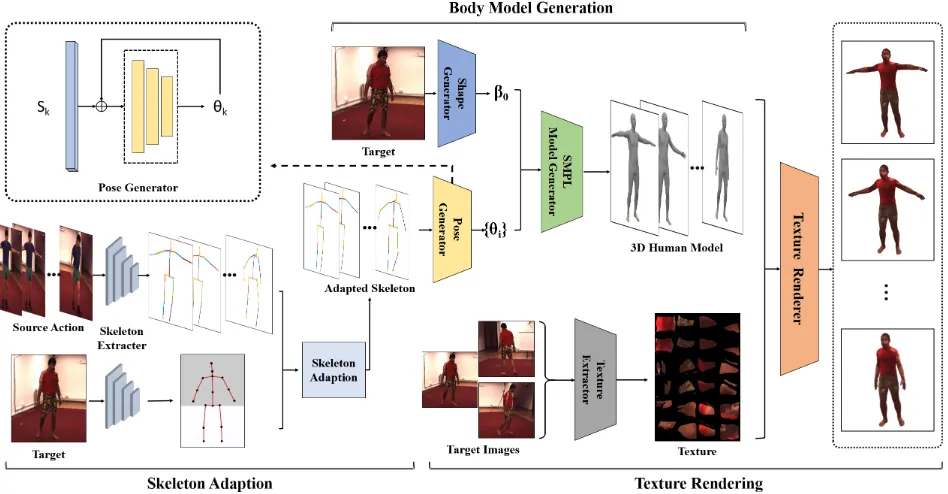
Figure 2 shows the overview of our pipline. Our pipline consists of three steps: (1)skeleton transfer, (2)3D model
generationand (3)texture rendering.
At the first step, we utilize DMHS (Popa, Zanfir, and Sminchisescu 2017) to estimate human’s 2D and 3D joints. Considering that the joint angle and bones length of the skeleton are the main factors affecting the action, we adjust the joint angle and bones length to achieve action transfer.
Figure 2: The overall framework for generating the 3D model which have the appearance of the target person and the motion of the source person. First we do the skeleton transfer by combining the skeleton bones length of the target person and the pose information of the source person. Then we generate the 3D human model (SMPL) based on the transformed skeleton and the shape of the target person. After that, we obtain the texture from the three pictures of the target person. Finally, using the method of barycentric transformation, we render the texture on the 3D human model.
have the sameβ. Firstly, we randomly choose an image from three reference images, and load a pretrained model pro-vided by HMR (Kanazawa et al. 2018) to estimate initial shapeβ0. Then we design another network to encode
trans-ferred skeleton sequence into corresponding pose parame-ters. Particularly, to ensure temporal consistence, we con-catenate current skeletonStand the former timestep pose
θt−1into network.
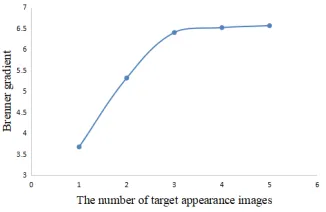
At the third step, we aim to render human’s cloth to 3D mesh model with different poses. According to information theory. The more pictures are provided, the less uncertain the information is. In our experiment, we found that the three images is enough.
Action Transfer
Since our goal is to combine the target’s appearance with the source action, we separate the information of skeleton bone lengths from pose of skeletons by using kinematic tree, in which the pose of a skeleton is expressed recursively, start-ing from the root joint and endstart-ing in the leaf joints. Specifi-cally, each skeleton can be expressed by poseDand skeleton bone lengthsL. Then the position of thenth jointpncan be expressed as
pn =pparent(n)+DnLn, (4)
wherepparent(n) means the position of parent node of the
nth joint;Dn is the direction of the nth joint with respect to its parent;Ln is the length between thenth joint and its
parent, which can be expressed as
Ln =||pn−pparent(n)||. (5)
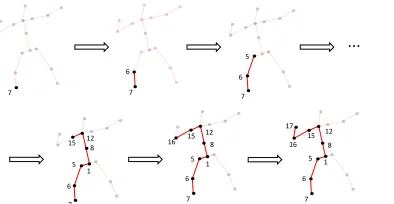
Therefore, given the root of the kinematic tree and the skele-ton information {L, D}, we can calculate the position of each joints recursively. In this work, we use left foot as the root. And we use17joints skeleton as our skeleton model.
For example, as shown in Figure 3, the position of the left hand can be expressed as
p17=pparent(17)+L17D17
=pparent(16)+L16D16+L17D17
=· · ·
=p7+L6D6+· · ·+L16D16+L17D17. (6)
since the 7th joint is the root (left foot). By this method, we can use the skeleton bone lengths and the kinematic tree to express the position of joints instead of using three-dimensional Cartesian coordinate.
···
7 7
6
7 6 5
7 6 5
1 12 15
7 6
5 1 12 15 16
7 6
5 1 12 15 16 17
8 8 8
Figure 3: Recursive joints position calculation of the kine-matic tree. Starting from the root joint (left foot), this method calculates each joint position recursively.
the target’s skeleton bone lengths and the motion sequence’s pose.
We also adjust the scale and the overall position of the skeleton sequence for projecting the 3D model, which is based on the skeleton sequence, back into the picture at the end of the whole process. Fortunately, using the skeleton bone lengths of the target, the scale of the skeleton is the same as in the original picture. For the overall position, we view the midpoint of the two feet as the fixed point since un-der most circumstances people stand on the ground instead of floating in the air.
Body Model Generation
Different from previous 3D people reconstruction methods which use both semantic map and joints of each frame, our model is conditioned on only one reference imageIr and the skeleton sequence{S1, S2, ...}. Our model contain two
parts: one is shape generatorGs(generate initial shape pa-rameterβ0) and another one is pose generatorGp( generate a set of pose parameters{θ1, θ2, ...}corresponding to action
sequence). Combiningβ0and{θ1, θ2, ...}, we can generate
a continuous SMPL sequence.
Shape Generator. we adopt the same structure as HMR and load a pretrained model. Inputting reference imageIr, shape generator will output corresponding human shapeβ ∈
R10. The formulation can be represented as follows:
β=Gs(Ir), (7)
whereβis the initial shape.
Pose Generator. we adopt three linear layers to get pose. Noticing that our goal is to generate human model with tinuous motion rather than individual human model, we con-catenate 3D jointsJ3d
t ∈R17×3at current timestep with the last timestep poseθt−1and then input it toGp. Our network structure is illustrated in Figure 4. We have experimentally verified that this operation achieves better results than di-rectly inputting 3D joints. The process can be express as:
θt=Gp([Jt3d, θt−1]), (8)
for t ∈ 1,2, ..., F.Here,[·,·]is concatenation operator, and
F is the number of action sequence. At each time-step, we
Figure 4: Pose Generator. To ensure the motion continuity, our model takes both the pose information and the tempo-ral information into consideration.Above:The basic model,
Below:Our model.
employ L2 loss on 3D joints and L1 loss on 2D joints to guide pose generator for learning pose better.
L3Djoints = K X
i=1
||Ji3D−Jismpl||2
2 (9)
L2Djoints = K X
i=1
||Ji2D−Π(Jismpl)||1 (10)
Jsmpl =R(βt, θt) (11)
whereJismplis theith3D joints regressed by generated 3D model, and Π(Jismpl) is 2D joints projected by an ortho-graphic projectionΠ,i= 1...Krepresent joints index.
However, only using these two constraints, our method will produce manlike monster models, as shown in later ablation study section. Referring to SMPLify(Bogo et al. 2016), we adopt pose prior to teach model what distribution pose should obey:
Lθ=minj(−gjlog(N(θ;µθ,j,Σθ,j))) (12)
whereN(µj,Σj)is the jthcomponent of Mixture Gaus-sian distribution;gjrepresents its corresponding weight; and
µandΣare learned from CMU dataset(Akhter and Black 2015).
To sum up, our loss function for 3D generation model is defined as :
Ltotal=L3Djoints+λ2dL2Djoints+λθLθ (13)
whereλ2dandλθare corresponding loss weight.
not compatible with SMPL joints. For this reason, we choose 14 joints of them to calculateL3DjointsandL2Djoints. Dur-ing trainDur-ing,λ2dis set to 10, andλθis set to 1. We use Adam optimizer(Kingma and Ba 2014) with default setting in Py-torch. For shape generator, we freeze it during training. For pose generator, we use initial learning rate of1×10−4and decrease it by 0.1 per 3 epoches. Batchsize is set to64, and training typically took 15 hours on a GPU (TITAN X).
Texture Rendering
With the help of DensePose (G¨uler et al. 2018), we render the texture on the 3D model. Different from the methods in computer graphics, the pose of the target person will not badly impact on our texture generation since DensePose use semantic map to decide each pixel belongs to which of the body part before corresponding the pixels of 2D image to the 3D model.
Here, we first transfer the RGB image into UV field; then, we find the color information of each point on 3D model from UV field. For the correspondence between 2D image and UV field, DensePose has already performed well on it. However, it can only find the correspondences of the exist-ing areas without predictexist-ing the missexist-ing areas. Therefore, for obtaining the whole texture, at least 2 images which pro-vide texture information from multi-angle are needed. Be-sides, we apply image inpainting on it in order to recover the missing area caused by occlusion. After getting a com-plete texture, we seek the color information of each point on the 3D model from the texture by two steps: first, we find the corresponding position of the6890vertices of the 3D model on texture; then, we use barycentric transforma-tion to find the corresponding positransforma-tion of the other points on the 3D model. For barycentric transformation, we first get
13776triangle areas formed by the6890vertices; after that, in each triangle area, we insert a certain number of joints by combining different times of base vectors of the barycentric coordinate; finally, we match the points in each triangle area into UV space by calculating the combination of the corre-sponding base vectors in UV space.
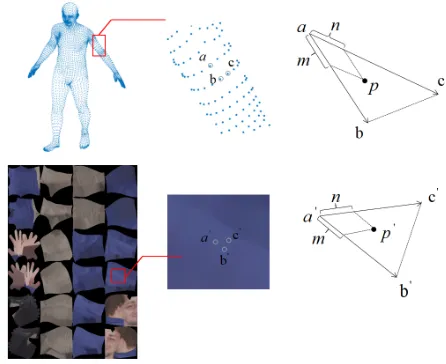
For example, when we render the texture in triangleabcas shown in Figure 5 , we first match the position of apexa,b,c
in UV space, which are shown asa0,b0,c0; then we calculate each pointpin the triangleabcby combiningmtimes base vectorsabandntimesac; finally, we match the position of
ptop0in the UV space by combiningmtimes base vectors a0b0andntimesa0c0.
In this work, we insert 65 points in each triangle. The number of points in each triangle can be changed according to the image resolution we need.
Experiments
Datasets
We evaluate the whole framework on Human3.6M and HumanEva-I dataset, and evaluate the texture rendering step individually in people-snapshot dataset(Alldieck et al. 2018).
Human3.6M Human3.6M dataset is a widely used benchmark for human action and pose related tasks, which
Figure 5: Barycentric transformation. Given the correspon-dence of the6890vertices in UV space and the13776 trian-gles formed by the vertices, barycentric transformation cor-responds with the points which locate in the13776triangles into UV space and then get the color information.
contains3.6million 3D human poses and corresponding im-ages with11professional actors and17different scenarios. It provides High-resolution (1000×1000)50frames per sec-ond video from4calibrated cameras and accurate 3D joint positions and joint angles from high-speed motion capture system, which we can use to perform skeleton adaption. In this experiment, we choose videos of five people (3males and2females) as training set and videos of two people (1
male and1female) as test set.
HumanEva-I HumanEva-I dataset is a structured com-prehensive development dataset for human pose estimation and motion tracking, which contains7calibrated video se-quences that are synchronized with 3D body poses obtained from a motion capture system with4subjects performing6
common actions. We choose videos ofWalkingandBoxof all three actors as training set and videos ofGestures,Jog,
ThrowandCatchas test set.
People-snapshotThe People-Snapshot dataset (Alldieck et al. 2018) consists of 24 sequences of 11 subjects varying a lot in height and weight. The sequences are captured with HD camera, and the resolution of each frame is1080×1080. All subjects are required to rotate while holding A-pose.
Evaluation Metrics
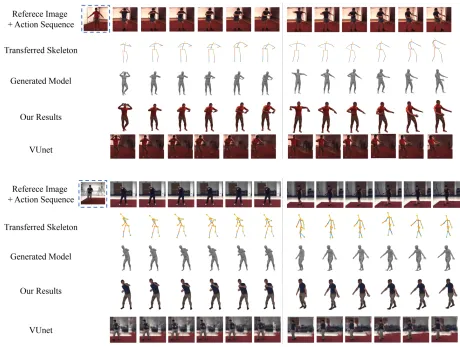
Figure 6: The experiment results of our framework on Human3.6M dataset (the first two lines) and HumanEva-I dataset (the last line). From top to bottom shows the target person and the source action video sequence, adapted skeleton sequence, generated human 3D model sequence, final transferred results, and the results from Variational U-net (Esser, Sutter, and Ommer 2018).
Transfer Results
We evaluate the whole proposed framework on both Hu-man3.6M and HumanEva-I datasets. Moreover, there have been a few works that can perform human action transfer tasks following the deep learning methods. Here, we choose the most competitive work proposed in (Esser, Sutter, and Ommer 2018) as our baseline, which is able to learn from the appearance and synthesis images at different poses ac-cording to the given appearance. The comparative result is shown in Figure 6, from which we can see that our method have better performance on retention of texture details and body shape consistency.We also evaluate the mean value of SSIM and PSNR on both methods, and the result is shown in Table 1.
Rendering Results
For the texture rendering step, we evaluate it individually on the Human3.6M dataset and People-snapshot dataset. As mentioned before, the number of images of the target person of different views needed is hard to determine, as fewer im-ages will provide insufficient appearance information while
Human3.6M HumanEva-I
SSIM P SN R SSIM P SN R
VUnet 0.88032 30.26613 0.87658 27.21103
Ours 0.90103 33.98061 0.89630 30.69898
Table 1: Transfer results comparison with Variational U-net. Mean SSIM and mean PSNR are used to assess the results
Figure 7: Mean Brenner gradient of the texture image vs. the number of appearance images in different views. When using3appearance images, the texture image is of the best quality.
Ours Alldieck et al.
Figure 8: The rendering results comparison using3 appear-ance images between our method and (Alldieck et al. 2018). Results of our methods are better when considering seman-tic information.
Ablation Study
Structure ComparisonWe analyze the effect of some in-dividual components in our proposed framework on the fi-nal transfer performance. As shown in Figure 4, the base architecture of the network we use to produce SMPL pose parameter (θ) does not consider the influence from the pre-vious pose. Therefore we improve this architecture to allow the network to take the information of previous poses into consideration. To verify that temporal structure can improve the smoothness of results, we use human evaluation met-ric. Firstly, we select 50 videos from test set of Human3.6M and HumanEva-I, each sequence contains 10 frames. Then we ask 100 volunteers to do MOS test on results, which are generated by basic model and temporal model respectively. Finally, we calculate the average fraction, shown in Table 2. We can find that temporal connection can produce better vi-sual results.
Loss AnalysisTo verify the effectiveness of prior loss, we show the compare results on Human3.6M in Figure 9. Firstly, We randomly choose two images from Human3.6M and put their 3D skeletons into pose generator to get the 3D model. Given the 3D model, we reproject the skeleton into the images to compare the accuracy of joint locations be-tween the model with prior loss and that without prior loss. Both reprojected skeleton and generated models are shown in Figure 9. Reprojected skeleton results indicate that the
Human3.6M HumanEva-I Basic Model 3.89±0.01 3.91±0.06
Temporal Model 4.13±0.09 4.20±0.11
Table 2: Mean Opinion Score (MOS) of base pose generator model and the improved model with temporal connection. The higher MOS score indicates better results.
Without Prior Loss
With Prior Loss
Skeleton Corresponding Image Reprojected Skeleton Generated Model
Figure 9: 3D human model generation results comparison between generators with and without prior loss. The gen-erator without prior loss will generate unreasonable human shape.
model without prior loss can fit correct joint locations, but the model with prior can fit more precisely. What’s more, without prior loss, the model will predict twisted ankles compared to the model with prior loss.
Conclusion
To solve the upper bound of traditional 2D generation method, we propose a novel network to improve action transfer in 3D viewpoint. With stronger structure prior than GAN or VAE, our skeleton-to-3D-mesh generator is able to generate complete and time-smooth human shape. In addi-tion, our texture generating process has more slack limita-tion to human pose than those in graphics.
Acknowledgements
The work was partly supported by State Key Research and Development Program (2016YFB1001003),National Science Foundation of China (U1611461, 61502301, 61527804, 61521062), China’s Thousand Youth Tal-ents Plan, STCSM (18DZ1112300, 17511105401, 18DZ2270700).
References
Akhter, I., and Black, M. J. 2015. Pose-conditioned joint angle limits for 3d human pose reconstruction. In Proceed-ings of the IEEE Conference on Computer Vision and
Pat-tern Recognition, 1446–1455.
models. InThe IEEE Conference on Computer Vision and
Pattern Recognition (CVPR).
Bellini, R.; Kleiman, Y.; and Cohen-Or, D. Dance to the beat: Enhancing dancing performance in video.
Bogo, F.; Kanazawa, A.; Lassner, C.; Gehler, P.; Romero, J.; and Black, M. J. 2016. Keep it smpl: Automatic estimation of 3d human pose and shape from a single image. In
Euro-pean Conference on Computer Vision, 561–578. Springer.
Brenner, J. F.; Dew, B. S.; Horton, J. B.; King, T.; Neurath, P. W.; and Selles, W. D. 1976. Automated microscope for cytologic research: Preliminary evaluation. Journal of
His-tochemistry & CyHis-tochemistry24(1):100–111.
Chan, C.; Ginosar, S.; Zhou, T.; and Efros, A. A. 2018. Everybody Dance Now. ArXiv e-prints.
Choi, K. J. 2000. Online motion retargeting. Journal of
Visualization & Computer Animation11(5):32–42.
Esser, P.; Sutter, E.; and Ommer, B. 2018. A variational u-net for conditional appearance and shape generation. The IEEE Conference on Computer Vision and Pattern
Recogni-tion (CVPR).
Fan, L.; Huang, W.; Gan, C.; Ermon, S.; Gong, B.; and Huang, J. 2018. End-to-end learning of motion represen-tation for video understanding. InProceedings of the IEEE Conference on Computer Vision and Pattern Recognition
(CVPR).
Gleicher, M. 1998. Retargetting motion to new characters.
InProceedings of the 25th Annual Conference on Computer
Graphics and Interactive Techniques, SIGGRAPH ’98, 33–
42. ACM.
G¨uler, R. A.; Neverova, N.; and Kokkinos, I. 2018. Dense-pose: Dense human pose estimation in the wild. The IEEE Conference on Computer Vision and Pattern Recognition
(CVPR).
Hecker, C.; Raabe, B.; Enslow, R. W.; DeWeese, J.; May-nard, J.; and van Prooijen, K. 2008. Real-time motion retargeting to highly varied user-created morphologies. In
ACM SIGGRAPH 2008 Papers, SIGGRAPH ’08, 27:1–
27:11. ACM.
Huang, Y. 2017. Towards accurate marker-less human shape and pose estimation over time. In3D Vision (3DV), 2017
International Conference on, 421–430. IEEE.
Ionescu, C.; Li, F.; and Sminchisescu, C. 2011. Latent struc-tured models for human pose estimation. InInternational
Conference on Computer Vision.
Ionescu, C.; Papava, D.; Olaru, V.; and Sminchisescu, C. 2014. Human3.6m: Large scale datasets and predictive methods for 3d human sensing in natural environments. IEEE Transactions on Pattern Analysis and Machine
Intelli-gence36(7):1325–1339.
Kanazawa, A.; Black, M. J.; Jacobs, D. W.; and Malik, J. 2018. End-to-end recovery of human shape and pose. InThe IEEE Conference on Computer Vision and Pattern
Recogni-tion (CVPR).
Kingma, D. P., and Ba, J. 2014. Adam: A method for stochastic optimization.arXiv preprint arXiv:1412.6980.
Lassner, C.; Romero, J.; Kiefel, M.; Bogo, F.; Black, M. J.; and Gehler, P. V. 2017. Unite the people: Closing the loop between 3d and 2d human representations. InIEEE Conf.
on Computer Vision and Pattern Recognition (CVPR),
vol-ume 2, 3.
Loper, M.; Mahmood, N.; Romero, J.; Pons-Moll, G.; and Black, M. J. 2015. SMPL: A skinned multi-person lin-ear model. ACM Trans. Graphics (Proc. SIGGRAPH Asia) 34(6):248:1–248:16.
Paszke, A.; Gross, S.; Chintala, S.; Chanan, G.; Yang, E.; DeVito, Z.; Lin, Z.; Desmaison, A.; Antiga, L.; and Lerer, A. 2017. Automatic differentiation in pytorch.
Pavlakos, G.; Zhu, L.; Zhou, X.; and Daniilidis, K. 2018. Learning to estimate 3d human pose and shape from a single color image.arXiv preprint arXiv:1805.04092.
Popa, A.-I.; Zanfir, M.; and Sminchisescu, C. 2017. Deep multitask architecture for integrated 2d and 3d human sens-ing. InConference on Computer Vision and Pattern
Recog-nition, volume 1, 5.
Sigal, L.; Balan, A. O.; and Black, M. J. 2009. Humaneva: Synchronized video and motion capture dataset and baseline algorithm for evaluation of articulated human motion.
Inter-national Journal of Computer Vision87(1):4.
Sigurdsson, G. A.; Russakovsky, O.; and Gupta, A. 2017. What actions are needed for understanding human actions in videos? InIEEE International Conference on Computer
Vision, 2156–2165.
Tak, S., and Ko, H.-S. 2005. A physically-based motion retargeting filter. ACM Trans. Graph.24(1):98–117. Villegas, R.; Yang, J.; Ceylan, D.; and Lee, H. 2018. Neu-ral kinematic networks for unsupervised motion retargetting.
In The IEEE Conference on Computer Vision and Pattern
Recognition (CVPR).
Wang, Z.; Bovik, A. C.; Sheikh, H. R.; and Simoncelli, E. P. 2004. Image quality assessment: from error visibility to structural similarity. IEEE Transactions on Image Process-ing13(4):600–612.
Yang, H.; He, X.; and Porikli, F. 2018. One-shot action lo-calization by learning sequence matching network. In The IEEE Conference on Computer Vision and Pattern
Recogni-tion (CVPR).
Zanfir, M.; Popa, A.-I.; Zanfir, A.; and Sminchisescu, C. 2018. Human appearance transfer. InProceedings of the IEEE Conference on Computer Vision and Pattern Recogni-tion, 5391–5399.
Zhou, Y.; Sun, X.; Zha, Z.-J.; and Zeng, W. 2018. Mict: Mixed 3d/2d convolutional tube for human action recogni-tion. InThe IEEE Conference on Computer Vision and