135
Copyright © 2018. IJEMR. All Rights Reserved.
Volume-8, Issue-4, August 2018
International Journal of Engineering and Management Research
Page Number: 135-149
DOI:
doi.org/10.31033/ijemr.8.4.17
Towards a Sustainable Value Co-Creation Framework: Ethical
Cognitive Couture, Cognitive System, and Sustainability
Prafulla Kumar Padhi
Independent Researcher, Global Governance LLC, The Founder / CEO / Chairman of the Board, USA
Corresponding Author: [email protected]
ABSTRACT
The aim of this paper is to develop a sustainable value co-creation (SVCC) conceptual framework in which ethical cognitive couture (ECC) brand stakeholders co-create value for sustainability facilitated by cognitive system and ethical criteria compliance. As per most literature on service dominant logic (SDL) perspective, all providers are service providers, and service is the fundamental basis of exchange. Even though SDL paradigm has contributed to the conceptualization of “value co-creation”, so far, no academic research study has investigated the role played by the stakeholders in ECC products and services sustainability. Sustainable value co-creation (SVCC) - a business strategy focused on inscribing economic, socio-cultural and environmental issues by recognizing sustainable competitive advantage that bring about community benefit. The research methodology utilizes literature review, relevant databases analytics, and multiple case studies that facilitates broad keywords search, identify high quality peer reviewed papers to obtain perspective on ECC brands to conceptualize a SVCC framework. The contribution of this study provides valuable insights, for the first-time, bestowing new knowledge to the literature on sustainable value co-creation (SVCC) framework elaborating systematically the five building blocks - Risk, Exchange, Advantage, Communication, and Transparency (REACT) and practices adopted by the stakeholders for the ECC market. This comprehensive framework can serve as an education model and practice guide for academia, industry practitioners, policy makers and non-profit organizations.
Keywords--- Ethical Cognitive Couture, Sustainable Value Co-Creation, Cognitive System
I.
INTRODUCTION
In this study, value is described in two ways. In the ethical sense, value denotes something of significance and contribution to the society to make a positive difference in humanity. From an economic point of view, value is defined as the utility of goods and services as well as the benefits arising from ownership.
Co-creation is getting other people to do the work and love the brand for it. Nowadays, most businesses are learning to listen, consult, co-operate to work with stakeholders. Furthermore, co-creation is a management dynamism, contemporary business thinking and a new frame of reference that brings the stakeholders together to jointly produce a mutually value-added result. While most people think of co-creation to innovate to transform the competitiveness, it is also a way of cutting cost. Value co-creation brings the unique blend of ideas to innovative ideas for the brand to provide unique experiences for the stakeholders with continual learning and enhanced market performance drivers.
The following are the two-best-known value chain processes for co-creation of value:
(i)
Stakeholder´s revetment process - the brand like Apple, able to cut promotional costs. Why is Apple so profitable? Among many other reasons, it draws its stakeholders to market to each other. Apple doesn‘t have to spend marketing dollars to promote the products and services (https://www.Apple.com).(ii)
Product or service development process - the company like IBM, engage third-party resources in product and service development processes. Why is IBM able to reduce its R&D cost? By setting up ―Collaboratory‘s‖ where its co-partners, as key stakeholders, not only bring their expertise in specific domains but also underwrite some of the cost of that research and development (https://www.IBM.com).Sustainable value denotes the approach to sustainable management, calibration of environmental and socio-cultural resource-based impact assessments on the enterprise valuable contribution to the society. Sustainable value co-creation (SVCC)- a business strategy focused on inscribing social issues by recognizing competitive advantage sources that bring about community benefit. It's also about diverting business exertions in a way that makes the enterprise profit and empowers communities.
136
Copyright © 2018. IJEMR. All Rights Reserved.
their stakeholders (customer, consumer,co-producer, co-distributor, co-promoter, co-manufacturer, co-partner, experience creator, co-innovator, co- creator, co-evaluator, co-designer, co-tester, suppliers, integrators, end users, and the society) continually should adopt a collaborative approach to business thinking. The ECC brand facilitates the resources enabling stakeholders to take part. Rather than simply considering customers as end consumers, fashion brands should actively engage in empowering users to be creative collaborators in the entire value chain process. Value is created by prospective stakeholders, who share their knowledge, throughout the entire value chain process. This spirit of collaboration is encouraged by companies' increased willingness to relinquish some control of their resources to stakeholders. Many factors; such as the convergence of technologies, swiftly changing markets, ubiquitous connectivity, and demanding stakeholders; has been the driver to transpose the global ECC market. Haute couture brands that recognize such new collaborative reality shall produce noteworthy organizational achievements in terms of stakeholder satisfaction. The totality of this collaborative creative consumer energy is higher than what the organization can achieve alone. With co-creation, a company competently instills their contribution into stakeholder‘s life and harnesses dexterity and inventiveness. Thus, the market becomes a podium for partnership in a culture of inter-exchange between companies and stakeholders attaining a pathway with the dynamic world of knowledge for creative collaboration to obtain sustainable value co-creation.
II.
BACKGROUND AND ECC
DEFINITION
Haute couture or Couture or Fashion is synonymous with each other in this study. Haute, meaning elegance, and Couture, meaning dressmaking, together make for intricate high-end fashion. The birth of haute couture as known today - seasonal, corporate, media-driven, and—above all—French. Haute couture, a French term lawfully protected by the Paris Chamber of Commerce, to attain high fashion status, a couture brand must produce a collection in line with the following guidelines: (i) creation and design custom made for clients with one or more fittings; (ii) have an atelier in Paris that employs at least fifteen people full-time; and (iii) minimum thirty-five dresses for both daytime wear and evening wear should be presented to Paris press two times per year. Companies such as Jasongrech, Falguni & Shane peacock, Marchesa, Chanel, Christian Dior, Givenchy, Cartier and Elie Saab are some of the haute couture brands (https://www.Jasongrech.com, https://www.Falguni & Shane Peacock.com, https://www.Marchesa.com, https//www.Chanel.com, https//: www. Dior.com, https://www. Givenchy.com, https://www.Cartier.com, https://www.ElieSaab.com). Ethical couture is an approach to the design, sourcing, and manufacture of apparels, which maximizes benefits
to society while minimizing impingement on the environment. "Cognitive system‖- an artificial intelligence (AI) system with other cognitive technologies (machine learning-ML, natural language processing-NLP) analyzes big data to interact with various constituents of information like the human brain that process on a mammoth scale enabling to project demand for ECC business.
Ethical cognitive couture (ECC) stands for attributes like ethical, sustainability, quality, value driven aesthetic and cutting-edge technology, transparent supply chain management and fashion ability. The author has coined ECC acronym to refer to ―Ethical Cognitive Couture‖ and the concept of ECC should be seen to unite the various terminologies used to describe the emerging ECC market in focus.
In this study, stakeholders are defined as customer, consumer, producer, distributor, co-promoter, co-manufacturer, co-partner, experience creator, innovator, creator, evaluator, co-designer, co-tester, suppliers, integrators, end users, and the society.
III.
RESEARCH MOTIVATION &
STUDY JUSTIFICATION
So far, no academic study has investigated the role played by ECC firms to attain sustainable value co-creation, hence the literature is void of a SVCC conceptual framework. Remarkably, historical research has failed to provide SVCC logic to recognize the dynamics of the cognitive diversity as well as the application of the cognitive system in an ECC firm´s sustainable value co-creation.
Value co-creation requires multi - dimensional approach and performance by ECC firms. Sustainable value is multi - faceted and all about integration of the economic, environmental and socio-cultural dimensions of sustainability concerns. The global challenges have ramifications for every aspect of a company‘s business model and strategy. Still, most top leadership team of an ECC firm consider sustainable development as one-dimensional opportunity. Such approach provides ECC firms shortcomings to deal with the challenges in a strategic way.
Hence, this conceptual research justifies filling the void in the literature to provide new knowledge important for all stakeholders as a multi - dimensional opportunity for the ECC market to comply with ethical criteria contributing to the discourse within the knowledge domain of sustainable value co-creation. Considering the above scenario, it is worthy of attention to fill the knowledge vacuum by conceptualizing SVCC framework for the ECC market.
137
Copyright © 2018. IJEMR. All Rights Reserved.
(i)
Entrepreneurs, investors, and managementpractitioners will be able to use to make decisions about the implementation of SVCC capabilities for the development of new or existing ECC brands and other business opportunities.
(ii)
Researchers, academic faculty members, and students will learn a methodology that explores principally the keywords search, literature review, uses various databases analytics, and case studies to propose another conceptual framework research.IV.
ECC AND COGNITIVE SYSTEM
The ―cognitive system (CS)‖ for the ECC market brings the couture trends in couture information systems and insights to support fashion business operations, e-commerce platforms, various cognitive technologies and enterprise resources planning systems to drive and sustain innovation. Also, CS operates, mimic elements of the human brain designed to interpret, derive meaning from human forms of communication, context, and dialogue management (such as speech, language, visual cues, gesture, color, touch) to provide appropriate inter-discipline informing systems between the global community and ECC stakeholders. The CS applications are to enhance consumer choice, customer service, support design creation and implementation, and execute intelligent procurement systems to manage inventory management control.
Cognitive system, a type of artificial intelligence system, analyzes vast amounts of data to make connections between various constituents of information like the human brain that process visual images, video, fashion reviews, social media and technology on a mammoth scale enabling to project demand for products. For example, IBM Watson is a cognitive system that can precisely project the colors and patterns to preeminent consumers‘ closets. Thus, trend analysis enables a profound effect on fashion brands. ECC brands uncover the insights through cognitive systems in seconds. For instance, ECC brands (Jasongrech, Falguni & Shane peacock & Marchesa,), leverage the power of IBM Watson system to take an entirely new creative approach to couture design influencing the choice of fabrics, color palettes, textures and are utilizing cognitive technologies to create modern cognitive couture. Haute Couture portals are getting more popular and more interactive and moving into a cognitive led social platform. Mobile applications could use the IBM® Watson™ cognitive system for customers to choose what clothes they would like to wear. The IBM cognitive system uses data from social media feeds, previous purchasing decisions, peer advice and helps in ECC design choice. (https://www.IBM.com).
The use of cognitive technologies in haute couture growing substantially because of two factors:
First, recently the performance of the cognitive technologies has significantly enhanced. Second, vast amount of investment has been invested to commercialize cognitive technologies. Together, progress in performance and commercialization are magnifying the scope of cognitive system applications for many industries including haute couture. Cognitive technologies don‘t replace the creative process. They are proving to enhance and accelerate it. While trends fade, new creative ideas inspired by unique combinations of those trends are timeless. The following potential business benefits of cognitive technologies are much broader than just cost savings:
Faster actions and decisions
Better results in terms of creativity
Higher efficiency
Greater scale
Innovation in cognitive dresses and service
Lower costs (reducing labor costs and faster execution with automation)
V.
SYNERGY BETWEEN ECC, AND
HUMAN EMOTIONS
The relationship between cognition and emotion has fascinated intellectuals and creative thinkers. Historically, emotion and cognition have been viewed as largely separate disciplines. Last two decades, however, increasingly research work has gained importance to the interdependence between cognition and emotion.Oschner and Gross describe “the impact of emotional content on cognitive functions has investigated cognitive-emotional interactions, namely, cognitive emotion regulation‖ [1] [2].
138
Copyright © 2018. IJEMR. All Rights Reserved.
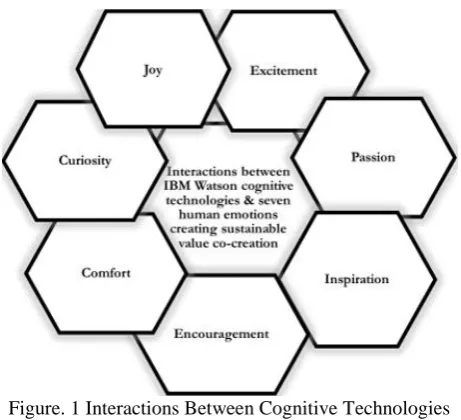
and cognitive technology have made quantum leapcloser to understanding the brain chemistry behind one‘s desire in couture. In the modern era of cognitive systems, as shown in the figure 1.
Figure. 1 Interactions Between Cognitive Technologies and Human Emotions
The author describes IBM Watson`s cognitive technologies interact with seven human key emotions (joy, comfort, passion, excitement, inspiration, encouragement and curiosity) to suggest and identify color palettes that matches with the desire of a fashion brand to achieve sustainable co-creation value for the ECC market.
Joy - an emotion in response to a pleasant observation and rewards for making progress toward achieving goals. Joy perfectly represents one‘s personality.
Passion - is an emotion - a state of the body and a state of the mind that is affected by something permanent external ―orientation‖ of human soul and is a compelling desire for someone or something. Emotion require passion; and passion require emotion. Both feelings are an extreme ―philosophical‖. Passion drives one to action and is all about making its subject better.
Excitement - Throughout history, technology has enabled humans to create haute couture. Today, cognitive systems like IBM Watson are giving artists, designers and creative minds the tools to make ground-breaking approaches with excitement for humans to think creatively in new ways.
Curiosity - Literature review shows curiosity as a contemporary emotion. As a source of motivation, curiosity plays a powerful role in the growth of knowledge and expertise. Curiosity is an emotion related to inquisitive thinking.
Encouragement - is a form of 'verbal persuasion' that would motivate people to be more persistent with the task in hand. Encouragement is also positive based on certain expectations and has a big effect on one's psyche and perceptions towards something.
Comfort - is a sense of psychological ease. Thinking (cognition) and feeling (effect) inextricably connected to offer comfort and helps one to feel happy, and contentedness. This has a unique impact on the positive emotion system. Functionality, style is important, but comfort is everything in wearables – as in physical, social and emotional comfort. What one wear´s is important, it affects comfort and confidence.
Inspiration -In the 1950‘s, couture designers began showing a bridal look creating a long-standing fashion tradition. Fashion inspiration is certainly the driver for the most impeccably style dressed women. Style is about intellectualization and aesthetic appeal.
Four takeaways should be considered for the bridal inspiration:
(i)
Color - Haute Couture brand Christian Dior can make it feel dynamic even with black white color scheme.(ii)
Message – Couture designer Maria Grazia Chiuri made fashion history by announcing, "We should all be feminists." This empowering message with powerful words likes "liberty" and "love" (https://www.vogue.com/tag/designer/maria-grazia-chiuri).(iii)
Beauty – Christian Dior couturewoman is like ―bring it on‖, when it comes to eye makeup.
(iv)
Masks - have so much significance in haute couture. They can be worn for protection, trickery, entertainment, and now, thanks to the couture masks by Dior brand today, they can be worn for chicness.(v)
It should be noted that the Marchesa brand objective was to convey the five key human emotions - joy, excitement, passion, curiosity, and encouragement for the Met Gala cognitive dress (https://www.Marchesa.com).The author argues seven key emotions (as stated above) are essential and should be implemented for better emotional experience of the cognitive dress particularly when inspiration provides the four takeaways and comfort makes one to feel contentedness.
VI.
ETHICAL COGNITIVE COUTURE
OVERVIEW
139
Copyright © 2018. IJEMR. All Rights Reserved.
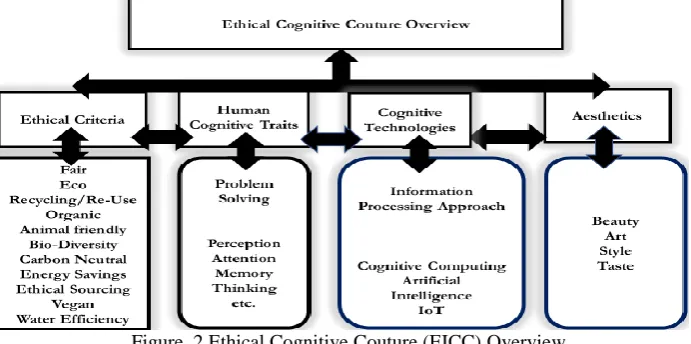
cognitive psychology to investigate the human mind.Psychologists came to understand the complexities of human cognition through computers as a tool for thinking how the human mind handles information. The mind works in a way like a computer - inputting, storing and retrieving data. The idea of information processing paradigm views the mind in terms of a computer when processing information and has been adopted by
cognitive psychologists as a model of how human thought works. Information processing models of cognitive processes such as memory follow a clear sequel. Cognitive approach applies highly controlled and rigorous methods enable researchers to infer cognitive processes at work.
Figure. 2 Ethical Cognitive Couture (EICC) Overview
The prominence of the ECC, however, is recently increasing and more fashion entrepreneurs founding new and prospering ventures under this concept.
VII. ECC MENIFESTO AND ETHICAL
CRITERIA
Couture as a discipline is different from couture as a business. Couture has two aspects, one is the couture creation and design and the other aspect is the couture business. As a discipline, the creation and design, the needs and the expression of consumers emotion is a powerful tool to influence the society. The couture business has evolved steadily as an industry. Couture designer´s manifesto ought to make a positive difference for the society and should be a force for good – therefore, it‘s vital to have the following characteristics of ECC manifesto:
(i)
Assure a fair wages for employees.(ii)
Restore the socializing aspects of work.(iii)
Due recognition to the creativity.(iv)
Refrain the utilization of materials that pollute production processes.(v)
Prohibition of materials killing animals (e.i. furs, ivory).(vi)
Scrap fashion models that insult humanity.(vii)
Avert fast fashion that exploit labour and wind up in landfill shortly.(viii)
ECC brands must act to stop poisoningwaterways around the world with hazardous chemicals.
(ix)
ECC brands need to be transparent regarding usage of chemicals discharging into the environment.140
Copyright © 2018. IJEMR. All Rights Reserved.
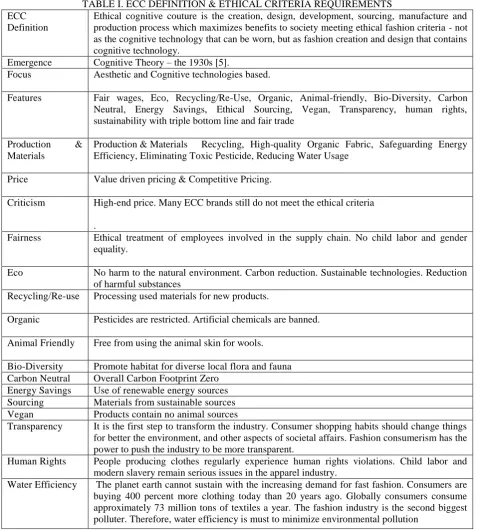
TABLE I. ECC DEFINITION & ETHICAL CRITERIA REQUIREMENTS ECCDefinition
Ethical cognitive couture is the creation, design, development, sourcing, manufacture and production process which maximizes benefits to society meeting ethical fashion criteria - not as the cognitive technology that can be worn, but as fashion creation and design that contains cognitive technology.
Emergence Cognitive Theory – the 1930s [5].
Focus Aesthetic and Cognitive technologies based.
Features Fair wages, Eco, Recycling/Re-Use, Organic, Animal-friendly, Bio-Diversity, Carbon Neutral, Energy Savings, Ethical Sourcing, Vegan, Transparency, human rights, sustainability with triple bottom line and fair trade
Production & Materials
Production & Materials Recycling, High-quality Organic Fabric, Safeguarding Energy Efficiency, Eliminating Toxic Pesticide, Reducing Water Usage
Price Value driven pricing & Competitive Pricing.
Criticism High-end price. Many ECC brands still do not meet the ethical criteria
.
Fairness Ethical treatment of employees involved in the supply chain. No child labor and gender equality.
Eco No harm to the natural environment. Carbon reduction. Sustainable technologies. Reduction of harmful substances
Recycling/Re-use Processing used materials for new products.
Organic Pesticides are restricted. Artificial chemicals are banned.
Animal Friendly Free from using the animal skin for wools.
Bio-Diversity Promote habitat for diverse local flora and fauna Carbon Neutral Overall Carbon Footprint Zero
Energy Savings Use of renewable energy sources Sourcing Materials from sustainable sources Vegan Products contain no animal sources
Transparency It is the first step to transform the industry. Consumer shopping habits should change things for better the environment, and other aspects of societal affairs. Fashion consumerism has the power to push the industry to be more transparent.
Human Rights People producing clothes regularly experience human rights violations. Child labor and modern slavery remain serious issues in the apparel industry.
Water Efficiency The planet earth cannot sustain with the increasing demand for fast fashion. Consumers are buying 400 percent more clothing today than 20 years ago. Globally consumers consume approximately 73 million tons of textiles a year. The fashion industry is the second biggest polluter. Therefore, water efficiency is must to minimize environmental pollution
VIII. RESEARCH METHODOLOGY
The choice of research methodology is dependent on the nature of the problem. Morgan and Smircich (1980) argue, ―the actual suitability of a research method, derives from the nature of the phenomena to be explored‖ [6].
In this conceptual study, the research methodology uses literature review, relevant databases (IBM® Db2™, My Source™, Fashion institute of technology, DBTA™, EBSCO Discovery Services - EDS™, Google Scholar), and multiple case (Jasongrech, Falguni & Shane peacock, Marchesa) studies that
facilitates broad search, identify high quality peer reviewed papers and analysis to obtain SVCC perspective on ECC brands.
(https://www.IBM.com,https://ethicalfashionforum.com, https://www.fitnyc.edu,
https://www.DBTA.com,https://www.ebsco.com/EDS, https://scholar.google.com.)
Literature review
The literature review includes the following two segments [7]:
141
Copyright © 2018. IJEMR. All Rights Reserved.
ECC definition, (c) cognitive system and ECC, (d)human emotions and cognitive system synergy, and (e) ECC overview, manifesto and ethical criteria.
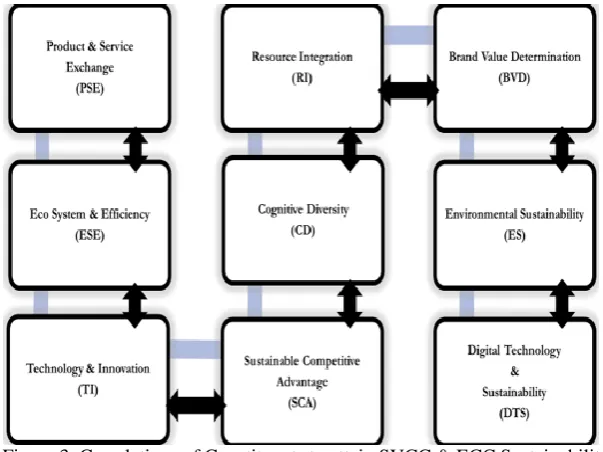
2. Also the literature review leads and focuses on the following nine principal constituents that are co-related to each other to drive ECC sustainability and SVCC attainment , as shown in the figure 3 : (i) products & service exchange (PSE), (ii) eco system & efficiency (ESE), (iii) technology & innovation (TI), (iv) resource integration (RI), (v) cognitive diversity (CD), (vi) sustainable competitive advantage (SCA), (vii) brand value determination (BVD), (viii) environmental sustainability (ES), and (ix) digital technology & sustainability (DTS).
Products & services exchange (PSE)
Value should be considered from social-economic context point of view. As per current SDL literature, all providers are service providers, and service is the fundamental basis of exchange [8]. Based on author´s extensive practitioner experience in value co-creation, this research is the basis for product and service exchange, a logic dominant in product and service system [9]. Value is co-created with the stakeholders,
measured based on value-in-context. Both communication and transparency are important building blocks to have a meaningful product and service exchange. The market is viewed as a product and service exchange between the stakeholders and the ECC brand.
Eco-system & efficiency (ESE)
For the ECC market ecosystems, human emotion factors become an integral part of the creation and design approach in cognitive haute couture and a pivotal determinant for the communication of the ECC brand with the stakeholders. Encircling ECC ecosystems design thinking with design tools are a path to generate systems co-creation. The introduction of ecosystems originates from the social sphere in the analysis of the system‘s organization dynamics and to introduce a system view on value co-creation.
Ecosystem can be explored from a macro-standpoint to generate value co-creation and new knowledge. that continuously implement enhanced points of view and on broader ecologies. The ecosystem is created by a collaboration between ECC ecosystem brand owners and other stakeholders
Figure 3. Correlations of Constituents to attain SVCC & ECC Sustainability
If one wants to build real ecosystems, then one need to focus in:
Generation of context where
intercommunication and consanguinity can quirk.
Combining intercommunications with the products and services one provides, in specific moments.
The salient features of ecosystems are:
(i) institutions; (ii) value propositions; (iii) resource integration. The two perspectives emphasize the need to interpret ecosystems as: (i) systems composed of people and organization actively engaged in resource integration, and (ii) sharing information through
digital technologies producing new social rules to enhance value co-creation and innovation [10].
Eco – efficiency services is defined as a product – service mix at the World Business Council for Sustainable Development as a higher added value and a lesser environmental impact [11].
Technology & innovation (TI)
142
Copyright © 2018. IJEMR. All Rights Reserved.
role of technology for leveraging knowledge exchangeto communicate with stakeholders and promote continual innovation systematically.
Resource integration (RI)
Various institutions play a vital role in resource integration between technology and organizations for encouraging value co-creation. Orlikowski‘s view on ―duality of technology—state that institutions and technology together generate resources integration‖ [12].
The resources exchanged between ECC brand owners and stakeholders can be divided into operand and operant resources. Stakeholders information exchange are not just about comments, criticisms or suggestions on ECC brand experience but also an exchange of information concerning the differences between diverse cultures and the acquisition and learning of new practices. The relevance of resources integration, specifically the role of experience in the exchange of operand and operant resources occur in all the phases of ECC brand operational journey. By confirming the relationship between value co-creation and sustainability, the mechanisms of resources integration bring advantages in terms of: (i) economic advantage to ECC brands, (ii) enhancing social well-being of stakeholders; and (iii) environmental benefits.
Cognitive diversity (CD)
People have disparate ways of epitomizing situations and problems. Calibrating a person‘s cognitive ability is far more predictive of success. Cognitive ability is fluid, not fixed. It can be changed with the right influence and behavior. Simply put, one has ample potential for change in his/her brain‘s ability to function and process. Team diversity offers super-additivity and build on enrichments. Cognitive diversity in which people: (i) make sense of latest information, (ii) solve problems, and (iii) respond to an unfamiliar situation. Cognitive diversity affects the decision-making process and brings a positive element to group performance and it leads to team creativity and improved quality of decision-making [13]. Group interactions are normally the dependent variables in examination of diversity. Research findings suggest that diverse teams have ample potential in terms of creativity. People with similar attributes tend to get along with each other. Getting along is a beneficial aspect to group process. Diverse teams have the creativity advantage and brings the risks of group clashes. Technologies make group members work across cultural and geographic boundaries. Drawing upon the literature, the author suggests that in technology-supported teams the positive effect of deep-level cognitive diversity is amplified.
Social innovation is oriented towards improving the social quality of life by identifying and implementing new competencies, new forms of participation, collaboration, relationships among individuals, and organizations to produce solutions. Within this innovation ecosystem, open forms of collaboration that are effective ways to co-create and co-develop ideas and knowledge to define sustainable solutions. In this
perspective, ECC brands need to manage social innovation activities, the development of products and services mainly contemplate a process of exchanging ideas and value. Moreover, quality and innovation are two necessary pillars to achieve sustainable competitive advantages for the ECC brands.
Sustainable competitive advantage (SCA)
Customer care and trend setting is at the core of the sustainable competitive advantage. Maintaining the quality is also one of the fundamental differentiations to attain sustainable competitive advantage (SCA) in the haute couture creation and design. No ECC brand alone can fully satisfy stakeholder needs. Sustainable value is a way of managing and calibrating sustainability performance. So, in line with the SVCC framework proposed, ecosystems can be the creation of technology promoted experiences for improving competitiveness to acquire sustainable competitive advantage.
Brand value determination (BVD)
The topic of ―brand value determination‖ is an important topic between financiers, marketers, entrepreneurs, and executives of ECC brand. intangible assets (copyrights, patents, trademarks, and customers) play a fundamental role in brand value determination. There are several ways to determine value of an ECC brand. It is paramount to engage stakeholders through online and offline experiences. Alliances can enhance build and enhance the brand value. ECC companies those who are brand centric have greater brand success enabling higher value determination. Brand economics uses an "economic value added (EVA)" framework to determine brand value. Also, the "Young & Rubicam Inc.‘s brand asset valuator (BAV®) - the world‘s largest database of consumer attitudes towards individual brands can be used to value determination. Both EVA and BAV sometimes is used to compare the brand value determination (https://www.yr.com).
Environmental sustainability (ES)
Many couture firms find that the need for trust is key to co-creation of value with the stakeholders and feel the need to involve sustainability campaigners, in their business priorities. Trust not only cuts the costs and but also delays in couture design, development and other processes. Since environmental, and other factors increasingly shape markets, the growth of trust between ECC brands and their stakeholders help hone sustainable competitive edge and innovation.
Environmental sustainability can be achieved in several ways:
(i)
integrating products and services with ECC brands environmental strategy.(ii)
linking products and services of ECC brands with the social, cultural, and organizational change.143
Copyright © 2018. IJEMR. All Rights Reserved.
Digital technologies & sustainability (DTS)
Melville asserted that ―information systems greatly influence organizations‘ beliefs and affect their actions concerning environment sustainability‖ [14]. The digital technologies such as cognitive technologies, information communication technology (ICT), artificial intelligence (AI), Internet of Things (IoT), Blockchain, augmented reality (AR) and social media technology, an integration of digital services with the physical products is emerging. The application of digital technologies can bring environmental benefits and sustainability by:
Converting, simplifying mechanical elements and replacing them by software.
Enhancing design via software through remote control.
Developing remote services regardless of the geographic dispersion of customers
Reducing transport of physical goods.
Information communication technologies along with the development of 3/4D printing to offer ECC companies‘ new opportunities to customers
Optimization service tasks.
Synchronizing the supply chain of product and services
Establishing a shared network and database so that products can be easily searched, matched, shared, exchanged, rented, refurbished, remanufactured and recycled.
Databases IBM® Db™
Database software optimized to offer solutions to deliver results rapidly by running queries and real-time analytics to generate actionable insights and performance while lowering costs, flexibility, scalability, reliability for ECC brands or any other enterprises in the cognitive, and digital era. Cognitive technologies ensure the customer with right product of choice, like in the case of Jasongrech, Falguni & Shane Peacock & Marchesa brands, without spending hours searching portals and can offer trans-formative value to online fashion retailers especially focusing on smart fashion wearable(https://www.ibm.com/analytics/en/db2).
My Source™
World‘s most comprehensive database of ethical fashion businesses and resources and is a platform of tools and services for ethical couture market aims to inspire fashion professionals and businesses to attain sustainability. This ethical fashion database is a one-stop-shop of invaluable and up to date information with a focus on sustainability and beyond. In this study, the author has used My Source™ for ethical criteria review requirement for the ECC brands [4].
Fashion Institute of Technology (FIT)
FIT's library supports the academic and research needs for the fashion community that includes specialized electronic and digital resources and materials not often found in conventional academic libraries, such as the fashion and trend forecasting services, sketch collections, clipping files, fashion show DVDs,
newspapers and periodicals more than 400 current subscriptions. FIT database provide access to thousands of full-text journal articles, books, images, research reports on fashion industry and has measurably facilitated and enrich the learning experience on the
SVCC perspective of ECC brands
(https://www.fitnyc.edu).
DBTA™
Database trends and applications (DBTA) is an authority on cognitive computing, big data analytics, data integration, and more. As DBTA states: ―A new era of cognitive computing and machine learning is unfolding, and its impact is already being felt across industries that can tap into the value of intelligent systems and applications.‖. The author has done comparative studies and validity of information between IBM Db2® and DBTA™ for the cognitive technologies applications, the value of intelligent cognitive system and its analysis for the couture industry (https://www.DBTA.com).
EBSCO Discovery Services - EDS™
EDS™is an online reference system accessible via the Internet and provides a variety of proprietary full text databases and popular databases from leading information providers with
Fast, simple access to all the library‘s collection (electronic and print)
Journals - high quality peer reviewed research papers for various industries including Fashion
Magazines including fashion industry
Books
Databases
Institutional Repositories
Highest-quality metadata of any discovery service.
For this study, the author has used EDS™- the only full featured research experience intuitive search for the extensive literature review on high quality peer reviewed research papers (https://www.ebsco.com/EDS).
Google Scholar
Google Scholar facilitated the author an effortless way to broadly search for scholarly peer reviewed research papers relevant to this study. From one place, the author could search articles, thesis, books, abstracts, opinions, academic publishers, professional societies, online repositories, and web sites on many disciplines and sources (https://scholar.google.com).
Case study - overview of the cases & perspectives
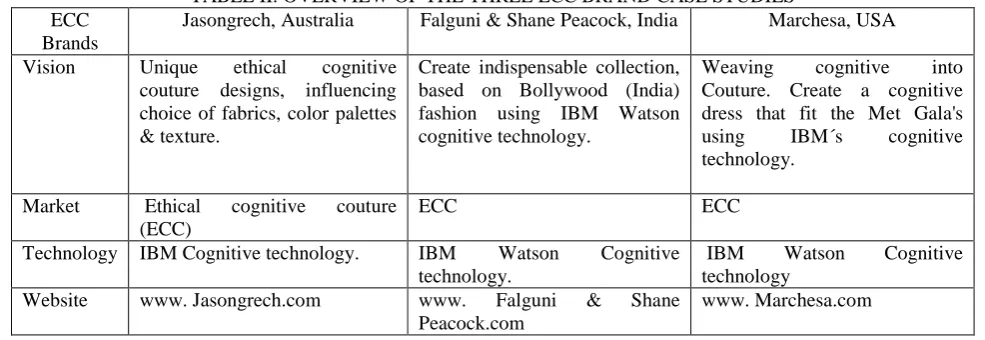
In the social science, multiple cases study involves in-depth investigation of the cases related to circumstantial conditions. The case study research had an outstanding position in many disciplines and industries ranging from fashion, technology, cognitive diversity, psychology, anthropology, sociology, and administrative science. In this study the "ECC cases. (Jasongrech, Falguni & Shane Peacock & Marches) " being studied from ECC brands perspective and their actions, existing in a specific time and place. Summary of the three ECC brands are shown in Table. II.
144
Copyright © 2018. IJEMR. All Rights Reserved.
TABLE II. OVERVIEW OF THE THREE ECC BRAND CASE STUDIES ECCBrands
Jasongrech, Australia Falguni & Shane Peacock, India Marchesa, USA
Vision Unique ethical cognitive couture designs, influencing choice of fabrics, color palettes & texture.
Create indispensable collection, based on Bollywood (India) fashion using IBM Watson cognitive technology.
Weaving cognitive into Couture. Create a cognitive dress that fit the Met Gala's using IBM´s cognitive technology.
Market Ethical cognitive couture (ECC)
ECC ECC
Technology IBM Cognitive technology. IBM Watson Cognitive technology.
IBM Watson Cognitive technology
Website www. Jasongrech.com www. Falguni & Shane Peacock.com
www. Marchesa.com
Jasongrech, an Australian couture designer, leverages through the power of cognitive technology to attain entirely modern and unique couture designs. The creativity is influenced via choice of fabrics, color palettes, and textures using the cognitive system. The ECC brand has made an alliance with IBM by utilizing the cognitive technology—via Watson on IBM Cloud to infuse uniqueness into the ethical couture designs and generally fashioned in dark color but by selecting Watson‘s visual-recognition technology (VRT) to identify and categorize consumers‘ opinions on colors, patterns, and fabrics. The company predicts the fashion trend‘s shifting preference towards pastels. Colors are implemented into the designs—a couture design element the brand would not have considered before. The information (data) collection and analysis process takes few days, as opposed to months, required through manually increasing revenue exponentially (https://www.Jasongrech.com.).
Falguni & Shane peacock, duo Indian designers, partnered with IBM to execute Watson cognitive technology for the brand‘s ECC new collection, inspired by Bollywood (Mumbai, India) fashion. One case in point: The brand analyzed 600,000 images from London, Paris, Milan, and New York fashion weeks for insights into haute couture aligned with 8,000 Bollywood images from the past forty years. Bigdata concomitant analysis of 100,000 print swatches allowed the ECC brand to create prints with the fashionable colors of the season. The result created three indispensable dresses based solely on IBM Watson‘s insights that became signature couture designs of their latest collection. Thus, cognitive technologies don‘t replace the creative process; but proving to enhance and accelerate the design process. While trends fade, new creative ideas inspired by unique combinations of those trends are timeless (https://www. Falguni & Shanepeacock.com).
Marchesa, an American couture designer firm, made an alliance with IBM to integrate cognitive technology with high-end couture design to highlight enhancement of human imagination to create the theme: high-end couture design in the age of cognitive era. Case in point: IBM and Marchesa unveiled a cognitive dress
that perfectly fit the Met Gala. The designer dress was embedded with wearable technology that facilitated purple lights. The special dress relied on a mix of Watson cognitive tools, application programmable interfaces (APIs), and solutions from Watson developer partner and the creative vision from the Marchesa design team. Marchesa objective was to convey the five key human emotions - joy, passion, excitement, encouragement and curiosity. IBM input the data into the cognitive color design tool that understood the psychological effects of colors, the interrelationships between emotions, and image aesthetics. Ultimately, Watson was able to suggest color palettes that were in line with Marchesa‘s brand and the identified emotions, which came to life on the dress during the Met Gala (https://www.Marchesa.com).
To meet the research objective, case study methodology has been applied to analyze the process and impact of sustainability initiatives of the three ECC brands. Information through extensive literature review, published reports, company website sources and various related databases has been used to explore SVCC.
Any kind of value must be co-created by working together with the stakeholders while meeting expectations that companies promise. With this goal in mind, ECCs are engaged in value creation with the stakeholders and community through supporting sustainability programs to ensure maximum stakeholder participation in value creation process. These engagements always foster stakeholder action and instill a sense of pride and confidence in them. Furthermore, these programs help the stakeholders to gain trust and confidence by maintaining transparency.
145
Copyright © 2018. IJEMR. All Rights Reserved.
value. Thus, this is an attempt to highlight the valueco-creation through sustainability initiatives and to analyze its impact on the lives of community stakeholders.
IX.
VALUECO-CREATION BUILDING
BLOCKS
The literature on value creation can be divided into three classifications: (i) a value model, that can be applied to firms or ventures specifying customer demands and the marketing environment, (ii) adaptive value model that is applicable to companies defining customers‘ need; and (iii) the value co-creation model, which can be applied to enterprises with complex environments and vague customer demands [15].
Co-creation is about the joint creation of value by the ECC brand and the stakeholders. Co-creation of value with stakeholders happen only when stakeholders embody their experience using a brand's value proposition. The ECC brand to excogitate greater value from its product-service investment in the form of new knowledge, higher return on investment (ROI) and superior brand equity. It is not the firm trying to please the stakeholders but allowing the stakeholders to co-construct the product - service experience to suit the context. Creating an experience environment in which stakeholders can have the active dialogue and co-construct personalized experiences is vital. ECC Product - service may be the same, but stakeholders can construct different experiences. Co-creation process includes two pivot steps:
(i)
Contributions by the stakeholders (co-producer, co-distributor, co-promoter, co-manufacturer, co-consumer, experience creator, co-innovator, co- creator, co-evaluator, co-designer, co-tester,supplier, integrators, end user, and the society) to the ECC firm.
(ii)
Selection of the most reassuring and entrancingcontributions. For the persuasive and meaningful purpose of value
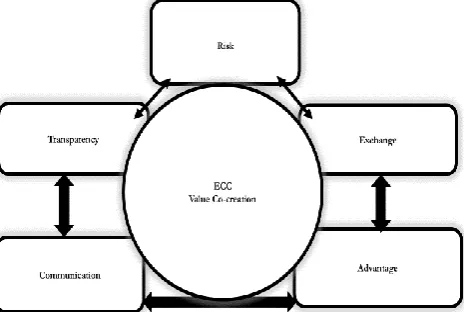
co-creation, the author introduces a concept that involves the following five building blocks - Risk, Exchange, Advantage, Communication, and Transparency (REACT) as shown in the figure 4:
(i)
Risk – Since technology is at the core of ECC innovation, adopting continual innovation could be risky. In the cognitive technology world, ECC brand deals with data analytics which is critical to a company‘s success. Concerns prevail in organization‘s data analytics not to work as intended or inappropriately used which raises risk perception. There is also a correlation between risk and profit, therefore ECC brands may avoid risk-taking and stick with existing tested products. Co-creation process aims at finding innovative ideas from the stakeholders, which echo their needs. Hence, the new product - service is developed to meet specific stakeholder needs, and the risk could be low.(ii)
Exchange - is a vital building block in the co-creation view. The ECC market is viewed as an exchange between the stakeholders, and the ECC brand. Exchange implies engagement, and willingness to act by both parties. But the exchange is strenuous if stakeholders do not have the appropriate communication and transparency to relevant information. Both communication and transparency are important building blocks to have a meaningful exchange.Figure 4. Building Blocks of ECC Value Co-creation
(iii)
Advantage -With the advent of cognitivetechnologies and pervasive marketing (Padhi, 2018), particularly social media, stakeholders are onerous a larger role in the value creation process. Inputs to the product design and service offering come from stakeholders through market research surveys, focus groups, and customer real-time feedbacks. Based on
146
Copyright © 2018. IJEMR. All Rights Reserved.
and service. ECC brands who are willing toinvolve stakeholders in the product design, production process, and service offering would be able to derive several advantages such as meaningful insights and foresight to innovate customer-centric products - services generating brand loyalty and cost reduction.
(iv)
Communication -Effective communication is a building block of successful brand. Communication promotes motivation and is a source of information for decision making as well as plays a pivotal role in changing stakeholder attitudes. ECC brands adopting user experience (UX) research is an integral part to achieve innovation. Stakeholders are at the nucleus of the innovation process. UX researchers execute both quantitative and qualitative methods to build a nuance understanding about stakeholders. There is a gap between how stakeholders see the product design, service offering and how the production team sees the user experience. This is due to UX researchers are middleman in the process. User value proposition and experiences are delivered to the production team in the form of data. Hence, direct communication between the production team and other stakeholders is essential as an integral part of the development process.(v)
Transparency – is all about open flow and disclosure of information. That means no information asymmetry between the brand and the stakeholders. The brand and the stakeholders ought to satisfy the conditions of the building blocks as described in the concept REACT, specifically the ECC brand has the primary responsibility. Although the interaction between the five building blocks are important and must work in a cohesive manner to attain value co-creation successfully. Transparency has been realized as a critical element of the ECC value chain and an essential factor influencing stakeholder´s decision and consumption practice toward ECC products and services. Transparency is paramount pre-requisite for realizing the other four building blocks mentioned above. A pre-requisite for attaining for relevant information through the real communication between stakeholders and brand is essential. When the stakeholders participate in the brand‘s co-creation value, both the brand and the stakeholders are responsible for the value creation. Thus, both play the pivotal role in the benefits and risk assessment. Hence, transparency is not only an absolute pre-requisite but also paramount to achieve the full potential of communication and the risk-benefit assessment. ECC brand ought tostrive for transparency to succeed in achieving sustainable value co-creation.
X.
MARKET INDIVISIBLE FROM
VALUE CO-CREATION
In the traditional market concept of product-service oriented economy, value is created inside the firm and consumers were outside the firm. However, socio-technical advancements make value creation a synchronic and interactive process [16]. Suppliers and customers are no longer on opposite sides but interact with each other for new business opportunities [17].
With the emergence and development of cognitive technology (CT), stakeholders are becoming more informed, connected, empowered, and active, and they desire the joint creation of value. Furthermore, value co-creation is not limited within ECC stakeholders for economic aims only. Elkington pointed out that ―new types of economic, social, and environmental partnership are required to achieve sustainable value and outstanding triple bottom line performance‖ [18].
Products can be commoditized, but co-creation experiences cannot be. The opportunities for value creation are improved substantially for ECC firms that encircle the concepts of co-creation experience as the origin of indispensable value. There is a difference in embodying the co-creation experience as opposed to ―stakeholders play the role as innovators.‖ Embodying the co-creation experience means promoting individualized interactions and experience results. An embodying co-creation experience is a totally different process— involves individual stakeholder on their stipulations. The change from a company-centric view to a creation view is much more fundamental. The co-creation of value through personalized interactions is based on individuals interacting with the company. Co-creation highlights on consumer-company interaction as the mien of value creation. Hence, value co-creation challenges the representation of a market.
Co-creation converts the market into a forum where exchange among the consumer, the ECC brand, and other stakeholders such as global, regional and local communities takes place. Co-creation of value fundamentally challenges the conventional supply and demand equation. For value co-creation experience the ECC firm needs to produce a product and offer service. Hence the focus moves to the total experience environment in which individual constraints and choices define their willingness to pay for experiences. In short, the market resembles a forum for co-creation experiences.
147
Copyright © 2018. IJEMR. All Rights Reserved.
creation, co-extraction of economic value is harder forcompanies to develop a sustainable competitive advantage.
The most sustainable differentiation can be to compete for customers‘ business. It is easy to copy and enhance products or services. But it is difficult to copy what one does and how people work with and engage stakeholders. Value creation works in a culture of stakeholder centricity.
The author contends value creation is on the cusp synergy thinking of a new era called multi – dimensional value co-creation. Synergy is by truly collaborating, one can produce a better result than separately and can look like 1+1=3. Value co-creation moves from teaching the stakeholders to learning from each other. It causes to leverage individual and shared experiences together. Value co-creation is daunting and requires much richer stakeholder‘s engagement and experience model. Consequently, value co-creation requires deep alignment and offers the best opportunity for disruptive innovations and is the ability for the stakeholders to create and customize their own experience. In the emerging ECC market, the locus is positioned on stakeholder-ECC brand interaction—the convergence of the fashion brand and the stakeholder. The market becomes indivisible from the value creation process.
XI.
TOWARDS A SVCC
FRAMEWORK
Sustainable value is multifaceted and all about integration of the economic, environmental and
socio-cultural dimensions of sustainability concerns. Still to date, most top leadership team of a firm consider sustainable development as a one-dimensional opportunity. Such one-dimensional approach provides firms shortcomings to deal with the challenges in a strategic way. The global challenges have ramifications for every aspect of a company‘s business model and strategy. Hence, value co-creation requires multi - dimensional approach by ECC firms to achieve optimum performance.
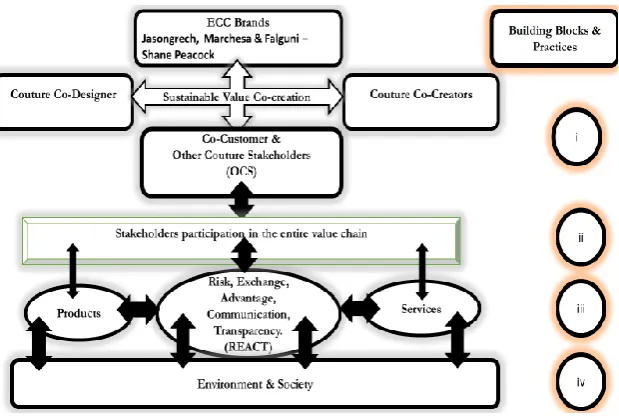
In this study, the development of a sustainable value creation framework is focused on the co-creation value model that involves ECC brands stakeholders and the relevant value chain in a multi -dimensional opportunity. The building blocks and practices of the sustainable value co-creation framework, as shown in the figure 5, are: (i) cooperation between the stakeholders and ECC brands, (ii) stakeholders‘ participation in the entire value chain, (iii) ECC products and services interactive actions with the application of REACT building blocks, and (iv) benefit and cost to the environment and society.
Using case studies on three ECC brands (Jasongrech, Falguni & Shane Peacock & Marchesa), the author examines the concept of sustainability to co-create value. Co-creation of value comprises a two-phase process: first, couture creators co-create value with couture designers for their customers or end users through sustainability awareness. Second, other ECC stakeholders co-create through a sustainable hybrid offering (a service bundled with a product).
Figure 5. Building Blocks of SVCC Framework
Such a proposition enables ECC brands to increase performance or to integrate sustainability into their supply chain. For each of the stakeholder there is a different focus. For example: ECC integrators together with suppliers focus on the system integration, synchronization and convergence of their products and
148
Copyright © 2018. IJEMR. All Rights Reserved.
promote joint efforts to achieve both economic growthand sustainability.
Based on the discussion above, a SVCC conceptual framework is constructed for the ECC brands, and the framework embraces the ECC stakeholders in which it operates. At the core of the framework stands the stakeholders interactive work ‗value co-creation‘ that is connected and enabled by cognitive technology. Hence a sustainable-value co-creation framework is presented that connects the global sustainability challenges to the creation of stakeholder value by the ECC brands such as Jasongrech, Falguni & Shane Peacock & Marchesa. This framework can be used as an education model and guide for all ECC stakeholders including suppliers, providers, customers, decision makers and for other industries who are seeking for value co-creation for sustainable development.
XII.
DISCUSSION AND CONCLUSION
To wear something on the body is a very important decision and not to be taken casually. Appearance is one of the fundamental desires of someone to wear an ethical cognitive couture. The fusion of fashion wearable into cognitive technology with ethical criteria consideration is the key to the widespread adoption of ECC. Couture design has started to merge with cognitive technology due to cultural change, seasonal attitudes and lifestyle evolution. Couture creation shouldn't renounce aesthetics for the sake of being cutting-edge cognitive technology.
The author contends that ECC will not succeed as a market until it is designed from the fashion perspective—not as a technology that can be wearable, but as- "Couturelogy" - haute couture design that contains cognitive technology.
Couture industry is at present the second largest polluting entity on the planet. There is a dire need for the couture wearable to be ethical to lessen its environmental impact whilst meeting the demands of a growing population. Raising awareness regarding ethical criteria among ECC stakeholders is paramount to accelerate its environmental and social impact reduction. Ethics in haute couture creation and design is valuable to lessen the global ecological crisis. Most company boards and top leadership team are amenable to business partnerships and accept the need for social and community partnerships. But environmental sustainability partnering, particularly in the couture industry, is still at the nascent stage. Environmentalists are viewed as a form of virus by many enterprises and should be kept away from a company. That view is gradually changing.
The ECC stakeholders need to understand the importance of the concept REACT to attain the SVCC, thus enriching new knowledge to the literature. Empowerment of stakeholders and rise of cognitive technologies have led to the acceptance of stakeholders in the ECC firm‘s value-creating process. This research
demonstrates cognitive technologies; such as IBM Watson technology interacting with seven human key emotions (joy, comfort, passion, excitement, inspiration, encouragement, and curiosity); can inexorably facilitate the sustainable value co-creation in the cognitive era enabling the environmental sustainability for the ECC market. In the future, the couture creators and designers need to think the seamless integration of cognitive technology with artificial intelligence that will give actionable feedback.
Technologies are not a universal panacea for sustainability. Their impact needs to be assessed on a comprehensive level to ensure net positive gains of value co-creation. Sustainable production need to ―do more with less‖ and profits need to be anchored to social benefits for people and the planet. To date, academic research on cognitive technology to meet the ethical couture market need has come up short. To be truly useful, usable and desirable for fashion consumers, it is vitally important to see the future improvements in user-centric, aesthetic appeal, and application-oriented cognitive technology that blends seamlessly into haute couture creating emotions.
Since there is a wide gap between the practice and academic research in the ECC scientific knowledge, the author argues that product and service exchange (PSE) in the value co-creation process is essential to explore the role of the stakeholders for the ECC brands. A quantitative analysis would make the paper more rigor and robust.
REFERENCES
[1] Ochsner, K. N. & Gross, J. J. (2005). The cognitive control of emotion. Trends Cognition Science, 9(5), 242-249.
[2] Ochsner, K. N. & Gross, J. J. (2008). Cognitive emotion regulation. Current Dir Psychological Science, 17(2), 153-158.
[3] Ethica Criteria. (2018, June 11). Available at: http://www.shopethica.com/ethical-criteria.
[4] Ethical Fashion Forum. (2018, June 11). Available at:
https://www.ethicalfashionforum.com/theissues/ethical-fashion.
[5] Frederiksen, N. (1983). Implications of cognitive theory for instruction in problem solving. Wiley Online Library. Available at: http://onlinelibrary.wiley.com, doi/10.1002/j.2330-8516.1983.tb00019.x/
[6] Morgan, G. & Smircich, L. (1980). The case for qualitative research. Academy of Management Review, 5(4), 491-500. Available at:
https://journals.aom.org/doi/pdf/10.5465/amr.1980.4288 947.
[7] Li, A. Q. & Found, P. (2017). Towards sustainability: PSS, digital technology and value co-creation. Science Direct, Procedia CIRP, 64, 79-84. Available at:
149
Copyright © 2018. IJEMR. All Rights Reserved.
[8] Kuzgun, E. & Asugman, G. (2015). Value in services-A service dominant logic perspective. Procedia- Social and Behavioral Sciences, 207, 242-251.
[9] Goedkoop, MJ, Halen, CJG van, Riele, HRM te, & Rommens, PJM. (1999). Product service systems, ecological and economic basics. Available at: http://teclim.ufba.br/jsf/indicadores/holan%20Product% 20Service%20Systems%20main%20report.pdf
[10] Padhi, P. K. (2018). A quest for born - Global speculative start-up: Pervasive Phenomenon Model.
Informing Science: International Journal of Community Development & Management Studies, 2, 87-103. Available at:
https://www.informingscience.org/Articles/v2p087-103Padhi4416.pdf
[11] Markus Lehni. (2000). Eco-efficiency: creating more value with less impact. Switzerland: Conches-Geneva. Available at: http://www.worldcat.org/title/eco-
efficiency-creating-more-value-with-less-impact/oclc/224028551
[12] Orlikowski, W.J. (1992). The duality of technology: Rethinking the concept of technology in organizations. Organizations Science, 3(3), 301-441. Available at:
https://pubsonline.informs.org/doi/10.1287/orsc.3.3.39 8
[13] Bantel, K.A. & Jackson, S.E. (1989). Top management and innovations in banking: Does the composition of the top team make a difference? Strategic Management Journal, 10(1), 107-124. Available at: https://www.researchgate.net/publication/227770306_To p_Management_and_Innovations_in_Banking_Does_the _Composition_of_the_Top_Team_Make_a_Difference [14] Melville, N. P. (2010). Information systems innovation for environment sustainability. MIS
Quarterly, 34(1), 1-21. Available at:
https://misq.org/downloadable/download/linkSample/lin k_id/838/
[15] Kito, T.; Fujita, K.; Takenaka, & T., Ueda, K. (2007). Multi-agent market modelling based on analysis of consumer lifestyles. The 41st CIRP Conference on Manufacturing Systems, Manufacturing Systems and Technologies for the New Frontier, London, UK, 26–28, Springer: London, UK, 507–510. Available at: http://citeseerx.ist.psu.edu/viewdoc/download?doi=10.1. 1.494.1940&rep=rep1&type=pdf
[16] Ramírez, R. (1999). Value co-production: Intellectual origins and implications for practice and research. Strategic Management Journal, 20, 49-65. Available at:
http://citeseerx.ist.psu.edu/viewdoc/download?doi=10.1. 1.460.6031&rep=rep1&type=pdf
[17] Galvagno, M. & Dalli, D. (2014). Theory of value co-creation: A systematic literature review. Journal of Service Theory and Practice, 24(6), 643-683. Available at:
https://www.researchgate.net/publication/262688549_Th
eory_of_Value_Co-creation_A_Systematic_Literature_Review
[18] Elkington, J. (1998). Partnerships from cannibals with forks: The triple bottom line of 21st-century business. Environmental Quality Management, 37-51. Available at: