R E S E A R C H
Open Access
Direct electrochemical analyses of human
cytochromes
b
5
with a mutated heme pocket
showed a good correlation between their
midpoint and half wave potentials
Tomomi Aono
1†, Yoichi Sakamoto
1†, Masahiro Miura
1, Fusako Takeuchi
2, Hiroshi Hori
3, Motonari Tsubaki
1*Abstract
Background:Cytochromeb5 performs central roles in various biological electron transfer reactions, where
difference in the redox potential of two reactant proteins provides the driving force. Redox potentials of cytochromesb5 span a very wide range of ~400 mV, in which surface charge and hydrophobicity around the
heme moiety are proposed to have crucial roles based on previous site-directed mutagenesis analyses.
Methods:Effects of mutations at conserved hydrophobic amino acid residues consisting of the heme pocket of cytochromeb5were analyzed by EPR and electrochemical methods. Cyclic voltammetry of the heme-binding
domain of human cytochromeb5 (HLMWb5) and its site-directed mutants was conducted using a gold electrode
pre-treated withb-mercarptopropionic acid by inclusion of positively-charged poly-L-lysine. On the other hand, static midpoint potentials were measured under a similar condition.
Results:Titration of HLMWb5 with poly-L-lysine indicated that half-wave potential up-shifted to -19.5 mV when the
concentration reached to form a complex. On the other hand, midpoint potentials of -3.2 and +16.5 mV were obtained for HLMWb5in the absence and presence of poly-L-lysine, respectively, by a spectroscopic
electrochemical titration, suggesting that positive charges introduced by binding of poly-L-lysine around an exposed heme propionate resulted in a positive shift of the potential. Analyses on the five site-specific mutants showed a good correlation between the half-wave and the midpoint potentials, in which the former were 16~32 mV more negative than the latter, suggesting that both binding of poly-L-lysine and hydrophobicity around the heme moiety regulate the overall redox potentials.
Conclusions:Present study showed that simultaneous measurements of the midpoint and the half-wave potentials could be a good evaluating methodology for the analyses of static and dynamic redox properties of various
hemoproteins including cytochromeb5. The potentials might be modulated by a gross conformational change in the
tertiary structure, by a slight change in the local structure, or by a change in the hydrophobicity around the heme moiety as found for the interaction with poly-L-lysine. Therefore, the system consisting of cytochromeb5and its partner
proteins or peptides might be a good paradigm for studying the biological electron transfer reactions.
Background
Cytochromes bcan be defined as electron transfer pro-teins having heme b group(s), noncovalently bound to the protein.b-Type cytochromes possess a wide range
of properties and functions in a large number of differ-ent redox processes. Among them, cytochromesb5 are
ubiquitously found in animals, plants, fungi and some bacteria. The microsomal and mitochondrial (outer membrane; OM) variants are known and are present in a membrane-bound form. On the other hand, bacterial and those from erythrocytes and some animal tissues are water-soluble (such as for the reduction of * Correspondence: [email protected]
†Contributed equally
1
Department of Chemistry, Graduate School of Science, Kobe University, 1-1 Rokkodai-cho, Nada-ku, Kobe, Hyogo 657-8501, Japan
Full list of author information is available at the end of the article
methemoglobin in erythrocytes and for the biosynthesis of N-glycolylneuraminic acid [1]). A membrane-bound (microsomal) form of cytochrome b5 is required for
numerous biosynthetic and biotransformation reactions, which include cytochrome P450-dependent reactions [2], desaturation of fatty acids [3], plasmalogen biosynth-esis [4], and cholesterol biosynthbiosynth-esis [5,6]. The role of cytochrome b5 in microsomal P-450-dependent
mono-oxygenase reactions has been studied most extensively [2]. In addition, a number of fusion enzymes exist in nature containing cytochrome b5 as a domain
compo-nent. These include mitochondrial flavocytochrome b2
(L-lactate dehydrogenase) [7], sulfite oxidase [8], theΔ5 -andΔ6-fatty acid desaturases [9], and yeast inositolpho-sphorylceramide oxidase [10]. Plant and fungal nitrate reductases are also cytochrome b5-containing fusion
enzymes [11].
For human cytochromeb5, only a few naturally
occur-ring mutations recognized as a genetic disorder have been reported. One such example was found by Kurian
et al. [12]. They reported that naturally occurring
human cytochrome b5 T60A mutant [12] displayed an
impaired hydroxylamine reduction capacity. They observed further that the expressed protein in rabbit reticulocyte lysate system showed an enhanced suscept-ibility to the proteolytic degradation. Expression level in transfected HeLa cells was also significantly lowered. Another genetically confirmed example was previously reported. In this case, Steggleset al. identified a homo-zygous splice site mutation in the CYB5A gene, resulting in premature truncation of the protein, leading to a very high methemoglobin concentration in red blood cells of the patient, being consistent with methemoglobinemia type IV [13]. The patient exhibited female genitalia at birth, but, was determined as a male pseudohermaphro-dite, probably due to the low levels of androgen synth-esis by the lack of cytochrome b5 activity, which has
been shown to participate in 17a-hydroxylation in adre-nal steroidogenesis [14].
Whereas more than 300 patients had been reported with hereditary methemoglobinemia types I or II, only a few cases of type IV had been reported. Thus, one may attribute that the rarity of naturally occurring cyto-chrome b5 mutation may be due to lethality of most
type IV mutations. However, in a very recent study by employing transgenic mice, Finnet al. found that cyto-chromeb5 completely null mice were viable, fertile and
produced grossly normal pups at expected Mendelian ratios [15]. Further, the cytochromeb5 null mice
exhib-ited a number of intriguing phenotypes, including altered drug metabolism, methemoglobinemia, disrupted steroid hormone biosynthesis. In addition, the cyto-chromeb5null mice displayed skin defects and
retarda-tion of neonatal development. These observaretarda-tions
suggested that cytochromeb5 might play a role
control-ling saturated/unsaturated homeostasis of fatty acids in higher animals including human.
The membrane-bound form of cytochromeb5 is
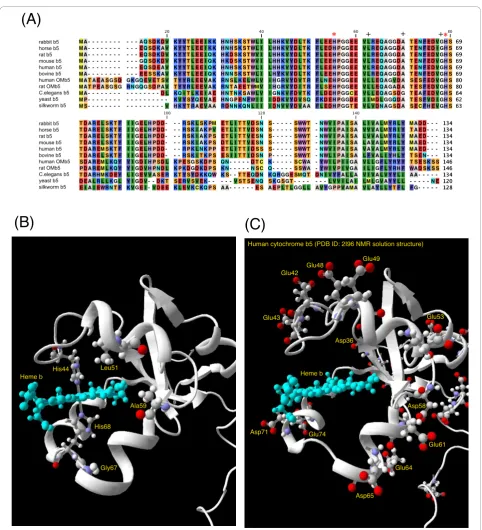
asso-ciated with the endoplasmic reticulum. It has a molecu-lar weight of 16,700 Da and contains about 134 amino acids in animals (Figure 1A). It is composed of three domains: a hydrophilic heme-containing catalytic domain of about 99 amino acids; a membrane-binding hydrophobic domain containing about 30 amino acids at the carboxy terminus of the molecule; and a membrane-targeting region represented by the 10-amino-acid sequence located at the carboxy-terminus of the mem-brane-binding domain. Three-dimensional structures of a number of cytochrome b5 are known [16], but only
for the heme-containing hydrophilic catalytic domain [17]. Two His residues (His44 and His68) provide the fifth and sixth heme ligands (Figure 1A, B), and two propionate groups of the heme b lies at the opening of the heme-binding pocket, which is formed by highly conserved hydrophobic amino acid residues (Figure 1A). The roles of each amino acid were investigated by detailed site-directed mutagenesis in the past with employing various structural, spectroscopic and electro-chemical techniques, including X-ray crystallography [18-20], NMR [21-23], UV-visible absorption spectro-scopy, and redox potential measurements [24].
Redox potentials of various forms of cytochrome b5
span a range of ~400 mV. It is well documented that several factors could regulate and induce changes in the reduction potential of cytochrome b5 spanning almost
entire range observed. The electrostatic contribution by surface charges might play important roles in adjusting the selectivity of the protein-protein interaction. On the other hand, difference in the redox potential of two reactant proteins provides the driving force for the elec-tron transfer reactions. Thus, the clarification of the reg-ulatory mechanism of the redox potentials might be essential for the understanding of the biological electron transfer reactions.
Biological redox potential measurements were usually conducted either by an equilibrating electrochemical method or by employing a dynamic cyclic voltammetry. Common features to all the past voltammetric experi-ments involving cytochrome b5 and electrodes
pre-treated with various thiol-containing aliphatic acid or related groups are the large difference between the half-wave potential (E1/2) and the midpoint potential
deter-mined by the equilibrating method [25]. In the case of rat OM cytochrome b5, its midpoint potential
(B)
(C)
(A)
MA - - - - - - - AQ SD KD V K Y Y T L E E I K K H N H SK S T WL I L H H K V Y D L T K F L E EH PGG E E V L R EQ A GGD A T EN F ED V GH S MA - - - - - - - EQ SD KA V K Y Y T L E E I K K H N H SK S T WL I L H H K V Y D L T K F L ED H PGG E E V L R EQ A GGD A T EN F ED I GH S MA - - - - - - - EQ SD KD V K Y Y T L E E I Q K H KD SK S T WV I L H H K V Y D L T K F L E EH PGG E E V L R EQ A GGD A T EN F ED V GH S MA - - - - - - - GQ SD KD V K Y Y T L E E I Q K H KD SK S T WV I L H H K V Y D L T K F L E EH PGG E E V L R EQ A GGD A T EN F ED V GH S MA - - - - - - - EQ SD EA V K Y Y T L E E I Q K H N H SK S T WL I L H H K V Y D L T K F L E EH PGG E E V L R EQ A GGD A T EN F ED V GH S MA - - - - - - - E E S SKA V K Y Y T L E E I Q K H N N SK S T WL I L H Y K V Y D L T K F L E EH PGG E E V L R EQ A GGD A T EN F ED V GH S MA T A EA SG SD GKGQ E V E T S V T Y Y R L E E V A K RN S L K E LWL V I H GR V Y D V T R F L N EH PGG E E V L L EQ A GV D A S E S F ED V GH S MA T P EA SG SG RN GQG SD P A V T Y Y R L E E V A K RN T A E E T WM V I H GR V Y D I T R F L S EH PGG E E V L L EQ A GAD A T E S F ED V GH S MA - - - - - - - D L KQ I T L K E I A E H N T N K SAWL V I GN K V F D V T K F L D EH PGGC E V L L EQ A G SD G T EA F ED V GH S M P - - - - - - - - K V Y S YQ E V A E H N G P EN FW I I I D D K V Y D V SQ F KD EH PGGD E I I MD L GGQD A T E S F V D I GH S M S - - - - - - - V H K Y T RA E V A A RD N N KQN L I I I D N V V Y D V A A F L ED H PGGT E V L V D N A G SD A S E C F H E V GH S
T D A R E L SK T F I I G E L H PD D - - - R SK L SK PM E T L I T T V D SN S - - - SWWT - NWV I P A I SA L I V A LM Y R L Y MAD D -T D A R E L SK -T F I I G E L H PD D - - - R SK I A K P V E T L I T T V D SN S - - - SWWT NWV I P A I SA V V V A LM Y R I Y T A ED -T D A R E L SK -T Y I I G E L H PD D - - - R SK I A K P S E T L I T T V E SN S - - - SWWT - NWV I P A I SA L V V A LM Y R L Y MA ED -T D A R E L SK -T Y I I G E L H PD D - - - R SK I A K P S D T L I T T V E SN S - - - SWWT - NWV I P A I SA L A V A LM Y R L Y MA ED -T D A R EM SK -T F I I G E L H PD D - - - R P K L N K P P E T L I T T I D S S S - - - SWWT NWV I P A I SA V A V A LM Y R L Y MA ED -T D A R E L SK -T F I I G E L H PD D - - - R SK I T K P S E S I I T T I D SN P - - - SWWT - NWL I P A I SA L F V A L I Y H L Y T S EN -SD A R EM L KQ Y Y I GD I H P SD L K P E SG SKD P S QN - - - D T C K - - - SCWA - YW I L P I I GA V L L G F L Y R Y Y T S E SK S S PD A R EM L KQ Y Y I GD V H PND L K P KD GD KD P S KN - - - N SC Q - - - S SWA - YW I V P I V GA I L I G F L Y RH F WAD SK S S T D A RHM KD E Y L I G E V V A S E R K T Y S Y D K KQW K S - - T T EQD N KQ RGG E SMQ T D N I V Y F A L L A V I V A L V Y Y L I A A -D EA L R L L KG L Y I GD V - - D K T S E R V S V E K - - - - - V S T S ENQ SKG SGT - - - - - - - L V V I L A I LM L GV A Y Y L L - - - N E E I A I EWRN T F K V G E I - V D E E K L E V K C KQ P S A A - - - E S A E P L T L GG L L A V Y G P P V AMA V L A Y L L Y T F L F G
-rabbit b5 horse b5 rat b5 mouse b5 human b5 bovine b5 human OMb5 rat OMb5 C.elegans b5 yeast b5 silkworm b5 rabbit b5 horse b5 rat b5 mouse b5 human b5 bovine b5 human OMb5 rat OMb5 C.elegans b5 yeast b5 silkworm b5
*
+ + +*
Figure 1Alignment of amino acid sequences of cytochromeb5from various species (A), a close-up view of tertiary structure of
human cytochromeb5around the heme-pocket with three conserved hydrophobic residues (Leu51, Ala59, and Gly67) and two heme
axial ligands (His44 and His68) indicated (B), a close-up view around the heme pocket with acidic amino acid residues (C). (A) Amino acid sequences of cytochromesb5from various species are aligned. Two heme axial ligands (His44 and His68) are indicated by an asterisk (*). On
the other hand, corresponding positions to three target residues (Leu51, Ala59, and Gly67) in the present study are indicated by a cross (+). Amino acid sequences were obtained from [GenBank; NP_001164735 for rabbitb5, P00170 for horseb5, AAB67610 for ratb5, P56395 for mouse
b5, AAA35729 for humanb5, NP_776458 for bovineb5, BAA23735 for human OMb5, AAH72535 for rat OMb5; CAB01732 forC.elegans b5, P40312
for yeastb5, NP_001106739 for silkwormb5]. (B) Human cytochromeb5NMR solution structure [PDB code: 2I96 model 1] is shown in a ribbon
model with a bound hemebprosthetic group. In addition, three conserved residues (Leu51, Ala59, and Gly67) and two heme axial ligands (His44 and His68) are indicated. (C) Acidic amino acid residues located on the surface of the heme-binding domain (corresponding to LMWb5)
[26] and chicken liver microsomal cytochromeb5(~+40
mV) [27].
The large positive shift (+110 mV) observed for rat OM cytochrome b5 were attributed to the binding of
multivalent cations, such as, poly-L-lysine, which were used for shielding the negatively charged protein surface and negatively-charged electrode surface to facilitate the electron transfer [25]. The difference in the potentials was ascribed, initially, for the binding of multivalent cations to the specific charged residues on the surface of cytochromeb5, such as Glu and Asp (Figure 1C) [25],
leading to the modulation of the heme redox potential differently from that measured by the equilibrating method. Later, however, a carboxylate of an exposed heme propionate group and conserved acidic residues (Glu44, Glu48, Glu56, and Asp60) (Figure 1C) (corre-sponding to Glu49, Glu53, Glu61, and Asp65, respec-tively, of human cytochrome b5) were proposed to be
responsible for the specific binding of multivalent cations [28]. The formation of such a complex will result in a neutralization of the charge on the heme pro-pionate and lowering of the dielectric of the exposed heme microenvironment by excluding water from the complex interface. These two factors act synergistically to destabilize the positive charge of the ferric heme with respect to the neutral ferrous heme, leading to a positive shift of the redox potential upon binding of poly-L-lysine [28,29]. This postulation was partly verified by the esterification of the heme propionate groups, leading to the half-wave potential to be independent of the con-centration of multivalent cations [28,29].
In the present study, we focused on three conserved hydrophobic amino acid residues (Leu51, Ala59, and Gly67) consisting of the heme-binding pocket (Figure 1A, B). These residues were not investigated previously despite of their higher conservation among the various members of cytochrome b5 protein family (Figure 1A).
Gly67 is located besides the heme axial His residue (His68) and is near the entrance of the heme-pocket crevice (Figure 1B). Leu51 and Ala59, on the other hand, are located in the bottom of the heme pocket (Figure 1B). The former is on the side of His44 residue, the other heme axial ligand. The latter is on the side of His68 residue. These two residues might be essential for the stabilization of the heme prosthetic group in the hydrophobic heme pocket. Therefore, we selected repla-cing amino acid residues not too hazardous for the maintenance of the heme cavity. Accordingly, we chose Thr, Ile, Ala, Ser residues for the replacement of Leu51, Ala59, and Gly67 residues. We produced and purified site-directed mutants for these three sites, having parti-cular interests in the changes of local structure and hydrophobicity of the heme pocket, which may affect the redox properties of cytochrome b5. We measured
spectroscopic and electrochemical properties (i.e., redox potentials were analyzed by an equilibrating method and a cyclic voltammetry technique) of these mutants to clarify the structural and electrochemical importance of the conserved residues.
Methods
Construction of the expression plasmid for wild-type and site-directed mutants of HLMWb5
The gene coding for a soluble domain (amino acid resi-dues from Met1 to Leu99; LMWb5) of human
cyto-chrome b5 in pIN3/b5/2E1/OR plasmid [30,31] was
subcloned into pCWori vector as previously described
[32]. Then, theBamH I-HindIII fragment of the pC/ LMWb5 plasmid encoding entire LMWb5 (amino acid
residues from Met1 to Leu99) was inserted into the
BamHI-Hind III site of pBluescript II KS(+) to form a plasmid pBS/LMWb5 for easier handling upon the
site-directed mutagenesis. The nucleotide sequence of the pBS/LMWb5 plasmid was confirmed with a DNA
sequencer (PRISM 3100 Genetic Analyzer, ABI).
The site-directed mutagenesis was conducted using QuikChange Site-Directed Mutagenesis Kit (Stratagene, La Jolla, CA, USA) according to the manufacturer’s manual. Following mutagenic primers were used (substi-tuted codons are underlined): for L51I, L51I-R (5’ -CCAGCTTGTTCCCTGATAACTTCTTCCCCACC-3’) and L51I-F (5’ -GGTGGGGAAGAAGTTATCAGGGAA-CAAGCTGG-3’); for L51T, L51T-R (5’-CCAGCTT GTTCCCTTGTAACTTCTTCCCCACC-3’) and L51T-F
(5’-GGTGGGGAAGAAGTTACAAGGGAACAAGCT
GG-3’); for A59V, A59V-R (5’ -CCTCAAAGTTCTCAG-TAACGTCACCTCCAGCTTG-3’) and A59V-F (5’-CAA GCTGGAGGTGACGTTACTGAGAACTTTGAGG-3’); for A59 S, A59S-R (5’ -CAAGCTGGAGGTGACTC-TACTGAGAACTTTGAGG-3’) and A59S-F (5’-CA AGCTGGAGGTGACTCTACTGAGAACTTTGAGG-3’); for G67A, G67A-R(5’ -GGCATCTGTAGAGTGCGC-GACATCCTCAAAGTTC-3’) and G67A-F (5’-GAAC TTTGAGGATGTCGCGCACTCTACAGATGCC-3’); and for G67 S, G67S-R (5’ -GGCATCTGTAGAGTGC-GAGACATCCTCAAAGTTC-3’) and G67S-F (5’-GAA CTTTGAGGATGTCTCGCACTCTACAGATGCC-3’). After the site-directed mutagenesis, transformation, and plasmid preparation, each mutated plasmid (pBS/L51I, pBS/L51T, pBS/A59V, pBS/A59 S, pBS/G67A, pBS/ G67S) was treated with Nde I and Hind III. The each
NdeI-HindIII fragment of pBS/LMWb5 plasmid and
the mutated plasmids was inserted into the NdeI-Hind
III site of pET-28b(+) vector (Novagen, Merck, Darm-stadt, Germany) to construct pET/HLMWb5, pET/L51I,
The pET-28b(+) vector contains a 6x-His-tag moiety at the upstream of theNde I-HindIII site and, therefore, gives an additional extension with a sequence of MGSSHHHHHHSSGLVPRGSH at the NH2-terminus of
the LMWb5 protein (designated as HLMWb5, hereafter).
Mutations were confirmed with an ABI PRISM 3100 Genetic Analyzer (Applied Biosystems Japan Ltd.) for both types of plasmids prepared from pBS and pET vec-tors. Escherichia colistrain BL21(DE3)pLysS was trans-formed with pET/HLMWb5 (or with one of the mutated
pET plasmids) and was cultivated in low-salt Luria-Ber-tani (LB) medium containing 30 μg/ml of kanamycin and 34μg/ml chloramphenicol at 37°C for pre-culture.
After the pre-culture, HLMWb5 protein (or each
mutant protein) was produced by growing the trans-formed cells at 37°C in TB medium (12.0 g/L of tryp-tone, 24.0 g/L yeast extract, 4 ml/L glycerol, 23.1 g/L KH2PO4, and 125.4 g/L K2HPO4) in the presence of
30μg/ml of kanamycin and 34 μg/ml of chlorampheni-col. Induction of the protein expression was achieved by addition of 200 μM (final) IPTG when the cells had grown to an O.D. of 0.6 at 600 nm. Then, the incuba-tion temperature was lowered to 26°C. Cells were har-vested 48 h after the addition of IPTG and were frozen in liquid nitrogen and stored at -80 °C until use. The thawed cells were mixed with a lysis buffer (20 mM Tris-HCl buffer (pH 8.0) containing 0.5 mM EDTA) and disrupted by the treatment with lysozyme (final, 1 mg/mL) and DNase (final, 50μg/mL) in the presence of 1 mM of phenylmethylsulfonyl fluoride followed by sonication on ice with a model 250 sonifier (Branson Ultrasonic). The disrupted cells were centrifuged at 26,000 g for 20 min at 4 °C. The supernatant was saved as a crude extract.
Purification of HLMWb5 was conducted as follows.
The crude extract was loaded onto a column of DEAE-Sepharose CL-6B previously equilibrated with 20 mM Tris-HCl (pH 8.0) buffer containing 0.5 mM EDTA. The HLMWb5 was adsorbed in the column as a reddish
band. The column was washed with the same buffer containing 50 mM NaSCN. The adsorbed LMWb5 was
eluted by a linear gradient of NaSCN concentration from 50 to 300 mM in the same buffer. Main fractions were collected based on the SDS-PAGE analysis (12% gel) and absorbance at 414 nm and were concentrated to about 5 mL using an Amicon concentrator and a Millipore membrane (MWCO = 10,000). The concen-trated HLMWb5 was, then, subjected onto an affinity
column chromatography with Ni-NTA agarose gel (QIAGEN) previously equilibrated with 50 mM sodium phosphate buffer (pH 8.0) containing 10 mM imidazole and 300 mM NaCl. The column was washed with 50 mM sodium-phosphate buffer (pH 8.0) containing 20 mM imidazole and 300 mM NaCl. Finally, adsorbed
HLMWb5 protein was eluted with 50 mM
sodium-phos-phate buffer (pH 8.0) containing 250 mM imidazole and 300 mM NaCl and the eluate was collected. Fractions that showed a single protein band on SDS-PAGE were pooled and concentrated, gel-filtrated against 50 mM sodium phosphate buffer (pH 7.0) with PD-10 mini-column (Amersham Bioscience). The full-length form of human cytochrome b5 was purified according to the
procedure as described previously [33]. Concentrations of purified recombinant proteins were determined spec-trophotometrically from the absorbance at 423 nm in the dithionite-reduced form using the extinction coeffi-cient of 163 mM-1cm-1[34]. The protein concentration was determined with a modified Lowry method as pre-viously described [35], in which bovine serum albumin was used as a standard.
EPR spectroscopy
Oxidized HLMWb5samples (or mutants in the oxidized
form) in 50 mM potassium-phosphate buffer (pH 7.0) were concentrated to about 200 ~500μM with a 50-mL Amicon concentrator fitted with a membrane filter (Millipore PTTK04110; pore size MWCO = 10,000). For HLMWb5and G67A mutant, concentrated poly-L-lysine
solution (5 mM; Sigma-Aldrich Japan K.K.; mol. wt. = 1,000~4,000; corresponding to 8~30 lysine residues) was added to make its final concentration as 400 μM. The samples were introduced into EPR tubes and frozen in liquid nitrogen (77 K). EPR measurements were carried out at X-band (9.23 GHz) microwave frequency using a Varian E-109 EPR spectrometer with 100-kHz field modulation. An Oxford flow cryostat (ESR-900) was used for the measurements at 15K. The microwave fre-quency was calibrated with a microwave frefre-quency counter (Takeda Riken Co., Ltd., Model TR5212). The strength of the magnetic field was determined with an NMR field meter (ECHO Electronics Co., Ltd., Model EFM 2000AX). The accuracy of the g-values was approximately +0.01.
Cyclic voltammetry
All electrochemical measurements were done as pre-viously described [25,32] using a water-jacketed conical cell that allowed measurements to be made at controlled temperatures using volumes as small as 150μL. An ALS electrochemical analyzer (model 611A) was used for all measurements. All sample solutions (100 μM, heme basis, in 50 mM sodium phosphate buffer pH 7.0) were purged with Ar gas before use and blanketed with Ar during the electrochemical determinations. For the mea-surements of the full-length form (1-134 aa) of human cytochrome b5, 50 mM sodium-phosphate buffer (pH
of 3-mercaptopropionate, as previously described [25,32]. Poly-L-lysine was added to a final concentration of 50~300μM just before the measurements. Concen-tration of poly-L-lysine solution was calculated assuming the formal mol. wt. = 4,000. Therefore, actual concen-tration of poly-L-lysine in the sample solution might be higher than the indicated values. The average of the cathodic and anodic peak potentials was taken as the formal potential. All potentials were measured at 25°C versus an Ag/AgCl electrode with an internal filling solution of 3 M KCl saturated with AgCl and are then converted versus the standard hydrogen potential (SHE).
Spectroscopic redox titrations
Spectroscopic redox titrations were performed essentially as described by Dutton [36] and Takeuchi [37], using a Shimadzu UV-2400PC spectrometer equipped with a ther-mostatted cell holder connected to a low temperature thermobath (NCB-1200, Tokyo Rikakikai Co, Ltd, Tokyo, Japan). A custom anaerobic cuvette (1-cm light path, 5-ml sample volume) equipped with a combined platinum and Ag/AgCl electrode (6860-10C, Horiba, Tokyo, Japan) and a screw-capped side arm was used. Purified HLMWb5
sample or its site-specific mutants (final, 15μM) either in the presence or absence of poly-L-lysine (200 μM) in 50 mM sodium-phosphate buffer (pH 7.0) was mixed with redox mediators (anthraquinone-2,6-disulfonate, 20μM; 1,2-naphthoquinone, 20μM; phenazine methosulfate, 20
μM; duroquinone, 20μM; 2-hydroxy-1,4-naphtoquinone, 20μM; riboflavin, 20μM). For the redox measurements of the full-length form of human cytochromeb5, 50 mM
sodium-phosphate buffer (pH 7.0) containing 0.5% (v/v) Triton X-100 was used as the buffer. The sample was kept under a flow of moistened Ar gas to exclude dioxygen and was continuously stirred with a small magnetic stirrer (CC-301, SCINICS, Tokyo, Japan) inside. Reductive titra-tion was performed at 25°C by addititra-tion of small aliquots of sodium dithionite (4 or 16 mM) solution through a nee-dle in the rubber septum on the side arm; for a subsequent oxidative titration, potassium ferricyanide (4 or 16 mM) was used as the titrant. In an appropriate interval, visible absorption spectra and redox potentials were recorded. The changes in absorbance (A555.0minusA565.6; the peak in reduced formminusisosbestic point of HLMWb5)
were corrected considering the dilution effect and ana-lyzed with Igor Pro (v. 6.03A2) employing a Nernst equa-tion with a single redox component.
Results
Purification of soluble domain of human cytochromeb5
(HLMWb5) and its mutants
Purification of HLMWb5 and its site-specific mutants
was successful except for L51T mutant. Failure of purifi-cation for the L51T mutant was due to the inability to
obtain a heme-bound holo-form. We confirmed that enough amounts of the protein corresponding to HLMWb5was produced inE. colicells upon addition of
IPTG based on the SDS-PAGE analysis and CBB-250 staining. Addition of excess amounts of heme solution during the disruption of the E. colicells to reconstitute the holo-form was unsuccessful, suggesting that the heme-pocket of the L51T mutant was perturbed signifi-cantly and not suitable for the accommodation of the heme prosthetic group, leading to the denatured form. Thus, we did not pursue the L51T mutant further in the present study.
Properties of soluble domain of human cytochrome b5 (HLMWb5) and its mutants
The purified HLMWb5 showed characteristic visible
absorption spectra as a native form of cytochromeb5 by
showing absorption peaks at 413 nm for oxidized form and at 555, 526, and 423 nm for reduced form (spectra not shown). Purified HLMWb5 showed a single
protein-staining band (CBB-250 protein-staining) upon SDS-PAGE (12% gel) analysis with an apparent molecular size of 16.5 kDa. This value was, however, much larger than the expected value (13548.91 Da) for the NH2-terminal
extension (20 amino acid residues, containing the 6x-His-tag moiety) plus the soluble domain (1-99 aa) of human cytochrome b5. To clarify the biochemical
nat-ure of the HLMWb5, we conducted MALDI-TOF-MS
analyses. Untreated HLMWb5 sample showed a single
peak at 13418 m/z corresponding to a mono-protonated form. A doubly-protonated form showed a weak peak at 6709 m/z. This result suggested that a post-translational modification (i.e., removal of the initial Met residue) had occurred in HLMWb5. MALDI-TOF-MS analyses
on the tryptic peptides of HLMWb5 (data not shown)
proved that the Met residue at the initiation site was missing. We concluded that the purified HLMWb5
pro-tein is a form with the sequence corresponding to 2-119 aa of HLMWb5 (theoretical molecular weight;
13471.72 Da).
All the purified mutants showed very similar UV-visi-ble absorption spectra with those of HLMWb5,
indicat-ing that those site-specific mutations around the heme-binding pocket (except for the L51T mutant) did not affect significantly on the coordination or the electronic structure of the heme moiety.
EPR spectroscopy of HLMWb5and its mutants
The EPR spectrum of oxidized HLMWb5 measured at
15K showed gz= 3.03, gy= 2.22, and gx = 1.43 (Figure
2A; tracea), very close to those reported for rat [38], rat outer mitochondrial membrane (OM) [39] and pig [40] cytochromesb5 and human LMWb5 [32] in which the
is not present, or human erythrocyte cytochrome b5
[41]. However, it was slightly different from the report for the recombinant human erythrocyte cytochrome b5
(gz = 3.06, gy = 2.22, and gx= 1.42) [42]. It must be
noted that there was no high-spin signals around g~6 nor the signals from adventitiously bound non-heme iron at g = 4.3 in the spectra (spectra not shown) [38].
All the purified mutants showed very similar EPR spectra to that of HLMWb5 as shown in Figure 2A.
Clo-ser examinations indicated that G67A mutant showed a slight perturbation on its heme coordination by showing gz= 3.06 and gy= 2.20, close to the values for house fly
cytochrome b5 [43]. These results confirmed that the
site-specific mutations introduced around the heme-binding pocket to modulate the hydrophobicity did not affect significantly on the coordination or the electronic structure of the heme prosthetic group.
For HLMWb5 and the G67A mutant, effects of the
addition of poly-L-lysine (final concentration, 400μM) on the EPR spectrum were examined. However, there was no apparent shift of their respective g-values (spec-tra not shown).
Cyclic voltammetry of LMWb5 and its mutants
The Au electrode pre-treated with 3-mercaptopropio-nic acid gave reversible voltammetric responses for the HLMWb5 solution but only in the presence of
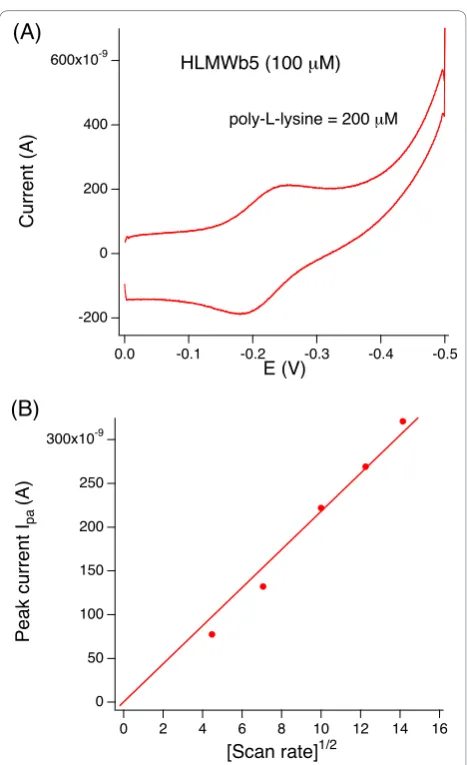
poly-L-lysine. Without poly-L-lysine, there was no peak cur-rent. At least 50 μM of poly-L-lysine was required to observe a stable peak current (data not shown). In Fig-ure 3A, a typical voltammogram for HLMWb5 in the
presence of 200 μM of poly-L-lysine is shown. A plot of the square root of the scan rate vs. peak current (Ipa) (or Ipc, result not shown) was linear for scan rates
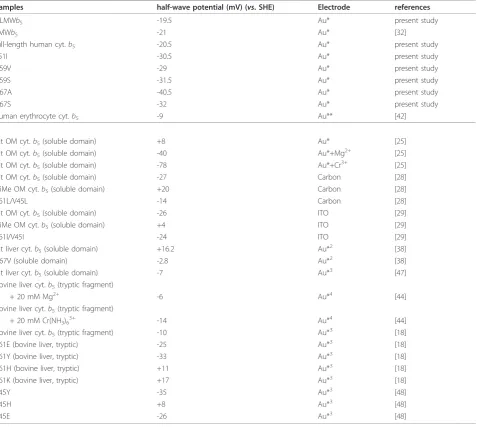
up to and greater than 200 mV/sec (Figure 3B), indi-cating a diffusion-controlled reaction. The half-wave potential (corresponding to the midpoint potential) was estimated as -19.5 mV (vs. SHE), which was close to the values for the full-length human cytochrome b5 (a)HLMWb5
Magnetic Field (T) (b)A59V
(c)A59S
(d)G67A
(e)G67S
(f)L51I
0.2 0.3 0.4 0.5
15K gy=2.22
gy=2.20
gz=3.03
gz=3.04
gz=3.06
Figure 2X-band EPR spectrum of oxidized HLMWb5measured
at 15K and effects of the mutations on the spectrum. Following samples in oxidized form in 50 mM sodium phosphate buffer pH 7.0 were frozen at 77K and their respective EPR spectrum was measured at 15K. HLMWb5(tracea, 0.50 mM); A59V (traceb, 0.12
mM); A59 S (tracec, 0.19 mM); G67A (traced, 0.20 mM); G67 S (tracee, 0.24 mM), and L51I (tracef, 0.27 mM). Ordinate of each spectrum was normalized appropriately based on the concentration for an easier visualization. Other conditions are described in the text. The signal around g = 2 in G67A mutant (d) was due to a contaminant from EPR tube.
600x10-9
400
200
0
-200
Current (A)
-0.5 -0.4 -0.3 -0.2 -0.1 0.0
E (V) HLMWb5 (100 μM)
poly-L-lysine = 200 μM
300x10-9
250
200
150
100
50
0
Peak current I
pa
(A)
16 14 12 10 8 6 4 2 0
[Scan rate]1/2
(A)
(B)
Figure 3Cyclic voltammogram of HLMWb5in 50 mM sodium
phosphate buffer pH 7.0. (PanelA) The gold electrode was modified withb-mercaptopropionic acid and the voltammogram of HLMWb5(100μM (final) in 50 mM sodium phosphate buffer pH 7.0)
(-20.5 mV) and LMWb5 without the 6xHis-tag moiety
(-21 mV) [32] and for bovine liver cytochrome b5
(-6 mV, -14 mV) [44] measured under similar experi-mental conditions (Table 1). These results indicated that presence of 6xHis-tag moiety or COOH-terminal hydrophobic transmembrane segment does not affect significantly on the redox properties of the hydrophilic heme-binding domain of HLMWb5. However, it must
be noted that, in the case of full-length human
cytochromeb5 (-20.5 mV), we observed relatively large
peak separation values and, more significantly, the plot of the square root of the scan rate vs. peak current was not clearly linear. This might be due to the pre-sence of detergent Triton X-100 (0.5~1.0%), which may interfere the smooth diffusion of cytochrome b5
molecules at the electrode surface by forming micelles with the COOH-terminal hydrophobic segments incorporated.
Table 1 Half-wave potentials of HLMWb5and its site-specific mutants in comparison with various animal cytochrome
b5and their site-specific mutants.
Samples half-wave potential (mV) (vs. SHE) Electrode references
HLMWb5 -19.5 Au* present study
LMWb5 -21 Au* [32]
full-length human cyt.b5 -20.5 Au* present study
L51I -30.5 Au* present study
A59V -29 Au* present study
A59S -31.5 Au* present study
G67A -40.5 Au* present study
G67S -32 Au* present study
human erythrocyte cyt.b5 -9 Au** [42]
rat OM cyt.b5(soluble domain) +8 Au* [25]
rat OM cyt.b5(soluble domain) -40 Au*+Mg2+ [25]
rat OM cyt.b5(soluble domain) -78 Au*+Cr3+ [25]
rat OM cyt.b5(soluble domain) -27 Carbon [28]
DiMe OM cyt.b5(soluble domain) +20 Carbon [28]
V61L/V45L -14 Carbon [28]
rat OM cyt.b5(soluble domain) -26 ITO [29]
DiMe OM cyt.b5(soluble domain) +4 ITO [29]
V61I/V45I -24 ITO [29]
rat liver cyt.b5(soluble domain) +16.2 Au*2 [38]
A67V (soluble domain) -2.8 Au*2 [38]
rat liver cyt.b5(soluble domain) -7 Au*3 [47]
bovine liver cyt.b5(tryptic fragment)
+ 20 mM Mg2+ -6 Au*4 [44]
bovine liver cyt.b5(tryptic fragment)
+ 20 mM Cr(NH3)63+ -14 Au*4 [44]
bovine liver cyt.b5(tryptic fragment) -10 Au*3 [18]
V61E (bovine liver, tryptic) -25 Au*3 [18]
V61Y (bovine liver, tryptic) -33 Au*3 [18]
V61H (bovine liver, tryptic) +11 Au*3 [18]
V61K (bovine liver, tryptic) +17 Au*3 [18]
V45Y -35 Au*3 [48]
V45H +8 Au*3 [48]
V45E -26 Au*3 [48]
The half-wave potentials (E1/2) were measured from respective cyclic voltammogram using various electrodes pre-treated as indicated. Au*, gold-electrode modified withb-mercaptopropionic acid + poly-L-lysine (200μM) carbon, DDAB-modified glassy carbon electrode ITO, indium-doped tin oxide electrode + poly-L-lysine (200μM)
Au**, gold-electrode modified with KCTCCA peptide Au*2
, gold-electrode modified with HO(CH2)4SH Au*3
, gold-electrode modified with cysteine Au*4
As noted previously, the voltammetric response of outer mitochondrial membrane (OM) cytochrome b5
measured by the Au electrode pre-treated with 3-mer-captopropionic acid (or similar thiol-containing reagents) were very dependent on the concentration of multivalent ions in the sample solution [25]. It was pos-tulated that multivalent cations could bind to the pro-tein surface and to the electrode surface simultaneously and allow the negatively charged protein to approach the negatively charged electrode [25]. This phenomenon was termed as “ion gating” [45]. Therefore, we con-ducted detailed analyses concerning the dependency of half-wave potential (E1/2) of HLMWb5 on the
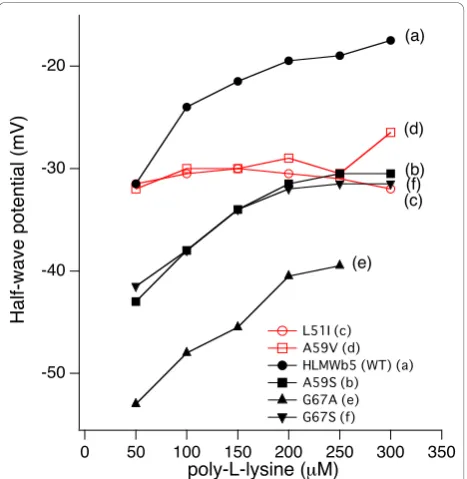
concen-tration of poly-L-lysine in a range of 50~300 μM (Fig-ure 4). Results showed that half-wave potential (E1/2)
shifted in the positive direction as the concentration of poly-L-lysine increased and, around 200μM of poly-L-lysine, it reached a plateau with a value about -20 mV (Figure 4 line (a)).
Rivera et al. reported that the electron transfer between the negatively charged electrode and the nega-tively charged OM cytochromeb5was promoted by the
addition of Mg2+ or Ca2+, instead of poly-L-lysine [25]. However, in the present study, we could not observe any effects of Mg2+ or Ca2+ (~20 mM) to produce a
reversible cyclic voltammogram of HLMWb5; rather it
caused a precipitation of the protein in the sample solu-tion. Therefore, we did not pursue further on the effects of these cations on the cyclic voltammogram in the pre-sent study.
We, then, measured the cyclic volatmmogram for the five site-specific mutants (L51I, A59V, A59 S, G67A, G67S) in the presence of poly-L-lysine in different con-centrations (50~300 μM) and the apparent half-wave potentials (E1/2) were calculated (Figure 4; Table 1).
A typical result for the A59 S mutant is shown in Figure 4 line (b). In this case, half-wave potential shifted posi-tively as the concentration of poly-L-lysine increased and, at 200 μM of poly-L-lysine, it reached a plateau as observed for wild-type HLMWb5 (Figure 4 line (a)). The
maximum value was around -30 mV. Similar concentra-tion dependency was also observed for the G67 S and G67A mutants (Figure 4 lines (e) and (f)), although the G67A mutant showed a significant negative shift in its half-wave potentials (Figure 4 line (e)). It is noteworthy that the concentration required to reach a plateau was around 200μM in most of the samples measured in the present study. This value was consistent with the pre-vious proposal for the formation of the OM cytochrome
b5-poly-L-lysine complex (1:2) [25]. However, for the
L51I and A59V mutants, dependency of the half-wave potential on the poly-L-lysine concentration was not observed (Figure 4 lines (c) and (d)). In these two mutants, the half-wave potential was around -30 mV irrespective of the concentration of poly-L-lysine (Figure 4 lines (c) and (d)).
Spectroscopic electrochemical titrations of HLMWb5
and its mutants
Spectroscopic redox behavior of HLMWb5 (Figure 5)
showed a good agreement between the points obtained during reductive and oxidative titrations (Figure 5; solid circles for the reductive phase and × for the oxidative phase). The apparent midpoint potentials were esti-mated to be around 0 mV at pH = 7.0. Least square fit-ting analysis using the Nernst equation with a single redox component showed the midpoint potential as -3.2 mV (Figure 5; a solid curve fitted for solid circles), con-sistent with a previous report on human erythrocyte cytochrome b5 (-2 mV) determined by a similar method
[46]. We also measured the midpoint potential for the full-length form of human cytochrome b5 (under an
identical buffer condition but in the presence of 0.5% (v/v) Triton X-100) and found it as -2.6 mV (data not shown). This result confirmed that presence of 6xHis-tag sequence (20 aa) at the NH2-terminal region or
COOH-terminal hydrophobic transmembrane segment does not affect significantly on the redox properties of the hydrophilic heme-binding domain of HLMWb5. -50
-40 -30 -20
Half-wave potential (mV)
350 300 250 200 150 100 50 0
poly-L-lysine (μM)
(a)
(b)
(c) (d)
(f)
(e)
Figure 4 Dependency of the half-wave potential (E1/2) of
HLMWb5, A59 S, A59V, L51I, G67A, and G67 S mutants on the
concentration of poly-L-lysine. Titration was conducted using the gold electrode modified withb-mercaptopropionic acid and the scan rate was maintained at 100 mV/sec. The peak to peak separation of the cyclic volatmmograms throughout the titration was around 67 mV. Line (a), HLMWb5(WT); line (b), A59 S, line (c),
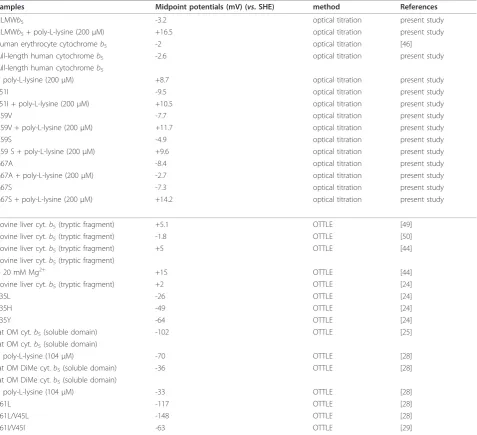
Midpoint potentials of the site-specific mutants were obtained similarly. The values were tabulated in Table 2. The lowest value was found for the L51I mutant; but all the midpoint potentials were found within a relatively narrow range of 7 mV difference. This fact indicated that the site-specific mutations introduced in the pre-sent study did not affect significantly on their static redox properties.
In the next stage, we examined the effect of addition of poly-L-lysine (final 200μM) on the redox potentials of HLMWb5and its site-specific mutants determined by
a static equilibrium method. In the case of HLMWb5,
the effect was evident (Figure 5B; solid squares for the
reductive phase and + for the oxidative phase). The least square fitting analysis using the Nernst equation with a single redox component showed that the addition of poly-L-lysine caused a positive shift of its midpoint potential by ~20 mV (from -3.2 mV to +16.5 mV). Simi-lar positive shifts of the midpoint potential upon addi-tion of poly-L-lysine were found for all the samples examined in the present study including the full-length cytochromeb5 and five site-specific mutants (Table 2).
It is noteworthy that the shifts were close to +20 mV except for the G67A mutant.
Discussion
Relative importance and roles of the three conserved residues
Three conserved hydrophobic amino acid residues (Leu51, Ala59, and Gly67) consisting of the heme-bind-ing pocket of cytochrome b5 were not investigated in
the past, despite of their relatively high conservation among the cytochrome b5 protein family (Figure 1A).
The most significant effect of the mutation was observed for the L51T mutant, in which the heme-pocket moiety might be perturbed significantly and would not be suitable for the accommodation of a heme prosthetic group, leading to an apo-form (or a dena-tured form) when expressed inE. coli cells. Introduction of a hydrophilic Thr residue in the bottom of the hydro-phobic heme-pocket might be too harsh to maintain the original native structure, suggesting the critical role of this hydrophobic residue (Figure 1B). Our computer modeling study indicated that the L51T mutant would have a larger cavity in the heme pocket above the heme plane, being consistent with this view (see Fig. S1(A and B); additional file 1). On the other hand, introduction of a Ser (or Ala) residue by replacing Gly67 residue did not cause such an effect within the heme-pocket, indi-cating that a hydrophilic residue at the entrance of the pocket might be tolerable and, therefore, did not cause significant influences (Figure 1B). Results of the compu-ter modeling study were consistent with this view (see Fig. S1(A and C); additional file 1). Ala59 residue resides in the lowest bottom of the heme pocket. The computer modeling study indicated that substitution with Ser (or Val) did not cause any substantial change in the heme pocket as well. EPR spectra of the oxidized forms of these mutants (except for the L51T) showed, indeed, similar spectra with that of HLMWb5 (Figure 2).
How-ever, only for the G67A mutant, its EPR spectrum indi-cated a slight but distinct perturbation (gz= 3.06, gy=
2.20) (Figure 2), suggesting some important role(s) of Gly67 residue as an adjacent one to the axial His68 resi-due. As a whole, these observations indicated that the three conserved hydrophobic amino acid residues (Leu51, Ala59, and Gly67) were not particularly
2.5
2.0
1.5
1.0
0.5
0.0
Absorbance
700 650 600 550 500 450 400
Wavelength (nm)
HLMWb5 (WT)
100
80
60
40
20
0
Reduced (%)
400 200
0 -200
Redox potential (mV) HLMWb5 (WT) (A)
(B)
Figure 5Midpoint potential measurement of HLMWb5with
spectroelectrochemical titration. Spectroelectrochemical titration was conducted by recording the absorption spectrum of HLMWb5
important in having direct interactions with the heme prosthetic group but were very important for maintain-ing the hydrophobic and structurally-organized environ-ments around the heme prosthetic group. It might be noteworthy that naturally occurring human cytochrome
b5T60A mutant [12] displayed an enhanced
susceptibil-ity to proteolytic degradation, indicating the destabilized structure around its heme pocket.
Cyclic voltammetry of cytochromeb5
In our present study, we observed a just reverse phe-nomenon reported for OM cytochrome b5 [25], in
which the half-wave potential was about 110 mV higher than the midpoint potential determined by the equili-brating method (Table 1 &2). In our present case, the half-wave potential of HLMWb5 (-19.5 mV; in the
pre-sence of 200 μM of poly-L-lysine) was about 16 mV lower than the midpoint potential measured by an equi-librium method (-3.2 mV) (Table 1 &2), although the half-wave potential itself showed a positive shift as the concentration of poly-L-lysine was increased, as found for OM cytochrome b5 [25], reaching the plateau of
-17.5 mV. A similar redox behavior to our HLMWb5
was reported previously for bovine liver cytochrome b5
Table 2 Midpoint potentials of human and bovine cytochromeb5and its site-specific mutants.
Samples Midpoint potentials (mV) (vs. SHE) method References
HLMWb5 -3.2 optical titration present study
HLMWb5+ poly-L-lysine (200μM) +16.5 optical titration present study
human erythrocyte cytochromeb5 -2 optical titration [46]
full-length human cytochromeb5 -2.6 optical titration present study
full-length human cytochromeb5
+ poly-L-lysine (200μM) +8.7 optical titration present study
L51I -9.5 optical titration present study
L51I + poly-L-lysine (200μM) +10.5 optical titration present study
A59V -7.7 optical titration present study
A59V + poly-L-lysine (200μM) +11.7 optical titration present study
A59S -4.9 optical titration present study
A59 S + poly-L-lysine (200μM) +9.6 optical titration present study
G67A -8.4 optical titration present study
G67A + poly-L-lysine (200μM) -2.7 optical titration present study
G67S -7.3 optical titration present study
G67S + poly-L-lysine (200μM) +14.2 optical titration present study
bovine liver cyt.b5(tryptic fragment) +5.1 OTTLE [49]
bovine liver cyt.b5(tryptic fragment) -1.8 OTTLE [50]
bovine liver cyt.b5(tryptic fragment) +5 OTTLE [44]
bovine liver cyt.b5(tryptic fragment)
+ 20 mM Mg2+ +15 OTTLE [44]
bovine liver cyt.b5(tryptic fragment) +2 OTTLE [24]
F35L -26 OTTLE [24]
F35H -49 OTTLE [24]
F35Y -64 OTTLE [24]
rat OM cyt.b5(soluble domain) -102 OTTLE [25]
rat OM cyt.b5(soluble domain)
+ poly-L-lysine (104μM) -70 OTTLE [28]
rat OM DiMe cyt.b5(soluble domain) -36 OTTLE [28]
rat OM DiMe cyt.b5(soluble domain)
+ poly-L-lysine (104μM) -33 OTTLE [28]
V61L -117 OTTLE [28]
V61L/V45L -148 OTTLE [28]
V61I/V45I -63 OTTLE [29]
Midpoint potentials of human cytochromeb5(HLMWb5) and its mutants were estimated for the redox titration data obtained in the absence or presence of poly-L-lysine by a least-square curve fitting using the Nernst equation with assuming a single redox component. For a comparative purpose, midpoint potentials for the tryptic fragment of bovine liver cytochromeb5and OM cytochromeb5obtained by OTTLE method were presented.
tryptic fragment, in which midpoint potential deter-mined by the equilibrating method (in the presence of 20 mM Mg2+) showed +15 mV, whereas the half-wave potential under a similar condition was -6 mV, leading to a negative shift of -21 mV (Table 1 &2) [44].
The difference between the half-wave potential and midpoint potential determined by the equilibrating method observed for bovine liver cytochromeb5tryptic
fragment was ascribed to the different surface properties of the electrodes used [44]. Following the proposal by
Wanget al. [44], our present results can be explained
reasonably. In the cyclic voltammetry, poly-L-lysine binds simultaneously with the protein moiety and the carboxy group ofb-mercaptopropionic acid on the sur-face of the electrode. In the spectroscopic equilibrating method, poly-L-lysine binds only to the protein and the electron transfer occurs directly between the electrode and the protein. Therefore, in the cyclic voltammetry, the interaction of poly-L-lysine with the carboxylates of the electrode-coatedb-mercaptopropionic acid decreased its effective density of positive charge and, therefore, the half-wave potential is more negative than those measured by the spectroscopic equilibrating method. Additionally, dehydration of the heme edge by excluding water from the complex interface might also contribute significantly on the positive shift of the half-wave potential [29].
However, the differences between the half-wave poten-tial and midpoint potenpoten-tial determined by the equilibrat-ing method were so much different each other among OM cytochromeb5, human cytochromeb5, and bovine
liver cytochromeb5. This fact suggested that the exact
mechanism for determining the redox potential is very complex. Reality might exist between the two simplified possibilities. The gross tertiary structures around the heme moiety would be conserved well among OM cyto-chromeb5, human cytochromeb5, and bovine liver
cyto-chrome b5 (Figure 1B and 1C) and, therefore, the
distributions of acidic residues on the surface of the heme domain are also well conserved (Figure 1A and 1C). Therefore, the proposed scheme for the formation of the complex between OM cytochromeb5and
poly-L-lysine occurs on the protein surface of HLMWb5
deli-neated by the exposed heme propionate and correspond-ing acidic residues (Glu49, Glu53, Glu61, and Asp65) as well. Therefore, slight conformational differences around the heme propionate group would be a very important factor for controlling the heme redox potentials.
Effects of site-specific mutations within the heme pocket on the cyclic voltammetry
Other factor(s) important for the regulation of heme redox potential is the hydrophobicity around the heme pocket [29]. To evaluate such a hydrophobic effect within the heme pocket on the redox potential, we
produced five site-specific mutants in expecting to have different modulations on the hydrophobicity. However, the midpoint potentials for these mutants showed only slight variations ranging from -5 to -9 mV. This result might be consistent with the results of our computer modeling study, which indicated that the site-specific mutants did not cause any substantial changes in the heme pocket except for the L51T mutant (see Fig. S1(A and B); additional file 1).
On the other hand, the half-wave potentials for these mutants showed a much larger variation (-29~-43 mV) and a more negative value than that of HLMWb5(-19.5
mV). More interestingly, the half-wave potentials for these mutants were categorized into two groups, one showing clear dependency on the poly-L-lysine concen-tration (HLMWb5, A59 S, G67A, and G67S), and the
other showing independency on the poly-L-lysine con-centration (L51I and A59V) (Figure 4). The curvature of the titration curves for those showing the dependency on the poly-L-lysine concentration was somewhat simi-lar each other (Figure 4), indicating a simisimi-lar mechanism for controlling the redox potential being operative within those. Therefore, for these mutants, very similar interactions between poly-L-lysine and the protein sur-face of HLMWb5 delineated by the exposed heme
pro-pionate and the acidic residues (Glu49, Glu53, Glu61, and Asp65) (Figure 1C) might occur, as proposed ori-ginally for rat OM cytochrome b5. Following this
sce-nario, one may argue that the large variation in the half-wave potential might be ascribed to the difference in the dehydration around the heme moiety upon the complex formation with poly-L-lysine [29]. On the other hand, the mutants showing an independency on the poly-L-lysine concentration (i.e., L51I and A59V) might be reflecting the difference in microenvironment around the heme propionate group itself caused by the slight change in the heme cavity structure. Alternatively, since both Leu51 and Ala59 locate in the bottom of the heme cavity (Figure 1B), slight conformational change upon the mutations might propagate to the local negative sur-face structure around Glu49, Glu53, Glu61, and Asp65 (Figure 1C), resulting in the independency on the poly-L-lysine concentration. However, our computer model-ing study did not support any of these possibilities, indicating the limitation of this kind of modeling study.
One may argue about the cause of the significant nega-tive shift in the half-wave potential of the G67A mutant (Figure 4 line (e); Table 1). The likely explanation for the negative shift would be a change in the hydrophobicity within the heme-pocket. But we should not exclude the possibility of a slight structural change caused by the replacement. Indeed, the G67A mutant showed a distinct negative value compared to HLMWb5 in the midpoint
G67 S mutant, that might be expected to cause just a reverse of the G67A mutant, actually showed an inter-mediate value between those of HLMWb5and the G67A
mutant. Therefore, the significant negative shift would be caused not only by changes in the hydrophobicity but by other factors including changes in the heme coordination (as evidenced by the slight shifts of g-values in its EPR spectrum) (Figure 2 traced). Further, the binding mode of poly-L-lysine itself might be altered due to a slight change in local negative surface structure, resulting in lowering of the dehydration effect upon the complex for-mation at the heme edge [29].
Correlations between the half-wave potential and midpoint potential
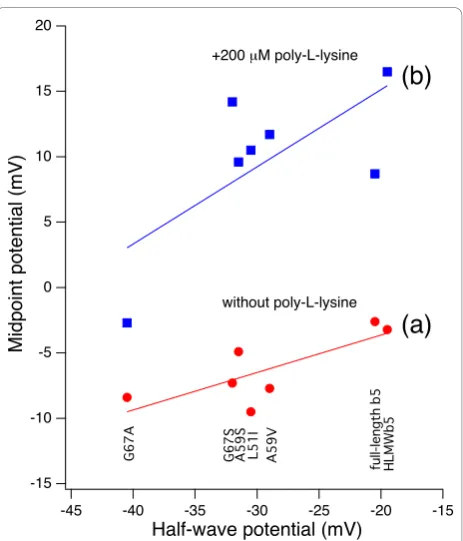
Interestingly, when the midpoint potential measured in the absence of poly-L-lysine was plotted against the half-wave potential for each of HLMWb5 and mutants,
there was a good correlation between these two values (Figure 6 line a), in which the former were always 16~32 mV more positive than the latter. When the mid-point potential measured in the presence of poly-L-lysine (200μM) was plotted against the half-wave poten-tial similarly, there was a good correlation as well, in which the midpoint potential values were further up-shifted by 10~20 mV (Figure 6 line b). This fact sug-gested that both the binding of poly-L-lysine and the changes of the hydrophobicity around the heme moiety (both within the heme-pocket and the exposed heme edge) regulate the half-wave potential of cytochromeb5
and that the overall redox potentials were modulated by both factors in similar extents.
Conclusions
Present study showed that simultaneous measurements of the midpoint potential and the half-wave potential could be a good evaluating methodology for the analyses of static and dynamic redox properties of various hemoproteins, including cytochromeb5, if we took them with an
appro-priate precaution. In the actual biological electron transfer, the reduction potential of cytochromeb5might be
modu-lated differently upon the formation of a transient complex with a partner protein (cytochromec, hemoglobin, or cytochrome b5reductase). The modulations might be
mediated by a gross conformational change in the tertiary structure, by a slight change(s) in the local structure including surface charges, or by the change(s) in the hydrophobicity around the heme moiety (both within the heme-pocket and the exposed heme edge), as found for the interaction with poly-L-lysine. Therefore, the system consisting of cytochromeb5 and its partner protein(s) or
small peptide(s) might be a good paradigm for the study of biological electron transfer reactions.
List of abbreviations used
Abbreviations used are: LMWb5: human liver microsomal cytochromeb5
soluble domain (amino acid residues from Met1 to Leu99); HLMWb5: human
liver microsomal cytochromeb5soluble domain with an additional
extension of the sequence of MGSSHHHHHHSSGLVPRGSH at the NH2
-terminus of the LMWb5protein; EPR: electron paramagnetic resonance; OM:
outer mitochondrial membrane; MALDI-TOF: matrix-assisted laser desorption ionization-time of flight; SHE: standard hydrogen electrode.
Additional material
Additional file 1: Results of Computer Modeling Study. A computer modeling study for the three-dimensional structure of human cytochromeb5using the coordinate of an NMR solution structure (PDB
code: 2I96; model 1) 20
15
10
5
0
-5
-10
-15
Midpoint potential
(mV
)
-45 -40 -35 -30 -25 -20 -15
Half-wave potential (mV)
+200 μM poly-L-lysine
without poly-L-lysine
(a)
(b)
Figure 6Correlations between the midpoint potential and half-wave potential (E1/2) for HLMWb5and its site-specific
mutants. The half-wave potentials (E1/2) were measured at a gold
Acknowledgements
This work was supported by Grants-in-Aid for Scientific Research on Priority Areas (System Cell Engineering by Multi-scale Manipulation; 18048030 and 20034034 to M.T.) from the Japanese Ministry of Education, Science, Sports and Culture and by Grant-in-Aid for Scientific Research (C) (22570142 to M. T.) from Japan Society for the Promotion of Science. We thank Dr. Park (Yokohama City University, Kanagawa, Japan) for helping us to perform the computer modeling study on cytochromeb5mutants.
Author details
1Department of Chemistry, Graduate School of Science, Kobe University, 1-1
Rokkodai-cho, Nada-ku, Kobe, Hyogo 657-8501, Japan.2Department of Pharmacy, College of Pharmaceutical Sciences, Ritsumeikan University, Kusatsu, Shiga 525-8577, Japan.3Center for Quantum Science and
Technology under Extreme Conditions, Osaka University, 1-3 Machikaneyama-cho, Toyonaka, Osaka 560-8531, Japan.
Authors’contributions
This study was designed and supervised by FT and MT. Experiments were performed by AT and YS. Analysis of the data was performed by AT, YS, MM and MT. EPR experiments and the data analysis were performed by HH. MT drafted the manuscript and all authors read and approved the final version.
Competing interests
The authors declare that they have no competing interests. Received: 26 August 2010 Accepted: 4 December 2010 Published: 4 December 2010
References
1. Kawano T, Kozutsumi Y, Kawasaki T, Suzuki A:Biosynthesis ofN -glycolylneuraminic acid-containing glycoconjugates. Purification and characterization of the enzyme of the cytidine monophospho-N -acetylneuraminic acid hydroxylation system.J Biol Chem1994, 269:9024-9029.
2. Schenkman JB, Jansson I:The many roles of cytochromeb5.Pharm Therap 2003,97:139-152.
3. Cho HP, Nakamura MT, Clarke SD:Cloning, expression, and nutritional regulation of the mammalianΔ-6 desaturase.J Biol Chem1999, 274:471-477.
4. Paltauf F, Prough RA, Masters BSS, Johnston JM:Evidence for the participation of cytochromeb5in plasmalogen biosynthesis.J Biol Chem 1974,249:2661-2662.
5. Fukushima H, Grinstead GF, Gaylor JL:Total enzymic synthesis of cholesterol from lanosterol. Cytochromeb5-dependence of 4-methyl sterol oxidase.J Biol Chem1981,256:4822-4826.
6. Vergères G, Waskell L:Cytochromeb5, its functions, structure and membrane topology.Biochimie1995,77:604-620.
7. Guiard B, Groudinsky O, Lederer F:Homology between bakers’yeast cytochromeb2and liver microsomal cytochromeb5.Proc Natl Acad Sci USA1974,71:2539-2543.
8. Guiard B, Lederer F:The“b5-like”domain from chicken-liver sulfite oxidase: a new case of common ancestral origin with liver cytochrome
b5and bakers’yeast cytochromeb2core.Eur J Biochem1977,74:181-190. 9. Napier JA, Sayanova O, Stobart AK, Shewry PR:A new class of cytochrome
b5fusion proteins.Biochem J1997,328:717-720.
10. Dunn TM, Haak D, Monaghan E, Beeler TJ:Synthesis of monohydroxylated inositolphosphorylceramide (IPC-C) in Saccharomyces cerevisiae requires Scs7p, a protein with both a cytochromeb5-like domain and a hydroxylase/desaturase domain.Yeast1998,14:311-321.
11. Lu G, Lindqvist Y, Schneider G, Dwivedi U, Campbell W:Structural studies on corn nitrate reductase: Refined structure of the cytochromeb5 reductase fragment at 2.5 Å, its ADP complex and an active-ste mutant and modeling of the cytochromebdomain.J Mol Biol1995,248:931-948. 12. Kurian JR, Longlais BJ, Trepanier LA:Discovery and characterization of a
cytochromeb5variant in humans with impaired hydroxylamine reduction capacity.Pharmaco Genom2007,17:597-603. 13. Steggles AW, Kaftory A, Giordano SJ:The analysis of type IV
methemoglobinemia. Identification of a patient lacking cytochromeb5. Am J Hum Genet1992,51:A177.
14. Giordano SJ, Kaftory A, Steggles AW:A splicing mutation in the cytochrome bs gene from a patient with congenital
methemoglobinemia and pseudohermaphrodism.Hum Genet1994, 93:568-570.
15. Finn RD, McLaughlin LA, Hughes C, Song C, Henderson CJ, Wolf CR: Cytochromeb5null mouse: a new model for studying inherited skin disorders and the role of unsaturated fatty acids in normal homeostasis. Transgenic Res2010.
16. Banci L, Bertini I, Ferroni F, Rosato A:Solution structure of reduced microsomal rat cytochromeb5.Eur J Biochem1997,249:270-279. 17. Lederer F:The cytochromeb5-fold: An adaptable module.Biochimie1994,
76:674-692.
18. Xue L-L, Wang Y-H, Xie Y, Yao P, Wang W-H, Qian W, Huang Z-X:Effect of mutation at valine 61 on the three-dimensional structure, stability, and redox potential of cytochromeb5.Biochemistry1999,38:11961-11972. 19. Yao P, Wu J, Wang Y-H, Sun B-Y, Xia Z-X, Huang Z-X:X-ray crystallography,
CD and kinetic studies revealed the essence of the abnormal behaviors of the cytochromeb5Phe35–> Tyr mutant.Eur J Biochem2002, 269:4287-4296.
20. Cao C, Zhang Q, Xue L-L, Ma J, Wang Y-H, Wu H, Huang Z-X:The solution structure of the oxidized bovine microsomal cytochromeb5mutant V61H.Biochem Biophys Res Commun2003,307:600-609.
21. Sarma S, Dangi B, yan C, DiGate RJ, Banville DL, Guiles RD:Characterization of a site-directed mutant of cytochromeb5designed to alter axial imidazole ligand plane orientation.Biochemistry1997,36:5645-5657. 22. Sun Y-L, Wang Y-H, Yan M-M, Sun B-Y, Xie Y, Huang Z-X, Jiang S-k, Wu H-M:
Structure, interaction and electron transfer between cytochromeb5, its E44A and/or E56A mutants and cytochromec.J Mol Biol1999, 285:347-359.
23. Cao C, Zhang Q, Wang Z-Q, Wang Y-F, Wang Y-H, Wu H, Huang Z-X:1H NMR studies of the effect of mutation at Valine45 on heme microenvironment of cytochromeb5.Biochimie2003,85:1007-1016. 24. Yao P, Xie Y, Wang Y-H, Sun Y-L, Huang Z-X, Xiao G-T, Wang S-D:
Importance of a conserved phenylalanine-35 of cytochromeb5to the protein’s stability and redox potential.Protein Eng1997,10:575-581. 25. Rivera M, Wells MA, Walker FA:Cation-promoted cyclic voltammetry of
recombinant rat outer mitochondrial membrane cytochromeb5at a gold electrode modified withβ-mercaptopropionic acid.Biochemistry 1994,33:2161-2170.
26. Glenn JDH, Bowden EF:Diffusionless electrochemistry of cytochromeb5 adsorbed on a multilayer film electrode.Chem Lett1996,25:399-400. 27. Bagby S, Barker PD, Di Gleria K, Hill HAO, Lowe VJ:The direct
electrochemistry of cytochromeb5at peptide-modified electrodes. Biochem Soc Trans1988,16:958-959.
28. Rivera M, Seetharaman R, Girdhar D, Wirtz M, Zhang X, Wang X, White S: The reduction potential of cytochromeb5is modulated by its exposed heme edge.Biochemistry1998,37:1485-1494.
29. Wirtz M, Oganesyan V, Zhang X, Studera J, Rivera M:Modulation of redox potential in electron transfer proteins: Effects of complex formation on the active site microenvironment of cytochromeb5.Faraday Discuss2000, 116:221-234.
30. Cooper MT, Porter TD:Cytochromeb5coexpression increases the CYP2E1-dependent mutagenicity of dialkylnitrosamines in
methyltransferase-deficient strains ofSalmonella typhimurium.Mutat Res 2001,484:61-68.
31. Mokashi V, Li L, Porter TD:Cytochromeb5reductase and cytochromeb5 support the CYP2E1-mediated activation of nitrosamines in a recombinant Ames test.Arch Biochem Biophys2003,412:147-152. 32. Nakanishi N, Takeuchi F, Okamoto H, Tamura A, Hori H, Tsubaki M:
Characterization of heme-coordinating histidyl residues of cytochrome
b5based on the reactivity with diethylpyrocarbonate: A mechanism for the opening of axial imidazole rings.J Biochem2006,140:561-571. 33. Hamada J, Nakanishi N, Takeuchi F, Park S-Y, Tsubaki M:Interaction of
tail-anchored proteins with liposomes in different cholesterol content; Initial steps for the fabrication of artificial neuroendocrine vesicles.International Symposium on Micro-NanoMechatronics and Human Science Symposium “Micro- and Nano-Mechatronics for Information-Based Society”, The 21st Century COE Program2006, 1-6.
35. Markwell MAK, Haas SM, Tolbert NE, Bieber LL:Protein determination in membrane and lipoprotein sampled: Manual and automated procedures.Methods Enzymol1981,72:296-303.
36. Dutton PL:Redox potentiometry: Determination of midpoint potentials of oxidation-reduction components of biological electron-transfer systems.Methods Enzymol1978,54:411-435.
37. Takeuchi F, Kobayashi K, Tagawa S, Tsubaki M:Ascorbate inhibits the carbethoxylation of two histidyl and one tyrosyl residues indispensable for the transmembrane electron transfer reaction of cytochromeb561. Biochemistry2001,40:4067-4076.
38. Sarma S, DiGate RJ, Goodin DB, Miller CJ, Guiles RD:Effect of axial ligand plane reorientation on electronic and electrochemical properties observed in the A67V mutant of rat cytochromeb5.Biochemistry1997, 36:5658-5668.
39. Rivera M, Barillas-Mury C, Christensen KA, Little JW, Wells MA, Walker FA: Gene synthesis, bacterial expression, and1H NMR spectroscopic studies of the rat outer mitochondrial membrane cytochromeb5.Biochemistry 1992,31:12233-12240.
40. Ikeda M, Iizuka T, Takao H, Hagihara B:Studies on the heme environment of oxidized cytochromeb5.Biochim Biophys Acta1974,336:15-24. 41. Passon PG, Reed DW, Hultquist DE:Soluble cytochromeb5from human
erythrocytes.Biochim Biophys Acta1972,275:51-62.
42. Lloyd E, Ferrer JC, Funk WD, Mauk MR, Mauk AG:Recombinant human erythrocyte cytochromeb5.Biochemistry1994,33:11432-11437. 43. Guzov VM, Houston HL, Murataliev MB, Walker FA, Feyereisen R:Molecular
cloning, overexpression inEscherichia coli, structural and functional characterization of house fly cytochromeb5.J Biol Chem1996, 271:26637-26645.
44. Wang Y-H, Cui J, Sun Y-L, Yao P, Zhuang J-H, Xie Y, Huang Z-X:The direct electrochemistry of cytochromeb5and its mutant proteins.J Electroanal Chem1997,428:39-45.
45. Takehara K, Yamada S, Ide Y:Use of the laser-desorption technique for the preparation of a mixed-thiol monolayer on a gold electrode.J Electroanal Chem1992,333:339-344.
46. Abe K, Sugita Y:Properties of cytochromeb5, and methemoglobin reduction in human erythrocytes.Eur J Biochem1979,101:423-428. 47. Rodgers KK, Sligar SG:Surface electrostatics, reduction potentials, and the
internal dielectric constant of proteins.J Am Chem Soc1991, 113:9419-9421.
48. Wang Z-Q, Wang Y-H, Wang W-H, Xue L-L, Wu X-Z, Xie Y, Huang Z-X:The effect of mutation at valine-45 on the stability and redox potentials of trypsin-cleaved cytochromeb5.Biophys Chem2000,83:3-17.
49. Reid LS, Taniguchi VT, Gray HB, Mauk AG:Oxidation-reduction equilibrium of cytochromeb5.J Am Chem Soc1982,104:7516-7519.
50. Walker FA, Emrick D, Rivera JE, Hanquet BJ, Buttlaire DH:Effect of heme orientation on the reduction potential of cytochromeb5.J Am Chem Soc 1988,110:6234-6240.
doi:10.1186/1423-0127-17-90
Cite this article as:Aonoet al.:Direct electrochemical analyses of human cytochromesb5with a mutated heme pocket showed a good
correlation between their midpoint and half wave potentials.Journal of Biomedical Science201017:90.
Submit your next manuscript to BioMed Central and take full advantage of:
• Convenient online submission
• Thorough peer review
• No space constraints or color figure charges
• Immediate publication on acceptance
• Inclusion in PubMed, CAS, Scopus and Google Scholar
• Research which is freely available for redistribution