SOLID STATE FERMENTATION FOR PRODUCTION OF
CHITOSAN BY ASPERGILLUS NIGER
V. Maghsoodi*
Biochemical and Bioenvironmental Engineering Research Centre Sharif University of Technology, P.O. Box 11365-8691, Tehran, Iran
J. Razavi and S. Yaghmaei
Department of Chemical and Petroleum Engineering Sharif University of Technology, P.O. Box 11365-9465, Tehran, Iran
[email protected] - [email protected]
*Corresponding Author
(Received: March 9, 2008 – Accepted in Revised Form: September 25, 2008)
Abstract The effect of Solid State Fermentation (SSF) on Chitosan production by A. niger was
investigated. A. niger BBRC 20004 from Biochemical and Bioenvironmental Research Centre of
Sharif University of Technology (Tehran, Iran), was grown on corn residue. Chitosan was extracted from the fungal mycelia using hot alkaline and acid treatment. A. niger was incubated for 12 days on
corn residue with moisture content of 35 % and 1.12 % of nitrogen. The Chitosan was obtained and 10.9 g/kg of Urea dry residue was added in various amounts to the medium in order to evaluate the effect of the nitrogen concentration in the production of Chitosan. The highest amount of Chitosan obtained by 6.5 g of urea after 12 days of incubation was 16.15 g/kg.
Keywords Chitosan, A. niger, Corn residue, SSF (Solid State Fermentation), Urea
ﻩﺪﻴﻜﭼ
ﺮﺠﻳﺎﻧ ﺱﻮﻠﻳﮊﺮﭙﺳﺁ ﭺﺭﺎﻗ ﺯﺍ ﻩﺩﺎﻔﺘﺳﺍ ﺎﺑ ﺪﻣﺎﺟ ﺖﻟﺎﺣﺮﻴﻤﺨﺗ ﺮﺛﺍ ٢٠٠٠٤
BBRC ) ﯽﺳﺪﻨﻬﻣ ﺕﺎﻘﻴﻘﺤﺗ ﺰﮐﺮﻣ
ﻒﻳﺮﺷ ﯽﺘﻌﻨﺻ ﻩﺎﮕﺸﻧﺍﺩ ،ﺖﺴﻳﺯ ﻂﻴﺤﻣ ﻝﺮﺘﻨﮐ ﻭ ﯽﻤﻴﺷﻮﻴﺑ (
ﺪﻣﺎﺟ ﯼﺍﺮﺘﺴﺑﻮﺳ ﻥﺍﻮﻨﻋ ﻪﺑ ﺕﺭﺫ ﻪﻟﺎﺠﻨﮔ ﻂﻴﺤﻣ ﯼﻭﺭ ،
ﺖﻓﺮﮔ ﺭﺍﺮﻗ ﯽﺳﺭﺮﺑ ﺩﺭﻮﻣ ﻥﮊﻭﺮﺘﻴﻧ ﯼﻭﺎﺣ .
ﺵﻭﺭ ﻪﺑ ﭺﺭﺎﻗ ﺯﺍ ﻩﺪﻣﺁ ﺖﺳﺪﺑ ﻥﺎﺳﻮﺘﻴﮐ ﺪﻳﺩﺮﮔ ﺝﺍﺮﺨﺘﺳﺍ ﺪﻴﺳﺍﻭ ﺎﻴﻠﻗ
.
ﺖﺑﻮﻃﺭ ﺎﺑ ﺪﻴﻟﻮﺗ ﺭﺍﺪﻘﻣ ﻦﻳﺮﺘﺸﻴﺑ ٣٥
ﻭ ﺪﺻﺭﺩ ١٢
/ ١ ﺖﺸﮐ ﻢﻫﺩﺯﺍﻭﺩ ﺯﻭﺭ ﺭﺩ ﻥﮊﻭﺮﺘﻴﻧ ﺪﺻﺭﺩ ٩
/ ١٠ ﻡﺮﮔ / ﻡﺮﮔﻮﻠﻴﮐ
ﺪﻣﺁ ﺖﺳﺪﺑ ﮏﺸﺧ ﻩﺩﺎﻣ .
ﺪﺷ ﻩﺩﻭﺰﻓﺍ ﺖﺸﮐ ﻂﻴﺤﻣ ﻪﺑ ﻒﻠﺘﺨﻣ ﺮﻳﺩﺎﻘﻣ ﺭﺩ ﯽﻧﮊﻭﺮﺘﻴﻧ ﻊﺒﻨﻣ ﻥﺍﻮﻨﻋ ﻪﺑ ﻩﺭﻭﺍ .
ﻦﻳﺮﺘﺸﻴﺑ
ﺖﺸﮐ ﻢﻫﺩﺯﺍﻭﺩ ﺯﻭﺭ ﺭﺩ ﻥﺎﺳﻮﺘﻴﮐ ﺭﺍﺪﻘﻣ ١٥
/ ١٦ ﻡﺮﮔ / ﺶﻳﺍﺰﻓﺍ ﺎﺑ ﻡﺮﮔ ﻮﻠﻴﮐ ٥
/ ٦ ﺪﻳﺩﺮﮔ ﺪﻴﻟﻮﺗ ﻩﺭﻭﺍ ﻡﺮﮔ .
1. INTRODUCTION
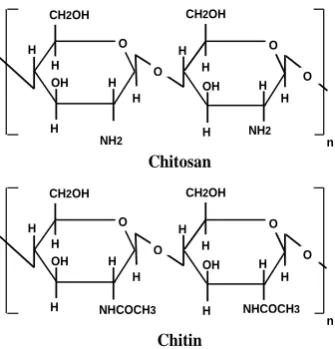
Chitosan, β-(1→4) D-glucosamine, is a partially deacetylated form of Chitin, β-(1→4) N-acetyl-D-glucosamine, by thermo-chemical deacetylation in concentrated sodium hydroxide solution. Figure 1 shows a dimmer of D-glucosamine and Chitin is a polymer of N-acetyl-D-glucosamine [1]. Environmental friendly alternative, Chitin is a substance found naturally in the exoskeletons of insects, shells of crustaceans such as crab, shrimp, crawfish and fungal cell walls. Chitosan is a natural and biodegradable biopolymer. It can be used in a wide range of fields such as biotechnology
also from squids, lobsters and crabs.
Chitin is obtained from the shells by removing calcium carbonate, pigments, proteins and lipids immediately after peeling the shrimps [3,4]. However it has heterogeneous and inconsistent physiochemical properties, since supplies of the seafood wastes are seasonable and variable, new researches have been carried out on the use of alternative sources for Chitosan [5,6]. The studies were focused mainly on Chitosan from fungi. Production and purification of Chitosan from the cell walls of fungi grown under controlled conditions, offer greater potential for more consistent products [6].
The advantage of using fungi is the easy handling, harvesting and controlling to produce high quality Chitosan, however recent advances in fermentation technology suggest that many of these problems concerning conventional methods can be overcome by culturing Chitosan-producing fungi. Fungal biomass can be produced by solid-state fermentation (SSF) and submerged fermentation (SMF). Among various groups of microorganisms used in SSF, the filamentous fungi are most exploited because of their ability to grow on complete solid substrate, which has been reported that the yield of Chitosan using SSF (w/w) is higher than that in SMF (w/v) due to the low amount of mycelia produced in SMF [1,2]. So, there has been considerable interest to produce Chitosan in SSF processes. It has been reported
that Chitosan yield from A. niger TISTR3245 grown on soybean residue with nitrogen content of 0.6 % (moisture 69.9 %, carbohydrate 18.4 %) and mung bean with nitrogen content about 0.002 % (moisture 77.5 %, carbohydrate 21.4 %), respectively reached a maximal value of 2.1 Chitosan (g/kg substrate) at 12 day of inoculation [5]. These findings can express the quality and amount of Chitosan extracted from the fungal mycelia depends on fungal strain, fermentation type, fermentation medium composition and harvesting time [1,2]. Since Chitosan is nitrogen containing biopolymer, so fungi require an inorganic or organic nitrogen source and sugar as nutrient to synthesize the chitin/Chitosan for their cell wall [1].
The purpose of the present work is to use A. niger as a fungal source and corn residue as a media. Also Urea in different concentrations is added to the medium to increase the production of Chitosan.
2. MATERIALS AND METHODS
2.1. Chemical
Potato dextrose agar (PDA), NaOH, and Acetic Acid obtained from Merck Company. Ethanol and acetone used in this study were of commercial grade. Other chemicals used for Macro Kjeldahl distillation (nitrogen test) and Anthrone Colorimetric Method (carbohydrate test) were of analytical or higher grade.2.2. Determination of Nitrogen and
Carbohydrate Content
The Kjeldahl method is a means of determining the nitrogen content of organic and inorganic substances [10]. Anthrone Colorimetric Method used for carbohydrate determination [11].2.3. Microorganism
The fungus strain used in this study was A. niger BBRC 20004, obtained from (Biochemical and Bioenvironmental Research Centre, Sharif University of Technology, Tehran, Iran).2.4. PDA Slants Preparation
Potato Dextrose Agar (PDA) slants were prepared in order to cultivate the selected A. niger BBRC 20004 strain;n
n
Chitosan
Chitin
O
O
O
O CH2OH
H
CH2OH
H H
H H
H
H H
NH2 NH2
OH OH
H H
O
O
O
O CH2OH
H
CH2OH
H H
H H
H
H H
NHCOCH3
OH OH
H H
NHCOCH3
therefore 3.9 gr of PDA powder was continuously dissolved in 100 ml of distilled water in a shaking flask on mild heat until the solution foamed by reaching to its boiling point. Afterwards the amount of 10 ml of prepared PDA solution is distributed into ten tubes, and then the tubes were plugged with cotton wool, covered with aluminium foil. At last the tubes were autoclaved at 121˚C for 20 minutes [12].
2.5. Culture Media
A. niger BBRC 20004 was harvested on 3.9 % Potato Dextrose Agar (PDA) slants at 30˚C for 3 days. The grown microorganism on PDA slant, is cooled and solidified, stored in the refrigerator for use.2.6. Spore Suspension Preparation
Spore suspension was used as an inoculum for residue culture media. A 5-day-old culture of A. niger grown on PDA slant was used to prepare spore suspension for inoculation into the residue media, so, the sterilized serums (9 g/lit NaCl solutions) which was sterilization at 121˚C for 20 minutes previously, were poured into a prepared PDA slant, and after sufficient shaking, it was poured back to the original serum tube. Then spores suspension in the serum tube was completely homogenized by means of tube shaker.After all, the number of spores in suspension was examined for the microscopic spore count with a Neubauer. The spore concentration was adjusted to about 3 × 10⁶ spores/ml by 10 to 20 times dilution.
2.7. Solid Substrate Preparation
Corn residue was supplied for solid culture medium of fermentation. The dry corn residue were examined for moisture, nitrogen, carbohydrate and ash content prior to solid-state fermentation, as shown in Table 1. The initial pH of the corn seed residue was 6.5.With respect to heat transfer restrictions and in order to have a suitable porosity in solid substrate medium of fermentation, 30 g of dry substrate weighed in 500 ml flasks. Since the prepared residues had moisture of 9.5 percent, which was not enough moisture for the growth of fungi; therefore, the substrate moisture was adjusted by adding distilled water. Then those flasks were hand shaken to homogenize the solid mediums and
autoclaved (121°C,20 min). One ml of spore suspension (about 3×10⁶ spores/ml) in sterile condition was inoculated into sterilized flasks and shaken to distribute the spores (The final moisture contents of the flasks before the incubation period were approximately 35 %). The variation of moisture content and pH values were studied according to the previous works [7,17]. The flasks were cotton-plugged and remained static during incubation at pH 6.5 for 4, 8, 12 and 16 days at 30°C. The amount of Chitosan obtained is shown in Figure 2, values are the average of the two replicates ± standard deviation. Shaking can alleviate some of the problems encountered with solid substrate beds. It can improve the
TABLE 1. Composition of Corn seed Residue withpH =
6.5 used in this Research Study (aMean ± SD, N = 3).
Composition g/100g
Substrates
Total Nitrogn Carbohydrate
Ash
Moisture
Corn Seed Residuea
1.12 ± 0.4
8.6 ± 0.18
5.8 ± 0.2
8 ± 0.4
chitosan production from A.niger BBRC20004 in corn residue at 35% moisture pH==6.5
0 2 4 6 8 10 12
4 6 8 10 12 16 Time(days)
C
h
it
os
a
ng/
k
gof
d
ry su
b
s
tr
at
e
accessibility of oxygen to the substrate surface by disrupting aerial fungal hyphae, which grow into and fill up the inter-particle spaces. However, shaking has deleterious effects; espatially shear forces can damage conidiophores, leading to decreased spore production [13], regarding thin layer bed and good oxygen accessibility, flasks remained static.
Urea was added in various amounts to the media. The results are shown (Figure 3-5), values are the average of two replicates ± standard deviation.
2.8. Chitosan Extraction
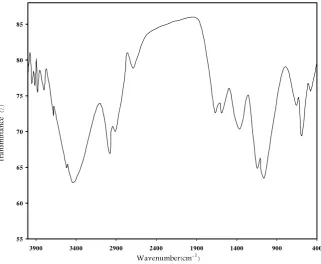
After cultivation, forty parts of 1 N NaOH solution were mixed with 1 part of mycelia (v/w). The alkaline suspension was homogenized [6]. Then the flask containing homogenized black fungal alkali suspension was sterilized at 121°C for 20 minutes (alkali treatment). After that, the alkali insoluble materials (AIM) centrifuged at 6000 rpm, and they were washed with distilled water several times and centrifuged until neutral condition obtained (pH=7). AIMs were dried in an oven at 40°C. Dried alkali insoluble materials were treated with acetic acid 2 % (v/v), as a Chitosan solvent, under reflux condition for 6 hours at 95°C. Afterwards by centrifugation the acid insoluble fraction was precipitated at 6000 rpm for 15-20 min and the supernatant containing the Chitosan was isolated. To precipitate fungal Chitosan, with clear yellowish colour, the pH was adjusted with 2N NaOH solution, and then flocculated Chitosan was centrifuged at 6000 rpm, for 15 min. Isolated Chitosan was washed four to five times with distilled water to neutralise. At the same time ethanol (96 %) and acetone were employed to rinse Chitosan and then it was dried in vacuum oven dryer at 60°C [5,6,9 and 14]. The IR spectra of Chitosan were carried out using the KBr disc method in Unicam Mattson 1000 FTIR spectrophotometer (Figure 6). Based on the infera-red spectrum the degree of deacetylation (DD) is determined according to [15] using the absorbance ratio A1655/A3450 and calculating according to the following equation:A (%) = (A1655/A3450) x 100/1.
A (%) = Degree of Deacetylation (DD)
A1655 and A3450 are the absorbance respectively. At 1655 and 3450 cm-1.
Spectrophtometric measurement of D-glucosamine residues in Chitosan extracted from fungi was analyzed. 10 mg of Chitosan were hydrolyzed with hydrochloric acid 4M for 12 h at 90˚C, and the content of D-glucoseamine estimated at 530 nm Figure 6.
Chitosan productio from A.niger BBRC20004 in corn residue+3.5g Urea at 3.5% moisture pH=6.5
0 5 10 15
4 6 8 10 12 16
Time(days)
C
h
it
o
s
an
g
/kg
o
f
d
ry su
b
s
tr
at
e
Figure 3. Chitosan increasement by increasing the concentration
of urea (3.5 g) for A. niger.
Chitosan prodjction from A.niger BBRC20004 in corn residue+4.5g Urea at 35% moisture pH=6.5
0 5 10 15
4 6 8 10 12 16
Time(days)
C
h
it
o
s
a
n
g
/k
g
o
f
d
ry su
b
s
tr
at
e
Figure 4. Chitosan increasement by increasing the concentration
of urea (4.5 g) for A. niger.
Chitosan production from A.niger BBRC20004 in corn residue+6.5g Urea at 35% moisture pH=6.5
0 5 10 15 20
0 5 10 15 20
Time(days)
C
h
it
os
a
n
g/
k
g
of
dr
y
s
ubs
tr
a
te
Figure 5. Chitosan increasement by increasing the concentration
3. RESULTS AND DISCUSSION
Chitosan production from A. niger BBRC 20004 in corn residue at 35 % moisture, pH = 6.5 is shown in Figure 2. The Chitosan concentration was maximized at 12 days of incubation, the production had an increasing trend started from 4th day, but it declined. This might be due to consumption of the chitin and Chitosan biopolymers by the microorganism as nutrients and an increase in biomass, including diffusion of enzymes, hydrolysis of polymers by hydrolytic enzymes and the diffusion of the hydrolyzed products [16]. Culture media with high moisture content did not produce sufficient amount of Chitosan and reduced porosity, loss of particle structure, development of stickiness and made it impossible to access the microorganism for oxygen uptake and nutrients. The moisture content of the medium is a critical factor that affects microbial growth and product yield, also nitrogen content and the type of microorganism play a major role in the production. In the solid state fermentation, the solid bed temperature was a primary aim to control the production, because overheating could seriously
impair process performance. Since any microorganism generates energy (metabolic heat) during its growth, this heat must be dissipated to overcome the undesirable solid bed temperature conditions. Hence in this study the solid bed was thin enough to solve this problem. Appropriate temperature and water content of the solid bed has been recognized as a good factor to optimize the conditions. Therefore 35 % of moisture was suitable to produce Chitosan [17]. The initial pH of the SSF medium strongly influences the rate of fungal growth. Most of white rot fungi grow best at pH value “Between” 5.9 to 6.5 [7]. Therefore in this study we had grown the mycelia on the SSF medium, in the initial pH about 6.5. Urea was added in various amounts to the medium as to evaluate the effect of the nitrogen concentration on the amount of Chitosan. The Chitosan production from A. niger BBRC 20004 in corn residue at 35 % moisture, pH = 6.5 is shown in Figures 3-5. The highest amount of Chitosan (16.15 g/kg) was obtained by 6.5 g of urea. In literatures Chitosan extraction based on the dry weight of the media [7] was around 4.3 (g/kg dry substrate) for soybean residue and 1.6 (g/kg dry media), for mung bean
55 60 65 70 75 80 85
400 900
1400 1900
2400 2900
3400 3900
Wavenumber(cm-1)
Tra
ns
m
itt
an
ce
(
%)
residue [5]. Crestini, et al [8] reported that the yields of isolated Chitosan were 6.18 g/kg of fermentation media under solid-state fermentation. In their research Lentinus edodes was grown on Wheat straw (the protein content was lower than 1 %), used as the basic media for solid-state cultivation. Chitosan (17.05 g/kg of dry substrate) was extracted from A. niger in soybean residue with moisture content of 37 % and 8.4 % of nitrogen content [17].
4. CONCLUSIONS
It can be concluded that the microorganism can utilize the prepared media effectively to produce Chitosan. A. niger was a suitable organism to produce Chitosan via solid state fermentation with 35 % moisture. pH 5.5-6.5 is best for the production of fungal Chitosan on solid state fermentation media. The yield of Chitosan from A. niger grown on corn residue 10.9 g/kg was higher than the previous experiments. The best condition for the solid state fermentation is corn residue together with 6.5 g urea/kg at pH 6.5 and moisture content of 35 %.
5. ACKNOWLEDGEMENT
The authors would like to thank the Vice-Chancellor in Research, Sharif University of Technology (Tehran, Iran).
6. REFERENCES
1. Guha, A.K., Chatterjee, B.P., Chatterjee, S. and Adhya, M., “Chitosan from Mucor Rouxii: Production and Physico-Chemical Characterization”, Process Biochemistry, Vol. 40, (2005), 395-400.
2. Nwe, N., Chandrkrachang, S., Stevens, W.F., Maw, T., Tan, T.K. and Khor, E., “Production of Fungal Chitosan by Solid State and Submerged Fermentation”,
Carbohydrate Polymers, Vol. 49, (2002), 235-237.
3. Harish Prashanth, K.V. and Tharanathan, R.N., “Chitin/Chitosan: Modifications and their Unlimited Application Potential an Overview”, Trends in Food Science and Technology, Vol. 17, (2006), 1-15.
4. Shahidi, F., Arachchi, J.K.V. and Jeon, Y.J., “Food Applications of Chitin and Chitosan”, Trends in Food Science and Technology, Vol. 10, (1999), 37-51.
5. Suntornsk, W., Pochanavanich, P. and Suntornsk, L., “Fungal Chitosan Production on Food Processing by Products”, Process Biochemistry, Vol. 37, (2002), 727-729.
6. Hu, K.J., Hu, J.L., Ho, K. P. and Yeung, K.W., “Screening of Fungi for Chitosan Producers, and Copper Adsorption Capacity of Fungal Chitosan and Chitosanaceous Materials”, Carbohydrate Polymers,
Vol. 58, (2004), 45-52.
7. Nwe, N. and Stevens, W. F., “Effect of urea on Fungal Chitosan Production in Solid Substrate Fermentation”, Process Biochemistry, Vol. 39, (2004),
1639-1642.
8. Crestini, C., Kovac, B. and Sermanni, G.G., “Production and Isolation of Chitosan by Submerged and Solid-State Fermentation from Lentinus Edodes”,
Biotechnology and Bioengineering, Vol. 50, (1996),
207-210.
9. Niederhofer, A. and Muller. B. W., “A Method for Direct Preparation of Chitosan with Low Molecular Weight from Fungi”, European Journal of Pharmaceutics and Biopharmaceutics, Vol. 57, (2004), 101-105.
10. Bradford, M.M., “A Rapid and Sensitive Method for Quantitation of Micrograms Quantities of Protein Utilizing the Principle of Protein Binding”, Anal Biochem, Vol. 72, (1976), 248-254.
11. Whistler, R.L. and Wolfrom, M.L., “Methods in Carbohydrate Chemistry”, Academic Press, New York and London, Vol. 1, (1962).
12. Harrigan, W.F., “Laboratory Methods in Food Microbiology”, Academic Press, Third Edition, SanDiego, U.S.A., (1998).
13. Nyein Aye, K., Karuppuswamy, R., Tangir, A. and Stevens, W. F., “Peripheral Enzymatic Deacetylation of Chitin and Reprecipitated Chitin Particles”, Bioresource Technology, Vol. 97, (2006), 577-582.
14. Rodriguez Couto, S. and Angeles Sanroman, M., “Application of Solid-State Fermentation to Food Industry-A Review”, Journal of Food Engineering,
Vol. 76, (2006), 291-302.
15. Roberts, G.A. F., “Macmillan Press”, Chitin Chemistry, London, U.K., (1992), 85-91.
16. Viccini, G., “Analysis of Growth Kinetic Profiles in SSF”, Food Technol. Biotechnol., Vol. 39, No. 40,
(2001), A-B.