World Maritime University
The Maritime Commons: Digital Repository of the World
Maritime University
World Maritime University Dissertations Dissertations
2000
An investigation into the feasibility of introducing a
marine engine simulator into the Algerian MET
[Maritime Education and Training] system
Djelloul Bouras
World Maritime University
Follow this and additional works at:http://commons.wmu.se/all_dissertations
Part of theEngineering Education Commons
Recommended Citation
Bouras, Djelloul, "An investigation into the feasibility of introducing a marine engine simulator into the Algerian MET [Maritime Education and Training] system" (2000).World Maritime University Dissertations. 76.
WORLD MARITIME UNIVERSITY
Malmö, Sweden
AN INVESTIGATION INTO THE FEASIBILITY OF
INTRODUCING A MARINE ENGINE SIMULATOR
INTO THE ALGERIAN MET SYSTEM
By
DJELLOUL BOURAS
Algeria
A dissertation submitted to the World Maritime University in partial Fulfillment of the requirements for the award of the degree of
MASTER OF SCIENCE
In
MARITIME EDUCATION AND TRAINING (Engineering)
DECLARATION
I certify that all the material in this dissertation that is not my own work has been identified, and that no material is included for which a degree has previously been conferred on me.
The contents of this dissertation reflect my own personal views, and are not necessary endorsed by the University.
……… (Signature)
Djelloul BOURAS
October 2000 (Date)
Supervised by:
………..
Name: Toshio HIKIMA Office: Associated Professor
Maritime Education and Training (Engineering) World Maritime University, Malmö, Sweden
Assessor:
……….
Name: Peter MUIRHEAD
Office: Professor of Maritime Education &Training World Maritime University, Malmö, Sweden
Co-assessor:
………..
DEDICATION
Dedicated to my wife
Fatim
And my son
ACKNOWLEDGEMENTS
I would like to express my sincere thanks to the World Maritime University for providing the generous fellowship, which makes it possible for me to study at this small, beautiful, and interesting University.
My gratefulness to Professor T.Hikima, my supervisor for his valuable guidance and contributions throughout the preparation of this dissertation.
My profound gratitude to Professor Peter Muirhead for its supportive role and lightening guidance during my two years study at WMU.
My special thanks to all the professors and visiting professor of WMU for imparting knowledge. My thanks is extended also to the WMU library staff for their willingness in providing information and assistance and my dear classmates for their kind ness to assist me whenever needed.
ABSTRACT
Title of Dissertation: An investigation into the feasibility of introducing a marine engine simulator into the Algerian MET System.
Degree: MSc
The proper operation of the ship equipment is a key problem of the ship management and safety. Simulator based education and training for ship officers will be used to solve the problem. Today the use of simulator in the education and training of ships engineer officers has became very important because of the following changes in the marine industry during the last decades:
- Stringent environmental protection rules and regulations.
- Intense international competition, which requires ships at optimum efficiency. - Highly rate marine power plants, using very poor quality fuels.
- Extensive use of automation and reduction of personnel onboard. - Qualified personnel with skills and experience for ship safety operation.
TABLE OF CONTENTS
Page
Declaration ii
Dedication iii
Acknowledgements iv
Abstract v
Table of contents vi
List of tables ix
List of figures x
List of abbreviations xi
1- INTRODUCTION. 1
1.1- Background of study 1
1.2- Methodology 3
2- MARITIME EDUCATION AND TRAINING IN ALGERIA. 5
2.1- Background. 5
2.2- Facilities and specialised training. 16
2.2.1- Training facilities and equipments. 16
2.2.2- Specialised training. 17
2.3- Impact of international rules (STCW). 18
3- TECHNICAL ANALYZIS OF SIMULATORS. 21
3.1- Introduction. 21
3.2- Full-mission. 23
3.2.1- Introduction. 23
3.2.2- Operational configurations. 24
3.2.2.3- Engine room. 27
3.2.3- Advantages of full-mission ERS. 28
3.3- Computer-Based Training (CBT). 29
3.3.1- Introduction. 29
3.3.2- Operational configuration. 30
3.3.3- Advantages. 32
3.3.4- Comparison between full mission & CBT. 33
3.4- Part task simulator. 34
3.5- Market penetration. 34
3.5.1- Kongsberg Norcontrol. 35
3.5.2- Transas Marine Ltd. 39
3.5.3- Marine Soft. 41
4- EFFECTIVENESS AND USE OF SIMULATORS FOR EDUCATION AND TRAINING. 42
4.1- Simulator as an effective teaching tool. 42
4.2- Use of simulator. 43
4.3- United States Merchant Marine Academy (USMMA), USA. 46
4.4- Hogeschool Van Amsterdam, Netherlands. 47
4.5- Maritime University of Sczecin, Poland. 50
4.6- Ecole Nationale de la Marine Marchande de Nantes, France. 51
4.7- Warsash Maritime Centre Southampton, UK. 52
5- SIMULATOR TRAINING NEEDS ANALYSIS. 53
5.1- Technical requirement needs. 53
5.1.1- For course coverage. 53
5.1.2- For assessment of competence. 55
5.1.3- For research. 56
5.1.4- Simulator approach. 57
6- CONCLUSIONS AND RECOMMENDATIONS. 60
6.1- Conclusions. 60
6.2- Recommendations. 61
BIBLIOGRAGHY. 63
APPENDIX 1: MARINE SOFT MACHINERY SPACE SIMULATOR AND PRICE LIST. 65
LIST OF TABLES
Page
LIST OF FIGURES
Page
Figure 2.1: Education training scheme from 1975 to 1984. 10
Figure 2.2: Education training scheme from 1984 to 1988. 11
Figure 2.3: Education training scheme from 1988 to 1995. 12
Figure 2.4: Education training scheme since 1995. 15
Figure 3.1: Full mission ERS. 25
Figure 3.2: PC-Net Version. 31
Figure 4.1: Increased training throughout early operational proficiency. 45
Figure 4.2: Relationship between the level of automation and acquisition cost, Operational cost and overall cycle cost. 47
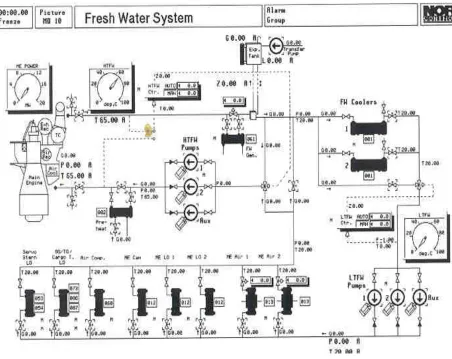
Figure 4.3: fresh water system. 52
Figure A 1.1: Single-PC System. 67
Figure A 1.2: PC-Net Version with instructor workstation. 68
Figure A 1.3: Console Version with instructor workstation. 69
LIST OF ABBREVIATIONS
ARPA Automatic Radar Plotting Aids CC Crude Oil Carrier
CBT Computer Based Training.
CNAN Compagnie National Algérienne de Navigation ENAATM Entreprise Nationale des Activités Auxiliaires et des Travaux Maritime
ENMM Ecole Nationale de la Marine Marchande de Nantes. ENTV Entreprise Nationale de Transport des Voyageurs ERENAV Entreprise de Réparation Navale
ERS Engine Room Simulator GPS
GMDSS Global Maritime Distress Safety System IFE Institute of Energy Technology (Norway) INFS Institut National de Formation Supérieur ISM Institut Supérieur Maritime
IMLA Convention of International Maritime Lecturers´Association IMO International Maritime Organization
JICA Japanese International Co-operation Agency LAN Local Area Network
MET Maritime Education & Training.
METE Maritime Education & Training Engineering. MMI Man-Machine Interface.
OTISS Operational Training Industrial Simulator System P&ID Process & Instrumentation Diagrams.
PPT Propulsion Plant Training PTS Part Task Simulator SAR
SAST Special Analysis & Simulator Technology.
SOLAS International Convention for the Safety of Life at Sea SNTM/HYPROC Société National de Transport Maritime des Hydrocarbures et des Produits Chimiques.
STCW International Convention on Standard of Training, Certification and Watchkeeping for Seafarers.
TEC Training & Evaluation Control System. USMMA United States Merchant Marine Academy. VLCC Very Large Crude Carrier
CHAPTER 1
INTRODUCTION
1.1 BACKGROUND TO THE STUDY
The impact of costs, economies of scale and profit maximization, lead shipping
companies to keep pace with technological innovations by using sophisticated
equipment on board ships. These latest technologies such use of specialized cargo
ships, port and cargo handling equipment, and sophisticated engine room make faster
turnaround time in ports and allow usually reduction of the workload of the crew. But
these aspects change the attitude of seafarers, which have been seen to become high
specialized to develop mastery of all sophisticated equipment. Then it is essential today
seafarers be skilled in both automated and manual operation of ships and its equipment.
To keep up with this trends the Maritime Education and Training (MET) should not
lose sight of that. It obvious that to meet the job requirement by education and training,
the educational system should to be close to the actual knowledge and performance to
which they relate. Therefore all MET institution should improve their curriculum in
It is recognized that computer based training including computer supported simulation
training, does differ, effective and over take in a fundamental way from the traditional
instructor based training. Because, in the traditional case, assurance of quality is
usually found in the credential of the instructor, not in the instruction itself, but
electronic training and simulation can be certified effective.
Before the simulator technology for training purpose was utilized in the maritime field,
it was been a feature for many year in several industries and particular in aircraft
industries where it was a well-established science.
The first simulators in the marine field were used for research purposes in Goteborg,
Sweden in 1967 (Professor P. Muirhead report: ship simulator, Historical Growth and
Development, September 1999). They were used manly to predict the behavior of crew,
ship designs, new material and procedures as well as for port design. But simulators
have had long since a history on the training of operators for dangerous and
inaccessible places in industries.
Today, because it is technically possible, the simulators are widely and intensively used
in many fields such as aeronautics, medicine, automobile industries, universities, space
research and operations. And it still continues to be employed manly to predict the
behavior of humans and equipment in large complicated, dangerous and expensive
systems.
The latest simulators have high performance, and could interact using multiple
variables, which duplicate phenomena likely to occur in the real life. Any complex
equipment requiring equally complex procedures in its operations could be simulated.
Specifically engine simulators are now able to generate environments where groups of
trainees can be trained in operational procedures, routines, corrective measures, fault
In the training area the engine room simulators play an important role in producing the
impossible situation related to the real life. It can provide the trainees with the required
experience to handle or at least minimize the effects in considerably fewer practice
hours than traditional methods. A simulator running in real-time can compress year of
experience into a few weeks.
1.2 METHODOLOGY
The content of this dissertation will be based on relevant literature from World
Maritime University Library, information from simulator manufacturers such as
NORCONTROL, POSEIDON, MARINE SOFT, TRANSAS SIMULATOR and
experience gained from field trips in Norway, USA, Poland, Netherlands, France and
UK. The study will focus on investigation of an adequate engine room simulator (ERS)
able to complement the teaching facilities and to enhance the existing program of
duel-purpose at ISM Bouismail in Algeria.
The proposed methodology applied to achieve these main objectives is on steps as
outlined below:
1- To examine the existing practical methods of marine engineering education and
training at ISM in Algeria.
2- To investigate prospective current ERS technology through different
manufacturers.
3- To examine a number of users of ERS and compare methods used in training.
4- To examine and analyze the outcomes of the simulators by comparing between
reliable types of ERS investigated and effectiveness in training from selective
The application of simulator in MET institution has brought a lot of insight in the
training process and their outcomes have been highly commented on by students and
instructors. Speed of delivery and student interactions have been made faster because of
a reduced time and cost in achieving the necessary operational experience.
The influence of STCW78 and revised in 1995 (STCW95-code) on MET system in
Algeria will be analyzed, and the recommendations on the effectiveness of engine room
CHAPTER 2
MARITIME EDUCATION AND TRAINING IN ALGERIA
2.1 BACKGROUND
Since the independence of Algeria in 1962, Maritime Transport has been recognized as
a strategic sector of economic development of the country taking into consideration that
the quasi totality of foreign trade is conducted by sea.
In order to consolidate its sovereignty, Algeria decided to acquire a national fleet for the
transportation of passengers and goods.
The mother Compagnie Nationale Algerienne de Navigation (CNAN) has made the
main acquisition of the fleet. Created in 1963 and operating under the auspices of the
ministry of transport. This operation has been accomplished in a short period of time,
about ten years, in order to respond to the increasing needs of the country.
The CNAN possessed five (5) ships in 1969,42 ships in April 1976,
- 63 ships at the end of 1977,
- 68 ships in 1983, and
- 72 ships in 1989 together with 10 oceans going tugs and 12 pilots launch.
The personnel of the maritime sector is represented in table 2.1.
More over, the complexity and the variety of tasks lasted the national fleet to take on the
requirement of a better management and at the same time have led the CNAN to
• One Company dealing with the transport of general cargo and passengers.
• One Company dealing with the transport of oil such as gas and chemical cargoes.
- And a second restructuring also in 1982 leading to the creation of four companies:
• The SNTM/CNAN dealing with the transport of general cargo.
• The ENTV dealing with the transport of passengers.
• The ENAATM dealing with auxiliary activity.
• The ERENAV dealing with ship repair and maintenance
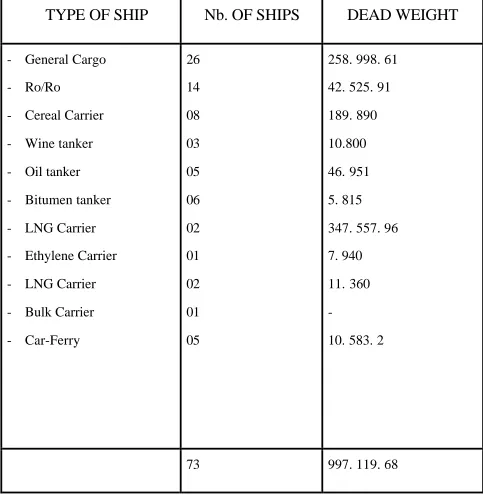
The rapid expansion of the fleet and the acquisition of such highly sophisticated and
expensive vessels indicated in table 2.2. It has required parallel strengthening of the
maritime infrastructure and personnel of the ministry responsible for transport,
specifically in the field of preparation and implementation of legislation and related
COMPANY
SEAGOING
PERSONNEL
SHORE BASED
PERSONNEL
TOTAL
1, -SHIPPING COMPANY - SNTM/CNAN - SNTM/HYPROC - CALTRAM - ENTVM 2607 1235 158 937 839 391 107 600 3446 1629 262 15372, - AUXILIARY
ACTIVITY - GEMA - MTA 1211 711 1211 711
3, - SHIP REPAIR AND
MAINTENANCE
- ERENAV
631 631
TOTAL 9427
In order to meet the urgent needs of qualified seafarers and replace gradually the
expatriate crewing the vessels, the necessity to establish an appropriate Maritime
Education and Training institution was strongly felt.
Consequently the Institut Superieur Maritime (ISM) was created at Bouismail in 1975.
The objectives of the change introduced each time is to elevate the standard of training
by the following actions:
- Elevation of the entry requirement.
Table 2.2: Composition of the merchant fleet. (Interview, 1999).
TYPE OF SHIP
Nb. OF SHIPS
DEAD WEIGHT
-
General Cargo
-
Ro/Ro
-
Cereal Carrier
-
Wine tanker
-
Oil tanker
-
Bitumen tanker
-
LNG Carrier
-
Ethylene Carrier
-
LNG Carrier
-
Bulk Carrier
-
Car-Ferry
26
14
08
03
05
06
02
01
02
01
05
258. 998. 61
42. 525. 91
189. 890
10.800
46. 951
5. 815
347. 557. 96
7. 940
11. 360
-10. 583. 2
In order to meet the urgent needs of qualified seafarers and replace gradually the
expatriate crewing the vessels, the necessity to establish an appropriate Maritime
Education and Training institution was strongly felt.
Consequently the Institut Superieur Maritime (ISM) was created at Bouismail in 1975.
The objectives of the change introduced each time is to elevate the standard of training
by the following actions:
- Elevation of the entry requirement.
- Updating of teaching syllabuses.
- Increasing the duration of the theoretical and practical training ashore.
- Reducing practical training at sea in favor of more accelerated curriculum.
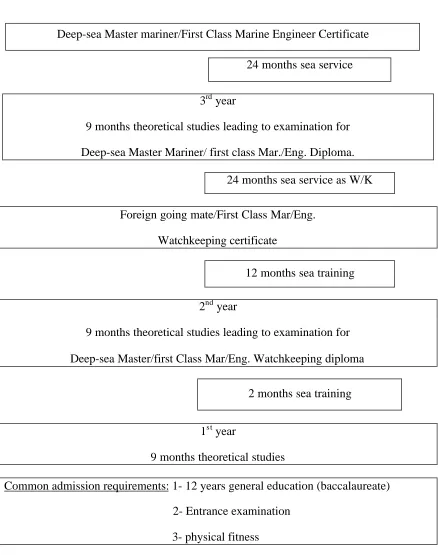
From 1975 to 1984 figure2.1, the students are enrolled by national examination at the
age of 19 years among holders of the Baccalaureate Diploma. They join ISM for two
years pre-sea training. After graduation with a Watchkeeping Diploma they have to
fulfill their practical training requirements on board ship for three years. An additional
year of post-sea training at ISM is conducted for the issue of higher Diploma of Master
Mariner or First Class Marine Engineer.
In 1984, a few changes have been introduced. The pre-sea training has been increased
to three years duration whilst the practical training on board has been reduced to two
years (figure 2.2).
In 1988, major reforms have been made to the training scheme following the decision
of the government to include Maritime Training with in the University System whilst
- Enrolment of student in ISM by National Examination from those who have
completed a two year course at the University. This provides them with basics in
technology and general sciences.
- The admitted students will join ISM in their third year of studies. They will then
specialize during two year pre-sea training, two year practical training and one year
24 months sea service
3rd year
9 months theoretical studies leading to examination for
Deep-sea Master Mariner/ first class Mar./Eng. Diploma.
24 months sea service as W/K
Foreign going mate/First Class Mar/Eng.
Watchkeeping certificate
12 months sea training
2nd year
9 months theoretical studies leading to examination for
Deep-sea Master/first Class Mar/Eng. Watchkeeping diploma
2 months sea training
1st year
9 months theoretical studies
Common admission requirements: 1- 12 years general education (baccalaureate)
2- Entrance examination
3- physical fitness
Figure 2.1: High-level education training scheme leading to master mariner/first class marine engineer certificates of competency from 1975 to 1984.
24 months sea-service
Figure2.2: High-level education training scheme leading to master mariner/first class
marine engineer certificates of competency from 1984 to 1988. Deep-sea Master Mariner/First Class Marine Engineer Certificate
4th year
9 months theoretical studies leading to examination for deep-sea Master Mariner/First Class Marine Engineer diploma
12 months sea service as W/K
Deep-sea Master Mariner/First Class Marine Engineer Watchkeeping Certificate
12 months sea-training
3rd year
9months theoretical studies leading to examination for Deep-sea Mate/ First Class Marine Engineer Watchkeeping Diploma
2nd year
9 months theoretical studies + 2 months sea-training
1st year
9 months theoretical studies + 2 months sea-training
Common admission requirements: 1- 12 years general education (baccalaureate)
2- Entrance Examination
Figure2.3: High-level education training scheme leading to master mariner/first class marine engineer certificates of competency from 1988 to 1995.
Deep-sea Master Mariner/First Class Marine Engineer Certificate
24 months sea-service
3rd year
9 months theoretical studies leading to examination for Master Mariner/First Class Marine Engineer Diploma
12 months sea-service
Deep-sea Master/First Marine Engineer Watchkeeping Certificate
12 months sea-training
2nd year
9 months theoretical studies leading to examination for Master Mariner/First Marine Engineer Watchkeeping Diploma
2 months sea-training
1st year
9 months theoretical studies
Common admission requirements:
1- 12years general education (Baccalaureate)
2- 2years University studies in sciences & technology
3- Entrance examination
The advantages of such a scheme are:
- On satisfactory completion of their training the graduates will be awarded a
Diploma recognized nationally.
- The classification of the ISM as INFS (Institut National de Formation Superieur) is
able to help the administration to improve the status of teachers and assist in
upgrading them.
- The increase of the output of qualified officers from ISM during the sixties led to
the gradual replacement of expatriates, and at the present time the totality of the
crew is Algerian.
- The stagnation of Algerian fleet during the latest years due to the economic
recession of the country has forced ISM to reduce gradually the recruitment of new
students during the last five years.
- The change in the technology has triggered also a new line of thought on ship
management. The new inventions together with the electronic module and
automation system introduced in the ship accordingly on the bridge and in the
engine room respectively made it possible for less manpower required than on
conventional ships. So with reduced tasks, we are moving toward the provision of a
small team of personnel, which will operate in a safe manner and contribute, of
course, to the economic viability of companies.
And to keep pace with the development of the training of sea going personnel in
advanced Maritime Nation, ISM has decided to review once again the training system,
and to set up a new curricular system called “POLYVALENCE”. The system allows the
grouping together of the two vocational training systems of the deck officer and engineer
today, due to the using of modern methods of teaching such as video, slides, handouts,
and the modern equipment.
Keeping the same entry requirements (two years at the University) the students spend
three years pre-sea training at ISM and gradually with a dual- purpose Diploma,
Nationally recognized. Twelve months at sea are required to obtain a dual Watch officer
certificate. When graduated the students will seek the accomplishment of his required
sea-service either on board Algerian ship, or use the foreign flag after establishing
Figure2.4: High-level education training scheme leading to master mariner/first class
marine engineer certificates of competency since 1995. .
Chief Engineer Certificate of competency
Master Mariner Certificate of competency
6 months advanced training 6 months advanced training
24 months as 2nd Engineer 24 months as Mate
6 months professional training modular courses
6 months professional training modular courses
24 months as Watchkeeping Officer Dual Purpose:
12 months sea-service
3rd year
9 months theoretical studies leading to Dual Purpose Watchkeeping Diploma
2nd year
9 months theoretical studies + 2 months sea-training
1st year
9 months theoretical studies + 2 months sea-training
Common admission requirements:
1- 12 years general education (Baccalaureate)
2- 2years university studies in sciences and technology
3- Entrance examination
2.2 FACILITIES AND SPECIALISED TRAINING
2.2.1 TRAINING FACILITIES AND EQUIPMENT
Institut Superieur Maritime constitutes an integrated training complex containing most
of the appropriate facilities necessary for Maritime Education and Training such as:
- Navigation bridge
- Radar simulator laboratory
- Radio station
- GMDSS simulator
- Marine diesel plant
- Automation laboratory
- Electricity and electronics laboratory
- Welding workshop
- Machining workshop
- Maintenance workshop
- Computer laboratory
- Lecture rooms
- Lecture hall
- Fire fighting center survival center
- Students housing of 315 single rooms
- Restaurant
- Cafeteria
- Medical center
- Sport complex (football, handball, basketball, volleyball, and tennis…)
2.2.2 SPECIALISED TRAINING.
Due to its dynamism, its qualified teaching staff and adequate teaching facilities and
equipment, ISM has been designed in 1988 as a Regional Branch of the World Maritime
University (WMU) among 14 others in the world. Within this frame work ISM has
embarked on a diversification program of its training activities by conducting a whole
range of specialized short courses towards seagoing and shore based personnel of the
shipping companies and other maritime activities by the use of the IMO model courses.
The priority was given to the conduct of IMO mandatory short courses with include the
following:
- Fire fighting courses
- Basic survival courses
- ARPA courses
- Chemical tanker safety courses
- Petroleum tanker safety courses
As far as the fire fighting and basic survival courses, ISM has established fire fighting
and survival centers, which have been operational since 1987.
In addition to these specialized short courses ISM has developed several tailor-made
courses to update the knowledge of some personnel such as:
- Anatomy of shipping
- Draft survey
- Welding techniques
- Machining-tools
- Ship construction
Combining the experience of graduate and specialized training, ISM has set up four
POST-GRADUATE courses of one-year duration in the following fields:
- Shipping: a course provided for shipping companies and related activities
management personnel.
- Port Management: for managers and operators.
- Maritime Administration: for maritime administration and regulation enforcement.
ISM and French Institute at Marseille run the first three mentioned courses jointly
through a co-operation project. The fourth course is taken in charge completely by
group of ISM teachers whom graduated from WMU. The course is composed mainly
of several IMO model courses dealing with maritime safety.
2.3 IMPACT OF INTERNATIONAL RULES (STCW)
The STCW convention is the main impetus to address this aspect of safety at sea. The
convention aims to provide an international standard for training and testing of seafarers.
It set minimum requirement for all levels of persons employed on board ship. It also
outlines in clear terms the obligation of states to ensure compliance with its regulations.
It also makes provision for reports to IMO in order that monitoring for compliance can
be accomplished easily. The need for quality system of training is addressed and
guidelines are given as to how these can be achieved. The revised convention is a major
improvement over the old one, which often left standards to the “satisfaction of the
administration”.
Today, sailing conditions are different than some years ago. Now new ships are
equipped with satellite navigation systems and sophisticated radar. Many of tasks, which
were conducted by humans in conventional ships, are now executed by handling system,
which are mainly composed of computers. And also technological innovations have
been introduced and emphasize improvement in vessel’ engine. All these new
technologies allow one to spend less time on nautical calculations and lectures. These
drastic innovations upon ship handling systems make a big change on ship operation
tasks. But these different tasks require a wide range of skill levels, from basic skills of
technician to ingenious knowledge, which requires experience and skills in the
Nevertheless, the systematic structure of Education and Training for ship operators
who use this new handling system has been fully organized in developed countries. If
the developing countries cannot cope with the new system in a timely manner, it will
be evident that operators from these nations cannot adapt themselves to the system, and
eventually there will be a danger maritime accidents being caused frequently.
Therefore, the details of education need to be examined as soon as possible in these
countries.
At Institut Superieur Maritime Bouismail, the STCW and SOLAS conventions are
seriously taken into the training of students for them to be safety conscious and
competitive. Many laboratories have been renovated, such as marine electric and
automation laboratory. Also ISM has benefited from Japan trough its International
Co-operation Agency (JICA) in an important aid project consisting of the:
- A modern 4 own Ship Radar Simulator
- Sophisticated Marine Diesel engine Plant
And more recently ISM has installed a GMDSS Simulator of 1 instructor, and 4 student
stations.
Since its establishment in 1975, ISM is fulfilling its mission in a very satisfactory
manner. ISM graduates are holding their position both at operational and managerial
levels within shipping companies and auxiliary activities such as maritime
administrations, ports, and training. It also plays a very important role in implementing
the STCW convention in order to maintain the quality standard for the training a
The main roles of ISM are:
- Improvement of the maritime safety and the prevention of marine environment.
- The endeavoring to be in line with national and international development.
- Establishment at the teaching syllabus of Maritime Education and Training and
curriculum for each course under the requirement of STCW 95.
- Establishment of appropriate Quality Standard System and examination
requirement for Maritime Education Training and Assessment.
- Effectively coordinating use of maritime instruments, equipment, simulators, and
seagoing training ships for training seafarers.
- Development of teaching methods such as the use of computers and simulators for
training and assessments purpose.
- Creation of Maritime Training Committee composed of representation of Maritime
Training Institutions and Maritime Industries
- Creation of Regional Examination Center at ISM for the conduct of training, and
assessment of seafarer’s competency. Establish procedures for the issuance of
documents of compliance for Algerian flag ships.
- Improvements upgrading and continuing the education program by providing
qualify teaching staff through WMU and other advanced institutions.
- To make the intensive use of IMO model courses either as short courses or
CHAPTER 3
TECHNICAL ANALYSIS OF SIMULATORS
3.1 INTRODUCTION
In the shipping industry today economic factors play an important role, thus, reducing
of number of crew on board ship is vital for shipping companies. This lower number of
crewmembers has not been able to overcome the technical maintenance demands of
these sophisticated ships, which incorporate high degree of automation.
Today the situation is different than it has been in the past, there is no time to train on
board, but the shipowners or companies demand well-trained engineer officers. Using
simulator facilities can be very useful partially replacing the traditional training done
on board ships.
The requirements of the ISM code have been implemented in the amendments to the
STCW Code. Standards for training have been enhanced, and those responsible for the
training clearly identified (Regulation I/14 of STCW convention, states that the
management of the company is responsible for the competency of seafarers serving on
their ships). And the chapter III of the STCW Code stipulates the minimum training
required for marine engineer officers and all personnel directly involved in operation of
the engine room.
The STCW code clearly defines the competence of these marine engineer officers.
However the code recommends training in the classroom, workshops, and simulators.
Even if the engine room simulator is only recommended, using ERS for training is an
To be competent, the engineer officers have to be prepared to perform properly their
tasks such as,
• Maintaining a safe engineering watch
• Operation of the main and auxiliary machinery and associated control
systems
• Operation of pumping system and associated control system
• Operation of alternators, generators and control systems
• Safety and emergency procedures
• Prevention and pollution
• Maintaining seaworthiness of the ship (ship stability)
Maritime training institutions have to train and to prepare operational skills of
shipboard personnel in order to meet the requirements of modern machinery space
technology. But to cover all training needs on real machinery in laboratories is
considerably restricted by requirements on:
• Safety environment protection,
• Training time, and
• Working costs.
Fortunately, simulator facilities can provide favorable training at Maritime Education
situations, and emergencies. Simulator becomes superior to real machinery in this
regard.
IMO recommends training on simulators and has published model courses in their use.
The revised STCW convention includes standards governing use of simulators training.
And the safety management system in compliance with the ISM code seems hardly to
be practicable without simulator support.
3.2 FULLMISSION
3.2.1 INTRODUCTION
A full mission engine room simulator consists of an electric switchboard, a control room
console and large touch screens for the engineers’ engine room action. As an example of
Norcontrol Simulator a full mission engine room simulator. It is a complete engine room
system where all the machinery has been reproduced through the application of a
computer programmed to represent a complete propulsion plant including all auxiliary
system.
The simulator models are based on real time programming, which enable to replicate
the dynamic behavior of the engine room plant and all its vital parameters as well as
the interactions between the sub-systems of a propulsion plant.
The control room equipment is built up from ship-shape control console and a model of
the main switchboard. From the control room the students may operate the main engine
and its auxiliary systems including the alternation. Equipment running lights and
indicators for all main operational parameters are mounted on the console showing the
and a flashing lamp from the alarm group affected will alert the operator to any
abnormal conditions.
Full mission simulator is arranged over the separate types of simulator configurations
mainly the operational configurations, workstation configurations and combined
operational and workstations configurations. The engine room simulator can also be
coupled with full-mission bridge simulator through Local Area Network (LAN).
3.2.2 OPERATIONAL CONFIGURATIONS
As an example of a configuration of Norcontrol Simulation is shown in (Fig. 3.1): The
full mission consists of an Engine Room System created by the interaction of computer
hardware and software and computer net work linking all parts of the Engine Room
Simulator. The Full- mission ERS may comprise the following sections:
• Workstation
• Engine Control Room
• Main Switchboard
Figure3.1: Full mission ERS “Combined operational Workstation Version Simulator”
Source: Propulsion Plant Training PPT 2000. Manual, Kongsberg Norcontrol.
Instructor room facilities
The instructor room can comprise the following separate units:
• Instructor workstation training
•Training and Evaluation Control (TEC) System
• Printer (event log and hard copy printer)
Students facilities
Students’ facilities comprise the following separate units:
• Student workstations
• Printers
This equipment has the capability to interface with the simulator or to stand-alone for
separate exercises. It will also function at the same time as exercises are in progress on
the simulator reporting the trainee activities and playing back the trainee exercise to
assist in the correction of errors in procedure. The instructor is provided with a
composite set of facilities which will effectively enable him to prepare exercises in
advance, to supervise exercises in progress and to debrief the trainee at the close of an
exercise.
3.2.2.2 ENGINE CONTROL ROOM.
The simulated control room is an extension of the engine room to be employed as a
remote sensing and control center for the propulsion machinery systems as formed on
The control room simulation units’ interface can operate the functions of the engine
room and at the same time provide a link in the remote plan/energy management
configuration. The control room is also the prime link in the bridge, control room/engine
room and unmanned simulated process may be monitored and controlled by the students
from the local panels as well as from the consoles in the engine room. The remote
monitoring and control systems are in full classification societies for unmanned remote
operation of a real engine room. The control room can be configured to include the
following.
• Main switchboard
• Engine Control Room Console
• Boiler console
• Communication
• Alarm/ Log Printer
Main switchboard
The main switchboard consists of the following sections
Diesel generator sections
• Shaft generator sections
• Turbo generator sections
• Synchronizing sections
Engine Control Room Console
The engine control room console includes the main engine’s remote control system.
The functions and design of the control room console are based on the “Data-Chief”
ship’s instrumentation system manufactured by NORCONTROL. The engine control
room console consist of the following sections:
• Generator/pump/compressor control section (Power-Chief)
• Monitoring/alarm and control section (Data-Chief)
• Main Engine remote control section (Auto-Chief).
Boiler Console
The steam generating system is based on a typical dual pressure type, auxiliary boiler,
and includes the following sections:
• Condenser consists of vacuum condenser and all necessary pumps and valves.
• Steam Generator consists of steam generator (secondary steam drum) with an
advanced and flexible feed water level control.
• Oil fired boiler consists of oil fired boiler with primary steam system,
super-heater and burner system with automation and manual control.
• Exhaust boiler consists of exhaust boiler with economizer, evaporator, and
super-heater. The exhaust boiler has automatic and manual control of the exhaust gas by
pass dampers. There is a circulation pump, circulating water from the steam generator
3.2.2.3 ENGINE ROOM.
The operation of the subsystem can be carried out on consoles/panels, interactive mimic
panels or local operational stations. The engine room can be configured as combination
of the above mentioned solutions. The most flexible solution because of these is the
workstation solution because it is then possible to run more than one engine model.
The engine room can also be configured to include main engine local control and the
entire interactive mimic panel may comprise all the relevant subsystems in the
propulsion plant. However it represent the various engine room system for single screw
propulsion system by distinctive color outlining of each system in line/block diagrams.
Each system contains the filers, header tanks, and pressure measuring devices,
temperature control, and valves essentials to the operation of the system.
The mimic panel interacts with facilities for local operation of pumps, valves,
auxiliaries and main engines. The state of operation is indicated by lights (running lights,
trip lights), and also by indicating instruments. Instruments are of the analog readout
type and more some may be of the dual scale face to accommodate readings appropriate
to the engine characteristics.
3.2.3 ADVANTAGES OF FULL–MISSION ERS.
The advantages are immense because their outwards appearance resembles actual
installation in full details and sound and light effects available. One of the major
advantages are advanced graphic capacities, which contribute greatly to study engine
equipment symbols on the panel to permit full understanding of the various systems to
facilitate maximum training effectiveness. Full-mission ERS are very convenient for
mastering skills in limited circle of time.
The operation of ERS has no risk of accident to trainees’ lives, to environment and
equipment damage. Hence it is a good place to learn and to make mistakes without
giving detrimental effect of cost.
The dynamic real time of ERS has real-time response of engine room systems besides
having some replica hardware. This facility allows the trainees to see the
cause-and-effect of their own performance immediately. This also directly influences the
enthusiasm of trainees and promotes motivation to learn.
3.3 COMPUTER-BASED TRAINING.
3.3.1 INTRODUCTION.
The Computer-Based Training (CBT) simulator is designed as software-driven PC-based
training facility with machinery controls and indicators being reproduced on the screen.
The simulator software simulates a ship engine room system including main engine,
boilers, fuel oil system, cooling water system and electrical power distribution system.
(Marine Soft, 2000)
The CBT simulator is able to perform normal operations such as trouble shooting,
watchkeeping and emergency operation scenarios. The computer-based training is able
to combine simulations with multimedia techniques such as audio, video and animation.
lights and machinery sound in order to make a more realistic approximation of
simulation environment. (Norcontrol, 1999).
The high expression ability of multimedia techniques makes CBT suitable for education
and training of students on-board and on-shore. The training potential of the CBT may
be used as stand-alone simulator or networked to form a training class.
Today it is more used as an individual training aid to students working at their own
pace, so many functions make these system an adequate tool for training and enhancing
student’s learning. One of these features is to be able to save any situation and the
subsequent repetition and corrections of errors and mistakes in operation. These features
allow trainees and students to develop skills and thinking processes necessary for facing
their real life at sea.
The use of CBT allows the student to be involved and to be motivated to learn. It
provides a facility for the development of competencies that cannot generally be
acquired in the workplace.
The computer-based training CBT uses a amount large of storage memory, which
enables the system to save a great number of situations and incidents. This allows
students and instructor to instantly replay or clarify and discuss the training during
debriefing and also repeat the exercise if that is needed. CBT can also allow
performance comparison between teams training under identical input. This is important
because it opens the possibility to use the simulator for assessments and examinations.
3.3.2 OPERATIONAL CONFIGURATION.
• Desk top-PC configuration in the best way capable for self-instruction within,
- On the job training to get familiarized with new machinery, refresh and coach
operational procedures, prepare pre-promotion assessments of competency, etc
- Institute-based training to deep on lessons, repeat exercises, prepare examinations,
etc.
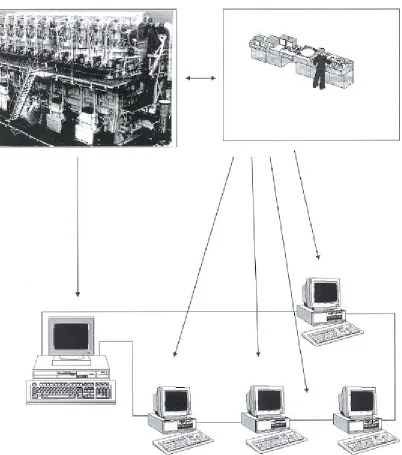
• PC-network configuration are appropriate to instructor guided group training,
with PC terminals being,
- Either autonomous with identical situations, i.e. multi-station training on identical
problem
- Or inter connected with different situation e.g. interactive training of the whole
engineering watchkeeping team.
The computer-based training simulator use covers procedures such as:
• Familiarization scenarios aimed at getting known with the machinery space
system, where it is arranged aboard and how reproduced for simulation, what indicators
Figure 3.2: PC- Net Version with Instructor Workstation.
Source: Machine Space Simulator Manual, Marine Soft.
•Normal operation scenarios aimed at learning how correctly to start up machinery
• Watch keeping scenarios aimed at learning how to take over and accept an
engineering watch, what watchkeeping routines are in use, and what duties must be
observed.
•Trouble-shooting and anti-accident scenarios aimed at how to identify,
localize and remedy faults and malfunctions in machinery space system, and
how to handle alarms.
• Emergency procedure scenarios aimed at skills and confidence in handling
of machinery space systems in emergencies.
3.3.3 ADVANTAGES
All teachers lecturing in the subject of maritime diesel engine operation maintenance
and diagnostics require a teaching aid to support the lectures or illustrate certain aspects
of a diesel engine operation. A real engine to make the demonstrating directed to basic
training is out of the question. It takes a great of time to set up and to monitor faults. The
same applies to more advanced courses when the knowledge of operational conditions is
required and subjected to more pressures.
According to Roy Johanson, instructor on engine room simulator at Tromso Maritime
high school Norway; there are three obvious advantages with the marine soft machinery
space simulator.
• The built-in CBT environment gives instructors appreciation about the
different systems.
• The dynamic in the active process.
The latter point makes the students able to use the simulator, at any time, in discussions,
in exercises or just in pursuing interest in the subject.
Computers e.g. PCs desktop and laptop are today relatively low cost tools that can be
applied to training, as stand alone or in network environment. At the level of basic
training the use of CBT- programs could be used in their own time at their own pace.
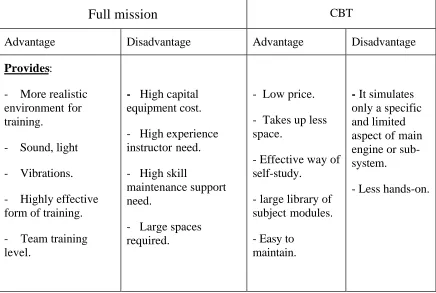
3.3.4 COMPARISON BETWEEN “FULL MISSION AND CBT”
Table 3.1: comparison full mission & CBT.
Full mission
CBTAdvantage Disadvantage Advantage Disadvantage
Provides:
- More realistic environment for training.
- Sound, light
- Vibrations.
- Highly effective form of training.
- Team training level.
- High capital equipment cost.
- High experience instructor need.
- High skill
maintenance support need.
- Large spaces required.
- Low price.
- Takes up less space.
- Effective way of self-study.
- large library of subject modules.
- Easy to maintain.
- It simulates only a specific and limited aspect of main engine or sub-system.
3.4 PART TASK SIMULATOR.
Part task simulator (PTS) is an intermediate instrument or facility between Full mission
Engine Room Simulator and Computer Based Training. PTS can simulate a single ship’s
system or limited combination of tasks relating to a system (from single task to
multi-task).
Part task Simulator can replicate, for example:
- Marine Diesel Engine
- Electrical Power Plant
- Sea Water Cooling System…etc.
This type of system is particularly appropriate to provide multiple trainee station for
familiarization training in preparation of a more comprehensive simulation to practice
part of tasks before acceding to a Full-mission ERS.
3.5 MARKET PENETRATION.
With respect to the economic change and technology change have triggered a new line
of thought on ship management. The new inventions of advanced machinery and
automation system have been installed on board ship. The impact of modern technology
on shipping industry and high technology ships has raised need of new training aids like
the engine room simulator.
Marine simulators have matured over a period of more than 25 years and have now
proven to be a reliable tool. Maritime Education and Training institution throughout the
Since the revised STCW convention and code have officially promoted the use of
simulators to enhance training, many manufacturers appeared on the market and propose
their new products such as ship- handling simulator, engine room simulator and cargo
handling simulator.
KONGSBERG NORCONTROL, MARINE SOFT, TRANSAS MARINE, are today one
of the leading pioneers of world successful marine simulator manufacturers.
3.5.1 KONGSBERB NORCONTROL
KONGSBERG NORCONTROL AS (KNC) is a marine automation system specialist. Its
main office is located in Horten, Norway. The company introduced the world’s first
introducing commercial automatic radar plotting aid (ARPA), integrated navigation
system, computerized engine room automation and electronic monitoring and control of
ship’s cargo. In 1972 the company ventured into simulation and it become the world’s
leading supplier of maritime training and simulation systems, offering a full range of
IMO-recommended trainers, from computer-based training systems to full-mission
simulators. The various types of simulators delivered to the maritime training
community include: radar/ARPA simulator, GMDSS and SAR trainers, shiphandling
simulators, cargo handling trainers, propulsion plant trainers and communication plant
trainers. “The company has delivered more than 550 simulators to more than 65
countries around the world.” (http://www.norcontrol.com, March 10 2000).
¦ Propulsion plant trainers
The Propulsion Plant Trainers (PPT) incorporates the main engine, the control system
and all relevant sub-and auxiliary systems. Accompanied by comprehensive
The software engineering of the entire propulsion plant is based on sub-models of the
main engine and the various auxiliary systems such as the fuel system, seawater system,
etc. These sub-systems consist in turn of basic models of pumps, pipes, filters, etc. All
systems are fully interactive, forming a dynamic real-time software model. The PPT
software models include a number of vessels with corresponding propulsion
configuration and main engine(s). Models range from Very Large Crude Carriers to
trawlers, and engines range from two-stroke low-speed diesels to four-stroke high-speed
diesels. The trainers simulate a large number of different engine makers, for example,
MAN B&W, Sulzer, Pielstick, MaK and MTU.
¦ Simulator engine room models
The following models of simulator engine configurations PPT 2000 are available both
as workstations and full mission trainers.
• Very Large Crude Carrier (VLCC), Diesel MC90
• Very Large Crude Carrier (VLCC), Diesel MC80
• Very Large Crude Carrier (VLCC), Steam
• Large Crude Oil Carrier (LCC), Diesel RND90
• Crude Oil Carrier (CC), Diesel RLB66
• Multipurpose Ship, Diesel Pielstick
• Ferry, Diesel MaK
• River Vessel, Diesel MaK
• Trawler. Diesel Caterpillar
• Research Vessel, Diesel Electric
• Auxiliary Oiler (tanker), Diesel
• Naval Vessels, Diesel M11
• Naval Vessels, Diesel M44
Naval Vessel, Combined Diesel/Gas Turbine
• Cruise Vessel, Diesel Electric
• High Speed Craft (Catamaran/diesel/water jets
• Large Container Ship 2RTA (C) – Coming
• Container Vessel, Diesel Pielstick
• Gas Turbine Training Package – Coming soon
These simulation models are configured by means of the OTISS software concept
(Operator Training Industrial Simulation System) developed by SAST, Special Analysis
and Simulation Technology Ltd, England.
The operator Man-Machine Interface (MMI) is realized by means of the EMULA
Graphic Software Package developed in Institute of Energy Technology (IFE), Halden,
- The simulated Engine Room
- The Instructor System
The simulated engine is arranged as sub-systems identical to those found onboard a real
ship. The engine room sub-systems are presented as Process and Instrumentation
Diagrams (P&ID) on the workstation by means of EMULA Graphic Software. The
sub-systems are further broken down into units (tanks, valves, pipes etc.) configured by
the OTISS System.
Parts of the engine as well as engine room equipment can be simulated in normal
operating condition or in fault/deteriorated conditions. The engine room models are
connected to a malfunction library controlled by the Instructor System.
The Instructor System, denoted the TEC System (Training and Evaluation Control),
comprises the facilities and features needed for the instructor to prepare, control and
evaluated the simulator training.
The OTISS-/EMULA- environment is very flexible. The mathematical models and the
man-machine interface are run as separate programs. The communication between them
is established by UNIX sockets. The Man Machine Interface program, EMULA, drives
the graphic pictures, and is installed individually on each workstation. The
OTISS-program can run on any of the involved computers.
When more than one EMULA station is connected to one OTISS program, the actions
taken at the one station will influence the shared process and the changes are observed
on all the workstations. This way of running the simulator is controlled by the instructor
to avoid chaos if different operators take inconsistent actions.
- In full simulation mode, the OTISS- program is run on the server.
- In part task simulation mode, the workstations are isolated from each other. The
OTISS-program and the EMULA-program will run on each workstation. This mode
is normally used for detailed studies of sub-systems of the simulator. For instance
part task mode can be used for running the Electric Power Plant. Each workstation
is also capable of running the complete simulation model i.e. several workstations
can control the simulation without interference with the others. Independent of
what simulation mode is used, the workstations need access to the hard disk.
¦ Computer Based Training
The company provides all a standard PC with a CD-ROM drive required to run the
wide selection of Computer Based Training CBT (Programs), The onboard library of
multimedia courses are on CD-ROM, and they cover an expanding number of subjects.
The following courses are an example of the main marine engineering module
available:
• Inert Gas Generator
• Marine Fuel Handling
• Operating Diesel Auxiliary, Engine
• Fuel gas Generator
• Marine Fuel Properties
• Fuel Oil System
• Cooling Water System
• Steering Gear
• Propulsion System Familiarization
• Marine Lubricants
• Operation of Generators.
3.5.2 TRANSAS MARINE Ltd
Transas Marine Limited comprises several associated international companies. Transas
produces a high-technology range of Integrated Marine Navigation System, Vessel
Traffic Management Information System, Oil Spill Response Management System and
a wide range of Marine Simulator. It main office is located in Southampton, UK.
Transas simulators are available on standard PC or with real consoles.
The product range includes:
• Navi-Trainer Simulators - simulator is based on the concept of the integrated
professional environment. The trainee’s work place (e.g. the bridge) may include, Ship
controls and Conning display module, ARPA/radar module, Electronic Chart System
module, Navigation aids module (GPS, Decca, DF, Loran, etc).
• GMDSS Simulators – full range of systems varying from full-size consoles including
• Engine room simulators: for the training of Engine Room watch-keeping personnel in
the proper operational of the ship diesel propulsion plant and electrical power plant.
• Liquid Cargo handling – for the comprehensive training of personnel responsible for
operation with any type of liquid cargo.
• Oil-Spill Simulator: for both training and actual response purposes.
¦ Transas engine room simulators
Transas Engine Room Simulators are implemented in three versions:
• ERS 2000 (Basic Version):
It a PC-based networked simulator, which includes up to 12 interactive Trainee
workstations operating under the instructor control and monitoring. The simulator can
be used for both, individual and team training.
• ERS 3000 (Enhanced Version):
The system is fitted with consoles containing built-in monitoring and control panels.
Engine Room Simulator 3000 consists of an Instructor workstation and one trainee
workstation, presented as a set of full-size Engine control Room consoles. The
equipment allows the replication of an actual Engine Room environment, including the
Main and Emergency Switch Boards of the Electric Power Plant.
• ERS Solo (Simplified Version):
This is a stand-alone desktop simulator, which requires no local network. ERS Solo is
designed to provide an instrument for a high-level training and education whilst
All these above Engine Room simulators include the following main component:
- Ship Diesel Propulsion Plant Simulator (SDPP)
(2-stroke Diesel Engine- Fixed propeller; 4-stroke Diesel Engine- Controllable Pitch
Propeller), comprises the following principal parts:
. Main Engine Remote Control System
. Fresh Water Cooling System
. Sea water Cooling System
. Fuel Oil Supply System
. Lubricating & Piston Cooling System
. Compressed Air System
. Exhaust Gas & Turbocharging System.
- Auxiliary Systems and Machinery Simulator (AS)
. Steam plant with combined fire-tube boiler
. Steering gear
. Engine Room bilge system with purifying system.
- Ship Electric power Plant Simulator (SEPP)
. Two Diesel Generators
. Emergency Diesel Generator
. Main &Emergency Switchboard including Synchronizing & Short Supply
sections
. Consumers.
3.5.3 MARINE SOFT
Marine Soft was founded 1990 in Rostock Germany. It specializes in the development
of Marine Software Solution and supports the seafaring community in its daily business
in accordance with the requirement of ISM code and STCW 95 convention.
It provides its solutions and concepts in the field of marine logistics, simulations,
training and navigation. The applications are used both onboard and ashore.
Marine Soft has designed the Machinery Space Simulator as a software package with
all essential operational system available as:
- Single PC version
- Networked PC version,
- Operating console version,
- Trainee/instructor station,
- Full Mission Simulator.
- Watch keeping training
- Trouble shouting and hazard prevention training
- Emergency procedures training.
The Simulation Software Package enables the user to reproduce a specific shipboard
system, as desired:
- Energy producers: (main engine, boiler, electric power station, compressors.)
- Supply system: (fuel oil system, lubricating oil system, fresh water system, salt
water system.)
- Energy consumers:
- Propulsion: (hydrodynamics of propeller and ship)
- Heat: (refrigeration, air conditioning, heating)
- Electric consumers: (non-rotating and asynchronous loads)
CHAPTER 4
EFFECTIVENESS AND USE OF SIMULATORS FOR
EDUCATION AND TRAINING
4.1 SIMULATOR AS AN EFFECTIVE TEACHING TOOL.
Traditional classroom teaching has for generations been an effective method for teaching theory. Teaching methods usually include the instructor lecturing to the class, with the possibility of using an overhead projector, chalkboard, or sometimes a movie or video to amplify training objectives. In traditional setting the instructor is in direct control and may or may not invite questions and discussion.
With the addition of simulation to the course curriculum, the instructor can fill the gap between theory and application. The instructor can create an interactive environment where instructor and students actively participate in a demonstration applying theory to the real world (Capt. Cross, 1999).
and chemical tankers. This change gave rise to the widespread perception that the maritime education and training establishment was failing to keep abreast of the development in the industry.
Today simulator-based training permits hands-on training to be conducted in a realistic marine environment without interfering with the vessel’s operation or exposing it to the risk. Training can continue independent of adverse weather conditions, engine room noise and vibrations, vessel operating schedules, and other training conditions encountered in a real shipboard operating environment.
Risks associated with training on operational equipment are a concern in any industry (i.e. within the commercial air carrier industry, the widespread use of simulator in training has reduced training accidents). (Marine engineering review, May 1993).
Simulators allow students to repeat a risky operation several times if needed. Unlike training on operation equipment, where an instructor must be prepared to intervene at all time, risky maneuvers can be safely practiced on simulator.
This teaching situation is different from that aboard a ship, where an instructor chief engineer is ultimately responsible for the vessel’s safety and must necessarily intercede and tutor as appropriate in each situation.
Simulators, when compared with real systems have the advantage of offering a great range of scenarios which are easier to realize, record and reproduce; furthermore, they can be interrupted at any time without problems. (Willi Wittig, Marine simulators as a tool for studies in experimental psychology, International Conference on Maritime Education and Training- IMLA, Kobe, Japan, September 1996.)
Using simulation, the instructor can control a training scenario according to learning objectives and terminate it as soon as its point has been made or repeat it until the lesson has been well learned. During the sea training the opportunities of repetition are very limited or impossible: because, the opportunity to repeat an exercise in training aboard ship may not occur for weeks or months.
Another important feature of simulator-based training is the ability to record and play back the just completed scenario for review, evaluation, and debriefing purpose. As a teaching tool, recording and playing back empower the instructor to let mistakes and accidents happen for instructional emphasis and allow trainees to review their actions and their correct and incorrect decisions and experience the results of their performance after the exercise is accomplished.
Fig.4.1: Increased training throughout early operational proficiency
Source: Hand-out Simulation system & Training Methodology Professor P.Muirhead, September 1999.
Job
Proficiency
4.2 USE OF SIMULATOR.
Because of recent trends in the marine industry towards small crew sizes, heightened public concern about marine safety and expectations for improvements, and changes in navigation and ship control technology, today’s new ships are highly modernized and optimized with regard to balance between personnel and automation.
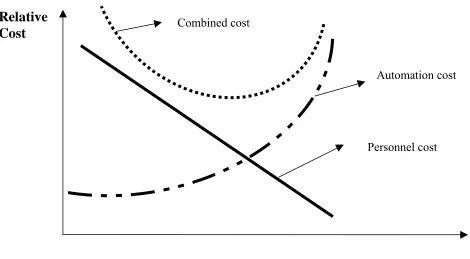
It is obvious the issue of minimal manning is centered on the economic factor where shipowners and shipping companies don’t want to spend a lot of money to fight an enemy that no longer exists. Today, technology is there, it permits building of highly modernized and rationalized ships, which allows being completely operational with fewer crew. The acquisition cost of this ship may be very high, but the savings realized from crew reduction would justify the cost. However there is a point where the cost of the automation outweighs the benefits of reducing crew size. (Ship design and procurement. (Visiting Professor Cushing, April 2000). Figure.4.2.
Merely covering the economic part by providing more sophisticated equipment for new ship will not enough prevent accidents because there are several human factors that must be considered in conjunction with automation. Experience of modern technology in the automobile and aviation industry has shown that advancing levels of automation can produce at least two problems:
- First, at short-term loss of situational awareness: As machine replace humans are moved from the role of operator to that of supervisor, and are moved further away the actual process. And as result of decreased interaction with the system, the supervisor may be unable or slow to detect problems.