
AIJ-EEE) )
٭
An Efficient Scheme for PAPR Reduction of OFDM
Based on Selected Mapping Without Side Information
S. Meymanatabadi
1٭, M. J. Musevi Niya
2, B. Mozaffari Tazehkand
31- Assistant Professor, Department of Electrical and Computer Engineering, University of Tabriz, Tabriz, Iran 2- Associate Professor, Department of Electrical and Computer Engineering, University of Tabriz, Tabriz, Iran 3- Associate Profess,or Department of Electrical and Computer Engineering, University of Tabriz, Tabriz, Iran
A
BSTRACTOrthogonal frequency division multiplexing (OFDM) has become a promising method for many wireless
communication applications. However, one main drawback of OFDM systems is the high peak-to-average
power ratio (PAPR). Selected mapping (SLM) is a well-known technique to decrease the problem of high
PAPR in OFDM systems. In this method, transmitter is obliged to send some bits named side information
(SI) for each data block. Such side information causes bandwidth efficiency to get decreased; in addition,
incorrect detection of SI in receiver side make the whole data block be lost. In this paper, we propose a
technique using linear feedback shift register (LFSR) in which side information bits are not explicitly sent.
By considering an OFDM system through the use of 16-QAM modulation as an illustrative example, it is
shown that the proposed technique from the view point of bit error rate (BER), probability of detection
failure (
P
df) and PAPR reduction performs very well.
K
EYWORDS1-INTRODUCTION
Orthogonal frequency division multiplexing (OFDM), a form of the multicarrier technology, is one of the most popular access methods for many wireless digital communications. It can adopt high data rate links [1]–[4] over harsh multipath fading. However, the time-domain OFDM signal presents a large peak-to-average power ratio (PAPR) at the transmitter's output which is one of the challenging issues in this system. A high PAPR takes out the power amplifier from linear region and reduces the average power of the amplifier output at the transmitter side [5]-[7]. In addition, it causes nonlinear distortion and imposes alteration in the signal constellation. To decrease this PAPR, plenty of methods have been suggested [8]-[14], one of the most well-known of which is Selected Mapping method (SLM) which is able to achieve a better PAPR without distortion.
In SLM, the transmitter generates multiple signals which all represent alike information through multiplying the input data by predetermined phase sequences [15]. Afterwards, the signal with the lowest PAPR is chosen for transmission. In this method, the selected signal index, called side information (SI), must be sent by transmitters to allow for the recovery of the original data block at the receiver side. The transmitted SI bits cause bandwidth efficiency to be decreased; besides, when SI is incorrectly detected by receiver, all received frames be lost. Hence, use of channel coding is needed, which results in system complication and sacrifices data rate. However, for eliminating the explicit transmission of side information some methods have been introduced [16]-[19]. In [19], channel estimation and PAPR reduction are combined in which channel estimation is performed by selecting the place of pilot tone employed inside each data block, and then power distinction between data symbols and the pilot tone is used in order to recover SI in the receiver side. Recently, some schemes have been proposed in [20-21], using permutation and m-sequence respectively to eliminate the pilot tones and displaces them with data symbols inside the data block.
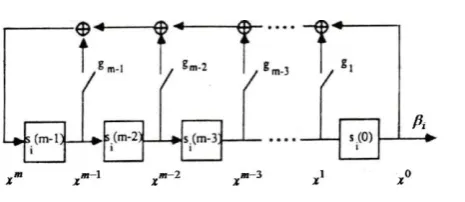
In this paper, we propose a new SLM scheme in which linear feedback shift register (LFSR) is used and enables receiver to recover data without explicit SI bits. We abandon the pilot tones and replace them with symbols existing inside the data block. The basic idea in the proposed technique is to fit the side information into transmitted symbols and some special locations in the transmitted data block are expanded, i.e. some transmitted symbols are extended. At the receiver side, it is tried to discover the places of the expanded symbols to recover the SI index. Because in our scheme, discovering the locations of expanded symbols corresponding to the SI index.
Figure 1: Shift register circuit
This paper is organized as follows. Distribution of PAPR in OFDM systems is presented in the next section. In Section 3, the LFSR circuit and maximum length binary sequence (m-sequence) are explained. In Section 4, we describe the proposed scheme in detail. In Section 5, we consider an example to evaluate the performance of the proposed method. Eventually, the paper is concluded in Section 6.
2-DISTRIBUTION OF PAPR IN OFDM SYSTEMS
The distribution of PAPR bears stochastic characteristics in an OFDM system. The complementary cumulative distribution function (CCDF) of PAPR helps to measure the probability that the PAPR of a certain data block exceeds the given threshold. The PAPR distribution of OFDM signals can greatly simplify the system design process. If the number of subcarriers N is small, the CCDF of PAPR is given below taken from [22].
N z
e z
PAPR P z PAPR
P( )1 ( )1(1 ) (1)
In the OFDM system with a very large N, an empirical approximation expression of the CCDF of PAPR can be written as [23]:
N z
e z
PAPR
P( )1(1 )2.8 (2)
Reference [24] derives a simple approximation of the CCDF of PAPR by using the extreme value theory as:
N Ne
z PAPR
P z
log 3 exp
1 )
( (3)
However, in an OFDM system using M-Quadrature Amplitude Modulation (MQAM), when all the subcarriers have the same phase, the maximum of PAPR happens. Therefore, the expression of the upper bound of PAPR, as shown in [25], can be written as:
1 ) 1 ( 3 1
3 2
max
M
M N PAPR M
N
3-MAXIMUM LENGTH BINARY SEQUENCE
One of the most important pseudo-random sequences is the maximum length binary sequence (m-sequence) generated by linear feedback shift register (LFSR) circuit. Fig.1 shows the LFSR circuit consisting of m memory elements (si) each containing a 0 or 1. The first value
considered for S(s(m1),s(m2),...,s(0)) is said to be the seed. Since each of the memory elements, si contains 0 or 1, there exist m
2 possible seeds for LFSR. When all-zero seed happens, the all-all-zero sequence appear in the output. By deducting the all-zero state, the number of maximum possible seeds is 2m1 [26]-[28]. However, for the goal of producing random sequences with a so long period it is required to use the well-chosen feedback in the LFSR circuit in Figure 1. Any LFSR circuit is associated with a generator polynomial determining situation of feedbacks. Accordingly, the well-chosen feedback depends on selecting a suitable generator polynomial. In this paper, we specify the generator polynomial byg(x):
0 1 1 1 ... )
(x g x g x gx g
g m m
m
m
(5)
where g0gm1 the other coefficients
g
i'
s
are 1when feedbacks in Figure 1 are connected and 0 otherwise. Furthermore, all algebraic operations are performed in modulo-2 and the output sequence is composed of 0 and 1 values. In design of LFSR circuits, the number of memory elements is equal to the generator polynomial degree. A sequence generated by an LFSR with period 2m1 is called a maximal length sequence, or
m-sequence. To create an m-sequence it is required to employ a primitive polynomial of degree m. (reference [29] defines the primitive polynomial). At the ith clock pulse, the LFSR state is a vector denoted as
)) 0 ( , ... ), 2 ( ), 1 (
(i i i
i s m s m s
s , the output sequence is ).
0 (
i i s
It is significant to say that in LFSR there are N
cyclic shifts for a sequence with period N and the output sequence () is an infinite vector with period N. By employing the primitive polynomial, the period of output sequence is equal to 2m1
containing 1
2m 1's and
1
2
m1
0's. Based on the above subjects, in the LFSR circuit if g(x) is a primitive polynomial of degree m, the output sequence is an m-sequence and relation (6) is concluded.
The number of possible seeds = Period of m-sequence = 2m1
(6)
4-THE PROPOSED SLMTECHNIQUE
In this part, we use marking in the shape of G() to express a vector G is composed of scalar quantities.
A- Design of transmitter in the proposed SLM scheme Suppose an OFDM system with Nsubcarriers which N
complex data symbols dn are transmitted concurrently on subcarriers; in addition, a data block is represented in the
form of D(N)dn
. In SLM, with the aim of generating a
sum of various OFDM signals, the original data is multiplied by L predetermined phase vectors
} 1 ,..., 1 , 0 { , ] 1 , ,..., 1 , , 0 , [ , ) (
l L
N l q l q l q n l q QN l where l
Q is composed of N complex numbers
q
l,n and1 ,n l
q , where
.
denotes the absolute value operator.Therefore, L various vectors ln N l
d
D
( )
,are produced with
n n l n l q d
d, ,. . In time domain, corresponding to the OFDM signal Il(t) is considered as:
t t t t f t f e d N t I N n f j n l l n 0 0 0 1 ) ( ) ( . 1 ) ( 1 0 2 , (7)wherein is time duration of the OFDM signal, fn is
the nth subcarrier frequency and f(t) specifies each interval. Then, among the produced signals Il(t), the one with the lowest PAPR is selected for sending. In other words, the SLM vector that produces the OFDM waveform with minimum PAPR is selected for transmission. Fig.2 depicts a block diagram of the SLM method. In order to discover the original data block D at receiver, the number of
L2
log SI bits must be sent by the transmitter. The SI bits specify the special phase vector having minimized PAPR among the L phase sequences.
In this paper, we suggest a scheme based on the LFSR circuit and m-sequence in which some special locations in the transmitted data block D are expanded. Determining the expanded symbols is equivalent to discovering the SI index. In our scheme, the phase vectors
} 1 ,..., 1 , 0 { , ] ,..., ,
[ ,0 ,1 , 1 ,
)
(
l L
q q q q
QN ln l l lN
l are such
that, for each (N) l
Q , the absolute values of some elements are set to a constant value C >1, while the absolute values of the other elements are set to 1. Note that the places whose absolute values are C >1 are not identical in the phase vectors Ql. That is, no two separate vectors Ql can
be united with identical C places. These locations, in general, are locations of 1's in m-sequence and are represented by l. For example, if a supposed phase vector Ql is associated with l {3,6,7,9}, it indicates that for each subvector of phase vector Ql only the
the SI index. Hence, for a given phase vector Ql there is
Figure 2: Block diagram of SLM technique
one and only one associated l and vice-versa. The phases of elements ql,n, as in conventional SLM, are set to any random values. In the proposed scheme, for creating the set of phase vectors we act as follows.
Step1: The phase vectors (N) l
Q are divided into subvectors of length U :
1 2
/
m
N
U (8)
Step2: For a given subvector of length U2m1, the absolute values of elements are set to 0 or 1 based on the
m-sequence. That is, for a supposed primitive polynomial of degree m (and different seeds) all of the possible m -sequences are produced each of which has the length of
. 1
2m It is noteworthy that in the proposed scheme, the number of phase vectors is equal to the number of possible m-sequences. From (6) it is concluded that in our scheme the number of phase vectors is equal to the length of each subvector, this in turn equals 2m1. From this, we can
have
1 2
m
U
L (9)
In Figure 3, we illustrate this subject via an example. In this example, an OFDM system with N=14 subcarriers is considered. Each phase vector is divided into 2 subvectors of length U2m12317. Corresponding to m-sequence of length U are produced by employing the primitive polynomial of degree m=3 ( ( ) 3 21
x x x
g ). According to (9) the number of phase vectors is equal to L=7.
Step3: In each subvector obtained from step 2, the ones and zeros are mapped to C >1 and 1, respectively. For a supposed subvector, the absolute values of the elements which are set to a constant value C >1 form a set
l
. In fact, l shows the side information that is not clearly sent because it is fit into the vector Ql. For
example, in figure 4 the ones and zeros obtained from step3 are mapped to C >1 and 1, respectively and two sub vectors of length U7 for an OFDM system with N=14 subcarriers are generated. In figure 4, we show that the absolute values of the elements because the phases of the elements, like conventional SLM, are chosen randomly. Note that the number of the primitive polynomial of
degree m is 1 (2m1)
m , where is the Euler's function.
Figure 3: List of L=7 phase vectors for an OFDM system with N=14 subcarriers before using the mapping (step2). Each phase vector Ql is divided into 2 subvectors of
length 2m12317
U . Corresponding to m-sequences of length U are produced by employing the generator primitive polynomial of degree m=3 and g(x)x3x21. Subvector 2 is a duplicate of subvector 1.
Figure 4: List of L=7 phase vectors for an OFDM system with N=14 subcarriers after using the mapping (step3). Only the absolute values of the elements have been shown because the phases of the elements are chosen randomly.
The Euler's function () for integer is defined as the number of positive integers that are not greater than
and are co-prime to (two numbers are co-prime when they share no factor other than 1). Therefore, in our technique, for detecting the phase vectors at the receiver side, it is necessary that both transmitter and receiver arrive at agreement about the value of "m" and primitive polynomial g(x) of degree m. We explain the detection algorithm in detail in Section B.
After making all of the phase vectors (N) l
Q , the proposed scheme performs like the conventional SLM. That is, through an element-wise multiplication of the data block D(N) by each phase vector, the number of L
vectors ln N l d
D ,
)
( with
n n l n
l q d
d, ,. and also the L
corresponding Il(t) are produced. Eventually, the vector having the lowest PAPR is selected for sending. All over this paper, this special vector is associated with the vectors (N)
V
D and (N) V
Q where
} ,..., 2 , 1 { ,
, ( ) ,
, )
( q D d n N
Q N Vn
V n V N
In the proposed method, by multiplying the data block )
(N
D with the phase vectors Ql(N), the average energy for
each transmitted symbol raises because of dl,n ql,n.dn ,
with ql,n equal to C>1 or 1, leading to
2 2
,n n
l E d
d
E , where E[.] is the expectation
operator.
B- Design of receiver in the proposed SLM scheme In this paper, we investigate our scheme on a Flat Rayleigh fading channel. The frequency-domain of each transmitted symbol dV,n after passing the Flat Rayleigh fading channel becomes:
} ,..., 2 , 1 { , . ,
, h d n n N
yVn n Vn n (11)
where hn, a real sample, indicates the fading affecting the nth subcarrier and nn, a complex sample, exhibits
complex Gaussian noise with zero mean and variance 2. The receiver, according to the agreement between receiver and transmitter, is aware of the m value and the corresponding primitive polynomial g(x) of degree m. That is, the receiver side knows that for each U-sample subvector ( 2m1)
U inside the transmitted data (YV(N)), some symbols have been expanded by a factor C, (the number of 1
2m symbols), and other symbols have not been expanded (the number of 2m11 symbols). We assume that at the receiver side the fading samples are perfectly known, that is, perfect channel state information (CSI) is considered. By finding the locations of the expanded symbols, the receiver can recover the SI index. Therefore, at the receiver side, it is tried to discover the places of the expanded symbols correctly to recover the side information. To exhibit the detection algorithm in the receiver side, it is necessary to explain some properties of the m-sequence [30]:
Property 1 (The Window Property):
By sliding a window of width m along an m-sequence, the number of 2m1 m-fold windows are extracted, each of which is seen exactly once.
For example, "000100110101111" is an m-sequence produced by employing m=4, ( ) 4 1
x x x
f and
seed=(0001). Slide a window of width 4 along this sequence and suppose this sequence is cyclically written. In this example, the contents of window #1 is 0001, the contents of the window #2 is 0010,..., and the contents of the window #5 is 0011 and so on.
Property2 (Indicator position Property):
In an m-sequence, a string of successive 0's of length 1
m happens exactly once. Hereafter, we denote the string of successive 0's of length m1 by an "indicator
window". If position of the indicator window in m
-sequence is distinguished, positions of other binaries will become specified.
Lemma 1 (Z-locations):
From property 2 it is concluded that:
If position of the indicator window in m-sequence becomes distinguished, the locations of ones (2m1
1's) will become specified.
Detection algorithm
In the proposed scheme, a SI detection by receiver is made of the following stages (see Figure 5).
a) A window of width m1 is slid along the received frame and 2m1 successive m1 fold windows (wi(m1) i{1,2,...,2m1}) are extracted. It is tried to find the window to which the indicator window is attributed.
b) By supposing each of the windows ( (m1) i
w ) as
indicator window, according to Lemma 1, locations of
1's for each window are specified. For each window )
1 (m
i
w the received samples existing in locations of 1's are specified by , {1,2,..., *(2 1)}.
,
m
r i r
R Similarly, for
each window (m1) i
w the fading samples existing in locations of 1's are specified by
} ) 2 ( * ,..., 2 , 1 { , 1 , m r i r
F .
c) The average energy of symbols existing in the locations of 1's for each window (m1)
i
w is given by:
} ) 2 ( * ,..., 2 , 1 { , ] ) [( ] [ 1 2 , 2 2 , m r i r i i r F E R E (12)
where
*(2 ) 1 2 , 1 2 , 1 ) 2 ( * 1 ] [ m r r i m r i R R E
and
*(2 ) 1 2 , 1 2 , 1 ) ( ) 2 ( * 1 ] ) [( m r r i m r i F F E
Hence, by computing (12) for each window ( (m1)) i
w
we can determine the one with the highest i. This window is guessed as the indicator window. Also, According to the Property 2, locations of other binaries will become specified.
d) By mapping the ones and zeros to C >1 and 1, respectively, we can guess the phase vector.
amount of C, a larger increase of the average energy can be achieved. This increase of energy can cause the error performance to decrease.
Figure 5: Algorithm of SI detection in receiver.
TABLE I
LFSR PARAMETERS USED IN THE EXAMPLE
m g(x)
Length of subvectors ) 1 2
( m
U
Number of subvectors
( )
*
U N
4 4 31
x
x 24115
U
4 60
8 120
17 255
34 510
68 1020
5-AN EXAMPLE
In this section, to further explain the proposed technique we assume an OFDM system with N subcarriers and 16-QAM modulation. In this example, m=4 and corresponding primitive polynomial ( ) 4 31
x x x g
have been employed to generate the m-sequences. Hence, the length of each subvector is equal to U2m115. Table I shows the LFSR parameters used in the example for an OFDM system with N=60,120,255,510 and 1020
subcarriers. The phases of ql,n with equal probabilities
are set to either 0 or π. We suppose the flat Rayleigh Fading channel for transmission and evaluate our scheme in terms of the probability of the SI detection failure
Pdf , PAPR reduction and bit error rate (BER).Figure 6. Probability of SI detection failure versus the expansion factor C for the proposed SLM technique compared to SLM techniques in [20-21].
C- Probability of SI detection failure
PdfThe probability of the SI detection failure, Pdf,
declares the probability that the receiver cannot discover the side information correctly; in other words, an entire received OFDM frame is lost. The results here are achieved for SNR=14dB and system parameters as in Table I. The probability of the SI detection failure Pdf vs. expansion factor C for the proposed SLM technique and the SLM techniques introduced in [20] , [21] are shown in figure 6. It is obvious that the proposed SLM has improved the SI detection performance. From figure 6, it is clear that the values of N and C much influence the Pdf
performance. Our SI detection algorithm in a higher value of constant C causes more distinction between the expanded and non-expanded symbols. Therefore, the proposed scheme especially in a higher value of C acts better. Additionally, whenever N rises, zero locations of each frame are also increased. Hence, it provides further valid estimates of the average energies in (12). Consequently, in the proposed scheme, the more increase in N, the better result can be achieved for any value of the expansion factor C. Other modulations, such as QPSK or 64-QAM, can be applied in the proposed scheme for the analysis of Pdf compared to the 16-QAM. For a given set
64-QAM or 256-QAM with 16-QAM this probability will be worsen. As a conclusion, if the probability of the SI detection failure is made small enough (e.g., by increasing the expansion factor C and/or the number of subcarriers), this probability in a case of QPSK will be smaller than the higher-order signal constellation.
Figure 7a. Comparison between BER performance of the proposed SLM and the SLM technique introduced in [20].
Figure 7b. Comparison between BER performance of the proposed SLM and the SLM technique introduced in [21].
D- BER performance evaluation
The simulation results here are obtained for system parameters as given in Table I and various values of constant C. Figures 7a and 7b show the BER performance of the proposed SLM technique compared to the SLM technique introduced in [20-21]. As seen from these figures, the proposed scheme has improved the BER performance. But the receivers in [20], [21] suffer from the differences between symbols energies and average symbol energy. The proposed receiver can overcome this problem because it estimates the symbol energy especially for high SNRs. The scenario of perfect SI is gained by
employing the strong channel code absolutely devoted to the SI protection as a result of which, system complication and reduction of data rate will happen. As figures 7a and 7b show, the proposed scheme improves the BER performance especially for C=1.2, and 1.3 and it comes closer to the perfect SI performance for C=1.4, and 1.5.
Figure 8. CCDF of the PAPR obtained with the proposed SLM method and the SLM techniques introduced in [20-21] with oversampling factor of 4.
E- Evaluation of PAPR reduction
The CCDF of PAPR has been shown in Figure 8. The simulation results of the proposed SLM technique are achieved for the 16-QAM modulation, C = 1.4, N = 60, 120, 255, and 510 subcarriers for system parameters according to Table I. These results have been achieved by application of oversampling=4 [31]. The CCDF of the proposed SLM technique compared to the SLM techniques introduced in [20-21] are shown in figure 8. It is obvious that the PAPR reduction performance of the proposed scheme, for all N values, is better than that of the SLM techniques introduced in [20], but not that of the other technique introduced in [21].
6-CONCLUSION
of the proposed method; in other words, there is a trade-off between PAPR reduction and both the BER and Pdf performances.
7-ACKNOWLEDGMENT
The authors wish to acknowledge the Iranian ICT Research Institute (former ITRC) for financial support.
8-REFERENCES
[1] R. van. Nee, G. Awater, M. Morikura, H. Takanashi, M. Webster, K. W. Halford, “New high-rate wireless LAN standards”, IEEE Commun. Mag, vol. 37, no. 12, pp. 82– 88, 1999.
[2] P. H. Moose, D. Roderick, R. North, M. Geile, “A COFDM-based radio for HDR LOS networked communications”, in Proc. IEEE ICC, vol. 1, pp. 187– 192, 1999.
[3] I. Koffman, V. Roman, “Broadband wireless access solutions based on OFDM access in IEEE 802.16”, IEEE Commun. Mag, vol. 40, no. 4, pp. 96– 103, 2002.
[4] H. Yang, “A road to future broadband wireless access: MIMO-OFDM based air interface”, IEEE Commun. Mag, vol. 43, no. 1, pp. 53– 60, 2005.
[5] S. B. Weinstein, P. M. Ebert, “Data Transmission by Frequency-Division Multiplexing using the Discrete Fourier Transform”, IEEE Trans. on Communications, vol. 19, no. 5, pp. 628– 634, 1971.
[6] R. Nee, R. Prasad, “OFDM for Wireless Multimedia Communications”, Boston, Artech House, 2000.
[7] L. Nuaymi, WiMAX-Technology for Broadband Wireless Access, West Sussex, John Wiley & Sons, 2008.
[8] X. Li and L. J. Cimini, “Effects of clipping and filtering on the performance of OFDM”, IEEE Commun. Lett., vol. 2, no. 5, pp. 131– 133, May, 1998.
[9] N. Carson and T. A. Gulliver, “Peak-to-average power ratio reduction of OFDM using repeat-accumulate codes and selective mapping”, in Proc. IEEE Int. Symp. Inf. Theory, Jun.–Jul., pp. 244– 244, 2002.
[10] S. H. Han and J. H. Lee, “An overview of peak-to-average power ratio reduction techniques for multicarrier transmission”, IEEE Wireless Communications, vol. 12, no. 2, pp. 56– 65, Apr, 2005.
[11] S. B. Weinstein and P. M. Ebert, “Data transmission by frequency division multiplexing using the discrete Fourier transform”, IEEE Trans.
Comm. Technology, vol. COM-19, no. 15, Oct, 1971.
[12] H. Ochiai and H. Imai, “Performance analysis of deliberately clipped OFDM signals”, IEEE Trans. Commun., vol. 50, no. 1, pp. 89– 101, Jan, 2002.
[13] S. H. Muller and J. B. Hubber, “OFDM with reduced peak-to-average power ratio by optimum combination of partial transmit sequences”, Electron. Lett., vol. 33, no. 5, pp. 368– 369, Feb, 1997.
[14] B. S. Krongold and D. L. Jones, “PAR reduction in OFDM via active constellation extension”, IEEE Trans. Broadcast., vol. 49, no. 3, pp. 258– 268, Sep, 2003.
[15] R. W. Bauml, R. F. H. Fischer, J. B. Huber, “Reducing the peak to-average power ratio of multicarrier modulation by selected mapping”, Electron. Lett, vol. 32, no. 22, pp. 2056- 2057, 1996.
[16] M. Breiling, S. H. Muller-Weinfurtner, J. B. Hubber, “SLM peak-power reduction without explicit side information”, IEEE Commun. Lett, vol. 5, no. 6, pp. 239– 241, 2001.
[17] K. Yang, S. Chang, “Peak-to-average power control in OFDM using standard arrays of linear block codes”, IEEE Commun. Lett, vol. 7, no. 4, pp. 174– 176, 2003.
[18] A. D. S. Jayalath, C. Tellambura, “SLM and PTS peak-power reduction of OFDM signals without side information”, IEEE Trans. Wireless Commun, vol. 4, no. 5, pp. 2006– 2013, 2005.
[19] N. Chen, G. T. Zhou, “Peak-to-average power ratio reduction in OFDM with blind selected pilot tone modulation”, IEEE Trans. Wireless Commun., vol. 5, no. 8, pp. 2210- 2216, 2006.
[20] S. Y. L. Goff, B. K. Khoo, C. C. Tsimenidis, B. S. Sharif, “A Novel Selected Mapping Technique for PAPR Reduction in OFDM Systems”, IEEE Transactions on Communication, vol. 56, no. 11, November, 2008.
[21] Saber. Meymanatabadi, Javad Musevi Niya, Behzad Mozaffari, “Selected Mapping Technique for PAPR Reduction Without Side Information Based on m-Sequence”, Wireless Personal Communication, vol. 71, no. 4, pp. 2523- 2534, August, 2013.
[23] R. van Nee, A. deWild, “Reducing the peak to average power ratio of OFDM”, in Proceedings of the 48th IEEE Semiannual Vehicular Technology Conference, vol. 3, pp. 2072– 2076, May, 1998.
[24] S. Q. Wei, D. L. Goeckel, P. E. Kelly, “A modem extreme value theory approach to calculating the distribution of the peak-to-average power ratio in OFDM Systems”, in IEEE International Conference on Communications, vol. 3, pp. 1686– 1690, Apr, 2002.
[25] J. G. Proakis., “Digital Communications”, 4th ed. New York, USA: McGraw-Hill, 2001.
[26] Golomb, S. W., Gong, G., “Signal Design for Good Correlation”, Cambridge University Press. 2005.
[27] Simon, M. K. Spread Spectrum Communications Handbook. Boston: McGraw-Hill. 1994.
[28] Don, T., “Principles of Spread Spectrum Communication Systems”, Springer. 2004.
[29] http://en.wikipedia.org/wiki/Primitive_polynomial.
[30] Williams, M., Sloane, F.J., “Pseudo-random sequences and arrays”, Proceedings of the IEEE, pp.1715- 1729, 1976.
[31] C. Tellambura, “Computation of the continuous-time PAR of an OFDM signal with BPSK subcarriers”, IEEE Commun. Lett, vol. 5, no. 5, pp. 185- 187, 2001.
9-BIOGRAPHIES
Saber Meymanatabadi received his BS and M.Sc. degrees in 2003 and 2007, respectively, and the PhD degree in Electrical Engineering from University of Tabriz, Iran. His research interests include digital signal processing, cellular mobile communications, multicarrier modulation and wireless communication systems.
Javad Musevi Niya received his BS degree from University of Tehran, his MS degree from Sharif University of Technology and his PhD degree in Electrical Engineering from University of Tabriz. He is working as an academic member of the Faculty of Electrical and Computer Engineering, University of Tabriz. His research interests are wireless communication systems, and signal processing.

![Figure 6. Probability of SI detection failure versus the expansion factor C for the proposed SLM technique compared to SLM techniques in [20-21]](https://thumb-us.123doks.com/thumbv2/123dok_us/18754.2001956/6.595.310.544.146.352/figure-probability-detection-expansion-proposed-technique-compared-techniques.webp)
![Figure 8. CCDF of the PAPR obtained with the proposed SLM method and the SLM techniques introduced in [20-21] with oversampling factor of 4](https://thumb-us.123doks.com/thumbv2/123dok_us/18754.2001956/7.595.70.278.390.583/figure-obtained-proposed-method-techniques-introduced-oversampling-factor.webp)
