R E S E A R C H
Open Access
Sex differences in the development of
vascular and renal lesions in mice with a
simultaneous deficiency of
Apoe
and the
integrin chain
Itga8
Ines Marek
1, Maurizio Canu
1, Nada Cordasic
2, Manfred Rauh
1, Gudrun Volkert
1, Fabian B. Fahlbusch
1,
Wolfgang Rascher
1, Karl F. Hilgers
2, Andrea Hartner
1*and Carlos Menendez-Castro
1Abstract
Background:Apoe-deficient (Apoe−/−) mice develop progressive atherosclerotic lesions with age but no severe renal pathology in the absence of additional challenges. We recently described accelerated atherosclerosis as well as marked renal injury inApoe−/−mice deficient in the mesenchymal integrin chainItga8(Itga8−/−). Here, we used thisApoe−/−,Itga8−/−mouse model to investigate the sex differences in the development of atherosclerosis and concomitant renal injury. We hypothesized that aging female mice are protected from vascular and renal damage in this mouse model.
Methods:Apoe−/−mice were backcrossed withItga8−/−mice. Mice were kept on a normal diet. At the age of 12 months, the aortae and kidneys of male and femaleApoe−/−Itga8+/+mice orApoe−/−Itga8−/−mice were studied. En face preparations of the aorta were stained with Sudan IV (lipid deposition) or von Kossa (calcification). In kidney tissue, immunostaining for collagen IV, CD3, F4/80, and PCNA and real-time PCR analyses forIl6,Vegfa, Col1a1(collagen I), andSsp1(secreted phosphoprotein 1, synonym osteopontin) as well as ER stress markers were performed.
Results:When compared to male mice,Apoe−/−Itga8+/+female mice had a lower body weight, equal serum cholesterol levels, and lower triglyceride levels. However, female mice had increased aortic lipid deposition and more aortic calcifications than males. MaleApoe−/−mice with the additional deficiency ofItga8developed
increased serum urea, glomerulosclerosis, renal immune cell infiltration, and reduced glomerular cell proliferation. In females of the same genotype, these renal changes were less pronounced and were accompanied by lower expression of interleukin-6 and collagen I, while osteopontin expression was higher and markers of ER stress were not different.
Conclusions:In this model of atherosclerosis, the female sex is a risk factor to develop more severe atherosclerotic lesions, even though serum fat levels are higher in males. In contrast, female mice are protected from renal damage, which is accompanied by attenuated inflammation and matrix deposition. Thus, sex affects vascular and renal injury in a differential manner.
Keywords:α8 integrin,Itga8, Atherosclerotic lesions, Renal lesions, Knockout mice, Sex differences, Apolipoprotein E, Vascular remodeling
* Correspondence:[email protected]
1Department of Pediatrics and Adolescent Medicine, University Hospital of
Erlangen-Nuernberg, Loschgestrasse 15, 91054 Erlangen, Germany Full list of author information is available at the end of the article
Background
Mice with a deficiency ofApoedevelop
hypercholesterol-emia followed by progressive atherosclerotic lesions [1, 2]. Hypercholesterolemia is a risk factor for renal damage [3,
4], although Apoe-deficient mice without an atherogenic
diet do not commonly develop overt renal pathologies [5].
We, therefore, crossed Apoe-deficient mice with mice
which had a deletion of theItga8 (alpha8 integrin) gene,
which have reduced nephron numbers and are prone to develop renal disease when challenged [6]. Alpha8 integrin is a matrix receptor mainly found on mesenchymal cells like vascular smooth muscle cells and renal mesangial cells [7]. It is known to exert protective effects for the vas-culature most likely by inhibiting smooth muscle cell mi-gration in vascular injury [5, 8, 9]. Moreover, the
expression ofItga8in renal mesangial cells supports their
adhesion and thereby confers structural integrity of the glomerular tuft [9]. As a consequence, mice with a
dele-tion ofItga8 do not develop overt glomerular injury per
se, but are prone to develop glomerulosclerosis when chal-lenged. Little is known so far regarding sex-specific differ-ences in integrin signaling; however, some studies suggest that there is an effect of sex [10, 11]. In a previous study, we investigated the vascular and renal phenotype of male
mice with a concomitant deficiency of Apoe and Itga8.
These mice developed more severe atherosclerotic lesions
than mice only deficient in Apoe. Moreover, renal injury
became overt in male mice with a concomitant deficiency ofApoeandItga8[5].
Sex has an impact on the development and
progres-sion of vascular and renal disease [12–14]. A number of
experimental studies inApoe-deficient mice detected sex
differences in the development and progression of vas-cular and renal disease [15]. In most cases, the male sex was a risk factor to develop more severe cardiovascular
and renal damage [16–19]. On the other hand, studies
exist which found females more seriously affected by vascular lesions [20], or alternatively, no significant dif-ferences between vascular lesion sizes of males and fe-males were observed [21]. In the present study, we have compared vascular and renal changes in male and female
mice with a deletion for both Apoe and Itga8. We
uti-lized the deficiency ofItga8to increase the susceptibility
of the Apoe-deficient mice to develop
glomerulosclero-sis. As the progression of glomerulosclerosis is critically
influenced by sex hormones [22–24], we hypothesized
that female mice are protected from the increased risk for glomerulosclerosis seen in male mice of our experi-mental atherosclerosis model.
Methods
Animal procedures
Itga8-deficient mice (Itga8−/−, gift from Dr. Ulrich Muller, Scripps Institute, La Jolla, USA) on a mixed
genetic background (C57BL/6x129Sv) were crossed with Apoe-deficient mice (Apoe−/−), which are prone to de-velop atherosclerotic lesions (Charles River, Sulzfeld, Germany). Animals were kept on a standard rodent maintenance diet (#1320, Altromin, Lage, Germany) containing 4% fat (http://www.altromin.com/fileadmin/ downloads/specs/standard/1320.pdf ) with free access to tap water in a room maintained at 22 ± 2 °C with a 12-h dark/light cycle. All procedures performed on animals were approved by the local government authorities (Regierung von Mittelfranken, AZ No. 621-2531.31-10/ 02) and were done in compliance with the DIRECTIVE 2010/63/EU of the European Parliament. Male and fe-male litters of the genotypesApoe−/− Itga8+/+(n= 11 for males andn= 12 for females) and Apoe−/− Itga8−/− (n=
12 for males and n= 18 for females) were used to
per-form histological analyses at the age of 1 year. For gene expression analyses, additional animals were used to
pre-pare RNA from aortae and kidneys (Apoe−/− Itga8+/+: n
= 6 for males, n= 5 for females andApoe−/− Itga8−/−: n
= 7 for males and n= 7 for females). Additional control
groups for the evaluation of the effects of an Itga8
defi-ciency only were Apoe+/+ Itga8+/+ (n= 11 for males and
n= 12 for females) and Apoe+/+ Itga8−/− at the age of
1 year (n= 14 for males and n= 11 for females). The
time point of sacrifice was chosen based on pilot studies and published data describing the time course of lesion development in this mouse model under standard ro-dent chow [25]. We also sacrificed some animals at the
age of 7 and of 9 months (n= 6 per group) to follow the
progress of lesion development. Mice were sacrificed be-tween 8:00 in the morning and noon without prior fast-ing. Blood samples were obtained at sacrifice after isoflurane anesthesia. For vascular analyses, adventitial tissue was removed from the aorta and the distal part of the brachiocephalic trunk. The brachiocephalic trunk was used for preparing paraffin sections. The aorta was prepared en face as described [26]. For kidney analyses, tissue samples were prepared for histology and immuno-histochemistry as described [27, 28].
Serum analyses
Total plasma cholesterol, high-density lipoprotein
(HDL), cholesterol, triglycerides, creatinine, and urea were measured using an automatic analyzer, Integra 800 (Roche Diagnostics, Mannheim, Germany). Serum values of low-density lipoprotein (LDL) were calculated using the Friedewald formula [29]. The concentration of tes-tosterone was measured in mouse serum by using liquid
chromatography-tandem mass spectrometry (LC–MS/
En face preparations of the aorta
The aorta was fixed with 4% paraformaldehyde and opened longitudinally after spanning the aortic arch to the iliac bifurcation as described before [26]. Sudan IV staining was performed to detect lipid deposition of ath-erosclerotic plaques. Von Kossa staining was used to de-tect calcifications. Native and Sudan IV-stained as well as native and von Kossa-stained aortic preparations were photographed, and the image analysis software MetaVue (Molecular Devices, Sunnyvale, CA, USA) was used to quantify atherosclerotic lesions as a percentage of total aortic surface area. Lipid deposition and calcification were quantified in the aortic arch and the descending aorta separately.
Vascular histology
The distal part of the brachiocephalic trunk was fixed in 4% paraformaldehyde and embedded in paraffin. Two-micrometer cross sections of the brachiocephalic trunk were stained with PAS and von Kossa to confirm calcifications.
Immunohistochemistry
For immunohistochemical staining, kidneys were fixed
in methyl Carnoy’s solution and embedded in paraffin.
Two-micrometer sections were stained as described
below. Sections were blocked with 3% H2O2. Primary
antibodies were incubated overnight at the following di-lutions: proliferating cell nuclear antigen (PCNA) for proliferating cells (M0879; DAKO) 1:50, F4/80 for mac-rophages (LMU8949; Linaris, Dossenheim, Germany) 1:50, CD3 for T cells (I7A2; BioLegend, Fell, Germany) 1:300, collagen IV (Southern Biotechnology, Birming-ham, AL, USA) 1:500, osteopontin (OPN; sc-21742, Santa Cruz Biotechnology, Heidelberg, Germany) 1:50. For staining with PCNA and osteopontin, a mouse-on-mouse kit was used (M.O.M. Kit, Vector, Burlingame, CA, USA). Appropriate secondary antibodies (Vector) were diluted 1:500, before avidin D peroxidase (Vector) was applied at a dilution of 1:2000. Finally, DAB (Vec-tor) was added, and sections were counterstained with hematoxylin and covered with entellan.
To analyze differences in glomerular proliferation, stained and unstained nuclei were counted and prolifera-tion was expressed as a percentage of positive nuclei/ glomerulus. CD3-positive cells (T cells) and F4/80-posi-tive cells (macrophages) were counted in five non-overlapping medium-power cortical views and presented as positive cells/cortical view. Glomerular collagen IV expression was quantified in 20 glomeruli/renal section, as a ratio of stained area/total area of glomerular cross sections, using MetaVue software.
Isolation of mRNA and real-time PCR
For expression analyses, kidneys and aortae were taken out and immediately snap frozen on liquid nitrogen and
stored at−80 °C. Aortic or kidney tissue (1–10 mg) was
homogenized in 300–500μl RLT buffer reagent (Qiagen,
Hilden, Germany) with an Ultraturrax for 30 s, and total RNA was extracted with RNeasy® Mini columns (Qia-gen) or RNeasy Fibrous Mini Kit (Qia(Qia-gen) according to
the manufacturer’s instructions including RNase-free
DNase I treatment on the columns of the RNeasy Mini Kit (Qiagen). RNA concentration was quantified using a NanoDrop ND-1000 spectrophotometer (Thermo Fisher Scientific, Waltham, MA, USA) by measuring the ab-sorbance at 260 nm. Purity of RNA was checked via the A260/A280 nm ratio. TaqMan reverse transcription re-agents (Applied Biosystems, Weiterstadt, Germany) with random hexamers as primers were used to obtain first-strand complementary DNA (cDNA). Final concentra-tions of the reverse transcription master mix were 1×
TaqMan RT buffer, 5.5 mM MgCl, 500 μM dNTP mix,
2.5 μM random hexamers, 0.4 U/μl RNAse inhibitor,
and 1.2 U/μl MultiScribe RT. RNAse-free water (Qiagen)
was adjusted to a final volume of 30μl per sample. Final
RNA concentration in the reaction mixture was adjusted
to 3 ng/μl. To test for genomic DNA contamination,
re-actions without MultiScribe reverse transcriptase were performed as negative controls. Reverse transcription was performed on a thermocycler (TRIO thermoblock, Biometra, Göttingen, Germany) with 10 min at 25 °C, 45 min at 48 °C, 5 min at 95 °C, and hold at 4 °C. cDNA
was stored at −20 °C. Reverse transcription products
were diluted 1∶1 with dH2O. Then, real-time PCR was
accomplished with a StepOnePlus Real-Time Cycler (Thermo Fisher Scientific) and Fast SYBR Green (Thermo Fisher Scientific) according to the
manufac-turer’s protocol in MicroAmp Fast 96-well reaction
plates (Thermo Fisher Scientific). Final concentration of the Fast SYBR Green Master Mix was 1× Fast SYBR Green Master Mix buffer, 200 nM forward primer,
200 nM reverse primer, 2.6μl DNA-free water, and 2μl
cDNA per 10 μl reaction sample/well. The temperature
profile included a holding stage of 20 s at 95 °C, then 3 s at 95 °C followed by 30 s at 60 °C. The cycle was re-peated 40 times. Melting curves were evaluated to check for primer specificity for the PCR product. NTCs were performed. Real-time PCR data were analyzed using the
comparative cycle threshold method with normalizingCt
toRn18s(18S rRNA). Comparison ofRn18s(18S rRNA),
Actb (beta actin), and Gapdh (glyceraldehyde
(PerkinElmer, Foster City, CA, USA) except for Ccl2 (CC-chemokine ligand 2, synonym MCP1) [31] and Eif2ak3 (eukaryotic translation initiation factor 2-alpha kinase 3, synonym PERK) (designed with PubMed pri-mer software).
Analysis of data
Data are expressed as mean ± standard error of the mean (SEM), median, and quartile ranges (1.Q/3.Q, IQR). After
testing for normality distribution using Shapiro-Wilk’s
test, we performed either one-way analysis of variance (ANOVA), followed by the Bonferroni post hoc test, or
non-parametric Kruskall-Wallis, followed by Dunn’s test,
where appropriate, to assess the differences between the groups using GraphPad Prism software (Version 7, Graph-Pad Software Inc, San Diego, CA, USA). For select param-eters, two-way ANOVA was performed to assess effects of the factors “sex” and “genotype” as well as their inter-action (IBM SPSS Statistics 21, Ehningen, Germany). Re-sults were considered significant atp< 0.05.
Results
Apoe-deficient (Apoe−/−) male and female mice, which are prone to develop atherosclerotic lesions with age, were compared for the extent of vascular plaque
forma-tion.Apoe-deficient male and female mice with an
add-itional deficiency of Itga8 (Apoe−/− Itga8−/−) were
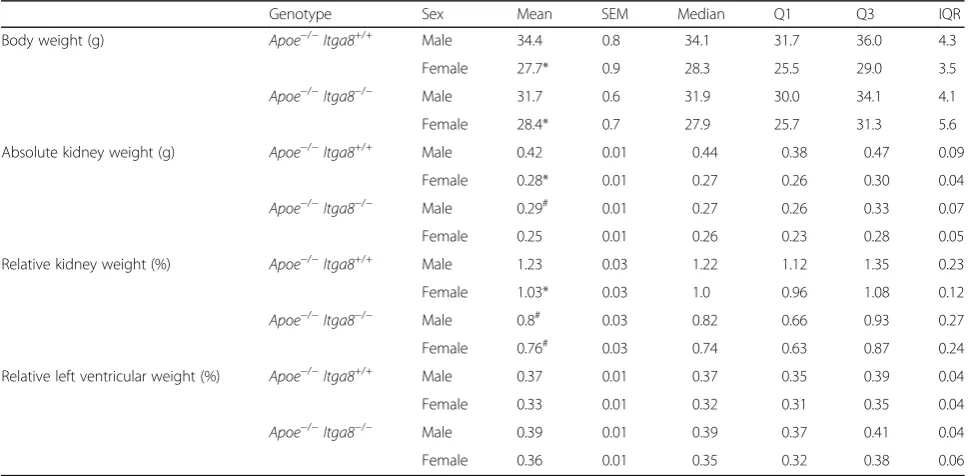
compared for the extent of renal injury. Assessment of body weights revealed significantly lower values in
fe-male mice of both genotypes (Apoe−/− Itga8+/+andApoe
−/−
Itga8−/−) compared to respective males at 1 year of age (Table 1). Relative kidney weights were lower in fe-male mice compared to fe-male mice of the same genotype.
A lack in Itga8 (Itga8−/−) resulted in reduced kidney
weights in males and females (Table 1). As an indirect marker of chronic arterial hypertension, we also assessed relative left ventricular weights, which were not signifi-cantly different between all groups (Table 1). Aortic
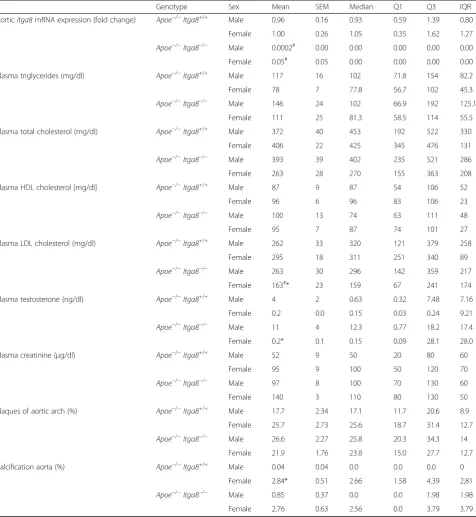
messenger RNA (mRNA) expression of Itga8was
quan-tified to confirm Itga8 deficiency in double-knockout
(Apoe−/− Itga8−/−) mice (Table 2). Compared with mice,
which were wild type for Apoe (Apoe+/+ Itga8+/+ and
Apoe+/+Itga8−/−) (Additional file 2), total serum choles-terol as well as LDL cholescholes-terol levels were elevated in Apoe-deficient (Apoe−/− Itga8+/+ and Apoe−/− Itga8−/−)
mice (Table 2). TheItga8genotype had no influence on
serum fat levels within the sameApoe genotype (Table 2
and Additional file 2), and mice with a deficiency of only Itga8 (Itga8−/−) did not develop hyperlipidemia (Add-itional file 2). Serum testosterone levels, which were sig-nificantly higher in male mice compared to female mice, did not differ significantly in male mice of the different genotypes (Table 2).
FemaleApoe-deficient (Apoe−/−Itga8+/+andApoe−/−Itga8 −/−) mice develop more severe vascular lesions than
males, despite similar serum fat levels
Total serum cholesterol levels, serum HDL levels, and serum triglycerides were not significantly different
be-tween males and females of the genotypes Apoe−/−Itga8
Table 1Anatomical data
Genotype Sex Mean SEM Median Q1 Q3 IQR
Body weight (g) Apoe−/−Itga8+/+ Male 34.4 0.8 34.1 31.7 36.0 4.3
Female 27.7* 0.9 28.3 25.5 29.0 3.5
Apoe−/−Itga8−/− Male 31.7 0.6 31.9 30.0 34.1 4.1
Female 28.4* 0.7 27.9 25.7 31.3 5.6
Absolute kidney weight (g) Apoe−/−Itga8+/+ Male 0.42 0.01 0.44 0.38 0.47 0.09
Female 0.28* 0.01 0.27 0.26 0.30 0.04
Apoe−/−Itga8−/− Male 0.29# 0.01 0.27 0.26 0.33 0.07
Female 0.25 0.01 0.26 0.23 0.28 0.05
Relative kidney weight (%) Apoe−/−Itga8+/+ Male 1.23 0.03 1.22 1.12 1.35 0.23
Female 1.03* 0.03 1.0 0.96 1.08 0.12
Apoe−/−Itga8−/− Male 0.8# 0.03 0.82 0.66 0.93 0.27
Female 0.76# 0.03 0.74 0.63 0.87 0.24
Relative left ventricular weight (%) Apoe−/−Itga8+/+ Male 0.37 0.01 0.37 0.35 0.39 0.04
Female 0.33 0.01 0.32 0.31 0.35 0.04
Apoe−/−Itga8−/− Male 0.39 0.01 0.39 0.37 0.41 0.04
Female 0.36 0.01 0.35 0.32 0.38 0.06
#p< 0.05 vsItga8+/+
+/+
and Apoe−/− Itga8−/− (Table 2). Serum LDL levels
were somewhat lower in female mice of the Apoe−/−
Itga8−/− genotype. To study the manifestation of athero-sclerosis, we assessed the formation of atherosclerotic plaques in the aorta and in the aortic arch. In the aorta, there were significantly more lesions detected in female Apoe−/− Itga8+/+ mice, compared to males of the same
genotype. In contrast, plaque formation was not
differ-ent in female and male double-knockout (Apoe−/− Itga8
−/−) mice, as male Apoe−/− Itga8−/− mice showed an
in-crease in atherosclerotic plaque formation in comparison
to male Apoe−/− Itga8+/+ (Fig. 1). By two-way ANOVA,
there was a significant interaction of sex with genotype regarding aortic plaque formation (see Additional file 3).
Table 2Cardiovascular and metabolic parameters
Genotype Sex Mean SEM Median Q1 Q3 IQR
AorticItga8mRNA expression (fold change) Apoe−/−Itga8+/+ Male 0.96 0.16 0.93 0.59 1.39 0.80
Female 1.00 0.26 1.05 0.35 1.62 1.27
Apoe−/−Itga8−/− Male 0.0002# 0.00 0.00 0.00 0.00 0.00
Female 0.05# 0.05 0.00 0.00 0.00 0.00
Plasma triglycerides (mg/dl) Apoe−/−Itga8+/+ Male 117 16 102 71.8 154 82.2
Female 78 7 77.8 56.7 102 45.3
Apoe−/−Itga8−/− Male 146 24 102 66.9 192 125.1
Female 111 25 81.3 58.5 114 55.5
Plasma total cholesterol (mg/dl) Apoe−/−Itga8+/+ Male 372 40 453 192 522 330
Female 406 22 425 345 476 131
Apoe−/−Itga8−/− Male 393 39 402 235 521 286
Female 263 28 270 155 363 208
Plasma HDL cholesterol [mg/dl] Apoe−/−Itga8+/+ Male 87 9 87 54 106 52
Female 96 6 96 83 106 23
Apoe−/−Itga8−/− Male 100 13 74 63 111 48
Female 95 7 87 74 101 27
Plasma LDL cholesterol (mg/dl) Apoe−/−Itga8+/+ Male 262 33 320 121 379 258
Female 295 18 311 251 340 89
Apoe−/−Itga8−/− Male 263 30 296 142 359 217
Female 163#* 23 159 67 241 174
Plasma testosterone (ng/dl) Apoe−/−Itga8+/+ Male 4 2 0.63 0.32 7.48 7.16
Female 0.2 0.0 0.15 0.03 0.24 9.21
Apoe−/−Itga8−/− Male 11 4 12.3 0.77 18.2 17.4
Female 0.2* 0.1 0.15 0.09 28.1 28.0
Plasma creatinine (μg/dl) Apoe−/−Itga8+/+ Male 52 9 50 20 80 60
Female 95 9 100 50 120 70
Apoe−/−Itga8−/− Male 97 8 100 70 130 60
Female 140 3 110 80 130 50
Plaques of aortic arch (%) Apoe−/−Itga8+/+ Male 17.7 2.34 17.1 11.7 20.6 8.9
Female 25.7 2.73 25.6 18.7 31.4 12.7
Apoe−/−Itga8−/− Male 26.6 2.27 25.8 20.3 34.3 14
Female 21.9 1.76 23.8 15.0 27.7 12.7
Calcification aorta (%) Apoe−/−Itga8+/+ Male 0.04 0.04 0.0 0.0 0.0 0
Female 2.84* 0.51 2.66 1.58 4.39 2,81
Apoe−/−Itga8−/− Male 0.85 0.37 0.0 0.0 1.98 1.98
Female 2.76 0.63 2.56 0.0 3.79 3.79
#p< 0.05 vsItga8+/+
Mice with a deficiency just of Itga8 (Apoe+/+ Itga8−/−) did not develop any atherosclerotic plaques (Additional file 4). The calcification of plaques was much more
prominent in femaleApoe-deficient mice than in males,
irrespective of the genotype (Fig. 2 and Additional file 3). In atherosclerotic plaques of female mice, osteopon-tin staining was much more abundant than in plaques of male mice (Additional file 5) and was predominantly de-tected at sites of calcification. To track the progress of atherosclerosis, we investigated the aortae of mice at an age of 7 and of 9 months, also. At the age of 7 months, lipid deposition was only weak and did not significantly differ between groups (Additional file 6), while at the
age of 9 months, femaleApoe−/−Itga8+/+mice displayed
an increased atherosclerotic plaque area compared to males of the same genotype (Additional file 6).
FemaleApoe-deficient (Apoe−/−Itga8−/−) mice are protected from the development of renal injury
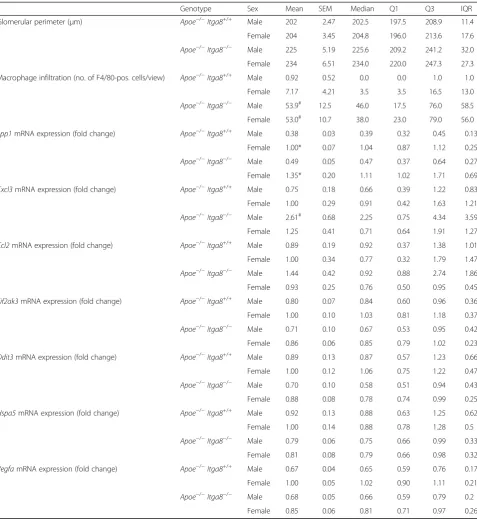
The deficiency of Itga8 (Itga8−/−) resulted in reduced
renal mass and increased glomerular perimeters (Table 3)
in both males and females. An increase in plasma urea
as a consequence of the lack ofApoeand Itga8(Apoe−/−
Itga8−/−) was observed in males only (Fig. 3a). A de-crease in cell turnover was likewise detected in double-knockout (Apoe−/− Itga8−/−) male mice (Fig. 3b), not in females. Moreover,Itga8deficiency (Itga8−/−) resulted in more pronounced glomerulosclerosis (Fig. 4) and
in-creased cortical collagen I expression (Fig. 5a) in
Apoe-deficient (Apoe−/−) males as compared to females.
Sev-eral renal inflammatory markers were induced in double-knockout (Apoe−/− Itga8−/−) male mice. The ex-pression of interleukin-6 (Il6) (Fig. 5b) and T cell infiltra-tion (Fig. 6) was significantly higher in the kidney cortex
of male compared to female mice deficient in bothApoe
and Itga8(Apoe−/− Itga8−/−). The expression of the che-mokines CXCL-3 (Cxcl3, chemokine (C-X-C motif ) lig-and 3) lig-and Ccl2 (Ccl2) tended to be higher in male mice that were deficient in Apoe and Itga8 (Apoe−/− Itga8−/−) when compared to females (Table 3). In contrast, renal macrophage infiltration was increased in both double-deficient (Apoe−/− Itga8−/−) male and female mice to a
Fig. 1Atherosclerotic plaque formation.aEvaluation of aortic plaque formation in male and femaleApoe−/−Itga8+/+orApoe−/−Itga8−/−mice.b
Exemplary en face preparations of aortae of male and femaleApoe−/−Itga8+/+orApoe−/−Itga8−/−mice, stained with Sudan IV (left) or unstained
(right).cExemplary PAS-stained cross sections of the brachiocephalic trunk of male and femaleApoe−/−Itga8+/+orApoe−/−Itga8−/−mice.
similar degree (Table 3). Renal cortical osteopontin ex-pression, on the other hand, was significantly higher in female mice compared to males irrespective of the geno-type (Table 3). The localization of renal osteopontin in both males and females of the different genotypes was predominantly found in tubular cells (Additional file 7). Data from a two-way ANOVA of several markers of renal damage are shown in Additional file 3. A reduced level of cell turnover, as seen in male double-deficient
(Apoe−/− Itga8−/−) mice, might indicate increased ER
stress of renal cells. Therefore, we investigated renal
markers for ER stress, i.e.,Eif2ak3,Ddit3(DNA
damage-inducible transcript 3) and Hspa5 (heat shock protein
family A (hsp70) member 5) expression. However, none of these markers were altered in their expression in the different genotypes and sexes (Table 3). We also
evaluated possible differences in renal (mRNA)Vegfa
ex-pression levels in male and female mice, which might ac-count for the sex differences in renal injury. Renal
(mRNA) Vegfa expression was somewhat higher in
fe-male Apoe-deficient mice compared to males of the
same genotype (Apoe−/− Itga8+/+). There were no
sex-specific differences in (mRNA) Vegfa expression levels
observed in male and female double-deficient (Apoe−/−
Itga8−/−) mice (Table 3). At 7 and 9 months of age, glomerular collagen deposition and plasma urea were
already increased in male double-deficient (Apoe−/−
Itga8−/−) mice compared to male Apoe−/− Itga8+/+. This was not observed in female mice (Additional file 6). Renal T cell infiltration was not yet different between groups at the age of 7 or 9 months (Additional file 6).
Discussion
From human studies as well as from experimental data, ample evidence exists for sex-dependent differences in the development and progression of cardiovascular dis-ease [32, 33]. The male sex is commonly recognized as an independent risk factor for cardiovascular disease
[34]. In male Apoe-deficient mice, previous studies
showed that a lack of the vascular integrin Itga8is
asso-ciated with aggravated atherosclerosis and the develop-ment of renal injury [5]. The aim of this study was to assess sex-dependent differences in the development of
vascular and renal lesions in this model of Apoe and
Itga8double deficiency.
In summary, we could show that female mice that
were deficient in Apoe (Apoe−/− Itga8+/+) developed
more severe atherosclerotic lesions when compared to males of the same genotype. In contrast, glomerular and interstitial lesions in the kidney were attenuated in fe-male mice deficient inApoeandItga8(Apoe−/−Itga8−/−) compared to male mice of the same genotype, which in-dicates that in this model, the female sex is protective for the development of renal injury, but not for the pro-gression of atherosclerosis.
In our experiments, we utilized male and female
Apoe-deficient litters on a mixed genetic background (Apoe−/− Itga8+/+), which were fed regular chow, and we detected more severe vascular damage in female mice compared
to males. In femaleApoe-deficient mice, we did not
ob-serve an aggravation of atherosclerotic lesions caused by
the additional underexpression of Itga8 (Apoe−/− Itga8
−/−), as we saw in maleApoe-Itga8double-deficient mice
[5]. These previous findings therefore seem to be limited to the male sex. Our observations of more prominent
atherosclerotic alterations in female Apoe-deficient mice
compared to males are in accordance with the findings of Caligiuri et al., which also showed more severe
ath-erosclerotic lesions in female Apoe-deficient mice in
comparison to males [35]. On the other hand, there are
Fig. 2Vascular calcification.aEvaluation of en face preparations of aortae of male and femaleApoe−/−Itga8+/+orApoe−/−Itga8−/−mice stained with von Kossa.bExemplary von Kossa-stained cross sec-tions of the brachiocephalic trunk of male and femaleApoe−/−Itga8
+/+
also numerous studies which report considerably more pronounced atherosclerosis in males compared to fe-males (reviewed in [18]). The reasons for these discrep-ant data are presently not clear, but might involve differences in the genetic background of experimental animals. In C57BL/6 mice, for example, significantly re-duced HDL levels were found under an atherogenic diet
in female animals [36]. In contrast, serum levels of HDL
in our Apoe-deficient mice on the mixed genetic
back-ground (C57BL/6x129Sv) were comparable between the sexes. Similar divergent observations were made with
triglyceride levels inApoe-deficient mice on the C57BL/
6 or Ola129 genetic backgrounds [21]. Furthermore, in
our study, Apoe-deficient animals were not exposed to
Table 3Renal parameters of anatomy, inflammation, and ER stress response
Genotype Sex Mean SEM Median Q1 Q3 IQR
Glomerular perimeter (μm) Apoe−/−Itga8+/+ Male 202 2.47 202.5 197.5 208.9 11.4
Female 204 3.45 204.8 196.0 213.6 17.6
Apoe−/−Itga8−/− Male 225 5.19 225.6 209.2 241.2 32.0
Female 234 6.51 234.0 220.0 247.3 27.3
Macrophage infiltration (no. of F4/80-pos. cells/view) Apoe−/−Itga8+/+ Male 0.92 0.52 0.0 0.0 1.0 1.0
Female 7.17 4.21 3.5 3.5 16.5 13.0
Apoe−/−Itga8−/− Male 53.9# 12.5 46.0 17.5 76.0 58.5
Female 53.0# 10.7 38.0 23.0 79.0 56.0
Spp1mRNA expression (fold change) Apoe−/−Itga8+/+ Male 0.38 0.03 0.39 0.32 0.45 0.13
Female 1.00* 0.07 1.04 0.87 1.12 0.25
Apoe−/−Itga8−/− Male 0.49 0.05 0.47 0.37 0.64 0.27
Female 1.35* 0.20 1.11 1.02 1.71 0.69
Cxcl3mRNA expression (fold change) Apoe−/−Itga8+/+ Male 0.75 0.18 0.66 0.39 1.22 0.83
Female 1.00 0.29 0.91 0.42 1.63 1.21
Apoe−/−Itga8−/− Male 2.61# 0.68 2.25 0.75 4.34 3.59
Female 1.25 0.41 0.71 0.64 1.91 1.27
Ccl2mRNA expression (fold change) Apoe−/−Itga8+/+ Male 0.89 0.19 0.92 0.37 1.38 1.01
Female 1.00 0.34 0.77 0.32 1.79 1.47
Apoe−/−Itga8−/− Male 1.44 0.42 0.92 0.88 2.74 1.86
Female 0.93 0.25 0.76 0.50 0.95 0.45
Eif2ak3mRNA expression (fold change) Apoe−/−Itga8+/+ Male 0.80 0.07 0.84 0.60 0.96 0.36
Female 1.00 0.10 1.03 0.81 1.18 0.37
Apoe−/−Itga8−/− Male 0.71 0.10 0.67 0.53 0.95 0.42
Female 0.86 0.06 0.85 0.79 1.02 0.23
Ddit3mRNA expression (fold change) Apoe−/−Itga8+/+ Male 0.89 0.13 0.87 0.57 1.23 0.66
Female 1.00 0.12 1.06 0.75 1.22 0.47
Apoe−/−Itga8−/− Male 0.70 0.10 0.58 0.51 0.94 0.43
Female 0.88 0.08 0.78 0.74 0.99 0.25
Hspa5mRNA expression (fold change) Apoe−/−Itga8+/+ Male 0.92 0.13 0.88 0.63 1.25 0.62
Female 1.00 0.14 0.88 0.78 1.28 0.5
Apoe−/−Itga8−/− Male 0.79 0.06 0.75 0.66 0.99 0.33
Female 0.81 0.08 0.79 0.66 0.98 0.32
VegfamRNA expression (fold change) Apoe−/−Itga8+/+ Male 0.67 0.04 0.65 0.59 0.76 0.17
Female 1.00 0.05 1.02 0.90 1.11 0.21
Apoe−/−Itga8−/− Male 0.68 0.05 0.66 0.59 0.79 0.2
Female 0.85 0.06 0.81 0.71 0.97 0.26
#p
< 0.05 vsItga8+/+
an atherogenic diet, which seems to be a relevant stimulus for HDL regulation in these mice [36]. Taken together, sex-dependent regulation of serum fat levels does not seem to be the underlying mechanism leading to more
se-vere atherosclerosis in femaleApoe-deficient mice in our
study. Sex hormones may exert protective roles in the de-velopment of atherosclerosis. While it is widely accepted that estrogens have protective effects on the cardiovascu-lar system [37], testosterone levels in the physiological range are also assumed to have protective effects [38]. In this context, the age-dependent decrease in testosterone levels and associated metabolic alterations are relevant pathogenetic factors for the development of atheroscler-osis in men [39, 40]. Vasculoprotective effects of testoster-one were also shown in animal studies. Thus, the less
severe atherosclerotic changes in male Apoe-deficient
mice compared to females might be caused by beneficial effects of testosterone.
Hyperlipidemia is associated with an elevated risk for the development of kidney disease [41, 42]. Numerous
clinical and animal studies suggest that Apoe deficiency
can be accompanied by renal disease [4, 43]. In our
model of Apoe deficiency, however, overt renal injury
did not develop without an additional challenge, like the
concomitant deficiency of Itga8 [5]. In male mice with
an Apoe-Itga8 double deficiency (Apoe−/− Itga8−/−), we detected marked glomerulosclerosis [5], which was clearly attenuated by the female sex, as shown in the present study. Different hormone levels in male and fe-male mice might affect the susceptibility to develop renal injury, as some evidence exists that testosterone action in the kidney may contribute to glomerulosclero-sis [44, 45].
ER stress response was shown to play a crucial role in the development of atherosclerosis and kidney disease
[46, 47]. The chaperone CHOP (synonym Ddit3) was
found as a target to modulate the severity of
atheroscler-otic lesions in Apoe-deficient mice [48]. Moreover, sex
differences in the induction of ER stress biomarker
Fig. 3Renal injury.aPlasma urea concentration of male and female
Apoe−/−Itga8+/+orApoe−/−Itga8−/−mice.bGlomerular cell
proliferation in the kidneys of male and femaleApoe−/−Itga8+/+or
Apoe−/−Itga8−/−mice. Data are presented as means ± SEM.
**p< 0.01; ***p< 0.001
Fig. 4Glomerulosclerosis.aEvaluation of glomerulosclerosis (collagen IV staining) of male and femaleApoe−/−Itga8+/+orApoe
−/−Itga8−/−mice.bExemplary photomicrographs of collagen
IV-stained renal sections of male and femaleApoe−/−Itga8+/+orApoe
−/−Itga8−/−mice. Data are presented as means ± SEM.
expression were detected in experimental hypertension [49]. Therefore, we tested the hypothesis that ER stress parameters might be differentially regulated in our male
and female Apoe-Itga8 double-deficient (Apoe−/− Itga8
−/−) mice. In our study, the expression patterns of the
chaperones Ddit3,Eif2ak3, andHspa5 were comparable
in males and females, arguing against a relevant role for ER stress in sex differences during the development of
kidney damage in Apoe-Itga8 double-deficient (Apoe−/−
Itga8−/−) mice.
In a rat study of chronic renal disease, female rats were protected from the progression of renal injury by
estrogen-stimulated Vegfa expression [50]. In contrast,
VEGF seemed to be detrimental for atherosclerotic
plaque progression [51]. We therefore tested Vegfa
ex-pression in our model. Vegfa expression was somewhat
higher in female Apoe-deficient (Apoe−/− Itga8+/+) mice
compared to males. However,Vegfa expression levels of
Apoe-Itga8 double-deficient (Apoe−/− Itga8−/−) were not different between males and females and can therefore not explain the higher susceptibility for renal injury in male mice of this genotype.
Several studies detected sex differences in the inflam-matory response during cardiovascular disease [52, 53]. Ji et al. showed a sex-dependent regulation of T cells and T cell-mediated functions in an animal model of hypertension with an induced activation of T cells in males [54]. T cells seem to have important functions in
the development of atherosclerosis of Apoe-deficient
mice. Laskowitz et al. showed an impaired T cell-associated immune response [55]. Robert et al. described a higher renal T cell infiltration rate in male animals after experimental kidney ischemia-reperfusion injury compared to females [56]. In our study, a significantly
higher T cell infiltration of the kidney from male
Apoe-Itga8 double-deficient (Apoe−/− Itga8−/−) animals
Fig. 5Renal markers of fibrosis and inflammation.aEvaluation of renal cortical collagen I expression of male and femaleApoe−/−Itga8
+/+
orApoe−/−Itga8−/−mice.bEvaluation of renal cortical
interleukin-6 expression of male and femaleApoe−/−Itga8+/+orApoe
−/−Itga8−/−mice. Data are presented as means ± SEM. *p< 0.05;
**p< 0.01; ***p< 0.001
Fig. 6Renal T cell infiltration.aEvaluation of renal cortical T cell number of male and femaleApoe−/−Itga8+/+orApoe−/−Itga8−/−
compared to females was also detected. This notion is supported by concordantly altered expression patterns of
the cytokines Il6 and Cxcl3, arguing for differences in
the inflammatory response in male and female
Apoe-Itga8double-deficient (Apoe−/−Itga8−/−) mice. These dif-ferences might contribute to the more severe renal in-jury in male mice compared to females.
In our experimental model, we observed higher
osteo-pontin levels in female mice of both genotypes (Apoe−/−
Itga8+/+ and Apoe−/− Itga8−/−) compared to males. Osteo-pontin (Spp1) is known to be regulated by sex hormones: Estrogen can induce osteopontin expression [57], while tes-tosterone is able to suppress it [58]. Osteopontin is a multi-functional protein contributing to the regulation of inflammation, atherosclerosis, and vascular calcification [59]. In accordance with our observations, osteopontin was described to be present in calcified vessels [60]. Whether osteopontin is beneficial or detrimental in atherosclerosis is controversial, but it seems that osteopontin contributes to the onset of aortic calcification, while it inhibits the pro-gression of atherosclerosis [61]. Matsui et al. found that osteopontin deficiency attenuated atherosclerosis in female Apoe-deficient mice [62]. We therefore speculate that high levels of vascular osteopontin might contribute to the more severe atherosclerotic lesions detected in our female Apoe-deficient mice (Apoe−/− Itga8+/+and Apoe−/− Itga8−/−). Al-though the action of osteopontin in the kidney is still
some-what controversial [63], several studies found
renoprotective effects of osteopontin [64–66]. This might
explain the protection from renal damage observed in our femaleApoe-Itga8double-deficient (Apoe−/−Itga8−/−) mice.
Conclusions
Taken together, we observed that in the Apoe-deficient
model of atherosclerosis, the female sex is a risk factor to develop more severe atherosclerotic lesions, although serum fat levels are not higher in females than in males. In con-trast, female mice are protected from renal damage induced
by the concomitant deficiency ofApoeandItga8. These
dif-ferences might be due to sex difdif-ferences in the inflammatory response and/or osteopontin levels. Thus, sex affects vascu-lar and renal injury not uniformly but in a differential man-ner. The reason for these differential outcomes is not clear by now, but our results suggest that there is more than one risk factor contributing to the development of vascular or renal lesions in our animal model of hyperlipidemia. The de-velopment of organ damage seems to be a result of an inter-play of sex, genotype, serum lipids, and inflammatory mediators, which might affect organs differentially.
Limitation
In our study, we used mice on a mixed genetic
back-ground. Therefore, our data cannot readily be
extrapolated to data that has been collected in similar studies performed with mice on a pure genetic background.
Additional files
Additional file 1:Primer pairs used in the study. (DOCX 24 kb)
Additional file 2:Anatomical and metabolic parameters of mice without a deletion inApoe(Apoe+/+Itga8+/+orApoe++Itga8−/−). (DOCX 22 kb) Additional file 3:Results from two-way ANOVA of markers of vascular and renal injury. (DOCX 19 kb)
Additional file 4:Atherosclerotic plaque formation in mice without a deficiency ofApoe. Exemplary en face preparations of aortae of male and femaleApoe+/+Itga8+/+orApoe+/+Itga8−/−mice, stained with Sudan IV
(left) or unstained (right). One en face preparation of the aorta of an
Apoe-deficient (Apoe−/−Itga8+/+) female mouse was stained for Sudan IV
as a positive control. (PDF 257 kb)
Additional file 5:Osteopontin in the brachiocephalic trunk. Exemplary osteopontin-stained cross sections of the brachiocephalic trunk of male and female mice with a deficiency ofApoe. (PDF 303 kb)
Additional file 6:Vascular and renal changes in 7- and 9-month-old mice. (DOCX 25 kb)
Additional file 7:Osteopontin in the kidney. Exemplary
photomicrographs of osteopontin-stained renal sections of male and fe-maleApoe−/−Itga8+/+orApoe−/−Itga8−/−mice. (PDF 548 kb)
Abbreviations
Actb:Beta actin, gene;Apoe: Apolipoprotein E, gene;Apoe−/−:Apoe-deficient;
Ccl2: CC-chemokine ligand 2, gene;Col1a1: Collagen 1, gene;
Cxcl3: Chemokine (C-X-C motif) ligand 3, gene;Ddit3: DNA-damage inducible transcript 3, gene;Eif2ak3: Eukaryotic translation initiation factor 2-alpha kin-ase 3, gene;Gapdh: Glyceraldehyde 3-phosphate dehydrogenase, gene; HDL: High-density lipoprotein;Hspa5: Heat shock protein family A (hsp70) member 5, gene;Il6: Interleukin-6, gene;Itga8: Integrin alpha 8, gene;Itga8
−/−:Itga8-deficient; LC–MS/MS: Liquid chromatography-tandem mass
spec-trometry; LDL: Low-density lipoprotein; PCNA: Proliferating cell nuclear antigen;Rn18s: 18S rRNA, gene; SEM: Standard error of the mean; SPE-HPLC-MS/MS: Solid-phase extraction-liquid chromatography-tandem mass spec-trometry;Spp1: Secreted phosphoprotein 1, gene;Vegfa: Vascular endothelial growth factor, gene
Acknowledgements
The authors thank Miroslava Kupraszewicz-Hutzler and Rainer Wachtveitl for excel-lent technical assistance. The authors further thank Sabrina Sarajy-Fahlbusch for re-vising the manuscript for the English language. Part of the experiments and analysis of data was performed by Maurizio Canu in fulfillment of the require-ments for obtaining the degree“Dr. med.”at the Friedrich-Alexander University of Erlangen-Nürnberg, Dept. of Pediatrics and Adolescent Medicine, Germany.
Funding
This study was supported by a grant from the Deutsche
Forschungsgemeinschaft, Bonn, Germany (SFB 423, Project A2) to AH; the “Interdisziplinaeres Zentrum fuer Klinische Forschung”at the University Hospital of Erlangen-Nuernberg, funded by the“Bundesministerium fuer Bil-dung und Forschung”(01 KS 0002) to AH and KFH; and an ELAN grant from the University of Erlangen-Nuernberg to AH.
Availability of data and materials
The datasets analyzed during the current study are available from the corresponding author on reasonable request.
Authors’contributions
writing of the manuscript. MR conducted experiments and participated in the data analysis. All authors read and approved the final manuscript.
Competing interests
The authors declare that they have no competing interests.
Consent for publication Not applicable
Ethics approval
All procedures performed on animals were approved by the local government authorities (Regierung von Mittelfranken, AZ No. 621-2531.31-10/02) and were done in compliance with the DIRECTIVE 2010/63/EU of the European Parliament.
Publisher’s Note
Springer Nature remains neutral with regard to jurisdictional claims in published maps and institutional affiliations.
Author details
1Department of Pediatrics and Adolescent Medicine, University Hospital of
Erlangen-Nuernberg, Loschgestrasse 15, 91054 Erlangen, Germany. 2
Department of Nephrology and Hypertension, University Hospital of Erlangen-Nuernberg, Erlangen, Germany.
Received: 1 February 2017 Accepted: 23 May 2017
References
1. Meir KS, Leitersdorf E. Atherosclerosis in the apolipoprotein-E-deficient mouse: a decade of progress. Arterioscler Thromb Vasc Biol. 2004;24(6):1006–14. 2. Knowles JW, Maeda N. Genetic modifiers of atherosclerosis in mice.
Arterioscler Thromb Vasc Biol. 2000;20(11):2336–45.
3. Balarini CM, et al. Hypercholesterolemia promotes early renal dysfunction in apolipoprotein E-deficient mice. Lipids Health Dis. 2011;10:220.
4. Wen M, et al. Renal injury in apolipoprotein E-deficient mice. Lab Invest. 2002;82(8):999–1006.
5. Menendez-Castro C, et al. Under-expression of alpha8 integrin aggravates experimental atherosclerosis. J Pathol. 2015;236(1):5–16.
6. Hartner A, et al. Lack of {alpha}8-integrin aggravates podocyte injury in experimental diabetic nephropathy. Am J Physiol Renal Physiol. 2010;299(5): F1151–7.
7. Schnapp LM, et al. Sequence and tissue distribution of the human integrin alpha 8 subunit: a beta 1-associated alpha subunit expressed in smooth muscle cells. J Cell Sci. 1995;108(Pt 2):537–44.
8. Zargham R, Thibault G. alpha8beta1 Integrin expression in the rat carotid artery: involvement in smooth muscle cell migration and neointima formation. Cardiovasc Res. 2005;65(4):813–22.
9. Hartner A, et al. The alpha8 integrin chain affords mechanical stability to the glomerular capillary tuft in hypertensive glomerular disease. Am J Pathol. 2002;160(3):861–7.
10. Tian Y, et al. Effects of gender on gene expression in the blood of ischemic stroke patients. J Cereb Blood Flow Metab. 2012;32(5):780–91.
11. Sofia RR, et al. Gender-based differences in cardiac remodeling and ILK expression after myocardial infarction. Arq Bras Cardiol. 2014;103(2):124–30. 12. Cobo G, et al. Sex and gender differences in chronic kidney disease:
progression to end-stage renal disease and haemodialysis. Clin Sci (Lond). 2016;130(14):1147–63.
13. Dasinger JH, Alexander BT. Gender differences in developmental programming of cardiovascular diseases. Clin Sci (Lond). 2016;130(5):337–48. 14. Maranon R, Reckelhoff JF. Sex and gender differences in control of blood
pressure. Clin Sci (Lond). 2013;125(7):311–8.
15. Meyrelles SS, et al. Endothelial dysfunction in the apolipoprotein E-deficient mouse: insights into the influence of diet, gender and aging. Lipids Health Dis. 2011;10:211.
16. Tangirala RK, Rubin EM, Palinski W. Quantitation of atherosclerosis in murine models: correlation between lesions in the aortic origin and in the entire aorta, and differences in the extent of lesions between sexes in LDL receptor-deficient and apolipoprotein E-deficient mice. J Lipid Res. 1995; 36(11):2320–8.
17. Bourassa PA, et al. Estrogen reduces atherosclerotic lesion development in apolipoprotein E-deficient mice. Proc Natl Acad Sci U S A. 1996;93(19): 10022–7.
18. Pereira TM, et al. Cardiac and vascular changes in elderly atherosclerotic mice: the influence of gender. Lipids Health Dis. 2010;9:87.
19. Carneiro SS, et al. Endogenous female sex hormones delay the
development of renal dysfunction in apolipoprotein E-deficient mice. Lipids Health Dis. 2014;13:176.
20. Smith DD, et al. Increased aortic atherosclerotic plaque development in female apolipoprotein E-null mice is associated with elevated thromboxane A2 and decreased prostacyclin production. J Physiol Pharmacol. 2010;61(3):309–16. 21. Surra JC, et al. Sex as a profound modifier of atherosclerotic lesion
development in apolipoprotein E-deficient mice with different genetic backgrounds. J Atheroscler Thromb. 2010;17(7):712–21.
22. Doublier S, et al. Testosterone and 17beta-estradiol have opposite effects on podocyte apoptosis that precedes glomerulosclerosis in female estrogen receptor knockout mice. Kidney Int. 2011;79(4):404–13.
23. Elliot SJ, et al. Gender-specific effects of endogenous testosterone: female alpha-estrogen receptor-deficient C57Bl/6J mice develop glomerulosclerosis. Kidney Int. 2007;72(4):464–72.
24. Zeier M, et al. Effects of testosterone on glomerular growth after uninephrectomy. Nephrol Dial Transplant. 1998;13(9):2234–40. 25. Reddick RL, Zhang SH, Maeda N. Atherosclerosis in mice lacking apo E.
Evaluation of lesional development and progression. Arterioscler Thromb. 1994;14(1):141–7.
26. Jacobi J, et al. Dimethylarginine dimethylaminohydrolase overexpression ameliorates atherosclerosis in apolipoprotein E-deficient mice by lowering asymmetric dimethylarginine. Am J Pathol. 2010;176(5):2559–70. 27. Menendez-Castro C, et al. Intrauterine growth restriction promotes vascular
remodelling following carotid artery ligation in rats. Clin Sci (Lond). 2012; 123(7):437–44.
28. Hartner A, et al. Glomerular osteopontin expression and macrophage infiltration in glomerulosclerosis of DOCA-salt rats. Am J Kidney Dis. 2001; 38(1):153–64.
29. Friedewald WT, Levy RI, Fredrickson DS. Estimation of the concentration of low-density lipoprotein cholesterol in plasma, without use of the preparative ultracentrifuge. Clin Chem. 1972;18(6):499–502.
30. Rauh M, et al. Automated, fast and sensitive quantification of 17 alpha-hydroxy-progesterone, androstenedione and testosterone by tandem mass spectrometry with on-line extraction. Steroids. 2006;71(6):450–8. 31. Kagari T, Doi H, Shimozato T. The importance of IL-1 beta and TNF-alpha,
and the noninvolvement of IL-6, in the development of monoclonal antibody-induced arthritis. J Immunol. 2002;169(3):1459–66.
32. Group EUCCS, et al. Gender in cardiovascular diseases: impact on clinical manifestations, management, and outcomes. Eur Heart J. 2016;37(1):24–34. 33. Thomas CM, Smart EJ. Gender as a regulator of atherosclerosis in murine
models. Curr Drug Targets. 2007;8(11):1172–80.
34. Mathur P, et al. Gender-related differences in atherosclerosis. Cardiovasc Drugs Ther. 2015;29(4):319–27.
35. Caligiuri G, et al. Effects of sex and age on atherosclerosis and autoimmunity in apoE-deficient mice. Atherosclerosis. 1999;145(2):301–8. 36. Paigen B, et al. Comparison of atherosclerotic lesions and HDL-lipid levels in
male, female, and testosterone-treated female mice from strains C57BL/6, BALB/c, and C3H. Atherosclerosis. 1987;64(2-3):215–21.
37. Perez-Lopez FR, et al. Gender differences in cardiovascular disease: hormonal and biochemical influences. Reprod Sci. 2010;17(6):511–31. 38. Snyder PJ, et al. Effect of transdermal testosterone treatment on serum lipid
and apolipoprotein levels in men more than 65 years of age. Am J Med. 2001;111(4):255–60.
39. Harman SM, et al. Longitudinal effects of aging on serum total and free testosterone levels in healthy men. Baltimore Longitudinal Study of Aging. J Clin Endocrinol Metab. 2001;86(2):724–31.
40. Barrett-Connor E, Goodman-Gruen D, Patay B. Endogenous sex hormones and cognitive function in older men. J Clin Endocrinol Metab. 1999;84(10):3681–5. 41. Sacks FM, et al. Association between plasma triglycerides and high-density lipoprotein cholesterol and microvascular kidney disease and retinopathy in type 2 diabetes mellitus: a global case-control study in 13 countries. Circulation. 2014;129(9):999–1008.
43. Liberopoulos E, et al. Apolipoprotein E polymorphism in northwestern Greece: frequency and effect on lipid parameters. Ann Clin Lab Sci. 2004; 34(3):347–54.
44. Herlitz LC, et al. Development of focal segmental glomerulosclerosis after anabolic steroid abuse. J Am Soc Nephrol. 2010;21(1):163–72.
45. Liu B, Ely D. Testosterone increases: sodium reabsorption, blood pressure, and renal pathology in female spontaneously hypertensive rats on a high sodium diet. Adv Pharmacol Sci. 2011;2011:817835.
46. Hotamisligil GS. Endoplasmic reticulum stress and atherosclerosis. Nat Med. 2010;16(4):396–9.
47. Taniguchi M, Yoshida H. Endoplasmic reticulum stress in kidney function and disease. Curr Opin Nephrol Hypertens. 2015;24(4):345–50. 48. Thorp E, et al. Reduced apoptosis and plaque necrosis in advanced
atherosclerotic lesions of Apoe-/- and Ldlr-/- mice lacking CHOP. Cell Metab. 2009;9(5):474–81.
49. Dai SY, et al. Endoplasmic reticulum stress in the brain subfornical organ contributes to sex differences in angiotensin-dependent hypertension in rats. Acta Physiol. 2016;217(1):33–44.
50. Kang DH, et al. The impact of gender on progression of renal
disease—potential role of estrogen-mediated vascular endothelial growth factor regulation and vascular protection. Am J Pathol. 2004;164(2):679–88. 51. Celletti FL, et al. Vascular endothelial growth factor enhances atherosclerotic
plaque progression. Nat Med. 2001;7(4):425–9.
52. Fairweather D. Sex differences in inflammation during atherosclerosis. Clin Med Insights Cardiol. 2014;8 Suppl 3:49–59.
53. Regitz-Zagrosek V, Kararigas G. Mechanistic pathways of sex differences in cardiovascular disease. Physiol Rev. 2017;97(1):1–37.
54. Ji H, et al. Sex-specific T cell regulation of angiotensin II-dependent hypertension RR. Hypertension. 2014;64(3):573–82.
55. Laskowitz DT, et al. Altered immune responses in apolipoprotein E-deficient mice. J Lipid Res. 2000;41(4):613–20.
56. Robert R, et al. Gender difference and sex hormone production in rodent renal ischemia reperfusion injury and repair. J Inflamm (Lond). 2011;8:14. 57. Craig AM, Denhardt DT. The murine gene encoding secreted
phosphoprotein 1 (osteopontin): promoter structure, activity, and induction in vivo by estrogen and progesterone. Gene. 1991;100:163–71.
58. Yagisawa T, et al. The influence of sex hormones on renal osteopontin expression and urinary constituents in experimental urolithiasis. J Urol. 2001; 166(3):1078–82.
59. Cho H-J, Cho H-J, Kim H-S. Osteopontin: a multifunctional protein at the crossroads of inflammation, atherosclerosis, and vascular calcification. Current Atherosclerosis Reports. 2009;11(3):206–13.
60. Evrard S, et al. Vascular calcification: from pathophysiology to biomarkers. Clin Chim Acta. 2015;438:401–14.
61. Shao JS, et al. Vascular calcification and aortic fibrosis: a bifunctional role for osteopontin in diabetic arteriosclerosis. Arterioscler Thromb Vasc Biol. 2011; 31(8):1821–U279.
62. Matsui Y, et al. Osteopontin deficiency attenuates atherosclerosis in female apolipoprotein E-deficient mice. Arterioscler Thromb Vasc Biol. 2003;23(6): 1029–34.
63. Xie YS, et al. Expression, roles, receptors, and regulation of osteopontin in the kidney. Kidney Int. 2001;60(5):1645–57.
64. Endlich N, et al. Analysis of differential gene expression in stretched podocytes: osteopontin enhances adaptation of podocytes to mechanical stress. Faseb J. 2002;16(11):1850.
65. Schordan S, et al. OPN deficiency results in severe glomerulosclerosis in uninephrectomized mice. Am J Physiol Ren Physiol. 2013;304(12):F1458–70. 66. Xie Y, et al. Expression of osteopontin in gentamicin-induced acute tubular
necrosis and its recovery process. Kidney Int. 2001;59(3):959–74.
• We accept pre-submission inquiries
• Our selector tool helps you to find the most relevant journal • We provide round the clock customer support
• Convenient online submission • Thorough peer review
• Inclusion in PubMed and all major indexing services • Maximum visibility for your research
Submit your manuscript at www.biomedcentral.com/submit