Page 1 UNIT-IV OFFSITE WASTE PROCESSING
LEARNING OBJECTIVES
After completing this Unit, you should be able to:
identify the purpose of waste processing;
explain the processing techniques for reducing the volume and size of wastes;
carry out separation of various components;
discuss the need for dewatering and drying of wastes;
assess technical viability of various processing techniques.
PURPOSE OF PROCESSING
The processing of wastes helps in achieving the best possible benefit from every
functional element of the solid waste management (SWM) system and, therefore,
requires proper selection of techniques and equipment for every element.
Accordingly, the wastes that are considered suitable for further use need to be
paid special attention in terms of processing, in order that we could derive
maximum economical value from them.
The purposes of processing, essentially, are (Tchobanoglous et al., 1993):
(i) Improving efficiency of SWM system: Various processing techniques are
available to improve the efficiency of SWM system. For example, before
waste papers are reused, they are usually baled to reduce transporting and
storage volume requirements. In some cases, wastes are baled to reduce the
haul costs at disposal site, where solid wastes are compacted to use the
available land effectively. If solid wastes are to be transported hydraulically
and pneumatically, some form of shredding is also required. Shredding is
LECTURE NOTES
Page 3 (ii) Recovering material for reuse: Usually, materials having a market, when
present in wastes in sufficient quantity to justify their separation, are most
amenable to recovery and recycling. Materials that can be recovered from
solid wastes include paper, cardboard, plastic, glass, ferrous metal,
aluminium and other residual metals.
(iii) Recovering conversion products and energy: Combustible organic
materials can be converted to intermediate products and ultimately to usable
energy. This can be done either through incineration, pyrolysis, composting
or bio-digestion. Initially, the combustible organic matter is separated from
the other solid waste components. Once separated, further processing like
shredding and drying is necessary before the waste material can be used for
power generation.
Having described the need for waste processing, we now discuss how waste
processing is actually carried out.
MECHANICAL VOLUME AND SIZE REDUCTION
Mechanical volume and size reduction is an important factor in the development
and operation of any SWM system. The main purpose is to reduce the volume
(amount) and size of waste, as compared to its original form, and produce waste
of uniform size. We will discuss the processes involved in volume and size
reduction along with their selection criteria, equipment requirement, design
Page 5 Volume reduction or compaction
Volume reduction or compaction refers to densifying wastes in order to reduce
their volume. Some of the benefits of compaction include:
reduction in the quantity of materials to be handled at the disposal site;
improved efficiency of collection and disposal of wastes;
increased life of landfills;
Economically viable waste management system.
However, note the following disadvantages associated with compaction:
poor quality of recyclable materials sorted out of compaction vehicle;
difficulty in segregation or sorting (since the various recyclable materials are
mixed and compressed in lumps);
Bio-degradable materials (e.g., leftover food, fruits and vegetables) destroy
the value of paper and plastic material.
Equipment used for compaction
Based on their mobility, we can categorise the compaction equipment used in
volume reduction under either of the following:
(i) Stationary equipment: This represents the equipment in which wastes are
brought to, and loaded into, either manually or mechanically. In fact, the
compaction mechanism used to compress waste in a collection vehicle, is a
stationary compactor. According to their application, stationary compactors
can be described as light duty (e.g., those used for residential areas),
commercial or light industrial, heavy industrial and transfer station
compactors. Usually, large stationary compactors are necessary, when
wastes are to be compressed into:
steel containers that can be subsequently moved manually or
LECTURE NOTES
Page 6 chambers where the compressed blocks are banded or tied by some
means before being removed;
chambers where they are compressed into a block and then released and
hauled away untied;
transport vehicles directly.
(ii) Movable equipment: This represents the wheeled and tracked equipment
used to place and compact solid wastes, as in a sanitary landfill.
Types of Compaction Equipment
Location or Type of Compactor
Remarks Operation Stationary/residential
Vertical compaction ram may be used;
may be mechanically or hydraulically
Vertical
operated, usually hand-fed; wastes
compacted into
corrugate
d box
containers, or paper or plastic bags; usedinmediumandhigh-rise
apartments.
Solid waste generation
Ram mechanism used to compact waste
into paper or
plasti
c bags on rotating points
Rotary
platform, platform rotates
as containers
are filled; used in medium and high-rise
apartments.
Page 7 or
Bag or extruder
continuous multi-bags; single bag must
be replaced and continuous bags must be tied off and replaced; used in medium
and high-rise apartments.
Compactors
According to their compaction pressure, we can divide the compactors used at
transfer stations as follows:
(i) Low-pressure (less than 7kg/cm2) compaction: This includes those used
at apartments and commercial establishments, bailing equipment used for
waste papers and cardboards and stationary compactors used at transfer
stations. In low-pressure compaction, wastes are compacted in large
containers. Note that portable stationary compactors are being used
increasingly by a number of industries in conjunction with material
recovery options, especially for waste paper and cardboard.
(ii) High-pressure (more than 7kg/cm2) compaction: Compact systems with
a capacity up to 351.5 kg/cm2 or 5000 lb/in2 come under this category. In
such systems, specialised compaction equipment are used to compress solid
wastes into blocks or bales of various sizes. In some cases, pulverised
wastes are extruded after compaction in the form of logs. The volume
reduction achieved with these high-pressure compaction systems varies
with the characteristics of the waste. Typically, the reduction ranges from
about 3 to 1 through 8 to 1.
LECTURE NOTES
Page 8 This is required to convert large sized wastes (as they are collected) into smaller
pieces. Size reduction helps in obtaining the final product in a reasonably uniform
and considerably reduced size in comparison to the original form. But note that
size reduction does not necessarily imply volume reduction, and this must be
factored into the design and operation of SWM systems as well as in the recovery
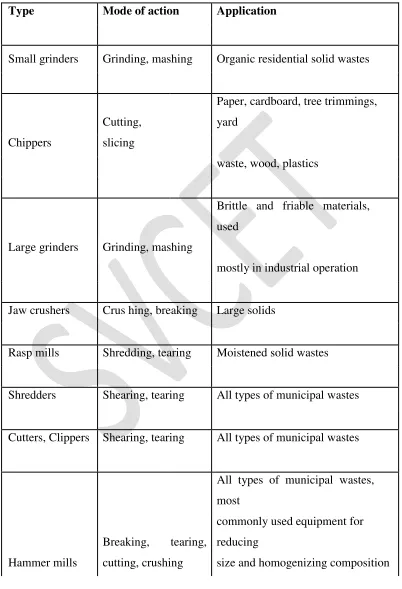
Page 9 Table Size Reduction Equipment
Type Mode of action Application
Small grinders Grinding, mashing Organic residential solid wastes
Chippers
Cutting,
slicing
Paper, cardboard, tree trimmings,
yard
waste, wood, plastics
Large grinders Grinding, mashing
Brittle and friable materials,
used
mostly in industrial operation
Jaw crushers Crus hing, breaking Large solids
Rasp mills Shredding, tearing Moistened solid wastes
Shredders Shearing, tearing All types of municipal wastes
Cutters, Clippers Shearing, tearing All types of municipal wastes
All types of municipal wastes,
most
Hammer mills
Breaking, tearing,
commonly used equipment for
reducing
LECTURE NOTES
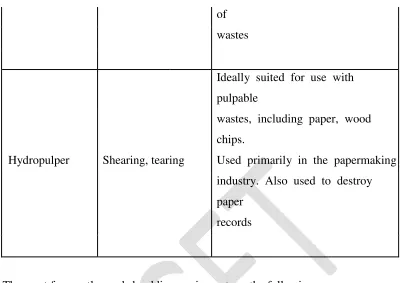
Page 10 of
wastes
Ideally suited for use with
pulpable
wastes, including paper, wood
chips.
Hydropulper Shearing, tearing Used primarily in the papermaking
industry. Also used to destroy
paper
records
The most frequently used shredding equipment are the following:
(i) Hammer mill: These are used most often in large commercial operations
for reducing the size of wastes. Hammer mill is an impact device consisting
of a number of hammers, fastened flexibly to an inner disk, which rotates at
a very high speed:
Page 11 Solid wastes, as they enter the mill are hit by sufficient force,
which crush or tear them with a velocity so that they do not
adhere to the hammers. Wastes are further reduced in size by
being struck between breaker plates and/or cutting bars fixed
around the periphery of the inner chamber. This process of
cutting and striking action continues, until the required size of
material is achieved and after that it falls out of the bottom of
the mill.
COMPONENT SEPARATION
Component separation is a necessary operation in which the waste components
are identified and sorted either manually or mechanically to aid further
processing. This is required for the:
recovery of valuable materials for recycling;
preparation of solid wastes by removing certain components prior to
incineration, energy recovery, composting and biogas production.
LECTURE NOTES
Page 12 collection. In many cities (e.g., Bangalore, Chennai, etc., in India), such systems
are now routinely used. The municipality generally provides separate, easily
identifiable containers into which the householder deposits segregated recyclable
materials such as paper, glass, metals, etc. Usually, separate collections are
carried out for the recyclable material. At curbside, separate areas are set aside for
each of the recyclable materials for householders to deliver material – when there
is no municipal collection system. In case the separation is not done prior to
collection, it could be sorted out through mechanical techniques such as air
separation, magnetic separation, etc., to recover the wastes
Air separation
This technique has been in use for a number of years in industrial operations for
segregating various components from dry mixture. Air separation is primarily
used to separate lighter materials (usually organic) from heavier (usually
inorganic) ones. The lighter material may include plastics, paper and paper
products and other organic materials. Generally, there is also a need to separate
the light fraction of organic material from the conveying air streams, which is
usually done in a cyclone separator. In this technique, the heavy fraction is
removed from the air classifier (i.e., equipment used for air separation) to the
recycling stage or to land disposal, as appropriate. The light fraction may be used,
with or without further size reduction, as fuel for incinerators or as compost
material. There are various types of air classifiers commonly used.
Page 13 Magnetic separation
The most common method of recovering ferrous scrap from shredded solid wastes
involves the use of magnetic recovery systems. Ferrous materials are usually
recovered either after shredding or before air classification. When wastes are
mass-fired in incinerators, the magnetic separator is used to remove the ferrous
material from the incinerator residue. Magnetic recovery systems have also been
used at landfill disposal sites. The specific locations, where ferrous materials are
recovered will depend on the objectives to be achieved, such as reduction of wear
and tear on processing and separation equipment, degree of product purity
achieved and the required recovery efficiency.
LECTURE NOTES
Page 14 Screening
Screening is the most common form of separating solid wastes, depending on their size by the
use of one or more screening surfaces. Screening has a number of applications in solid waste
resource and energy recovery systems. Screens can be used before or after shredding and after
air separation of wastes in various applications dealing with both light and heavy fraction
materials. The most commonly used screens are rotary drum screens and various forms of
vibrating screens.
Rotary Drum Screen
DRYING AND DEWATERING
Drying and dewatering operations are used primarily for incineration systems,
with or without energy recovery systems. These are also used for drying of
sludges in wastewater treatment plants, prior to their incineration or transport to
land disposal. The purpose of drying and dewatering operation is to remove
Page 15 fraction is pelletised after drying to make the fuel easier to transport and store,
prior to use in an incinerator or energy recovery facility.
Moisture Content of Municipal Solid Waste Components
Component
Moisture (in percent)
Range Typical
Food wastes 50 – 80 70
Paper 4 – 10 6
Cardboard 4 – 8 5
Plastics 1 – 4 2
Textiles 6 – 15 10
Rubber 1 – 4 2
Leather 8 – 12 10
Garden trimmings 30 – 80 60
Wood 15 – 40 20
Glass 1 – 4 2
Tin cans 2 – 4 3
Nonferrous metals 2 – 4 2
Ferrous metals 2 – 6 3
Dirt, ashes, brick, etc. 6 – 12 8
LECTURE NOTES
Page 16
Drying
The following three methods are used to apply the heat required for drying the wastes:
(i) Convection drying: In this method, hot air is in direct contact with the wet solid waste
stream.
(ii) Conduction drying: In this method, the wet solid waste stream is in contact with a heated
surface.
(iii) Radiation drying: In this method, heat is transmitted directly to the wet solid waste
stream by radiation from the heated body.
Dewatering
Dewatering is more applicable to the problem of sludge disposal from wastewater treatment of
plants, but may also be applicable in some cases to municipal/industrial waste problems. When
drying beds, lagoons or spreading on land are not feasible, other mechanical means of
dewatering are used. The emphasis in the dewatering operation is often on reducing the liquid
volume. Once dewatered, the sludge can be mixed with other solid waste, and the resulting
mixture can be:
incinerated to reduce volume;
used for the production of recoverable by-products;
used for production of compost;