©Walden University, LLC, Minneapolis, MN DOI: 10.5590/JSBHS.2017.11.1.08
Ashley Youngs is now a graduate student at Department of Psychology, Radford University.
These data were collected in partial fulfillment of the PhD requirements in life-span developmental psychology at West Virginia University, under the direction of Julie Hicks Patrick, PhD. This research was supported in part by grants from the Department of Psychology, West Virginia University, and the Eberly College of Arts and Sciences, West Virginia University, awarded to Allyson S. Graf. This manuscript was completed in partial fulfillment of undergraduate independent study credit at Elmira College, under the direction of Allyson S. Graf, PhD.
Please address queries to: Allyson S. Graf, Department of Psychology, Elmira College, Elmira, NY 14901. Email: [email protected]
Innovating the Innovation: Applying Mobile Research
Methods to Experience Sampling
Ashley Youngs
Elmira College
Allyson S. Graf
Elmira College
As technology continues to grow and flourish, research methods are being adapted to take advantage of the many benefits online methods can offer. Compared to traditional methods, online methods tend to be cost and time effective, increase feelings of anonymity for
participants, and reduce human error through prevention or accommodation. Mobile research methods—online research conducted through mobile devices using email or application technology—represent the newest frontier in online research methods, presumably increasing convenience for participants and accessibility to daily life for researchers. As with any new method, however, researchers must find the best way to engage with participants while weighing the pros and cons of the method. Mobile methods have not received critical attention in this way, despite the increase in research applications. Through examination of the extant literature and solicited feedback following an experiential sampling method study completed primarily using mobile methods, the current paper
provides the perspectives of participants and researchers about utilizing mobile methods for research. We then synthesize those observations and end with a list of proposed best
practices for use in future applications of mobile research methods. The primary takeaways include practicing caution in assuming the convenience of mobile research methods and the need for further examination of the limits and boundaries of the technology used. The promise is great, but the pitfalls are plentiful.
Journal of Social, Behavioral, and Health Sciences 116
Introduction
In research, current and best method practices provide guidance and help to reduce the time and energy researchers spend designing studies, eliminating redundant preparations and allowing focus on proven methods of success (Eglene, 2000). Researchers across many disciplines regularly
evaluate, revise, and provide recommendations to keep abreast of new and ongoing challenges. Although each discipline may coin a slightly different term (best practices, evidence-based practices, promising practices, smart practices, good practices, etc.), the collective understanding is that these recommendations are deemed to be acceptable and appropriate alternatives to other practices as supported by evidence from industry experts. The dissemination of methodological successes or cautionary tales of missteps helps to keep scientific practices evolving in line with technological advancements and demands. The growing field of online research methods is no exception.
Traditionally a platform for survey delivery, the newest areas of exploration falling under the purview of online research are the opportunities presented by mobile technologies (Intille, 2012; Miller, 2012). Due to its novelty, there is not a great deal of literature on the evaluation or best practices to employ when utilizing mobile technologies for research purposes (Kjeldskov & Graham, 2003). Following a brief summary of the utility of online and mobile research methods, we provide qualitative observations (participant and researcher) gathered from an experience sampling study implemented online and mainly on mobile devices. Experience sampling methods (ESMs) are a type of methodology used to examine the content and context of daily life, allowing for timely and nuanced observations (Hektner, Schmidt, & Csikszentmihalyi, 2007). We end with recommended best
practices for future research employing mobile research methods in combination with ESM.
Online Research Methods: Accessibility, Anonymity, and Cost Effectiveness
With the advent of new technologies, researchers have cautiously adapted their methods for these platforms (Miller, 2012). For example, survey data used to be collected most commonly via pencil and paper, either in self-guided or face-to-face interview formats. With the introduction of alternative forms of communication, however, new and more efficient methods became available. The earliest transition toward these methods was with telephone surveying in the 1970s (Gunter, Nicholas, Huntington & Williams, 2002). By the middle of the decade, computers were introduced that could interface with telephone interviews. In the 1990s, the Internet was flourishing, creating yet another avenue for researchers to penetrate. By the early 2000s, the most common type of online survey was deliverable via email, embedded within the email body, attached as a fill-in document or a survey program, or accessed as a web-based survey through a provided link (Van Selm & Jankowski, 2006).
In part, the drive to move survey research online had to do with gaining access to more diverse segments of the population (Van Selm & Jankowski, 2006). As of 2015, 84% of American adults use the Internet, and hard-to-reach population segments, such as older adults, have reached 58% with projected continual growth (Perrin & Duggan, 2015). Aside from recruitment, online data collection allows for convenience, eliminating the physical need to visit a lab or alternative meeting location, as well as the pressure and biases of being present in a lab setting. Additionally, online methods save time and are less costly while producing faster results (Crews & Curtis, 2011). Beyond cost and time savings, online methods can minimize human error, standardize administration, and provide comparable reliability and validity to traditional methods (Emery, 2014). For these reasons, online research has become one of the fastest growing areas in social science research (Taylor, 2000).
Journal of Social, Behavioral, and Health Sciences 117 from U.S.-based companies, the average budget allowance for online/digital marketing expenditures, including research, was 25% (Gartner, 2013). Other industries, including government, healthcare, and education, also utilize online methods. It is possible that these methods are preferred over paper-pencil methods because the data are timely (“of the moment”) with many survey programs offering coded data downloads or pre-programmed analytic tools, thereby foregoing the need for manual data entry or lengthy periods of analytical processing (Van Selm & Jankowski, 2006). Another advantage of online research methods is the potential for greater ecological validity in comparison to survey methods which are removed from the context where behaviors of interest occur. Thus, online methods seem better aligned for directorial decision-making (Intille, 2012).
Technological innovations have continually changed the way individuals engage online as well (Miller, 2012). Thus, researchers employing online research methods needed to track and understand such patterns of engagement in order to better capitalize on such developments. One such observed pattern has occurred with the rise of social media. In the United States, 67% of individuals over the age of 12 use some form of social media (King, 2015). King, O’Rourke, and DeLongis (2014) have advocated for using this platform to recruit diverse populations cost effectively. Facebook has been the focus because the social media site has cross-national reach and advertisement options that cater to a person’s interests. King et al. (2014) used Facebook advertising as part of recruitment strategy for a study of older adults with bipolar disorder. They secured around 2,100 individuals from 30 countries, demonstrating a successful use of a social media to recruit a diverse sample for a clinical psychology study.
Beyond clinical studies, online recruitment can also be helpful in reaching underserved and hidden populations, people who do not have access to services or those who would not want to participate in person (Emery, 2014). Some individuals may forego participation in face-to-face studies because they harbor fear or resentment of authority figures and societal institutions. By providing online data, however, participants in one study stated that they did not mind answering personal questions because they felt secure with the degree of anonymity (Duncan, White, & Nicholson, 2003). The increased sense of anonymity is an advantage compared to traditional face-to-face interviews, where participants may feel pressured to portray themselves in a positive way (Van Selm & Jankowski, 2006). With anonymity, however, does come a risk of deindividuation, an absence of social cues, and reduced self-awareness, which may in turn create a context for disinhibition (Joinson, 2007). This risk must be considered given the focus and target audience of the study or evaluation.
For example, Duncan et al. (2003) conducted the DRUGNET study to demonstrate effective means of sampling and collecting data from hidden drug populations. Normally, research on drug use only includes those who have been arrested or admitted for clinical treatment. The researchers created a survey on their own website and solicited participants through online mailing lists. When completed, they had the largest sample of nonabusing illicit drug user data. Other special populations, including alcoholics, surgical patients, smokers, and college students, may benefit from this method (Farrell & Petersen, 2010).
Journal of Social, Behavioral, and Health Sciences 118 traditional paper evaluations as well (i.e., teacher not present during survey administration).
Moreover, online evaluations allowed students to complete them on their own time, which produced responses that were more constructive. In business, online evaluative surveys are used to provide client feedback and indicators of employee satisfaction (Emery, 2014). Again, despite the apparent benefits, online methods do not automatically guarantee quality responses. In fact, one of the best-demonstrated shortcomings of moving from paper to online surveys is a reduction in response rates (Nulty, 2008). Caution should be practiced in making such shifts with appropriate attention given to goals of the project.
Multiple disciplines are taking advantage of online methods across a broad range of applications, and this has only continued to increase in current years (Van Selm & Jankowski, 2006). For businesses, schools, and independent researchers, a cost-effective method that reaches diverse samples in a short amount of time is optimal. As the transition from offline traditional methods of research to online methods has been successful, it is now time to continue expanding research with technology’s advances: mobile devices (Miller, 2012).
Expanding the Use of Mobile Technology: Experience Sampling Methods
One type of research that efficiently interfaces with online technology is ESM. ESM involves participants reporting life experiences as they happen through momentary analysis (Christensen, Barrett, Bliss-Moreau, Lebo, & Kaschub, 2003; Hektner et al., 2007). This helps reduce recall error and provides the researcher with glimpses of variables in vivo. Researchers can sample responses randomly, on a specific schedule, or as a triggered self-reported event by the participant (Scollon, Kim-Pietro, & Diener, 2003). Prior to the advent of online research, ESM studies were conducted by completing paper surveys or diaries when prompted to do so or by responding to telephone calls from the researchers who would record the data. Often, the validity of the results was questionable, however, because participants had to recall and approximate the details of an event alongside their concurrent behaviors, thoughts, or feelings (Christensen et al., 2003). The types of events and timing of reports can be limited by accessibility to the reporting tools (e.g., paper surveys, diaries, landline telephones). Granting participants a longer window of response time can help, but the longer the period of time the greater the opportunity for a variety of memory and cognitive biases to influence reporting (Scollon et al., 2003). Another potential reporting inaccuracy stemmed from completing responses beyond a reasonable retrospective window, also known as backfilling (Shiffman, Stone, & Hufford, 2008). Transporting physical diaries or paper surveys and administrative hassles, such as mailing survey responses to the researcher, created additional burdens for participants.
With a majority of individuals in the United States using the Internet (Anderson & Perrin, 2016), online methods are a beneficial way to overcome the shortcomings of traditional pencil-and-paper ESM reporting (Intille, 2012). Additionally, the Internet is now accessible on many mobile devices, thereby reducing many of the logistical concerns and enhancing the likelihood of obtaining
ecologically valid responses. The most common form of mobile technology today is cellphones (Monroe, Thompson, Bassett, Ritzhugh, & Raynor, 2015), although mobile technology can also include tablets and any other easily transportable device with Internet connectivity. The proportion of cellphone users, however, spans across the demographics of age, gender, race, urbanity,
Journal of Social, Behavioral, and Health Sciences 119 massive industry will allow researchers access to large representative groups equipped with ready-to-use technology (Miller, 2012).
According to Poynter (2014), 25–30% of online surveys completed in 2014 were done on a mobile device. This means that online research is already going mobile without explicit direction, and it is no surprise. According to a recent report, 93% of individuals with smartphones look at their device within the first 3 hr after waking up (Deloitte, 2015). Mobile technology is becoming commonplace. Therefore, delivering surveys to mobile devices affords increased accessibility by building on an already existing part of daily life.
Besides accessibility, there are other benefits to using mobile technology. For example, a sizeable minority of individuals are already using apps for health monitoring. Of the individuals who have apps on their phones, 38% reported having health applications (Monroe et al., 2015). The most popular type of these is exercise-related. If people are already using these apps for their own personal knowledge, researchers may be able to use this data to answer health-related hypotheses. Furthermore, with technology like the Fitbit (Fitbit, Inc., Boston, MA), a multitude of health variables are recorded automatically, and could therefore be linked with other self-reported data from particular moments throughout the day.
Expanding with technology and into mobile methods allows researchers to target a platform wherein people are presumed to be already familiar and comfortable with the technology they possess in the hopes of gaining increasingly valid and timely information (Miller, 2012). Therefore, the shift to tech-driven methods is not impeded by a learning curve, a seeming disadvantage in comparison to paper-and-pencil methods. There are other barriers, however. There is some recent research (Ickin et al., 2012) on overall quality of experience when using mobile technology to support positive user
perceptions, but factors such as inconsistent application performance and battery and phone features make design decisions for mobile research complex.
Despite the expansive growth of online research methods in general, there is a dearth of
consideration for the best practices to employ when moving into mobile online research. Our goal is to examine participant perceptions of mobile method barriers, challenges, and improvements specific to the research experience following the implementation of an ESM study completed mostly through mobile technology. Based on general recommendations from the literature, researcher observations during study implementation, and participant feedback collected in an exit survey at the time of study completion or dropout, we provide observations regarding the use of mobile technologies in research and suggest best practices for future applications.
Method
Procedure and Participants
Journal of Social, Behavioral, and Health Sciences 120 participants had to be at least 25 years of age and not currently enrolled as a full-time college student. These sample selection criteria were specified in relation to an important measure of the original study (daily hassles and uplifts) wherein college students demonstrate different patterns relative to adults. Participants also had to reside in the targeted geographic regions (selected because of common health and well-being conditions) and indicate their willingness and ability to continue with Phase II of the study, the experience sampling phase. This included having a smartphone or unrestricted access to another device (e.g., tablet, computer, etc.) with Internet connectivity to complete the experience sampling portion of the study.
One hundred fourteen individuals completed the prescreen survey, which included multiple measures of health and wellbeing. Fifteen of these participants did not meet study requirements (geographic restrictions and consistent Internet access), and 11 more did not start the ESM phase for unspecified reasons All participants who started the ESM procedure (N = 88) were sent an exit survey, regardless of whether they completed the full study protocol. The exit survey was included as a follow-up to assess overall impressions of the entire study experience. Participants were also provided the opportunity at the end of each study day (evening ESM signals) to inform the research team of any events that may have influenced that day’s reports. Although participants varied greatly in the number of ESM signals completed (M = 39.69, SD = 14.55, range = 3–56), 76 completed the exit survey.
Participants were compensated following completion of the exit survey or after three follow-up attempts with no response. A monetary honorarium was provided using a flat rate ($6.00 USD) for the baseline survey and an incremental, bonus-based compensation system was used to prorate ESM participation. Specifically, compensation for the ESM phase was described to participants as
contingent on the number of completed surveys at a rate of $0.25 USD per survey (maximum $1.00 USD per day). A $5.00 USD bonus was possible for those completing each week’s worth of time points (28 total). Payment was made per the participant’s preference, either via mailed check or PayPal transfer.
For the purposes of the following analyses, two of the 76 participants were removed for incomplete data. The final sample consisted of 74 individuals (55.4% female) between the ages of 25 and 71 (M = 44.95, SD = 13.16). Most (97.3%) participants identified as White/Caucasian and non-Hispanic (91.9%). A majority (78.4%) reported being married, with the remaining either divorced (4.1%), never married (5.4%), cohabiting (4.1%), or widowed (4.1%). A little over half (56.8%) were employed full time, with 13.5% reporting full retirement, 9.5% working part time, 2.7% partially retired, and 1.4% unemployed. The sample was well-educated with 23.0% having completed some college, 17.6% having received a bachelor’s degree, and 32.5% holding a master’s degree or higher.
Measures
Timestamps and Completed Survey Signals
Journal of Social, Behavioral, and Health Sciences 121 answered their next survey at 11:00 a.m., both time points would be retained. Valid responses were counted and compared to estimates (see below).
Exit Survey
As part of the exit survey, participants reflected on their research experience using a variety of Likert-type and open-ended questions, included specifically to gauge perceptions of different elements of the study design. Ten Likert-type items and four open-ended questions were developed solely for descriptive purposes, addressing aspects of ESM designs that have been areas of concern in the extant literature (Christensen et al., 2003; Scollon et al., 2003; Shiffman et al., 2008). These items were reviewed by a five-person committee, all of whom were familiar with ESM designs. The items were deemed appropriate for gaining subjective perceptions of the research experience. The Appendix contains these items.
First, participants indicated whether they completed the full 2-week protocol, a possible 56
individual survey signals. If negative, they estimated how many survey signals they had missed and responded to the following: “Briefly describe the main reasons for missing assessments.” Next, they reported their overall satisfaction with the research experience followed by reported satisfaction with different aspects of the study, including the baseline survey, daily surveys, study organization, study flexibility, communication by researcher team, and compensation, using a 5-point scale ranging from
extremely unsatisfied to extremely satisfied. Again, using a five-point scale, participants indicated their likelihood, given their experience, of participating in other research in general, other research like this study, and recommending that others participate in research studies. Lastly, participants open-endedly detailed any difficulties they experienced during participation and responded to the prompt, “What should be done differently in future studies using daily surveys?”
Data Analysis
All analyses are based on the 74 participants who completed the exit survey. We first report descriptive data concerning discrepancies between the number of completed ESM signals and participant perceptions of their completion rates. This is meant to contextualize the open-ended exit survey responses that are our focus of analysis. This also underscores the meaningfulness of
qualitative data in understanding not only the participant experience, but also important methodological considerations, such as missingness and attrition.
Next, we focus on the open-ended survey items. Given the inconsistency with which the daily questions were answered (due to missed time signals and failure to complete the open-ended response portion) and the overlap between the responses given in the daily ESM responses and the exit surveys, we opted to analyze the exit survey responses for the purposes of this report. We employed content analysis, systematically and iteratively organizing the responses into multilevel categories. The first author had on-the-job training in qualitative data analysis and the co-author received training during graduate coursework. An independent third-party who regularly publishes and teaches an undergraduate course on qualitative research was also consulted about the analysis procedure.
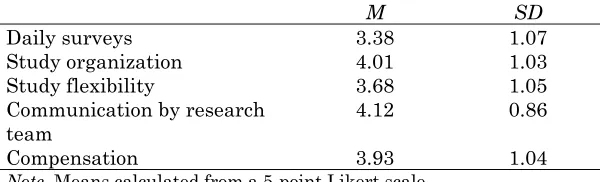
Journal of Social, Behavioral, and Health Sciences 122 was repeated for each open-ended question analyzed. The identified themes are discussed below (in italics) with implications and applications to future practices examined in the discussion. Means and standard deviations are reported for the Likert-style items (see Table 1); these results are briefly discussed as they are primarily descriptive of the sample and cannot be compared or generalized.
Results
Discrepant Participant Perceptions
Of the 74 participants, only six completed all 56 ESM signals. Participant perceptions of their completion rate suggested otherwise. Nearly one-third of the sample (n = 23, 31.1%) indicated that they had completed all the survey signals when they had not. It is possible that some participants had indeed completed most, if not all, of the survey signals, but due either to a transmission error or violation of the study protocol (e.g., completing the survey outside of the 2-hr survey window
timeframe) they ended up with incomplete data. Additionally, some participants may also have been using the number of survey signals they completed at the point of dropping out of the study as opposed to the full study protocol. For example, five participants (6.8%) who completed the exit survey had completed less than 10 ESM surveys and self-selected out of the study very early in the process. The major theme to emerge in response to reasons for missing survey signals revolved around time and included the sub-themes of study design (e.g., limited time windows, length of the surveys) and lifestyle obligations (e.g., scheduling conflicts). These are discussed in conjunction with recommended improvements below.
Study Protocol Violations
Some participants did not heed the instructions regarding the valid time window for responses. Therefore, they may have reported a higher rate of completion than the final cleaned data file indicated. Six participants had their data entirely removed from the ESM analyses because most of their responses were backfilled. Other individuals had individual time points invalidated due to timing. In total, 270 individual time points (of a possible 4,928) were removed because of invalid timing. Another eight time points were excluded because they were too close in time to another response.
Reported Difficulties
Technology emerged as the main difficulty experienced throughout the 2 weeks. Approximately one in three participants (n = 25, 33.8%) reported issues with Internet access, email, or phone availability
as either a reason for missing surveys or as a difficulty in receiving the surveys. Four individuals (5.4%) indicated problems with inconsistent Internet access. Specific references to email included issues such as the surveys going into the participant’s spam (n = 5, 6.8%), the email service provider experiencing technical difficulties resulting in delayed or surveys that would only partially load (n = 10, 13.5%), and other generic references. In regard to cellphones, two participants (2.7%) could not access the survey on their phones and others did not always have their phones charged or with them (n = 5, 6.8%). Despite these reported difficulties, over half (n = 42, 56.8%) of the participants stated that they had no difficulties and 16 (21.6%) left the question unanswered.
Participant Satisfaction
Journal of Social, Behavioral, and Health Sciences 123 likelihood to participate in other research studies in general (M = 4.00, SD = 1.24), likelihood to participate in other studies like this one (M = 3.93, SD = 1.27), and likelihood to recommend others participate (M = 3.97, SD = 1.18).
Table 1.
Self-Reported Satisfaction From Participants
M SD
Daily surveys 3.38 1.07
Study organization 4.01 1.03
Study flexibility 3.68 1.05
Communication by research
team 4.12 0.86
Compensation 3.93 1.04
Note. Means calculated from a 5-point Likert scale.
Recommended Improvements
Participants supplied open-ended suggestions for future studies that echoed their reasons for missing survey signals. The themes stemming from these questions surrounded time restrictions
(e.g., “give more time to complete surveys”), study structure (e.g., “less daily surveys, only two a day,” “Fewer surveys per day or spreading survey days out over a longer period of nonconsecutive days”), and survey content (e.g., “Maybe a wider array of questions,” “Possibly the opportunity to reflect at the end of the day in a recap kind of format?”).
In regard to timing, participants thought that the 2-hr window to complete each survey was inadequate because of competing obligations like “being busy,” family, and work. In fact, lifestyle obligations were the most reported reason for missing survey responses with over half of participants indicating so (n = 41, 55.4%). Several recommendations were made to improve the study design. Over a quarter of participants (n = 20, 27.0%) suggested altering the time window restrictions as a way of improving the design. One participant suggested having the option to backfill missed surveys and another even went as far to suggest a decreased compensation scale for reporting at different times outside of the acceptable window. A small minority of people (n = 13, 17.6%) stated that the surveys were too long and that completing four a day was too much. Moreover, in addition to suggestions to make the surveys shorter, a few participants indicated that answering the same types of question each time was too repetitive. Specifically, one participant stated that “changing the question a little every so often would keep the interests of the participant.” Although these limitations of the research design are more general, they represent some failed assumptions about the ease provided by a mobile methods design.
In reference to the mobile aspect, participant suggestions and reasons for missing responses underscored the limitations of technology or technological difficulties. As noted above, although individuals had the required technology, a handful (n = 7, 9.5%) reported that either they did not remember their phone on a given day or that the phone had lost battery power and died. One participant admitted to not having a mobile device and an inability to get to a computer in time. Therefore, although prior to participation, participants were advised about the need to have regular access to a mobile device or computer, they were not always able to follow through with such a commitment. Furthermore, one participant reported problems viewing the surveys on their
Journal of Social, Behavioral, and Health Sciences 124
Discussion
Mobile methods provide easy accessibility for participants, and presumably convenience, because of habitual mobile device use (Deloitte, 2015); however, there is some research to suggest that while quality of experience is generally favorable, obstacles are present (Ickin et al., 2012). Observations made in the current study indicated that mobile methods for the purposes of research might not be as convenient as anticipated. The average number of surveys completed (approximately 40 out of a possible 56), the number of responses invalidated due to missed response windows (270), and the qualitative participant commentary together support this conclusion. Yet, despite the seeming lack of convenience, participants on average still rated their overall satisfaction and likelihood to participate in similar studies on the higher end of the provided scale. The lowest reported mean, however, was in response to satisfaction with the daily surveys.
Although the current study incorporated best practice considerations for ESM (Scollon et al., 2003) and a portion of the protocol was pilot-tested a priori, we highlight several limitations pertaining to the implementation of mobile methods. Participant suggestions and response patterns revealed that although individuals had access to the required technology, usage might not have been consistent across individuals or even within the same individual across study days. Simply owning a device did not seem to be indicative of familiarity with all functions or frequency of use; as one participant stated, “Only checked email one time a day or not at all.” Furthermore, the most commonly cited barrier to completion surrounded lifestyle obligations, such as family and work. Such barriers are typical of the sample demographic, but the researchers believed the use of mobile methods,
specifically the ability to respond with a device that was readily at hand for many, would serve as a solution. These observations are consistent with data suggesting that mobile device usage follows the daily routine of the individual, resulting in some applications being used more or less frequently throughout the day (Ickin et al., 2012). Some participants also perceived the surveys as long and repetitive, possibly reducing their motivation to take time away despite the ease of access. Therefore, although researchers may view this method as more convenient than traditional pencil-and-paper methods (Shiffman et al., 2008), participants’ inconsistent use of their mobile devices and everyday obligations still produced barriers to participation.
Despite these obstacles, mobile research methods still offer much of value. Assumptions of
convenience, however, must be refined and other limitations improved. Harrison, Flood, and Duce (2013) have proposed a usability model for evaluating mobile applications that expands on previous models by incorporating a multifactor approach to consider not only the user, but also the task and the context. Although this model was developed to address mobile applications, it may be a useful guide in the implementation of mobile technology as a methodological tool, accounting for aspects such as effectiveness, efficacy, participant satisfaction, and cognitive load. This may be especially true for researchers who develop specific applications for their data collection as opposed to using existing ones.
Journal of Social, Behavioral, and Health Sciences 125
Acknowledged Limitations
Two participants requested the ability to backfill responses when they missed the window for
response, one of which suggested decreased compensation for missing the window. Some participants backfilled, regardless of the instructions dissuading such. Backfilling responses counters the purpose of ESM to capture events in the moment, but the requests to backfill provides insight into
participants’ willingness to complete the task, but with some flexibility. Short of explaining to the participants the importance of timely responses given the nature of the investigation, technology may be used to adapt the method to allow for greater flexibility (e.g., planned missingness designs; Rhemtulla, Savalei, & Little, 2016) or to set survey expirations to restrict backfilling (e.g.,
programming surveys to close at a specified time).
An assumed benefit of mobile methods is potentially fewer instances of backfilling (Scollon et al., 2003; Shiffman et al., 2008). There are some limits to this notion; however, as limits to technology itself may produce new reasons to backfill. Although there is less incidence of error in mobile research (Emery, 2014), technology is not flawless. Limitations such as software glitches and restricted battery life affect the way people interact with mobile devices (Ickin et al., 2012). Furthermore, individual differences exist in mobile device use and practiced etiquette (Rainie & Zickuhr, 2015). For example, some people may always have their phone within a few feet of them; others may leave their phones off or not immediately accessible until needed. Participants
anticipated the surveys at certain times throughout the day, but it is unlikely they altered their mobile device habits. Additionally, although a person’s phone may be within range, they may be hesitant to interrupt a meeting or a personal conversation to check for missed notifications. In other words, context matters when it comes to mobile usage (Ickin et al., 2012).
Other recorded issues related to the duration of the survey. Best practices in ESM suggest a survey no longer than a few minutes (Cain, Depp, & Jeste, 2009), and researchers should take great care to stay within these recommendations. Again, researchers should be cautious about assuming online surveys will be generally more convenient and easier to navigate than offline methods. As one participant indicated, “It took me a couple days to feel comfortable with the format of the study.” It is possible that this convenience factor applies to only a segment of the population or to a limited set of computing system specs, such as the operating system or age of the device. Ickin and colleagues (2012), however, were unable to make such a connection between quality of experience and quality of service. In relation to mobile methods specifically, lengthy surveys may not load similarly across different forms of technology, possibly increasing the survey duration by delaying access. What participants perceived as service provider issues might have been these interfacing issues between the survey program and their specific technology.
Best Practices for Future Studies using Mobile Methods
Journal of Social, Behavioral, and Health Sciences 126 First, as with any research method, researchers need to carefully plan their methods and run pilot studies based on the constructs they are measuring (Christensen et al., 2003). This is especially essential in the implementation of mobile research because of its novelty and possible assumptions researchers hold about participants’ use and comfort with technology. Pilot studies provide feedback on whether the method effectively captures the desired constructs as well as foretelling specific barriers within the population of interest and possible limitations with the technology. From the current results, a pilot study could have indicated whether four time points in a day was necessary to capture change in the variables of interest. Although this decision was based on previous research concerning similar constructs, it is possible that for this particular variable (self-assessed health) it was not necessary. An extension of this a priori testing could include a period of monitoring typical mobile device usage patterns during recruitment with tweaks, or potentially, customization appropriate to the participant and their device. For instance, participant suggestions such as the ability to sync survey schedules to calendar programs or difficulties like “the survey size did not match my screen size on my smart phone” may have helped to improve participation and increase convenience. There are known barriers within mobile applications generally (Harrison et al., 2013), which need to be monitored and addressed to successfully incorporate mobile methods into research.
Participants need to feel comfortable with not only their mobile devices, but also with the
expectations of a mobile research protocol involving that device. Learnability is part of the usability model proposed by Harrison and colleagues (2013); it is based on data that users typically spend a limited amount of time trying to learn a new mobile application. The more natural participation seems may help reduce attrition. One possible suggestion is to send recruited participants practice surveys before the study begins so that they have a general idea of what will be required and how the surveys will interact with their devices. This can also help respondents start to integrate their participation within their daily schedule as well as familiarize them with the required technology. This may not, however, be helpful for everyone; as one participant stated, “the frequency of the surveys did become bothersome even after I incorporated them into my routine.”
Researchers can also provide the option for initial or ongoing feedback, creating an open dialogue between researchers and participants and potentially improving adherence (Christensen et al., 2003). There was some indication that at least some participants may have welcomed this approach, with one participant saying in response to reasons for missing signals “Just the ability to get them done in what I perceived (but wasn't sure) was a rigid time frame.” Here again, online technology may provide a solution. Video conferencing, such as Skype, creates the opportunity for a face-to-face exchange despite physical distance. Participants can actually show researchers what they see. Open and ongoing communication may help participants feel more confident in their participation,
generating higher quality responses and building rapport. Such interactions also address the
potential for strained relationships between researchers and participants in online studies, a concern recently brought forth in a survey of 750 U.S. universities’ Human Research Ethics Boards
(Buchanan & Hvizdak, 2009).
Journal of Social, Behavioral, and Health Sciences 127 surveys as was occasionally reported. The app could also include notifications for the participants, with the standard options for mobile devices (e.g., tones, vibration, etc.) to remind participants to complete a survey (Scollon et al., 2003).
Utilizing app technology might require participant training on installation, use, and features, thus communication between the researcher and participants would remain an important design feature. Websites or Internet applications, such as YouTube, can facilitate this training asynchronously through instructional videos. Scheduled group or one-on-one training sessions could be provided through Skype or other video call technology. Over a third of individuals already use health-specific applications for their own purposes (Monroe et al., 2015); hence, some individuals might be
comfortable engaging with applications already. Online technologies could again prove useful for those not as familiar with app technology or those experiencing technical difficulties.
Finally, mobile method researchers might consider providing participants with mobile devices to use strictly for study purposes during the duration of the study. As echoed in the sentiments of the individual without a mobile device, “[participating] might have been better for me if I had a mobile device. Computer limits me to only when I am home and changes the responses as I am always alone or with my spouse.” The concept of loaning out technology is nothing new, as previous studies have used pagers, gaming devices, and other hardware (Christensen et al., 2003). Loaning
equipment not only helps participants that may not have the required technology, thus expanding the representativeness of the sample, but also provides those who do with a distinct device dedicated to the study. Standardization of devices may also reduce issues with the survey appearance and display.
Beyond loaning equipment, pairing the mobile device with something physical may be an effective method for reminding participants to respond to surveys in the allotted time window. One
participant went as far as making “a note and plac[ing] it where I would be sure to notice it!” An upgrade to the use of physical reminders, such as notes or calendar notifications, stems from new technology currently on the market—wearable devices, such as the Fitbit and smartwatches (Weber, 2015). These devices pair with a smartphone to track health-related targets and can receive phone notifications. Pairing the survey signals to a device like this could give participants a physical reminder, such as vibration, that is independent of their phone, possibly inducing higher participation rates. Notifications also could be programmed to increase as the response window reaches closing. This could effectively condition participants after a short period to complete the surveys without as many reminders. The addition of these devices might require training on the technological aspects and possibly a period of acclimating to actually putting on and wearing the device, but this option allows momentary mobile research to capitalize on innovative technologies. Although potentially expensive, investments could be justified by using the devices across multiple studies or gifting the devices as honorarium.
Journal of Social, Behavioral, and Health Sciences 128
References
Anderson, M., & Perrin, A. (2016). Pew Research Center Fact Tank: 13% of Americans don’t use the Internet. Who are they? Retrieved from
http://www.pewresearch.org/fact-tank/2016/09/07/some-americans-dont-use-the-Internet-who-are-they/
Buchanan, E. A., & Hvizdak, E. E. (2009). Online survey tools: Ethical and methodological concerns of Human Research Ethics Committees. Journal of Empirical Research on Human Research Ethics: An International Journal, 4, 37–48. doi:10.1525/jer.2009.4.2.37
Cain, A. E., Depp, C. A., & Jeste, D. V. (2009). Ecological momentary assessment in aging research: A critical review. Journal of Psychiatric Research, 43, 987–996.
doi:10.1016/j.jpsychires.2009.01.014
Christensen, T. C., Barrett, L. F., Bliss-Moreau, E., Lebo, K., & Kaschub, C. (2003). A practical guide to experience-sampling procedures. Journal of Happiness Studies, 4, 53–78.
doi:10.1023/A:1023609306024
Crews, T. B., & Curtis, D. F. (2011). Online course evaluations: Faculty perspective and strategies for improved response rates. Assessment & Evaluation in Higher Education, 36, 865–878. doi:10.1080/02602938.2010.493970
Deloitte. (2015). 2015 Global Mobile Consumer Survey: U.S. Edition. Retrieved from http://www.deloitte.com/us/mobileconsumer
Duncan, D., White J., & Nicholson, T. (2003). Using Internet-based surveys to reach hidden
populations: Case of nonabusive illicit drug users. American Journal of Health Behavior, 27, 208–218. doi:10.5993/AJHB.27.3.2
Eglene, O. (2000). Conducting best and current practices research: A starter kit. Center for Technology in Government. Retrieved from
https://www.ctg.albany.edu/publications/guides/conducting_best/conducting_best.pdf Emery, K. (2014). So you want to do an online study: Ethics considerations and lessons learned.
Ethics and Behavior, 24, 293–303. doi:10.1080/10508422.2013.860031
Farrell, D., & Petersen, J. C. (2010. The growth of Internet research methods and the reluctant sociologist. Sociological Inquiry, 80, 114–125. doi:10.1111/j.1475-682X.2009.00318.x Gartner. (2013). Key findings from U.S. Digital Marketing Spending Survey, 2013. Retrieved from
www.gartner.com/technology/research/digital-marketing/digital-marketing-spend-report.jsp Graf, A. S., Long, D. M., & Patrick, J. H. (2017). Successful aging across adulthood: Hassles, uplifts,
and self-assessed health in daily context. Journal of Adult Development. Advance online publication. doi:10.1007/s10804-017-9260-2
Gunter, B., Nicholas, D., Huntington, P., & Williams, P. (2002). Online versus offline research: Implications for evaluating digital media. Aslilb Proceedings, 54, 229–239.
doi:10.1108/00012530210443339
Harrison, R., Flood, D., & Duce, D. (2013). Usability of mobile applications: Literature review and rationale for a new usability model. Journal of Interaction Science, 1, 1–16. doi:10.1186/2194-0827-1-1
Journal of Social, Behavioral, and Health Sciences 129 Ickin, S., Wac, K., Fiedler, M., Janowski, L., Hong, J. H., & Dey, A. K. (2012). Factors influencing
quality of experience of commonly used mobile applications. IEEE Communications Magazine, 50, 48–56. doi:10.1109/MCOM.2012.6178833
Intille, S. (2012). Emerging technology for studying daily life. In M. R. Mehl & T. S. Conner (Eds.),
Research methods for studying daily life (pp. 267-284). New York, NY: Guilford Press. Joinson, A. N. (2007). Disinhibition and the Internet. In J. Gakenbach (Ed.), Psychology and the
Internet: Intrapersonal, interpersonal, and transpersonal implications (pp. 75–92). Burlington, MA: Elsevier.
King, D. B., O’Rourke, N., & DeLongis, A. (2014). Social media recruitment and online data collection: A beginner’s guide and best practices for accessing low-prevalence and hard-to-reach populations. Canadian Psychology, 55, 240–249. doi:10.1037/a0038087
King, D. L. (2015). Why use social media? Library Technology Reports, 51, 6–9. doi:10.5860/ltr.51n1 Kjeldskov, J., & Graham, C. (2003). A review of mobile HCI research methods. In L. Chittaro (Ed.),
Proceedings of Mobile HCI 2003 (pp. 317–335). Berlin, Germany: Springer-Verlag.
Miller, G. (2012). The smartphone psychology manifesto. Perspectives on Psychological Science, 7, 221–237. doi:10.1177/1745691612441215
Mind Commerce. (2012). Smartphones: New user paradigms and behaviors. Retrieved from http://www.mindcommerce.com/index.php
Monroe, C. M., Thompson, D. L., Bassett, D. R., Ritzhugh, E. C., & Raynor, H. A. (2015). Usability of mobile phones in physical activity-related research: A systematic review. American Journal of Health Education, 46, 196–206. doi:10.1080/19325037.2015.1044141
Nulty, D. D. (2008). The adequacy of response rates to online and paper surveys: what can be done?
Assessment & Evaluation in Higher Education, 33, 301–314. doi:10.1080/02602930701293231 Paquette, K. R., Corbett, F., & Casses, M. (2015). Student evaluation response rates of teacher
performance in higher education online classes. Quarterly Review of Distance Education. 16, 71–82.
Perrin, A., & Duggan, M. (2015). Americans’ Internet access: 2000–2015. Pew Research Center. Retrieved from http://www.pewinternet.org/2015/06/26/americans-Internet-access-2000-2015/ Poynter, R. (2014). Mobile market research, 2014. International Journal of Market Research, 56,
705–707. doi:10.2501/IJMR-2014-050
Rainie, L., & Zickuhr, K. (2015). Americans view on mobile etiquette. Pew Research Center. Retrieved from http://www.pewInternet.org/2015/08/26/americans-views-on-mobile-etiquette/
Rhemtulla, M., Savalei, V., & Little, T. (2016). On the asymptotic relative efficiency of planned missingness designs. Psychometrika, 81, 60–89. doi:10.1007/s11336-014-9422-0
Scollon, C. N., Kim-Prieto, C., & Diener, E. (2003). Experience sampling: Promises and pitfalls, strengths and weaknesses. Journal of Happiness Studies, 4, 5–34.
doi:10.1023/A:1023605205115
Shiffman, S., Stone, A. A., & Hufford, M. R. (2008). Ecological momentary assessment. Annual Review of Clinical Psychology, 4, 1–32. doi:10.1146/annurev.clinpsy.3.022806.091415 Taylor, H. (2000). Does Internet research work? Comparing online survey results with telephone
Journal of Social, Behavioral, and Health Sciences 130 Van Selm, M., & Jankowski, N. W. (2006). Conducting online surveys. Quality & Quantity, 40, 435–
456. doi:10.1007/s11135-005-8081-8
Weber, R. M. (2015). DT* phone home: The Apple Watch. Journal of Financial Service Professionals, 69, 49–52.
Journal of Social, Behavioral, and Health Sciences 131
Appendix
Exit Survey Items Assessing Perceptions and Satisfaction with Participation
We have a few more questions in hopes of gaining insight into how participants felt about this method of research (called experience sampling). Please answer the following questions.
Did you complete the full 2-week protocol? yes no
If no, how many time assessments did you miss? ____________ (number of missed surveys)
Briefly describe the main reasons for missing assessments:
_____________________________________________________________________________________________ _____________________________________________________________________________________________ ________________________________________________
How satisfied were you with the following?
Extremely
unsatisfied unsatisfied Somewhat
Neither satisfied or
unsatisfied Somewhat satisfied Extremely satisfied
Overall research experience Baseline survey
Daily surveys Study organization Study flexibility Communication by the
research team Compensation
How likely are you to do the following?
Extremely
unlikely Somewhat unlikely
Neither likely or
unlikely Somewhat likely Extremely likely
Participate in other research studies
Participate in other research studies like this one
Recommend others participate in research studies
Journal of Social, Behavioral, and Health Sciences 132 _____________________________________________________________________________________________ _____________________________________________________________________________________________ ________________________________________________
What should be done differently in future studies using daily surveys?
_____________________________________________________________________________________________ _____________________________________________________________________________________________ ________________________________________________
Your feedback will be helpful in informing future scientists about the utility of this method. Thank you!!