Vol. 5, No. 1, 2014, 19-27
ISSN: 2320 –3242 (P), 2320 –3250 (online) Published on 25 November 2014
www.researchmathsci.org
19
International Journal of
Complement of Type-2 Fuzzy Shortest Path
Using Possibility Measure
V. Anusuya*1 and R.Sathya2 1
PG and Research Department of Mathematics, Seethalakshmi Ramaswami College Tiruchirappalli – 620 002, Tamil Nadu, India
E-mail :[email protected]
*Corresponding Author 2
Department of Mathematics, K.S.Rangasamy College of Arts & Science Tiruchengode – 637 215, Tamil Nadu, India
E-mail: [email protected]
Received 2 November 2014; accepted 12 November 2014
Abstract. This paper presents a complement fuzzy shortest path problem on a network by possibility measure using extension principle. A proposed algorithm gives the complement shortest path and complement shortest path length. Complement type-2 fuzzy number have been taken for each edge which have been assigned by type-2 fuzzy number. An illustrative example also included to demonstrate our proposed algorithm.
Keywords: Type-2 fuzzy set, complement type-2 fuzzy set, possibility measure, type-2 fuzzy number, extension principle
AMS mathematics Subject Classification (2010): 94D05 1. Introduction
In graph theory, the shortest path problem is the problem of finding a path between source node to destination node on a network. It has applications in various fields like transportation, communication, routing and scheduling. In real world problem the arc length of the network may represent the time or cost which is not stable in the entire situation, hence it can be considered to be a fuzzy set.
20
ability to handle uncertainty, and many advances appeared in both theory and applications. A complement of type-2 fuzzy set is also considered as a type-2 fuzzy set having complement for fuzzy membership function only.
The fuzzy measures was introduced by sugeno [13], Good surveys of various types of measures subsumed under this broad concept were prepared by Dubois and Prade [3], Bacon [2] and Wierzchon [14]. There were many researches using different approaches, but we will mainly focus on an approach based on possibility theory proposed by Okada [12].
This paper is organized as follows: In Section 2, we have some basic concepts required for analysis. Section 3, gives an algorithm to find the complement shortest path and shortest path length with complement type-2 fuzzy number. Section 4 gives the network terminology. To illustrate the proposed algorithm the numerical example is solved in section 5. Finally in section 6, conclusion is included.
2. Preliminaries 2.1. Type-2 fuzzy set
A Type-2 fuzzy set denoted Aɶ, is characterized by a Type-2 membership function ( , )
A x u
µ
ɶ where x∈
X and u∈
Jx⊆[0,1].ie., Aɶ = { ((x,u),
µ
Aɶ( , )x u ) / ∀ x∈
X, ∀ u∈
Jx⊆[0,1] } in which 0 ≤µ
Aɶ( , )x u≤ 1. Aɶ can be expressed as Aɶ =
( , ) /( , )
xA x X u J
x u
x u
µ
∈
∫ ∫
∈ɶ Jx⊆[0,1], where
∫ ∫
denotes union over all admissible x and u. For discrete universe of discourse
∫
is replaced by ∑.2.2. Complement of type-2 fuzzy set
The complement of the type-2 fuzzy set having a fuzzy membership function given in the following formula.
( ) / (1 ) /
x x x X u J
A f u u x
∈ ∈
= −
∑ ∑
ɶ
2.3. Type-2 fuzzy number
Let Aɶ be a type-2 fuzzy set defined in the universe of discourse R. If the following conditions are satisfied:
1.Aɶ is normal,
2.Aɶis a convex set,
21 2.4. Discrete type-2 fuzzy number
The discrete type-2 fuzzy number Aɶ can be defined as follows:
(x) / x A x X
A
µ
∈
=
∑
ɶɶ where
(x)
(u) / u
x x A
u J
f
µ
∈
=
∑
ɶ whereJx is the primary membership.
2.5. Extension principle
Let A1, A2, . . . . , Ar be type-1 fuzzy sets in X1, X2, . . . ,.Xr, respectively. Then, Zadeh’s Extension Principle allows us to induce from the type-1 fuzzy sets A1, A2, . . , Ar a type-1 fuzzy set B on Y, through f, i.e,B = f(A1, . . . .,Ar), such that
1 1
1 2
1 1
, ,... ( )
( )
sup
min{
( ),...,
(
)
( )
n n
B A A n
x x x f y
y
x
x iff
y
µ
µ
µ
φ
−
− ∈
=
≠
0, f−1( )y =
φ
2.6. Addition on type-2 fuzzy numbersLet Aɶ and Bɶ be two discrete type-2 fuzzy number be Aɶ =
∑
µ
Aɶ( ) / xx and(y) / y
B
B
ɶ
=
∑
µ
ɶ whereµ
Aɶ( )
x
=
∑
f
x(u) / u
andµ
Bɶ( )
x
=
∑
g
y(w) / w
. The addition of these two types-2 fuzzy numbersA
ɶ
⊕
B
ɶ
is defined as(z)
(
(x)
B(y))
A B A
z x y
µ
⊕µ
µ
= +
=
ɶ ɶ
∪
ɶ∩
ɶ((
f (u ) / u )
x i i(
y(w ) / w ))
j ji j
z x y
g
= +
=
∪
∑
∩
∑
,
(z)
((
(f (u )
x i y(w )) / (u
j iw ))
jA B
i j z x y
g
µ
⊕= +
==
∑
∧
∧
ɶ ɶ
∪
2.7. Relative possibility
Let Aɶand Bɶ be two discrete type-2 fuzzy number then the relative possibility for av(Aɶ) = x and av(Bɶ)= y can be defined as
(A) (B
s(av ɶ = ∧x av ɶ) = y)=
∑∑
u f u w g w. ( ). . ( )where av(A)ɶ is the actual value of fuzzy set Aɶ and Aɶ=
∑
fx(u) / u/ x and(w) / w/ y
y
B
ɶ
=
∑
g
.2.8. Possibility measure
22 ( , ) ( )
( , ) (T)
(
( )
( )
)
(
)
(
( )
( )
)
x y A B
x y
s av A
x
av B
y
s A
B
s av A
x
av B
y
∈Ω < ∈Ω
= ∧
=
<
=
= ∧
=
∑
∑
ɶ ɶɶ
ɶ
ɶ
ɶ
ɶ
ɶ
where Ω <(Aɶ Bɶ)is the set of all possible situations where av( )Aɶ <av B( )ɶ .
(T) (A B) (A B) (A B).
Ω = Ω ɶ < ɶ + Ω ɶ = ɶ + Ω ɶ > ɶ Similarly
( , ) ( )
( , ) (T)
(
( )
( )
)
(
)
(
( )
( )
)
x y A B
x y
s av A
x
av B
y
s A
B
s av A
x
av B
y
∈Ω > ∈Ω
= ∧
=
>
=
= ∧
=
∑
∑
ɶ ɶɶ
ɶ
ɶ
ɶ
ɶ
ɶ
and ( , ) ( )( , ) (T)
(
( )
( )
)
(
)
(
( )
( )
)
x y A B
x y
s av A
x
av B
y
s A
B
s av A
x
av B
y
∈Ω = ∈Ω
= ∧
=
=
=
= ∧
=
∑
∑
ɶ ɶɶ
ɶ
ɶ
ɶ
ɶ
ɶ
. 2.9. Degree of possibilityThe Degree of possibility Dp for the path P is defined as
1
min{ ( ) ( )}
p i j i j
p p
D s p p s p p
∈
= ≤ + =
. 3. Algorithm
Step 1: Complement type-2 fuzzy number
Form the complement type-2 fuzzy number using definition 2.2 for each edge. Step 2: Computation of possible paths
Form the possible paths from starting node to destination node and compute the
corresponding path lengths, Lɶi i = 1,2,. . . .n for possible n paths. Step 3: Computation of relative possibilities
( ) /x A
Aɶ =
∑
µ
ɶ x andB
ɶ
=
∑
µ
Bɶ(y) /y
Compute relative possibility s av p x( (ɶi( k))∧av p(ɶj(x )))k for all situations where
xk is the actual value of the path
p
ɶ
i and j = i + 1.Step 4: Computation of possibility measure i) i = 1
ii) j = i+1
iii) Compute sij(pɶi < pɶj)using definition 2.7
iv) Write sij(pɶi < pɶj) v) Put j = j +1
23 vii) Put i = i + 1
viii) If i<n then go to (ii)
ix) Compute the possibility of sij(pɶi = pɶj)
Step 5: Computation of degree of possibility
( i) min{ (ij i j) (1/ 2) (ij i j)}
D pɶ = s pɶ < pɶ + s pɶ = pɶ where i = 1,2, . . .n and j = i+1.
Step 6: Shortest path and shortest path length
The path which is having highest degree of possibility is the Shortest path and the corresponding path length is the Shortest path Length for the complement type-2 fuzzy number.
4. Network technology
Consider a directed network G(V,E) consisting of a finite set of nodes V = {1,2, . . .n} and a set of m directed edges E⊆VXV. Each edge is denoted by an ordered pair (i,j), where i,j
∈
V and i≠j. In this network, we specify two nodes, denoted by s and t, which are the source node and the destination node, respectively. We define a path Pij as a sequence Pij = {i = i1, (i1,i2),i2,. . . ., il-1, (il-1,il), il = j} of alternating nodes and edges. The existence of at least one path Psi in G(V,E) is assumed for every node i∈
V – {s}.dɶijdenotes a Type-2 Fuzzy Number associated with the edge (i,j), corresponding to the length necessary to transverse (i,j) from i to j. The fuzzy distance along the path P is denoted as d Pɶ( )is defined as( , )
( ) ij
i j P
d P d
∈
= ∑
ɶ ɶ
5. Numerical example
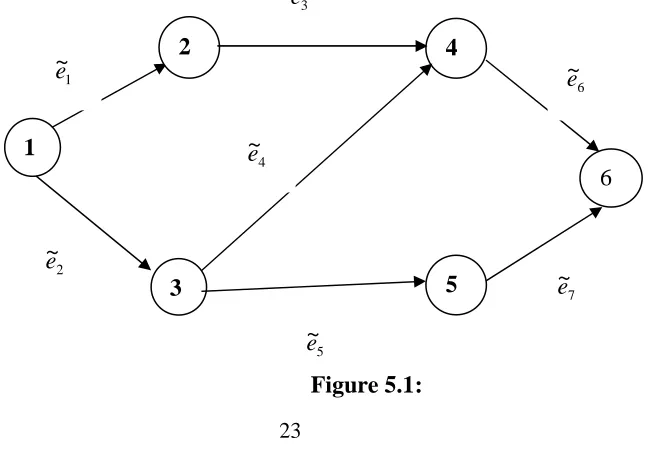
The problem is to find the shortest path and shortest path length between source node and destination node in the network having 6 vertices and 7edges with complement type-2 fuzzy number.
4
1
2
3 5
6 1
~
e
2
~
e
3 ~ e
4
~
e
5 ~ e
6 ~ e
7 ~ e
24 Solution:
The edge Lengths are
1
eɶ = (0.5/0.2+0.4/0.3)/2 + (0.4/0.2)/3
2
eɶ = (0.3/0.2 + 0.8/0.3)/1 + (0.2/0.8)/3
3
eɶ = (0.7/0.2)/2 + (0.9/0.4 +0.7/0.5)/4
4
eɶ = (0.6/0.2)/4
5
eɶ = (0.9/0.4 +0.7/0.5)/3 + (0.4/0.7)/5
6
eɶ = (0.8/0.3 + 0.4/0.5)/2
7
eɶ = (0.6/0.4)/2 +(0.7/0.5+ 0.5/0.6)/4
Step 1: Complement type-2 fuzzy number The complement of type-2 fuzzy numbers are
1
e
ɶ
= (0.5/0.8+0.4/0.7)/2 + (0.4/0.8)/32
e
ɶ
= (0.3/0.8 + 0.8/0.7)/1 + (0.2/0.2)/33
e
ɶ
= (0.7/0.8)/2 + (0.9/0.6 +0.7/0.5)/44
e
ɶ
= (0.6/0.8)/45
e
ɶ
= (0.9/0.6 +0.7/0.5)/3 + (0.4/0.3)/56
e
ɶ
= (0.8/0.7 + 0.4/0.5)/27
e
ɶ
= (0.6/0.6)/2 +(0.7/0.5+ 0.5/0.4)/4 Step 2: Computation of Possible PathsForm the possible paths from starting node to destination node and compute the
corresponding path lengths,Lɶi i = 1,2,. . . .n for possible n paths.
1 pɶ =
1
e
ɶ
+3
e
ɶ
+6
e
ɶ
= 1 – 2- 4- 62 pɶ =
2
e
ɶ
+4
e
ɶ
+6
e
ɶ
=1 – 3- 4- 63 pɶ =
2
e
ɶ
+5
e
ɶ
+7
e
ɶ
=1 – 3- 5- 61
Lɶ = (0.5/0.7+0.4/0.5)/6+(0.4/0.7+0.4/0.5)/7+ (0.5 /0.6 +0.5/0.5)/8 + (0.4/0.6+0.4/0.5)/9
2
Lɶ = (0.6/0.7+0.4/0.5)/7 + (0.2/0.2)/9
3
Lɶ = (0.6/0.6 + 0.6/0.5)/6 + ( 0.2/0.5+0.2/0.4)/8 + (0.2/0.3)/10 + (0.2/0.2)/12
Step 3: Computation of Relative Possibilities
( ) /x A
25
(y) /y
B
B
ɶ
=
∑
µ
ɶCompute relative possibility s av p x( (ɶi( k))∧av p(ɶj(x )))k for all situations where
xk is the actual value of the path
p
ɶ
i and j = i + 1.2 1
(
6
7)
s p
ɶ
= ∧
p
ɶ
=
= 0.341s p
(
ɶ
1= ∧
6
p
ɶ
2=
9)
= 0.0221 3
(
6
6)
s p
ɶ
= ∧
p
ɶ
=
= 0.363s p
(
ɶ
1= ∧
6
p
ɶ
3=
8)
= 0.0991 3
(
6
10)
s p
ɶ
= ∧
p
ɶ
=
= 0.033s p
(
ɶ
1= ∧
6
p
ɶ
3=
12)
= 0.0221 2
(
7
7)
s p
ɶ
= ∧
p
ɶ
=
= 0.2976s p
(
ɶ
1= ∧
7
p
ɶ
2=
9)
= 0.01921 3
(
7
6)
s p
ɶ
= ∧
p
ɶ
=
= 0.3168s p
(
ɶ
1= ∧
7
p
ɶ
3=
8)
= 0.08641 3
(
7
10)
s p
ɶ
= ∧
p
ɶ
=
= 0.0288s p
(
ɶ
1= ∧
7
p
ɶ
3=
12)
= 0.01921 2
(
8
7)
s p
ɶ
= ∧
p
ɶ
=
= 0.341s p
(
ɶ
1= ∧
8
p
ɶ
2=
9)
= 0.0221 3
(
8
6)
s p
ɶ
= ∧
p
ɶ
=
= 0.33s p
(
ɶ
1= ∧
8
p
ɶ
3=
8)
= 0.0991 3
(
8
10)
s p
ɶ
= ∧
p
ɶ
=
= 0.028s p
(
ɶ
1= ∧
8
p
ɶ
3=
12)
= 0.0221 2
(
9
7)
s p
ɶ
= ∧
p
ɶ
=
= 0.2728s p
(
ɶ
1= ∧
9
p
ɶ
2=
9)
= 0.01761 3
(
9
6)
s p
ɶ
= ∧
p
ɶ
=
= 0.2904s p
(
ɶ
1= ∧
9
p
ɶ
3=
8)
= 0.07921 3
(
9
10)
s p
ɶ
= ∧
p
ɶ
=
= 0.0264s p
(
ɶ
1= ∧
9
p
ɶ
3=
12)
= 0.01762 3
(
7
6)
s p
ɶ
= ∧
p
ɶ
=
= 0.4092s p
(
ɶ
2= ∧
7
p
ɶ
3=
8)
= 0.11162 3
(
7
10)
s p
ɶ
= ∧
p
ɶ
=
= 0.0372s p
(
ɶ
2= ∧
7
p
ɶ
3=
12)
= 0.02482 3
(
9
6)
s p
ɶ
= ∧
p
ɶ
=
= 0.0264s p
(
ɶ
2= ∧
9
p
ɶ
3=
8)
= 0.00722 3
(
9
10)
s p
ɶ
= ∧
p
ɶ
=
= 0.0024s p
(
ɶ
2= ∧
9
p
ɶ
3=
12)
= 0.0016Step 4: Computation of Possibility Measure i) i = 1
ii) j = i+1
iii) Compute sij(pɶi < pɶj)using definition 2.7
iv) Write sij(pɶi < pɶj) v) Put j = j +1
vi) If j≤ n then go to (iii) vii) Put i = i + 1
viii) If i<n then go to (ii)
26 12
(
1 2)
s
p
ɶ
<
p
ɶ
= 0.105913
(
1 3)
s
p
ɶ
<
p
ɶ
= 0.100312
(
1 2)
s
p
ɶ
=
p
ɶ
= 0.082613
(
1 3)
s
p
ɶ
=
p
ɶ
= 0.1211221
(
2 1)
s
p
ɶ
<
p
ɶ
= 0.1609s
21(
p
ɶ
2=
p
ɶ
1)
= 0.082623
(
2 3)
s
p
ɶ
<
p
ɶ
= 0.046623
(
2 3)
s
p
ɶ
=
p
ɶ
= 031
(
3 1)
s
p
ɶ
<
p
ɶ
=0.266532
(
3 2)
s
p
ɶ
<
p
ɶ
= 0.11609Step 5: Computation of Degree of Possibility
( i) min{ (ij i j) (1/ 2) (ij i j)}
D pɶ = s pɶ < pɶ + s pɶ = pɶ where i = 1,2, . . .n and j = i+1.
1
(
)
D p
ɶ
= min{0.1472, 0.1609} = 0.14722
(
)
D p
ɶ
= min{ 0.2022, 0.0466} = 0.04663
(
)
D p
ɶ
= min{0.32706, 0.11609} = 0.11609Step 6: Shortest Path and Shortest Path Length
The path which is having highest degree of possibility is the Shortest path and the corresponding path length is the Shortest path Length for the complement type-2 fuzzy number.
Since highest degree is
p
ɶ
1 ie.,0.1472.We conclude that the Shortest Path is 1 – 2 – 4 – 6 and the shortest length is
1
Lɶ =(0.5/0.7+0.4/0.5)/6+(0.4/0.7+0.4/0.5)/7+(0.5/0.6+0.5/0.5)/8+(0.4/0.6+0.4/0.5)/9
6. Conclusion
In this paper we have developed an algorithm for finding complement shortest path and shortest path length using possibility measure with complement type-2 fuzzy number. The order of getting the degree of possibility for possible paths for the given edge weights in a network is getting reversed while we use the complement of the edge weights in a same network. We conclude that the complement shortest path is not at all a shortest path for the given edge weight but it is the shortest path for complement of given type-2 fuzzy number.
REFERENCES
1. V.Anusuya and R.Sathya, Type-2 fuzzy shortest path, International Journal of Fuzzy Mathematical Archive, 2 (2013) 36-42.
2. G.Bacon, Distinction between several subsets of fuzzy measures, Fuzzy Sets and Systems, 5 (1981) 291 – 305.
27
4. D.Dubois and H.Prade, Theory and applications: Fuzzy Sets and Systems, Man and Cybernetics, 23(2) (1993) 403 – 405.
5. G.J.Klir and T.A.Folger, Fuzzy sets, Uncertainty and Information, Prentice Hall of India Private Limited, New Delhi, 1995.
6. J.Caha and J.Dvorsky, Optimal Path Problem with possibilistic weights, GIS Ostrava, Jan 2014, 27-29.
7. N.N.Karnik and J.M.Mendel, Operations on type-2 fuzzy sets, Fuzzy Sets and Systems, 122 (2001) 327-348
8. S.Lee and K.H. Lee, Shortest path problem in a type–2 weighted graph, J. of Korea Fuzzy and Intelligent Systems Society, 11(6) (2001) 528 – 531.
9. M.Mizumoto and K.Tanaka, Some properties of fuzzy set of type-2, Academic Press, Vol.31, No.4.
10. A.Nagoor Gani, and V.Anusuya, On shortest path fuzzy network, Adv. in Fuzzy Sets and Systems, 1(3) (2006) 219-230.
11. S.Okada and T.Soper, A shortest path problem on a network with fuzzy arc lengths, Fuzzy Sets and Systems, 109 (2000) 129 – 140.
12. S.Okada, Interactions among paths in Fuzzy shortest path problems, Proc.of the Joint 9th IFSA world congress and 20th NAFIPS International Conference, 2001, pp.41-46.
13. M.Sugeno, Fuzzy measures and Fuzzy integrals- a survey, In Gupta, saridis, and Gaines, 1977, pp.89-102.
14. S.T.Wierzchon, On fuzzy measure and fuzzy integral, In: gupta and Sanchez, 1982, pp.79-86.
15. L.A.Zadeh, The concept of a linguistic variable and its application to approximate reasoning – 1, Inform. Sci., 8 (1975) 199 – 249.
16. V.Anusuya and R.Sathya, A new approach for solving type-2 fuzzy shortest path problem, Annals of Pure and Applied Mathematics, 8(1) (2014) 83-92.