Vol. 14, No. 1, 2017, 125-130
ISSN: 2320 –3242 (P), 2320 –3250 (online) Published on 11 December 2017
www.researchmathsci.org
DOI: http://dx.doi.org/10.22457/ijfma.v14n1a15
125
International Journal of
A New Distance and Ranking Method for Triangular
Fuzzy Numbers
S. Yahya Mohamed1 and N. Karthikeyan2
1
Department of Mathematics, Government Arts College, Trichy, Tamilnadu, India
2
Department of Mathematics, Kongunadu College of Engineering and Technology Trichy, Tamilnadu, India
1
Corresponding Author
Received 18 November 2017; accepted 8 December 2017
Abstract. This study presents an approximate approach for ranking fuzzy triangular
numbers based on the distance method of a fuzzy triangular number and its area. The total approximate is determined by convex combining of fuzzy triangular number’s relative and its area that based on decision maker’s optimistic perspectives. The proposed approach is simple in terms of computational efforts and is efficient in ranking a large quantity of fuzzy triangular numbers. By a group of examples in [2] demonstrate the accuracy and applicability of the proposed approach. Finally we construct a new ranking system for fuzzy triangular number which is very realistic and also matching our intuition as the crisp ranking system on R.
Keywords: Fuzzy numbers, triangular number, approximate approach, ranking, distance. AMS Mathematics Subject Classification (2010): 94D05, 90BXX
1. Introduction
126
areas of a fuzzy number that it performs simple arithmetic operations for the ranking purpose and it can be a rank the combination case of some fuzzy numbers and crisp numbers and the case of discrete fuzzy numbers and useful in ranking a large quantity of fuzzy numbers. Comparing the proposed approximate approach with the existing methods using both Bortolan and Degani’s examples [2].
The methods of measuring of distance between fuzzy numbers have became important due to the significant applications in diverse fields like remote sensing, data mining, pattern recognition and multivariate data analysis and so on. Several distance measures for precise numbers are well established in the literature. Several researchers focused on computing the distance between fuzzy numbers [1, 2, 4]. Here we introduce a new distance between two trapezoidal fuzzy numbers by the new approach proposed for them. This paper is organized as following:
In Section 2, the basic concept of fuzzy number operation is brought. In Section 3, introduces the ranking approach, and presents some comparative examples which demonstrate the accuracy of the proposed approach over the exiting methods. A new distance measure between fuzzy numbers is defined in Section 4. Concluding remarks are finally made in section 5.
2. Preliminaries
Definition 2.1. A fuzzy number A in R is said to be a triangular fuzzy number if its membership function µA:R→[0,1] has the following characteristics.
1
1 2
2 1
2
3
2 3
3 2
,
1 , ( x )
,
0 , A
x a
a x a
a a
x a
a x
a x a
a a
o t h e r w i s e
µ
−
≤ ≤ −
=
= −
≤ ≤ −
It is denoted by A=(a(1),a( 2 ),a(3)) where a(1)
is Core (A), a( 2 ) is left width and
(3)
a is right width. The geometric representation of Triangular Fuzzy number is shown in figure. Since, the shape of the triangular fuzzy number A is usually in triangle it is called so.
Membership function of triangular fuzzy number
The Parametric form of a triangular fuzzy number is represented by
(1) (2) (1) (3)
(1 ), (1 )
A=a −a −r a +a −r
3. Main results
Ranking of triangular fuzzy number with distance method
Let all of fuzzy numbers be either positive or negative. Without less of generality, Assume that all of the m are positive. The membership function of,a∈R is u0
( )
x =1if( )
0
: 0, . 0
127
( )
0
1 0
0 0.
x u x
x
=
=
≠
Sinceu0
( )
x ∈E, left fuzzinessσ
and right fuzzinessβ
are 0, so for each u0( )
x ∈E(
)
( )
( )
1
1 1 2
2 2
2 0
0 0
,
d u u u r dr u r− dr
−
= + +
∫
∫
Thus we have the following definition.
Definition 3.1. For u and v∈E , define the ranking of u and vby saying
(
) (
)
(
) (
)
(
) (
)
0 0
0 0
0 0
, ,
, ,
, , .
d u u d v u if and only if u v
d u u d v u if and only if u v
d u u d v u if and only if u v
> <
= ≈
≻
≺
Property 3.1. Suppose u and v∈Eare arbitrary then:
1. If u v then u v= ≈
2. If v u and u r
( )
2 u r( )
2 v r( )
2 v r( )
2 for all r[ ]
0, 1 then v u.− −
− −
⊆ + > + ∈ ≺
Remark 3.1. The distance triangular fuzzy number u=
(
x0, ,σ β
)
of u0is defined asfollowing
(
)
2 2 2(
)
120 0 0
, 2 / 3 / 3
d u u = x +
σ
+β
+xβ σ
− Remark 3.2. The distance trapezoidal fuzzy number u=
(
x y0, 0, ,σ β
)
of u0is defined asfollowing
(
)
2 2 2 2 120 0 0 0 0
, / 3 / 3
d u u =x +y +
σ
+β
−xσ
+yβ
Remark 3.3. If
u v
≈
, it is not necessary thatu v
=
. Since if u v≠ and( )
( )
( )
( )
1 1
2
2 2 2 2 2
.
u r u r v r v r then u v
− −
− −
+ = + ≈
4. Procedure
A popular fuzzy number
u
is the symmetric triangular fuzzy number S[
x0,σ
]
centered128
( )
(
)
(
)
+ ≤ ≤ +
−
≤ ≤ − +
−
=
otherwise x x x x
x
x x x
x x
x u
, 0
, 1
, 1
0 0
0
0 0
0
σ
σ
σ
σ
σ
σ
which its parametric form is u−
( )
r =x0 −σ
+σ
ru
( )
r =x +σ
−σ
r−
0
Remark 4.1. The distance triangular fuzzy number S
[
x0,σ
]
of u0is defined as[
]
(
)
21 2 2
0 0
0
3 2 2 ,
,
σ
u = x +σ
xS d
If for ranking fuzzy numbersS
[
x0,σ
]
, S[
x0,β
]
and σ ≠βwe used Yao and Wu [8],method we would haveS
[
x0,σ
] [
=S x0,β
]
. But with our method we have[
x0,σ
] [
S x0,β
]
.S ≠
We shall now compare the methods used by other authors in [7,8,9,12,13] and our method with four sets of examples taken from Yao and Wu [13].
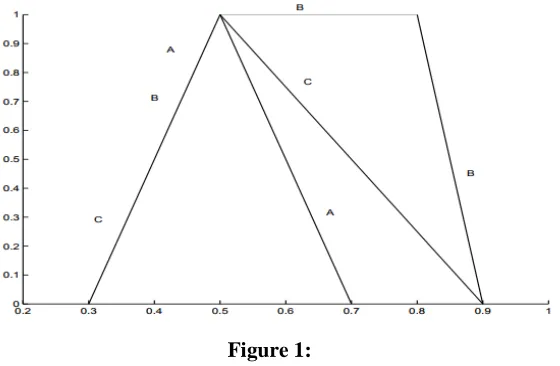
Set 1: A=
(
0.5,0.1,0.5)
, B=(
0.7,0.3,0.3)
, C=(
0.9,0.5,0.1)
. Set 2:A=(
0.4,0.7,0.1,0.2)
(Trapezoidal fuzzy number)(
0.7,0.4,0.2)
, =(
0.7,0.2,0.2)
= C
B
Set 3: A=
(
0.5,0.2,0.2)
, B=(
0.5,0.8,0.2,0.1)
, C=(
0.5,0.2,0.4)
. Set 4: A=(
0.4,0.7,0.4,0.1)
, B=(
0.5,0.3,0.4)
, C =(
0.6,0.5,0.2)
.129 Figure 2:
Table 1:
set Fuzzy
number
Choobinech
and Li Yager Chen
Baldwin
and Guild Wu
1 A B C 0.33 0.50 0.667 A < B < C
0.60 0.70 0.667 A < B < C
0.3375 0.50 0.667 A < B <
C
0.30 0.33 0.44 A < B < C
0.60 0.70 0.80 A < B < C
2 A B C 0.458 0.583 0.667 A < B < C
0.575 0.65
0.7 A < B < C
0.4315 0.5625 0.625 A < B <
C
0.27 0.27 0.37 A ≈ B < C
0.575 0.65 0.70 A < B < C
3 A B C 0.33 0.4167 0.5417 A < B < C
0.50 .055 0.625 A < B < C
0.375 0.425 0.55 A < B <
C
0.27 0.37 0.45 A < B < C
0.50 0.625
0.55 A < C < B
4 A B C 0.50 0.5833 0.6111 A < B < C
0.45 0.525
0.55 A < B < C
0.52 0.57 0.625 A < B <
C
0.40 0.42 0.42 A < B ≈ C
0.475 0.525 .0525 A < B ≈ C
By using our method, we have the following results:
Set 1: d
(
A,u0)
=0.8869, d(
B,u0)
=1.0194,d(
C,u0)
=1.1605, and by definition: A < B < C130
Set 3: d
(
A,u0)
=0.7257, d(
B,u0)
=0.9416,d(
C,u0)
=0.8165, and by definition: A < C < BSet 4: d
(
A,u0)
=0.7853, d(
B,u0)
=0.7958, d(
C,u0)
=0.8386, and by definition: A < B < C5. Conclusion
We construct a new ranking system for fuzzy triangular number which is very realistic and also matching our intuition as the crisp ranking system on R. In table 1, we have the following results: In set 1, our method has the same result as in other five papers. In set 2, our method has the same result as in the other four papers. However in set 3, we and Yao and Wu have A < C < B, but all other the four papers have A < B < C. We can see from Fig 1, that define ordering A < C < B is better than define ordering A < B < C. In set 4, Fig 2, A < B < C, our method leads to the same result as that of Choobinech and Li, Yager and Chen. The result of Yao and Wu, Baldwin and Guild have A < B ≈ C.
REFERENCES
1. S.Abbasbandyand S. Hajighasemi, A Fuzzy distance between two fuzzy numbers IPUM 2010, part II, CCIS, 81 (2010) 376 – 382.
2. S.Abbasbandy and T.Hajjari, A New approach for ranking of trapezoidal fuzzy numbers, Comput. Math. Appl., 57 (2009) 413 – 419.
3. L.H.Chen and H.W.Lu, An approximate approach for ranking fuzzy numbers bassed on left and right dominance, Computers and Mathematics, 41 (2001) 342-348. 4. C. Chakraborty and D. Chakraborty, A theoretical development on a fuzzy distance
measure for fuzzy numbers, Math. Comput. Modeling, 43 (2006) 254 – 261. 5. L.A.Zadeh, Fuzzy sets, Inform and Control, 8 (1965) 338-353.
6. S.Abbasbandy and B.Asady, A note on" A new approach for defuzzification", Fuzzy Sets and Systems, 128 (2002) 131-132.
7. J.F.Baldwin and N.C.F.Guild, Comparison of fuzzy numbers on the same decision space, Fuzzy Sets and Systems, 2 (1979) 213-233.
8. S.Chen, Ranking fuzzy numbers with maximizing set and minimizing set, Fuzzy Sets and Systems, 17 (1985) 113-129.