The Open Journal of Occupational Therapy
The Open Journal of Occupational Therapy
Volume 4
Issue 3 Summer 2016 Article 7
July 2016
Development of a Clinical Performance Assessment Tool for an
Development of a Clinical Performance Assessment Tool for an
Occupational Therapy Teaching Clinic
Occupational Therapy Teaching Clinic
Whitney Henderson
University of Missouri, Columbia - USA, [email protected]
Follow this and additional works at: https://scholarworks.wmich.edu/ojot
Part of the Occupational Therapy Commons
Recommended Citation Recommended Citation
Henderson, W. (2016). Development of a Clinical Performance Assessment Tool for an Occupational Therapy Teaching Clinic. The Open Journal of Occupational Therapy, 4(3). https://doi.org/10.15453/ 2168-6408.1217
This document has been accepted for inclusion in The Open Journal of Occupational Therapy by the editors. Free, open access is provided by ScholarWorks at WMU. For more information, please contact
Development of a Clinical Performance Assessment Tool for an Occupational Development of a Clinical Performance Assessment Tool for an Occupational Therapy Teaching Clinic
Therapy Teaching Clinic
Abstract Abstract
Health professional education is experiencing increased accountability from higher education and professional accrediting bodies to produce professionals who are prepared to meet the demands of the complex, fast-paced, ever changing health-care environment. Using competency-based assessment methods to evaluate a student’s performance can assist to decrease the gap between education and practice and ease the critical transition from the classroom to the clinic. A variety of assessment methods that use a Competency-Based Medical Education (CBME) framework to assess student performance and competency can be found throughout the health professions literature. Because of the lack of literature about the assessment of student performance in occupational therapy education, and because of the inability to find an appropriate assessment tool for the on-site teaching clinics in the author’s program, the author developed a new assessment tool to measure student competency and performance in the clinical education setting. This paper discusses each phase of development; the professional literature used; and the reasoning for domain, item, and scoring selection. The final assessment includes a 5-point rating scale to score 42 items in six domains in order to assess student performance and competency during an occupational therapy teaching clinical education experience.
Keywords Keywords
clinical education, competency-based assessment, student performance, occupational therapy education
Cover Page Footnote Cover Page Footnote
I acknowledge Dr. Brenda Coppard, PhD, OTR/L, FAOTA, professor at Creighton University, for feedback and guidance on this paper; Mr. James Hart for editing and feedback; and the faculty, staff, and students at the University of Missouri-Columbia occupational therapy program for the continuous feedback and willingness to incorporate the assessment into clinical education.
Credentials Display
Whitney Henderson, MOT, OTR/L, Post Professional Doctorate of Occupational Therapy student
Copyright transfer agreements are not obtained by The Open Journal of Occupational Therapy (OJOT). Reprint permission for this Applied Research should be obtained from the
corresponding author(s). Click here to view our open access statement regarding user rights and distribution of this Applied Research.
DOI: 10.15453/2168-6408.1217
The health care system in the United States
is a complex, fast-paced, ever-changing
environment. The public’s concern with current
health care practice requires that professionals
provide high quality care that is safe, effective, and
patient-centered (Kogan, Conforti, Lobst, &
Holmboe, 2014). Health professional education is
experiencing increased accountability from higher
education and professional accrediting bodies to
produce professionals who are prepared to meet
these demands. These demands also encourage
shifting from a focus on content to a focus on
competency in curricular and assessment methods
(Dawson, Miller, Goddard, & Miller, 2013). Using
competency-based assessment methods to evaluate
a student’s performance can help decrease the gap
between education and practice and ease the critical
transition from the classroom to the clinic (Costello,
Plack, & Maring, 2011; Hsu & Hsieh, 2013).
Although the multifaceted nature of clinical skills
makes it difficult to develop a perfect assessment
tool, the ability to assess a student’s performance is
an essential component of health professional
education (Anderson et al., 2014; Costello et al.,
2011).
Clinical education provides students with
clinical experiences that are integrated throughout a
curriculum (Wilson, 2014). These experiences
incorporate the basic sciences through didactic
coursework with early exposure to clinical skills
and encounters (LaRochelle, Dong, & Durning,
2015). These opportunities are critical for the
development of student competency in preparation
for full-time internships and entry-level practice
(Costello et al., 2011; LaRochelle et al., 2015;
Wilson, 2014). The assessment of a student’s
performance in clinical education is important for
the development and attainment of new
competencies (Holmboe, Sherbino, Long, Swing, &
Frank, 2010). Wu, Enskär, Lee, and Wang (2015)
define clinical competency as “theoretical and
clinical knowledge used in the practice of nursing,
incorporating psychomotor skills and
problem-solving ability with the goal of safely providing care
for patients” (p. 348). It is necessary for educators
to use a holistic, outcome-based assessment to
determine a student’s competency in a set of
complex, multidimensional skills (Dawson et al.,
2013; Hsu & Hsieh, 2013). In the Department of
Occupational Therapy at the University of
Missouri-Columbia, occupational therapy students
participate in faculty-supervised on-site teaching
clinics to develop the skills and competencies
needed for future success. However, the program
lacks an effective assessment to measure student
achievement.
Literature Review
A variety of assessment methods that use a
Competency-Based Medical Education (CBME)
framework to assess student performance and
competency can be found throughout the health
professions literature. One popular method of
assessment includes the use of an Objective
Structured Clinical Examination (OSCE). An
OSCE uses multiple stations at which students
perform identified clinical tasks with standardized
patients. Standardized patients are trained
individuals who receive compensation for
simulating a clinical scenario (Mookherjee, Chang,
skills, such as obtaining a history, performing a
physical examination, maintaining professional
behaviors, and demonstrating appropriate
communication skills, have been assessed through
the use of an OSCE (LaRochelle et al., 2015). An
OSCE offers a valuable assessment, as it challenges
students to demonstrate clinical skills rather than
just simply knowing clinical skills, and provides
students with the opportunity for practice and
feedback (Holmboe et al., 2010; Mookherjee et al.,
2013). The use of standardized patients also allows
for increased reliability and validity in the
assessment of a student’s performance (Mookherjee
et al., 2013). However, using an OSCE to assess
student performance and competency has
limitations. These limitations include the lack of
authentic patient encounters, increased cost and
time associated with standardized patients, and the
restricted amount of clinical skills that can be
assessed through these interactions (Costello et al.,
2011). Although widely used and established in
medical education, the OSCE in occupational
therapy is less understood and researched (Costello
et al., 2011; O’Brien & McNeil, 2013). In
occupational therapy literature, O’Brien and McNeil
(2013) studied the correlation of scores from the
short OSCE with scores from Level II fieldwork in
occupational therapy education. While faculty and
students found the OSCE useful, scores from the
OSCE did not correlate with performance scores on
the Fieldwork Performance Evaluation (FWPE) for
the Occupational Therapy Student. Additionally, an
OSCE established in medical education lacks
fluency to the occupational therapy profession. An
OSCE established in occupational therapy
education lacks assessment of specific clinical skills
and competencies demonstrated in a teaching clinic,
such as grading an intervention according to the
client’s response or performing appropriate skilled
and evidence-based interventions.
An additional competency-based assessment
is a workplace-based assessment. Kogan et al.
(2014) state that workplace-based assessments are
“conducted in authentic situations (i.e., day-to-day
practice) and evaluate multiple, essential
competencies in an integrated, simultaneous
fashion” (pp. 721-722). Through direct observation
of a student’s interaction with a “real-life” patient,
educators are able to assess a set of interconnected,
complex clinical skills (Holmboe et al., 2010;
Kogan et al., 2014). This type of assessment can
help identify students who would benefit from
remediation or determine which students to consider
for advanced placement (Holmboe et al., 2010).
Although workplace-based assessments are
tremendously valuable, they place demands on
educators because of increased time commitments
and a need for keen and accurate observation
(Holmboe et al., 2010). In addition, concerns for
reliability exist when there are multiple raters who
have different expectations and frames of reference
affected by the variability among and within
patients (Kogan et al., 2014). The use of
workplace-based assessments is frequently seen in
medical education literature. Similar to medical
education, occupational therapy education provides
students with clinical experience following their
early years of education. However, there is little
evidence supporting the use of workplace-based
assessments in occupational therapy education.
Many articles addressing student assessment
are found in medical education literature, and
several articles exist about the development of an
assessment for student performance in other
disciplines of professional education. However,
discussion of the development of a reliable and
valid assessment for measuring student performance
in occupational therapy clinical education remains
limited. Muhamad, Ramli, and Amat (2015)
discussed a pilot study to determine the reliability
and validity of the Clinical Competency Evaluation
Instrument (CCEVI). This assessment measures the
clinical competency of physical therapy students
using a 5-point Likert scale to assess 40 items
across eight domains. Hsu and Hsieh (2013)
discussed the development of a competency
inventory for baccalaureate nursing students. This
assessment tool uses a 7-point Likert scale to
measure clinical competency of 52 items across
eight domains. Finally, O’Brien and McNeil (2013)
studied the relationship between case-based and
performance-based examinations for student
performance on Level II fieldwork in occupational
therapy education. The OSCE was used to assess
clinical skills, while the Integrated Performance
Procedural Instrument (IPPI) was used to assess
clinical reasoning throughout a case. The IPPI
demonstrated greater correlation with student
performance on fieldwork performance (O’Brien &
McNeil, 2013). While each of these assessment
methods has strengths and weaknesses, these
methods did not fit the context for the assessment of
student competency and performance in this
institution’s on-site teaching clinic because of the
lack of similar and demonstrable skills related to the
profession and setting.
Method
Lacking literature about the assessment of
student performance in occupational therapy
education and accepting the inability to use
previously developed assessments because of a poor
match, the author sought to develop the Clinical
Performance Assessment Tool (see Appendix) to
measure student competency and performance in
the on-site clinical setting at the University of
Missouri-Columbia. Similar to the program
discussed by Wilson (2014), the University of
Missouri-Columbia occupational therapy program’s
curriculum includes two semesters of clinical
education experiences in the on-site pediatric and
adult clinics. These on-site clinics serve individuals
with a variety of diagnoses and impairments in the
local community who might not otherwise receive
occupational therapy services because of financial
reasons. In addition to and aside from Level I
fieldwork, these clinical experiences occur in the
graduate portion of the curriculum during the
second and third years of the occupational therapy
program. Under the supervision of a faculty
member, the students provide one-on-one
occupational therapy services to individuals once a
week for the duration of the semester. Each student
is responsible for developing the evaluation and
intervention plans, implementing the intervention
plans, and documenting the outcome of the
interventions. The supervising faculty member
provides written feedback on the evaluation plan,
weekly treatment plans, weekly documentation, and
feedback on the intervention implementation
following each session. The students meet with the
supervising faculty member at midterm and at the
end of the semester to discuss their progress and
score in clinical performance. Prior to the
development of the Clinical Performance
Assessment Tool, the faculty in the University of
Missouri-Columbia occupational therapy program
lacked a comprehensive, objective tool to measure
clinical performance, competency, and educational
outcomes.
Several resources were useful for
developing the Clinical Performance Assessment
Tool. First, Keating, Dalton, and Davidson (2009)
outlined six phases in the development of an
assessment tool for clinical education. The first
three phases of this outline were used in the
development of the Clinical Performance
Assessment Tool, whereas the last three phases
could be used at a later date. Mookherjee et al.
(2013) also provided an outline for the development
of an assessment of the clinical skills and
competency of students in medical education;
however, this outline discussed the longitudinal
development and assessment of skills as a medical
student progresses throughout the program.
Although somewhat different, Moorkherjee et al.
(2013) provided several areas of overlap to the
phases discussed by Keating et al. (2009), such as
identification and development of relevant
objectives and the use of professional documents
and competency-based frameworks to guide
development of the assessment.
Map the Construct
The first phase of this process is mapping
the construct, which includes determining what the
assessment tool will measure, the continuum of
performance, and the identification of domains
(Keating et al., 2009). As previously stated and
discussed, it was determined to measure the clinical
performance and competency of students during
on-site clinical experiences at the University of
Missouri-Columbia. In order to determine the
continuum of performance and domains, attention
was turned to the review of the literature. The
common theme identified in the literature was the
use of professional documents to guide the
development of the assessment (Anderson et al.,
2014; Costello et al., 2011; Dawson et al., 2013,
Hsu & Hsieh, 2013; Mookherjee et al., 2013;
Wilson, 2014; Wu et al., 2015). Based on this
information, the author consulted the Accreditation
Council for Occupational Therapy Education
(ACOTE) Standards and Interpretive Guide, the
Standards of Practice for Occupational Therapy,
and the FWPE for the Occupational Therapy
Student for selection of domains and items
(American Occupational Therapy Association
[AOTA], 2002; AOTA, 2010; AOTA, 2011).
Section B (which is the Content Requirements from
the ACOTE Standards and Interpretive Guide)
identifies the expected outcomes of students who
graduate from an accredited occupational therapy
education program (AOTA, 2011). The Standards
of Practice for Occupational Therapy discusses the
minimum practice standards for professionals
practicing in the field of occupational therapy
(AOTA, 2010). Finally, the FWPE for the
Occupational Therapy Student is the assessment
used by fieldwork educators to determine
entry-level competency of occupational therapy students
during Level II fieldwork (AOTA, 2002). These
three documents were compared and contrasted, and
then the author extrapolated common areas
appropriate for the context. During this process, the
FWPE for the Occupational Therapy Student
proved to be most applicable and useful because
this tool measures a student’s performance
throughout the delivery of the occupational therapy
process (AOTA, 2002). The Standards of Practice
for Occupational Therapy proved to be the least
applicable and useful because this document
discusses the minimum practice standards of an
occupational therapy practitioner and not a student
(AOTA, 2010).
In addition to these three documents, two
additional documents provided valuable
contributions to this phase. First, addressing
similarities in clinical experiences provided during
the educational program at the University of Puget
Sound, the article written by Wilson (2014) served
as a useful resource for further identification of
domains. Second, in addition to Keating et al.
(2009), the Undergraduate Clinical Evaluation Tool
used at the University of North Carolina Chapel Hill
School of Nursing (2012) provided an excellent
continuum of the measurement of student
performance and competency. Following synthesis
and analysis of this information, the six domains
and continuum were identified and selected based
on (a) the relevance to the institution’s on-site
educational setting, (b) a review of literature and
professional documents, and (c) identified
importance by supervising faculty. The six domains
include communication, documentation, safety and
judgment, evaluation, intervention, and professional
behaviors, and the continuum includes dependent,
novice, assisted, supervised, and self-directed stages
of performance (University of North Carolina
Chapel Hill School of Nursing, 2012).
Assemble an Item Pool
Keating et al. (2009) report that the second
phase of assessment development is the assembling
of an item pool. This includes collecting and
categorizing individual items for each domain from
multiple resources. An item must meet the
following four criteria for selection and inclusion: Target one attribute (explicit learning
outcome).
Describe an observable and measureable behavior.
Be unambiguous, clear, and defensible. Be important to students, educators,
and/or key stakeholders. (Keating et al.,
2009, p. 164)
The three previously mentioned occupational
therapy documents, as well as the addition of the
Occupational Therapy Essentials for Clinical
Competence (Jacobs, MacRae, & Sladyk, 2014),
were compared and contrasted an additional time to
determine important items to include in each
domain. Articles that included a discussion of the
items were reviewed and relevant items were added
to the pool. The articles included Costello et al.
(2011), which assessed 23 items with physical
therapy students; Hsu and Hsieh (2013), which
students; and Muhamad et al. (2015), which
assessed 40 items with physical therapy students.
The five characteristics of a successful clinical
student, as described by Goldie, Dowie, Goldie,
Cotton, and Morrison (2015), were also considered.
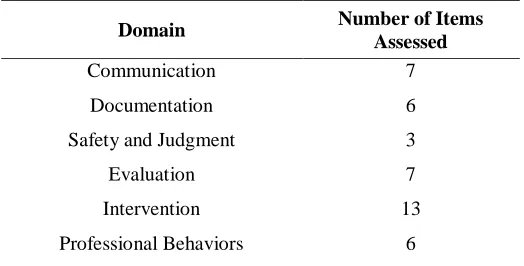
After completion of this thorough review of
literature, 42 items were identified for the Clinical
Performance Assessment Tool (see Table 1).
Table 1
Number of Items Assessed in Each Domain
Domain Number of Items Assessed
Communication 7
Documentation 6
Safety and Judgment 3
Evaluation 7
Intervention 13
Professional Behaviors 6
Mookherjee et al. (2013) recommended
these items be translated into observable and
measureable objectives, and Hsu and Hsieh (2013)
recommended assessing a combination of cognitive,
affective, and psychomotor skills. Based on these
recommendations, Gronlund and Bookhart’s (2009)
textbook, Gronlund’s Writing Instructional
Objectives, provided the best model for each of the
42 items. Examples of selected items include (a)
demonstrates therapeutic use of self throughout the
occupational therapy process (communication
domain), (b) writes client-centered goals according
to the COAST format in which the occupation is
measureable (documentation domain), (c) modifies
the evaluation plan based on the client’s clinical
presentation (evaluation domain), (d) uses creativity
and a variety of treatment methods to facilitate the
client’s progress toward established goals
(intervention domain), and (e) demonstrates
effective time management of session (professional
behaviors domain).
Determine Indicators and Scales
The third and final phase used for the
development of the Clinical Performance
Assessment Tool was the determination of
performance indicators and rating scales (Keating et
al., 2009). According to Anderson et al. (2014), the
use of a 5- to 7-point scale provides the highest
level of reliability. With this information in mind,
the rating scales described in the Keating et al.
(2009) and the University of North Carolina Chapel
Hill School of Nursing (2012) documents were
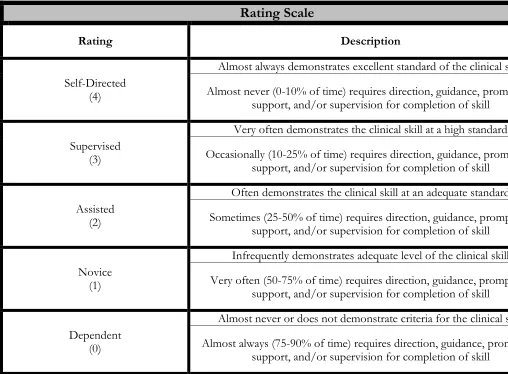
combined and modified to develop a 5-point rating
scale for each item (see Figure 1).
Rating Scale
Rating Description
Self-Directed (4)
Almost always demonstrates excellent standard of the clinical skill
Almost never (0-10% of time) requires direction, guidance, prompting, support, and/or supervision for completion of skill
Supervised (3)
Very often demonstrates the clinical skill at a high standard
Occasionally (10-25% of time) requires direction, guidance, prompting, support, and/or supervision for completion of skill
Assisted (2)
Often demonstrates the clinical skill at an adequate standard
Sometimes (25-50% of time) requires direction, guidance, prompting, support, and/or supervision for completion of skill
Novice (1)
Infrequently demonstrates adequate level of the clinical skill
Very often (50-75% of time) requires direction, guidance, prompting, support, and/or supervision for completion of skill
Dependent (0)
Almost never or does not demonstrate criteria for the clinical skill
Almost always (75-90% of time) requires direction, guidance, prompting, support, and/or supervision for completion of skill
Figure 1. Rating scale used to rate each item.
Kogan et al. (2014) strongly suggested using the
midpoint of a rating scale as the determination for
satisfactory or competent performance, as this is the
minimal standard of care required for a particular
setting. This appeared appropriate for the
educational level of the students in the on-site
clinic. It is not the expectation that the students are
independent or near independent at this point in
their education, as that would defeat the purpose of
Level II fieldwork experiences.
Scoring guidelines were developed based on
evidential support; however, reassessment with
potential revision is anticipated following
implementation of the tool (Anderson et al., 2014;
Keating et al., 2009; University of North Carolina
Chapel Hill School of Nursing, 2012). Scoring
guidelines are as follows: A score of a 0
(dependent) and 1 (novice) are an acceptable score
for an item at midterm, as long as a plan is
identified for student development for the item
evaluated. However, a score of 0 or 1 for any item
at final is unacceptable. Kogan et al. (2014) support
this decision with the statement that “being
competent is not the aspiration, it is the floor” (p.
724). It is also not the expectation that students will
passing at final, as this would negate the need for
ongoing growth and development of skills and
competency throughout clinical experiences.
Therefore, a competent distribution of scores was
considered to determine a passing score of 115 at
the time of final. A student must achieve this score
to pass the clinical education component of the
curriculum prior to beginning Level II fieldwork.
In addition to the quantitative information
provided by a rating scale, an opportunity to
provide qualitative feedback was incorporated into
the assessment tool. According to Holmboe et al.
(2010), educators should incorporate qualitative
approaches to assessment in order to provide
narrative feedback about student performance. In
addition, Dawson et al. (2013) reported that
students desired more qualitative feedback and that
students perceived increased validity with the
addition of qualitative feedback to a quantitative
assessment. Therefore, an area for subjective
feedback was added to each assessed item. The
assessment also included a development plan at the
end in order to articulate and identify clearly a
student’s strengths and suggested areas for
improvement, and to provide an opportunity to
discuss with the student a meaningful plan for
progress and development. Finally, the purpose and
directions of the assessment tool were written with
guidance from the FWPE for the Occupational
Therapy Student and the Undergraduate Clinical
Evaluation Tool (AOTA, 2002; University of North
Carolina Chapel Hill School of Nursing, 2012).
Discussion
Clinical educators need accurate and
objective assessments in order to communicate and
evaluate the development and achievement of
clinical performance and competency (Anderson et
al., 2014; Kogan et al., 2014; Muhamed et al.,
2015). Not only is this crucial for the development
of clinical skills and competency, but the
assessment of clinical performance provides
information on current curriculum and educational
outcomes, promotes professional self-regulation by
assuring students can meet high standards of
practice, and prepares students to meet the demands
of the rapidly changing health care environment in
future clinical experiences and entry-level practice
(Holmboe et al., 2010; Hsu & Hsieh, 2013). While
the Clinical Performance Assessment Tool currently
lacks reliability and validity, the author hopes that
the assessment can be used and further developed in
the on-site clinical education portion of the
curriculum at the University of Missouri-Columbia.
It is hoped that the assessment will provide both
students and educators with measureable successes
of their aims to prepare client-centered health care
professionals.
As described by Keating et al. (2009), the
final three phases of development, which include a
pilot test, a field test for validity, and a field test for
reliability, will be implemented to establish an
effective assessment for measuring student
competency and performance in a clinical education
experience. The Clinical Performance Assessment
Tool will undergo pilot testing with graduate
students enrolled in the clinical education
component of the curriculum during the spring and
fall semesters of the 2016 calendar year. Efforts to
recruit experienced educators engaged in clinical
education are underway to establish the content
validity of the assessment. Following completion of
these steps, feedback and data will guide the
revision of the assessment. Once revisions have
been completed, further reliability and validity
studies will be completed during the 2017 calendar
year.
Since the purpose of the Clinical
Performance Assessment Tool is to assess student
performance during an on-site clinical education
component of a curriculum, this tool should not,
without further research development, be used to
assess student performance on Level I fieldwork or
in clinics in which faculty complete a majority of
the occupational therapy process. Occupational
therapy programs with a clinical education
component of the curriculum are invited to use the
assessment and collaborate with the author to
contribute data toward its psychometric
development. However, educators should complete
an in-depth review of the assessment to ensure an
appropriate fit with the clinical education
experience. As with any new assessment, educators
using this assessment outside of a research context
should do so with caution because of a lack of
psychometric data at this time.
References
American Occupational Therapy Association. (2002).
Fieldwork performance evaluation for the occupational therapy student. Retrieved from
http://ot.lr.edu/sites/ot.lr.edu/files/AOTA%20FW%2 0Performance%20Evaluation.pdf
American Occupational Therapy Association. (2010). Standards of practice for occupational therapy. The American Journal of Occupational Therapy, 64(6), s106-s111.
http://dx.doi.org/10.5014/ajot.2010.64S106 American Occupational Therapy Association. (2011). 2011
Accreditation Council for Occupational Therapy
Education standards and interpretive guide.
Retrieved from
https://www.aota.org/-/media/corporate/files/educationcareers/accredit/stan dards/2011-standards-and-interpretive-guide.pdf
Anderson, C., Cosgrove, M., Lees, D., Chan, G., Gibson, B. E., Hall, M., & Mori, B. (2014). What clinical instructors want: Perspectives on a new assessment tool for students in the clinical environment.
Physiotherapy Canada, 66(3), 322-328.
http://dx.doi.org/10.3138/ptc.2013-27
Costello, E., Plack, M., & Maring, J. (2011). Validating a standardized patient assessment tool using published professional standards. Journal of Physical Therapy Education, 25(3), 30-45.
Dawson, S. D., Miller, T., Goddard, S. F., & Miller, L. M. (2013). Impact of outcome-based assessment on student learning and faculty instructional practices.
Journal of Veterinary Medical Education, 40(2), 128-138. http://dx.doi.org/10.3138/jvme.1112-100r Goldie, J., Dowie, A., Goldie, A., Cotton, P., & Morrison, J.
(2015). What makes a good clinical student and teacher? An exploratory study. BMC Medical Education, 15(40), 1-8.
http://dx.doi.org/10.1186/s12909-015-0314-5
Gronlund, N. E., & Brookhart, S. M. (2009). Gronlund’s writing instructional objectives (8th ed.). Upper Saddle River, NJ: Pearson Education, Inc. Holmboe, E. S., Sherbino, J., Long, D. M., Swing, S. R., &
Frank, J. R. (2010). The role of assessment in competency-based medical education. Medical Teacher, 32(8), 676-682.
http://dx.doi.org/10.3109/0142159X.2010.500704 Hsu, L.-L., & Hsieh, S.-I. (2013). Development and
psychometric evaluation of the competency inventory for nursing students: A learning outcome perspective.
Nurse Education Today, 33(5), 492-497.
http://dx.doi.org/10.1016/j.nedt.2012.05.028 Jacobs, K., MacRae, N., & Sladyk, K. (2014). Occupational
therapy essentials for clinical competence (2nd ed.). Thorofare, NJ: SLACK Incorporated.
Keating, J., Dalton, M., & Davidson, M. (2009). Assessment in clinical education. In C. Delany & E. Molloy (Eds.), Clinical education in the health professions
(pp. 147-172). Sydney, Australia: Elsevier. Kogan, J. R., Conforti, L. N., Iobst, W. F., & Holmboe, E. S.
(2014). Reconceptualizing variable rater assessments as both an educational and clinical care problem.
Academic Medicine, 89(5), 721-727.
http://dx.doi.org/10.1097/ACM.0000000000000221 LaRochelle, J. S., Dong, T., & Durning, S. J. (2015).
Preclerkship assessment of clinical skills and clinical reasoning: The longitudinal impact on student performance. Military Medicine, 180(45), 43-46.
Mookherjee, S., Chang, A., Boscardin, C. K., & Hauer, K. E. (2013). How to develop a competency-based examination blueprint for longitudinal standardized patient clinical skills assessments. Medical Teacher,
35(11), 883-890.
http://dx.doi.org/10.3109/0142159X.2013.809408 Muhamad, Z., Ramli, A., & Amat, S. (2015). Validity and
reliability of the clinical competency evaluation instrument for use among physiotherapy students.
Sultan Qaboos University Medical Journal: Clinical and Basic Research, 15(2), e266-e274. Retrieved from
http://www.ncbi.nlm.nih.gov/pmc/articles/PMC4450 791/pdf/squmj1502-e266-274.pdf
O’Brien, J. C., & McNeil, S. D. (2013). Teaching effectiveness: Preparing occupational therapy students for clinical practice. The Open Journal of
Occupational Therapy, 1(3), Article 3.
http://dx.doi.org/10.15453/2168-6408.1045 University of North Carolina Chapel Hill School of Nursing.
(2012). Undergraduate clinical evaluation tool. Retrieved from
https://nursing.unc.edu/files/2012/11/CLINICAL-EVALUATION-TOOL-revised-8-12.docx Wilson, A. M. (2014). Integrated clinical experiences in a
campus onsite clinic: A self-contained model of physical therapy clinical education. The Internet Journal of Allied Health Sciences and Practice,
12(3), Article 8.
Wu, X. V., Enskär, K., Lee, C. C. S., & Wang, W. (2015). A systematic review of clinical assessment for undergraduate nursing students. Nurse Education Today, 35(2), 347-359.
http://dx.doi.org/10.1016/j.nedt.2014.11.016
Appendix
Clinical Performance Assessment Tool
Student: Semester: Client Initials:
Client Diagnosis: Midterm OR Final
Number of Sessions at Midterm
Number of Sessions at Final
Purpose: The Clinical Performance Assessment Tool is intended to assess a student’s performance during the clinical education portion of the curriculum. Additionally, this assessment tool is intended to monitor and document a student’s progress, growth, and competency prior to initiation of Level II fieldwork. The Clinical Performance Assessment Tool also evaluates a student’s ability to connect concepts learned in the classroom to clinical practice.
Directions: The Clinical Performance Assessment Tool includes 42 objectives across six domains. Every objective must be scored using the 5-point rating scale described below. The student and clinical educator should review the rating scale descriptions prior to midterm and final evaluation. The clinical educator should highlight or circle the number that best corresponds to the student’s performance for each clinical skill. Provide additional feedback in the feedback column as needed. Total and record each domain separately and total all domains for an overall score of the student’s performance. The clinical educator and student discuss the results of the Clinical Performance Assessment Tool at a midterm and final meeting. The assessment is used to
identify strengths and weaknesses in order to collaboratively determine a plan for growth and development of clinical skills and competency. Finally, the student and clinical educator need to sign and date the midterm and final document to confirm discussion and understanding of clinical performance and the development plan.
Scoring:
Midterm: The score of 0 (dependent) and 1(novice) are acceptable scores for an objective at midterm and should be accompanied by an identified plan for student development. A score of 4 (self-directed) should rarely be used at midterm. It is not the expectation that the student receive a passing grade at midterm.
Final: A score of 0 (dependent) and 1 (novice) are unacceptable at final. If a student accumulates enough points to pass the clinical experience but scores a 0 or a 1 on any objective at final, remediation is at the
discretion of the clinical educator. A score of 115 or higher is required to pass the clinical experience. A score of 114 or lower will result in failure of the clinical experience. In this case, remediation of the clinical
experience will be offered at the discretion of the clinical educator and should be accompanied by an identified plan for student development.
Rating Scale
Rating Description
Self-Directed (4)
Almost always demonstrates excellent standard of the clinical skill
Almost never (0-10% of time) requires direction, guidance, prompting, support, and/or supervision for completion of skill
Supervised (3)
Very often demonstrates the clinical skill at a high standard
Occasionally (10-25% of time) requires direction, guidance, prompting, support, and/or supervision for completion of skill
(2)
Sometimes (25-50% of time) requires direction, guidance, prompting, support, and/or supervision for completion of skill
Novice (1)
Infrequently demonstrates adequate level of the clinical skill
Very often (50-75% of time) requires direction, guidance, prompting, support, and/or supervision for completion of skill
Dependent (0)
Almost never or does not demonstrate criteria for the clinical skill
Almost always (75-90% of time) requires direction, guidance, prompting, support, and/or supervision for completion of skill
Doma in Item Numbe r Objective Score Feedback De pe nde nt Novic e As sis ted S upe rvis ed S elf Dir ec ted C omm unica ti on
1 Defines role of occupational therapy to the client, caregiver,
family, etc. 0 1 2 3 4
2 Articulates the value of occupation as a means and as an end to
the client, caregiver, family, etc. 0 1 2 3 4
3 Uses verbal communication appropriate to situation and to the
client, caregiver, family, etc., and level of understanding. 0 1 2 3 4
4 Uses non-verbal communication that is appropriate for the client,
caregiver, family, etc. 0 1 2 3 4
5 Demonstrates therapeutic use of self throughout occupational
therapy process. 0 1 2 3 4
6 Collaborates with the client, caregiver, family, etc., throughout
the occupational therapy process. 0 1 2 3 4
7 Demonstrates an understanding of health literacy when providing
education and training to the client, caregiver, family, etc. 0 1 2 3 4
Communication Total:
Doc
umenta
ti
on
1 Uses correct spelling, punctuation, and grammar in
documentation. 0 1 2 3 4
2
Provides accurate and professional documentation according to clinic guidelines (abbreviations, L/R, ROM rules, treatment
media, etc.).
0 1 2 3 4
3 Documents evaluation results that provide an objective measurement of the client’s function. 0 1 2 3 4
4 Writes client-centered goals according to the COAST format in
which the occupation is measureable. 0 1 2 3 4
5 Communicates need and rationale for OT services in
documentation. 0 1 2 3 4
6 Accurately documents the client’s performance and response to
intervention. 0 1 2 3 4
Documentation Total: S af ety and Judgment
1 Adheres to clinic safety and cleaning procedures. 0 1 2 3 4
2 Demonstrates sound judgment and awareness of client safety
throughout occupational therapy process. 0 1 2 3 4
3 Provides client with appropriate assistance and supervision
techniques to ensure safety. 0 1 2 3 4
Safety and Judgment Total:
E
va
luation
1 Provides a clear rationale and appropriate selection of screening
and/or assessment methods. 0 1 2 3 4
2 Is prepared to administer planned standardized and
non-standardized assessments. 0 1 2 3 4
3 Develops an occupational profile that is detailed and
comprehensive. 0 1 2 3 4
4 Accurately administers assessments to measure client factors and
performance skills. 0 1 2 3 4
5 Uses skilled observation to accurately identify the client’s
strengths and weaknesses. 0 1 2 3 4
6 Modifies the evaluation plan based on the client’s clinical
presentation. 0 1 2 3 4
7 Analyzes and interprets assessment data accurately. This includes
interpretation of criterion and norm-referenced assessments. 0 1 2 3 4
Evaluation Total:
Inter
ve
nti
on
1 Selects interventions that are appropriate to the client’s clinical
presentation. 0 1 2 3 4
2
Articulates a rationale for therapeutic interventions, which includes a connection to the client’s goals and discussion of
theory, models of practice, and frames of reference.
0 1 2 3 4
3 Uses in-class resources in the development of treatment plans. 0 1 2 3 4 4 Uses outside resources in the development of treatment plans. 0 1 2 3 4
5 Selects and performs interventions that are skilled and
evidenced-based. 0 1 2 3 4
6 Selects and performs interventions that motivate and challenge
the client. 0 1 2 3 4
7 Performs interventions that are client-centered and
occupation-based. 0 1 2 3 4
8 Uses creativity and a variety of treatment methods to facilitate the client’s progress toward established goals. 0 1 2 3 4
9 Appropriately incorporates remediation and compensation
strategies into intervention. 0 1 2 3 4
10 Performs appropriate “hands-on” techniques to facilitate the client’s progress toward goals. 0 1 2 3 4
11 Demonstrates flexibility through appropriate modification and
grading of interventions. 0 1 2 3 4
12 Develops and monitors a home exercise program that is appropriate for the client’s clinical presentation. 0 1 2 3 4
13 Appropriately refers the client to additional resources and
disciplines. 0 1 2 3 4
Intervention Total:
P
rof
es
sional
B
eha
vior
s
1
Demonstrates effective time management. This includes arriving to the clinic 15 min prior to session, managing time in session appropriately, and adhering to deadlines for clinic documentation.
0 1 2 3 4
2 Maintains professional appearance through adherence to clinic
dress code policy. 0 1 2 3 4
3 Maintains professional attitude and behavior. 0 1 2 3 4
4
Appropriately collaborates with the instructor and peers during and outside of clinic sessions. This includes appropriately seeking
assistance when needed.
0 1 2 3 4
5 Responds to and incorporates the instructor’s constructive
feedback. 0 1 2 3 4
6 Remains actively engaged and eager to learn. 0 1 2 3 4
Student Development Plan Student’s Strengths:
Student’s Areas for Improvement:
Plan:
Student Signature: Date:
Clinical Educator Signature: Date: