87 IPA
International Journal of Psychology Vol. 8, No. 1, Winter & Spring 2014
PP. 87-110
Iranian Psychological
Association
Investigating the Mediating Role of Facial Emotion
Recognition in the Relationship between Cognitive
Functioning and Social Performance
in Patients with Schizophrenia
Elham Moosavian, MS.c *
Department of Clinical Psychology School of Education and Psychology
Shiraz University
Habib Hadianfard, PhD
Department of Clinical Psychology School of Education and Psychology
Shiraz University
Mohammad Ali Goodarzi, PhD
Department of Clinical Psychology School of Education and Psychology
Shiraz University
Norollah Mohammadi, PhD
Department of Clinical Psychology School of Education and Psychology
Shiraz University
88
Keywords: neurocognition, schizophrenia, social cognition, social performance.
Deficits in social-skills is one of the hallmarks of schizophrenia which affect the ability to achieve meaningful social relationships, maintain employment, and fulfill personal needs through appropriate interactions with the environment (Addington and Addington, 1999; Bellack,
Morrison, Wixted and Mueser, 1990). These deficits are evident in individuals at-risk for developing schizophrenia and at illness onset (e.g., Pinkham, Penn, Perkins, Graham and Siegel, 2007), are stable over time (Mueser, Bellack, Douglas, & Morrison, 1991), and are refractory to pharmacologic intervention (Bellack et al., 1990). Moreover, impairment in social functioning may affect patients’ quality of life (Penn, Corrigan, Bentall, Racenstein and Newman, 1997; Tien & Eaton, 1992). Therefore, social malfunctioning is one of the fundamental features of schizophrenia which has significant implications on the initiation, the progression and outcome of the disorder.
Interventions targeting functional impairment should be guided by research on the factors that contribute to problems in functioning. Several factors have been theoretically and empirically linked with social functioning. Neurocognition and social cognition are significantly associated with social functioning in prior research. The empirical support for each of these constructs is outlined in the following paragraphs.
89
neurocognitive impairment plays a role in most of the disturbances observed in schizophrenia (Cornblatt, Green, Walker and Mittal, 2009).
Although neurocognitive impairment may account for 20–60% of the variance in real-world outcomes (Green, Kern, Braff and Mintz, 2000), 40–80% of the variance in functional outcome is unaccounted for by traditional neurocognitive measures. Clearly other relevant factors contribute to functional impairment in schizophrenia. In line with this notion, independent research groups have suggested that attention must focus on identifying factors that mediate the relationship between neurocognition and social functioning in order to enhance predictive value and identify further treatment targets (Green et al., 2000).
Social cognition, “a domain of cognition that involves the perception, interpretation, and processing of social information” (Ostrom, 1984), clearly requires neurocognitive skills (e.g., reasoning, attention, basic perception) and has obvious links with social behavior. Thus, it is not surprising that social cognition has been proposed as likely candidate for mediation. Specifically, it has been demonstrated that social cognition is distinct from neurocognition, and that it is significantly associated with functional outcome (Couture et al., 2011). The most important components of social cognition are considered as emotions perception, theory of mind and attribution style, and social perception.
90
1995; Pinkham & Penn, 2006; Roncone et al., 2002). Affect recognition skills play a central role in any model of social cognition specifically, as well as any integrated model of social competence more generally
(Bellack et al., 1990). Despite this fact, data on the relationship between affect recognition, performance-based social skill and elementary neurocognition remains limited.
Therefore, findings of some studies suggest that emotion recognition is associated with social performance on one hand and cognitive functions on the other hand; hence, these findings indicate that face emotion recognition can play an important role in connection with the relationship between social and cognitive functions (Addingtone, Saeedi & Addington, 2006).
Since there is little support on improving social cognition in schizophrenia patients through prescribed drugs, a keen interest has been emerged in psychosocial treatments to improve facial emotion recognition in this group of patients. As a result, with the understanding that the components effect of this important structure on social function, fruitful steps can be taken in the treatment process of this group of disorders.
91
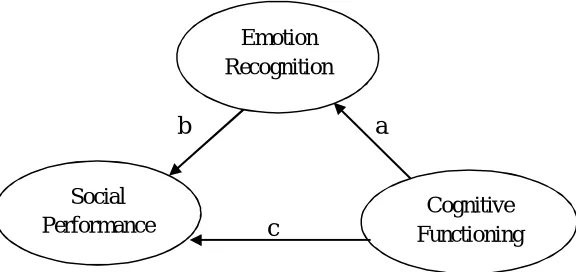
b a
c
Figure 1. The Research Model Presentation
functioning and based on the above mediator model, it is predicted that: People who are impaired in cognitive functions have a weak performance in emotion recognition (path a) and due to the defect in emotion recognition, their social performance in this group of individuals is reduced (path b). Eventually, it is assumed that if the mediator variable is controlled, the relationship between cognitive functions and social performance is reduced (path c).
Material and Method
Participants include 51 patients (18 men and 33 women) with schizophrenia; patients admitted and hospitalized in psychiatric hospitals in Shiraz were selected by available sampling. They had been received diagnosis of the disorders by the psychiatrist. After that, they were interviewed and diagnosed by experienced psychiatrist on the basis of the structured clinical interview for the Diagnostic and Statistical Manual of Mental Disorders Fourth Edition DSM-IV (1994). Exclusion criteria were diagnosing the disorder in axis 1 based on diagnostic criteria of the Diagnostic and Statistical Manual of Mental Disorders Fourth Edition DSM-IV (1994), history of drug addiction, physical illness and neurological disorders such as epilepsy, any type of brain injury and
Social
Performance FunctioningCognitive Emotion
92
mental illness other than the original diagnosis (such as mental retardation or schizoaffective) (Meyer, Krutz, 2009). It should be mentioned that all human studies have been approved by the appropriate ethics committee.
The following instruments were used in the present study:
Cognitive functions including, short-term verbal memory, understanding nonverbal interpersonal situations and sustain attention were assessed, respectively, through paired associated verbal subtests of the Wechsler Memory Scale Revised, The Wechsler Intelligence Scale subtests set of images and continuous performance test.
93
stimulus, and response providing error occurred when the subject responded to non-target stimulus. Upon completion of the test, performance results of the subject were registered as a record on the computer screen (Hadianfard et al., 2000).
Wechsler Memory Scale Revised (WMS-R). In the WMS-R, eight groups of words are read for the subject and asked to complete the second word by heart (Orangi, 2006). We used Persian version of this scale that Orangi, Atefvahid and Ashayeri (2002) reported a good validity and reliability for this scale. The reliability of the scale was measured through a test-retest method. The reliability coefficients of the retests ranged from .28 to .98 for the subtests and for the composite tests, which are satisfactory. The standard error of measurement was calculated as well. To investigate the validity of the new version of the Scale, it was administered to a clinical group who were either diagnosed with or suspected of memory impairment. In comparison with the normative sample in terms of the five indices, the clinical group scored lower in the scale indices
Wechsler Adult Intelligence Scale (WAIS). Wechsler Adult Intelligence Scale (WAIS) subtests set of images consists of eight set of cards from three sets of the subtests. Each batch of scattered card was presented to the subject, and he/she had to put them together regularly to show a story.
Facial Affect Recognition Task
94
images were executed in a 41-person group composed of students of clinical psychology of Shiraz University in the age range of 19 to 22 years. Then, in respect of the 41 selected images (6 images for each emotion except for the fear emotion to which 5 images were allocated) more than 85 percent of those who were in the initial screening agreed to the correct diagnosis of the emotions related to the images as stimuli recognition. There were 7 images (related to 6 emotional states and the neutral state) on which subjects had 100 percent agreement as main options. Therefore, a multiple choice test was designed with the 41 items, and the 7 images with 100 percent agreement and each specifically representing one of the six main emotions (sadness, happiness, fear, surprise and anger) and the neutral state were considered as the test options. Other images of the test items were considered as test options and were placed constantly in front of the subjects in the form of 7 cards of 20*30 cm and other images were consecutively passed by on the monitor of the computer in front of subjects. It is noteworthy that these images were randomly numbered and then were shown to the subjects with the same number (Ekman &Friesen, 1976). After communicating with each subject and inform him/her satisfactorily, he/she sat at a 40±5 cm distance from the computer monitor on a comfortable chair and the procedure was explained to him/her. The test was run using the computer.
The test procedure was such that one of the 7 images including test options were shown to the subject, and then one of the other 41 images was shown on the 16-inch handled computer with 800*1280 pixels for 500 milliseconds.
95
Figure 2.An Example of Ekman and Friesen (1976) Emotional Images
correct answers.
96
general social performance are scored based on the obtained information (Morosini et al., 2000). This scale has been normalized in different countries with good reliability and validity. For example, its German version Cronbach’s alpha has been reported to be .84 and high retest reliability, and also a good validity which has been obtained from the high correlation with other social performance measuring tests such as GAF (r= .91), SOFAS (r= .91) (Juckle, et al., 2008). With respect to the Spanish version of this scale the Cronbach’s alpha has been reported to be .84 and high validity which has been obtained from correlation with GAF test (Apiquian et al., 2009). Since PSP has not been normalized in Iran, the researchers sought to obtain psychometric properties of this questionnaire in the normal population of Iran.
Therefore, after translating the text into Persian and confirming it by two MA English students, it was translated back into the original language, and the accurate translation was selected. The reliability and validity of this questionnaire were calculated in a sample of 30 patients with schizophrenia. An internal consistency of .78 was obtained by calculating the Cronbach’s alpha. To assess its validity, the convergent validity, which is shown in Table 1, was used. The correlations vary from .33 to .63 showing the validity of this instrument.
Table 1
Correlation Matrix of Personal and Social Performance Scale Components
Components 1 2 3 4
1. Social Activity 1
2.Self-Caring .45** 1
3.Social and Personal Relations .58** .37* 1
4. Aggressive Behavior .63* .33* .44** 1
97
Descriptive statistics of the study include mean and standard deviation. After preparing the correlation matrix, Moshiro’s hierarchical multiple regression analysis was used to investigate the existing relationship in the proposed model of the study based on Baron and Kenny’s (1986) method. According to Baron and Kenny (1986), the instruction states that the following steps are necessary to establish mediated relationship:
1. The correlation between the predictor variable (cognitive functions) and the criterion variable (social performance) must be significant.
2. The correlation between the predictor variable (cognitive functioning) and the mediator variable (emotion recognition) must be significant.
3. The correlation between the mediator variable (emotion recognition) and the criterion variable (social performance) must be significant.
4. The correlation between the predictor variable (cognitive functions) and the criterion variable (social performance) must be reduced after controlling the mediator variable (emotion recognition) (Ostovar, 2007).
The SPSS16 software was used to run the above operations.
Then, the structural equation model was evaluated using LISREL software. The compliance parameters have been extracted using the same software. In addition to the above operations in the entire model, direct and indirect effects of each of the model variables on the criterion variable were calculated (Alborzi, 2008).
Results
98
were males and the other remaining 35.3 percent were females; 60 percent of them were single, 23 percent married and 15 percent divorced. Education in guidance and high schools had the highest frequencies (37.3, 37.3) and then primary and upper diploma, respectively.
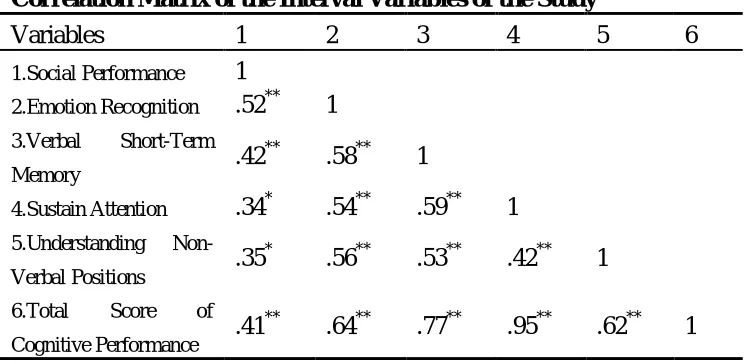
Before performing regression analysis, correlation was evaluated between the variables through assessing the correlation matrix. In Table 2, correlation matrix of the interval variables of the study is presented.
Table 2
Correlation Matrix of the Interval Variables of the Study
Variables 1 2 3 4 5 6
1.Social Performance 1
2.Emotion Recognition .52** 1 3.Verbal Short-Term
Memory .42
**
.58** 1
4.Sustain Attention .34* .54** .59** 1 5.Understanding
Non-Verbal Positions .35 *
.56** .53** .42** 1
6.Total Score of
Cognitive Performance .41 **
.64** .77** .95** .62** 1
**: P< .01, *: P< .05
In the following paragraphs, the mediator model was examined and the model results were reported in detail.
99
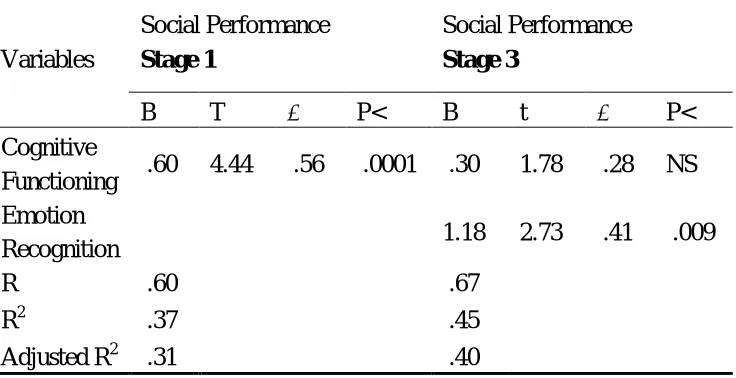
(cognitive functioning) has a significant relationship with the criterion variable (social performance) (β= .56, P< .0001).
Table 3
Results of Baron and Kenny’s Regression Analysis of the First and Third Stages
Variables
Social Performance
Stage 1
Social Performance
Stage 3
B T β P< B t β P<
Cognitive
Functioning .60 4.44 .56 .0001 .30 1.78 .28 NS Emotion
Recognition 1.18 2.73 .41 .009
R .60 .67
R2 .37 .45
Adjusted R2 .31 .40
NS=Non-Significant
100 Table 4
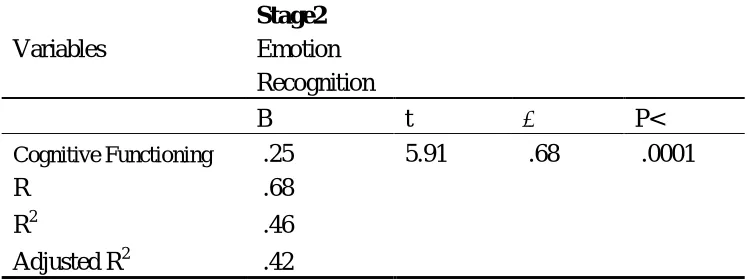
Results of Baron and Kenny’s (1986) Regression Analysis of the Second Stage
Variables
Stage2
Emotion Recognition
B t β P<
Cognitive Functioning .25 5.91 .68 .0001
R .68
R2 .46
Adjusted R2 .42
In the third stage of the analysis, a regression model was used to test the effect of the mediator variable (emotion recognition) on the relationship between the predictor variable (cognitive functioning) and the criterion variable (social performance). In this model, the regression of social performance on emotion recognition was calculated by controlling cognitive functioning and its results were reported in Table 3 as the third stage.
101
Results of regression analysis in Figure 3 can be summarized as follows:
. .68 . .58
Figure 3.Presenting the Final Model of the Study based on Regression Analysis According to Baron and Kenny’s (1986) Instructions
The above mediator model was investigated through regression analysis. In the model, cognitive functioning was analyzed as the predictor variable (independent), emotion recognition as the mediator variable and social performance as the criterion variable (dependent). In order to investigate direct and indirect effects of cognitive functioning variable on social performance variable, two separate regression models were used. In the first model, regression of the cognitive functioning variable was analyzed as the predictor variable and social performance as the criterion variable. As it can be seen in the Table 3, the cognitive functioning variable with β coefficient of .56 explained 37 percent of the variance of the social performance variable (R2= .37). In the second regression model, social performance regression (the criterion variable) on emotion recognition (the mediator variable) by controlling cognitive functioning variable (the predictor variable) was evaluated to test indirect effects of cognitive functioning variable (the predictor variable) on social performance (the criterion variable). As figure 3 shows, by controlling emotion recognition variable (the mediator variable), the coefficient of cognitive functioning variable (the predictor variable) has been reduced to 0.28 and is not significant anymore.
Cognitive Functioning
Emotion
102 The Final Model Fitness
According to the various stages of the path analysis and removing non-significant paths, the final model of the effect of cognitive functioning on social performance mediated by emotion recognition is displayed in Figure 4.
.64 .3 .28
Figure 4. Presenting the Final Model of the Study based on the Final Model Fitness
The obtained results from the structural equation model in the field of model fitness indicators represent the optimal matching of the obtained model. In this model, chi square (P= .11, df =1, X2=2.74) was calculated. Goodness of fit index (GFI) which represents the explained variance and covariance value by the model was calculated .97. It should be mentioned that GFI more than .90 represents compliance of the model with the data. Adjusted goodness of fit index (AGFI) that adjusts goodness of index, to some extent, to the sample size and degrees of model freedom can vary from 0 to1.0 and values close to one indicate better goodness of fit of the model (Khormayi, 2006). AGFI was calculated .83 for the model that confirms goodness fitted. Mean of the explained variance and covariance of the model was calculated by the root mean square residual (RMR). The more this value is closer to zero, the better fitness the model will have and values less than .1 are acceptable (Hosseini, 2011). RMR value was calculated 0.06 for the model that represents the model’s fitness with the real sample. Table 5 presents all the model fitness indices.
Social performanc Emotion
Recognition Cognitive
103 Table 5
The Model Fitness Indices
indices GFI AGFI RMR CN CFI IFI NFI
Values .97 .83 .06 146 .95 .96 .93
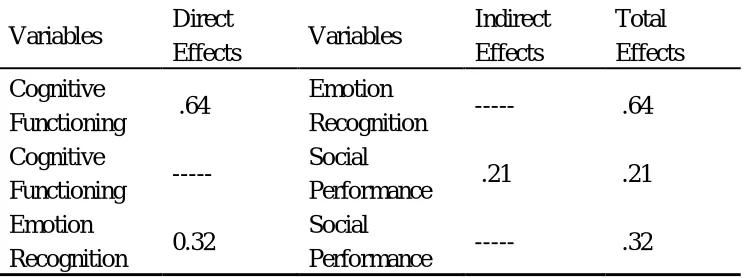
In Table 6, direct, indirect and total significant effects are listed for the model.
Table 6
Direct, Indirect and Total Significant Effects of the Model
Variables Direct
Effects Variables
Indirect Effects
Total Effects
Cognitive
Functioning .64
Emotion
Recognition --- .64 Cognitive
Functioning ---
Social
Performance .21 .21 Emotion
Recognition 0.32
Social
Performance --- .32
Discussion and the Overall Conclusion
104
and it only had 21 percent indirect effect on social performance mediated by emotion recognition, while emotion recognition played 31 percent direct effect on social performance. All findings confirmed the mediating role of emotion recognition and represented that if cognitive functions have a relationship with social performance, it will be indirect. And it only mediated by emotion recognition, that is to say, increasing cognitive skills will be followed by better recognition of emotions and better recognition of emotions will be led to improvement in social performance in this group of patients.
The finding indicates that this is the facial emotion recognition that has a direct relationship with social performance not the cognitive functions. Therefore, in order to increase social performance in the group of patients, improvement of facial emotion recognition is prioritized.
Our knowledge of the relationship between cognition and social functioning is limited. We have evidence of the importance of cognition in determining outcome and examining potential mediators such as affect recognition holds promise for increasing our understanding. Additionally it is possible that such mediators may be the targets for intervention, although the potential of such treatments are in the early stages of development ( Hogarty et al., 2004; Medalia et al., 2002).
Thus , these results suggest that improvements in social cognition leads to improvements in daily social functioning, which makes interventions such as the ones listed below essential in the quest for improvement in this area: Training of Affect Recognition (TAR; Fromann, Streit and Wölwer, 2003; Wölwer et al., 2005), Emotion Management Training (EMT; Hodel Brenner, Merlo and Teuber, 1998); Psychological Integrate Therapy for Schizophrenia (IPT; Roder, Brenner, Kienzle and Fuentes 2007; Cognitive Enhancement Therapy (CET; Hogarty and Flesher, 1999); and Social Cognition and Interaction Training(SCIT; Penn et al., 2005).
105
it represents ever-changing events. Some investigators suggest that because the lack of important dynamic information that facial photographs have, patients need to interpret facial expressions more accurately. It suggests that future studies that make use of videotaped representations of facial expressions of emotions could address this issue (Hargarave, Maddock & Stone, 2002).
Although the findings of this study suggest the facial emotion recognition has a direct relationship with social performance not cognitive function, there is a need that the future research use the current research model on other mental disorder, other subdivision of schizophrenia and on acute and chronic schizophrenia independently, until the underlying mechanisms of social dysfunction as one of the vital characteristics of this disorder clearly be evaluated.
Refferences
Addington, J., & Addington, D. (1999). Neurocognitive and social functioning inschizophrenia. Schizophrenia Bulletin, 25 (1), 173–182.
Addington, J., Saeedi, H., Addington, D. (2006). Facial affect recognition: a mediator between cognitive and social functioning in psychosis?
Schizophrenia Research, 85, 142-150.
Alborzi, M. (2008). Motivational beliefs as a mediator in a creativity model with regard to parenting, scholll factors and attributional beliefs in elementary school children [PhD Thesis]. Shiraz: Faculty of Education & Psychology.
Apiquian, R., Ulloa, R. E., Horrera-Estrella, M., Moreno-Gomes, A., Erosa, S., & Contreras, V., et al. (2009). Validity of the Spanish version of the Personal and Social Performance scale in schizophrenia. Schizophrenia Research, 112, 181-186.
106 psychology, 51, 1173-1182.
Bellack, A., Gold, J., & Buchanan, R. (1999). Cognitive Rehabilitation for schizophrenia: Problems, prospects, and strategies. Schizophrenia Bulletin, 25, 257-274.
Bellack, D., Morrison, R., Wixted, J., & Mueser, K. (1990). An analysis of social competence in schizophrenia. British Journal of Psychiatry,
156, 809-818.
Brune, M. (2005). Emotion recognition, theory of mind and social behavior in schizophrenia. Psychiatry Research, 133, 135-147.
Cornblatt, B. A., Green, M. F., Walker, E. F. & Mittal, V. A. (2009).
Schizophrenia: Etiology and Neurocognition. (Blaney, P. H., Millon, T, Eds.). New York: Oxford University Press.
Corrigan, P. W., & Toomey, R. (1995). Interpersonal problem solving and information processing in schizophrenia, Schizophrenia Bulletin,
21(3), 395-403.
Couture, S. M., Granholm, E. M., & Fish, S. C. (2011). A path model investigation of neurocognition, theory of mind, social competence, negative symptoms and real-world functioning in schizophrenia, Schizophrenia Research, 125, 152-160.
Edwards, J., Jackson, H. J., & Pattison, P. E. (2002). Emotion recognition via facial expression and affective prosody in schizophrenia: a methodological review. Clinical Psychology, 22, 789–832.
Ekman, P., & Friesen, W. V. (1976). Pictures of Facial Affect. CA: Consulting Psychologists Press, Palo Alto.
Frommann, N., Streit, M., & Wölwer, W. (2003) Remediation of facial affect recognition impairments in patients with schizophrenia: a new training program. Psychiatry Research, 117, 281-284.
107
Green, M. F., Kern, R. S., Braff, D. L., & Mintz, J. (2000). Neurocognitive deficits and functional outcome in schizophrenia: are we measuring the “right stuff”? Schizophrenia Bulletin, 26 (1), 119–136.
Hadianfard, H., Najarian, B., Shokrkon, H., & Mehrabizadeh Honarmand, M. (2000). Construction and validation of the Farsi version of Continuous performance Scale. Journal of psychology, 16, 388-404.
Hogarty, G. E., Flesher, S., Ulrich, R., Carter, M., Greenwald, D., Pogue-Geile, M., Kechavan, M., Cooley, S., DiBarry, A. L., Garrett, A., Parepally, H., & Zoretich, R. (2004). Cognitive enhancement therapy for schizophrenia: effects of a 2-year randomized trial on cognition and behavior. Arch. Gen. Psychiatry,61, 866–876.
Hargrave, R., Maddock, R., & Stone, V. (2002). Impaired recognition of facial expressions of emotion in Alzheimer’s disease. The Journal of neuropsychiatry and clinical Neuroscience, 14, 64-71.
Heinrichs, R. W., & Zakzanis, K. K.(1998). Neurocognitive deficit in schizophrenia: a quantitative review of the evidence. Neuropsychology, 12 (3), 426–445.
Hodel, B., Brenner, H. D., Merlo, M. C., & Teuber, J. F. (1998). Emotional management therapy in early psychoses. British Journal of Psychiatry, 172 (33), 128-133.
Hoff, A. L., & Kremen, W. S. (2002). Is there a cognitive phenotype for schizophrenia: the nature and course of the disturbance in cognition?
Curr Opin Psychiatry,15 (1), 43–48.
Hogarty, G., & Flesher, S. (1999). A development theory for cognitive enhancement Therapy for schizophrenia. Schizophrenia Bulletin, 25, 677-692.
Hosseini, F. (2011). Causal explanation of the mathematic academic emotions based on some individual and situational variables scrutinizing cognitive and behavioral outcomes [PhD Thesis]. Shiraz: Faculty of Education & Psychology.
108
(2008). Validation of the Personal and Social Performance (PSP) Scale in a German sample of acutely ill patients with schizophrenia.
Schizophrenia research, 104, 87-93.
Khormayi, F. (2006). The casual model of personality traits, motivational orientation and cognitive learning styles [PhD Thesis]. Shiraz: Faculty of Education & Psychology.
Medalia, A., Revheim, N., & Casey, M. (2002). Remediation of problem-solving skills in schizophrenia: evidence of a persistent effect.
Schizophrenia Research, 57, 165– 171.
Mandal, M. K., Pandey, R., & Prasad, A. B. (1998). Facial expression of emotions and schizophrenia: a review. Schizophrenia Buletinl, 24, 399– 412.
Meyer, M. B., & Krutz, M. M. (2009). Elementary neurocognitive function facial affect recognition and social skills in schizophrenia.
Schizophrenia Research, 110, 173-179.
Morosini, P. L., Magliano, L., Brambilla, L., Ugolini, S., & Pioli, R. (2000). Development, reliability and acceptability of a new version of the DSM-IV Social and Occupational Functioning Assessment Scale (SOFAS) to assess routine social functioning. Acta Psychiatrica Scandinavica, 101(4), 323–329.
Mueser, K. T., Bellack, A. S., Douglas, M. S., & Morrison, R. L. (1991). Prevalence and stability of social skill deficits in schizophrenia.
Schizophrenia Research, 5, 167–176.
Orangi, M. (2006). Wechsler Intelligence Scale Revised. Shiraz: Kooshamehr. ( 1987).
Orangi, M., Atef Vahid, M. K., & Ashayeri, H. (2002). Standardization of the revised Wechsler memory scale in Shiraz. Iranian Journal of Psychiatry and clinical psychology, 7(4), 56-66.
109
Ostovar, S. (2007). Explaining the mediating role of self-focused attention and social self-efficacy on the relationship between social anxiety and cognitive orientation, PhD thesis, Shiraz University, College of Psychology and Educational Sciences.
Pan, Y. J., Chen, Sh., Chen, W. J., & Liu S. K. (2009). Affect recognition as an independent social function determinant in schizophrenia.
Comper Psychiatry, 50(5), 443-452.
Penn, D. L., Corrigan, P. W., Bentall, R. P., Racnstein, J. M., & Newman, L. (1997). Social cognition in schizophrenia. Psychological Bulletin, 121, 114-132.
Penn, D., Roberts, D., Munt, E., Silverstein, E., Jones, N. & Sheitman, B. (2005). A pilot study of social cognition and interaction training (SCIT) for schizophrenia. Schizophrenia Research , 80, 357-359.
Pinkham, A. E., Penn, D. L., Perkins, D. O., & Lieberman, J. (2003). Implications for the neural basis of social cognition for the study of schizophrenia. Am. J. Psychiatry, 160, 815– 824.
Pinkham, A. E., & Penn, D. L. (2006). Neurocognitive and social cognitive predictors of social skill in schizophrenia. Psychiatry Research, 143, 167-178.
Pinkham, A. E., Penn, D. L., Perkins, D. O., Graham, K. A., & Siegel, M. (2007). Emotion perception and social skills over the course of psychosis: a comparison of individuals at risk for psychosis and individuals with early and chronic schizophrenia spectrum illness.
Cogn. Neuropsychiatry, 12, 198–212.
Roder, V., Brenner, H. D., Kienzle, N., & Fuentes, I. (2007). Terapia Psicológica Integrada para la Esquizofrenia. Granada: Alboran.. Roncone, R., Falloon, I. R., Mazza, M., DeRisio, A., police, R., Necozion,
S., et al. (2002). Is theory- of-mind in schizophrenia more strongly related to clinical and social functioning than neurocognition.
Psychopathology, 35, 280-288.
110
sociodemographic risk factors for the schizophrenia syndrome.
Archives of General Psychiatry, 49, 37-46.
Wechsler, D. (1987). Wechsler Memory Scale–Revised Manual. New York: psychological cooperation Inc.
Wölwer, W., Frommann, N., Halfmann, S., Piaszek, A., Streit, M. &