Demographic Research a free, expedited, online journal of peer-reviewed research and commentary
in the population sciences published by the Max Planck Institute for Demographic Research Konrad-Zuse Str. 1, D-18057 Rostock · GERMANY www.demographic-research.org
DEMOGRAPHIC RESEARCH
VOLUME 19, ARTICLE 5, PAGES 73-84
PUBLISHED 01 JULY 2008
http://www.demographic-research.org/Volumes/Vol19/5/ DOI: 10.4054/DemRes.2008.19.5
Research Article
Overview Chapter 3:
Birth regulation in Europe:
Completing the contraceptive revolution
Tomas Frejka
This publication is part of Special Collection 7: Childbearing Trends and Policies in Europe (http://www.demographic-research.org/special/7/)
© 2008 Frejka.
1 Introduction 74
2 Contraception 76
3 Induced abortions 79
4 Effects 81
Demographic Research: Volume 19, Article 5
research article
Overview Chapter 3:
Birth regulation in Europe:
Completing the contraceptive revolution
Tomas Frejka1
Abstract
Early in the 21st century modern contraception -- primarily hormonal methods, advanced IUDs, sterilization and condoms -- has become the main instrument of birth regulation in Northern and Western Europe and gaining ground in Southern Europe and the formerly state socialist countries of Central and Eastern Europe. Legal induced abortion use, which was highly prevalent in Central and Eastern Europe, has been declining since the demise of authoritarian regimes around 1990. Nonetheless, abortions are still used in countries of the former Soviet Union and the Balkans, where the “abortion culture” had been deeply ingrained. Liberal abortion legislation, modern induced abortion technology, and modern contraceptives, have enhanced women’s health, been instrumental in childbearing postponement, have been a factor in changing partnership relations, and in the evolution of values regarding sexuality, reproduction, and childbearing, but they have not been a principal cause of contemporary low fertility. Assisted reproductive technology (ART) is emerging and having a slight positive impact on fertility in some countries.
1. Introduction
Contraception and induced abortions were the principal means of regulating fertility in Europe in recent decades. Both were known already in the ancient cultures of Egypt, Greece, Rome and other countries (Himes 1936; van de Walle 1999), but were not widely practiced prior to the 19th century.
In addition to abstinence, the most widespread contraceptive method of the 19th and early 20th centuries was coitus interruptus – withdrawal (Santow 1993). The practice of induced abortion was also widespread. With time, other contraceptive methods were increasingly used, namely the douche, the rhythm method (also known as the calendar method or periodic abstinence) and condoms. The first intrauterine devices (IUDs) were introduced in the 1920s, but were not in general use before the 1960s. The U.S. Food and Drug Administration approved oral hormonal contraception, the “pill,” in 1960; this marks the initiation of the era of truly modern contraception. The generally accepted contemporary classification of modern contraceptives includes sterilization, condoms and barrier methods in addition to IUDs, and various forms of hormonal contraception, such as the pill, injectables and implants. (We will use this terminology even though the characterization “modern” is historically inaccurate.) Rhythm, withdrawal, prolonged abstinence and douching are considered traditional methods. One reason for distinguishing between modern and traditional methods is the difference in their effectiveness in preventing conception. Modern methods are very effective when properly administered, whereas traditional methods tend to have high failure rates. When a modern contraceptive method is used consistently for 12 months, fewer than one pregnancy per 100 women-years will materialize, compared to 14 – 26 pregnancies when traditional methods are used2 (United Nations 2000).
In the second half of the 20th century, several European countries had legal restrictions on the use of contraceptive methods, reflecting the position and influence of religious institutions, notably Christian churches. In the Netherlands, for example, “it was forbidden to sell or advertise contraceptives” in the 1960s, but “in 1969 the [Dutch] government removed the statutory prohibition on contraceptives” (Netherlands chapter). In principle, none of these restrictions are any longer in force early in the 21st century.
Abortion laws can be classified into five broad categories, reflecting various degrees of restrictiveness: (1) strict prohibition, or abortion only allowed to protect the woman’s life; (2) abortion also permitted to protect a woman’s physical health; (3) abortion permitted to protect a woman’s physical and mental health; (4) abortion permitted on socioeconomic grounds; and (5) abortion permitted on demand during a
2 Although the male condom is considered a modern method its effectiveness is low: the probability of failure
Demographic Research: Volume 19, Article 5
prescribed period of the pregnancy without restriction as to reason. Induced abortions were almost universally illegal in the first half of the 20th century. After 1950, laws were liberalized in most European countries, first in the formerly state-socialist countries of Central and Eastern Europe in the mid-1950s, and gradually elsewhere. As of the early 21st century, induced abortions are permitted without any restriction as to reason in almost all European countries (Rahman et al. 1998), although a few countries have some legal constraints, and there are two significant exceptions. The most restrictive laws are still in force in Ireland. In Poland, abortion was permitted on socioeconomic grounds in 1956, but the law was revised in 1993 to permit abortion only when a pregnancy threatens the woman’s life or health, when a pregnancy is the result of a crime, or if the foetus appears to be severely and incurably damaged (Kulczycki 1995).
The legal status of abortion may entail various consequences, such as increased health risks or the need to travel to other countries to obtain an abortion. Where restrictive laws are in force, the health risks can be considerable because induced abortions may not be performed in optimal hygienic conditions with advanced medical procedures. Following the imposition of extensive restrictions in eligibility for an induced abortion in Romania in October 1966, the abortion-related maternal mortality rate increased from 16.9 per 100,000 live births in 1965, to 151.3 in 1982, a nine-fold increase. Throughout the 1980s, 85 to 90 percent of maternal deaths in Romania were due to abortions (Baban 1999). The response to restrictive legislation in some countries is that women with a strong motivation to interrupt an unwanted pregnancy will travel to another country to obtain an abortion. “In Ireland … an increasing number of women have been travelling to England for abortion services” (Henshaw et al. 1999). The health risks to these women are negligible because of the good quality of the services in England. Nonetheless, even with liberal legislation the quality of abortion services may differ from one country to another, with differential effects on women’s reproductive health.
Customarily, only the means to prevent conception and births -- contraception and induced abortion -- have been subsumed under the concept of birth regulation. In recent decades, however, various methods of assisted reproduction have been increasingly used by couples facing infertility, and these methods have become relevant for fertility trends (e.g., Stephen 2000). Assisted reproductive technology (ART) has led to a rise in the frequency of multiple births (Czech Republic chapter), and arguably has also had a slight positive impact on fertility rates, especially at higher reproductive ages (Hoorens et al. 2007, Sobotka et al. 2007). Leridon’s (2004) study shows that assisted reproduction can partly offset the negative effects of fertility postponement on the ability to conceive. These findings justify the inclusion of such activities in the “birth regulation” concept.
The first human conceived by in vitro fertilization (IVF) was born in 1978 in England (Steptoe and Edwards 1978). A few other methods of ART have been developed since then, of which the most prominent is the intracytoplasmatic sperm injection (ICSI), which is commonly used in the case of male-factor infertility. The use of ART differs greatly between countries. These variations can be attributed to a number of factors, including differences in the provision of ART by the various national health care systems, differences in the legislative regulation of ART, and varying levels of access to ART treatments (Schenker 1997). In most European countries with available statistics on assisted reproduction, the proportion of children born after an ART treatment ranges between one and three percent, with Macedonia recording a very low volume of 0.2 percent, and Denmark reporting the highest success rate of 3.9 percent in 2003 (Anderson et al. 2007, these data exclude intrauterine inseminations).
2. Contraception
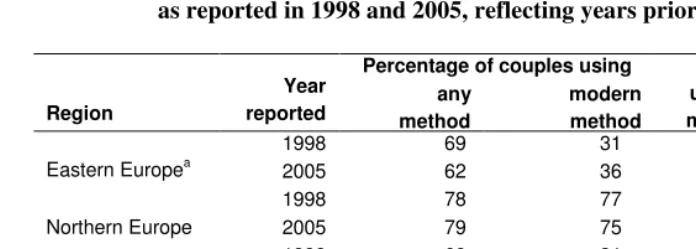
It is possible to get a general idea of levels and trends in contraceptive use in the four main regions of Europe in the past two decades from Table 13.
3 The United Nations Population Division periodically provides an overview of contraceptive use around the
Demographic Research: Volume 19, Article 5
Table 1: Contraceptive use and use of modern methods, by regions in Europe, as reported in 1998 and 2005, reflecting years prior to these dates
Percentage of couples using
Region
Year
reported method any modern method
Percentage of users employing modern methods
1998 69 31 44
Eastern Europea 2005 62 36 58
1998 78 77 98
Northern Europe 2005 79 75 95
1998 69 31 46
Southern Europe 2005 69 49 71
1998 75 71 94
Western Europe 2005 74 70 95
Sources: United Nations 2001, 2006.
Note: aThe formerly state-socialist countries of Central and Eastern Europe.
The main observations that can be drawn from these data are as follows:
Contraceptive prevalence was higher in Northern and Western Europe than in Eastern and Southern Europe;
The use of modern contraceptives was almost universal in Northern and Western Europe;
Although relatively low, the use of modern contraceptives increased substantially in Eastern Europe and especially in Southern Europe during recent years.
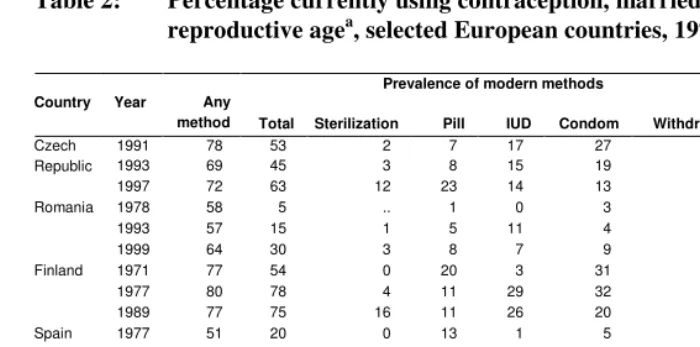
Table 2: Percentage currently using contraception, married women of reproductive agea, selected European countries, 1971-1999
Prevalence of modern methods Country Year Any
method Total Sterilization Pill IUD Condom Withdrawal
Percentage of users employing modern methods
1991 78 53 2 7 17 27 25b 68
1993 69 45 3 8 15 19 22 65
Czech Republic
1997 72 63 12 23 14 13 7 88
1978 58 5 .. 1 0 3 26 9
1993 57 15 1 5 11 4 34 26
Romania
1999 64 30 3 8 7 9 29 47
1971 77 54 0 20 3 31 16 70
1977 80 78 4 11 29 32 2 98
Finland
1989 77 75 16 11 26 20 1 97
1977 51 20 0 13 1 5 22 39
1985 59 38 5 16 6 12 16 64
Spain
1995 81 67 20 15 8 24 11 83
1972 64 21 0 11 1 8 33 33
1978 79 48 5 27 10 6 22 61
1988 81 67 7 30 26 4 7 83
France
1994 75 69 8 36 20 5 3 92
Sources: United Nations 2001, 2006.
Notes: a – Women currently married or in consensual unions, usually ages 15-44 or 15-49; b - includes rhythm.
There was considerable variation between countries in the composition of contraceptive methods used, and in their trends of use over time. Taking into account that contraceptive methods tend to be used differentially depending on age (mainly, on the age of women), an almost universal increase in the use of the more effective methods, sterilization and the pill can be observed (Table 2). Conversely, the use of traditional methods has declined across the board, as exemplified by the trends in the use of withdrawal.
One specific development is worth pointing out. The overall use of sterilisation has generally been increasing. Nonetheless, the delay of childbearing, with a growing number of women “catching up” towards the end of their reproductive period, has led to some decline in the use of sterilisation at those ages. In Great Britain, for example, “since the 1980s, particularly among couples in their 30s and early 40s, the popularity of sterilisation as a method of contraception seems to have decreased, whilst among women aged 45–49 it appears to have increased” (Botting and Dunnell 2000). This phenomenon is apparently occurring in several Western countries (see, for example, Figure 19 and its discussion in Netherlands chapter).
Demographic Research: Volume 19, Article 5
in progress. In those countries where the contraceptive revolution is complete, the use of traditional methods is now almost zero. In a number of countries, such as the Czech Republic and Spain, change in the use of contraceptives was progressing rapidly during the 1990s, and the patterns of use are coming close to those of countries with a completed transformation. Romania is an example of a country where changes in contraceptive use still have a long way to go. Despite a significant ongoing metamorphosis, fewer than half of all couples in Romania were using modern contraceptives in 1999, but the transformation no doubt continued during the 2000s (Romania chapter).
3. Induced abortions
“Abortion culture” is the term succinctly characterizing the nature of birth regulating behaviour in the formerly socialist countries of Central and Eastern Europe for the four decades of the 1950s through the 1980s (Stloukal 1999). Liberal abortion legislation, coupled with health systems advancing curative, rather than preventive, medicine, made induced abortions easy to obtain and socially acceptable. With the exception of Hungary, the GDR, and parts of the former Yugoslavia, modern contraceptives, especially the pill, were difficult to obtain, and most couples were using traditional ineffective contraception (Stloukal 1995; Sobotka 2003). Withdrawal, and, to a lesser extent, the rhythm method and condoms, were being employed by a majority of users (Frejka 1983; David 1999).
There were major differences between these countries in the incidence of induced abortions. For the most part, women had an average of one to two lifetime abortions. But in the Soviet Union and Romania, the total induced abortion rate around 1960 was on the order of five to almost eight lifetime abortions per woman (Frejka 1983).
were improving unevenly and gradually, and it was taking time for birth preventing behaviour to modernize.
Table 3: Legal induced abortions, rates (per 1000 women of reproductive age) and total abortion rates, selected countries, 1980–2003
Rates of legal induced abortion Total induced abortion ratec
Country 1980 1990 1996 2003 1980 1990 1996 2003
Croatiaa 50.3 40.1 12.9 6.5 1.5 1.2 0.4 0.2
Czech Republic 32.3 47.7 20.7 12.6 1.0 1.4 0.6 0.4
Hungary 36.3 41.2 34.7 25.8 1.1 1.2 1.0 0.7
Romaniaa u 181.7 78.0 34.8 u 5.5 2.3 1.0
Russian Federationa [123.1] [109.3] 68.4e 44.5 3.7 3.3 2.0e 1.3
Russian Federation (see
chapter) 3.4d 2.5 1.6
Finland 20.4 11.1 10.0 10.8 0.6 0.3 0.3 0.3
Sweden 20.7 21.3 18.7 20.2 0.6 0.6 0.6 0.6
Spaina u 4.3 5.7 8.5 u 0.1 0.1 0.2
Germany u 8.5 7.6 7.7 u 0.3 0.2 0.2
France 21.6 16.4 16.6 16.5 0.6 0.5 0.5 0.5
France (see chapter) 19.0f 14.0d 14.2 14.1 0.6f 0.5d 0.5 0.5
Netherlandsb 6.7 5.2 6.5 8.6 0.2 0.2 0.2 0.3
Sources: Henshaw et al. 1999 (for columns 1980, 1990, and 1996); Sedgh et al. 2007 (for column 2003); Rossier and Pirus (2007) for France; papers in this volume.
Notes: a – Incomplete or of unknown completeness; b – Residents only; c – The total induced abortion rate is the average number of induced abortions per woman during her lifetime if present levels were to prevail. It is commonly estimated by multiplying rates per 1000 women of reproductive age by 30 (the number of years between age 15 and age 45). Data in the table are either such estimates or those cited in papers of this volume; d – 1991; e – 1995; f – 1981; u – Unknown.
Demographic Research: Volume 19, Article 5
increasing in Spain since decriminalization in 1985, the level of induced abortions is perceived as high, especially among young people, and “may be regarded to be a consequence of shortcomings in sex education, for these subjects are not included in school curricula” (Spain chapter).
4. Effects
The significant advancements in contraceptive and induced abortion technologies, and their relatively easy and widespread availability, are phenomena of the second half of the 20th century. Presumably this could imply that they have had a profound impact on fertility levels and trends. Was that the case? What would the course of fertility have been towards the end of the 20th century without modern contraceptive technology, and without liberal abortion legislation? If the absence of the latter features had been the only societal development that was different over the past half century, fertility trends might not have been much different than they were in reality. Remember that over half of Europe’s population was reproducing at below the replacement level in the 1920s (Kirk 1946), and that this was brought about by employing mainly withdrawal, condoms and illegal abortions. Restricted childbearing motivation was the critical factor. For a more modern example, let us note that developments in Poland in the 1990s suggest that legislative changes may have only negligible visible fertility consequences. The rescinding of liberal abortion legislation in 1993 apparently had only a marginal effect on declining fertility, although without the ban fertility might have declined faster. On the other hand, under certain circumstances the legal curtailment of induced abortion, combined with limited access to contraception, can affect fertility markedly, as was the case in Romania after 1966. There fertility was retained at a relatively high level compared to most other formerly state-socialist countries through the late 1980s.
and contraceptive technologies, made it easier for people to have the number of children they desired.
Several additional, overlapping, crucial effects surface when childbearing developments of the past 50 years are examined in greater detail.
Modern contraceptives have reduced the incidence of unwanted and mistimed pregnancies and births, which, in turn, has reduced the incidence of legal and illegal induced abortions. The latter is a significant contribution to improved reproductive health.
Modern contraceptives have contributed to a decline in unwanted and mistimed pregnancies and births at all ages. In most countries, this decline has been more pronounced among young women, especially teenagers.
Modern contraception and liberal abortion legislation have been instrumental in enabling women and couples to postpone childbearing to higher ages. Postponed fertility generates period fertility that is lower than what would otherwise be the case, and can be a factor in declining lifetime childbearing.
The use of modern contraceptives, complemented by relatively easy access to legal induced abortions, provides women (couples) with tools that allow them to time pregnancies more effectively than was previously possible, and thus to have greater control over life-cycle events, such as education, employment, career development and marriage (Presser 2001; Sobotka 2004).
The use of modern contraceptives, complemented by relatively easy access to legal induced abortions, constitutes one out of a number of basic components/phases of the second demographic transition (van de Kaa 2001). At the same time, the application of modern contraceptives and liberal abortion legislation are instrumental in generating other characteristics of the SDT, namely postponement of marriages and births, and the separation of sex and procreation. These characteristics are, in turn, preconditions for new forms of partnership and family behaviour, as well as changes in values and norms on sexuality, reproduction and childbearing.
Demographic Research: Volume 19, Article 5
References
Anderson, N. A., A. V. Goossens, L. Gianaroli, R. Felberbaum, J. de Mouzon, and K. G. Nygren. 2007. Assisted reproductive technology in Europe, 2003. Results generated from
European registers by ESHRE. Human Reproduction 22(6): 1513–25.
Baban, A. 1999. Romania, in H. P. David (Ed.), From Abortion to Contraception: A Resource to Public Policies and Reproductive Behavior in Central and Eastern Europe from 1917 to the Present. Westport, Connecticut: Greenwood Press, pp: 191-221.
Botting, B., and K. Dunnell. 2000. Trends in fertility and contraception in the last quarter of the 20th century. Population Trends 100, UK National Statistics http://www.statistics. gov.uk/articles/population_trends/fertconttrends_pt100.pdf.
David, H. P. (Ed.) 1999. From abortion to contraception. A resource to public policies and reproductive behavior in Central and Eastern Europe from 1917 to the present. Westport, Connecticut: Greenwood Press.
Frejka, T. 1983. Induced Abortion and Fertility: a Quarter Century of Experience in Eastern
Europe, Population and Development Review 9(3): 494–520.
Henshaw, S. K., S. Singh, and T. Haas. 1999. Recent trends in abortion rates worldwide,
International Family Planning Perspectives 25(1): 44–48.
Himes, N. E. 1936 (reprinted 1963). Medical History of Contraception. New York: Gamut Press.
Hoorens, S., F. Gallo, J. A. K. Cave, and J. C. Grant. 2007. Can assisted reproductive technologies help to offset population ageing? An assessment of the demographic and
economic impact of ART in Denmark and UK, Human Reproduction 22(9): 2471–2475.
Kirk, D. 1946. Europe’s Population in the Interwar Years. Princeton, NJ: League of Nations and
Princeton University Press
Kulczycki, A. 1995. Abortion policy in post-communist Europe. The conflict in Poland,
Population and Development Review 21(3): 471–505.
Leridon, H. 2004. Can assisted reproduction technology compensate for the natural decline in
fertility with age? A model assessment, Human Reproduction 19(7): 1549–1554.
Presser, H. B. 2001. Comment: A gender perspective for understanding low fertility in post-transitional societies, in R. A. Bulatao and J. B. Casterline (Eds.), Global fertility
transition. Supplement toPopulation and Development Review 27: 177–183.
Rahman, A., L. Katzive, and S. K. Henshaw. 1998. A global review of laws on induced abortion,
1985–1997, International Family Planning Perspectives 24(2): 56–64.
Rossier C., and C. Pirus. 2007. Estimating the number of abortions in France, 1976–2002,
Populatio E 62(1): 57–88.
Santow, G. 1993. Coitus interruptus in the twentieth century, Population and Development
Review 19(4): 767–792.
Schenker, J. G. 1997. Assisted reproduction practice in Europe: legal and ethical aspects, Human
Reproduction Update 3(2): 173–184.
Sedgh G., S. K. Henshaw, S. Singh, A. Bankole, and J. Drescher. 2007. Incidence and recent
trends in legal abortion worldwide, International Family Planning Perspectives
Forthcoming September 2007.
Sobotka, T. 2004. Postponement of childbearing and low fertility in Europe. Doctoral thesis, University of Groningen, Amsterdam: Dutch University Press.
Sobotka, T., M. Hansen, T. Jensen, and N. E. Skakkebaek. 2007. Will fertility among Danish women remain stable due to assisted reproduction? Assessing the role of in vitro fertilization in sustaining cohort fertility rates. PAA Annual Meeting, New York. Socialstyrelsen (The National Board of Health and Welfare, Centre For Epidemiology, Sweden),
2006. Aborter 2005. www.socialstyrelsen.se.
Steptoe, P. C., and R. G. Edwards. 1978. Birth after the reimplantation of a human embryo,
Lancet 2(8085): 366.
Stephen, E. H. 2000. Demographic implications of assisted reproductive technologies, Population
Research and Policy Review 19(4): 301–315.
Stloukal, L. 1995. Demographic aspects of abortion in Eastern Europe: A study with special reference to the Czech Republic and Slovakia. PhD Thesis, Canberra: Australian National University.
Stloukal, L. 1999. Understanding the ‘abortion culture’ in Central and Eastern Europe, in H. P. David (Ed.), From Abortion to Contraception: A Resource to Public Policies and Reproductive Behavior in Central and Eastern Europe from 1917 to the Present. Westport, Connecticut: Greenwood Press, pp 23-37.
United Nations. 2001. Levels and Trends of Contraceptive Use as Assessed in 1998.
ST/ESA/SER.A/190. New York: United Nations
United Nations. 2006. World Contraceptive Use 2005. New York: United Nations.
Van de Kaa, D. J. 2001. Postmodern fertility preferences: from changing value orientation to new behavior, in R. A. Bulatao and J. B. Casterline (Eds.), Global fertility transition.
Supplement toPopulation and Development Review 27: 290–331.
Van de Walle, E. 1999. Towards a demographic history of abortion, Population. An English
Selection 11: 115–132.
Van de Walle, E. 2003. Induced abortion: history, in P. Demeny and G. McNicoll (Eds.),
Encyclopedia of Population, New York: MacMillan Reference USA, pp: 527–529.