Paper received: 03.04.2007 Paper accepted: 15.05.2008
Tailoring Functionality and Durability of Polymeric Products
by Modifying Processing Conditions
Urška Florjančič '* - Igor E rm i
1,2
1
Center for Experimental Mechanics, University of Ljubljana, Slovenia2
Institute for Sustainable Innovative Technologies, Ljubljana, SloveniaWe investigate new possibilities fo r modifying functionality o f polymeric products by changing their material structure during processing and consequently their time-dependent properties, which define the durability o f final products. In the first part o f the paper we report on significant differences in material structure as observed at atomistic scale due to differences in processing conditions. A short overview o f recent studies on multi-scale phenomena in material structure formation is included. Several experimental approaches are proposed fo r studying the effect o f processing conditions on material structure formation and hence, the macroscopic properties o f the final polymeric product.
The second part o f the paper deals with two questions to be answered, (i) does current industrial polymer processing equipment (in our case extruder) allows processing under such conditions that initiate nonlinearities in the material structure formation processes, and (ii) to what extent can material structure be modified, and consequently the mechanical and other properties o f the final polymeric product, by changing the thermo-mechanical boundary conditions (i.e., processing conditions).
We demonstrate that it is possible to modify the functionality o f the final polymeric products by modifying the inherent material structure with properly selected processing conditions. We observed that the processing conditions within the range o f temperatures and pressures that are typical fo r industrial extrusion o f polymers can be changed so that we can significantly influence the structure formation and consequently the time-dependent mechanical properties o f the material in solid state and, as a result, the functionality o f the final product. Durability o f polymeric products made from such material can be improved by several orders o f magnitude! Utilizing this approach opens new possibilities fo r modifying the functionality ofpolymeric products and hence better competitiveness in the world market.
© 2008 Journal o f Mechanical Engineering. All rights reserved.
Keywords: polymers, structural formation, functionality, durability
0 INTRODUCTION
The quality o f polymeric products is defined by their functionality and durability (i.e., long-term stability), which in turn depend on the structure o f material in the product. The material structure, which is formed during melt solidification in the polymer processing stage and defines the time-dependent properties o f the final product in solid state (i.e., its mechanical and other physical properties), is determined by the initial kinetics (i.e., the molecular structure o f material, molecular distribution and molecular topology), and also by thermo-mechanical boundary conditions to which a polymeric material is exposed during a technological process. Optimal selection o f the processing conditions ensures appropriate functional properties o f the material and its durability.
At this point, a question arises whether it is possible, by changing technological parameters
o f polymer processing in the industrial environment, to modify the structure o f the material and consequently its time-dependent mechanical properties to such an extent that the functionality and durability o f final products made o f these materials could be improved. Knowing and understanding the effect o f the technological parameters (temperature, pressure, humidity, mechanical loading) on the material stmcture formation which defines the behavior of the final product in solid state (i.e., its mechanical and other physical properties) offers new possibilities for the development o f polymer products with improved functionality and durability.
We first discuss significant differences in material structure as observed at atomistic scale due to differences in processing conditions. A short overview o f recent studies on multi-scale phenomena in material structure formation is included. Several experimental approaches are
proposed for studying the effect o f processing conditions on material structure formation and hence, the macroscopic properties o f the final polymeric product.
0.1 Multiscale Phenomena in Material Structure Formation
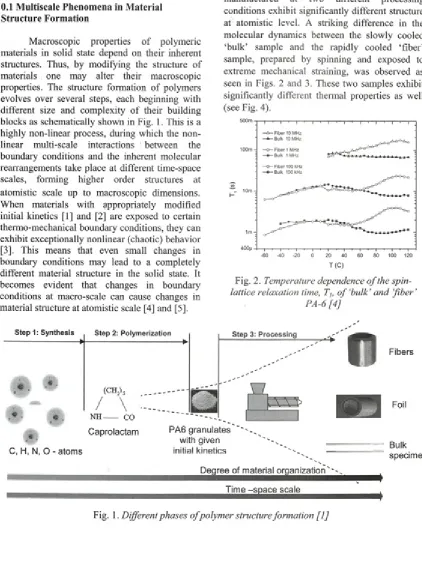
Macroscopic properties o f polymeric materials in solid state depend on their inherent structures. Thus, by modifying the structure o f materials one may alter their macroscopic properties. The structure formation o f polymers evolves over several steps, each beginning with different size and complexity o f their building blocks as schematically shown in Fig. 1. This is a highly non-linear process, during which the non linear multi-scale interactions between the boundary conditions and the inherent molecular rearrangements take place at different time-space scales, forming higher order structures at atomistic scale up to macroscopic dimensions. When materials with appropriately modified initial kinetics [
1
] and [2
] are exposed to certain thermo-mechanical boundary conditions, they can exhibit exceptionally nonlinear (chaotic) behavior [3]. This means that even small changes in boundary conditions may lead to a completely different material structure in the solid state. It becomes evident that changes in boundary conditions at macro-scale can cause changes in material structure at atomistic scale [4] and [5],As presented in recent study [4] o f the proton motion in ‘bulk’ and in highly drawn ‘fiber’ polyam ide
6
(PA-6
) by proton nuclearmagnetic resonance (NMR), products
manufactured at two different processing conditions exhibit significantly different structure at atomistic level. A striking difference in the molecular dynamics between the slowly cooled ‘bulk’ sample and the rapidly cooled ‘fiber’ sample, prepared by spinning and exposed to extreme mechanical straining, was observed as seen in Figs. 2 and 3. These two samples exhibit significantly different thermal properties as well (see Fig. 4).
Fig. 2. Temperature dependence o f the spin-lattice relaxation time, Tj, o f ‘bulk’ and fib e r ’
PA-6 [4]
Fibers
Foil
-100 -50 0 50 100 v - r [kHz]
-to o -50 50 100
[kHz]
Fig. 3. Measured (solid line) and calculated (dashed line) proton NMR spectra o f (a) ‘bulk’
and (b) fib e r’ PA-6 [4]
Fig. 4. DSC measurements o f (A) ‘bulk’ and (B) fib e r ’ PA-6. The glass transition and the pre
melting phenomena are shifted to higher temperatures. The onset o f melting o f fiber ’
samples is shiftedfor about 50°C to higher temperatures [4]
Another example o f complex multi-scale processes in the transition from the molten to the solid state is the spinning o f polyamide fibers, where the variation o f thermo-mechanical boundary conditions take place at about the same time-scale as the structural rearrangements o f the molecules. As observed in a recent study [5] of PA
-6
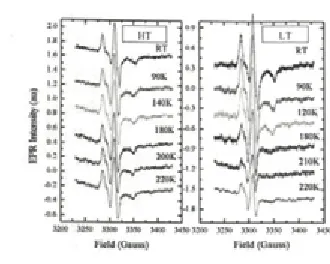
fiber structure by electron paramagnetic resonance (EPR), the differences in fiber production process enhance significantly different structures at atomistic level as shown in Figs. 5 and6
. Similarly the modifications in fiber production process enhance significant changes in the shrinking behavior o f polyamide66
(PA-66
) fibers [6
] (see Fig. 7).Above presented experimental results correspond to the numerical simulations performed [7] to [10] and the analysis of polyamide structure formation during
Field (Gauss) Field (Gauss)
Fig. 5. Temperature dependences o f the electron paramagnetic resonance (EPR) spectra o f the ‘high tension (PIT) ' and ‘low tension (LT) ' nylon
6 fibers [5]
T em perature ( "C )
Fig.
6
. Temperature dependences o f the intensity o f the EPR spectra o f the ‘high tension (PIT) ’ and‘low tension (LT) ’ nylon 6 fibers [5]
Time [s]
Fig. 7. Shrinkage o f PA-66 fibers subjected to three different manufacturing conditions [6]
material by several orders o f magnitude. Similar results are reported by some other research groups in the world [3], [13] to [21],
The recent studies on multi-scale phenomena in material structure formation as presented above show that by changing the material structure we may significantly influence the physical properties and durability (i.e., long term stability) o f final products, w hich opens new potential for tailoring the functionality o f products. Changes in the material structure can be caused by modifying the initial kinetics o f the material (i.e., by changing its molecular w eight distribution, by adding nanoparticles into polymeric matrix, etc.), and more important, by changing the thermo-mechanical boundary conditions (i.e., technology) to w hich material has been exposed during processing.
The investigation o f the latter, i.e., the effect o f processing conditions on the material structure formation, and hence the durability and the functionality o f the final product, is discussed in the second part o f this paper.
1 THE PRESENT RESEARCH
We investigate whether it is possible, by changing technological parameters o f polym er processing in the industrial environment, to modify the structure o f the material and consequently its time-dependent mechanical properties to such an extent that the functionality and durability o f the final products made o f these materials could be improved.
Let us first consider the following questions: (i) which thermo-mechanical boundary conditions cause changes in material structure at which scale, and (ii) w hich changes in material structure cause which changes o f physical properties o f the material.
In order to answer these questions, first, a good understanding o f the effect o f temperature and pressure on the material structure formation is required, and second, we need sophisticated experimental devices for polym er processing and material characterization.
At the processing level, such an equipment is a laboratory extruder PolyLab OS (Thermo HAAKE Electron Corporation), see Figure
8
, which enables an accurate control o f the processing conditions (pressure, temperature, screw speed, torque) along the extm der cylinderduring polymer processing, but at the same time this equipment simulates (mimics) the real industrial processing conditions, appropriate for up-scaling. By using this device, the processing conditions within the range o f temperatures and pressures that are typical for industrial extrusion o f polymers, can be changed so that we can significantly influence the structure formation and consequently the time-dependent mechanical properties o f the material and, as a result, the functionality o f the final product, as discussed in the present paper. This opens new possibilities for modifying the functionality o f polym er products, thus increasing their competitiveness in the global markets.
At the material characterization level, the analysis o f changes in the material structure and the resulting physical properties o f the final product, caused by variations in thermo mechanical boundary conditions, requires at least three groups o f measuring systems, i.e.:
(a) equipment for analyzing the material structure at different observation levels, from atomistic to macro scale; for this purpose several experimental techniques are widely used, i.e., PALS, NM R, EPR, WAXS, SAXS, AFM, TEM, SEM, optical microscopy, thermal methods, etc.;
(b) equipment for analyzing the time-dependent behavior o f the material in solid state [
22
]; such an instrument, i.e., CEM apparatus for relaxation measurement [23] and [24], wasrecently ranked among ASTM
recommendations (guidelines) for polymer testing. Proposed guidelines will be published in »Springer Handbook o f Experimental Solid M echanics« [25];
(c) experimental approach for monitoring the solidification process; several research groups actively w ork on this subject [16] to [
21
] and [26] to [30],2 EXPERIMENTAL APPROACH
For the purpose o f the present research we extruded low density polyethylene (LDPE) specimens under different (extreme) processing conditions using a laboratory extruder PolyLab OS (Thermo HAAKE Electron Corporation), see Figure
8
, which simulates the real industrial processing conditions, but at the same time this equipment provides a better control o f the conditions (pressure, temperature, screw speed, torque) along the extruder cylinder during polymer processing. The changes in the structure o f extruded LDPE samples were analysed with different experimental methods with respect to the time-space scale o f the structure observation. Optical microscopy was used to analyse the morphological properties, the thermal properties were determined by DSC measurements, and the shear creep measurements were performed to study the time-dependent mechanical behavior o f LDPE samples. The proposed approach enabled us to examine the type and the magnitude o f the structural changes in polymer product and consequently its mechanical and other properties, which can be achieved by changing processing conditions) in the industrial environment.The results o f this research show that it is possible to change the technological conditions in the range o f temperatures and pressures, typical for polymer extrusion in industrial environment, in such extent that we significantly influence the structural formation and consequently the time- dependent mechanical properties o f the material, and hence the functionality o f the final product. We observe that by changing the processing conditions in the industrial environment the durability o f polymer products improves for several orders o f magnitude! That opens new possibilities in the field o f modifying the functionality o f polymer products and hence better competitiveness in the world market.
3 POLYMER PROCESSING
3.1. Material
Low Density Polyethylene (LDPE) OKITEN® 245 S by Dioki was chosen for three reasons: it is the most widespread material in polymer processing technology, it is easy to handle, and does not easily form structures.
Should the proposed analysis show that the processing conditions have a significant effect on the structural formation and consequently on the time-dependent mechanical behavior o f the final LDPE product, this would mean that the processing technology will influence also other types of polymeric materials which form more complex structures.
3.2. Laboratory extruder
PolyLab OS laboratory extruder by Thermo HAAKE Electron Corporation (see Fig.
8
) was used for the production o f the LDPE specimens. It is a twin-screw co-rotational extruder with the extrusion part length to screw diameter ratio 40:1. The device allows adaptation of the length o f extrusion part barrel to a ratio of 25:1. The machine, consisting o f the driving partRheoDrive 4 and the extrusion part Rheomex PTW 16, operates with a through put rate o f 5 kg/h in rpm range o f 0-1100 m in '. The maximum operating pressure is
100
bar, the maximum temperature 400°C (the lowest temperature is determined by room conditions), and the maximum torque 129.6 Nm.Fig.
8
. The PolyLab OS laboratory twin-screw co-rotational extruder (Thermo HAAKE Electron3.3 Thermo-mechanical Conditions for LDPE Extrusion
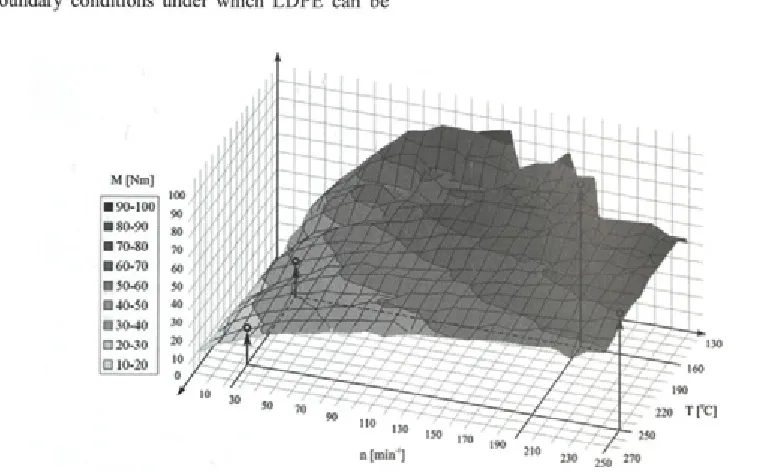
The range o f processing parameters that can be changed during polym er extrusion process depends on the extruder capacity and polym er properties. The lower and the upper limit o f the temperature tolerance range for LDPE, i.e., 130— 270°C, was determined by DSC measurements. During the LDPE material extrusion process, we varied the number o f the screw revolutions and the temperature along the extruder barrel. At a certain temperature which was the same on all ten heaters along the extruder barrel, we set the num ber o f screw revolutions, and recorded the pressure value in the m elt at the extruder outlet and the torque on both screws during the extrusion process. The tolerance range o f the pressure and torque values was ±10%. The next step was to change the number o f revolutions and repeat the procedure at the same temperature. At each temperature, the operating range o f revolutions was 10-250 min"1.
The operational range o f thermo-mechanical boundary conditions under which LD PE can be
extruded on the PolyLab OS laboratory extruder is show n in Figs. 9 and 10. During the extrusion, the screw torque reached a critical operating level, and therefore it was taken into account as a key param eter for determining the extreme thermo-mechanical conditions o f the LDPE specimen extrusion.
3.4. Specimen Preparation Conditions
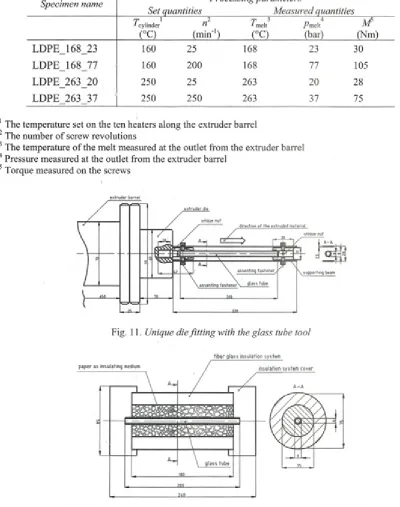
Based on the analysis o f the therm o m echanical boundary conditions o f LDPE extrusion (see Figs. 9 and 10), we selected four different com binations o f processing conditions, illustrating extreme conditions o f extrusion, i.e., lowest pressure - lowest tem perature, highest pressure - low est tem perature, lowest pressure - highest tem perature, highest pressure - highest temperature. The processing param eters defining these conditions are shown in Table 1. Under these conditions, we produced the specim ens o f extruded LDPE intended for subsequent analysis o f their structure form ation as the result o f these m odified processing conditions.
M [N m ]
■ 90-100
■ 80-90
■ 70-80
■ 60-70
■ 50-60
B 40-50
■ 30-40
□ 20-30
□ 10-20
Fig. 9. The torque, M, measured on the screws during the extrusion process, depending on the set temperature, T, along the extruder barrel and the set number o f screw revolutions, n, during LDPE extrusion. It was observed that the higher the temperature in the extruder barrel the more slowly the torque on screws increases with the increasing number o f screw revolutions. The extreme torque values
■ 45-50 ■ 40-45 ■ 35-40 ■ 30-35 ■ 25-30 ■ 20-25 H 15-20 010-15 05-10
Fig. 10. The pressure, p, measured in the melt at the extruder outlet, depending on the set temperature, T, along the extruder barrel and the set number o f screw revolutions, n, during LDPE extrusion. Similarly to
the torque measurement, the maximum pressure appears at low temperatures in the cylinder, but this happens at a higher number o f revolutions (over 200 min-1). As opposed to torque, the increase o f the pressure resulting from the increasing number o f screw revolutions is less distinct at high temperatures, while at low temperatures the pressure increases more markedly than torque. Arrows indicate 4 extreme
conditions at which LDPE specimens were extruded
The geometry (i.e., shape and dimensions) o f LDPE specimens, i.e., cylinders o f
6
mm in diameter, was defined by the requirements o f the creep measuring device [31] to [36]. For this purpose, a unique extruder die fitting was made to which a tool in the form o f a glass tube with an internal diameter6
mm and a length o f200
mm was fastened (see Fig. 11). The extrusion process o f the polymer melt which exited from the extruder through the die fitting and entered into the glass tube in the selected conditions lasted unti] the melt was evenly mixed and constant conditions were established in the extruder barrel. Then the glass tube with melt was removed and inserted into the insulation system (see Fig. 12), where the specimen slowly cooled down. This specimen extrusion procedure was performed under four different processing conditions (see Table 1).The specim en production process consists o f three consecutive segm ents, i.e., heating and m elting o f the granulate in the extruder barrel, m elt extrusion into the glass tube w here the process o f cooling is already going on, follow ed by slow cooling in the insulation system . Fig. 13 schem atically
Table 1. The set and the measured processing parameters ofLD PE specimen extrusion. We selected the lowest and the highest temperature fo r extrusion, i.e., 160°C and 250°C, respectively. At these two set temperatures we influenced the pressure in the melt measured at the exit from the extruder by changing the number o f screw revolutions. At the lowest temperature and the number o f screw revolutions o f 25
and 200 min-1, we achieved the pressures o f 23 and 77 bar, respectively. In the case o f the highest
temperature and the number o f screw revolutions o f 25 and 250 m in 1, we achieved pressures o f 20 and 37 bar, respectively.
Specimen name Processing parameters
Set quantities Measured quantities
T 1
1 c y lin d e r T1 m e lt3
4
.P m e l t Mb
(°C) (m in ') (°C) (bar) (Nm)
L D P E 168 23 160 25 168 23 30
L D P E 168 77 160
200
168 77 105L D P E 263 20 250 25 263
20
28L D P E 263 37 250 250 263 37 75
— —
1
The temperature set on the ten heaters along the extruder barrel2
The number o f screw revolutions3
The temperature o f the m elt measured at the outlet from the extruder barrel4
Pressure measured at the outlet from the extruder barrel5
Torque measured on the screwsexfruxter barrel
Fig. 11. Unique die fitting with the glass tube tool
fiber glass insulation system
Fig. 13. Schematic diagram o f the temperature profiles fo r producing extruded LDPE specimens at two different temperatures o f melt, i.e., the lowest temperature, 168°C (left), and the highest temperature,
263°C (right)
The extrusion process pushed the melt at the outlet from extruder into the glass tube, which was open at the end (i.e., exposed to normal air pressure o f
1
bar), whereby the pressure dropped to 1 bar, and the temperature fell to 140°C or 240°C, respectively (depending on the set temperature, see Fig. 13). After a period o f approximately10
minutes, required for the equilibrium state to be established in melt along the entire extruder barrel under the set processing conditions (i.e., temperature and the rotational speed o f the screws), the extrusion process was stopped, the glass tube with the extruded LDPE removed and then inserted into the insulation system where the extrudate was cooling down to room temperature for approximately 90 minutes. The extruded LDPE specimen was then removed from the glass tube and prepared for the analysis o f morphology, thermal properties and time- dependent mechanical behavior.4 MATERIAL CHARACTERIZATION
4.1. Morphological Analysis - Optical Microscopy
The analysis o f the morphological
properties o f the extruded LDPE specimens (see
Fig. 14) showed that specimens extruded at a lower temperature (168°C) exhibit oriented structure in the form of concentric rings, while no orientation was observed in specimens extruded at a higher temperature (263°C). This indicates that a random structure forms at higher temperatures when the response times are short, while at lower temperatures when the material response times are long, molecules keep the configuration, which has been forced on them by the mechanical shear loading through the screw rotation and is reflected in the structural orientation o f the solid product.
Fig. 14. Optical microscopy images o f extruded LDPE specimens, produced at different processing
conditions, (a) LDPE_l68 23: T = 168°C, p = 23 bar, M = 30 Nm, n = 25 min ', (b) LDPE l 68_77:
T = 168°C, p = 77 bar, M = 105 Nm, n = 200 m in', (c) LD P E J63 20: T = 263°C, p = 20 bar,
M = 28 Nm, n = 25 m in', (d) LDPE 263 37: T = 263°C, p = 37 bar, M = 75 Nm, n = 250 m in'.
The results are in conformity with the theory o f the nonlinear processes in the material during structure formation as a consequence o f three effects: temperature, pressure and shear. For detailed explanation see [31].
4.2. Thermal Analysis - Differential Scanning Calorimetry
The thermal analysis o f the extruded LDPE
specimens showed no difference in thermal properties (i.e., crystallization and melting temperatures) due to different processing conditions (see Table 2). It is highly probable that because o f the nature o f this experiment the method is not sufficiently sensitive to detect changes in the structure by mèasuring the thermal characteristics o f the material.
4.3. Analysis of time-dependent mechanical properties - Shear creep testing
The analysis o f the time-dependent
mechanical properties o f the extruded LDPE
specimens was done based on the shear creep experiments, performed by using the shear creep torsiometer, which was developed in CEM [31] to [36], The results o f shear creep compliance analysis determine (i) the temperature stability o f products, (ii) their time stability which determines durability, and (iii) the frequency stability o f products during dynamic loading.
4.3.1 Temperature stability
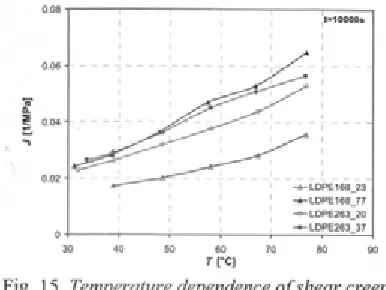
The temperature stability analysis tells us how much the shear creep compliance changes with a change in temperature. It becomes evident that the effect o f temperature on shear creep compliance is least distinctive in the material w ith the most complex (oriented) structure (i.e., the specimen extruded at 168°C and 23 bar) as seen in Fig. 15. A change in temperature from 30 to 80°C initiates a noticeably smaller change in this material than in other materials. This shows that the material with the m ost oriented structure is also most temperature-stable.
4.3.2 Time stability
The comparison o f the shear creep curves at the reference temperature o f 39°C (see Fig. 16)
r [°c]
Fig. 15. Temperature dependence o f shear creep isochrones at the longest time o f 10.000 s, determining the experimental window o f the measurement, obtainedfrom the segments o f shear creep measurement fo r four extruded LDPE
specimens produced under different processing conditions
shows that by changing the processing parameters within the operating range o f the laboratory extruder we can improve the time dependence by as much as ten to more than one million times.
The comparison of the time and temperature stability o f the extruded specimens shows that the effect o f the same polymer processing conditions on the temperature stability differs from the effect on the time stability o f these products, which indicates an extremely nonlinear effect of the thermo-mechanical boundary conditions.
Fig. 16. The shear creep master curves at the reference temperature o f 39°C, showing logarithmic time-dependence o f the shear creep
compliance fo r fo u r extruded LDPE specimens produced under different processing conditions
operation in the range of nonlinear processes within the material can be used to our advantage in order to improve the mechanical properties by several orders o f magnitude.
4.3.3 Frequency stability
In line with the theory o f linear viscoelasticity, we calculated the dynamic properties o f the LDPE extrudates from experimentally determined shear creep curves by using software based on the Emri-Tschoegl algorithm [37] to [42] for the calculation of dynamic material functions from static ones across the mechanical spectrum. By comparing the dynamic material functions of the extruded LDPE specimens (see Figs. 17 and 18), we analyzed the behavior o f materials under dynamic loading.
Fig. 17. Frequency dependence o f the real part o f dynamic shear creep compliance, J', calculated
from the master curves o f shear creep at the reference temperature o f 39°C fo r four extruded
LDPE specimens produced under different processing conditions
The material with the highest degree of orientation, which was produced at the lowest temperature and t h e , lowest pressure (168°C, 23 bar), has better frequency stability than others regarding the ability o f the material to return to the initial state after the cessation o f loading. On the other hand, this material has the least ability to dissipate energy (damping) compared to the materials produced at a higher temperature and a higher pressure, which is reflected in the smallest value o f the imaginary part o f dynamic shear creep compliance, J". At the same time, it is evident that with respect to the amount o f energy
log (td [1/s])
Fig. 18. Frequency dependence o f the imaginary part o f dynamic shear creep compliance, J", calculatedfrom the master curves o f shear creep
at the reference temperature o f 39°C fo r four extruded LDPE specimens produced under
different processing conditions
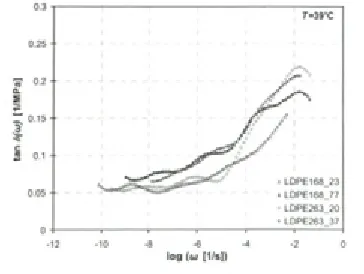
lost, which is not returned by the material after unloading, the frequency stability, J\cò), is similar for all materials. We arrive to a similar conclusion by comparing the frequency dependence o f the damping indicator, tan S (see Fig. 19), which expresses the damping characteristics of the material. We find that all four specimens o f extruded LDPE are frequency- stable at lower frequencies, while at higher frequencies they become very sensitive to any changes in the excitation frequency.
Fig. 19. Frequency dependence o f the damping indicator, tan 5, calculatedfrom the master curves o f shear creep at the reference temperature o f 39°C for
four extruded LDPE specimens produced under different processing conditions
excitation frequency and above it the frequency dependent material damping changes by a factor o f more than
2
(100
%).The relevant findings indicate that modification o f the processing conditions within the range o f temperatures and pressures typical for industrial polymer extrusion processes can improve the temperature stability o f LDPE consumer products exposed primarily to static loads during their use by a factor o f
2
, the time-stability can be improved from10
to more than1
,000,000
times (see Fig. 16), and the frequency stability above the critical frequency can differ for a factor o f more than2 (100%).
Improving the mechanical properties generally decreases production capacity which means that an optimum balance between the product quality and quantity produced should be found for each product within a price bracket. When producing simple products, technology optimization is o f no special relevance since the quantity o f product (and not the quality level) is a decisive factor in production. However, when manufacturing products whose durability and temperature stability are important requirements, the optimization o f the technological process is o f the key relevance.
5 CONCLUSIONS
The recent studies on m ulti-scale phenom ena in m aterial structure form ation show that by changing the m aterial structure we m ay significantly influence the physical properties and durability (i.e., long-term stability) o f final products, w hich opens new potential for tailoring the functionality o f products. Changes in the m aterial structure can be caused by m odifying the initial kinetics o f the m aterial (i.e., by changing its m olecular w eight distribution, by adding nanoparticles into polym eric m atrix, etc.), and m ore im portant, by changing the therm o-m echanical boundary conditions (i.e., technology) to w hich m aterial has been exposed during processing.
The investigation o f the latter, i.e., the effect o f processing conditions on the m aterial structure form ation, and hence the durability and the functionality o f the final product, has found that by changing the processing conditions w ithin the scope o f the tem peratures and pressures typical for polym er extrusion in industrial conditions it is possible to
significantly affect the m aterial structure form ation and consequently its tim e-dependent m echanical properties, w hich determ ine the functionality and durability o f the final product. These findings open new possibilities in m odifying the functionality o f polym er products, and consequently contribute to their better com petitiveness in the global market.
6
ACKNOW LEDGEM ENTAuthors thank to coorporation Thermo HAAKE Electron Corporation for supporting the research activities.
7 REFERENCES
[1] Emri, L, von Bemstorff, B.S. The Effect o f M olecular Mass Distribution on Time- Dependent Behavior o f Polymers, Journal o f Applied Mechanics-Transactions o f the
ASME, 2006, vol.73, no.5, p.752-757.
[2] Sedlarik, V., Saha, N., Kuritka, L, Emri, L, Saha, P. M odification o f poly( vinyl alcohol) w ith lactose and calcium lactate: potential filter from dairy industry, Plastics
rubber and composites, 2006, voi.35, no.9,
p.355-359.
[3] Greer, A.L. Too hot to melt, Nature 404, 2000, p.134-137.
[4] Blinc, R., Apih, T., Jeglič, P., Emri, L, Prodan, T. (2005) Proton NM R study o f molecular motion in bulk and in highly drawn fiber polyamide-
6
, Appi. Magn.Reson. 29, p.577-588.
[5] Cevc, P., Arčon, D., Blinc, R., Emri, I. (2005) Electron paramagnetic resonance o f stressed fibre nylon
6
: annealing effects, J.phys. D: Appi. phys. 38, p.2299-2301.
[
6
] Emri, L, von Bemstorff, B., Voloshin, A. (2006) A Simple Technique for Studying Shrinkage Dynamics o f Fibers,Experimental Mechanics vol.46, no.
6
,p.683-690.
[7] Balabaev, N.K., Darinskii, A.A., Neelov, I.M., Lukasheva, N.V., Emri, I. (2002) M olecular dynamics simulation o f a two dimensional polymer melt, Polymer
Science Series A vol.44, no.7, p.781-790.
separation in brushes capable o f liquid crystal ordering, Polymer Science Series A vol.45, no.7, p.665-675.
[9] Tupitsyna, A.I., Darinskii, A.A., Birhstein, T.M., Amoskov, V.M., Emri, I. (2004) Self-consistent Brownian dynamics simulation o f an anisotropic brush under shear flow, Macromol. theory simul.
voi.13, no.9, p.771-782.
[10] Lyulin, S.V., Lyulin, A.V., Darinskii, A.A., Emri, I. The effect o f dendrimer charge inversion in complexes with linear polyelectrolytes, Polymer Science Series
A 47(l 1), 2005 p.1217-1227.
[11] Dlubek, G., Supej, M., Bondarenko, V., Pionteck, J., Pompe, G., Krause-Rehberg, R . , Emri, I. Ortho-positronium lifetime distribution analyzed with MELT and LT and free volume in poly(e-caprolactone) during glass transition, melting, and crystallization, J. polym. sci. Part
B-Polym. phys., 2003, voi.41, no.23, p.3077-
3088.
[12] Supej, M. The relation between the free volume and the mechanical properties o f
viscoelastic materials, MSc. Thesis.
University o f Ljubljana, Ljubljana, 2002. [13] Fréchet, J.M.J. Functional Polymers and
Dendrimers: Reactivity, Molecular Architecture, and Interfacial Energy,
Science, 1994, 263, p.1710-1715.
[14] Aharoni, S.M. n-Nylons: Their Synthesis,
Structure and Properties. J. Wiley & Sons,
Inc., New York, 1997.
[15] Doi, M., Edwards, S.F. The Theory o f
Polymer Dynamics. Oxford University
Press, Oxford, UK, 1986.
[16] Salem, D.R. Structure Formation in
Polymer Fibers. Carl Hanser Verlag, 2001,
p.521-552.
[17] Swartjes, F.F1.M., Peters, G.W.M., Rastogi, S. , Meijer, H.E.H. Stress Induced Crystallization in Elongational Flow,
International Polymer Processing, 2003,
13, p.53-66.
[18] Swartjes, F.H.M. Flow induced
crystallization in elongation flow, Ph.D.
thesis. Eindhoven University of Technology, 2001, http://www.mate.tue.nl. [19] Komfield, J.A., Kumaraswamy, G., Verma,
R.K. Novel flow apparatus for investigating shear-enhanced crystallization and structure
development in semicrystalline polymers,
Rev. Sei. Instrum., 1999, 70, p.2097.
[20] Eder, G., Janeschitz-Kriegl, H. Structure Development during Processing: Crystallization, in Meijer, H.E.H. (ed.)
Materials Science and Technology 18.
VCH, Weinheim, 1997, p.269-342. [21] Eder, G., Janeschitz-Kriegl, H., Liedauer,
S. Crystallization Processes in Quiescent and Moving Polymer Melts under Heat Transfer Conditions, Progr. Polym. Sci.,
1990, 15, p.629-714.
[22] Emri, I. Rheology o f Solid Polymers, in Binding, D.M., Walters, K. (eds.)
Rheology Reviews 2005. TA Instruments,
New Castle, 2005, p.49-100.
[23] Emri, L, Prodan, T. A Measuring System for Bulk and Shear Characterization of Polymers, Experimental Mechanics, 2006, vol.46, no.4, p.429-439.
[24] Kralj, A., Prodan, T., Emri, I. An apparatus for measuring the effect of pressure on the time-dependent properties of polymers, J.
Rheol., 2001, vol.45, no.4, p.929-943.
[25] Sharpe, W.N., Jr. (ed.), Springer
Handbook o f Experimental Solid
Mechanics, to be published
(http://refworks.springer.com/)
[26] Filipe, S., Cidade, M.T., Wilhelm, M., Maia, J.M. Evolution of morphological and rheological properties along the extruder length for blends o f a commercial liquid crystalline polymer and polypropylene,
Polymer, 2004, vol.45, no.7, p.2367-2380.
[27] Filipe, S., Cidade, M.T., Wilhelm, M., Maia, J.M. Evolution of the morphological and rheological properties along the extruder length for compatibilized blends o f a commercial liquid-crystalline polymer and polypropylene, Journal o f applied
polymer science, 2006, voi.99, n o .l, p.347-
359.
[28] Covas, J.A., Cameiro, O.S., Costa, P., Machado, A.V., Maia, J.M. Online monitoring techniques for studying evolution o f physical, rheological and chemical effects along the extruder,
Plastics rubber and composites, 2004,
vol.33, no.l, p. 55-61.
various polym er systems along a twin- screw extruder, Canadian journal o f
chemical engineering, 2002, voi.80, no.6,
p.1065-1074.
[30] Potente, H., Bastian, M., Gehring, A., Stephan, M., Potschke, P. Experimental investigation o f the morphology development o f polyblends in corotating twin-screw extruders, Journal o f applied
polymer science, 2000, voi.76, no.5, p.708-
721.
[31] Mohar, U., Ferfolja, J. The Analysis o f the Effect o f Structure (Morphology) on Time-Dependent Behavior o f Polymers - The Effect o f Processing Conditions on
Time-Dependent Mechanical Properties o f
Extruded LDPE, Research work, rewarded
with Prešeren Award for students. University o f Ljubljana, Ljubljana, 2006. [32] Metlikovič, P., Emri, I. Analiza procesa
lezenja viskoelastičnih materialov pod vplivom strižne obremenitve, Kovine,
zlitine, tehnologije , 1994, vol.28, no. 1-2,
p.407-409.
[33] Metlikovič, P. Analiza procesa lezenja viskoelastičnih materialov pod vplivom strižne obremenitve (Magistrska naloga).
Fakulteta za strojništvo, Ljubljana, 1989.
[34] Metlikovič, P., Emri, I. Naprava za merjenje lezenja torzijsko obremenjenih polimernih preizkušancev, Stroj, vestn.,
1989, vol.35, p.56-58.
[35] Metlikovič, P., Emri, I. Naprava za merjenje lezenja torzijsko obremenjenih polimernih preizkušancev, Stroj, vestn.,
1990,36, p .101-104.
[36] Cvelbar, R., Emri, I. Analiza prehodnega pojava pri merjenju lezenja viskoelastičnih materialov, Kovine, zlitine, tehnologije,
1994, vol.28, no. 1-2, p.359-362.
[37] Emri, L, Tschoegl, N.W. Generating Line Spectra from Experimental Responses. L
Relaxation Modulus and Creep
Compliance, Rheologica Acta, 1993, voi.32, no.3, p.311-321.
[38] Tschoegl, N.W ., Emri, I. Generating Line Spectra from Experimental Responses. 2. Storage and Loss Functions, Rheologica
Acta, 1993, voi.32, no.3, p.322-327.
[39] Tschoegl, N.W ., Emri, I. Generating Line Spectra from Experimental Responses. 3. Interconversion between Relaxation and Retardation Behavior, International
Journal o f Polymeric Materials, 1992,
v o i.18, n o .1-2, p. 117-127.
[40] Emri, L, Tschoegl, N.W. Generating Line Spectra from Experimental Responses 4. Application to Experimental-Data,
Rheologica Acta, 1994, voi.33, n o .l, p.60-
70.
[41] Emri, L, Tschoegl, N.W. Generating Line Spectra from Experimental Responses. 5. Time-Dependent Viscosity, Rheologica
Acta, 1997, voi.36, no.3, p.303-306.
[42] Emri, L, Tschoegl, N.W. Determination o f M echanical Spectra from Experimental Responses, International Journal o f Solids
and Structures, 1995, voi.32, no.6-7,