The Comprehensive Evaluation of New Energy
Industry Developing Capability Based on
Wavelet Neural Network Model
Shaomei Yang
Economics and Management Department, North China Electric Power University, Baoding City, China Email: [email protected]
Qian Zhu
Department of Economic and Trade, Hebei Finance University, Baoding City, China Email address:[email protected]
Zhibin Liu
Economics and Management Department, North China Electric Power University, Baoding City, China Email: [email protected]
Abstract—Accelerate the development and utilization of new energy sources, which is basic requirements of implementing the scientific development concept, and building a resource-saving and environment-friendly society, and which has very important meaning for adjusting industrial structure, changing the mode of economic development, expanding employment, and promoting economic society sustainable development, how to evaluate the new energy industry developing capability has been a key issues. In this paper, based on defining the new energy industry developing capability and analyzing the key factors, proposed the new energy industry developing capability index system, built comprehensive evaluation model of the new energy industry developing capability based on neural network; in Hebei Province, through the training set to train the network, get the simulation results of the testing set; the example has proved that the method has a certain scientific and practical, which can be fully used in the new energy industry developing capability, and be promoted in other areas.
Index Terms—wavelet neural network model; new energy industry; developing capability; Comprehensive evaluation
I. INTRODUCTION
With the global energy shortage, environmental pollution and global warming have become increasingly prominent; promote actively the energy revolution, develop vigorously renewable energy, and accelerate the popularization and application of new energy sources, which have become an important strategic choice of fostering the new economic growth point, building a resource-conservation and environment-friendly society. Relative to developed countries, China's new energy industry, which development is relatively late start, technology is relatively backward, and the overall industry is not high, however, China has abundant natural resources and huge market demand space. Through the
focus on development the part few years, China has been rapid development in the field of new energy. The end of 2008, the new energy proportion of total primary energy has more than 9% in China. Among them, in China, the total installed capacity of wind power reached 12.21 million kilowatts, ranking the fourth in the world; the gross output of polycrystalline silicon materials more than 6,000 tons; the solar cell production reached 200 million kilowatts, accounting for 15% of global production, solar photovoltaic power generation capacity was 15 million kilowatts, the total collector area of solar water heaters reached 125 million square meters, the production capacity of solar water heater reached 4,000 million square meters, the usage and output accounting for 50% of the world total. The end of 2009, in China, the biomass generation power installed capacity reached 315 million kilowatts; the annual fuel ethanol production capacity reached 1649000 tons. China has made very big progress in the new energy development, and ranked first in many areas. The end of 2009, in China, the wind power installed capacity reached 17.58 million kilowatts, the solar power installed capacity reached 23 million kilowatts, compared to 2000, increased respectively 51 times and 7.7 times; photovoltaic power generation show explosive growth, the annual installed volume more than 160 MW, over the total installed capacity decades before 2009. Among them, the grid accounted for 85% of the total power generation, reaching 135 megawatts. At present, China's solar manufacturing capacity and utilization area has reached the world, the wind power doubled for several years, in 2009 the new wind power installed capacity more than 1,000 megawatts, ranking first in the world, followed by the United States and Germany. From the total installed capacity of view, ranking the third, behind the United States and Germany.
region, achieve the health and sustainable development of new energy industry, which has become an urgent issue. In this paper, use the combination of qualitative and quantitative analysis methods, based on building comprehensive evaluation index system of new energy industry developing capability, analyze and evaluate quantitatively by wavelet neural network model.
II. COMPREHENSIVE EVALUATION INDEX SYSTEM OF
NEW ENERGY INDUSTRY DEVELOPING CAPABILITY
The new energy industry developing capability is a comprehensive and dynamic concept, which embodies a series of related capability, such as the resource supply capability, continuous innovation, personnel support capability, industry growth capability, environment-friendly and policy support, market expansion and promotion capability. Each capability can only enhance the new energy industry developing capability and then play a role in the development from different aspects, but the interaction between these capabilities has a direct impact on the new energy industry development, and ultimately decided that the strength of developing capability, the speed and the level of developing quality of new energy industry. The development of new energy industry can not? Capacity development is good or not? In this paper, discuss the problems from 6 fields, such as resources, technology, personnel, economic, environmental and market factors.
A. Resources
Resources are the basis for the new energy industry development: the more abundant resources, the more range widely and the more accessible, the greater developing potential and the stronger developing capability for the new energy industry, whereas the less developing potential and weaker developing capability. Including 4 secondary indicators, which are resources abundance, resources distribution, resources inputs, and resources utilization.
B. Technology
Technology is the core of the new energy industry development, which restricts directly the developing capability of the new energy industry: the more immature of new energy technologies, the uncertainty and risk of industry development is greater; as the technology continues to mature and improve, the larger space industry development, the stronger the development capability. Including 5 secondary indicators, which are R&D investment, technological innovation, R & D output, advanced technology, the technology industry level.
C. Personnel
Talent is the key to the new energy industry development, and the reasonable personnel structure is security: R&D personnel can enhance technological innovation; management personnel can promote technology demonstration, promotion and application; marketing personnel can accelerate the pace of industrialization. Including 3 secondary indicators, which are human inputs, personnel structure, and personnel management.
D. Economy
The interaction and mutual influence between economy and new energy industry development is that: the sustainable economic development requires the support of the new energy industry; powerful new energy industry can promote the economy to a more effective, more sustainable direction development. Including 4 secondary indicators, which are R&D costs, production costs, management costs, leading economic capacity.
E. Environment
The natural environment of new energy industry development is the increasingly harsh for the climate change, so the new energy technologies must be environmentally friendly technologies; policy environment is personnel constraints of new energy industry development, so the new energy industry conducive to structural adjustment easier to get the support of relevant policies, developing capability is increasing. Including 3 secondary indicators, which are environmental constraints capability, environmental supply capability, and environmental friendly capability.
F. Market
The market is touchstone of testing the new energy industry developing: with broad domestic and international markets, the new energy industry developing capability is relatively strong; only domestic or foreign markets, which is relatively weak. Including 3 secondary indicators, which are the allocation resources capability, market share and market growth skills.
III. THE THEORY AND MODEL CREATION OF WAVELET NEURAL NETWORK
A. Network Structure
Wavelet basis function network is neural network model based on wavelet analysis, which the non-linear wavelet takes the usual nonlinear Sigmoid function; the signal expression can be achieved by the selected wavelets linear superposition, which is a linear neuron output in the output layer.
Wavelet transform principle based on the following discrete: In the Hilbert space, choose a mother wavelet function
ψ
(
x
t−1,
x
t−2,
⋅
⋅⋅
,
x
t−p)
, to satisfy the admissibility condition(
)
+∞
<
⋅⋅
⋅
×
+
⋅⋅
⋅
+
+
⋅⋅
⋅
∫
=
− −
− −
−
− −
−
∧
p t t
p t t
t
p t t
t
x x
x x
x
x x
x
L
d
d
c
ω
ω
ω
ω
ω
ω
ω
ω
ψ
ψ
,
,
,
,
1
2 1
2 1
2 2 2 2
(1)
Where,
(
)
p t t
t x x
x− −
⋅
⋅⋅
− ∧ω
ω
ω
Get wavelet functions through transforming
ψ
(
x
t−1,
x
t−2,
⋅
⋅⋅
,
x
t−p)
, which is scaling, translation and rotation.
(
)
(
)
(
t xt t p xt p)
p t t b a
b
x
b
x
r
a
a
x
x
= −⋅
⋅⋅
−
−
=
⋅
⋅
⋅
− − − − − −,
,
,
,
1 1 1 1 1 , , θ θψ
ψ
(2)Denoted by
( )
•
b a,θ,
ψ
, where isa
∈
R
, and0
≠
a
is the expansion coefficient,(
)
Px
x
b
R
b
b
p t
t
⋅
⋅⋅
∈
=
−1,
,
− is translation vector. Rotationvector
θ
−
r
(
x
t−1,
x
t−2,
⋅
⋅
⋅
,
x
t−p)
is defined as(
)
θ
θ
θ
x
t 1,
,
x
t i,
,
x
t j,
x
t px
t icos
x
t jsin
r
−⋅
⋅⋅
−⋅
⋅⋅
−⋅
⋅⋅
−=
−−
−p
j
i
≤
≤
≤
1
Choose appropriately scaling and translation parameters,
a
>
0
,
b
,( )
•
b a,θ,
ψ
meet the frameworknature of the function space based on
θ
2 2
, , , 2
,
f
B
f
f
A
b a b a≤
≤
∑
ψ
θ,
0
≤
A
≤
B
<
∞
(3)Where, A and B are the framework sector.
The established wavelet basis function network, and its single hidden layer neuron activation function has been targeted set of wavelet functions
{
( )
•
}
b a,θ,
ψ
,re-sort
{
( )
•
}
b a,θ,
ψ
and get( ) ( )
,
,
,
( )
,
2
1
•
ψ
•
⋅
⋅⋅
ψ
n•
ψ
theform of the wavelet neural network approximation
f
( )
•
is( )
∑
(
)
= − − − ∩⋅⋅
⋅
=
•
n i p t t t b ai
x
x
x
f
1 2 1 , ,θ,
,
,
ψ
ω
(4)Can also be written
( )
∑
( )
= ∩•
=
•
n i i if
1ψ
ω
(5)Where,
ω
i can be used as weights between hiddenlayer nodes and output layer nodes;
{
ψ
a,θ,b( )
•
}
can beused as the output value of hidden nodes. The error limit is
⎟⎟ ⎠ ⎞ ⎜⎜ ⎝ ⎛ −21
n
O through formula (4) or
formula (5) approximating nonlinear function
f
( )
•
.B. Learning algorithm and model Creation
All the parameters in Equation (4) together, collectively referred to as
φ
,f
φ( )
•
instead off
( )
•
in equation (4), train the network using learning algorithm based ongradient descent, and the constructed cost function as follows:
( )
[
( )
]
22
1
∑
•
−
=
=
py
f
c
E
φ
φ (6)Where, p is the number of training samples.
To recursive reduce standard formula (6) with the input / output data, after the gradient algorithm of each measurement, the parameter
φ
retard along the gradient direction of function( )
[
[
( )
]
2]
2
1
y
f
c
Kφ
=
φ•
−
(7)The goal is to determine
ω
i,
a
i,
b
i,
γ
−
θ
,
make wavelet network optimal sequence fitting between the predictive valuesf
φ( )
•
sequence and the actual valuey
k sequence. Where,ω
i,
a
i,
b
i,
γ
−
θ
,
can be optimized by type (7) the least square error energy function.In this paper, Morlet wavelet can be as activation function of the wavelet neural network hidden node,
( )
(
2/2)
2/20
0t t
i
e
e
e
t
=
−ω−
−ω −ψ
.Whenω
0≥
5
,0
2 / 2 0≈
−ωe
, so ignore the second, it can often be approximated asψ
( )
t
=
e
−iω0te
−t2/2.Remember
ψ
( )
x
=
d
ψ
( )
x
/
dx
,e
Kf
φ( )
•
−
y
K ,(
i)
i
a
x
t
Z
=
−
, for the function (7), each component of each vector parameter, which the partial differentials are:K e f c = ∂
∂ (8)
( )
i K iZ
e
c
ψ
ω
=
•
∂
∂
(9)( )
(
i)
i K i
Z
e
b
c
θ θψ
γ
γ
ω
•
−•
′
−•
−
=
∂
∂
(10)( )
(
i)
i K i
Z
e
a
c
θ θψ
γ
γ
ω
•
−•
′
−•
−
=
∂
∂
2 (11)(
i)
(
( )
i)
i
K
x
t
Z
e
c
θ θγ
ψ
ω
γ
− −′
•
−
•
•
−
=
∂
∂
(12)Among them, the weight update amount
is i i
c
ω
ω
∂
∂
=
Δ
.The calculation steps are:
1) Initialization
ω
i,
a
i,
b
i,
γ
−
θ
;2) Calculate the parameters in step① according to equation (9) to (12);
3) The parameters obtained in step① into the Eq (4),
4) Calculate error,
( )
(
)
∑
∑
= =
−
•
=
ni i n
i
i i
y
y
f
err
1 1
2
;
5) Repeat steps 2) 3) 4), until it meets the precision requirements;
6)
i
=
i
+
1
, turn to step 2).By network learning, after achieving precision, the interconnection weights of the network parameters have been fully established, including the hidden layer and output layer, so the whole network system is stable, then other unknown samples can be identified and predicted.
IV. EXAMPLE APPLICATIONS
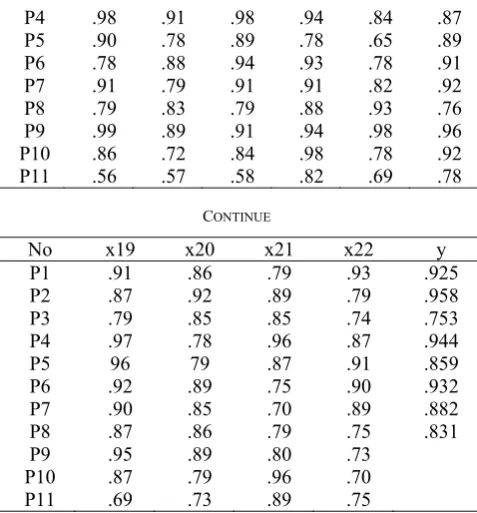
In this paper, Hebei Province, combined 6 major indicators, which are resources, technology, personnel, economic, environmental and market, comprehensive evaluated new energy industry developing capability for 11 districts in Hebei. Based on the collected historical data, the data and expert scoring of candidate evaluation objects, the data of each region separately dimensionless, and then get the following data, shown in Table 1. The first 8 groups can be as training set of wavelet network to train network; the last 3 groups can be as the test sets to simulate the object to be evaluated.
TABLE I. SIMULATION DATA
No x1 x2 x3 x4 x5 x6
P1 .89 .78 .92 .95 .91 .91
P2 .92 .94 .87 .96 .95 .79 P3 .75 .76 .75 .63 .89 .71 P4 .79 .87 .78 .93 .79 .89
P5 .78 .78 .95 .89 .84 .84
P6 .92 .95 .79 .82 .87 .74
P7 .78 .75 .81 .95 .81 .78
P8 .65 .97 .93 .91 .78 .71 P9 .93 .96 .98 .89 .85 .96 P10 .89 .96 .71 .90 .57 .69
P11 .59 .51 .66 .62 .51 .79
CONTINUE
No x7 x8 x9 x10 x11 x12
P1 .86 .98 .97 .71 .87 .78
P2 .81 .87 .88 .92 .91 .87
P3 .83 .72 .95 .91 .69 .73
P4 .95 .87 .79 .81 .90 .81 P5 .85 .83 .86 .96 .84 .93 P6 .89 .88 .87 .69 .96 .98
P7 .89 .91 .91 .90 .89 .89
P8 .87 .78 .74 .93 .79 .81
P9 .95 .97 .93 .86 .96 .96
P10 .90 .79 .92 .79 .74 .92 P11 .71 .60 .70 .69 .62 .59
CONTINUE
No x13 x14 x15 x16 x17 x18
P1 .95 .91 .80 .93 .92 .92 P2 .95 .94 .96 .98 .98 .91
P4 .98 .91 .98 .94 .84 .87
P5 .90 .78 .89 .78 .65 .89
P6 .78 .88 .94 .93 .78 .91
P7 .91 .79 .91 .91 .82 .92 P8 .79 .83 .79 .88 .93 .76 P9 .99 .89 .91 .94 .98 .96
P10 .86 .72 .84 .98 .78 .92
P11 .56 .57 .58 .82 .69 .78
CONTINUE
No x19 x20 x21 x22 у
P1 .91 .86 .79 .93 .925
P2 .87 .92 .89 .79 .958
P3 .79 .85 .85 .74 .753 P4 .97 .78 .96 .87 .944 P5 96 79 .87 .91 .859
P6 .92 .89 .75 .90 .932
P7 .90 .85 .70 .89 .882
P8 .87 .86 .79 .75 .831
P9 .95 .89 .80 .73 P10 .87 .79 .96 .70 P11 .69 .73 .89 .75
Training process can be achieved by drawing up wavelet network program based on Matlab; Training results are shown in Table II. They are very close to the actual evaluation values, the simulation results of three groups of untrained test data shown in Table III.
TABLE II. TRAINING RESULTS
No P1 P2 P3 P4
Training results .9235 .9647 .7420 .9512
Desired output .925 .958 .753 .944
Relative error % .1622 .6994 1.4608 .7627
CONTINUE
No P5 P6 P7 P8
Training results .8634 .9421 .8817 .8274 Desired output .859 .932 .882 .831
Relative error % .5122 1.0836 .0340 .4332
TABLE III. SIMULATION RESULTS
No P9 P10 P11
Training results .9615 .8063 .6488 Sort Results P9 >P10 >P11
Favorably to the inferior sort of the simulation results is P9>P10>P11, which can determine the strength of the all regions new energy industry developing capability.
V. CONCLUSION
calculation, also can make up the shortcomings of BP neural network, which accuracy is not high, convergence is poor and the selection is difficult; it has a strong practical significance for solving the problem of the new energy industry developing capability evaluation.
ACKNOWLEDGMENT
This work is supported by the 2010 projects of Social Scientific Research Foundation of Hebei Province Office of Education under Grant No. SZ2010504.
This research was supported by “the Fundamental Research Funds for the Central Universities”.
This research was supported by the Philosophy and Social Science Research Topics of Baoding City. The item No. is 200902035.
REFERENCES
[1] GAO Yang and Liu Yanqiong. Comprehensive Evaluation Method of Virtual Enterprise’s Partner Selection Based on Wavelet Network. Value Engineering, Nov. 2008, pages 87-90.
[2] Han Yaming, Chen Zhong, Zhang Zhizhong and Li Guigen. Evaluation method for software system developers based on Wavelet network. Computer Applications, Sept. 2005, pages 2015-2017.
[3] Meng Hao and Cheng Yingjian. Comprehensive Assessment on Developing Capability of New Energy Industry. China Science and Technology Forum, June. 2010, pages 51-58. [4] Tian Jingwen and Gao Meijuan. The research and
application on artificial neural network algorithm. Beijing institute of technology press, July. 2006, pages . 116-119. [5] K. Ermis, A. Midilli, I. Dincer and M. A. Rosen. Artificial neural network analysis of wodd green energy use. Energy Policy. 2007(35), pages 1731—1743.
[6] Patrik Sderholm and Thomas Sundqvist. Empirical challenges in the use of learning CHIVES for assessing the economic prospects of renewable energy technologies. Renewable Energy, 2007 (32), pages 2559—2578. [7] Feriol F, Schoots K, vanderZwaan B C C. Use and
imitations of learning chIVes for energy technology policy: a component- learning hypothesis [J]. Energy Policy, 2009, 37: 2525—2535.
[8] Leonardo Barreto, Socrates Kypreos. Endogenizing R&D and Manet experience in the“bottom-up” energy-systems ERIS model [J]. Technovation, 2004, (24): 615—
629.
[9] Wang D W, Yung K L, Ip W H. A heuristic genetic algorithm for subcontractor selection in global manufacturing environment [J] . IEEE Transaction on System, Manufacturing and Cybernetics — Part C: Applications and Reviews, 2001, 31 (2): 189-198.
[10] Wu N, Map N, Qian Y M. An approach to partner selection in agile manufacturing [J] . Journal of Intelligent Manufacturing, 1999, 10 (6): 519-529.
[11] Talluri S, Baker R C. A quantitative framework for designing efficient business process alliances [A] . Proceedings of International Conference on Engineering Management[c]. Vancouver: IEEE Engineering Management Society Press, 1996. 656-661.
[12] Cuo Qing—xiang, Liu Lei. Driving force prediction for inclusion complexion of Z-cyclodextrin with Benzene
derivatives by wavelet neural network [J] . Chemical Physics Letters。1998, 290: 514—518.
[13] Wu Caifang, Zeng Yong, Zhang Zixu, et a1. The fuzzy—
neural networks and theory of forecasting Theeoal—·
gas—· outburst [J] . CoalGeology&Exploration, 2002, 30 (6): 4— 8.
[14] Hansen J V, Nelson R D. Neural network and tradi—
tional time series methods: A synergistic combination in state economic forecasts [J] . IEEE Transaction On Neural Networks, 1997, 8 (4) : 863—873.
[15] Zhang Jun, Walter Gilber G. Wavelet neural net— work for function learning [J] . IEEE Transaction on Signal Processing, 1995, 43 (6) : 1485—1495.
[16] Masters T. Neural, Novel and Hybrid Algorithms for Time Series Prediction [M] . New York: John Wiley and Sons. Inc, 1 995.
[17] Ho K H, Hsu Y Y, Chen C F. Short—term load forec asting of Taiwan power system using a knowledge—
based expert system[J]. IEEE Trans on Power Systems, 1 990, 5(4): 1214—1221.
[18] Moriarty D, Miikkulainen R. Efficient reinforcement learning through symbiotic evolution [J] . Machine Learning, 1996, 22 (3) : 11—32.
[19] Bahavik R B, Stephanopoulous G. Wave-net: A muhiresolusion, hierarchical neural network with localized] carning [J] . A2CHE Journal, 1993, 39 (2) : 57
—81.
[20] Zhang J, Walter G G. Wavelet neural networks for function learning [J]. IEEE Transaction on signal Processing, 1995, 43 (June) : 1485—1495
Shaomei Yang, was born in Handan City, China, and
graduated from the agricultural university of Hebei in 2003, gained the master's degree of management. The author’s major field of study is the business management.
Since 2003, she has been working at the North China Electric Power University, Baoding City, China. And she has published more than 20 papers and 2 books. Such as the Electric Power Enterprise Management (Beijing: Chinese Electric Power Publishing Company).
Qian Zhu, was born in Baoding City, China, and graduated
from the North China Electric Power University in 2011, gained the master's degree of management. The author’s major field of study is the Management Information System and E-commerce.
Since 2004, he has been working at the Hebei Finance University, Baoding City, China. And she has published more than 10 papers and 2 books.
Zhibin Liu, was born in Luannan County, China, and
graduated from the agricultural university of Hebei in 2004, gained the master's degree of management. The author’s major field of study is the information management.