7615
TRACKING COMMUNITY MOTIVATION TO USE ONLINE
SOCIAL NETWORKS: A CASE STUDY OF FACEBOOK
1IMANE EL HAOUTA, 2ABDELOUAHAB IDELHADJ
1.2Algebra Team and its Applications, Department of Mathematics, Abdelmalek Essaadi University, Faculty
of Sciences Tetouan, Morocco E-mail: 1[email protected]
ABSTRACT
Most people use the social network in their day to day life. In fact, social networking has become central in the era of globalization. Facebook (FB) is a great illustration of this phenomenon as its popularity has increased tremendously in the last couple of years. It has become an essential tool for connecting people and creating different kinds of interactions. In our study, we aim to explore people’s motivations for using an online social network among a sample of FB users in Morocco (N=355). It investigated how eight motivations to use FB predicted the intensity of Facebook use (IFU). The results demonstrate that the motivation to use FB for checking and posting status updates is the major predictor of IFU. Findings are discussed in term of helping to build a better knowledge of social networks and their user's behaviors as expanding motivations to use Facebook.
Keywords: Facebook, Motivation, Intensity of Facebook Use, Social Networking Sites, Morocco
1. INTRODUCTION
Digital connectivity is rapidly growing and changing people’s lives all around the world. Local,
regional and global communities spread
information and interact with a variety of internet tools [1].
This digital transformation is getting more and more surprising from a day to another. In recent years, the use of online social networking sites (SNSs) including FB has become a necessity in our life.Since its creation in 2005, FB became much more popular, diversified and acceptable due to various inherent social and interpersonal affordances [2]. The use of FB alows people to create their own profile, create new friends and participate in computer-mediated environments. It is also used by people from different cultural, demographic as well as geographical settings in different ways to satisfy different motives and needs [3][4].Indeed, many researchers over the world tried to understand why and how people use FB (e.g., U.S [5],[6],[7] and Taiwan [8],[9],[10]). Therefore, it becomes important to study this social phenomenon in other countries and cultures such us Morocco.
Based on previous studies, the aim of the research is to explore people’s motivations to use
FB using a sample of Moroccan FB users (N=355). More specifically, the study investigates the relationship among motivations to use FB and FB intensity behavior on the site. Motivations mainly reflect on why one uses FB, while FB intensity concerns the level of involvement in FB use. It is possible that one has various motivations to use FB, but the given person will use it with low intensity. Furthermore, it is possible that one has a unique motivation, but the FB intensity will be high [11].Because of this complex relationship, it became essential to explore how motivations to use FB predict use intensity behavior on the site?
This paper is organized as follows: section 2 presents a brief background literature; section 3 describes SNSs use; section 4 reviews the uses and gratifications approach as the theoretical framework for this investigation; section 5 research methodology of the study; section 6 analyzes the results; section 7 discussion; and section 8 study limitations; section 9 conclusion of the study.
2. BACKGROUND LITERATURE 2.1 Motivations for Using FB
7616 professional and personal satisfaction, also a combination of relaxation and entertainment. The reasons why people use FB change over time [6].Different users come to FB driven by different motives, such as social connection (e.g., connecting with strangers or interacting only with friends and family), shared identities (e.g., creating/joining groups and event), social investigation (e.g., meeting new people, looking for friends), sharing photographs, videos, content (applications, games, etc.), social network surfing (e.g., browsing profiles) and viewing and posting status updates [12].
Nadkarni and Hofmann [4] examined the user’s ability to share social information. As results FB’s use could be motivated by two needs: the need of belonging which can be influenced by demographic and cultural factors, and the need for self-presentation which can be induced by personality traits such as shyness, narcissism, neuroticism, and self-esteem
2.1.1 The need of belonging
The need for social belonging is a fundamental motive to initiate and maintain social relationships [13]. Ellison, Steinfield, and Lampe [5] explained that keeping in touch with friends is considered the priority for FB’s users as it is essential for some people to boost their social capital. Extending the circle of friends can have an impact on the social capital through the benefits that emerge from relationships [7]. Maksl and Young [14] showed that FB users who are more comfortable with sharing personal and private online information are those who have a great esteem for the social capital built through this site.
SNS can be used to strengthen new distant relationships [15]. It may be used also to make new friends through the option of suggestion of others. In fact, it is possible to add people with whom users have contacts in common. FB’s users can enlarge their circle of friends and even add people with whom they have no relationship.
Chou and Edge [16] explained that online life is characterized by some features such as facilitating the access to happiness and wellness. It appears that there is a relationship between the number of face-to-face (real-life) friends, FB friends and well-being [17]. Indeed, this social network can lead to such emotional state [9],[18].
However, spending valuable time on social networks such as FB also has its drawbacks. In fact, some existing researches found a convergence between social media platforms such as FB and cases of isolation, depression, and loneliness. More
people use social networks, more they isolate themselves. Indeed more time is spent on the Internet, less time is allocated to real life interactions [19].
2.1.2 Self-presentation
Self-presentation is a key element for social media users [20]. It’s a dynamic process [21] which is considered to be strategic as people work meticulously on selecting the best aspects to present themselves to others [22].
Self-presentation activities represent the majority of FB usage [23]. It is considerably crucial for users to create and maintain online personal impressions such as expressive control [24],[25], privacy control [25],[26], and images or videos control [27],[28],[29]. Binder, Howes, and Sutcliffe [30] demonstrated that unsuccessful self-presentation is usually associated with criticism and rejection. In order to ease identity construction and self-presentation, the self-concept clarity is considered to be a good indicator [31].
By using FB, individuals can create their profiles and use several options to present themselves [32]. They have the possibility to publish images, photos, videos, to start conversations with friends and to share all kinds of content. By checking news feeds, users can discover day by day what's going on in their friends’ lives.
Users tend to manipulate visual cues as they aim to reflect an ideal, instead of simply presenting who they really are [23].
Indeed, users have a tendency to present themselves positively to receive favorable feedback from other users [29],[32],[33]. This is consistently associated with perceived social support and self-esteem [34]. For instance, users are mindful when it comes to posting profile pictures, as these play an important role in building a positive impression. In fact, the choice of a profile picture generally reflects the user’s personality [35],[36].
2.2 Motivations and FB Intensity
Usage patterns on FB have become diversified, supporting various forms of social interactions and interpersonal. A popular feature of FB includes
member profiles, which contain personal
7617 people use FB in different ways and for different motives and needs [3],[4].On another hand, since developed by Ellison et al. [5], FB intensity has been employed in many studies to assess the comprehensive use of FB, and to examine the relation between different sides of motivations (i.e., the need of belonging and/or self-presentation) and IFU.
Steinfield et al. [7] used a survey of undergraduate students to examine the relationship between IFU and psychosocial motivations of well-being (e.g., maintenance of social capital, and bridging of social capital.).
Johnston et al. [37] examined the IFU and maintenance of social capital amongst also university students. The results explained a strong association between the IFU and perceived bridging, bonding and maintained social capital.
Liu and Yu [9] studied the relationship between online and general social support, psychological well-being, and IFU. The results showed the factor of general social support guided the relationship between well-being and online social support.
Joinson [12] made a multidimensional FB use scale on the basis of qualitative data by using open-ended questions referring to the motivation of FB use. The scale consists of seven dimensions as social connection, shared identities, photographs, content, social investigation, social network surfing, status updates. The study suggests that increasing the IFU experiencing low satisfaction with university life, for example, might be beneficial.
Pempek et al. [38] investigated FB use by focusing IFU based on the time users spend on FB and concerning their activities on the site (photo upload, chat, and sharing). Fighting boredom or passing time was one of the motivations that contributed to the IFU.
Sheldon [39] examined the relationship between the unwillingness to communicate attribute and behavioral and attitudinal outcomes, e.g. IFU
According to Alhabash et al. [8] based on multidimensional FB use scale of Joinson [12], the study investigated how seven different motivations to use FB predicted the IFU and content-generation behaviors on FB. Different motivation such as (e.g,
content, social connection, shared identities, photographs, social network surfing and status updates) were significantly correlated with IFU. Furthermore, process uses and gratifications, of status updates, were strong predictors of IFU.
The recent study by Alhabash et al. [40] examined the relationship between motivational reactivity, FB uses and gratifications and IFU. The finding showed a positive relationship among the three elements, entertainment and self-expression were strong predicting factors of IFU.
The study of Park and Lee [2] reports that four motivations (i.e, entertainment, relationship maintenance, self-expression, and communication) together with impression management were significantly associated with FB intensity. The study gave positive association between FB intensity and people’s sense of belonging.
When these findings are applied in the context of FB use, we consider that different motivations for FB use are likely to affect FB intensity. The Uses and gratifications framework suggests that users take a direct role in selecting media or technologies, and therefore, users’ motivations will be dependent upon their gratification needs. These motivations are likely to affect users’ attitude toward, or perceived importance of FB. In the current study, we examine how individuals’ different motivations predict FB intensity. We took into consideration different motivations of the multi-dimensional FB use scale of Joinson [12] consisted of seven dimensions: social connection, shared identities, photographs, content, social investigation, social network surfing and status updates. However, in this investigation, we have added another element (videos) to the scale, because online video consumption is now one of the most popular internet activities worldwide. At a global level, FB users watch 100 million hours of video every 24 hours [41]. In fact, videos have already influenced the way content is delivered and consumed on the largest social media network (e.g., FB Live videos).
Based on this prior work, we propose the following hypothesis:
H1: Will the highest motivation to use FB be the most significant predictors of IFU.
7618
3. SNSs USE
At a global level, more than half of households worldwide had access to the internet in 2017 [42]. Nearly 37 percent of the world's populations are active on social networks, which is the equivalent of almost 2.80 billion active Internet users [43]. Behind, North America checked 66 percent, Western Europe recognized 54 percent compared to South Asia 15 percent and finally comes Africa with a social network penetration rate of 14 percent worldwide [44].
The SNSs have become part of our daily lives. Many researchers tried to understand how these sites have changed the way people behave, identify themselves, and connect with others [45],[46],[47]. These virtual communities represent an opportunity for people to interact and connect with each other. They generally provide users with profiles and enable them to upload and share photos, videos and various types of content [48]. Moreover, these sites overflow with information resources, plus emotional and social support [5],[15].
From all the platforms, FB is the most well-known computer-mediated communication platform. In fact according to new online statistical analysis [49], the most popular of all SNSs in 2018 is FB, appeared to occupy the first place, with 2.196 billion users, followed by YouTube, WhatsApp,
Messenger, WeChat, Instagram, QQ,
Qzone,Doujin/Tik Tok, Sina Weibo, Twitter, Reddit, Baidu Tieba, Skype, Linkedln, Viber, Snapchat,Line,Pinterest and Telegram. Whether in developed countries or developing countries, the penetration rate of FB continues to increase.
In fact, SNSs such as FB allow their users to establish and maintain relationships, share photos/videos, update status, organize social activities, and establish virtual groups and communities [50],[51]. The expanding use of the site contributes to changing the way news are produced and disseminated. Moreover, it alters the way people get in touch with the news [52].
4. USES AND GRATIFICATIONS OF SNSs
The Uses and gratifications (U&G) theory is a
popular theoretical framework which
allows scholars to understand how and why people tend to use a specific type of medium. This approach postulates that users actively choose media stimuli in order to fulfill specific needs [53]. The U&G perspective allows explaining user’s goals when engaging with media and thus permits to describe media selection processes.
Previous literature has classified the U&G of computer-mediated communication platforms into three broad categories: content (e.g., information seeking and exposure), process (e.g., social influence, escape and entertainment),and social U&G (e.g., connecting and coordination) [54].
As new technologies faced up users with a greater variety of media choices, the expected satisfaction of specific needs became a crucial component of their motivation to use appropriate medium [12]. Lampe et al. [55] applied the U&G approach to explain motivations to contribute to a content-generation of an online community, different motivations for use were tied to different patterns of contribution by site members and intentions to contribute in the future. Alhabash et al. [8] explained also that content, social connectedness (i.e., social investigation) and the process of self-presentation (i.e., shared identities, photographs, status updates) through U&G were significantly correlated with IFU.
Indeed, researchers have used U&G in order to get a better understanding of the extent to which users expect various needs and desires to be fulfilled by using FB.
Considering the strength of the U&G approach for exploring various motivations of different SNSs usage, specifically FB, in the current study we opted for the U&G approach as the theoretical framework. We had focused on one pattern FB uses (IFU). The IFU can be estimated from FB habits, time spent on the site, the number of group memberships and the number of friends on the platform [11]. In fact, many investigations [7],[11],[56],[57] on the IFU scale, involve the number of FB friends and the time spent per day on the site, to capture users’ engagement on the platform.
5. METHODOLOGY
5.1 Data Collection, Study Participants
This paper reports on an exploratory study of Moroccan’s FB usage and motivations. FB, which is the most popular SNS in the country, was used by nearly 39 percent of the Moroccan population in 2016, which is the equivalent of about 13 million Moroccans [58].
7619 The participants are FB users who are members of the Moroccan active FB group '' J'ai testé à RABAT ... je vous le recommande ! ''. Any FB user who has posted photos, comments etc. on the platform was encouraged to participate in the study. This resulted in a total of (N =355) participants who completed the questionnaire. Participants’ mean age was about 27 years old (SD= 7.22). Also, the majority of the sample was women (72.84 percent). Nearly one-third of the sample (30.25 percent) reported being married. (94.44 percent) of participants reported having a high school diploma. Finally, the majority (91 percent) of respondents were students or employees (45.68 percent for each category).
5.2 Study measures
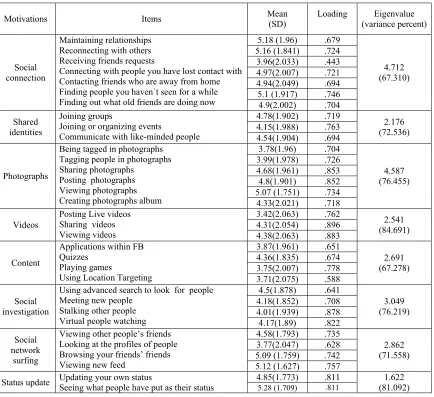
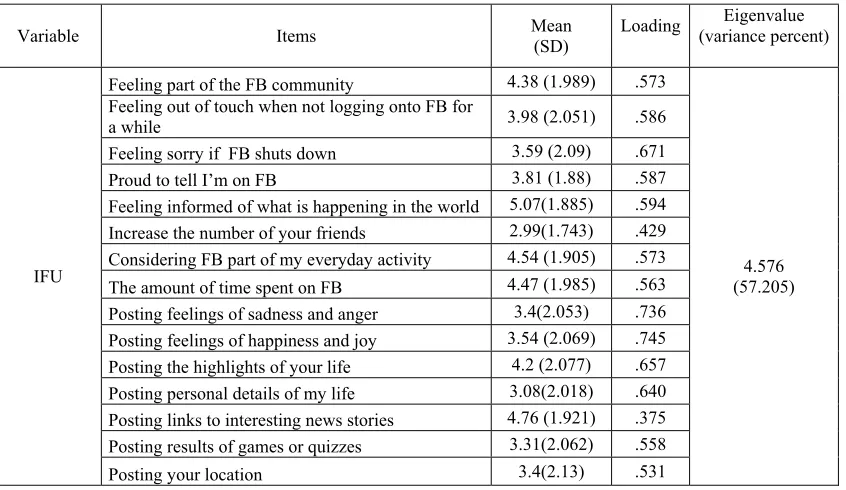
The current study used a 33-items scale to measure the eight different motivations for using FB: social connection, shared identities, photographs, content, social investigation, social network surfing and status updates as shown in Table 1. The intensity of FB use was measured using 8 questions related to the number of friends, the daily time spent on the site plus the affective and cognitive statements as shown in Table 2. All scale items were rated on a seven-point scale ranging from 1 = “strongly disagree” to 7 = “strongly agree”.
5.3 Statistical analysis
The statistical method adopted for the extraction of data is that of principal component analysis (PCA). “It is a dimension-reduction tool that can be used to reduce a large set of variables to a small set that still contains most of the
information present in the large set” [59].In our
study, we have several items for each motivation, so it is imperative to reduce the data contained in these items in a single factorial axis that reflects the corresponding motivation. We have used the same procedure for all the other items.
The last three columns of the table are the results of the PCA analysis. The quality of representation reflects the information rate recorded for each item and projected on the factorial axis. Whereas the rate of variance explained indicates the rate of information explained by each axis (or motivation variable).
Thus, the rate that is higher than 50 percent shows that data reduction could keep more than 50 percent of the initial information. Therefore, the
result can be considered as good since we had no consequent loss of information.
In our case, the representation is better for some motivations whose the rate of variance explained is higher than 70 percent. As a result, we obtained eight factorial axes of regression which will be the independent variables of the multiple linear regressions.
We also got one factorial axe of regression representing the IFU which will be a dependent variable of our regression.
6. RESULTS
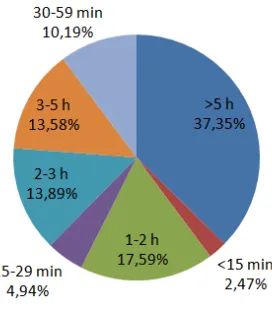
Among the data that attracts attention and requires analysis, there is the information about the number of friends on FB with whom Moroccan users interact every day to maintain the social relationships. Nearly half of the sample (47.22 percent) reported communicating with more than 3 friends daily on FB. In addition (37.35 percent) of participants indicated using FB more than 5 hours per day as illustrated in Figure 1.
Figure 1: Daily Time Spent On FB
As illustrated in Figure 2, slightly more than half (53.40 percent) of participants reported using FB for personal reasons. While the use for commercial purposes only represents (6.79 percent). Also, those who use the platform for both personal and business purposes constitute (39.81 percent).
Finally, the highest motivation to use FB was to update status and view other people’s status updates (M=5.065,SD=1.57).
[image:5.612.348.484.365.520.2]7620
Figure 2: Moroccan's Reasons to Use FB
shared identities it provides
(M=4.49,SD=1.64),photographs
(M=4.442,SD=1.68),social_invistigation
(M=4.215,SD=1.65),videos (M=4.037,SD=1.89)
and finally content (M=3.923,SD=1.61).
Motivations predicting IFU
Multiple linear models were suggested to explain the IFU. The eight motivations for using FB served as independent variables in the model. Before testing the proposed models, Pearson's bivariate correlations among independent and dependent variables must first be examined to justify the use of regression analysis. The results of the correlations showed that the IFU was significantly correlated without exception with all motivational variables, and the coefficients ranged from 0.419 to 0.532 as shown in Table 3. Therefore we could extend the study by adopting multiple linear regression of which the IFU is the dependent variable and the eight motivations are the independent variables. However, the significant correlations of the eight motivations could cause a risk of multicollinearity. This was also assessed using the tolerance and the Variance Inflation Factor (VIF) in the following regression analyses.
Indeed a stepwise regression analysis was conducted to explore which of the motivations to use FB is the strongest, which were the most significant predictors of IFU, and how the others motivations predict the IFU.
At each step of the stepwise regression, the most significant predictor is added to the model until none of the independent variables left out of the model. As a result of the regression analysis of FB use intensity by using stepwise regression
analysis, social connection, social network surfing and content were dropped from the model, and five predictors were found to be significant at the critical level of 0.05 as shown in Table 4.
H1 predicted that the highest motivation to use FB would be the most significant predictors of IFU.
The results show that the first predictor added to the model was status updates, accounting for 28.3 percent (R2) of the variance, supporting H1. Then, videos significantly added 8.9 percent to the explained variance. The social investigation shared identities and photos were subsequently added to the model, increasing significantly the amount of the variance explained (3.3 percent, 1.8 percent, and 1.7 percent, respectively). The final regression model with these five predictors yielded an F-ratio (p < 0.001) and explained 43.9 percent of the variance in the IFU.
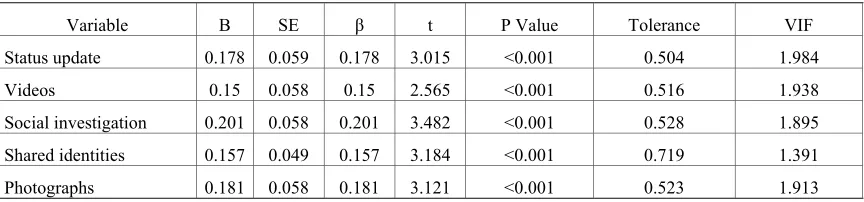
The model represented in Table 5 approves H2 witch foreseen that different motivations predict IFU, social investigation (β = 0.201), photographs (β = 0.181) and status updates (β = 0.178), subsequently, shared identities (β= 0,157) appeared to positively influence IFU, supporting H2. The lowest coefficient is relevant to FB videos (β = 0.15). The collinearity statistics shows that none of the five predictors has a tolerance value smaller than 0.10 and VIF greater than 10, suggesting no serious multicollinearity in the model.
7. DISCUSSION
The first goal of the present study was to understand motivations to use FB among a large sample of Moroccan citizens, based on a study done in Taiwan [8]. To do so, we used the U&G approach to examine individuals’ intentions related to the social media usage. The findings of this study provide valuable explanations reflecting the descriptive results of the current sample. First, in samples from Morocco, nearly a half of users daily interact with more than 3 FB friends, compared to the Taiwanese investigation reported a lower number of FB friends [8]. This variation might be due to the cultural differences.
7621 examined the impact of intensity of FB and Twitter use on social capital, as well as Johnston et al. [37] they studied the intensity of FB use and maintenance of social capital. In the present study, we examine relationships among motivations to use FB and FB intensity. We find that Moroccan people try to put their own content forward for a best self-representation; the highest rated motivation to use FB was status updates, a trend that is different from what was found in the study of Taiwan; the highest rated motivation to use FB in Taiwan was social connection [8].This serves to illustrate the universal utility of SNSs and how they expand within different cultures.
However, Findings show that the motivation to use FB for status updates is the strongest predictor of IFU. Similar results were found in Taiwan [8]. It is important to investigate in the online social networking behavior, as it calls for the need to dissect the different sides of SNSs. Furthermore, several prior studies out of Africa have investigated the relationships among different FB U&G and different facets of the IFU. Ellison et al. [5] developed a measurement scale of the IFU in order to measure the complexly integrated user engagement in FB and measuring the emotional connectedness in this site. Previous studies [5],[7] had shown that the IFU use measure had sufficient internal consistency, and it can be evaluated with a variety of different FB users. Moreover, Tomai et al. [61] adapted another measure for using IFU, with two dimensions of intensive use (i.e., traffic intensity and time spent on FB use). Additionally, the IFU measure was adapted to address the intensive use of SNSs [10],[60],[62].
Finally, dissimilar to traditional media, new media like SNSs are a convergence of various types of media. U&G approach guided our investigation to frame and understand how and why people tend to use a specific type of medium.
Moreover, our findings confirm that the differences among FB users might be related to the culture to which they belong. This is prevalent in the qualitative comparison between the motivations and uses of FB Moroccan users and FB Taiwanese users.
A future investigation on SNSs should begin to untangle under what circumstances FB users rely on features of cultural differences when it comes to the reason and the way individuals use SNSs.
8. LIMITATIONS
There are limitations with the present research that have to be mentioned. First, our sample selected
from an active Moroccan FB group, thus limiting to generalize our results to the whole population. Second, participants in the offline conditions limited to Moroccan, not generalizing to the larger African population. This investigation not allowed future studies to explore FB motivations and uses on a larger scale. Finally, the investigation deals with the relationship between FB motivations and one pattern of FB uses (IFU), thus limiting the generalizability of our findings to the rest of FB uses. Future studies should include a more exhaustive set of FB uses in order to investigate which ones play an influential role.
9. CONCLUSION
This study contributes to the growing quantity of knowledge around SNSs behaviors and usage. Highlighting how motivations to use FB predicted IFU using a sample from Morocco. By applying U&G theory, the study shows that the pattern of use (intensity) is predicted by different motivations to use FB. The study expands the U&G approach to the specificity of SNSs behavior.
REFRENCES:
[1] M. Eid and S. Ward, “Ethics, new media, and social networks”, Global Media
Journal-Canadian Edition, vol. 2, no. 1, pp. 1–4, 2009.
[2] N. Park and S. Lee, “College Students’
Motivations for Facebook Use and
Psychological Outcomes”, Journal of
Broadcasting & Electronic Media, vol. 58, no.
4, pp. 601–620, 2014.
[3] A. Dhir, P. Kaur, S. Chen, and K. Lonka, “Understanding online regret experience in Facebook use – Effects of brand participation, accessibility & problematic use ”, Computers
in Human Behavior, vol. 59, pp. 420–430,
2016.
[4] A. Nadkarni and S. G. Hofmann, “Why do people use Facebook?”, Personality and
Individual Differences, vol. 52, no. 3, pp. 243–
249, 2012.
[5] N. B. Ellison, C. Steinfield, and C. Lampe, “The Benefits of Facebook “Friends:” Social Capital and College Students’ Use of Online Social Network Sites”, Journal of
Computer-Mediated Communication, vol. 12, no. 4, pp.
1143–1168, 2007.
7622
in Proceedings of the 2008 ACM conference
on Computer supported cooperative work,
2008, pp. 721–730.
[7] C. Steinfield, N. B. Ellison, and C. Lampe, “Social capital, self-esteem, and use of online social network sites: A longitudinal analysis”,
Journal of Applied Developmental
Psychology, vol. 29, no. 6, pp. 434–445, 2008.
[8] S. Alhabash, H. Park, A. Kononova, Y. Chiang, and K. Wise, “Exploring the Motivations of Facebook Use in Taiwan”,
Cyberpsychology, Behavior, and Social
Networking, vol. 15, no. 6, pp. 304–311, 2012.
[9] C.-Y. Liu and C.-P. Yu, “Can Facebook Use Induce Well-Being?”, Cyberpsychology,
Behavior, and Social Networking, vol. 16, no.
9, pp. 674–678, 2013.
[10] S. Alhabash and A. R. McAlister, “Redefining virality in less broad strokes: Predicting viral behavioral intentions from motivations and uses of Facebook and Twitter”, new media &
society, vol. 17, no. 8, pp. 1317–1339, 2015.
[11] G. Orosz, I. Tóth-Király, and B. Bőthe, “Four facets of Facebook intensity — The
development of the Multidimensional
Facebook Intensity Scale”, Personality and
Individual Differences, vol. 100, pp. 95–104,
2016.
[12] A. N. Joinson, “Looking at, looking up or keeping up with people?: motives and use of facebook”, in Proceedings of the SIGCHI conference on Human Factors in Computing
Systems, 2008, pp. 1027–1036.
[13] R. F. Baumeister and M. R. Leary, “The need to belong: desire for interpersonal attachments as a fundamental human motivation”,
Psychological bulletin, vol. 117, no. 3, p. 497,
1995.
[14] A. Maksl and R. Young, “Affording to Exchange: Social Capital and Online Information Sharing”, Cyberpsychology,
Behavior, and Social Networking, vol. 16, no.
8, pp. 588–592, 2013.
[15] M. Burke, C. Marlow, and T. Lento, “Social network activity and social well-being”, in
Proceedings of the SIGCHI conference on
human factors in computing systems, 2010,
pp. 1909–1912.
[16] H.-T. G. Chou and N. Edge, “They Are Happier and Having Better Lives than I Am : The Impact of Using Facebook on Perceptions
of Others’ Lives”, Cyberpsychology,
Behavior, and Social Networking, vol. 15, no.
2, pp. 117–121, 2012.
[17] J. F. Helliwell and H. Huang, “Comparing the Happiness Effects of Real and On-Line Friends”, PLoS ONE, vol. 8, no. 9, p. e72754,
2013.
[18] X. Hu, A. Kim, N. Siwek, and D. Wilder, “The Facebook Paradox: Effects of Facebooking on Individuals’ Social Relationships and Psychological Well-Being”, Frontiers in
Psychology, vol. 8, 2017.
[19] B. A. Primack et al., “Social Media Use and
Perceived Social Isolation Among Young Adults in the U.S.”, American Journal of
Preventive Medicine, vol. 53, no. 1, pp. 1–8,
2017.
[20] J. Van Dijck, “You have one identity: performing the self on Facebook and LinkedIn”, Media, Culture & Society, vol. 35,
no. 2, pp. 199–215, 2013.
[21] C. Yang and B. Bradford Brown, “Online
Self-Presentation on Facebook and Self
Development During the College Transition”,
Journal of Youth and Adolescence, vol. 45, no.
2, pp. 402–416, 2016.
[22] P. M. Valkenburg and J. Peter, “Online Communication Among Adolescents: An Integrated Model of Its Attraction,
Opportunities, and Risks”, Journal of
Adolescent Health, vol. 48, no. 2, pp. 121–
127, 2011.
[23] N. Ellison, R. Heino, and J. Gibbs, “Managing Impressions Online: Self-Presentation Processes in the Online Dating Environment”,
Journal of Computer-Mediated
Communication, vol. 11, no. 2, pp. 415–441,
2006.
[24] D. N. Byrne, “Public Discourse, Community Concerns, and Civic Engagement: Exploring Black Social Networking Traditions on BlackPlanet.com”, Journal of
Computer-Mediated Communication, vol. 13, no. 1, pp.
319–340, 2007.
[25] J. C. Feaster, “Expanding the Impression Management Model of Communication Channels: An Information Control Scale”,
Journal of Computer-Mediated
Communication, vol. 16, no. 1, pp. 115–138,
2010.
[26] S. Waters and J. Ackerman, “Exploring
Privacy Management on Facebook:
Motivations and Perceived Consequences of Voluntary Disclosure”, Journal of
Computer-Mediated Communication, vol. 17, no. 1, pp.
101–115, 2011.
7623 Women Are from Venus? Examining Gender Differences in Self-Presentation on Social
Networking Sites”, Cyberpsychology,
Behavior, and Social Networking, vol. 15, no.
2, pp. 91–98, 2012.
[28] E. M. Morgan, C. Snelson, and P. Elison-Bowers, “Image and video disclosure of substance use on social media websites”,
Computers in Human Behavior, vol. 26, no. 6,
pp. 1405–1411, 2010.
[29] A. Metzler and H. Scheithauer, “The long-term benefits of positive self-presentation via profile pictures, number of friends and the initiation of relationships on Facebook for adolescents’ self-esteem and the initiation of
offline relationships”, Frontiers in
psychology, vol. 8, p. 1981, 2017.
[30] J. Binder, A. Howes, and A. Sutcliffe, “The problem of conflicting social spheres: effects of network structure on experienced tension in social network sites”, in Proceedings of the SIGCHI conference on human factors in
computing systems, 2009, pp. 965–974.
[31] C. Fullwood, B. M. James, and C.-H. (Josephine) Chen-Wilson, “Self-Concept Clarity and Online Self-Presentation in Adolescents”, Cyberpsychology, Behavior,
and Social Networking, vol. 19, no. 12, pp.
716–720, 2016.
[32] S. Zhao, S. Grasmuck, and J. Martin, “Identity
construction on Facebook: Digital
empowerment in anchored relationships”,
Computers in Human Behavior, vol. 24, no. 5,
pp. 1816–1836, 2008.
[33] A. L. Gonzales and J. T. Hancock, “Mirror, Mirror on my Facebook Wall: Effects of Exposure to Facebook on Self-Esteem”,
Cyberpsychology, Behavior, and Social
Networking, vol. 14, no. 1–2, pp. 79–83, 2011.
[34] C. Twomey and G. O’Reilly, “Associations of Self-Presentation on Facebook with Mental Health and Personality Variables: A
Systematic Review”, Cyberpsychology,
Behavior, and Social Networking, vol. 20, no.
10, pp. 587–595, 2017.
[35] N. J. Hum, P. E. Chamberlin, B. L. Hambright, A. C. Portwood, A. C. Schat, and J. L. Bevan, “A picture is worth a thousand words: A content analysis of Facebook profile photographs”, Computers in Human Behavior,
vol. 27, no. 5, pp. 1828–1833, 2011.
[36] Y.-C. J. Wu, W.-H. Chang, and C.-H. Yuan, “Do Facebook profile pictures reflect user’s personality?”, Computers in Human Behavior,
vol. 51, pp. 880–889, 2015.
[37] K. Johnston, M. Tanner, N. Lalla, and D. Kawalski, “Social capital: the benefit of Facebook "friends" ”, Behaviour &
Information Technology, vol. 32, no. 1, pp.
24–36, 2013.
[38] T. A. Pempek, Y. A. Yermolayeva, and S. L. Calvert, “College students’ social networking experiences on Facebook”, Journal of Applied
Developmental Psychology, vol. 30, no. 3, pp.
227–238, 2009.
[39] P. Sheldon, “The Relationship Between Unwillingness-to-Communicate and Students’ Facebook Use”, Journal of Media Psychology,
vol. 20, no. 2, pp. 67–75, 2008.
[40] S. Alhabash, Y. Chiang, and K. Huang, “MAM & U&G in Taiwan: Differences in the uses and gratifications of Facebook as a function of motivational reactivity”,
Computers in Human Behavior, vol. 35, pp.
423–430, 2014.
[41] J. Constine, “Facebook Hits 100M Hours Of Video Watched A Day, 1B Users On Groups, 80M On Fb Lite”, 27-Jan-2016. [Online]. Available:
https://techcrunch.com/2016/01/27/facebook-grows/.
[42] International Telecommunication Union, “Measuring the Information Society Report”, 2017,[Online].Available:
https://www.itu.int/en/ITU-D/Statistics/Documents/publications/misr2017 /MISR2017_Volume1.pdf.
[43] S. Kemp, “Digital in 2017 Global Overview”, 24 January 2017. [Online]. Available:
https://wearesocial.com/special-reports/digital-in-2017-global-overview. [44] Statista, “Taux de pénétration Monde 2017 -
Statistique”, 21 February 2018. [Online]. Available:
https://fr.statista.com/statistiques/570671/medi a-sociaux-taux-de-penetration-globale-en--par-region.
[45] R. Grieve and N. Kemp,“Individual differences predicting social connectedness derived from Facebook: Some unexpected findings”, Computers in Human Behavior,
vol. 51, pp. 239–243, 2015.
[46] T. Kaya and H. Bicen, “The effects of social media on students’ behaviors; Facebook as a case study”, Computers in Human Behavior,
vol. 59, pp. 374–379, 2016.
7624
Computers in Human Behavior, vol. 67, pp.
23–32, 2017.
[48] C. Kim and S.-U. Yang, “ Like, comment, and share on Facebook: How each behavior differs from the other”, Public Relations Review, vol.
43, no. 2, pp. 441–449, 2017.
[49] Statista, “Most famous social network sites 2018, by active users”, 20 February 2018. [Online]. Available:
https://www.statista.com/statistics/272014/glo bal-social-networks-ranked-by-number-of-users.
[50] L. P. Tosun, “Motives for Facebook use and expressing “true self” on the Internet”,
Computers in Human Behavior, vol. 28, no. 4,
pp. 1510–1517, 2012.
[51] C. Yang and B. B. Brown, “Motives for Using Facebook, Patterns of Facebook Activities, and Late Adolescents” Social Adjustment to College’, Journal of Youth and Adolescence,
vol. 42, no. 3, pp. 403–416, 2013.
[52] R. K. Nielsen and K. C. Schrøder, “The Relative Importance of Social Media for Accessing, Finding, and Engaging with News: An eight-country cross-media comparison”,
Digital Journalism, vol. 2, no. 4, pp. 472–489,
2014.
[53] E. Katz, H. Haas, and M. Gurevitch, “On the use of the mass media for important things”,
American sociological review, pp. 164–181,
1973.
[54] T. Stafford and M. R. Stafford, “Determining Uses and Gratifications for the Internet”,
Decision Sciences, vol. 53, pp. 260–288,
2004.
Behavior, and Social Networking, vol. 16, no. 11,
pp. 806–812, 2013.
[55] C. Lampe, R. Wash, A. Velasquez, and E. Ozkaya, “Motivations to participate in online communities”, in Proceedings of the SIGCHI conference on Human factors in computing
systems, 2010, pp. 1927–1936.
[56] M. Kalpidou, D. Costin, and J. Morris, “The Relationship Between Facebook and the Well-Being of Undergraduate College Students”,
Cyberpsychology, Behavior, and Social
Networking, vol. 14, no. 4, pp. 183–189, 2011.
[57] S. Jamil, F. Zehra, R. Naqvi, and S. Bhamani, “Impact of facebook intensity on academic grades of private university students”, in
Information & Communication Technologies (ICICT), 2013 5th International Conference on, 2013, pp. 1–10.
[58] I. Beji, “Chiffres clés sur les réseaux sociaux en Afrique : Facebook, Linkedin, Instagram)”,
2 December 2016. [Online]. Available: http://blog.medianet.com.tn/blog/chiffres-cles- sur-les-reseaux-sociaux-en-afrique-facebook-linkedin-instagram-presentes-lafrican.
[59] T. R. Ricky, “Towards Data Science”, 25-Jan-2018.[Online].Available:
https://towardsdatascience.com/another- twitter-sentiment-analysis-with-python-part-8-
dimensionality-reduction-chi2-pca-c6d06fb3fcf3.
[60] C. Petersen and K. A. Johnston, “The Impact of Social Media Usage on the Cognitive Social Capital of University Students”,
Informing Science, vol. 18, 2015.
[61] M. Tomai, V. Rosa, M. E. Mebane, A. D’Acunti, M. Benedetti, and D. Francescato, “Virtual communities in schools as tools to promote social capital with high schools students”, Computers & Education, vol. 54,
no. 1, pp. 265–274, 2010.
[62] A. Dhir and T. Torsheim, “Age and gender differences in photo tagging gratifications”,
Computers in Human Behavior, vol. 63, pp.
7625
Table 1:Motivation For Using Facebook (FB)
Motivations Items Mean (SD) Loading (variance percent)Eigenvalue
Social connection
Maintaining relationships Reconnecting with others Receiving friends requests
Connecting with people you have lost contact with Contacting friends who are away from home Finding people you haven`t seen for a while Finding out what old friends are doing now
5.18 (1.96) .679
4.712 (67.310) 5.16 (1.841) .724
3.96(2.033) .443 4.97(2.007) .721 4.94(2.049) .694 5.1 (1.917) .746 4.9(2.002) .704 Shared
identities
Joining groups
Joining or organizing events
Communicate with like-minded people
4.78(1.902) .719
2.176 (72.536) 4.15(1.988) .763
4.54(1.904) .694
Photographs
Being tagged in photographs Tagging people in photographs Sharing photographs
Posting photographs Viewing photographs Creating photographs album
3.78(1.96) .704
4.587 (76.455) 3.99(1.978) .726
4.68(1.961) .853 4.8(1.901) .852 5.07 (1.751) .734 4.33(2.021) .718
Videos
Posting Live videos Sharing videos Viewing videos
3.42(2.063) .762 2.541 (84.691) 4.31(2.054) .896
4.38(2.063) .883
Content
Applications within FB Quizzes
Playing games
Using Location Targeting
3.87(1.961) .651
2.691 (67.278) 4.36(1.835) .674
3.75(2.007) .778 3.71(2.075) .588
Social investigation
Using advanced search to look for people Meeting new people
Stalking other people Virtual people watching
4.5(1.878) .641
3.049 (76.219) 4.18(1.852) .708
4.01(1.939) .878 4.17(1.89) .822 Social
network surfing
Viewing other people’s friends Looking at the profiles of people Browsing your friends’ friends Viewing new feed
4.58(1.793) .735
2.862 (71.558) 3.77(2.047) .628
5.09 (1.759) .742 5.12 (1.627) .757
7626
[image:12.612.89.512.113.358.2]**p < 0.01.
Table 2: Facebook Use Measures - Intensity of Facebook Use (IFU)
Variable Items Mean (SD) Loading
Eigenvalue (variance percent)
IFU
Feeling part of the FB community 4.38 (1.989) .573
4.576 (57.205) Feeling out of touch when not logging onto FB for
a while 3.98 (2.051) .586
Feeling sorry if FB shuts down 3.59 (2.09) .671 Proud to tell I’m on FB 3.81 (1.88) .587 Feeling informed of what is happening in the world 5.07(1.885) .594 Increase the number of your friends 2.99(1.743) .429 Considering FB part of my everyday activity 4.54 (1.905) .573 The amount of time spent on FB 4.47 (1.985) .563 Posting feelings of sadness and anger 3.4(2.053) .736 Posting feelings of happiness and joy 3.54 (2.069) .745 Posting the highlights of your life 4.2 (2.077) .657 Posting personal details of my life 3.08(2.018) .640 Posting links to interesting news stories 4.76 (1.921) .375 Posting results of games or quizzes 3.31(2.062) .558 Posting your location 3.4(2.13) .531
Table 3: Pearson Correlations Among Variables
Social connection
Shared
identities Photographs Videos Content
Social investigation
Social network
surfing
Status update
Shared identities 0.551**
Photographs 0.473** 0.349**
Videos 0.433** 0.446** 0.649**
Content 0.429** 0.410** 0.455** 0.478**
Social
investigation 0.467
** 0.386** 0.474** 0.428** 0.576**
Social network
surfing 0.419
** 0.349** 0.491** 0.370** 0.470** 0.725**
Status update 0.484** 0.447** 0.469** 0.443** 0.502** 0.656** 0.755**
[image:12.612.86.531.429.607.2]7627
Table 4. Stepwise regression results to predict the IFU
Model R2
adjR2 R2change F change p Value
A 0.283 0.280 0.283 127.180 < 0.001
A+B 0.371 0.367 0.089 45.413 < 0.001
A+B+C 0.404 0.399 0.033 17.765 < 0.001
A+B+C+D 0.422 0.415 0.018 9.720 < 0.001
A+B+C +D +E 0.439 0.430 0.017 9.738 < 0.001
A, status update; B, videos; C, social investigation; D, shared identities; E, photographs.
Table 5:Regression Coefficients of Predictors for the IFU
Variable B SE β t P Value Tolerance VIF
[image:13.612.91.523.309.410.2]