IJPSR (2014), Vol. 5, Issue 6 (Research Article)
Received on 16 December, 2013; received in revised form, 15 February, 2014; accepted, 25 April, 2014; published 01 June, 2014
DEVELOPMENT AND EVALUATION OF HERBAL FORMULATION FOR THE TREATMENT OF ACNE
Y.M. Charde, P.H. Sharma, N.G. Choudhary and J.G. Avari*
University Department of Pharmaceutical Sciences, Department of Pharmaceutics, Rashtrasant Tukdoji Maharaj Nagpur University, Mahatma Jyotiba Fuley Shaikshanik Parisar, Amravati Road, Nagpur-440033, Maharashtra, India
ABSTRACT: Acne vulgaris is a most common skin disorder of pilosebaceous unit that affect areas containing the largest oil glands, including the face, back, and trunk. It is generally characterized by formation of seborrhea, comedone, inflammatory lesions. Propionibacterium acnes and Staphylococcus epidermidis have been recognized as pus-forming bacteria triggering an inflammation in acne. Staphylococcus aureus support to cause inflammation in acne. The present research work deals with formulation and evaluation of herbal gels against this etiologic agent of acne vulgaris. The ethanolic extract of Neem (leaves), Nutmeg (fruit), and Black pepper (fruit) were prepared and formulated into a topical gel. In vitro antibacterial activity was performed against P. acnes, S. epidermidis and S. aureus, using agar well diffusion method. The measured zones of inhibitions of the prepared formulations were compared with standard antibiotic (Clindamycin) and standard marketed topical herbal formulation. The prepared gels were evaluated for pH, viscosity, spreadability, stability, drug content, acute skin irritancy activity and in vitro diffusion. The results from the agar well diffusion showed that Neem, Nutmeg and Black pepper would inhibit the growth of P. acnes, S. epidermidis and S. aureus and the prepared polyherbal gels showed comparable antimicrobial activity against these bacterias with the marketed preparation. However, the standard Clindamycin was more active than that of prepared polyherbal gels, marketed herbal anti-acne preparation and extracts of Neem, Black pepper and Nutmeg. Taken together, our data indicated that Neem, Black pepper and Nutmeg had inhibitory and synergistic effect against P. acnes, S. epidermidis and S. aureus.
INTRODUCTION: Acne vulgaris is a most common chronic inflammatory skin disorder of pilosebaceous unit that affect areas containing the largest oil glands, including the face, back, and trunk 1.
QUICK RESPONSE CODE
DOI:
10.13040/IJPSR.0975-8232.5(6).2250-60
Article can be accessed online on:
www.ijpsr.com
DOI link: http://dx.doi.org/10.13040/IJPSR.0975-8232.5(6).2250-60
It is almost a universal disease occurring in all races and affecting 95% of boys and 83% of girls.
Acne vulgaris is generally characterized by formation of seborrhea, comedone, inflammatory lesions and presence of bacteria Propionibacterium acnes, Staphylococcus epidermidis and Staphylococcus aureus in the follicular canal and sebum production 2. P. acnes have been described as an obligate anaerobic microorganism. It is implicated in the development of inflammatory Keywords:
Acne, Neem, Nutmeg, Black pepper
Correspondence to Author:
Dr. (Mrs.) J.G. Avari
Professor (Pharmaceutics), Department of Pharmaceutical Sciences, Rashtrasant Tukadoji Maharaj Nagpur University, Mahatma Jyotiba Fuley Educational Campus, Nagpur - 440 033, Maharashtra, India
acne by its capability to activate complements and by its ability to metabolize sebaceous triglycerides into fatty acids, which chemotactically attract neutrophils. On the contrary, S. epidermidis, an aerobic organism, usually involves in superficial infections within the sebaceous unit 3. When the chemicals produced by P. acnes destroy the cellular structure of skin cells, Staphylococcus aureus, grows causing acne lesions. These factors provide a potential target for treatment. P. acnes, S. epidermidis and S. aureus are the target sites of antiacne drugs 4, 5.
With the excessive use of antibiotics for long periods has led to the increased resistance in acne causing bacteria i.e. P. acnes, S. epidermidis and S. aureus 6-9. The development of antibiotic resistance is multifactorial, including the specific nature of the relationship of bacteria to antibiotics, how the antibacterial is used, host characteristics, and environmental factors. To overcome the problem of antibiotic resistance, medicinal plants have been extensively studied as alternative treatments for diseases 10, 11.
In the present study, three medicinal plants, which have been traditionally used as antimicrobial and anti-inflammatory agents were examined for antimicrobial activities against microorganisms frequently involved in acne inflammation, such as
Propionibacterium acnes, Staphylococcus epidermidis and Staphylococcus aureus.
MATERIALS AND METHODS:
Plants Material:
Collection and drying of Plant parts: The fresh leaves of Neem (Azadirachta indica) were collected from the local area of Nagpur district in the month of June 2011. While the fruits of Nutmeg (Myristica fragrans) and Black pepper (Piper nigrum) were purchased from the local market of Nagpur district. The plant specimens were dried and their herbarium sheets were prepared as shown in Figure 1, 2 and 3.
It was authenticated by Dongarwar Sir; Head of Department of Botany, R.T.M. Nagpur University, Nagpur.
FIG. 1: THE SPECIMEN VOUCHER NUMBER OF NEEM (AZADIRACHTA INDICA) IS 9306
FIG. 2: THE SPECIMEN VOUCHER NUMBER OF NUTMEG (MYRISTICA FRAGRANCE) IS 9307
FIG. 3: THE SPECIMEN VOUCHER NUMBER OF BLACK PEPPER (PIPER NIGRUM) IS 9308
The fresh leaves of neem and the fruits of nutmeg and black pepper were dried under shade and were powdered.
[image:2.612.356.522.40.185.2] [image:2.612.358.519.223.363.2] [image:2.612.361.522.398.528.2]METHODS:
Procedure: 1 g of Carbopol 934 was dispersed in 50 ml of distilled water with continuous stirring. The 5 ml of distilled water was taken and required quantity of methyl paraben and propyl paraben were dissolved by heating on water bath. The solution was cooled, then propylene glycol 400 and polyethylene glycol 200 were added as shown in
Table 1.
Further required quantity of ethanolic extracts of Neem, Nutmeg and Black pepper as shown in
Table 2 were mixed to the above mixture and volume was made up to 100 ml by adding remaining distilled water. Finally all ingredients were mixed properly to the Carbopol 934 gel with continuous stirring and triethanolamine was added drop wise to the formulation for adjustment of required skin pH (6.8-7) and to obtain the gel of required consistency. The same method was followed for preparation of control sample without adding any extract 12-18.
TABLE 1: FORMULATION OF GEL
Sr. No. Contents Quantity (100 gm)
1 Carbopol 934 1.0 gm
2 Methyl paraben 0.15 gm
3 Propyl paraben 0.03 gm
4 Propylene glycol 5.0 ml
5 Polyethylene glycol 15.0 ml
6 Distill water Upto100ml
TABLE 2: CONCENTRATION OF EXTRACTS USED IN ANTIACNE GEL FORMULATION
Sr. No. Plant
Extracts
Concentration of extracts (100gm gel)
G 1 G 2
1 Black pepper 1.75 gm 3.5 gm
2 Neem 1.5 gm 3.0 gm
3 Nutmeg 0.5 gm 1.0 gm
The test organisms used in this study were as followed: Propionibacterium acnes (MTCC 1951), Staphylococcus epidermidis (MTCC 931) and Staphylococcus aureus. These bacteria were obtained from the Microbial Type Culture Collection and Gene Bank, Chandigarh, India. Brain Heart Infusion medium, Tryptone Soya Broth and Nutrient Agar medium all these medias were purchased from Hi-media.
Antibacterial activity testing:
Sample Preparations: Solutions of extracts of Neem, Nutmeg, Black pepper, prepared polyherbal gels and marketed formulation were prepared using 100 mg of formulation in 10ml of dimethyl sulfoxide (DMSO). Clindamycin (10mg/ml) was used as a positive control and DMSO as a negative control.
Antibacterial Assay: The antibacterial activity of different extracts and formulations were determined by modified agar well diffusion method in which nutrient agar plates were seeded with 0.2 ml each of 24 h broth culture of S.aureus, plates of soyabean caseine digest media plate were seeded with 0.2 ml each of 24 h broth culture of S. epidermidis and plates of brain heart infusion media were seeded with 48 h broth culture of P. acnes.
The plates were dried for 1 h. With a sterile 8 mm borer four wells of equidistance in each of plates were cut into which 0.5 ml of solutions of extracts, prepared polyherbal gels, Clindamycin, marketed herbal formulation and allopathic Clarithromycin gel were introduced in each plate. The plates of S. epidermidis and S. aureus were incubated at 37oC for 24h and of P. acnes were incubated for 48h. The antibacterial activity was evaluated by measuring the diameter of zones of inhibition (in mm). The experiments repeated four times and the mean was calculated. The results are depicted in
Table 5.
Determination of Minimum Inhibitory Concentrations (MIC): The MIC was defined as the lowest concentration of the compound to inhibit the growth of microorganisms. In order to determine the relative minimum inhibitory concentration values extracts were dissolved in DMSO to make a concentration of 100 mg/ml.
EVALUATION OF EXTRACTS:
Characteristics of extracts: The ethanolic extracts of Neem, Nutmeg and Black pepper were evaluated for its physical state, colour, odour, taste and percent yield and results are shown in Table 3.
Phytochemical screening of extracts: The ethanolic extracts of Neem, Nutmeg and Black pepper were subjected to preliminary phytochemical testing for the detection of major phytoconstituents such as phenols, tannins, steroids, alkaloids, glycosides and flavonoids and the results are depicted in Table 4.
EVALUATION OF GEL: These topical formulations were tested for colour, appearance, pH, viscosity, spreadability, stability, drug content and in vitro diffusion.
Physical Evaluation: Physical parameters such as colour and appearance were checked visually and results are depicted in Table 7.
Measurement of pH 20: The pH of various formulations was determined by using Digital pH meter. One gram of gel was dissolved in 100 ml of distilled water and stored for two hours. The measurement of pH of each formulation was done in triplicate and average values are depicted in
Table 7.
Viscosity: The measurement of viscosity of prepared gels were carried out with Brookfield Viscometer The measurements was over speed setting of 100 rpm at 25 ºC using Brookfield viscometer. The values of each formulation are depicted in Table 7.
Spreadability 21: Spreadability denotes the extent of area to which the gel readily spreads on application to skin or the affected part. The bioavailability efficiency of a gel also depends on its spreading value. The Spreadability was expressed in terms of time in seconds taken by two slides to slip off from the gel, placed in between the slides, under certain load. Lesser the time taken for separation of the two slides, better the Spreadability. Two sets of glass slides of standard dimensions were taken. The gel formulation was placed over one of the slides.
The other slide was placed on the top of the gel, such that the gel was sandwiched between the two slides in an area occupied by a distance of 6.0 cm along the slide. 100 gm weight was placed upon the upper slides so that the gel between the two slides was pressed uniformly to form a thin layer. The weight was removed and the excess of gel adhering to the slides was scrapped off. The two slides in position were fixed to a stand without slightest disturbance and in such a way that only the upper slide to slip off freely by the force of weight tied to it. A 20 gm weight was tied to the upper slide carefully. The time taken for the upper slide to travel the distance of 6.0 cm and separated away from the lower slide under the influence of the weight was noted. The experiment was repeated by three times and the mean time taken for calculation.
Spreadability was calculated by using the following formula:
S = M × L / T
Where, S= Spreadability, M = Weight in the pan (tied to the upper slide), L = Length glass slide and
T = Time (in sec.) taken to separate the slides.
Stability Study 22: The stability study was performed as per ICH guidelines. The formulated gels were filled in the collapsible tubes and stored at fixed temperature and humidity condition, viz. 40oC ± 2oC/ 75% ± 5% RH for a period of three months and studied for appearance, pH, viscosity and spreadability. Results are depicted in Table 9.
Drug content: Each formulation (1g) was accurately weighed and transferred to 100 ml volumetric flask to which about 70 ml of methanol was added. After shaking, the volume was made up to 100 ml with methanol. The content was filtered through a suitable filter paper. 1ml filtrate was taken and suitable diluted and the drug content (extract) was estimated by using UV/Visible spectrophotometer at 250nm for neem, 276nm for nutmeg and at 330 nm for black pepper. Results are shown in Table 7
USA; dry, unwashed, pre-cut and open ended; fiat width: 35 mm; inflated diameter, 21mm; Length: 30mm). The membrane soaked in phosphate buffer pH 7.4 for 6-8 h was clamped carefully to one end of the hollow glass tube of dialysis cell (2.3 cm diameter, 4.16 cm2 area). 100 ml of phosphate buffer was taken in a beaker, which was used as receptor compartment for the study. 1gm of each formulation was spreaded uniformly on the membrane.
The donor compartment was kept in contact with the receptor compartment and the temperature was maintained at 37±0.50C. The solutions on the receptor side were stirred by externally driven Teflon-coated magnetic bars. At pre-determined time intervals, 2 ml of solution from the receptor compartment was pipetted out and immediately replaced with 2 ml fresh phosphate buffer solution. The drug concentration of the receptor fluid was determined spectrophotometrically at 250nm, 276nm and 330nm against appropriate blank. The amounts of drug permeation of all the formulations were calculated. This experiment was carried out in triplicate and the results are extrapolated in Figure 7and 8.
Acute skin irritation study 21: The primary skin irritation test was performed on albino rats and weighing about 150-200 gm. The animals were maintained on standard animal feed and had free access to water ad libitum.
The animals were kept under standard laboratory condition. The total mass was divided into four batches, each batch containing seven animals. Two batches of each were used for control and test. Dorsal hairs at the back of the rats were clipped off one day prior to the commencement of the study. Animals showing normal skin texture were housed individually in cages with copography meshes to avoid contact with the bedding. 50 mg of the each formulation of different concentrations were applied over one square centimeter area of intact and abraded skin to different animals. A 0.8 %v/v aqueous solution of formalin was applied as standard skin irritant. The formulation was removed after 24 h and score of erythema was recorded and compared with standard. Score of erythema is read and recorded as: Score 0 for no erythema; Score 1 for Mild erythema (barely perceptible- light pink); Score 2 for Moderate erythema (dark pink); Score3 for Severe erythema (Extreme redness).Results are depicted in Table 10.
RESULTS:
EVALUATION OF EXTRACTS:
Characteristics of ethanolic extracts of neem, nutmeg and black pepper: The physical state, color, odor, taste and percent yield of all three extracts are as follows
TABLE 3: CHARACTERISTICS OF EXTRACTS
Sr. no. Characteristics Observations
Neem Nutmeg Black pepper
1 Physical state Semisolid Semisolid Semisolid
2 Color Greenish Brownish Blackish brown
3 Odor Aromatic Aromatic Aromatic
4 Taste Bitter Characteristic Characteristic
5 Percent yield 20.41%w/w 18.56%w/w 15.25%w/w
Phytochemical screening of ethanolic extracts of neem, nutmeg and black pepper: The following phytoconstituents were found to present in the
ethanolic extracts of neem, nutmeg and black pepper respectively.
TABLE 4: PHYTOCHEMICAL SCREENING OF EXTRACTS
Test for Phytoconstituents Plant extract
Neem Nutmeg Black pepper
Phenols + + +
Tannins + + +
Steroids + + -
Alkaloids + + +
Glycosides + + -
Antimicrobial activity of Extracts: The ethanolic extracts of neem, nutmeg and black pepper and there combination were examined for antimicrobial activities against microorganisms frequently involved in acne inflammation, Propionibacterium acnes, Staphylococcus epidermidis and
Staphylococcus aureus.
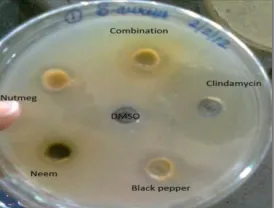
From the results shown in Table 6, it was observed that the combination of all three extracts showed maximum zone of inhibition as compared to individual extracts of neem, nutmeg and black pepper but lesser zone of inhibition as compared to standard antibiotic clindamycin.
TABLE 5: ANTIMICROBIAL ACTIVITY OF MEDICINAL PLANT EXTRACT
Bacteria
Zone of inhibition(mm)
Plant Extracts (20mg/ml) Standard
Black pepper (A) Neem (B) Nutmeg (C) Combination of A, B and C Clindamycin
P. acnes 16 20 18 23 36
S. epidermids 20 19 17 22 33
S. aureus 12 13 14 17 31
Concentration of the each extract used: 20 mg/ml, Clindamycin: 1.0 mg/ml
Antimicrobial activity against Propionibacterium acnes: Zone of inhibition of ethanolic extracts neem, nutmeg and black pepper against
Propionibacterium acnes is shown in fig. 4a, fig. 4b and in fig. 4c respectively. The comparative study of extracts of neem, nutmeg and black pepper each of concentration 10 mg/ml and the combination of all three extracts is shown in fig. 4d.
Zone of inhibition of neem, nutmeg and black pepper extract against P. acnes:
FIG. 4A: ZONE OF INHIBITION OF NEEM AGAINST
P. ACNES
FIG. 4B: ZONE OF INHIBITION NEEM AGAINST
P.ACNES AGAINST P. ACNES
FIG. 4C: ZONE OF INHIBITION OF BLACK
FIG. 4D: ZONE OF INHIBITION OF COMBINATION OF NEEM, NUTMEG AND BLACK PEPPER AGAINST
P. ACNES
Antimicrobial activity against Staphylococcus epidermidis: Zone of inhibition of ethanolic extracts of neem, nutmeg and black pepper against
Zone of inhibition of neem, nutmeg and black pepper extract against S. epidermidis:
FIG. 5A: ZONE OF INHIBITION OF NEEM AGAINST
S. EPIDERMIDIS
FIG. 5B: ZONE OF INHIBITION OF NUTMEG AGAINST S. EPIDERMIDIS
FIG. 5C: ZONE OF INHIBITION OF BLACK PEPPER
AGAINST S. EPIDERMIDIS
FIG. 5D: ZONE OF INHIBITION OF COMBINATION NEEM, NUTMEG AND BLACK PEPPER AGAINST S. EPIDERMIDIS
Antimicrobial activity against Staphylococcus aureus: Zone of inhibition of ethanolic extracts neem, nutmeg and black pepper against
Staphylococcus aureus is shown in fig. 6a, fig. 6b
and in fig. 6c respectively. The comparative study of extracts of neem, nutmeg and black pepper each of concentration 10 mg/ml and the combination of all three extracts is shown in fig. 6d.
Zone of inhibition of neem, nutmeg and black pepper extract against S. aureus:
FIG. 6A: ZONE OF INHIBITION OF NEEM AGAINST
S. AUREUS
FIG. 6B: ZONE OF INHIBITION OF NUTMEG AGAINST S. AUREUS
FIG. 6D: ZONE OF INHIBITION OF COMBINATION OF NEEM, NUTMEG AND BLACK PEPPER AGAINST
S. AUREUS
Minimum inhibitory concentration of extracts:
The MIC was defined as the lowest concentration of the compound to inhibit the growth of
microorganisms. The MIC of all the extracts is as shown in Table 6.
Evaluation of Formulations:
Physicochemical evaluations of different formulation of gels: The prepared polyherbal gels using different concentration of extracts of neem, nutmeg and black pepper were tested for appearance, pH, viscosity, spreadability, drug content and from the results it was found that prepared gel 2 showed good pH, viscosity, Spreadability and drug content as compared to gel 1.
TABLE 6: MINIMUM INHIBITORY CONCENTRATION OF THREE MEDICINAL PLANT EXTRACTS
Sr.no. Bacteria Minimum inhibitory concentration(mg/ml)
Neem Nutmeg Black pepper
1 P. acnes 6.0 2.0 10.0
2 S. epidermidis 6.0 0.3 3.0
3 S. aureus 4.0 2.0 0.7
TABLE 7: EVALUATION OF GELS
Sr. No. Formulations Appearance pH Viscosity (cps) Spreadability (gm-cm/sec) Drug content
1. Gel 1 Brownish 6.67 3800 11.76 95.65%
2. Gel 2 Brownish 6.79 3900 11.53 96.66%
In vitro diffusion study of different formulations of gel: The in vitro diffusion studies of the gel 1 and 2 were performed by using dialysis membrane and the results were observed as shown in fig. 7
[image:8.612.105.243.41.145.2]and fig. 8. The study showed that the percent release of all the active ingredients of gel 2 was better as compared to gel 1.
[image:8.612.314.561.464.614.2]FIG. 7: IN VITRO DIFFUSION STUDY OF GEL 1 (A1- Neem, A2- Nutmeg, A3- Black pepper)
FIG. 8: IN VITRO DIFFUSION STUDY OF GEL 2 (A1- Neem, A2- Nutmeg, A3- Black pepper)
Comparative study of prepared gels with the marketed formulations and standard antibiotic:
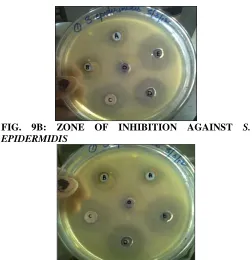
The comparative antimicrobial activity was performed on the basis of zone of inhibition of extracts of neem, nutmeg and black pepper, combination of all three extracts, prepared gel 1
[image:8.612.48.297.475.629.2]TABLE 8: ANTIBACTERIAL ACTIVITY OF VARIOUS FORMULATIONS AGAINST PROPIONIBACTERIM
ACNES, STAPHYLOCOCCUS EPIDERMIDIS AND STAPHYLOCOCCUS AUREUS
Sr. no. Different formulations
Susceptibility of bacteria to different formulations, Zone of inhibition (mm)a*
P. acnes S. epidermidis S. aureus
1 Azadirachta indica 20 19 13
2 Myristica fragrance 18 17 14
3 Piper nigrum 16 20 12
4 Combination(1,2 and 3) 23 22 17
5 Prepared gel 1 11 14 12
6 Prepared gel 2 13 16 14
7 Marketed herbal formulation 12 18 15
8 Clarithromycin gel 23 26 25
9 Standard antibiotic
(clindamycin) 36 33 31
[image:9.612.49.568.79.237.2]Concentration of the each extract and formulation used : 20 mg/ml, Clindamycin: 1.0 mg/ml
FIG. 9A: ZONE OF INHIBITION AGAINST P. ACNES
FIG. 9B: ZONE OF INHIBITION AGAINST S. EPIDERMIDIS
FIG. 9C: ZONE OF INHIBITION AGAINST S. AUREUS
FIG. 9: COMPARATIVE STUDY OF
ANTI-MICROBIAL ACTIVITY OF PREPARED
FORMULATIONS WITH THE MARKETED HERBAL
FORMULATION AND STANDARD ANTIBIOTIC. A- Gel 1, B- Gel 2, C- Clarina Cream, D- Clarithromycin Gel, E- Clindamycin
Stability study of different formulations of gel:
Stability study of the two formulations were carried out at 40oC± 2oC/ 75% ± 5% RH temperature and relative viscosity for the period of 3 months. The different parameters which were recorded for the change during this period were as follows:
a. Changes in appearance
b.Changes in pH
c. Changes in viscosity
d.Changes in Spreadability
Skin irritation study of gel: All the formulations did not produce any skin irritation, i.e., no erythema and oedema was seen for about a week when applied over the skin.
[image:9.612.102.244.261.378.2] [image:9.612.47.299.399.659.2]TABLE 9: STABILITY STUDY OF GELS AT 40OC ± 2oC/ 75% ± 5% RH AT 3RD MONTH
Sr.no. Formulations Appearance pH Viscosity (cps) Spreadability (gm-cm/sec)
1. F1 Brownish 6.61 3600 11.54
2. F2 Brownish 6.74 3840 11.34
TABLE 10: SKIN IRRITATION STUDY
Formulations Treatment
Day 1 Day 2 Day 3 Day 4 Day 5 Day 6 Day 7
Control - - - -
Gel 1 - - - -
Gel 2 - - - -
The present research work deals with formulation and evaluation of herbal antiacne gels. The plant material used for the formulations was ethanolic extract of leaves of Azadirachta indica (neem), ethanolic extract of fruits of Myristica fragrance
(nutmeg) and Piper nigrum (black pepper). Although various topical herbal formulations for acne containing neem are available in the market, we propose to make use of black pepper and nutmeg extract for the first time in the developed formulations.
Neem, nutmeg and black pepper has been reported in the literature as a good antibacterial agent and anti-inflammatory agent. The developed formulations were evaluated for their in vitro anti-bacterial activity against P. acnes, S. epidermidis and S. aureus. The Zones of inhibitions for the antibacterial activity were compared with the standard Clindamycin, marketed herbal antiacne preparation, active ingredients used in the formulation (ethanolic extracts of neem, nutmeg and black pepper). The prepared ethanolic extracts of neem, nutmeg and black pepper showed antimicrobial activity against P. acnes, S. epidermidis and S. aureus but the combination of all three extracts showed more zone of inhibition as compared to individual extracts.
ACKNOWLEDGEMENT: Authors are grateful to Dongarwar Sir, Head of Department of Botany, R.T.M. Nagpur University, Nagpur for authentication of plant specimen and thankful to the Head of the department of Pharmaceutical Sciences, R.T.M Nagpur University, Nagpur for providing us the research facilities.
REFERENCES:
1. Leyden JJ: Therapy for Acne vulgaris. The New Eng J Med. 1997; 156-1162.
2. Leyden JJ: Current issues in antimicrobial therapy for the treatment of acne. J Eur Dermatol Venereol. 2001; 15(3): 51-55.
3. Burkhart CG, Burkhart CN and Lehmann PF: Acne a review of immunologic and microbiologic factors. J Post grad Med. 1999; 75: 328-331.
4. Leyden JJ: The evolving role of Propioni bacterium acnes in acne. Semin Cutan Med Surg. 2001; 20: 139-143.
5. Hamnerius N: Acne-aetiology and pathogenesis. Treatment of Acne. 1996; 32: 29-38.
6. Degroot HE and Friedlander SF: Update Acne. Curr Opin Pediatr. 1998; 10: 381-386.
7. Swanson IK: Antibiotic resistance of Propioni bacterium acnes in Acne vulgaris. Dermatol Nurs. 2003; 5: 359-361.
8. Bojar RA and Holland KT: Acne and Propioni bacterium acnes. Clin Dermatol. 2004; 22: 375 379. 9. Kumar GS and Khanam S: Antiacne activity of few
natural products. Ind J Nat Prod. 2004; 30(4): 7-9. 10. Kubo I, Muroi H and Kubo A: Naturally occurring
antiacne agents. J Nat Prod. 1994; 57(1): 9-17.
11. Chien YW: Logics of transdermal controlled drug administration. Drug Dev. Ind. Pharm. 1983; 9: 497. 12. Banker GS and Rhodes CT: Modern Pharmaceutics.
Marcel Dekker, Inc., Madison Avenue, New York , Edition 2, Vol. 40, 1990: 263-264.
13. Vyas SP and Khar K: Controlled Drug Delivery. Vallabh Prakashan, Edition 1, 2002: 416-417.
14. Ansel HC, Popovich NG and Allen LV: Pharmaceutical Dosage Forms and Drug Delivery Systems. B. I. Publications Pvt. Ltd. Edition 8, 2005: 415-419. 15. Kesavanarayanan KS and Ilavarasan R: Topical dosage
form of valdecoxib: Preparation and pharmacological evaluation. Acta Pharm. 2007; 57: 199-209.
16. Chaple DR and Chaware PA: Formulation and evaluation of topical antifungal drug delivery system of henna extract. Indian Drugs. 2007; 44(1): 61-62. 17. Reddy M, Mutalik S and Veerabhadra G: Preparation
and evaluation of minoxidil gel for topical application in alopecia. Indian J. Pharm. Sci. 2006; 432-436. 18. Sahin F, Karaman I, Gulluce M, Ogutcu H, Sengul M,
19. Panigrahi L, Jhon T, Shariff A and Shobanirani RS: Formulation and Evaluation of Lincomycin HCl Gels. Indian Journal of Pharmaceutical Sciences. 1997; 59(6): 330-32.
20. Kim JY Song JY Lee EJ and Park SK: Rheological properties and microstructure of carbopol gel network system.Colloid polymer Science. 2003; 281: 614-623.
21. Sperling F: Toxicology Principles and Practice. Wiley Interscience Publication, New York. Edition 4, 1984;168-177.
22. Liberman HA Rieger MM and Banker GS: Pharmaceutical Dosage Form: Disperse Systems, Marcel Dekker, New York, Edition 3, 1989: 594.
All © 2013 are reserved by International Journal of Pharmaceutical Sciences and Research. This Journal licensed under a Creative Commons Attribution-NonCommercial-ShareAlike 3.0 Unported License.
This article can be downloaded to ANDROID OS based mobile. Scan QR Code using Code/Bar Scanner from your mobile. (Scanners are
available on Google Playstore)
How to cite this article: